Two photos from my week. I had to pick up some prescriptions one day and parked in the two-story structure next to the clinic. As I was driving out again along the back wall, I noticed the sun shining down into the alcove, illuminating the stairs that lead down from the top tier. It wasn’t busy (I was the only person in the garage at the moment), so I stopped at the far end right in front of the stairs to take a picture before turning and heading out of the structure.
Here is the more “arty” photo, with a cool mix of diagonal lines and movement from light to shadow.
And here is a just plain photo, which isn’t particularly artful. You can see all the “warts” on display, like the plate covering a pipe on the garage floor and the pile of dead leaves that probably collected recently over several windy days.
But I also liked how the bright yellow diagonal lines sort of met up with the diagonal lines of the lower and upper staircase flights.
In an ideal world, everything here would have been freshly swept and scrubbed, with freshly laid black asphalt and newly painted lines just waiting for me to come by and take a picture.
In the real world, however, we have to take what we can get. Which usually includes the warts.
And that’s okay, right? Because we can imagine the “ideal” only once we have the “real” to show us the way.
Just a photo from my week. Every Milwaukee School of Engineering graduate since the 1970s will immediately recognize this as the skywalk between the Walter Schroeder Library and the Science Building (officially the Allen-Bradley Hall of Science and Fred Loock Engineering Center).
I’ve walked through the bridge so many thousands of times since starting my job at MSOE in 1996(!) that I don’t really notice it anymore as I walk across. The bridge provides an especially lovely view of the “Mall” (the “Werwath Mall,” named for the father and son founder and first two presidents of the school, Oscar and Karl) after a snowfall, but other than that, I’m usually too preoccupied with thoughts of class prep, etc., to pay attention to my surroundings.
This day, though, Tuesday I think, was bright and sunny, and as I walked through after class, I suddenly became aware of how the contrast between sharp, dark shadows and bright sunlight added fun interest to the kaleidoscopic geometry of perspective it revealed. So I stopped short, took a picture, then kept rolling along with my cart (full of teaching paraphernalia) over to the doorway into the Library Building.
One thing weird and slightly unsettling that I learned while taking this photo: when you stand on a bridge (instead of walking), you can feel a slight vibration and “give” in the floor from the footsteps of other people crossing over. This is apparently a completely normal thing, having nothing to do with safety. Still, it’s a phenomenon producing enough discomfort for pedestrians that bridge designers will routinely add components to dampen the sensation, again strictly to make people feel safer, not to make the bridges any safer in reality, because they’re already plenty safe.
Isn’t that interesting? I learned something new about bridges just because it was a sunny day and I saw a familiar place in a new light (literally😀).
Not really, of course, but when I found this photo lurking in my camera roll (I snapped it one sunny afternoon last fall while taking the long way back to my office from the Science Building at MSOE in downtown Milwaukee), that was my first reaction: Gee this feels like someplace in New Mexico or Arizona, a stream working it’s way down a hillside.
Really interesting, provocative article here from Time magazine by Apryl Williams, Assistant Professor of Communication and Digital Studies at the University of Michigan, on how dating apps insert and perpetuate race- and appearance-based parameters into technology intended to help people find someone to love and build a romantic relationship with. This opinion piece on dating apps offers up an argument that the digital “machine” amplifies humanity’s weaknesses (like the conscious and unconscious biases that narrow our outlook) and 2) diminishes/minimizes humanity’s intuitive ways of knowing, one example of which is the magical spark of recognition that suddenly makes us aware that we’ve found a kindred spirit in another person. Finding our soulmate, becoming friends with people who truly “get” us and value us for who we are—these are some of the most important things we’ll ever do in life. This “seeking out” requires that we journey through a mysterious landscape shrouded in a fog of uncertainty and contradiction. The “if/then” reasoning of a binary “swipe left/right” system is completely at odds with the non-rational, chaotic serendipity of unexpected encounters, attraction of opposites, against-all-odds coincidences, and other logic-defying “inexplicables” of human experience.
As Shakespeare says of Cleopatra, “Age cannot wither her, nor custom stale / Her infinite variety.” Loving another person goes hand in hand with unpredictability, delight, drama, pain, and unbounded lifelong discovery. No matter how carefully designed an algorithm might be, it is still a functionally closed system. Love, on the other hand, amounts to the most open system in the universe.
If my comments above make any sense to you, and they are more my “take” (okay, “rant”😀) on the article more than a summary, I highly recommend clicking over and giving this a read.
I suppose every generation believes it has discovered something new when actually that something has been around not just for a while but for a very long time. Like, sometimes centuries!
Let me start off with a little Milwaukee hometown bragging. You know how people sometimes cut stripes or diamond patterns in their lawns? And they got the idea from seeing similar designs cut into the grass of Major League Baseball stadiums’ outfields?
Well, this technique began in Milwaukee, in 1993, when the Milwaukee Brewers’ assistant groundskeeper, David Mellor, cut a fancy diamond pattern in the team’s then-home, County Stadium, to distract from a muddy, damaged section of lawn in front of the stage for a Paul McCartney concert that had taken several rainy days to set up. Soon Mellor was routinely creating elaborate patterns in the outfield, and it didn’t take long after that before groundskeepers for other baseball teams began copying his handiwork.
Mellor is now Senior Director of Grounds for the Boston Red Sox Baseball team at Fenway Park, where he has worked since 2001. Here’s a great interview with him that I found on YouTube, where he is indeed credited with starting the craze for cutting patterns into grass.
As the “Stripe Your Lawn Like the Major Leagues” video above shows, the stripes are achieved by light reflecting (or not reflecting) off of the roller-bent blades of grass, depending on which way the grass now lies.
David Mellor’s life story is really inspiring. At age 18 he was struck by a car and suffered an injury that ended his dream of playing professional baseball. Although he was on crutches for three years, he managed to land a job as a major league groundskeeper after college. He’s written two books on lawn care and has a new book coming out that chronicles his experiences with PTSD after sustaining a sequence of serious injuries from being struck by cars three separate times in his life and enduring 43 surgeries. For more info on Mellor, here’s a link to his website: https://www.davidrmellor.com/
Anyway, getting back to the grass, I always thought that these elaborate, decorative outfield designs were a late 20th-century invention associated with Major League Baseball. And then one day I was watching Downton Abbey, the Season 6 episode where Mary’s beau, Henry, is racing at Brooklands Race Track (a newly-built facility in 1925, when this episode is set) and saw this.
What?
I already know better than to accuse Downton Abbey of anachronisms (e.g., see my post “A Downton Abbey anachronism?” and the many replies, leading to the correct determination that no indeed, “Downton Abbey” was not guilty of inserting an anachronism into Season One, Episode Three). So I did some online poking around and discovered that 1) the lawn mower was invented in 1830 (where else but in England, home of those stately country mansions surrounded by expansive lawns of lush, green grass) and that 2) one by-product of this newfangled equipment was its ability to create stripes in said lawns, simply by virtue of the rollers that were situated behind the blades in order to flatten down any unevenly cut spots.
That’s right. By the time of Henry’s motorcar race at Brooklands in 1925, lawn striping would have been about 100 years old.
In a related “everything new is old” moment, I was reading a Wall Street Journal article on home decoration last spring that showed a photo of some wallpaper in a familiar-looking pattern. Then I saw this text:
In the bar, the chromatically bold wallpaper, a historic flame stitch reinterpreted by British purveyor Fromental, is accurate to the 1700s.
From “This English Country Home Is a Master Class in Decorating With Personality,” Wall Street Journal (April 20, 2023)
What?
I thought this vaguely zigzagged look was from the early 1970s. Lots of girls at my junior high school wore knit sweaters in this pattern, and I thought it was the coolest, most mesmerizing psychedelic design ever.
Results of Google image search for “1970s flame stitch sweater”
Well, it certainly was cool. It definitely was mesmerizing.
But as it turns out, it was absolutely NOT “psychedelic,” a word coined in 1956 by English psychiatrist Humphry Osmond in a letter to Aldous Huxley to describe his drug-distorted experiences under the influence of mescaline.
Nope, the “flame-stitch” pattern, as it’s called, long predates the hallucinatory LSD trips of the 1950s. According to this article in a magazine called “Frederic,” the pattern (in general) dates at least as far back as 5th-century Greece (shown in a mosaic tile-floor pattern) and 12th-century Sweden (shown in the Skog tapestry, documenting Scandinavian monarchs shortly after the region’s conversion to Christianity). It emerged in something more closely resembling the modern pattern in 17th-century Italy and quickly began showing up across Europe but especially in 18th-century France and England in everything from shoes to clothing and home décor.
Who knew? Not me, for sure.
So once I’d been reminded of this stitch pattern that had so fascinate me in my junior high school days, I noticed it pop up in a fun Monk episode in which it’s worn by the mom in a fictional “Brady Bunch” type TV show called “The Cooper Clan,” complete with 1970s-era-appropriate clothing and home décor.
From “Mr. Monk’s Favorite Show” (Season 8, Episode 1)
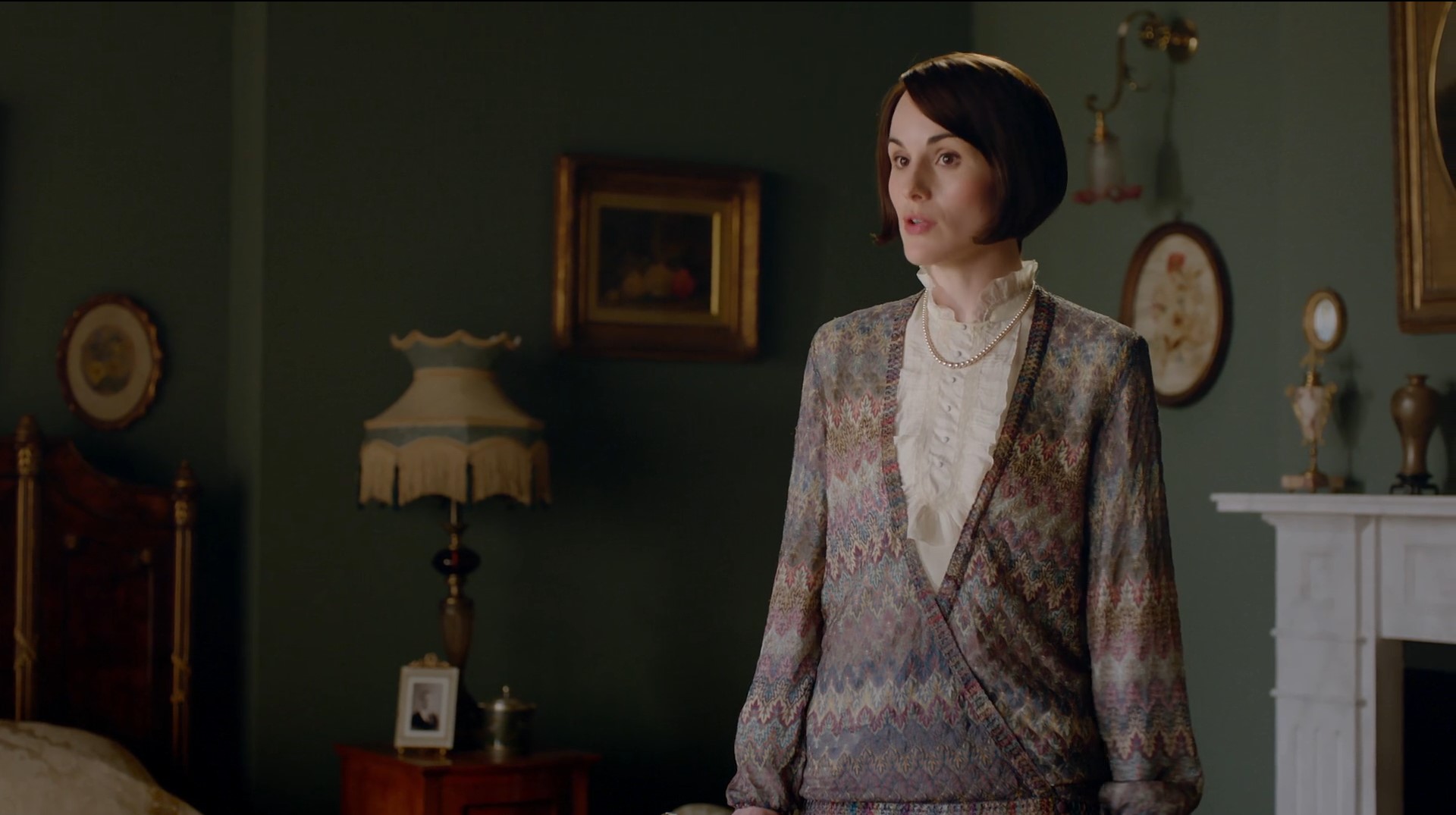
And then, not long after, it turned up again in that same Downton Abbey season, set in the year 1925, in a sweater worn by the oh-so-elegant Lady Mary Crawley (both images below from Season 6, Episode 8).
In a different vein but still somewhat related to all this, I have spent my whole life seeing the derivative (usually in the form of parody) long before discovering the original that the copy was taken from.
For example, my introduction to Charles Dickens’ “A Christmas Carol” came from a 1962 (in reruns! I’m not quite that old!) television special, in which Scrooge is played by Mr. Magoo, who is voiced by Jim Backus.
And, of course, speaking of Jim Backus, my first introduction to Shakespeare’s “Hamlet” was the brilliant “Gilligan’s Island” episode (“The Producer”), in which the gang tries to impress marooned movie impresario Harold Hecuba (Phil Silvers) with their musical staging of “Hamlet,” in hopes that he’ll take them back to Hollywood with him when he’s rescued. (Unfortunately for them, he sneaks off the island having stolen their idea, as revealed shortly afterward via a news broadcast received on the radio that is the castaways’ link to the outside world.)
Speaking of Hollywood impresarios, I didn’t know till much later (the baggy-thighed jodhpurs were my clue) that director Roscoe Dexter (“Dex”) in Singin’ in the Rain (featured in one of the film’s funniest scenes below, involving that newfangled “sound” technology) was actually a stand-in for the extremely famous director Cecil B. DeMille, whose work spanned the silent era through the 1956 VistaVision epic The Ten Commandments.
Cecil B. DeMille, Columbia Broadcasting System-CBS, Public domain, via Wikimedia Commons
And who could forget Dan Aykroyd’s contributions to my well of cultural knowledge?
First was his hilarious and bloody “French Chef” sketch on “Saturday Night Live.” Only later did I learn who Julia Child was (and that she actually had cut herself with a knife on camera while filming her television show).
And then there was this guy, Dan Aykroyd’s chain-smoking, late-late-night talk show host.
Who I (much) later found out was actually a real talk-show host, Tom Snyder (born and raised in Milwaukee, FYI, to work in another plug for my city 🙂 ).
Looking for some “real” Tom Snyder clips, I came across these. First, Tom Snyder interviewing KISS, one of my favorite bands during high school.
And then, this one, an interview with one of my favorite directors, Alfred Hitchcock.
(Note: I don’t really expect anyone reading my blogpost to actually sit here and watch all these clips. Including them is mostly a way for me to save them in one spot so I can come back and view them later. But this also makes it easy for you to click and view immediately if you’re curious 🙂 )
There are probably quite a few more examples of me being late to the party, as it were, thinking the derivative was the original, but I can’t think of any at the moment off the top of my head. I can always update this post once I remember them, which will probably happen here and there while standing in line at the post office, walking on the treadmill, or performing some equally mundane activity.
And my point?
Well, nothing earth shattering, naturally. Lawn stripes? Mr. Magoo? Musical “Hamlet”?But maybe this: Even as it’s disconcerting to realize that we humans keep repeating ourselves while naively believing we’ve created or encountered something “original,” it’s also sort of reassuring to realize how permanent things are. Quality endures, and nothing good, essential, or “true” is ever really lost or discarded.
In fact, perhaps one purpose we have as humans living in our own accidental period of history is to keep finding and “recognizing” all those things worthy of rediscovery.
This is revisiting only in a general sense. During discussion in my political science class this morning, I had occasion to refer to Joseph Campbell. My students had not heard of him, so I gave some quick background, referring to the usual anchors of his book The Hero with a Thousand Faces and how George Lucas based his Star Wars story on Campbell’s teachings about mythology, etc.
Anyway, after class I still had the Wikipedia article on Campbell open, which I had pulled up just to have a visual that students could look at while I talked about him. And somehow in doing that, I came across all of the bill Moyers interviews with Joseph Campbell from the late 1989s.
Cool! I have the series at home on VHS tape. Not particularly convenient. But I have been wanting to go through them again, and now it’s easy. Not only are the videos available in one place, but there are also transcripts of each interview’s conversation.
You can link here to BillMoyers.com, a website that has the entire collection of interview videos on one page. When you click on each, it takes you from the thumbnail to the actual video, and below the video is the transcript of that episode, which I love. Although I enjoy video interviews, I can read a transcript so much faster. Nice to have both right there together.
Because I teach political science courses, as well as a course titled “Digital Society,” I subscribe to an email newsletter from Project Liberty. Some info on that:
Project Liberty is advancing the responsible development of the internet of tomorrow – designed and governed for the common good.
Anyway, this morning’s email is extremely interesting, a post titled, “The religious and moral impacts of AI.” Among other things, it provides a brief summary of AI-related issues that the world’s major religions are grappling with, as well as each religion’s current response to the complexities posed by this new technology.
For my Digital Society class, in particular, areas like these are essential to keep up on and consider when framing in-class discussions for my students, most of whom can’t really remember a world without iPhones, social media, and digital everything. When we break down our course name to think about “digital” and “society” as separate terms, it is extremely challenging to find anything in American society that doesn’t somehow carry a digital fingerprint.
Maybe I’ll try to put a little time into writing some posts related to this topic. I’ve been quite absent from my blog lately, and at least this subject matter is what’s on my mind anyway!
Although this song appeared on “Weird Al” Yankovic’s 2003 album Poodle Hat, it was apparently not released as a single, nor was there ever an official music video made. “Weird Al” did performthis song at eBay Live! 2003, and a portion of the performance is seen at the beginning of a CNBC documentary, The eBay Effect: Inside a Worldwide Obsession, according to the song’s Wikipedia article (https://en.wikipedia.org/wiki/EBay_(song)).
I guess what I love most about this song is how, like a time capsule, it captures so many details unique to the early 2000s era. The Backstreet Boys, obvs. The drama of “auctions” on eBay (“I am the type who is liable to snipe you / with two seconds left to go / whoa”). And all the ridiculous, otherwise impossible to find, treasures one might have encountered on the site in 2003 (“some Beanie Babies new with tag” and “a Kleenex used by Dr. Dre”).
I would never have discovered this song except that I just watched a cheesy “Weird Al” documentary last night. Now I can’t stop listening to it. Plus, the visuals used in what I assume must be a fan-made video are spot on, with killer editing that matches music and lyrics to each image “reveal” in a way that demonstrates some deft comedic timing.
Both song and video give me something new to smile over every time I hit “play.” Hope you will also enjoy!
(I just discovered that the embedded video apparently doesn’t show up in the WordPress Reader If you go to KatherineWikoff.com, it does show up on my blog online. Sorry about that if you’re using the Reader and getting the “video unavailable” message!)
Would you like new posts delivered to your inbox? To subscribe, click here.
Well, I learned something new today while teaching my political science course.
I was walking students through my recommended process for getting started doing research on political issues, and at this point we were comparing basic Google search results with Wikipedia (don’t worry, we got far more specific and advanced, which might be a good blog post for another day?), and as I was skimming through Wikipedia articles turned up by my search for “political issues related to engineering Wikipedia,” which was the same phrase used for my Google search, minus the “Wikipedia” add-on, I saw an article titled “Technocracy.”
Well, “technocracy” is one of our course’s basic vocabulary words, so I thought I’d take a look at that article. By the way, I was projecting my own computer screen onto the big screen at the front of the room so everyone could watch what I was doing as I talked about it. Anyway, this is where it got interesting. I was skimming through the article, seeing lots of the usual stuff, blah blah blah. Pausing to make note of the article’s reference to Plato’s “Republic,”which our class had read an excerpt from (a selection from Book VII, the “Allegory of the Cave” and associated discussion of who should “rule” and how).
And then I stopped short. I was just astonished by what I was reading, and I told the students I had never known this until that very moment when I was seeing it with them. Read through the following excerpt from this Wikipedia article, and tell me if you are surprised, as well.
The former government of the Soviet Union has been referred to as a technocracy.[20] Soviet leaders like Leonid Brezhnev often had a technical background. In 1986, 89% of Politburo members were engineers.[20]
Leaders of the Chinese Communist Party used to be mostly professional engineers. According to surveys of municipal governments of cities with a population of 1 million or more in China, it has been found that over 80% of government personnel had a technical education.
(Wikipedia’s article on “Technocracy”)
As I told my students, very few members of the United States Congress have ever been engineers. Currently, in the 118th Congress, there are nine engineers in the House and one in the Senate. That is 10 engineers out of 535 members of Congress, House and Senate combined, which works out to less than 2% of our Congress! We could add in some scientists, but that wouldn’t bring the numbers up all that much. But then compare that with almost 90% of the Soviet Union’s version of Congress being made up of engineers! And the idea that leadership of the communist party in China used to be mostly engineers!
Leonid Brezhnev
Completely bemused and nonplussed, I couldn’t help laughing and told my students (mostly engineering majors, as I teach at Milwaukee School of Engineering!) that I’m not sure what this info might imply about authoritarianism and engineering. Are engineers somehow well-suited to authoritarianism? Do authoritarian governments find themselves attracted to the ability of engineers to design and operate systems? I have no clue, but as I told my students, it might be an intriguing topic to look into more. And I suppose a related political issue to think about is what it means for America that the people making policy at the federal level apparently have little professional knowledge of engineering and technology.
Anyway, that’s my blog post for today. I was just very surprised, and because I’ve been teaching political science for decades and have been interested in politics much longer than that and never knew this, I figured you probably also didn’t know and it would be interesting for you to learn about, too!
Would you like new posts delivered to your inbox? To subscribe, click here.













 Katherine Wikoff