
Our MSOE (Milwaukee School of Engineering) Faculty and Staff Book Club met Monday night to discuss this short but fascinating novel. But first a “prologue,” complete with photo.
We meet at a place called The Explorium Brewpub, which is located in the historic Third Ward, the area of downtown Milwaukee running along the river south of the office district, in a renovated building that is part of a complex of beautiful old Italianate buildings that once housed the largest wholesale hardware company in “the region” (according to its Wikipedia article, HERE).
I guess that usually when I arrive, it must already be dark outside. Or maybe just overcast and/or raining. Or maybe I’m walking in with other people and focused on talking with them? Whatever the case, on Monday night the angle of the sun at around 5:30 PM cast a beautiful light on this sculpture I’d never noticed before. So, of course, I took a picture before heading inside!
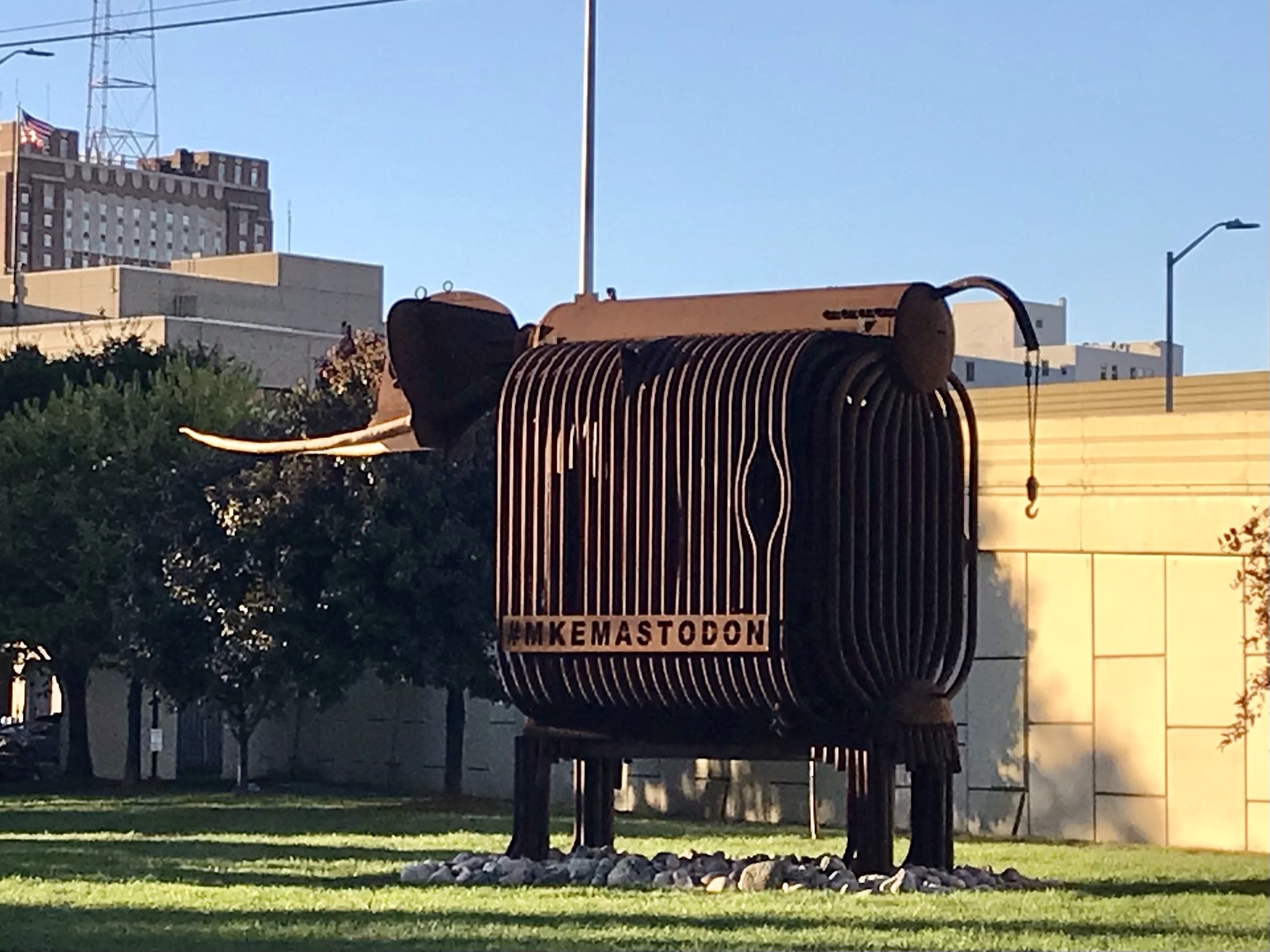
Rusty, the Milwaukee Mastodon
Now for the book. I had never heard of it before. It’s by a South American author I had also never heard of, and it was recommended as a selection by a fellow professor who is from Argentina. A clue that I would probably like it, though (which I did!), was that the novel was dedicated to and the prologue written by the legendary Jorge Luis Borges (Wikipedia article HERE), whom I had not only heard of but had also read multiple works by.
The Invention of Morel (Wikipedia article HERE), by Adolfo Bioy Casares, was published in 1940.

It’s a really short book, easy to read, yet difficult in terms of its strangely magical, even fantastical and at times slightly grotesque tale of a fugitive living alone on an island containing abandoned but somehow pristine accommodations (a museum/hotel, a chapel, and a swimming pool) that a mysterious group of tourists has come to visit for an extended stay. This nameless fugitive begins a diary on the day of their arrival, and the entire story is told from his point of view, by turns curious, enchanted, horrified, questioning, and ultimately resigned to and accepting of his unhappy fate, even as he is also hopeful that there is a heaven and that someone will understand how to employ the mysterious piece of technology that would make it possible for him to spend eternity in the company of the person he loves.
As I mentioned in my “dead leaves” post yesterday, this novel deals with themes of life versus death, image versus reality, and evanescent material presence versus indelible virtual immortality. Think about the way Facebook maintains profiles of those who have passed away and how those people maintain an eternal life somehow in their continued presence and the ability of others to interact with them via comments and uploaded photos. Or, if you have audio of a loved one’s voice, say in a voicemail message, how they are “alive” to you in some ways. When you hear their voice, when you smell their perfume, anything like that, you have the sensation of connection with them as a living person who is somehow present even in their absence.
In the novel, without giving too much away that you wouldn’t get from perusing the Amazon description, the main character falls in love with one of the tourists, Faustine, a woman who apparently was based on Louise Brooks, the silent movie actress, with whom the author was fascinated in real life. She is also, I believe, the woman shown in the novel’s cover photograph.
(Aside: I have long known of Louise Brooks but at the same time known absolutely nothing about her. As I was reading the novel, I went and looked up her article in Wikipedia, and now I’m fascinated, too. She wrote a memoir, in the form of collected essays, titled Lulu in Hollywood, published in 1982. So now I have a fun little project set up for myself going forward: to watch her movies and to read her memoir 🙂 )
Anyway, in a manner reminiscent of M. Night Shyamalan’s The Sixth Sense, our narrator spends time with Faustine every afternoon when she goes to sit near the ocean, looking out at the sea. She does not seem acknowledge his presence, but the narrator, at first quite skittish around all these tourists (understandably so as he is a fugitive from justice), develops a habit of approaching her when she appears each afternoon, tentatively at first but becoming increasingly comfortable with her, attracted to her beauty and serene silence.
Then comes the day that another man, Morel, intrudes on their idyll by the sea. Our narrator is jealous, because it appears that Morel may have a relationship with Faustine. Then our narrator notices that when Morel and Faustine talk, their conversation seems to repeat itself. And then all the tourists vanish, except that they also then begin reappearing on the island at night. Other strange things begin to occur, as well. For one thing, there are suddenly two suns and two moons in the sky. And the tourists behave in manners at odds with the actual conditions; for example, they seem to be experiencing cold temperatures while the narrator feels the oppressive heat.
Much internal monologue commences as our narrator tries to puzzle out what is happening. Who are these people? Why are they here? Where did they go? How did they come back when their ship is gone? Why does no one acknowledge him, even when he is not hidden well?
Finally, Morel calls a big meeting for all the tourists, at which he reveals that he has invented a “machine” like a radio, except that instead of transmitting only audio waves or visual waves like a television, he can transmit the entire wave spectrum of a person. You don’t just hear and see the person (like a hologram, which wasn’t invented till 1948 but which I assume must have been an idea with some currency around the time the novel was published), but you can smell them and feel them, as well. Morel has spent the week “capturing” the tourists’ “images” to preserve them indefinitely.
(Aside: I suppose the idea of capturing audio and video was still somewhat new, as the mediums of “talkies” and commercial radio would have been only 10-20 years old at the time the novel was written, and television was in its absolute infancy. The meaning and implications of images capable of capturing and preserving the immediacy of, say, a “living” moment in time or a person’s animated physical presence beyond what was possible in a still image like a photograph must have still been somewhat novel.)
But Morel apparently has not merely captured the tourists’ images. When he describes his earliest experiments with the equipment, things take an ugly turn. One of the tourists realizes he was at the place where and when these experiments happened (in Germany, I think he said? I don’t have the book with me at the moment to double check), and he angrily accuses Morel of murdering the men whose images were captured . . . and captured without their consent. Morel brushes this off. He does apologize, but not for killing people and stealing their souls in the process of preserving their images. Instead he regrets “this tedious incident” (the meeting? The week (during which their images have been preserved and their souls stolen?), and he tells everyone that thoughts of the pleasant week they’ve spent together will make the “important things” he has to tell them seem “less important.”
Finding out about “the invention” was, for me, the most intriguing part of the novel. In order to “capture” an image, Morel’s invention sucks up the entire “wavelength” of the subject’s “being” from the earthly plane and transforms it into a three-dimensional image (or maybe even a fourth- or fifth-dimensional image, considering all the sensory dimensions being “broadcast”) that will exist forever.
This transmogrification reminds me of an essay I wrote as an exercise for my writing group ten years ago and published as a blog post, “The truth about statues.” When I was very young, I thought that people in paintings or statues had somehow lost their lives in the process of being transformed into the artwork.
This also reminds me of the belief in some cultures that photographs steal the subject’s soul. Although usually characterized as the naive, childlike superstition of a primitive worldview, who knows? Maybe this belief is more worthy than our own sophisticated dismissal of the idea as magical nonsense.
Even beyond the ethical issues of soul stealing in modern media, what I find especially compelling as an academic who studies media and teaches both a film and media studies course and a course entitled “Digital Society” is the asymmetrical relationship established between an image and the material context(s) in which that image exists. How is the original altered by the ways in which its image is used? If an overlay of an entirely different image is superimposed upon that image, how is that image changed, and how does the new composited image alter one or both of the original subjects?
Aside: The 4-episode John Berger series “Ways of Seeing” (BBC, 1972), based at least in part on the brilliant 1935 Walter Benjamin essay, “The Work of Art in the Age of Mechanical Reproduction,” gets at these questions beautifully. (Link to a PDF of this essay posted by MIT: https://web.mit.edu/allanmc/www/benjamin.pdf)
Also, links to the four “Ways of Seeing” episodes below, FYI, in case you’re interested:
- Episode 1 https://www.youtube.com/watch?v=0pDE4VX_9Kk
- Episode 2 https://www.youtube.com/watch?v=m1GI8mNU5Sg
- Episode 3 https://m.youtube.com/watch?v=Z7wi8jd7aC4
- Episode 4 https://www.youtube.com/watch?v=5jTUebm73IY&t=2s
And back to our novel once again. As the narrator digests the startling revelation that all these tourists are actually projections playing out an endless recreation of a distinct series of events, he goes through a perhaps predictable sequence of emotional responses: confusion, anger, despair, resignation, curiosity.
Echoing the idea of and/or alluding to the title of Louise Brooks’ most famous film, Pandora’s Box (1929), the narrator is eventually drawn to the idea of finding Morel’s invention wherever it is hidden on the island. He hopes to figure out how it works and, most importantly, how to maintain his access to Faustine, the love of his life.
Of course, once he does find it, he also feels compelled to experiment with it. He “photographs” some plants and insects. Then he gets a little confused when he sees both the dead flies and flowers and the living ones side by side. What is real? What is not? More to the point, what is alive right now, in the world, and what is eternally preserved and both in the world and not in the world?
He gets brave (or stupid) enough to try photographing himself. But only his hand. And yes, soon an image of his hand appears among the plants and insects he had previously photographed, even as his own hand begins to deteriorate. To his horror, he realizes that his eternally waving hand (for that’s the way he filmed it, waving) has now taken up a place among the other images on exhibit on the walls of the museum.
The novel ends with our narrator wondering what will happen if he photographs his entire self. His image will live forever in the museum along with all the other images, but will his image ever encounter Faustine’s image? Does the actual machine of Morel’s invention still exist, or is the current camera/projector just an image? Because what if Morel somehow photographed the machine and what we see now is just an image, a replica that lacks the “soul” and authentic image-making capabilities of the original. The narrator implores whoever finds his diary: Please, please, if possible and the technology can be figured out, and also if there is indeed a heaven, please, please, find a way to upload both his and Faustine’s images to heaven, together, so that his soul can spend eternity with hers.
Just a really bizarre and unsettling tale is The Invention of Morel, but also definitely a page turner (for me, anyway) and most definitely an allegorical cornucopia of mind-bending questions and ideas that are still relevant today! I recommend it for anyone looking for something different to read.


 Katherine Wikoff
Fascinating! I’ll have to read it!
LikeLiked by 1 person
This sounds so interesting! I stopped reading partway through because I want to read it without knowing too much what it’s about!
By the way, Rusty the Mastodon is very cute.
LikeLiked by 1 person
Oops, it should have occurred to me to add a spoiler alert. Hope you enjoy the book if you decide to read it!
LikeLike
This is so interesting! I love the exploration of images vs reality, and have often thought about the way our dearly departed pop up in different ways online — it can be so odd emotionally. This books sounds like a must-read. Thank you for sharing!
LikeLiked by 1 person
Literary science fiction for people who don’t normally read SF!
LikeLiked by 1 person
Yes, that’s a good way to describe it! I was initially thinking of it as more of a “fantasy” novel, but that machine does seem to send it in a sci-fi direction.
LikeLiked by 1 person
Heh, the boundary between SF and fantasy is a very fuzzy one! On some level, all fiction is fantasy, so where does one draw the line? It seems to have to do with magic versus technology, but Clarke’s Third Law says sufficiently advanced technology is indistinguishable from magic, so… 🤷🏼♂️
LikeLiked by 1 person
Perfect example! And conversely, I have occasionally wondered if at some point we’ll discover that astrologers and alchemists were right all along!
LikeLiked by 1 person
It is possible to turn lead into gold, but it takes way more to do it than the gold is worth!
LikeLiked by 1 person