Today’s post is something different for me. My friend Kathleen is editor of a newsletter that publishes fiction, poetry, and essays. Because her publication is limited to black-and-white reproduction of images, and the article below contains a color image, she asked if I would be willing to publish it on my website.
I would be happy to do this as a favor for my friend anyway, but it was a pleasant surprise to discover that the article fits in nicely with what I like to publish here, so it’s kind of a win–win–win all the way around, for Kathleen, for the author, and for me!
And so now, without further ado, please allow me to introduce Joe Burke and his intriguing exploration of unexpected dimensions behind a commonly used phrase.
“I See What You Mean”
by Joe Burke
Many of us have heard someone use that phase, and some of us may have used it ourselves. It is an odd expression since it combines two different sensory functions of the body. The phrase combines sight and the spoken words filtered through the intellect producing some degree of understanding. But what does one really see?
Recently I participated in a spiritual discussion about living in the LIGHT. Having been a photographer my mind jumped to my definition of a photograph as an image that was painted by LIGHT. And I am aware that this LIGHT is only the visual spectrum that our human eyes can SEE. No infrared, nor ultraviolet, nor X-Rays are involved. So, immediately, my mind says that living in the LIGHT, with the visual spectrum, could have limitations.
The phrase, “I see what you mean” came to mind. How much of the LIGHT am I really seeing in my life? Communication demands a speaker and a listener. The words of the speaker may or may not have the same meaning for the listener. Hence I give you this example from photography. The same photograph could be “seen” in high contrast black and white, or possibly in black and white filled with grey tones, or possibly reproduced with all the colors available in the visual spectrum.

It may not be fair to assume that the listener “sees” a colorful statement if he/she is only looking at it with the eyes adapted for high contrast black and white. Even the opposite is possible. The speaker may be using high contrast black and white words and the listener tries to “see” it as a color image.
When a person says, “I see what you mean” do they see the same spectrum and the full meaning of all that the speaker was relating? The conversation can become complicated. I am not sure it can be resolved without each party double checking with each other.
Suppose we add grey tones to the “seeing”. The conversation becomes deeper and picks up more nuances’. More understanding is required, more facts must be communicated. More information is being passed, so more concentration is demanded on both sides. The speaker realizes that his/her message is more important and must use words to indicate that, and the listener must adjust his/her hearing to adapt.

In some cases a whole new meaning is being communicated. Where there was nothing, now there is something. And that something has to be part of the conversation. Both parties have so much more to work with. But if one party is giving this much information, the other party cannot be on the high contrast black and white level. Much more is demanded of the communicator and so much more from the listener or meaningful communication cannot happen.
For the final step in our experiment what happens when the speaker is using the full color spectrum? Oh my, we are now in full conversation where both the speaker is communicating precisely his/her message and the listener must now open up completely in order to “see” what is being presented.

Can the speaker find the words necessary to relay his/her full message, and can the listener absorb all the color tones that are being sent to him/her? When the listener now says, “I see what you mean” both parties are responsible to double check each other if the conversation is to continue on the same level. Living in the LIGHT is not a simple task.
I hope you can “see what I mean”
P.S. Remember, this example only relates to the visual spectrum here.
NOTE — If you would like to see this article in its original format, please click on the title here ‘I See What You Mean’ – by Joe Burke to open a PDF of the original Word document.
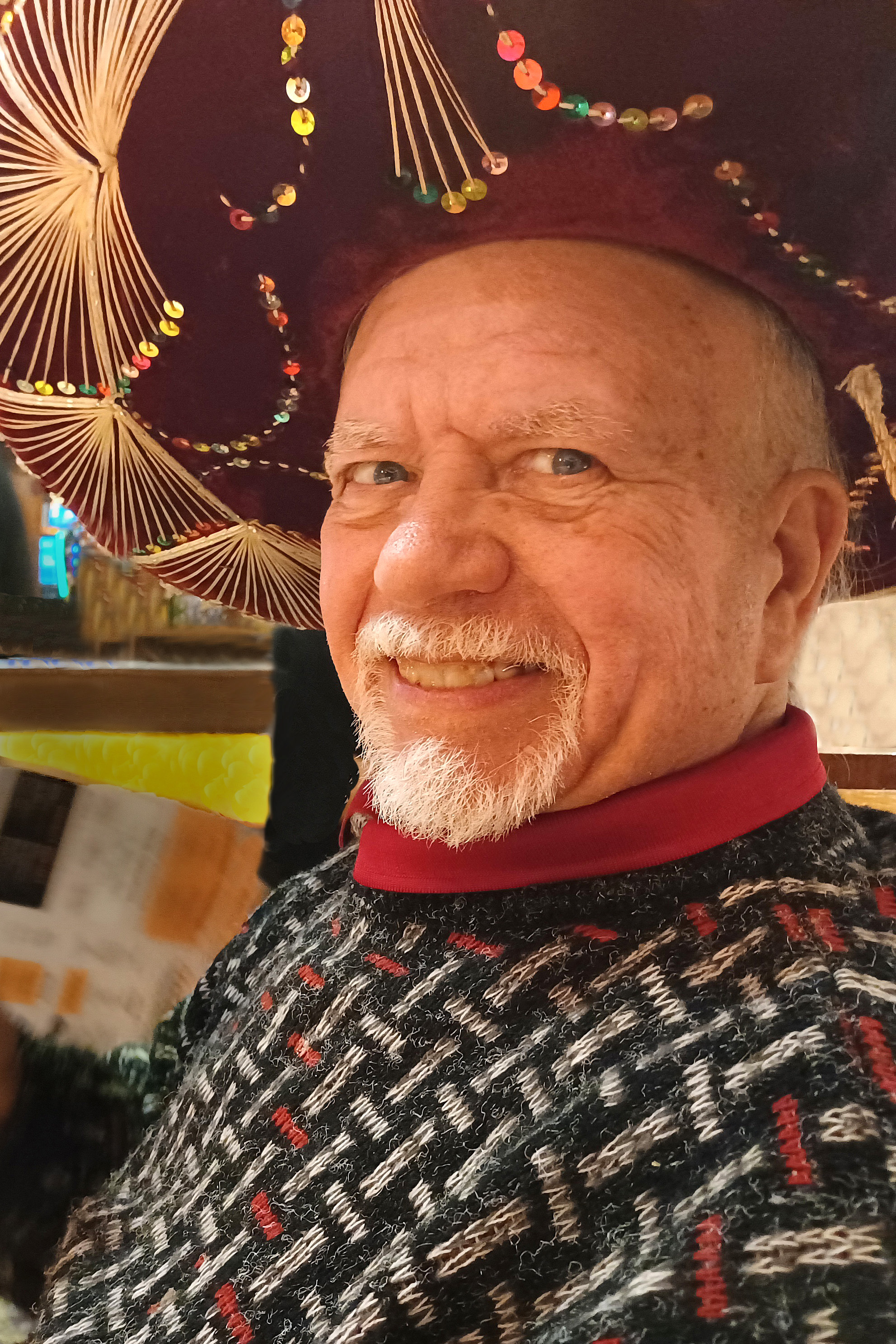
Photo of the author, Joe Burke
Contributor’s note
I was a medical photographer in Richmond VA., supplying the medical staff with visuals for their lectures, publications, and books. I photographed patients before, during and after operations. I was in the operating room, in the morgue, and behind the microscope gathering my photos and then processing and printing them for the doctors. I also taught them how to take better and more accurate photographs for their research.
In my retirement I use the computer to adjust or repair old and new photographs. And because I read a lot of progressive theology I create photos like the one attached [below].
My wife and I live in a retirement community in Milwaukee, WI. At 84 we are still active and curious about life.

A FINAL WORD FROM ME — Thank you, Joe, for sharing your article with my readers!


 Katherine Wikoff