
Just a super quick post this morning to share an article I found fascinating: “1 big thing: AI gospel singer tops Christian charts, from Axios AI+, a newsletter I subscribe to. Here is the link to the article online: https://www.axios.com/newsletters/axios-ai-plus-3f578c6c-b15f-4520-b015-ec13435e4b35.html
The gist of what I find fascinating is that, like me and my posts of AI-co-written short stories and poetry along with my chats, the humans behind the AI “artists” in this article are experimenting with AI to produce (co-produce?) creative work. The man who brought the Gospel singer into being describes his creation as “a musical project, not a political puppet.” The point appears to be exploring new tools for making art rather than challenging people’s fundamental worldviews of what is and isn’t acceptable (moral, ethical) behavior and what it means to be human and —at least, not challenging those worldviews any more than good art usually does lol
Take a few minutes to click over and read the article if you have any interest.
In my opinion, the type of work described is the future of creativity: art produced by a human in partnership with an AI tool. The fact that these AI-generated artists and songs have risen to the top of the Christian and Country music charts indicates that other humans recognize something in these creations that is valuable and connects with whatever it is inside humans that responds to works of art.
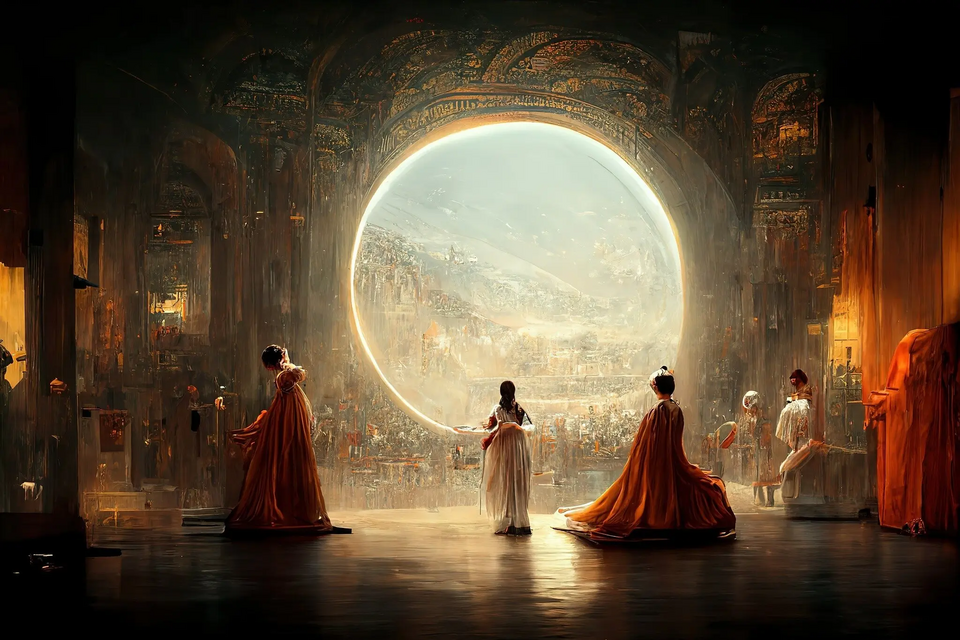
“Théâtre D’opéra Spatial,” the award-winning artwork that started it all – Midjourney, Public domain, via Wikimedia Commons
Interesting, also, is the way copyright and intellectual property protections are evolving alongside artists’ experimentation with AI. See, for example, this article from April 2025 in WIPO Magazine, the publication of the World Intellectual Property Organization, which is the United Nations agency “that serves the world’s innovators and creators, ensuring that their ideas travel safely to the market and improve lives everywhere.”
I liked this highlighted section of the article, which captures its focus:
The capabilities of today’s generative AI (genAI) technologies raise significant questions about the nature and scope of human authorship. How much human input must an artwork, such as a piece of music, have in order for it to receive copyright protection?
Although the article talks mostly about U.S. copyright law processes and principles, its broader point is to consider the entire worldwide ecosystem for protecting the rights of creators, whether artists or inventors.
Okay, so that’s my post for today. Hope you find it interesting. I’d probably keep on going with this topic this morning, sharing more articles and writing up commentary on them, if I had more time. Lucky for you, though, I have to go finish up my final course grades for the semester! 🙂


 Katherine Wikoff
It’s happening in pop and rock, too. Musical “groups” that don’t actually exist. Whatever value judgements one might make about it, I think it’s inevitable that artists will leverage any tool that strikes their fancy.
I do wonder if a possible counter-reaction (one seen in some SF books) will be that work that is 100% certifiably human will become more valuable. I can foresee a market for hand-crafted things. Things that retain some humanity.
LikeLiked by 1 person
I absolutely agree! In fact, it wouldn’t shock me to see some enterprising individual create a new business that certifies that certain products are 100% human created. There’s going to be so much stuff out there that people will want the equivalent of a “Consumer Reports” type review service to help them find “real,” human-created material and artwork.
LikeLiked by 1 person
A certification service. Yes, that makes perfect sense.
LikeLiked by 1 person