
As a professor who teaches political science from as neutral a position as possible (sort of like teaching a comparative religion course from an observer’s perspective versus teaching a theology course from a believer’s perspective), I try to present “The Press” as a quasi-governmental entity (as in “The Fourth Estate) characterized by both positive and negative attributes. Americans have long held the press in high esteem, so one of the flashpoints of “disagreement,” shall we term it, between people with left-leaning versus right-leaning political ideologies in recent years has been the issue of journalism’s trustworthiness.
I have been dismayed by the news media’s complicity in its own destruction. Donald Trump may have popularized the concept of “fake news” and led the growth of widespread mistrust among his followers, but I have also seen too many blatant falsehoods and twisted/spun versions of the facts to take much of anything I see reported in the news at face value. Sometimes I listen to other people talking politics and have to will myself not to allow any physical movement, like shaking my head or widening my eyes, to convey my suprise at their seemingly willfull acceptance of “opinion” for “fact” in the news they consume. These are smart, thoughtful people. I don’t know why they don’t see what I see. But I never say anything. I remember my Greek mythology and what happened to Cassandra (slavery, and later murder) when she tried to warn the people of Troy of the danger associated with kidnapping Helen and accepting that gift of a giant wooden horse from the Greeks.
Maybe I shouldn’t even say anything here on my blog, except I’m speaking directly to (yet indirectly, in terms of the media channel; maybe I should say instead that I’m directly “addressing my remarks to”) the Associated Press. Maybe the people responsible for the article I’m going to talk about weren’t deliberately trying to be manipulative. Maybe their own biases are so ingrained that they don’t even see it on the page (or, in this case, on the screen). But this is basic stuff that a good editor who cares about quality journalism should not allow to slip through.
So, here was the headline that caught my eye this morning:
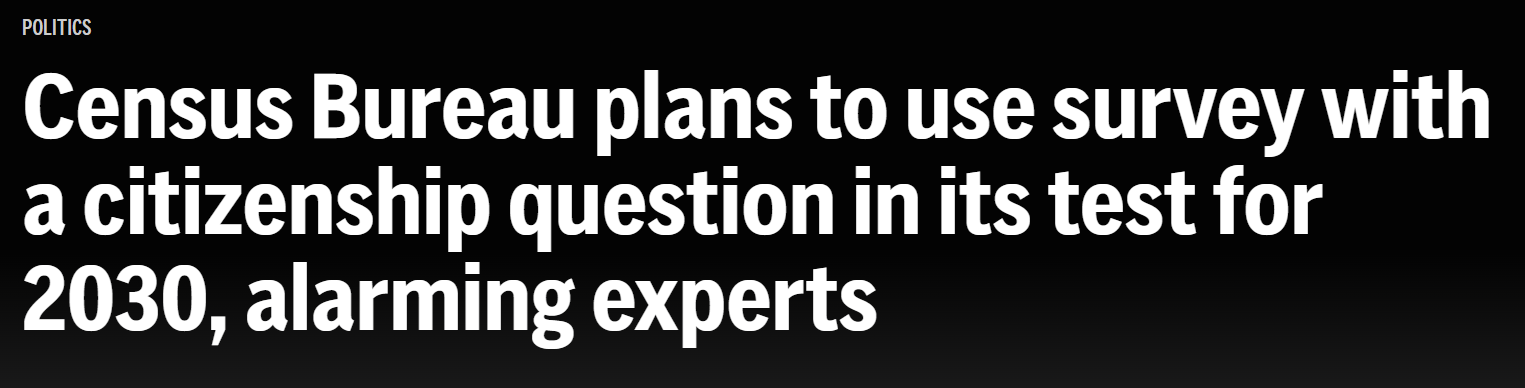 Associated Press headline, from a story dated February 6, 2026
“Experts?” I wondered. What kind of “experts” exist on the topic of the U. S. Census? Would these be political scientists? No. The only experts quoted were a “former congressional staffer who consults on census issues” and “an associate vice president at the Population Reference Bureau,” described by the reporter as a “nonpartisan research group.” Neither of these sources is objectionable, and both individuals do work closely with organizations on matters related to the Census Bureau, but in my opinion, it is a bit of a stretch to call them “experts” in the context of that headline. They might be experts about the U. S. Census, but they are not experts about the impact a citizenship question might have on society.
Additionally, what even is going on with the last paragraph in this screenshot: “Among the questions on the ACS is one that asks, ‘Is this person a citizen of the United States?’ Questions for the census aren’t supposed to ask about citizenship, and they haven’t for 75 years.”
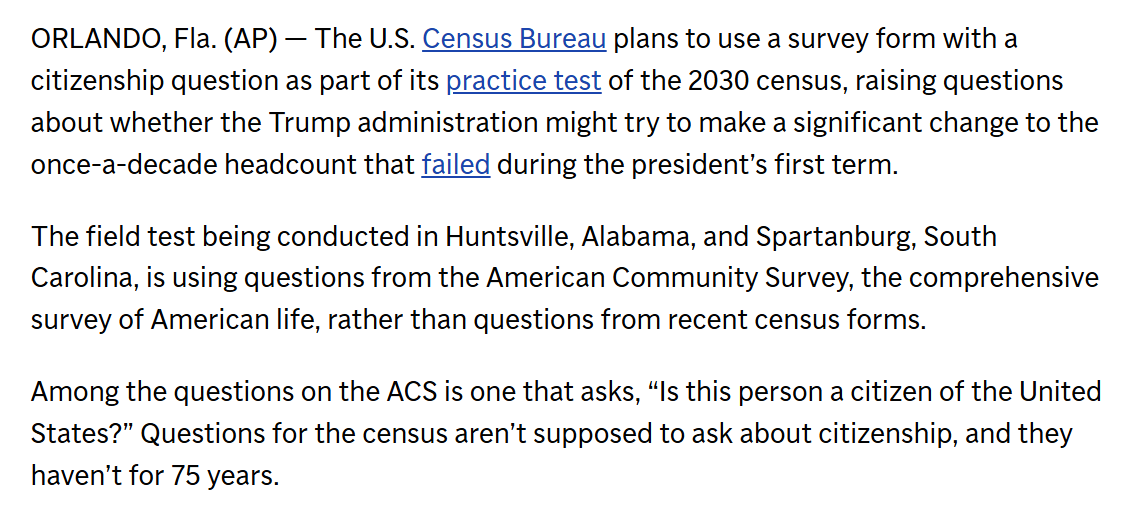 Opinion stated as fact in the Associate Press news article dated February 6, 2026
If you parse that last sentence out, I suspect you’ll be as surprised as I was.
Who says, for example, that questions for the census aren’t supposed to ask about citizenship? Is there some international treaty to which the U. S. is signatory decreeing that all countries must abide by this rule? Is there an international body, like some agency at the United Nations, with the power to issue standards of governance related to census-taking procedures? No, there is not.
And the second half of that same sentence (“and they haven’t for 75 years”) immediately had me googling to see what the case was prior to that. Which search, as you might guess, informed me that from 1890 to 1950 the U. S. Census did indeed ask about citizenship.
Now, why would a reporter issue such a baldly-stated non fact as the first part of that sentence (“questions for the census aren’t supposed to ask about citizenship”) followed immediately by the clue that would direct any thinking person with a couple extra minutes to the proof needed to demonstrate that the first part is, for want of a better term, “fake news”?
This is exactly the kind of incompentence or dishonesty (take your pick) that has landed legacy news media in the situation they currently enjoy. And it’s too bad. The Associated Press was one of the few remaining bastions of quality journalism that I turned to every day. But for several years now, I’ve seen too much of this truth “fudging” for my high regard to continue indefinitely.
Reuters, it’s up to you now ❤
Unless/until the AP shapes up, you’re the one news organization I find the least fault with (basically none). Please don’t let me down and leave me with no news source I can rely on to be unerringly trustworthy in this crazy, confusing world!


 Katherine Wikoff
Tragically, I no longer trust nor have any interest in “journalism”. It seems to have died. And because of Ai and human slop, I basically don’t trust anything I get off the interweb anymore.
LikeLiked by 1 person