Writing exercise – “Bridges” (brought to you by ChatGPT and me!)

Lately, I have been trying two things as an experiment with my writing group exercises. First, I’ve been using every prompt as a jumping-off point to initiate a scene for my novel. Second, I’m setting every scene up with a prompt in ChatGPT as a booster for my ideas and as a quick way to generate a (very) rough draft. I’m having fun with this.

Writing as an act of discovery has taken on surprising new dimensions. I love putting ideas together and seeing what happens. The ChatGPT output is definitely “rough,” but reshaping it and crafting those scenes into finished passages will be a behind-the-scenes, painstaking, and time-consuming job, although certainly satisfying in its own way, and I look forward to sharing my story in final form someday.

Meanwhile, I’m enjoying the “discovery” phase of writing these scenes immensely. Working with ChatGPT is like having a really smart, quick-witted partner who can synthesize your ideas and execute them quickly so that you can, equally quickly, reject the things that aren’t right and amplify the things that are.

Some ChatGPT background for you if you haven’t yet tried this tool. When you start a new project, you basically begin a new “chat,” similar to a string of text messages on a phone or a conversational thread on a social media platform.

All of these scenes with Addy, the 1930s era in my novel, are part of one long “chat.” Each time I write a new scene, I just add a new section of conversation to the same thread of previous prompts and ChatGPT-returned results. What’s kind of neat about this is that in writing this week’s scene, ChatGPT reached back to my earlier prompts and took background information from them to build out today’s scene. For example, I mentioned a conversation that happens among the boarders at the rooming house where Addy lives, and ChatGPT remembered information from a discarded prompt (I didn’t like the scene and asked for a rewrite based on a new prompt) to supply the other boarders’ names and even added context based on their occupations.

My original plan was to introduce Addy and then murder her. Not in any direct, graphic way; we’d simply find out in the 1970s and the contemporary portions of the novel (via local lore and via microfilm newspaper articles) that Addy fell victim to a 1930s serial killer. But now that I’ve met Addy and gotten to know her, I’m too attached. Killing her off feels like a betrayal, like a bait and switch where I introduced a likeable character and tricked readers (including me!) into caring about her, and then BAM! She’s dead. Karen and I had a great conversation about this at our meeting today, searching for alternatives that could keep her alive. We didn’t figure out any specifics, but maybe some other shantyboat girl will die in her place, some cipher of a character that we can feel sorry for but not actually grieve too much!

Karen asked me today if I felt like using ChatGPT was cheating, and I told her no. I told her about some of the fragmented, theoretical “lenses” I’m using to frame my thinking, which she was kind enough to listen to and act as a sounding-board/alpha reader for. I want to start posting that discussion in mini-installments, maybe thinker/idea by thinker/idea at first, to keep the posts manageable, and then once I’ve done that, I can put it all together in one long post or article. Anyway, as (I think) I’ve said before, my dissertation topic was plagiarism (“The Problematics of Plagiarism,” in case you’re curious, which for an academic dissertation is a nice, short title, not to mention alliterative 🙂 ), and I’ve been deeply curious about the relationship between plagiarism and originality for years. Generative AI is something different from plagiarism, in my opinion. It’s a new kind of originality. Badly-written student ChatGPT papers that result from lazy misuse of the tool may reflect academic dishonesty, for sure, but thoughtful, well-informed use of the tool is something else again.

But that’s a discussion for the coming week, or whenever I feel like my grading is under control enough again that I have time to write those posts.

Meanwhile, below is the string of prompts and resulting drafts of the latest scene from the 1930s era of my novel. I haven’t thrown in my usual writing-exercise disclaimer in a while, so here it is, as well. This is a work of fiction. Names, characters, businesses, places, events, locales, and incidents are either the products of the author’s imagination or used in a fictitious manner. Any resemblance to actual persons, living or dead, or actual events is purely coincidental.

And now, my exercise, incorporating both this week’s writing group prompt of “bridges” and my ongoing ChatGPT chat on the 1930s portion of my novel.

1)  My initial prompt, for today’s first draft

Write a scene in which Addy is sitting in the kitchen with her landlady eating her warmed up stew. Addy has just returned from her job at the menswear store. It is about a 20-minute walk to the boarding house where she lives.

Addy and the landlady are talking about a conversation that had happened the previous weekend. It is Monday night, and on the previous Saturday, Addy had been eating dinner with all the rest of the borders, when a conversation ensued that Addy hadn’t really understood. It was about bridges. The new bridges that were going across the Ohio river up and down stream. Mr. Delaney, who was a traveling salesman, said, “it’s all about the bridges. If you keep an eye on the bridges, you’ll understand what’s coming.” Addy does not understand, but Mrs. Hudson, the landlady had seemed to understand and had carried on quite an involved conversation. The other borders seemed as befuddled as Addy. She knows Mrs. Hudson is extremely intelligent, and Addy wants to understand. Mrs. Hudson explains that the bridges are a sign of progress, and progress leads us into the future. The future of Adell Ferry does not look good because no one crosses by ferry anymore, they drive to the bridges. It is not good for Adell Ferry that it is at a bow in the river. The distance between two bridges would be much shorter with a road connecting them directly, rather than along the meandering river road, leaving their town cut off, with no reason for anyone to stop there anymore. The future is going to leave Adell Ferry behind, the landlady tells her. In the course of talking about bridges, the landlady also says that the river itself is going to change. This is progress, taming the water and making it work for us, taming nature, taming the rivers. Just look at all the dams they’re building up and down the Mississippi, the landlady says. Look at the Tennessee Valley Authority and the dams they are building. Think about that gigantic dam they are building on the Columbia River in Washington state. That is the future. She tells Addy that “your parents are so lucky they got to live your father’s dream before it got taken away by the future.”

Addy is upset and confesses that she is very concerned for her future. She doesn’t know what to do or where to go. “I think my father is dying,” she tells the landlady. “My parents sold everything to live on that boat, and my father’s cough is getting worse and worse.” Addy begins to cry. “I don’t know if I’m ever going to see him again,” she says. The landlady comforts her and tells Addy that, like her, she is a survivor. You know what it is to work hard, she tells Addy. You will always do what is necessary to survive. Ignore variations in spelling in this prompt. The two characters are Addy and Mrs. Hudson. The town they live in is Adell Ferry. Two themes to emphasize in this scene are safety and survival. Mrs. Hudson is safe, her kitchen is warm, there is always delicious food to eat. Addy used to be hungry on the shantyboat. The future is frightening, Addy’s parents’ situation is precarious, progress is an imperceptible enemy–or is it? Mrs. Hudson has survived her husband’s death, her own scary financial situation, and also the shame of the bank failure. But she didn’t lose her house and she is facing the future with grit. Addy works hard. Mrs. Hudson believes in her. The warm kitchen, the filling stew, and Mrs. Hudson all make her feel safe. Regarding survival, Addy feels guilty that she stayed in Adell Ferry. She is working five hours a day 4:00 – 9:00 PM on school nights and 8 hours on Saturdays. She’s seventeen. But she might never see her father again. Mrs. Hudson tells her that survival is a choice, and in her opinion it is always the right one.

ChatGPT said:

Addy sat at the worn wooden table in Mrs. Hudson’s kitchen, the warmth from the stove filling the small space. Her raincoat hung on a peg by the door, dripping faintly onto the tiled floor. She had walked home from the store in a steady drizzle, her shoes damp, her hair frizzing slightly around her face. The room smelled of stew—carrots, onions, and beef—and the familiar scent made her stomach growl. Mrs. Hudson placed a steaming bowl in front of her, followed by a plate of thick slices of bread.

“Eat up, girl,” Mrs. Hudson said, sitting down across from her with a cup of tea. Her wiry frame seemed smaller in the soft light of the kitchen, but her sharp eyes sparkled with their usual intelligence.

“Thank you,” Addy murmured, dipping her spoon into the stew. The first bite warmed her from the inside out, and she felt her body begin to relax.

They ate in companionable silence for a while, the rain tapping lightly against the window. Addy couldn’t help but think back to Saturday evening, when all the boarders had gathered for supper. The conversation had been lively at first—Mr. Freeman sharing tales of his days as a mason, Lorna Rooney complaining about a demanding customer at the bank—but then Mr. Delaney had made his comment about bridges.

“It’s all about the bridges,” he’d said, his tone conspiratorial as he pointed his fork in the air. “If you keep an eye on the bridges, you’ll understand what’s coming.”

Addy had glanced around the table, puzzled. Mr. Freeman had looked equally mystified, and Lorna Rooney had raised an eyebrow, but Mrs. Hudson had leaned forward, nodding as if she understood perfectly. She and Mr. Delaney had talked for a good ten minutes, their words flying too fast and heavy for Addy to follow. She’d felt like an outsider, trying to grasp the meaning of something just out of reach.

“Mrs. Hudson,” Addy said now, setting down her spoon. “On Saturday, you and Mr. Delaney were talking about bridges. What did he mean?”

Mrs. Hudson set her tea down and gave Addy a long, measured look. “He meant progress,” she said simply.

“Progress?” Addy repeated, frowning.

“Yes. Bridges are more than just things that span a river. They’re symbols of the future. Adell Ferry is named for the ferry that used to carry folks across the river. But who needs a ferry anymore? People drive to the bridges now. They’re faster, more convenient. And that’s the problem for this town. We’re at a bend in the river, and the bridges are upstream and downstream. There’s no reason for anyone to stop here anymore.”

Addy leaned back in her chair, the words settling heavily. “So… Adell Ferry’s being left behind?”

Mrs. Hudson nodded. “That’s the way of things. Progress doesn’t wait for anyone. And it’s not just here. The river itself is changing. They’re building dams up and down the Mississippi, controlling the water, taming it. Look at the Tennessee Valley Authority. Look at that massive dam they’re building on the Columbia River out west. The world’s changing, Addy, and it’s not going to stop.”

Addy stared down at her half-eaten stew, her appetite fading. “My parents are so lucky,” Mrs. Hudson continued, her tone softening, “that they got to live your father’s dream before it was taken away. The river as he knew it is disappearing. It’s progress, yes, but it’s also an end.”

The mention of her parents made Addy’s throat tighten. “I think my father’s dying,” she blurted, her voice barely above a whisper. She looked up, her eyes filling with tears. “My parents sold everything to live on that boat, and now his cough just keeps getting worse. I don’t even know if I’ll ever see him again.”

Mrs. Hudson reached across the table and took Addy’s hand in her own. Her grip was firm, steady. “Addy, you’ve survived so much already,” she said. “You’ve worked hard, you’ve kept going. That’s what survival is. It’s a choice. And it’s always the right one.”

Addy shook her head, tears slipping down her cheeks. “But what if I shouldn’t have stayed? What if I should’ve gone with them? I’m working, I’m going to school, but—” Her voice broke. “I feel like I abandoned them.”

“You didn’t abandon anyone,” Mrs. Hudson said firmly. “Your parents wanted this for you. They wanted you to have a future. Staying here, finishing school, working—that’s not abandoning them. That’s honoring their sacrifice.”

Addy swallowed hard, the words sinking in. The warmth of the kitchen, the solid feel of Mrs. Hudson’s hand, the taste of the stew—they were all small reminders that she was safe, that she was surviving. She took a deep breath, trying to steady herself.

“You’re a survivor, Addy,” Mrs. Hudson said. “Just like me. Life knocks us down, but we get back up. We keep going. And one day, you’ll look back on this moment and see how strong it made you.”

Addy nodded, wiping her eyes. She picked up her spoon again, the stew now lukewarm but comforting nonetheless. Mrs. Hudson leaned back in her chair, sipping her tea, and the rain continued its steady rhythm against the window. The future still loomed, uncertain and frightening, but for now, the kitchen was warm, the stew was filling, and Addy felt just a little less alone.

2)  My follow-up prompt, for today’s second draft

Very nice! But maybe a bit too heavy on the survival emphasis. Mrs. Hudson is a little too direct in her pronouncements about the future. Please write another draft and tone those two elements down a bit.

ChatGPT said:

Addy sat at the kitchen table, a steaming bowl of stew in front of her, the savory aroma filling the small space. The warmth from the stove made the air cozy and soft, a stark contrast to the cold drizzle she’d walked through on her way home. Her raincoat hung on a peg near the door, its hem still dripping faintly onto the tiled floor. The kitchen had become her favorite room in the boarding house, with its mismatched chairs and the steady hum of Mrs. Hudson’s presence.

Mrs. Hudson, thin and wiry, sat across from her, sipping tea. Her sharp eyes darted to Addy’s plate. “Eat, child. No sense in letting good food go cold.”

Addy smiled faintly and lifted her spoon. The stew was rich and filling, the kind of meal that felt like it stuck to your ribs. She chewed slowly, letting the warmth spread through her, but her mind wasn’t on the food. “Mrs. Hudson,” she said after a moment, setting her spoon down. “On Saturday, at dinner… when Mr. Delaney said that thing about the bridges… I didn’t understand what he meant. But you did.”

Mrs. Hudson tilted her head, her expression sharpening. “Oh, the bridges.” She tapped a finger on the table, as if sorting her thoughts. “Well, he’s not wrong. The bridges tell a story if you know how to read it.”

“What story?” Addy asked, leaning forward.

Mrs. Hudson sighed and sat back, her tea steaming faintly in the light of the overhead lamp. “Bridges are about connections. They bring people together—or take them past you. Adell Ferry used to be a stop for everyone. You needed the ferry to cross the river. Now? Folks just drive to the bridges. They don’t stop here anymore. Progress is like that—it changes everything, sometimes for the better, sometimes not.”

Addy frowned, her thoughts swirling. “So… the bridges are why Adell Ferry is struggling?”

“That’s part of it,” Mrs. Hudson said. “But it’s more than that. Progress has a way of leaving places behind. We’re at a bend in the river, and that’s not where people want to be anymore. It’s easier to drive straight across on a bridge than to come through town. That’s just how things go.”

Addy stirred her stew absently, watching the flicker of shadows on the walls. “It’s strange,” she said softly. “The river was everything to my parents. It felt like freedom, like possibility. But now it feels like… something else.”

Mrs. Hudson nodded, her expression unreadable. “The river’s changing, too. They’re taming it, building dams and locks. The water’s not wild anymore—it’s being controlled, put to work. That’s progress, too.”

Addy hesitated, her throat tightening. “I’m worried about my parents,” she said, her voice barely above a whisper. “My father’s cough keeps getting worse. They sold everything for that boat, and now… I don’t even know if I’ll see him again.”

Mrs. Hudson reached out and placed a bony hand over Addy’s. Her touch was cool but steady. “They’re doing what they thought was best, Addy. Just like you are. It’s not easy, any of it, but they wanted you here, safe and building your future.”

Addy’s eyes filled with tears, but she blinked them away, embarrassed. “I feel guilty,” she admitted. “Like I should have stayed with them. I hate thinking of them out there, and I’m here in this warm kitchen.”

Mrs. Hudson’s lips pressed into a thin line, her eyes softening. “Guilt doesn’t change anything, child. Your parents made their choice, and you made yours. You’re not abandoning them by being here—you’re doing what they hoped you’d do.”

Addy nodded, though her chest still felt heavy. She picked up her spoon again, the stew now only lukewarm but comforting in its own way. Mrs. Hudson sat back and sipped her tea, her gaze drifting to the window where the rain blurred the world beyond.

“Keep eating,” Mrs. Hudson said gently. “The rain’s not letting up, and you need your strength.”

Addy smiled faintly, the warmth of the kitchen seeping into her bones. The future still felt like an unknown, full of shifting currents and bridges to nowhere. But here, in the moment, the stew was good, the kitchen was warm, and Mrs. Hudson’s quiet strength made her feel just a little steadier.

3) My third prompt:

Good, but emphasize that if someone built a road connecting the bridges upstream and downstream, the straight line between them would completely isolate Adell Ferry. And progress likes straight lines, not a meandering highway along the riverbend

ChatGPT said:

Addy sat at the kitchen table, a warm bowl of stew in front of her, its aroma filling the small, tidy kitchen. Her coat dripped faintly from its peg by the door, the steady patter of rain outside mingling with the low hum of the stove. Mrs. Hudson sat across from her, cradling a mug of tea in her wiry hands, her sharp eyes glinting in the light of the overhead lamp.

Living here felt like a compromise, Addy thought—a step toward being on her own, but with someone looking out for her. And tonight, the warmth of the kitchen wrapped around her like a quilt.

“Eat your stew,” Mrs. Hudson said, nodding at Addy’s spoon. “No sense letting it go to waste after I kept it warm for you.”

Addy obeyed, taking a slow bite, savoring the way the flavors filled her. She stirred her spoon idly for a moment before speaking. “On Saturday, when Mr. Delaney said that thing about the bridges… I didn’t understand it. Something about keeping an eye on them?”

Mrs. Hudson gave a wry smile and leaned back in her chair, her mug resting on the table. “Ah, Delaney’s a talker, but he’s got a point. Bridges tell you a lot about where the world’s headed.”

Addy frowned, setting her spoon down. “What do you mean?”

Mrs. Hudson’s gaze drifted toward the window, where the rain blurred the darkness outside. “Progress likes straight lines, Addy. The road from one bridge to the other—it should run straight. But it doesn’t, not now. It winds through Adell Ferry, following the riverbend. For now, that’s what keeps us on the map. But someday, someone’s going to build a road that goes straight between those bridges. And when they do? There’ll be no reason for anyone to come through here.”

Addy felt a chill unrelated to the rain outside. “But the town… it’s always been here.”

Mrs. Hudson’s mouth tightened into a thin line. “So’s the river. But they’re taming it now, Addy. Dams, locks, reservoirs—progress doesn’t care about what’s been. It cares about what’s next. And straight roads are what’s next. One day, people will look at a map and see two bridges connected by a single line. Adell Ferry? It’ll just be a dot they don’t stop for.”

Addy looked down at her bowl, her appetite waning. “That’s awful,” she murmured.

Mrs. Hudson shrugged, her expression practical. “It’s just the way things go. When progress comes, you either figure out how to keep up or you’re left behind. I know this house feels solid, but I’ve had to fight to keep it standing.”

Addy thought about her parents on the shantyboat, drifting with the currents, and how her father’s cough had sounded the last time she saw him. “I don’t even know if I’ll see them again,” she said suddenly, her voice trembling. “My father’s so sick, and they sold everything for that boat. If something happens…” Her words trailed off as tears threatened to spill over.

Mrs. Hudson set her mug down and leaned across the table, her hand resting lightly on Addy’s. “They’re doing what they thought was right for them. And you’re doing what’s right for you.”

“But it feels wrong,” Addy said, her voice barely above a whisper. “Like I left them behind.”

Mrs. Hudson’s grip tightened just a fraction. “They wanted you here, Addy. Safe. Building something for yourself. That’s not leaving them behind—it’s honoring what they worked for.”

Addy blinked back her tears, trying to hold on to Mrs. Hudson’s words. She picked up her spoon and took another bite of stew, its warmth grounding her.

Mrs. Hudson leaned back again, her gaze soft. “You’re strong, Addy. You’ll figure it out, one step at a time. You don’t have to have all the answers tonight.”

The rain continued its steady rhythm outside, but inside the kitchen, it felt still and safe. Addy wasn’t sure what the future held—for herself, for her parents, or for Adell Ferry—but for now, she focused on the meal in front of her and the steady presence of Mrs. Hudson.

4) My fourth and final prompt, as I could see no real improvement was being made:

This is good, but not quite right yet. Include the dinner scene with Delaney, Rooney, the other boarders. Take out the “living here felt like a compromise” section. Don’t have Mrs. Hudson call Addy “child.”

ChatGPT said (and you will note that my request to include the actual dinner conversation was ignored):

Addy’s spoon clinked against her bowl as she stirred the stew Mrs. Hudson had kept warm for her. The kitchen was quiet except for the soft patter of rain against the window. The scent of simmering vegetables and broth filled the room, blending with the faint smell of damp wool from her coat hung on the peg by the door.

Mrs. Hudson sat across the table, her teacup resting in her hands. The lamplight above cast long shadows on the walls, making the small kitchen feel both cozy and fragile. Addy took a bite, savoring the warmth that spread through her, but her thoughts drifted to Saturday night’s dinner with the other boarders.

“I’ve been thinking about what Mr. Delaney said,” Addy said, setting her spoon down. “About the bridges.”

Mrs. Hudson raised an eyebrow. “He does like to get people talking, doesn’t he?”

Addy gave a small smile. “He said, ‘It’s all about the bridges. If you keep an eye on the bridges, you’ll understand what’s coming.’ I don’t understand what he meant, but you seemed to.”

Mrs. Hudson leaned back in her chair, the corner of her mouth tugging into a knowing smile. “That’s because he’s right, in a way. Progress does like bridges. They’re not just crossings—they’re signs of change, of what’s to come.”

Addy frowned, her mind circling back to the conversation. She’d glanced around the table that night, hoping someone else would ask what he meant, but Lorna Rooney had simply nodded along, and Mr. Freeman had muttered something about not trusting anything that replaced a good ferry.

“Delaney was talking about the bridges upstream and downstream, wasn’t he?” Addy asked.

Mrs. Hudson nodded. “Those two bridges are like anchors. They connect towns, people, trade. But look at where Adell Ferry sits—right in the bend of the river. That bend forces the road to wind through here. If someone builds a straight road between those bridges, cutting across the land, it’ll bypass the bend entirely. No reason for anyone to stop here anymore.”

Addy felt a cold pit settle in her stomach. “But… that would leave the town isolated.”

Mrs. Hudson’s face softened. “That’s exactly it. Straight lines are the future. They’re faster, more efficient. And progress doesn’t care much for meandering rivers or the towns that grew up alongside them.”

Addy stared at the steam rising from her bowl, the thought sinking in. “But this town—these people—what happens to them?”

Mrs. Hudson shrugged. “Some will move on, others will stay and make do. It’s happened before, in other places. It’ll happen here.”

Addy thought about her parents, adrift on their boat somewhere downriver, their world as fluid as the water they traveled on. “You said something else Saturday. About the river itself changing.”

Mrs. Hudson’s eyes flickered. “The river’s not free anymore, not like it used to be. Dams and locks, reservoirs and levees—they’re taming it, making it work for us. It’s progress, Addy, for better or worse.”

Addy looked out the rain-speckled window toward the darkness where she knew the river flowed. “My parents are out there,” she murmured. “They sold everything for that boat, and my father… his cough is worse every time I see him. I don’t even know if I’ll see him again.”

Her voice cracked on the last word, and she bit her lip, trying to hold back tears. She hadn’t let herself cry on Saturday when they’d said goodbye. Not when her mother had clung to her and whispered, “My baby,” over and over. Not when her father’s watery eyes had said everything he couldn’t bring himself to.

But now, in the quiet warmth of the kitchen, the tears came.

Mrs. Hudson didn’t rush to speak. She let Addy cry, her gaze steady and patient. When Addy wiped her eyes, sniffling softly, Mrs. Hudson finally leaned forward.

“Your parents gave you this chance, Addy, because they believed in you. And they were right to. You’ve got grit. You’ll figure things out.”

“I don’t know,” Addy whispered. “The future feels so big and uncertain. Everything feels… fragile.”

Mrs. Hudson nodded slowly. “It is. But fragile things can still hold up if you take care of them. This town might struggle, but some folks will stay. And you’ll find your way too, no matter what happens.”

Addy looked up at her, searching for something to hold on to. “Do you really think so?”

Mrs. Hudson’s eyes were firm but kind. “I do. You’re stronger than you think.”

The rain drummed softly on the roof, a steady rhythm that matched the thrum of her thoughts. Addy picked up her spoon again, the warmth of the stew grounding her as she took another bite. For now, she let the safety of the moment anchor her, even as the river and the future waited just beyond.
Posted in Creativity, generative AI, Learning, writing exercises, Writing, blogging | Tagged , , , , , , , , , | 1 Comment

Why the Detroit Lions and Dallas Cowboys always play on Thanksgiving

I have wondered about this for years. It seemed like my dad and grandfather watched the Detroit Lions on Thanksgiving afternoon every single year of my childhood. Do the Lions always play on Thanksgiving, or is my memory just playing tricks on me? Read on for the answer, thanks to USA Today.

Thanksgiving has featured professional football for more than 100 years. Here’s why two teams have played more games on the holiday than any others.
— Read on www.usatoday.com/story/sports/nfl/2024/11/28/detroit-lions-dallas-cowboys-thanksgiving-nfl-history/76598292007/.

Posted in Learning, Life, Popular culture, Television | Tagged , , , | Leave a comment

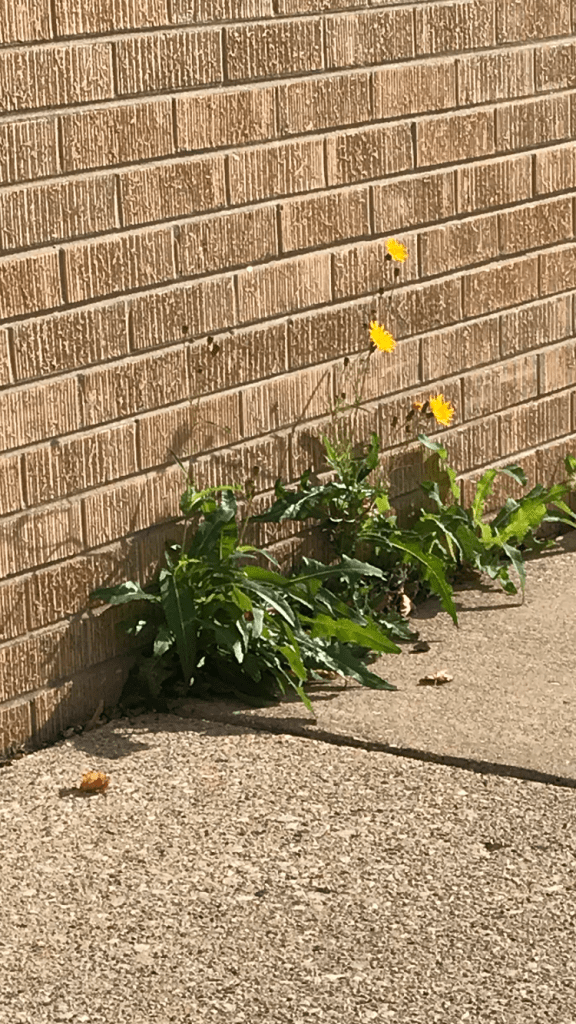
Bloom where you’re planted!

I thought of that saying right away about two weeks ago when I saw these cheerful flowers (um, weeds) growing out of the crack at the base of this brick wall where it hits the sidewalk (and took a picture, of course). There’s something so optimistic and vital about flowers sprouting up in hostile environments. It makes you realize that even the most dire straits can’t completely stifle our yearning to reach for our dreams. As Jeff Goldblum’s character, Dr. Ian Malcolm, says in Jurassic Park, “Life finds a way.” (Although the actual line, as delivered in the movie, is more like this: “Life . . . uh . . . finds a way.” That “uh” adds a ton of dramatic import that a straight delivery just can’t match. If you don’t remember that scene, go find the clip on YouTube where the baby dinosaur hatches, and I’ll bet you agree! 😀)

Yellow flowers on weeds growing out of a crack where a brick wall meets the sidewalk

I’ve always liked the saying I used to title this post, “Bloom where you’re planted,” which I think I first heard from artist Mary Englebreit. She was extremely popular in the 1980s and 1990s, is probably still popular even today (I haven’t paid attention), and her story always inspired me to make the most of whatever circumstances I happened to find myself in. Born in St. Louis, Englebreit wanted to be an artist, a children’s book illustrator, I believe. She tried shopping her work around New York, took it to all the publishers, and was rejected. Did she let their “no”s stop her? Heck, no. She took a job in advertising in St. Louis and kept making her art.

Next thing you know, she owned a multimillion dollar business (greeting cards, mugs, calendars, home decor) centered around her very unique, whimsical style of art. And she managed to build that empire right there in her hometown of St. Louis. Bloom where you’re planted, indeed!

Anyway, when I found myself at that same brick wall today (my pharmacy, where I accidentally arrived before it opened, so I had to sit in the car and wait fifteen minutes, which gave me ample time to observe the landscape, as it were), I noticed that those flowers are still growing—even though we had a rather aggressive early-season snowstorm a couple days ago.

Today is chilly and overcast in Milwaukee, a very November shade of gray.

Seems like a great time, consequently, to post this photo and celebrate yellow flowers defying the odds and stretching toward the sun❤️

Posted in Life, Milwaukee, Nature, Photography | Tagged , , , , , , , , , | 3 Comments

Abstraction: Efflorescence on a Concrete Wall

This caught my eye this morning, and I immediately envisioned it as something that might make a nice abstract image in a photograph.

Efflorescence on a concrete wall

I know what “efflorescence” is only because when I worked as a litigation paralegal many years ago, we had a case involving shoddy construction. The brick walls were covered with a crystallized white powdery substance, and I can’t remember now if the cause was poor quality (or incorrect) mortar or failure to include weep holes. But I do remember that term, “efflorescence,” because it was a phenomenon I’d noticed all my life, and I’ve always loved learning the “backstory” of things like that.

Apparently the term stuck with me, because even after 40 years, I knew what I was looking at this morning when I saw these fluffy, crystalline puffs on the wall 😀

Posted in architecture, Photography | Tagged , | 5 Comments

Writing Exercise – “November Rain” (co-authored by my writing buddy, ChatGPT)

As I’ve mentioned before, I’m in a small “Community of Practice” group at Milwaukee School of Engineering, the college where I teach, and am trying to immerse myself both in reading the current scholarship on generative AI (or, “GenAI,” as I sometimes see it called) and in learning everything I can about the new technology by engaging with it in my own writing.

In addition to ChatGPT, everyone in the group has received a license for Microsoft Copilot, the super expensive version that businesses use. Copilot has access to my Outlook, my Teams, my Word and Excel documents, my PowerPoint slideshows (for classroom lectures)—in short, everything associated with Microsoft in my MSOE account. I’ve tried out Copilot just once since getting the license last week, and it screwed up the job lol. I asked it to create a sign-up sheet for student conferences in a two-columned document, and I provided the dates and times for each available slot. Copilot repeated one of the dates. Oops. Thank goodness an eagle-eyed student caught that before I became double booked with two students signed up per slot on that day. Everyone tells me, that I’m going to LOVE Copilot. We’ll see. I have an open mind. However, at the moment I do find myself thinking about that famous Ronald Reagan line, “trust but verify.” (By the way, there’s a really interesting, sort of fun backstory associated with that quote. You can read about it in this Wikipedia article if you, like me, enjoy rabbit holes. Link here: https://en.wikipedia.org/wiki/Trust,_but_verify.)

Anyway, all that is secondary to the main point of today’s post, which is to share another writing exercise with you that I completed with ChatGPT. My writing group does an exercise each week, and lately I’ve been 1) viewing the prompt itself as a heuristic of sorts, almost like an oracular message from the universe providing oblique guidance and insight on my novel and 2) using ChatGPT so I can get in some additional practice with it, a hands-on engagement that helps me understand how it operates in all aspects of writing.  

By the way, in response to some excellent comments and questions at the end of recent posts about using ChatGPT in my own writing, I’m currently working on a longer post talking about the reasons why I see GenAI use as something different from old-school plagiarism. I hope it’s not too long of a post, which at the moment it is—WAY too long. Cutting/editing is time consuming, so that’s the source of delay. What’s that Mark Twain quote? He apologized for writing such a long letter, but he didn’t have time to write a short one? I love that! Yep, that’s what’s going on with my “ChatGPT, plagiarism, and originality” post. I haven’t forgotten it. Maybe I should feed it into ChatGPT for some editing help 🙂 

So finally, after exhausting you with all that side talk but hoping you’re still here anyway, I present to you my exercise from last week. The prompt was “November rain.” (Which we have had plenty of in Milwaukee so far this month!)

When we left off last time, our 1930s girl, Addy, was feeding the chickens on the bank of Ohio River (where her family’s shantyboat was moored) and thinking about how she’d turn seventeen on her upcoming birthday and wanted to stay in the nearby town to have a senior year in high school instead of traveling downriver to Mississippi for the winter.

This time, for the “November rain” prompt, I decided that Addy got her wish, and she is now living alone in a room in that town, having essentially become an adult, with her parents leaving for the winter. Partly I was inspired in this plot development by the story of Joe Rantz, the protagonist in The Boys in the Boat, an extremely engaging nonfiction account of the rowing team that represented the United States at the 1936 Olympic Games. Joe was more or less abandoned by his family and left to fend for himself at age 15. In the book, no one seems particularly shocked by this turn of events, which leads me to think that such situations were not uncommon during the Depression. So it’s not completely unrealistic for me to have a 17-year-old girl living on her own during the confusing, even catastrophic social and economic upheaval of that era. Adulthood apparently arrived much earlier generations ago than it does today, at least for many young people in developed nations.

My first prompt to ChatGPT clearly wasn’t very good, because what got returned was a scene that I viewed as overly melodramatic and filled with trite, obvious, and clichéd interactions and conversations. I liked my second try better, and then I refined that just a little bit more, to eliminate additional tropes (e.g., the “sturdy” landlady).

This scene needs way more work before I’ll be happy with it, but once again, I enjoyed the experience of discovery, to see what my prompt might result in, to try again. The writing process becomes a game, a back-and-forth “call and response” type conversation. There’s a momentum that deeply engages you, similar to but quite different from the usual experience of writing.

Sadly (?), using ChatGPT isn’t all that much faster when it comes to drafting a text. That’s something I need to emphasize. Done well, writing with ChatGPT can be a fairly time-consuming process.

In fact, my initial, highly negative view of GenAI, generated by a handful of horrible ChatGPT student papers that began arriving out of left field almost two years ago, was a mistake. It was a mistake for me to assume that the mindless (literally) quality of writing I saw in those essays, marked by deceptively smooth prose but devoid of meaningful content, was an intrinsic feature/flaw of the GenAI technology itself. Once I began using ChatGPT in my own work, it became clear that the fault of those essays was not in the technology (“our stars”?) but in the devoid-of-meaningful-content prompts that initiated them (“ourselves”?).

This insight arrived courtesy of an old term from my computer science courses in college: GIGO, or “garbage in, garbage out,” (you can read Wikipedia’s article here: https://en.wikipedia.org/wiki/Garbage_in,_garbage_out).

ChatGPT’s output will be only as good as the input that prompts it.

Which brings to mind a T. S. Eliot quote that I am using in my post on ChatGPT, plagiarism, and originality:

Immature poets imitate; mature poets steal; bad poets deface what they take, and good poets make it into something better, or at least something different. The good poet welds his theft into a whole of feeling which is unique, utterly different from that from which it was torn; the bad poet throws it into something which has no cohesion. A good poet will usually borrow from authors remote in time, or alien in language, or diverse in interest.

But I digress! The main thing, again, is that using ChatGPT well means shaping, reshaping, and reshaping again. You have an initial vision; you write up a prompt: ChatGPT responds; and then you need to “re-vision” it, based on what was returned, and reengage at the new level to build out from what you’ve already created.

And then there’s the editing. Which, talk about tedium! But it’s an extremely necessary part of the job with this technology if you don’t want a garbage text.

You’ll see below that ChatGPT ignored my peanut butter sandwich instruction. I kind of liked the penknife and spreading peanut butter right on the slices. Will I keep it? Maybe. It was a nice surprise, something I hadn’t thought of, something novel. Am I plagiarizing if there’s no bread involved? No, I don’t think so. Is that a hill I’m willing to die on, staking a claim that apple slides spread with peanut butter is still “my work” even if I asked for a sandwich? I suspect that battles over what constitutes plagiarism and “originality” may end up being fought upon the slopes of hills just such as this.

Some items repeat themselves irritatingly so (e.g., Rosie, the favorite reddish-brown chicken from the shantyboat), and I’m not sure why that happens.

The initially returned scene, the overly melodramatic parting of parents and child, brought up the “best of times, worst of times” theme from the previous writing exercise. I hadn’t asked for that, and it seemed ham handed to me (adding greatly to the scene’s melodramatic tone).

Addy’s hair is in braids, but then she tucks her hair behind her ears as she’s heading down the driveway. This somewhat implausible hairstyle seems akin to those six-fingered hands in AI-generated photos. The time is also screwed up. What time is it? How much time has passed? What time does Addy need to be at work? ChatGPT has no trouble making things up, but you need to stay sharp to catch things that don’t make sense.

Finally, also in need of editing are the too-many mentions (in my mind) of the mud, the river, the gray, the rain. I think a little less should go a long way here, so I need to decide where those references are most effective and cut them otherwise. Along those same lines, Mrs. Hooper’s voice “floats” from the kitchen. In the previous scene with the chickens on the riverbank, Addy’s mother’s voice “floats” out from the shantyboat. I liked that verb there, what with being on the water, but Mrs. Hooper’s voice has no reason to “float” out of the kitchen. That’s a tic, whether a fiction-writing tic that’s “out there,” floating about (couldn’t resist) in the collective cyberspace or a tic specific to my prompts and my 1930s time period. In either case, I don’t want anyone else to notice voices floating here there and everywhere. (While I’m in editing mode, I’m not sure “Hooper” is a good name for the widow of a bank president. Gotta think about that one some more.)

And one last (post-finally 🙂 ) thing: I liked bits and pieces from all these drafts, so the next time-consuming thing I’ll need to do is go through them all, carefully and tediously selecting phrases and sentences that I like to assemble them painstakingly into my final version.

My initial prompt, which I added to the “chat” from the previous writing exercise prompt and results:

Write a new scene with this same character, Addy. It is November 1936. Addy’s parents stayed moored on the Ohio River near the town of Adell Ferry so that Addy could have her senior year of high school there. Addy lived on the shantyboat with them for September and October. But now it’s November, and her parents feel some urgency to move downriver to the Mississippi before winter sets in and the Ohio River freezes. If it does freeze, they’ll be trapped.

The nice librarian, Mrs. Paley, helped Addy find a room to let. It’s above her brother-in-law’s men’s clothing store in the center of town. Addy can easily walk to school and to the grocery store. The brother-in-law is letting Addy have the room above the story rent-free in exchange for helping out in the store evenings and weekends, plus doing general cleaning and tidying of the merchandise.

In this scene, Addy’s parents have just finished helping her move into her room. Other lodgers are old Mr. Freeman, age 70, a retired mason; Lorna Rooney, a teller at the bank; and Daniel Swain, a traveling salesman who isn’t around much.

Include description of Addy’s room. It is on the second floor of the building and overlooks the parklike grounds of the town square. She also has a view of the Ohio River, which she is glad for, because it makes her feel connected to her parents. The room has a small chest of drawers, a bed, and a chair. There is an overhead light fixture that Addy finds ugly and a lamp beside the chair that she likes for its cozy, warm light and domestic appearance.

Addy’s mother is crying, saying they’ll get in touch with her as soon as they’ve settled. She suggests sending correspondence to the church in the little town of Albee where they stayed previously. That’s where they intend to winter this year. “My baby,” the mother keeps repeating. Addy’s father is more reserved, but Addy can see that his eyes look watery.

Mention the arrival of November rain. That was the final signal to her parents that it was time for them to leave. Rain nearly every day. Cold, miserable weather. Addy’s mother worries that her baby won’t be adequately clothed for winter weather.

Addy’s parents have given her a fair amount of cash, with instructions on how to scatter it around her room and hide it to keep it safe. Lots of hugs and kisses and final bits of advice. Addy knows that this is the end of her childhood and the beginning of her life as an adult. She won’t be asking her parents for money, which they have offered to send her. She knows they don’t have any extra, and she is resourceful and smart. She is ready and excited even as she is also filled with sadness and dread for the future, both hers and her parents. She wonders if she’ll see her father again, or will his cough worsen even in the warmer climes of the South.

ChatGPT said:

The November rain had arrived in sheets, drumming against the windows as Addy stood in her small new room, watching the gray drizzle blur the world outside. The view was a patchwork of the town square, with its bare, skeletal trees and the muddy path that cut through it. Beyond the square, she could just make out the line of the Ohio River, a silver ribbon in the distance. The rain made it hard to see clearly, but it was there, and for now, that was enough.

Her father leaned against the doorframe, his shoulders slumped a bit more than usual. Addy could tell he was trying to look stoic, but his eyes were misty, betraying him. Her mother sat on the bed, her face in her hands, shoulders shaking. Addy’s heart clenched at the sight of her. This wasn’t how she’d imagined starting her life on her own.

“Addy, honey, are you sure you’ll be all right?” her mother asked, looking up with red-rimmed eyes. “The weather’s turned so cold already. You don’t even have a proper winter coat.”

Addy swallowed hard, her throat tight. “I’ll be fine, Ma. The store’s warm, and I can pick up hours there to make a little extra money. Besides, Mrs. Paley said she’d keep an eye on me.”

Her mother’s lip quivered as she tried to smile. “Mrs. Paley is a good woman. But she’s not me.” She reached out, grabbing Addy’s hands in her own. Her fingers were cold, shaking. “My baby,” she whispered. “Oh, my sweet girl…”

Addy squeezed her mother’s hands, feeling the flood of her own emotions rising up, threatening to spill over. “It’s just until spring,” she said, her voice barely above a whisper. “We’ll write each other. I’ll send letters to the church in Albee, just like we planned.”

Her mother nodded, but Addy could see the doubt in her eyes. “I’ll get word to you as soon as we settle,” she said, wiping her cheeks with the back of her hand. “Just… don’t forget about us.”

“I could never forget you,” Addy replied, fighting back tears of her own. She glanced at her father, who was staring out the window, his face tight, as if he were trying to keep everything inside. When he finally looked at her, his eyes were glassy, his mouth pressed into a thin line.

“You’ve got a good head on your shoulders, Addy,” he said gruffly. “I’m proud of you. Always have been.”

Addy bit her lip, holding his gaze. “I’m going to make you both proud,” she promised, her voice trembling. It felt like such a small thing to say in the face of this moment, in the face of everything that was changing all at once.

Her father nodded, his Adam’s apple bobbing as he swallowed. “I know you will.” He stepped forward, pulled her into a hug that was almost too tight. She could feel the roughness of his beard against her cheek, the way his chest shuddered when he breathed. He held her for a long time before letting go.

Her mother pulled out a small pouch from her coat pocket and handed it to Addy. “There’s some cash in here,” she said, her voice trembling. “Not much, but enough to get by. I want you to hide it—split it up and tuck it into your drawers, maybe under the mattress. Don’t keep it all in one place.”

Addy nodded, taking the pouch. It felt heavy in her hand, and she knew what it meant. It was everything they could spare, maybe more. She knew she’d never ask them for money. She couldn’t. They barely had enough for themselves.

“I’ll be careful, Ma,” she said. “I’ll make it last.”

Her mother hugged her again, tighter this time. “You’ve grown up so fast,” she whispered into Addy’s hair. “I still remember when you were just a little thing, running down the riverbank, chasing the chickens. And now look at you. You’re practically a woman.”

Addy pulled back, looking at her mother’s tear-streaked face. She tried to smile, but it felt shaky and small. “I guess this is the end of my childhood, huh?” she said, her voice soft.

Her mother nodded, a fresh wave of tears welling up in her eyes. “It is, sweetheart. It is.”

Addy turned to her room, taking it all in—the narrow bed with its thin blanket, the chest of drawers where she’d stash her clothes and hide her money, the chair by the window with its cozy little lamp. She hated the overhead light, a bare bulb hanging from an ugly fixture, but the lamp on the nightstand cast a warm glow that made the room feel like home, even if only a little bit. She’d have a good view of the river from here, a reminder of her parents as they made their way south.

The rain had been nearly constant for the past week, each downpour a reminder of the urgency her parents felt. The cold, miserable weather meant the river could freeze soon, trapping them in place if they didn’t leave now. They’d made the decision to go, and she couldn’t argue. They had to move on before winter set in. But that didn’t make this goodbye any easier.

She turned back to her parents. Her father was staring out the window again, his eyes far away, as if he could already see the river pulling them away from her. Her mother was still crying, her hands pressed to her mouth.

“Take care of each other,” Addy said, her voice thick with tears she was trying to hold back. “And take care of Pa, Ma. Keep him warm.”

Her mother nodded, her face crumpling. “I will, I promise. And you take care of yourself, Addy. Promise me you’ll wear your scarf and hat. It gets so cold here in the winter.”

Addy gave a watery smile. “I promise, Ma. I’ll be fine. I’ve got this.”

Her father stepped forward again, pressing a kiss to her forehead. “We’ll see you again, Addy. You know we will. Come springtime, we’ll be right back up here, looking for you.”

Addy nodded, but in her heart, she wasn’t sure. She could see the wear in his face, the way the sickness had hollowed out his cheeks, the cough that had become a constant, rattling sound in his chest. She wondered if this was the last time she’d see him, if he’d make it through the winter. But she didn’t say it. She couldn’t.

They hugged one last time, and then her parents pulled away, her mother wiping her eyes, her father giving her a final nod before turning to leave. Addy watched them go, standing in the doorway of her room as they made their way down the narrow stairs, her mother glancing back once, twice, as if she couldn’t bear to leave her behind.

When they were finally gone, the room felt impossibly quiet. Addy closed the door, leaning her forehead against the cool wood. She let out a shaky breath, tears slipping down her cheeks as she realized she was truly alone for the first time in her life.

This was it—the beginning of her life as an adult. No more asking her parents for help, no more running down the riverbank to her mother’s arms. It was just her now, in this small room above a men’s clothing store, with the rain tapping at the window and the gray November sky pressing down on her.

Addy wiped her tears away, took a deep breath, and straightened up. She had work to do, a life to build. She’d make it through the winter, finish school, and figure out what came next. She had to. It was the best of times, it was the worst of times—she’d just have to make the best of it.

My follow-up prompt:

This is not quite what I was looking for. Let’s try again. Instead of living over the men’s clothing store, Addy has already moved into a room in an old house just off of the main street of shops, on First Street. The house is on the bluff above the Ohio River, and Addy’s room on the third floor, basically a former maid’s room in the attic, has a small window overlooking the river. The scene is happening now. Addy is stopping back home to drop her school books in her room before walking several blocks to the men’s store where she has a job. She won’t get home till 9:00 tonight, but Mrs. Hooper, the widowed landlady will have kept her dinner warm for her in the oven.

It is raining again. November rain is a primary theme in this scene. The rain is gentle but cold. The sky is constantly overcast, no sun. The days are all the same. Like watercolors where the colors have run together and produced a colorless muddy shade. Addy is happy but tired. It is Thursday. Two Saturdays ago, almost two weeks now, Addy said goodbye to her parents and moved in. Keep some of that scene, but as flashbacks. Addy is remembering as she tidies her room, eats a quick snack of an apple and a peanut butter sandwich. Show some of that day, moving and saying goodbye to her parents, but take out the melodrama and sentimentality. Change the tone to be more matter of fact. Addy is sad about the departure of her parents, but she likes school, she likes her rooming house, she likes her job.

Her job. She works with men, waits on men. She never knew she could feel so natural around men. It’s kind of exciting to her. Sometimes boys from school come in, and she likes talking with them.

Addy puts on her raincoat and walks down the back stairs. She usually comes and goes this way. She also works for her landlady doing cleaning, helping with the laundry, taking care of the chickens in the far backyard in the coop and fenced area along the bluff. The rain has let up some. She stands at the fence talking nonsense to the chickens, remembering Rosie, hoping her family is safe, hoping her father’s cough isn’t too bad. Then she walks down the driveway, headed toward town.

ChatGPT said:

Addy pushed open the narrow door to her attic room, shaking the rain from her coat as she stepped inside. The small window on the far wall framed a view of the Ohio River, the water merging with the colorless sky under a curtain of cold November rain. She dropped her school books on the small table by the bed, the sound of them landing with a thud. It was just after four, and the room was dim, filled with the quiet patter of rain on the roof.

The room was cozy in its own way, despite being little more than a converted maid’s quarters. The sloped ceiling made her feel like she was in a nest tucked high above the world. A small, scuffed chest of drawers held her clothes, and there was a single chair by the window where she liked to sit and watch the river flow by. It wasn’t much, but it was hers, and she felt a sense of ownership that was new and heady.

Addy pulled out an apple and a jar of peanut butter from the drawer where she kept her snacks. She hadn’t had time to eat lunch today—too busy catching up on a geometry assignment she’d fallen behind on. She cut the apple into slices with her pocketknife and spread peanut butter on each one, taking a bite as she leaned against the window ledge. The river looked swollen and brown, its banks hidden beneath the rising water. Rain had fallen almost every day for weeks now. It was like the sky had decided to open up and wash everything clean.

As she chewed, Addy let her thoughts drift back to two Saturdays ago, when her parents had helped her move into this room. The memory was sharp and clear in her mind, like it had happened just yesterday. She could still see her mother carefully smoothing the bedspread, her hands lingering on the quilt as if trying to leave a piece of herself behind. Her father had stood by the window, looking out at the river with that faraway look he got sometimes, the one that made her feel like he was already halfway downriver in his mind.

“You’ve got a good spot here, Addy,” he’d said, his voice a bit rough. “You can see the river. It’ll be like we’re not so far away.”

Addy had nodded, her heart heavy but her head filled with a strange, bubbling excitement. She was sad to see them go, but she’d wanted this for so long—her own place, a chance to finish school and maybe figure out what came next. They’d hugged, the three of them standing awkwardly in the small room. Her mother had fussed over her, giving her last-minute instructions about money, about keeping warm, about being careful.

But then they were gone, their footsteps fading down the stairs, the door swinging shut behind them. And Addy had stood there, feeling the room settle around her, quiet and still. She hadn’t cried, hadn’t even felt like crying. Instead, she’d taken a deep breath, looked out at the river, and felt a strange lightness in her chest. It was the beginning of something new.

She finished the last slice of apple, licking the peanut butter off her fingers. The rain had slowed to a drizzle, just a fine mist now. Addy glanced at the clock—half past four. She had to be at the men’s store in thirty minutes. Time to get moving.

She grabbed her raincoat from the hook by the door and shrugged it on, checking her reflection in the small, cracked mirror. Her hair was a little wild, curls escaping from her braids, but she didn’t mind. She liked the way it made her look—a little older, a little tougher. With one last glance around her room, she headed down the narrow back stairs, her footsteps echoing in the quiet house.

Mrs. Hooper’s voice floated up from the kitchen as Addy passed by. “Dinner will be in the oven for you when you get home, Addy,” she called out. “I made a beef stew. It’ll keep you warm after all this rain.”

“Thanks, Mrs. Hooper!” Addy called back. She liked Mrs. Hooper, a sturdy woman with a kind face. Living here felt like a good compromise between being on her own and still having someone looking out for her.

She pushed open the back door and stepped into the yard. The rain had let up, but everything was soaked and shining. The world was washed in shades of gray, the trees stripped bare of their leaves, the ground a muddy mess. The backyard stretched out to the edge of the bluff, where the chickens were pecking around in their fenced-in area. Addy made her way over, the mud sucking at her shoes.

“Hey there, ladies,” she said, leaning on the fence. The chickens clucked and scratched, barely acknowledging her presence. She smiled, her mind flashing back to Rosie, her favorite reddish-brown hen back on the shantyboat. Rosie had always been the first to greet her, clucking happily as if she were a puppy. Addy wondered how she was doing, if her mother was taking care of her the way she liked, letting her out to forage along the riverbank.

“I hope you’re staying warm, Rosie,” Addy murmured, reaching out to stroke one of the hens pecking near the fence. She felt a pang of longing, a sharp stab of homesickness for the shantyboat, the life she’d left behind. She wondered how her father was faring, if his cough had gotten any worse. The colder weather would have made it harder for him, she knew. She hoped they’d made it downriver before the worst of it set in.

But she couldn’t dwell on it. There was work to do, and standing here in the cold wouldn’t help anyone. Addy pulled up her hood, tucked her hair behind her ears, and started down the driveway, her shoes slipping a little in the mud. She took a deep breath of the damp, chilly air, feeling the familiar buzz of excitement mixed with nervousness in her stomach.

Working at the men’s store had been a surprise in so many ways. She’d never imagined herself behind a counter, helping men pick out ties and hats, measuring inseams, wrapping up packages. But she liked it, the sense of purpose it gave her, the way she felt capable and grown-up. And she liked the conversations she had, the way she could make people laugh or feel at ease. Even the boys from school who came in—at first, she’d felt shy around them, but now she found she liked talking with them, teasing them a bit. It was a new side of herself she hadn’t known existed.

She reached the end of the driveway and turned onto the sidewalk, the town spread out before her, muted and gray under the rain. It was a short walk to the shop, just a few blocks. She passed the library, its lights glowing warmly through the windows, and she made a mental note to stop in there soon. Mrs. Paley had been kind to her, letting her take out books even without a card. It would be nice to sit and read by the big front windows, to lose herself in a story for a while.

But for now, she had work to do, a life to live. Addy squared her shoulders and picked up her pace, the rain pattering gently on her hood, the cold November air biting at her cheeks. She was ready for whatever came next.

I replied:

Much better! I like this. Take out the mud as Addy walks down the driveway. Have her avoid a puddle instead. Mrs. Hooper should not be sturdy. She is skinny and wiry, capable, shrewd (somehow reminding Addy of Rosie the chicken). Mrs. Hooper’s husband died a few years ago, shortly after the bank failed (he was president) and after a short period of mourning and shame (was it suicide? no one knew but everyone gossiped), she pulled herself together and began taking in boarders. Rewrite the passage with these changes, but pretty much keep everything else. I like it!

ChatGPT said:

Addy pushed open the narrow door to her attic room, shaking the rain from her coat as she stepped inside. The small window on the far wall framed a view of the Ohio River, the water merging with the colorless sky under a curtain of cold November rain. She dropped her school books on the small table by the bed, the sound of them landing with a thud. It was just after four, and the room was dim, filled with the quiet patter of rain on the roof.

The room was cozy in its own way, despite being little more than a converted maid’s quarters. The sloped ceiling made her feel like she was in a nest tucked high above the world. A small, scuffed chest of drawers held her clothes, and there was a single chair by the window where she liked to sit and watch the river flow by. It wasn’t much, but it was hers, and she felt a sense of ownership that was new and heady.

Addy pulled out an apple and a jar of peanut butter from the drawer where she kept her snacks. She hadn’t had time to eat lunch today—too busy catching up on a geometry assignment she’d fallen behind on. She cut the apple into slices with her pocketknife and spread peanut butter on each one, taking a bite as she leaned against the window ledge. The river looked swollen and brown, its banks hidden beneath the rising water. Rain had fallen almost every day for weeks now. It was like the sky had decided to open up and wash everything clean.

As she chewed, Addy let her thoughts drift back to two Saturdays ago, when her parents had helped her move into this room. The memory was sharp and clear in her mind, like it had happened just yesterday. She could still see her mother carefully smoothing the bedspread, her hands lingering on the quilt as if trying to leave a piece of herself behind. Her father had stood by the window, looking out at the river with that faraway look he got sometimes, the one that made her feel like he was already halfway downriver in his mind.

“You’ve got a good spot here, Addy,” he’d said, his voice a bit rough. “You can see the river. It’ll be like we’re not so far away.”

Addy had nodded, her heart heavy but her head filled with a strange, bubbling excitement. She was sad to see them go, but she’d wanted this for so long—her own place, a chance to finish school and maybe figure out what came next. They’d hugged, the three of them standing awkwardly in the small room. Her mother had fussed over her, giving her last-minute instructions about money, about keeping warm, about being careful.

But then they were gone, their footsteps fading down the stairs, the door swinging shut behind them. And Addy had stood there, feeling the room settle around her, quiet and still. She hadn’t cried, hadn’t even felt like crying. Instead, she’d taken a deep breath, looked out at the river, and felt a strange lightness in her chest. It was the beginning of something new.

She finished the last slice of apple, licking the peanut butter off her fingers. The rain had slowed to a drizzle, just a fine mist now. Addy glanced at the clock—half past four. She had to be at the men’s store in thirty minutes. Time to get moving.

Se grabbed her raincoat from the hook by the door and shrugged it on, checking her reflection in the small, cracked mirror. Her hair was a little wild, curls escaping from her braids, but she didn’t mind. She liked the way it made her look—a little older, a little tougher. With one last glance around her room, she headed down the narrow back stairs, her footsteps echoing in the quiet house.

Mrs. Hooper’s voice floated up from the kitchen as Addy passed by. “Dinner will be in the oven for you when you get home, Addy,” she called out. “I made a beef stew. It’ll keep you warm after all this rain.”

“Thanks, Mrs. Hooper!” Addy called back. She liked Mrs. Hooper—a skinny, wiry woman with a sharp gaze that could slice right through you. There was something almost birdlike about her, the way she moved quickly and decisively, like a hen pecking at grain. It made Addy think of Rosie, her favorite reddish-brown chicken back on the shantyboat.

Mrs. Hooper’s husband had died a few years back, shortly after the bank where he’d been president went under. There had been whispers around town—maybe it was suicide, maybe just a broken heart or the weight of shame. No one knew for sure, but the gossip buzzed for months. Addy admired the way Mrs. Hooper had pulled herself together. Instead of sinking into her grief, she’d thrown open the doors of her big, empty house and started taking in boarders. Now she was shrewd, practical, and fiercely independent—just the kind of woman Addy hoped she’d become one day.

Addy pushed open the back door and stepped into the yard. The rain had let up, just a fine drizzle now, turning the world into a blur of wet grays and browns. She avoided a large puddle at the base of the steps, the water shimmering with ripples from the raindrops. The backyard stretched out to the edge of the bluff, where the chickens were pecking around in their fenced-in area. Addy made her way over, the damp air cool against her cheeks.

“Hey there, ladies,” she said, leaning on the fence. The chickens clucked and scratched, barely acknowledging her presence. She smiled, her mind flashing back to Rosie. Rosie had always been the first to greet her, clucking happily as if she were a puppy. Addy wondered how she was doing, if her mother was taking care of her the way she liked, letting her out to forage along the riverbank.

“I hope you’re staying warm, Rosie,” Addy murmured, reaching out to stroke one of the hens pecking near the fence. She felt a pang of longing, a sharp stab of homesickness for the shantyboat, the life she’d left behind. She wondered how her father was faring, if his cough had gotten any worse. The colder weather would have made it harder for him, she knew. She hoped they’d made it downriver before the worst of it set in.

But she couldn’t dwell on it. There was work to do, and standing here in the cold wouldn’t help anyone. Addy pulled up her hood, tucked her hair behind her ears, and started down the driveway, the gravel crunching under her shoes. She took a deep breath of the damp, chilly air, feeling the familiar buzz of excitement mixed with nervousness in her stomach.

Working at the men’s store had been a surprise in so many ways. She’d never imagined herself behind a counter, helping men pick out ties and hats, measuring inseams, wrapping up packages. But she liked it, the sense of purpose it gave her, the way she felt capable and grown-up. And she liked the conversations she had, the way she could make people laugh or feel at ease. Even the boys from school who came in—at first, she’d felt shy around them, but now she found she liked talking with them, teasing them a bit. It was a new side of herself she hadn’t known existed.

She reached the end of the driveway and turned onto the sidewalk, the town spread out before her, muted and gray under the rain. It was a short walk to the shop, just a few blocks. She passed the library, its lights glowing warmly through the windows, and she made a mental note to stop in there soon. Mrs. Paley had been kind to her, letting her take out books even without a card. It would be nice to sit and read by the big front windows, to lose herself in a story for a while.

But for now, she had work to do, a life to live. Addy squared her shoulders and picked up her pace, the rain pattering gently on her hood, the cold November air biting at her cheeks. She was ready for whatever came next.

I said:

I really liked this section from the previous draft. Can you merge it somehow with the same section in the most recent draft. I liked this version’s backyard scene a little better, and I liked the first line that talked about how living in the boarding house was a good compromise, on her own but being taken care of by Mrs. Hooper. Rewrite the scene with a merger of this part from the previous draft with the most recent version: Living here felt like a good compromise between being on her own and still having someone looking out for her.

She pushed open the back door and stepped into the yard. The rain had let up, but everything was soaked and shining. The world was washed in shades of gray, the trees stripped bare of their leaves, the ground a muddy mess. The backyard stretched out to the edge of the bluff, where the chickens were pecking around in their fenced-in area. Addy made her way over, the mud sucking at her shoes.

 “Hey there, ladies,” she said, leaning on the fence. The chickens clucked and scratched, barely acknowledging her presence. She smiled, her mind flashing back to Rosie, her favorite reddish-brown hen back on the shantyboat. Rosie had always been the first to greet her, clucking happily as if she were a puppy. Addy wondered how she was doing, if her mother was taking care of her the way she liked, letting her out to forage along the riverbank.

ChatGPT said:

Living here felt like a good compromise between being on her own and still having someone looking out for her. Mrs. Hooper was shrewd and wiry, more capable than most folks Addy knew. She ran the boarding house with a sharp eye and a firm hand, but she also made sure Addy had warm meals and a place that felt, if not exactly like home, then at least like a safe harbor.

Addy pushed open the back door and stepped into the yard. The rain had slowed to a drizzle, a fine mist that coated everything in a wet sheen. The backyard sloped gently to the edge of the bluff, and from here, she could see the wide, brown expanse of the Ohio River, swollen from the endless November rain. Everything looked washed out, painted in shades of gray and muted brown, the colors bleeding together like a watercolor left in the rain.

She made her way across the yard, avoiding a large puddle at the base of the steps. The air was cool and damp, the kind that seeped into your bones and made you shiver even under a coat. The chickens were scratching around in their fenced area near the bluff, pecking at the wet ground. Addy leaned against the fence, watching them with a small smile.

“Hey there, ladies,” she called, her voice low and soft. The hens clucked and shuffled, their feathers ruffled from the drizzle. They didn’t pay her much mind, too busy with their foraging. Addy’s smile widened as she thought of Rosie, her favorite reddish-brown hen back on the shantyboat. Rosie had been different from the rest, always the first to greet her, pecking at her shoes and clucking as if she were trying to hold a conversation.

“I hope you’re staying warm, Rosie,” Addy murmured. She wondered if her mother was letting Rosie out to forage along the riverbank the way she liked, or if the rain had kept them cooped up. Her thoughts drifted to her father, and she felt a pang of worry. The cold, damp weather wouldn’t be good for his cough. She hoped they had made it south in time, that the warmer air would give him some relief.

Addy pulled up the hood of her raincoat, shaking off the damp chill that clung to her skin. The rain had stopped, but the air was still heavy with moisture, and the ground was slick and shining. She took a deep breath, the damp, earthy smell of wet leaves filling her lungs. This yard, this place—it wasn’t the shantyboat, but it had its own kind of comfort. She liked taking care of the chickens, liked the simple, repetitive tasks that kept her grounded. It reminded her of home, of the rhythm of life on the river, even as everything else around her changed.

She glanced at the clocktower in the distance, visible above the rooftops of the town. She had just enough time to get to the men’s store before her shift. She liked her job there, liked the way she felt capable and grown-up helping customers, mostly men, pick out hats and ties, or wrapping up packages with crisp, precise folds. It was a new experience for her, being around men who weren’t her father or the rough shantyboat folks she’d grown up with. Sometimes boys from school would come in, and she found herself enjoying the easy banter, the way she could make them laugh or tease them a bit.

Addy gave the fence a final tap and turned back toward the house. She slipped down the narrow, gravelly driveway, her shoes crunching on the wet stones. The rain had let up just enough to give the air a fresh, clean scent. She felt a small thrill of independence, a sense of stepping into a new part of her life. It was exciting, and a little terrifying, knowing she was on her own now. Not completely—Mrs. Hooper was here, and her parents were just a letter away, wherever they docked next—but still, this was the start of something. A new chapter, one where she had to find her own way.

Addy carefully avoided a deep puddle in the driveway, the water shimmering under the faint gray light. The town spread out ahead of her, quiet and still in the late afternoon drizzle. She tucked her hands into her pockets and started walking, the familiar path to the men’s store ahead of her, the river whispering behind her, always a reminder of where she’d come from.

Posted in Creativity, generative AI, Teaching, Technology, WPLongform (posts of 1000 words or longer), writing exercises, Writing, blogging | Tagged , , , , , | Leave a comment

Abstraction: Office Building Foyer

Just really liked the various lines and colors. The “whole” isn’t so interesting, but a closeup in isolation is kind of fun.

For comparison, here’s the bigger picture of the building’s entrance, taken from farther away.

Posted in architecture, Milwaukee, Photography | Tagged , | Leave a comment

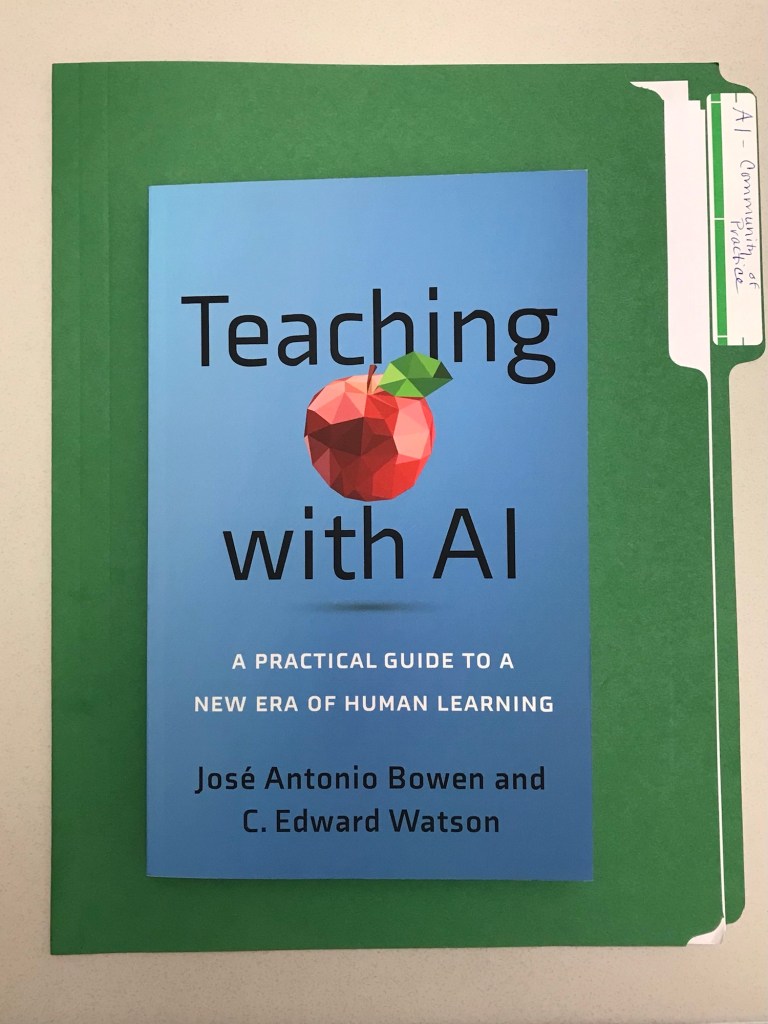
Teaching with AI

I recently joined a small group of faculty and administrators on campus that meets every two weeks to talk shop (research, theory, practice) on the topic of AI in higher education. Our official committee designation is “community of practice,” and we hope not only to learn how to use the new AI tools effectively ourselves but also to develop strong classroom practices for teaching and learning and to share those with the entire campus.

One of our first assignments starting out is to read this book. I just got it yesterday, so I haven’t started yet myself, just skimmed through the TOC and several pages at random, but one of my colleagues told me he was several chapters in and thought it was very good. So if you are a teacher and are looking for insights and practical applications for integrating AI into your own courses, this book should give you a great place to start.

I wasn’t even going to post about this “community of practice,” but I guess if I’m starting to talk about using generative AI in my own writing and exploring its possibilities in my students’ learning, it also makes sense to share some of the things I’m doing otherwise to learn about the new tools.

The main reason for today’s post, though, is so much more mundane. (So much more, well, “me”!😀) When I walked into my office this morning, my book and “community of practice” folder were lying on my desk where I’d left them yesterday. Those were the only items on my desk, and the colors jumped out at me as being really pretty together.

Don’t you agree? I loved the blue of the book’s cover and how the saturated Kelly green of the folder framed it so perfectly!

Not necessarily the most logical reason for me to make a book recommendation to you lol, but sometimes that’s how things work around here. I like sharing photos, and this one just happened to be a perfect combination of great colors and interesting info, so there you go!

Here are links to the book on Amazon and Barnes & Noble, in case you’d like to check it out. Even if you are not a teacher but are interested in learning how to use the technology for your own work, this is a very clearly written text with great information.

Amazon: https://www.amazon.com/Teaching-AI-Practical-Guide-Learning/dp/1421449226/ref=asc_df_1421449226

Barnes & Noble: https://www.barnesandnoble.com/w/teaching-with-ai-jos-antonio-bowen/1143977253

Posted in Creativity, Digital society, generative AI, Teaching, Writing, blogging | Tagged , , , , , | Leave a comment

Double Take

I don’t think my grocery store understands how sales are supposed to work 😂

Posted in Life, Uncategorized | Tagged , | 2 Comments

My election commentary on Swedish public television news

Because I teach political science at Milwaukee School of Engineering (MSOE), I was tapped us someone to interview this morning in connection with yesterday’s Presidential election in the U.S. I tag-teamed with one of my colleagues, Dr. Jeremy Kedziora, which made the experience a lot more fun and a lot less scary (LIVE TV!!!).

Although this interview was a live appearance, you can slide back the timeline on the video to watch a particular spot. My part begins at 1:08:48. I don’t know how long it will stay up, but I wanted to share.

Here’s the link: https://www.svt.se/nyheter/utrikes/senaste-nytt-om-valet-i-usa

Be sure to “accepter alles” on the cookies prompt.

UPDATE: Now that the broadcast is over, the “live feed” clip also appears to have disappeared. However, I was watching the show in my office first thing this morning to get a feel for what was happening in this broadcast before I went upstairs to the roof garden atop my building (the Grohmann Museum) for my 15 minutes of fame, and I discovered this afternoon that I had left my original tab open when I paused the feed to go get interviewed. The video was still there on that unrefreshed page, so I was able to play it after all and do a screen recording of our interview. I uploaded that 12-minute clip to my YouTube channel so I could share it with my family and colleagues, and I labeled it as “unlisted,” meaning it’s not exactly public but not completely private, either. If you have the link you can find it.

Here it is 🙂  (The audio goes out at the very end, so whatever BRILLIANT things I was saying at that point are lost forever, LOL)

Posted in Political Analysis | Tagged , , , , , | 3 Comments

More ChatGPT practice in my writing group exercises

The arrival of generative AI is bringing lots of changes to my job as a college professor. I teach some humanities and social science courses (film and media studies, political science, digital society, etc.), but I also teach quite a few courses that are centered around writing and editing (for example, composition, technical communication, presentations, writing for digital media, digital storytelling).

I can envision positive uses for generative AI in all of them. Students want to learn how to use this tool well, and more and more I have come to believe that my job as a teacher is to help them do that. Even as a writing teacher, I am bringing generative AI practice into the classroom as much as possible.

The future of writing instruction, in fact, will likely become far more about helping students develop discernment (to know whether a text is “good” in terms of aesthetics, form, content, and functionality) and advanced editing skills (the reshaping, molding, enhancing, and crafting of a text using multiple inputs) than it will be about having them generate words on the page in the first place. Even before ChatGPT, most writing teachers saw generation of text as merely the starting point, the rough draft. Sadly, students sometimes think they’re done at the rough draft stage, like they’ve exhausted the subject, and they find it extremely difficult to “revise” in any significant ways. Our job as teachers is to help them push past that and tackle the hard work of seriously redeveloping the draft into something more substantial, more refined (down to the essentials), more audience focused, more aligned with its purpose and intended function.

The best way for me to learn almost anything is to dive right in, get messy, put in lots of practice hours. And that’s what I’m doing with generative AI. Only by using it myself can I understand what the tool can and can’t do.

Which brings me to my writing group exercises. If you follow my blog, you already know that my writing group does short exercises to share each time we meet. We take turns coming up with prompts, and then all of us do our own responses to share when we get together. Several weeks ago as I was using ChatGPT to do some research for an academic project on a Friday afternoon, I got the idea to try prompting the generative AI to produce my writing group response. I’ve done it a couple more times since then and have been impressed with the results so far. Just for fun, in the immediate future anyway, I’m going to try using ChatGPT not only to craft my writing group responses but also to respond to each prompt in a way that utilizes the serendipity of “fate” (in the form of that prompt) to move my novel forward.

Logically, this is where I would tell you about my novel. But my novel is difficult to explain, far too complicated and confusing. Hopefully once it’s finished I can just as ChatGPT to produce a nice logline for me 🙂  I know my characters and the overall structure, but the novel has three main story arcs that, while thematically related, are quite separated from each other temporally and only minimally connected by geography and certain specific plot incidents. Suffice it to say that much of the action is set in the fictional Ohio River town of Adell Ferry. Part of the story happens in the 1930s, part of it happens in the early/mid-1970s, and part of it happens today. 

“Today” being somewhat fluid and indeterminate, as I started writing this novel literally almost thirty years ago, LOL. I’ve had to change out the technology a lot since I started (e.g., pay phones?) and long ago realized I’d better try to deemphasize the specifics of anything tech related as much as possible to avoid dating it too terribly.

Today’s writing group exercise is aimed at the 1930s section of the novel. I hope it’s not overkill, but I thought I’d show you all the various drafts (three in all) that ChatGPT came up with. Each draft has good things, but I liked the last one best. Probably what I’ll do is keep it as the foundation and then pull out additional items that I liked from the other drafts to insert throughout the text wherever they seem to fit.

Also, you may note that ChatGPT ignored some of the instructions I gave it, maybe because it couldn’t easily find any text out there online to scrape, so I’ll need to write up those parts myself if I want them in there. I’m showing all three drafts so you can also see the good parts as well as the clichés.

But the main thing I want to emphasize is that the final ChatGPT draft—which, again, is my favorite of the three—will not be MY final draft. My own final draft will incorporate not only bits of the other two ChatGPT attempts but also my own original text. 

So here it is. First, of course, the usual disclaimer: This is a work of fiction. Names, characters, businesses, places, events, locales, and incidents are either the products of the author’s imagination or used in a fictitious manner. Any resemblance to actual persons, living or dead, or actual events is purely coincidental.

And now, my exercise. I’ve included little markers to indicate my prompts and ChatGPT’s responses. 

Oh wait, I almost forgot! The prompt for this week’s writing group exercise was “It was the best of times, it was the worst of times.”

1)  My initial prompt:

Write a scene for a novel.

A big part of the scene is background information, woven together with Addy walking along a lightly wooded area on the bank of the Ohio River in summer 1936. Addy’s father became sick with a cough and progressive weakness and wasting. The farm became too much for him, plus the Depression is making farming difficult. He had always wanted adventure but got married, had Addy, took over his father’s farm. But now that he’s so sick, and it’s the Depression (it is summer of 1936), he wants adventure at last. Addy’s family is living on a shantyboat, has been for a couple of years. They stay up and down the Ohio River in summer, then move south along the Mississippi during winter. Addy’s schooling has been spotty, as a result. 

Write that first background scene framed by Addy, age 16, walking along the riverbank just south of a small town on the Ohio side of the Ohio River called Adell Ferry. She has been feeding their chickens on the riverbank. Her father picked it because its name was so similar to Addy’s (full name Adele). He didn’t realize the town’s name was pronounced ADD-uhl, like someone’s brains were “addled.” It’s a nice town and Addy has met some girls at the drugstore, where they were sitting at the soda fountain counter giggling over movie star magazines. Addy would like to stay and do her senior year of high school here.

Some background to show in flashback entries to this scene:

Many people who live on shantyboats are shifty, criminal. They steal. Addy’s father has always taken pains to introduce himself to the people whose homes are near where the family docks, to impress upon them that he and his family are upright citizens fallen on hard times and ill health.

Addy’s family keeps chickens. They are in cages on the shantyboat during the night but forage on the riverbank during the day

Include details of river life and shantyboat living in particular. Also mention the attitudes of townspeople toward shantyboat dwellers. Mention that the strip of land near the river was often considered “extra” for the farmers because they knew shantyboat people would steal it. Almost like an agreed upon deal that shantyboat people would harvest crops near the water.

Addy has been spending lots of time at the library in town. She can’t get a library card (no address) but the librarian has been kind. Addy stays in the library for hours several days a week. She reads in a small room at the back of the building filled with local reference materials. Small room but high ceilings and lots of light. High ceilings help with the heat. And the building is made of local limestone, so it retains the nighttime cool temperatures inside throughout the morning.

Addy has been reading A Tale of Two Cities. The librarian told her a secret place in the quiet, small local references room where she can hide the book and then pick it up again the next day.

Highlight Addy’s thoughts throughout this chapter scene about the first line in that novel. “It was the best of times, it was the worst of times.” In some ways, she realizes, this is true of her own life right now. Her father is happy but dying. Their family (father, mother, her) are closer than ever, but they are alone, cut off from all their relatives. With the exception of some kind people like the librarian, they are also viewed with suspicion and dislike because they are river rats. Addy has met many, many people and seen many wondrous things in the adventure of the last few years living on the Ohio and Mississippi Rivers, but she has no friends and is stuck on the water.

ChatGPT said:

Addy knelt in the shade of a thick-limbed maple, crumbling a handful of breadcrumbs between her fingers, scattering the crumbs for the chickens scratching and pecking at the brush along the riverbank. Their soft clucking, punctuated by the occasional squawk of a hungry hen, floated on the breeze, mingling with the lazy lap of the Ohio River. Summer hung in the air, thick and hot, and Addy could feel the damp warmth clinging to her as she straightened up, brushing dirt from her dress.

Adell Ferry, the name of the small town nearby, had amused her father. “Almost your name,” he’d said, his voice thin but bright with mischief as he’d explained it. “Adele and Adell—seems like it was meant for us.” Addy smiled faintly, though the irony was bittersweet. Her father hadn’t known the locals said it like “addled,” as if their minds had gone soft. She’d overheard the kids in town laughing at her family, calling them “river rats,” and it stung. Still, her father had insisted on pulling up their shantyboat here, calling it a good place to rest. A nice town with good people, he’d said. And sometimes, Addy believed him.

For the past few days, she’d taken to wandering up here on her own, after chores, after feeding the chickens. The river stretched out in both directions, as familiar to her as the scratchy wool blanket she’d had since she was a little girl. It was her home—at least, it had been for a while now. They’d been living on the water since her father took ill. A cough, a stubborn one, that had started slow but grown worse, until every breath sounded like it might tear him apart. Farming became too much for him, and when they couldn’t keep up, he sold the land. Then they built the shantyboat, and here they were, drifting with the seasons and the rivers.

Up and down the Ohio in the summer, south along the Mississippi in the winter. That was their pattern. Their chickens—her father’s pride, and, for her mother, a lifeline—were tethered to their own small cages each night, and she’d gotten used to the river mud and stray feathers that marked her days. It wasn’t the life she imagined, but she had seen things in these years on the river—sunsets that set the sky afire, islands where no one lived but deer and wild foxes, towns like Adell Ferry where life stopped every evening for pie and talk at the soda fountain.

Adell Ferry was quaint, full of friendly faces and busybodies, both of whom turned suspicious whenever a shantyboat came near. People like her father did their best to ease folks’ fears—he’d make a point to introduce himself wherever they moored, showing the neighbors they meant no harm. Most folks had grown up with shantyboats coming and going, the river a lifeline in hard times, though the Depression made it feel more crowded, the edges of the riverbanks lined with makeshift homes.

Despite her father’s coughing fits, despite her mother’s furrowed brows, this little town had something to offer Addy that felt close to hope: school. She’d gone inside the local high school once when she stopped by the library, imagining herself slipping into one of those desks, a real senior with real classes. The idea of finishing high school was thrilling, almost as thrilling as her afternoons in the limestone library, the building that felt cool and quiet and steady, like a fortress against the summer heat.

The library had become her safe haven, especially the tiny room at the back where the local history books were kept. The librarian, a kind woman with a soft voice and sharp eyes, knew Addy couldn’t check out books without an address, but she didn’t seem to mind when Addy lingered for hours, pouring over any book she could find. She was deep into A Tale of Two Cities now, keeping her place tucked away in a hidden nook the librarian had showed her.

“It was the best of times, it was the worst of times,” Addy murmured as she walked along the river’s edge, the opening line playing over in her mind. She’d read it dozens of times, and each time it felt heavier, deeper. It made sense to her. Her life felt split, just like that book. On one hand, she had her family, closer than they’d ever been, bonded by the water and their strange existence on a drifting house. On the other, she was alone, cut off from a future that seemed to drift farther out of reach with each passing mile down the river.

She thought of the girls she’d met at the soda fountain, crowded around a glossy magazine, giggling over some movie star or other, looking up only to smile politely at her. They were nice enough but clearly bewildered by her life, this “river rat” who knew the water better than the roads, whose family carried everything they owned on a shantyboat tethered to the land with nothing but hopes and a few chickens.

The river could feel like a prison sometimes, its endless roll hemming her in, keeping her separate from the ordinary lives of others. But her father—he was happy here, that was plain enough. She could see it in his face, in the way he seemed lighter somehow, despite the illness eating away at him. It was a chance at the adventure he’d never had, the one he’d traded away to raise a family and work the land. Now that life was nearly gone, he was finally doing what he’d always dreamed of, floating free and wild on the river.

Her family had seen so many wonders, but Addy wanted something else now. Not the endless journey, not the constant moving, but a place to settle, a chance to stay in one town long enough to make a friend, to finish high school, to know what it felt like to belong.


2)  I said:

Change the voice slightly. Don’t use words like “quaint.” Don’t use cliches to describe the small towns. Add in more details of Addy’s current activity. Talk about the sun on her face, the breeze off the wide, brown river. Talk about her favorite reddish brown chicken and its curious personality. Maybe add a conversational exchange with her mother about a missing chicken and the fact that Addy will be walking into town to the library soon.

ChatGPT said:

Addy squinted against the sun, shading her eyes with one hand as she watched the chickens scramble along the bank, their feathers ruffled up against the breeze blowing off the wide, brown river. The sunlight poured down, hot and steady, soaking into her skin, and she let herself feel it, standing there on the river’s edge, just south of the town with the funny name. Adell Ferry—close to her own, almost like her father had meant for them to end up here. Except he hadn’t known the locals pronounced it “Add-uhl,” like their brains were addled. The first time she’d heard it, Addy had nearly laughed, imagining her name as something strange and broken, the kind of word a mother might say with a frown.

But her father had wanted to stay, and she supposed she couldn’t blame him. There was something gentle here, in the way the river curved slowly past, in the sounds of the breeze and distant bird calls, in the low hum of insects that filled up the gaps between her thoughts.

She tossed another handful of crumbs onto the ground, watching her favorite hen—reddish brown with bright, alert eyes—pecking her way around the other chickens, strutting as if she owned the place. “You think you’re special, don’t you, Rosie?” Addy murmured, watching the hen dart forward, always a step quicker, always curious enough to dig under leaves and branches the other hens ignored. Rosie was a quick one, too, always seeming to sense when Addy was near and ready to steal scraps right from her hand. Addy could spend half an hour watching her scratch and flutter, her way of making a whole event out of a little crumb.

“Addy!” Her mother’s voice floated from the shantyboat a few yards off. It was patched with old boards, speckled with faded paint, the only home they’d known these last few years. “Addy, have you seen Nellie?”

Addy looked around, scanning the edge of the riverbank. “Probably hiding in the trees again, Ma. I’ll find her before I head into town.”

“Well, don’t leave without her! Can’t afford to lose another hen to a hawk.”

Addy gave a quick nod, making a mental note to keep her eyes open. They’d lost one chicken already the previous month, and with each one that went missing, her mother’s expression grew darker, her lips pressed thin. It was too easy to lose things when you lived on the water, where every day meant tying and untying, drifting away or finding your footing all over again. It seemed like every part of their lives was precarious, from the chickens to the makeshift garden her mother kept in old crates on deck.

With a final handful of crumbs scattered for Rosie and the others, Addy wiped her hands on her dress and took in the scene around her. The air was thick with summer warmth, the river’s scent—a mix of wet earth and waterlogged wood—seeming to rise up to meet her. Somewhere in the trees, cicadas droned on in waves, their sound mixing with the creak of the boat shifting in the breeze.

Today, she’d walk the half-mile stretch to town for a couple hours at the library. The thought made her smile a little. The librarian never asked too many questions about her, though she’d kindly offered a chair in the quiet, high-ceilinged room at the back, and even a place to tuck away her book, a thick, worn copy of A Tale of Two Cities. Addy had memorized that first line, reading it over and over. It was the best of times, it was the worst of times.

Addy thought about that line a lot as she walked along the river, her thoughts filled with the strange truth of it. Here was her family, closer than they’d ever been. But they were alone, cut off from everyone they’d known before the river. Her father, with his rough cough and the tired lines carved into his face, seemed almost lighter here, as if the water had given him some of his youth back. He’d wanted to drift, always talked about floating on the river like Huck Finn, even though he’d tied himself to a farm and a family instead. Now, even sick as he was, he seemed happy, looking out from their boat with something close to pride.

Addy wasn’t sure what she wanted. She’d met a few girls in town, their laughter bright as they huddled around a magazine at the soda fountain, whispering about movie stars and what dress they’d wear to the homecoming dance. She’d felt like an outsider, watching them, but they’d smiled, and a few of them had even waved her over to sit with them. Sitting at that counter, with the clang of dishes and the smell of syrup and coffee, Addy had felt an ache she couldn’t quite put words to.

Maybe, she thought, brushing her hair back as the wind picked up, it was the ache of wanting more than just a good view of the water, or the chance to see another new town when winter came and they headed south again. She wanted a place she could be known, maybe even finish her last year of high school. But those were big dreams, dreams that felt weightless in the heat of the afternoon. For now, she’d go find Nellie, then set her sights on the cool, quiet library waiting up the road.


3)  I said:

This is great. keep everything pretty much the same, but add in a bit more reflection on the best of times and the worst of times tension and ambivalence in Addy’s life. Emphasize the fact that she’ll turn 17 in a few weeks. She’s starting to think about her own future and how that will take her away from her parents and then they’ll be alone and she’ll be alone. But it can’t be helped. She has to find her place in the world, and it for sure isn’t living on the river like a hobo

ChatGPT said:

Addy squinted against the sun, shading her eyes with one hand as she watched the chickens scramble along the bank, their feathers ruffling up against the warm breeze rolling off the wide, brown river. She straightened up, feeling the sun settle heavy on her shoulders, its heat sinking into her skin as she dusted breadcrumbs off her fingers. She let herself stand still for a moment, breathing in the smell of river mud and sun-dried grasses.

In a few weeks, she’d be seventeen. The thought felt strange, stretching through her like an itch she couldn’t quite scratch. Seventeen should mean something, didn’t it? But here she was, floating from town to town on the water, her whole life tied to a makeshift boat and the banks of the Ohio River. Turning seventeen on a shantyboat wasn’t exactly what she’d imagined for herself.

Across the bank, Rosie, her favorite hen, strutted with her usual cocky little bounce, pecking the dirt with quick, sharp motions, already snatching up crumbs before the other hens even noticed. Rosie was a bossy, curious little thing. She was bold enough to eat straight from Addy’s hand, smart enough to figure out where the food was hidden, and a good bit faster than the rest of the flock. Addy grinned, watching her scratch around, tilting her head up at Addy as if expecting to be admired.

“Addy!” Her mother’s voice floated from the shantyboat, which sat bobbing gently a few yards off. Addy glanced over, taking in its patched boards and weather-worn sides, the battered little home her father had patched together for them, now their lifeline and their whole world.

“Yeah, Ma?” Addy called back.

“Have you seen Nellie? I don’t see her with the others.”

Addy scanned the riverbank, looking for any sign of the little gray hen. “She’s probably hiding in the trees again. I’ll find her before I go into town,” she called, hoping that would soothe her mother’s worry.

“Well, don’t leave without her! We can’t afford to lose another to a hawk.”

“I know, Ma,” Addy replied, though she felt a pang of frustration under her words. They’d lost a hen already, and she knew how much each loss stung her mother. But to Addy, it felt like just one more reminder of how fragile everything was. It seemed like they were always losing things—hens, bits of the boat, pieces of themselves—as if the river claimed a toll just for letting them stay.

With a final handful of crumbs tossed for Rosie and the others, Addy brushed her hands off on her skirt and took in the scene around her. The air was thick with summer heat, the river’s scent—a mix of wet soil and waterlogged wood—settling over her like a fog. Somewhere in the trees, cicadas buzzed in waves, their droning chorus filling the air, mixing with the low groan of their boat shifting with the current.

She knew she’d be heading to the library soon. There was something steady and cool in that limestone building, with its thick walls and high ceilings that trapped the morning’s chill. She loved the little reading room the librarian had shown her, the one filled with dusty history books, and that spot behind the shelf where she hid her novel. She was halfway through A Tale of Two Cities, reading it in stolen moments, pages at a time. It was the best of times, it was the worst of times. That line had caught her right away, and the more she read, the more it seemed to dig into her.

Best of times, worst of times—that was her life all right, all those opposites tangled up and pulling at her. Here she was, with her family closer than ever, practically living on top of one another, bound by sickness and hard times, by the river and the towns that watched them with wary eyes. She loved them, and they loved her—she knew that as sure as anything. And yet, in less than a month, she’d be seventeen, and she felt something hard and restless growing inside her, something that made her stomach twist when she thought about staying on this shantyboat forever.

Her father seemed happy enough here, as though this life was the adventure he’d never quite gotten to have. She saw it sometimes in the way he looked out over the water, coughing but content, with that dreamy look of his, as if he were floating beyond the river itself. Her mother…well, Addy could tell her mother wasn’t thrilled about the river life. But she’d stayed for him, for all of them, and made the shantyboat into some kind of home.

Addy loved her parents, but she couldn’t imagine herself here a year from now, or even six months. She didn’t want to turn seventeen with her whole future drifting in circles on the river, living like a hobo, mooring near towns that kept their distance or looked down on her. She wanted a place that was hers, a chance to finish school, to make something of herself that was more than just the “river rat” everyone saw.

The ache of it hit her hard sometimes, especially after a day like yesterday, sitting at the soda fountain with the girls in town. They’d smiled, welcomed her, even laughed at some of her jokes, but she could feel it—the strangeness in the way they watched her, their half-hidden glances at her patched clothes, her river-weathered hands. They’d been polite, but they didn’t know her. They’d never understand what it was like to sleep on a floating floor, to wake up wondering if the river might carry you away one night if you didn’t tie your rope tight enough.

She couldn’t be sure where she belonged, but she was starting to know for certain where she didn’t. And in the quiet hours when she sat reading, letting herself get lost in A Tale of Two Cities, she felt the pull of it even stronger. She knew the risk—leaving her parents behind, knowing they’d be alone, just the two of them and the chickens, drifting through the seasons without her. And she’d be alone, too, starting out somewhere new without her family to fall back on. It wasn’t a thought that sat easy in her chest.

But it couldn’t be helped. She had to find her place in the world, and it wasn’t on the river. That was just the way of things, she thought, glancing down at Rosie pecking her way through the underbrush. Every creature eventually left the nest—or, in her case, the shantyboat—and when her time came, she’d go, because that was what seventeen meant. She’d find Nellie soon, get herself into town, and let the pages of her book carry her to some other life, just for a little while.

A FINAL NOTE: I got tears in my eyes when I read this last paragraph at writing group. ChatGPT came up with the “leaving the nest” connection with the chickens, and I loved it. Plus the phrasing of  that whole sentence, including “when her time came, she’d go, because that was what seventeen meant.” I mean, just beautiful, right?

Posted in Creativity, Higher education, Teaching, Technology, WPLongform (posts of 1000 words or longer), writing exercises, Writing, blogging | Tagged , , , , , , | 6 Comments