This probably did not need to be a separate post, but as these colors aren’t GREEN, they would have messed up my green-themed post from two days ago😂
I mentioned in that post that the Marcus Performing Arts Center changes color. I probably didn’t specify that the colors change like every 10-15 minutes, it seems. The lights will be one color while I’m walking to my parking garage after work, and then by the time I’m in my car, leaving the garage, the lights are a different color entirely.
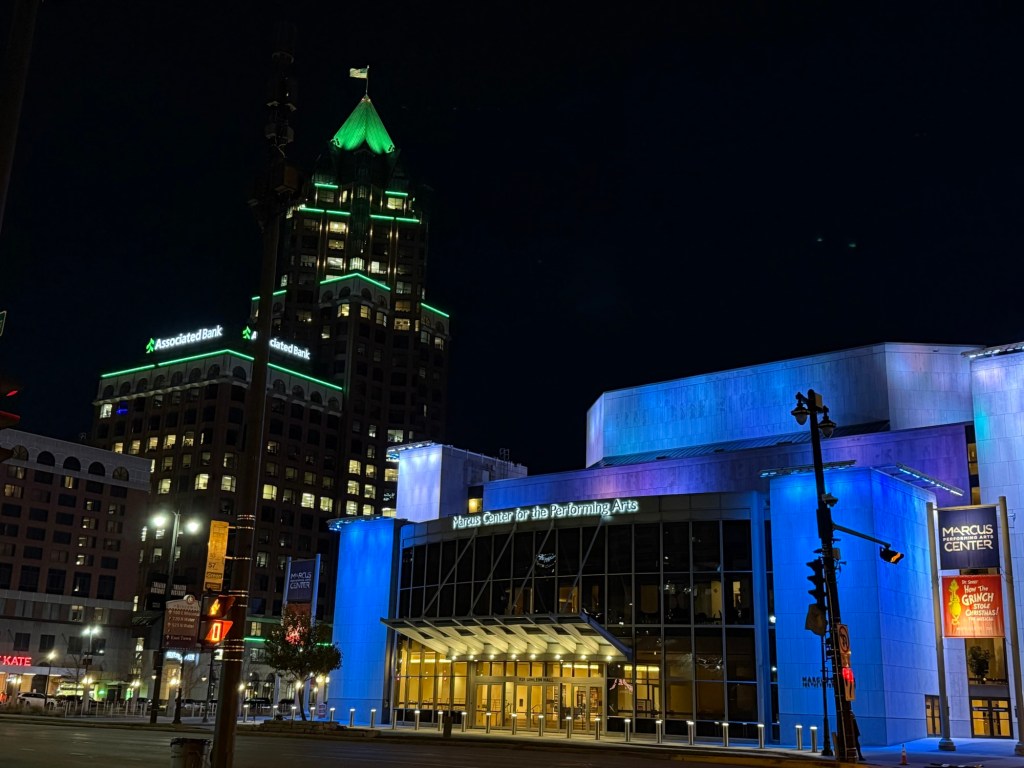
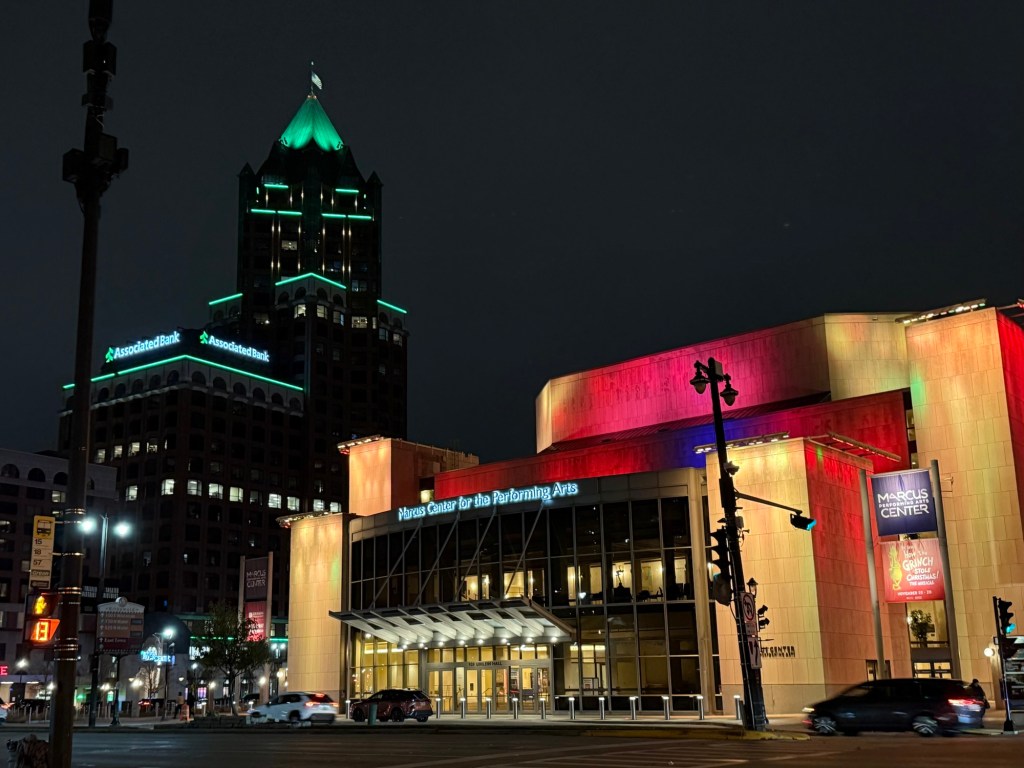
Anyway, here are two more lighting combinations. The changes in color are achieved with lighting that is thrown onto the building from attached fixtures.
I guess this one (above) is purple, but at the time I took the picture, I was thinking of it as blue. So maybe they have another one that’s lighter and more purpleish.
I took the picture below when  I was coming home last night (yes, sadly, I was working in my office on a Saturday; never believe those fairytales that professors don’t work hard). This time I noticed it was the yellow and red, which I hadn’t seen in a while, so I thought I’d take a picture and add that to my little collection, as well.
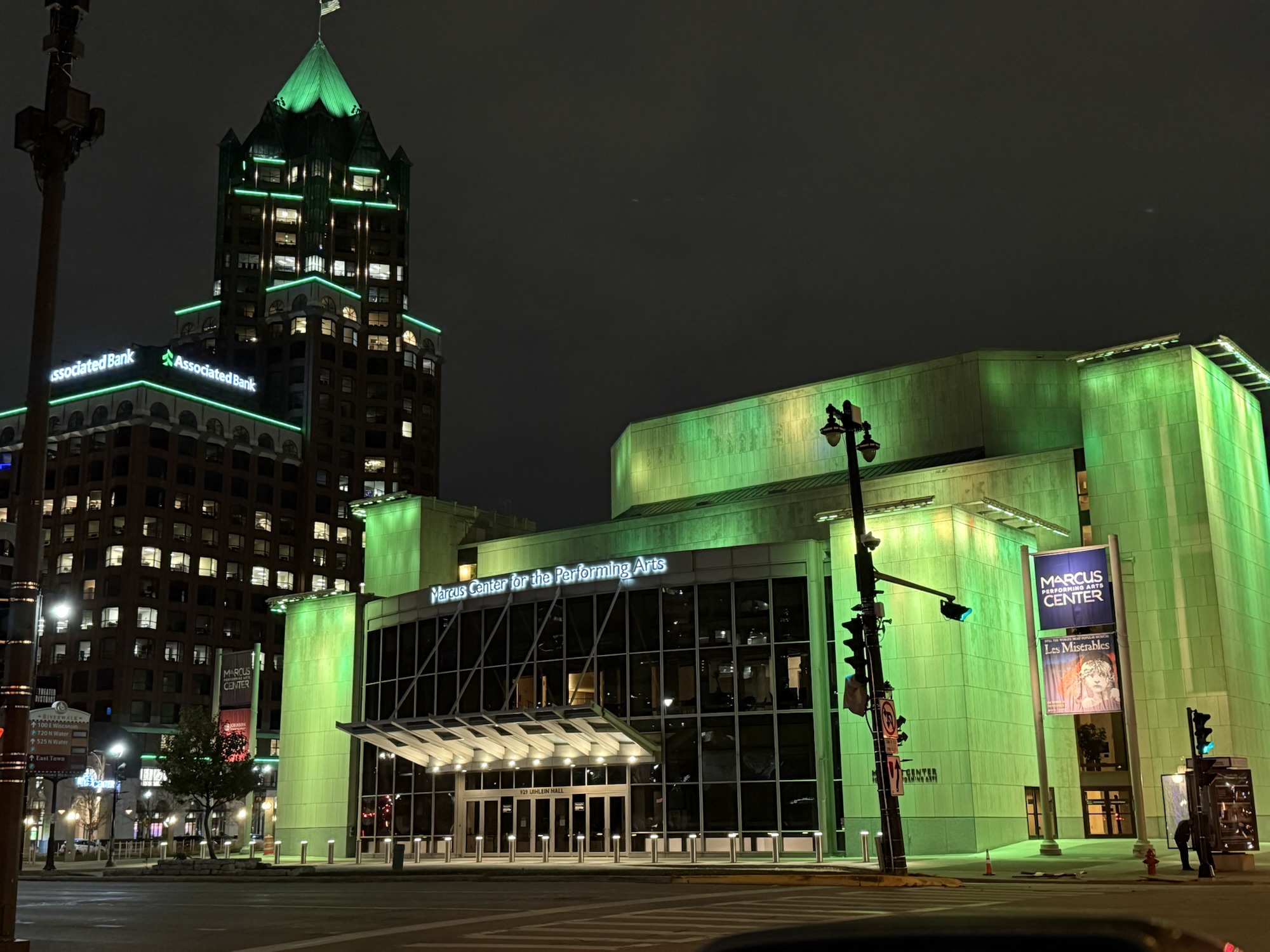
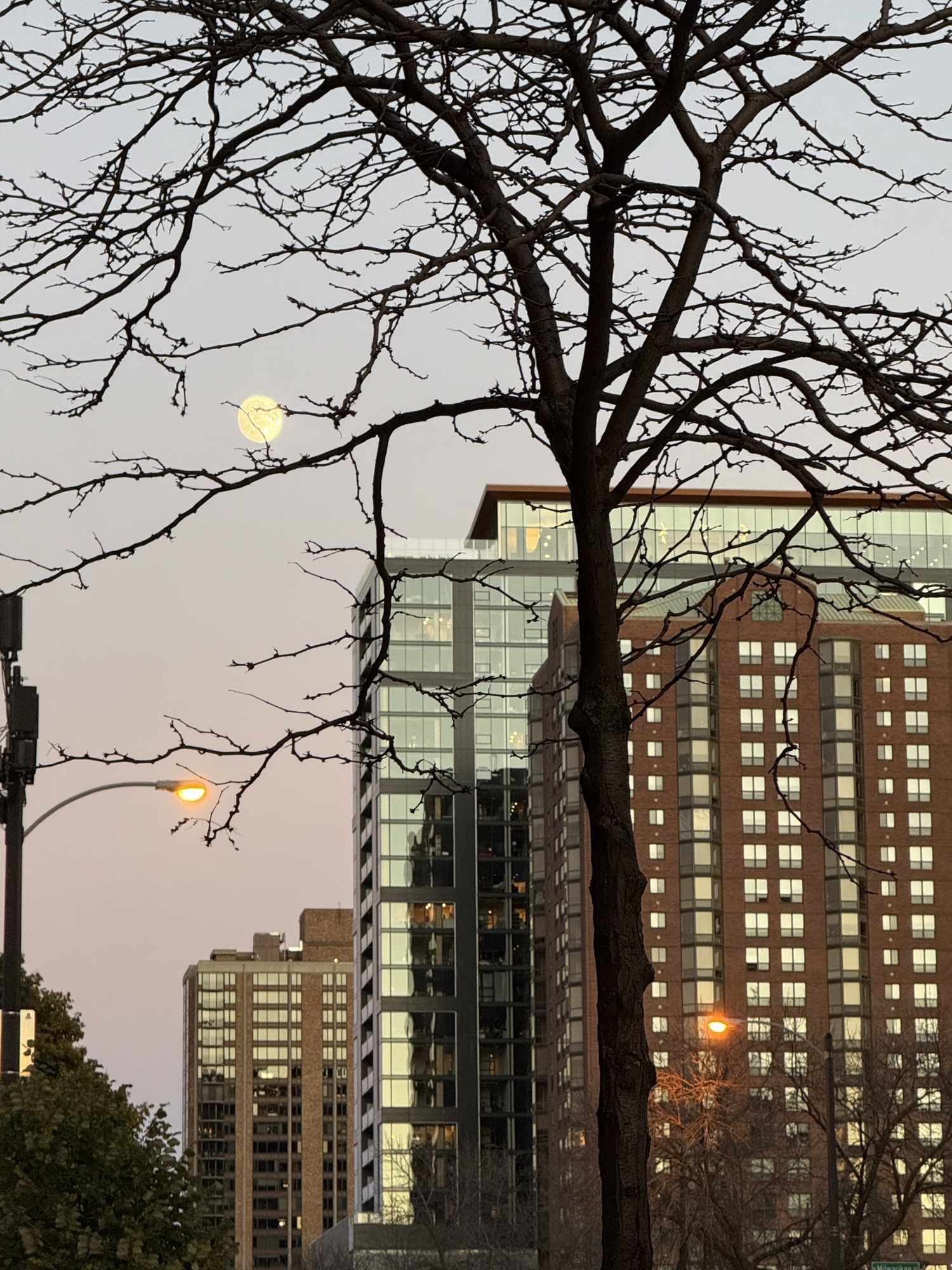
I took this photo Tuesday evening, around 8 PM. The streets were quiet and the buildings were washed in the same green light—two neighbors, one devoted to finance, the other to performance.
On the left (taller of the two) is the Associated Bank River Center; on the right is the Marcus Performing Arts Center, which I still call the PAC, as it was known prior to 1994, when the Marcus Corporation (local entertainment/hospitality juggernaught) made a sizable donation in honor of its founder, Ben Marcus—hence the name that’s stuck ever since.
The performing arts center shimmers with shifting hues at night—bathed in red and orange one minute, light and dark shades of blue the next—while the bank traces its rooflines in steady neon green. Most of the time, anyway. Check out the glimmering, flickering white lights from last night. Don’t know what that was about; never seen it before.
That shade of green in my Tuesday night photo can mean so many things—growth and renewal, envy and money, permission to go. I thought about titling this post “The Green Light,” something Gatsbyesque, but it didn’t really seem to fit. There’s something sad and pathetic about Gatsby’s longing gazes across the bay toward that green light at the end of Daisy’s dock. I mean it works in the novel, but still, it’s sad and pathetic. (EDITORIAL COMMENTARY: Don’t waste your life on a dream that was never worthy of you anyway!)
Mostly, I just liked the colors in the photo. As I mentioned, the PAC lighting is constantly shifting palettes, and only some of its shades really hit for me. There’s a purple-lavender combination I love, and I often like the blues you see in the video. But as you can also see in the video with the flashing white lights, the PAC’s changing tones really need the complementary green lines of the bank building to achieve their full impact.
That’s why, when I saw those “Emerald City” greens earlier this week, especially set against the darkness like gems nestled in a jewelry box lined with black velvet, I felt compelled to capture the image. The colors seemed almost too alive in their intensity, calling to mind cinema’s associations with the supernatural—as if the city were dreaming in the language of ghosts, its memories flickering green against the dark.
[UPDATE — That last sentence is so super dramatic that I almost expect it to be followed by: “And so we beat on, boats against the current,” etc. 😂]
I am SUPER BUSY at work right now, working crazy long hours and racing from one project deadline to the next. That’s what’s so funny about the current state of my phone’s camera roll: It is brimming with new photos taken this week and last.
I can hardly think straight, but everywhere I go, I see potential photographs—things I need to whip out my phone and take a picture of PRONTO! It’s like one part of my brain is exhausted, so another part of my brain is stepping up?
Anyway, it looks like my blog posts are going to be a bit photo heavy into the foreseeable future 🙂
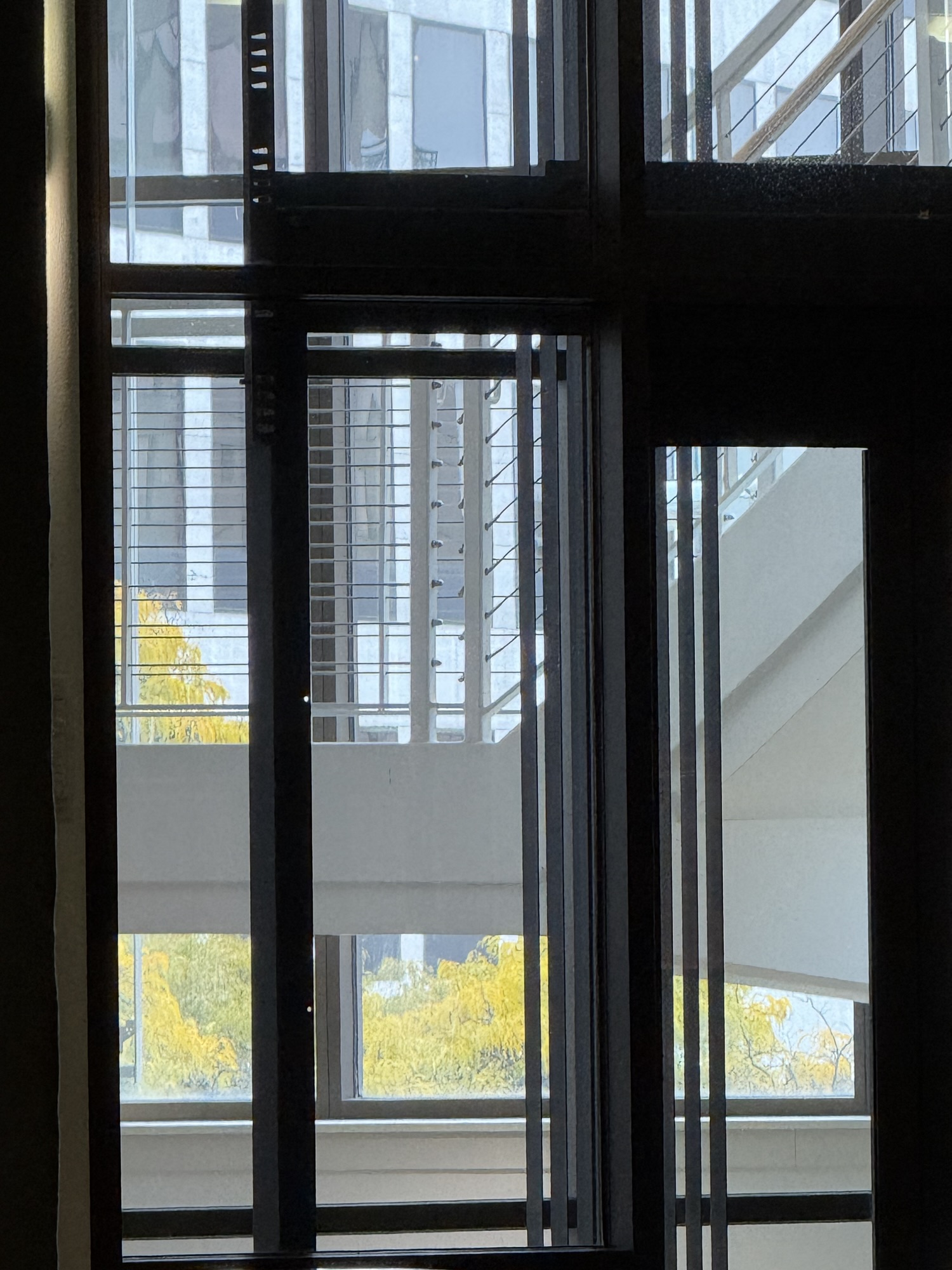
The image below is from today. It’s a view through the elevator shaft in the glass atrium of the Grohmann Museum, the building I work in. I was coming back to my office from getting water for my coffee maker (super busy = lots of coffee) when I happened to glance over across the gallery and noticed all the cool lines of varying angles and thickness.
Reminds me a little of Mondrian’s work and also the work of Edward Lewandowski, a Milwaukee precisionist artist I’ve only lately discovered, whose paintings of the Edmund Fitzgerald are featured in the Grohmann Museum’s special exhibition marking fifty years since that ship’s sinking.
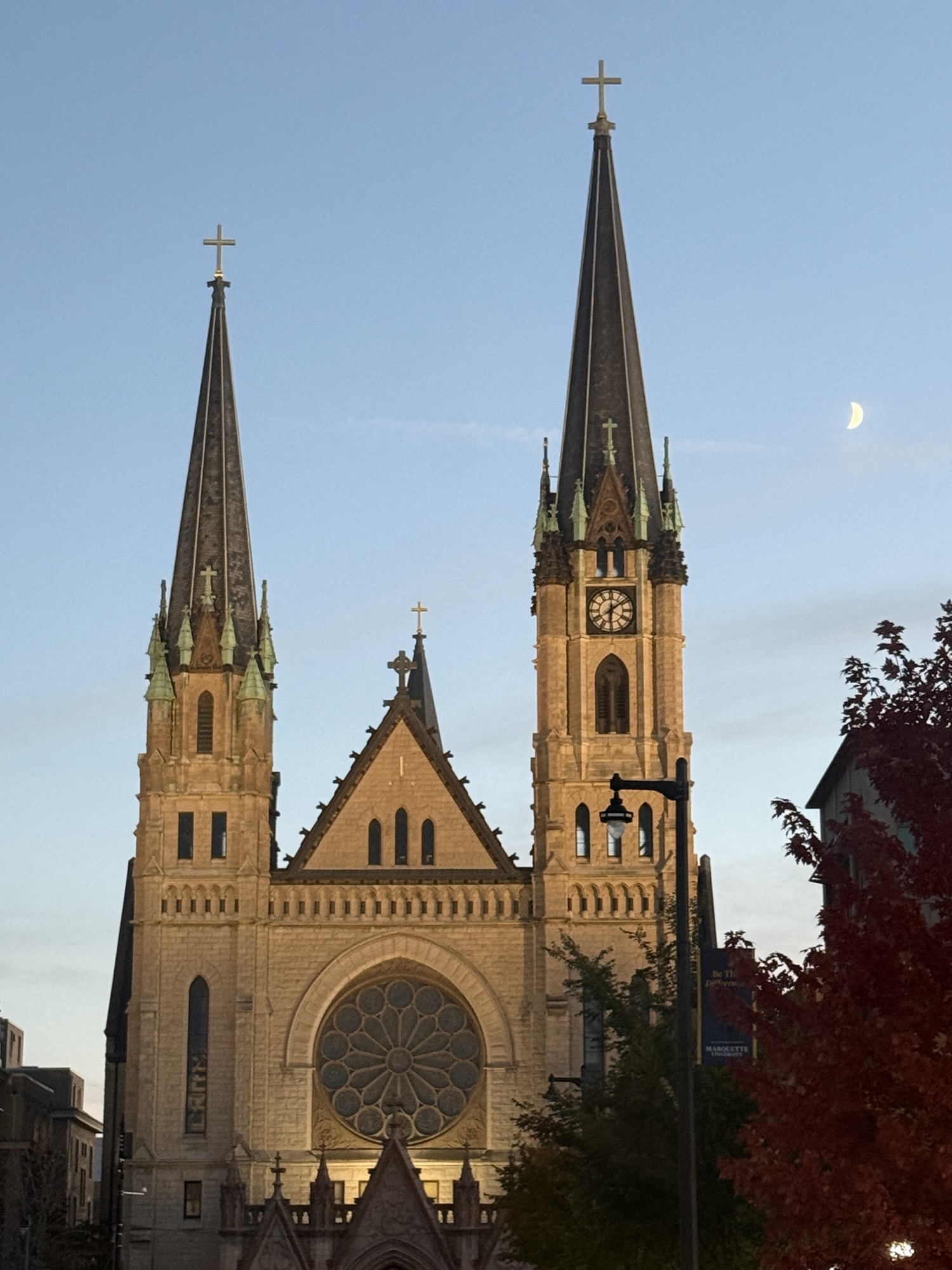
Took this photo in the early evening on Monday of this week. Church of the Gesu (is on the campus of Marquette University, on Wisconsin Avenue at 12 Street, in downtown Milwaukee. (By the way, Gesu is pronounced JAY ZOO, in case you were wondering😀)
A beautiful and rather large, imposing church, but with an oddly reassuring presence as it looms over the intersection above students walking to and from their classes.
I drive by this church pretty often, but it was the moon that caught my eye Monday evening and turned the moment into a photograph 🙂
These slender, feathery grasses are part of the landscaping at Milwaukee School of Engineering, where I teach. I walk past these plants several times a week, but I don’t think I’ve ever noticed them quite as much as I did earlier today. Maybe the lighting? It was an overcast day, and maybe that subdued light (as opposed to bright sun) allowed the plumed, silvery tips to shine.
In any case, they caught my eye today on my way back from teaching my 11:00 class, and I thought you might enjoy them, too. Not quite my usual style (curved lines instead of straight, geometric lines), but then again, the somewhat abstract pattern of repeating curves feels a bit Art Deco, so maybe it’s not so very different after all!😀
In honor of the occasion, I want to share a quick memory. I don’t know why—because, really, who cares what “National Taco Day” makes me remember? But that’s the great thing about having a blog, you know? Having the ability to inflict my musings on the world at large anytime I feel like it, lol.
But FYI, and for whatever it’s worth: I happen to know that the first Taco Bell restaurant ever to open up east of the Mississippi River was located at 2100 E. Main Street in Springfield, Ohio, and began operating in 1968. How do I know this (and now you do, too!)?
My grandmother, who spent much of her childhood in New Mexico, lived in Springfield for much of her adult life and ate at that Taco Bell every day for lunch. Sometimes if she had us kids with her, for whatever reason, she would treat us to lunch at Taco Bell, too.
I loved going there. Grandma was friends with the owner, Jim Lopez, and he seemed to be working in the restaurant himself every time we went. That’s kind of amazing when you think about it from today’s perspective: The owner worked in his restaurant, side by side with his employees—making the food, greeting the customers, and keeping the place clean (tables, seats, floors wiped down).
And the food was AMAZING! I don’t think that’s just the fondness of nostalgia speaking.
My favorite item on the menu was the “enchirito,” which as the name implies was a cross between an enchilada and a burrito. My second favorite (and my grandmother’s favorite) was the “spicy burrito,” which was wrapped in a flour tortilla and contained beans, cheese, possibly onions, and a green sauce. It was fabulous, and apparently it may be available right now (at least at one Chicago-area Taco Bell) as some kind of retro/throwback (see the Taco Bell website HERE).
In the process of just now discovering that Taco Bell has reintroduced the green burrito as part of its “Decades” promotion, at least for a limited time, I also found that the enchirito was similarly reintroduced briefly a couple years ago, but is no longer available (tragic, and the story of my life: finding things out TOO LATE!).
So back to that first Taco Bell in Springfield, Ohio. I’m sure it didn’t take long for other Taco Bells to open up east of the Mississippi after the success of that first restaurant. But for a while, it was the only Mexican restaurant around. Most people had never even heard of tacos. My junior high social studies teacher, during our study of Mexico, called frijoles “FRIJ-i-joles.” Not sure I conveyed his pronunciation well enough. He said the word “fridge,” followed by the short “i” sound, followed by “joles” (rhymes with moles). So almost zero familiarity with Mexican food at that time in the Midwest.
Yet, thanks to Grandma and that first-east-of-the-Mississippi Taco Bell, we knew all about burritos and frijoles and tostadas.
So what?
Well, life experiences are funny that way. Do you remember the movie Slumdog Millionaire? The plot centers around a young man who is advancing to increasingly higher levels on the quiz show and is accused of cheating because he knows the answers to questions that someone of his background would not be expected to know. Most of the film comprises scenes from his background that not only explain how he acquired his knowledge of each item but also tell the story of his life through each of these hard-acquired “lessons.”
I’ve come by a lot of my knowledge of the world in odd ways from strange sources, as well. Part of the fun in noting trivial things like “National Taco Day,” for me, is the associations they trigger. Part of who I am was formed at that Taco Bell.
It made an impression on me that when Grandma walked into that restaurant, the owner greeted her by name. It made a similar impression that I knew the correct pronunciation of words that my social studies teacher mangled in front of the class.
I wrote about a scene in the movie Working Girl several weeks ago in a post about connection-making and a new engineering/science fabrication technique (“Bloom Patterns“) inspired by a student’s love for origami. The particular scene I described was the one in which Tess thwarts her boss’s attempt to steal credit for her business idea by explaining how she conceived of it in the first place by putting together elements from wildly different sources. With her night school college education and her job as a secretary, Tess has been condescended to by bosses and managers throughout the film.
But Tess is smart. When she suggests serving dim sum dumplings at a work function and mentions that she’s been reading about them in W (a fashion magazine), a snooty colleague of her boss sneers, “You read W?”—the implication being that Tess, a Staten Island girl with the accent to prove it and a wardrobe to match, couldn’t possibly be reading an “in”-crowd publication like W.
Tess keeps her cool, though. Her response (and the setup for her later moment of triumph at the film’s climax) is blunt and simple:
I read a lot of things. I mean, you never know where the big ideas could come from. You know?
This is the way things work in my life—and probably yours, too. You never know where the big ideas could come from. Nothing is truly trivial. Every little factoid is a piece of the bigger puzzle. As Steve Jobs said in his famous Stanford University commencement address in 2005:
[Y]ou can’t connect the dots looking forward; you can only connect them looking backwards. So you have to trust that the dots will somehow connect in your future. You have to trust in something—your gut, destiny, life, karma, whatever. This approach has never let me down, and it has made all the difference in my life.
So, happy National Taco Day to you! Today happens to be Taco Tuesday, as well. Let’s all go out there and engage with the important things in life. No one knows what they are yet, so just be open to everything 🙂
On Friday I posted my comparison of Public AI’s attempt at writing an autumn poem versus ChatGPT’s—a head-to-head challenge that ChatGPT won handily. Then to illustrate my post, I asked ChatGPT to create a quick, simple image of pumpkins for me.
At least I thought it would be quick and simple. In the event, it was not. Although I was frustrated because I had to wrap up that blogpost quickly and get back to work, it was actually really funny to watch ChatGPT get it wrong over and over. Kind of like watching our dog suddenly (and stubbornly) fail to comprehend simple commands that I know she understands but is pretending not to know because she doesn’t want to do what I’m telling her to.
So here is the chat of those image fails, along with the resulting images.
I said:
Can you produce an image to go along with this poem? Something featuring pumpkins and scattered fallen, colorful leaves. Thank you!
ChatGPT said:
First try for a ChatGPT pumpkin image
I said:
Can I revise? Can you make this an image of multiple pumpkins sitting on the steps leading up to a porch, maybe some on the porch, too, with fallen, colorful leaves scattered about. Thank you!
ChatGPT said:
I said:
Beautiful! But too many pumpkins. Let’s keep two on the porch and just have one on each step. All pumpkins should be enough to the side of the pathway up that people can actually walk up and down the steps and onto the porch. Can you revise? Thank you!
ChatGPT said:
I said:
I’m sorry! I’m not being clear enough. Let’s keep the basic steps and porch here. I want three pumpkins: one on each step, set far to the side so that people can still walk up to the porch without tripping over pumpkins. Keep the fallen leaves; that part of the image looks great. Thank you for trying again!
ChatGPT said:
[Note/Aside: If you look carefully, you’ll see that ChatGPT created an entirely new, nearly identical wrong image. The two pumpkins are slightly different, and if you look at the leaves on the bottom step to the left of that pumpkin, for example, you’ll see three leaves to the left of the pumpkin in the first image and four to the left and immediately below, two of which are very small, in the second image.]
I said:
How about let’s try this: ONE large pumpkin, sitting on the porch next to the pillar. Thank you 🙂
ChatGPT said:
At which point I just laughed, threw up my hands in surrender, and went with the first image (non-porch) just to get the post illustrated and published. AI’s logical judgment clearly isn’t all there quite yet. ChatGPT can put any number of pumpkins you’d like on a front porch, but it apparently can only do so in a way that will obstruct people’s ability to walk up and down the steps!
I love the idea of the Swiss AI Initiative’s Apertus and Public AI. As sort of the Linux of LLMs, Apertus, via the Public AI Initiative, aspires to democratize generative AI:
Public AI refers to the development, deployment, and maintenance of artificial intelligence (AI) systems that are open, transparent, and accessible to all members of society. It’s about creating AI technology that benefits the public good, is accountable, fair, and respectful of human rights and ethical standards.
Unlike proprietary AI systems that are controlled by a few powerful entities, public AI initiatives aim to democratize AI by allowing its development, dissemination, and control to be shared among various public and private actors, including governments, research institutions, civil society organizations, and the wider public.
Released just a month ago (September 2), Apertus is something I learned of only just today. And because I appreciate the general philosophy behind it, I thought I’d give the Public AI chat a test drive.
I’ve been using ChatGPT for creative writing exercises lately (over the past year), so naturally the first thing I thought of was to give a quick poetry prompt to Public AI and see what it was able to do with it.
UGH, terrible!
So I turned around and submitted an identical prompt to ChatGPT.
And OH MY GOD!!!
ChatGPT won.
Hands down, decisive victory, not even close.
I copied and pasted both of my attempts into a single document and created a PDF. If you’re interested in seeing the head-to-head comparison of these two AIs, take a look. It’s like reading the work of a fourth grader steeped in the archaic style of poetry from 100+ years ago versus reading a rough draft produced by a decently talented adult who reads contemporary literature.
Link to PDF with both of my chats and resulting poems HERE.
First try for a ChatGPT image of pumpkins
(P.S. – Although I need to get back to work now, you might find it amusing to read about the many ChatGPT image-generation FAILS that I went through in an effort to illustrate this post. The image above was the first one out of the gate. Okay, but upon reflection was not what I wanted. Tried again and again, but ChatGPT kept getting it comically wrong. I’ll share in a post tomorrow 🙂 )
Well. I’ve never cried in a museum before, but the Edmund Fitzgerald exhibition at the Grohmann Museum had me in tears yesterday afternoon.
I was making my way through the special exhibit’s gallery, looking at photographs and paintings of the doomed ship, which sank 50 years ago (November 10,1975), when I unexpectedly heard the opening notes of Gordon Lightfoot’s song.
In the far corner is a screen that loops both the song (with video of the ship) and a video-recorded interview with Captain Bernie Cooper of the Arthur M. Anderson, another ship that was 10 miles behind the Fitzgerald out on Lake Superior that night. Cooper was in radio contact with the Edmund Fitzgerald’s captain right up until the time the other ship disappeared from radar. In the video Cooper speculates that the Fitzgerald must have gone down fast, too fast to issue a mayday. Despite the dangerous weather, the Arthur M. Anderson went back out on the lake that night, even after they’d already made it safely to port, to search for survivors.
I don’t know, I’ve heard that song for close to 50 years now, but it never affected me the way it did yesterday, especially watching video of rough seas breaking over the ship while Captain Cooper talked about the two most likely scenarios he could envision behind the ship’s sinking and seeing the photos of the men who died, along with their names, ages, and home cities—all while surrounded by photos, paintings, and models of the Fitzgerald and the Arthur M. Anderson.










 Katherine Wikoff
