This morning, I noticed that a blog post I wrote 11 years ago was getting lots of views, and traffic seemed to be coming from both Reddit and Bluesky. So I did some quick digging and found that, for whatever reasons that are still not entirely clear to me, a discussion on F. Scott Fitzgerald”s contribution to the sport was trending on Bluesky, and from there people must’ve been going over to Reddit discussions and then linking over to my blog post.
Anyway, I updated that post to include new links to the source material, and it occurred to me that I ought to share with you so you can be up on the latest discussions, too! 😀
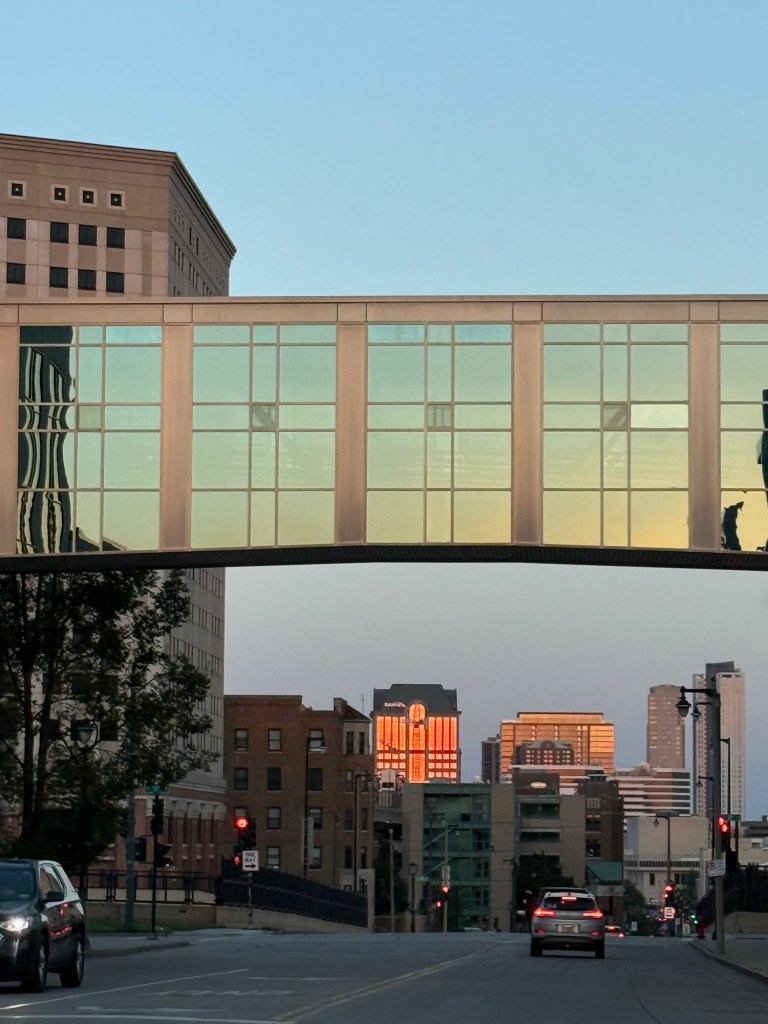
Heading east on State Street, stopped at the traffic light at 12th Street. I love the way the sun reflects off the glass of the Aurora Sinai hospital skywalk and, farther east, slightly left of center, the 1000 North Water Street office tower, and even farther east, some other new apartment building that I should know the name of but don’t. Whatever it is, it’s even closer to Lake Michigan than the Yankee Hill Apartments, which are several blocks east of the 1000 North Water Street building and are the skinny brick building in the distance that’s far beyond the parking garage in the foreground but right in front of the taller (no name) building’s shiny, gold reflection.
Whew, that was a long sentence and probably way more description than you actually needed or wanted. So maybe just ignore all that and enjoy tonight’s sunset on me! 😀
I’m teaching two sections of the freshman composition class at MSOE, and among the things we cover in this course are how to “read” art as a “text” and how to talk about any work of art. We spend about three weeks learning art concepts, we visit the Grohmann Museum and do some formal analysis of a couple paintings and sculptures, and then students take a class period to wander around the museum on their own and select an artwork to analyze and present to the class (in five minutes, very informal).
Today was our first day of focusing on art in our class (as opposed to writing, rhetoric, and composition). We have a whole list of terms and concepts (like color, lighting, lines, shapes, perspective, composition, etc.), so I go term by term, showing examples of the various concepts and discussing them.
When I reached the point of talking about mediums/media and materials used in creating a work of art in today’s lecture, I suddenly thought of Portrait of a Textile Worker, a large quilt created by Milwaukee native Terese Agnew that is part of the Museum of Arts and Design’s permanent collection. The “portrait” of this woman sewing in a factory among other garment workers was created entirely from clothing labels. Agnew needed thousands of labels in order to have the broad palette of colors and tones needed to “paint” her picture. People spread the word of Agnew’s project, went into their closets to cut labels out of their clothes, and the raw materials for this quilt poured in from around the world.
Although I remembered the quilt and the garment worker’s image earlier today, I couldn’t immediately recall Agnew’s name. But I did remember the spectacular dragon she created and installed in the mid-1980s on the North Point Water Tower (a fabulous Gothic-looking structure similar to Chicago’s water tower that famously survived the Great Chicago Fire in 1871), so I just Googled that and found this fun article.
Like Portrait of a Textile Worker, the 1985 Milwaukee water-tower dragon project was a collaborative effort. This is something I always found fascinating about Agnew. Even very, very early in her career, when she was only about 25 years old, she seemed to understand the power of partnership. With every city hearing that she had to present at to win approval for moving forward, word began spread about her dragon project (basically, she looked at this medieval-castle-looking tower one day and thought: wouldn’t it be great to have a dragon perched up there?). In the end, she had a large(ish) crew of people helping her hoist the massive sculpture up there and get it securely installed. Although it apparently remained on the tower for a mere five days, I can still vividly remember seeing it and thinking it was fabulous.
With Portrait of a Textile Worker, created about 20 years after the dragon project, not only did Agnew have people sending her the raw materials she needed to construct the quilt, but she also, and possibly as a consequence, then had a huge base of supporters who were willing to help raise the necessary funds and otherwise contribute to the effort to get a museum to purchase and display this artwork.
It’s ironic. We have this collective mental picture in our heads of artists and writers as individual geniuses, the lone poet or painter toiling away in an unheated garret apartment (a romantic image, perhaps, but no doubt uncomfortable).
The reality, in my experience, is usually the exact opposite.
Successful artists and writers are often more like project managers. They do the creative work, of course, but they also collaborate with others along the way and take the lead on tedious but necessary things like moving a project through the process of getting approvals from, say, the Historic Preservation Committee, the Milwaukee Arts Commission, the water tower landmark trust, the entire Common Council, the Milwaukee County engineers, and the mayor—all of which Agnew had to do for her dragon back in 1985. They don’t wait for inspiration; they have deadlines and multiple irons in the fire.
If you happen to be in San Francisco in the next couple of days, you might want to check out the final weekend of this temporary exhibit at the Exploratorium museum, running through Sunday (Sept. 14) at Pier 15 on the waterfront. Sponsored by Anthropic (makers of Claude), the exhibit explains how AI works (in a fun, clear way 🙂 ), provides some hands-on opportunities to try it out, and also highlights some of the social and environmental dangers by bringing guests into “physical” contact with them via immersive activities.
First, I was on 10th Street just west of the Wisconsin Club, housed in the 1843 mansion built by Alexander Mitchell, founder of the Marine Bank and president of the Chicago, Milwaukee and St. Paul Railway, later known as the Milwaukee Road, a major Midwestern transportation force for many years, plus grandfather of Billy Mitchell, who commanded all air combat units in France during World War I, who had a primary part in creating the United States Air Force, and for whom Milwaukee’s Mitchell Internation Airport is named.
Aside: Another interesting FYI about Billy Mitchell is that he’s buried in Milwaukee’s well-known Forest Home Cemetery, which is not only a beautiful and unusual place somewhat reminiscent of the Père Lachaise Cemetery in Paris but is similarly also the final resting place of many (local) luminaries. (The Père Lachaise is home to the graves of many world-renowned figures like Balzac, Chopin, Fourier, Colette, and, of course, Jim Morrison 🙂 ).
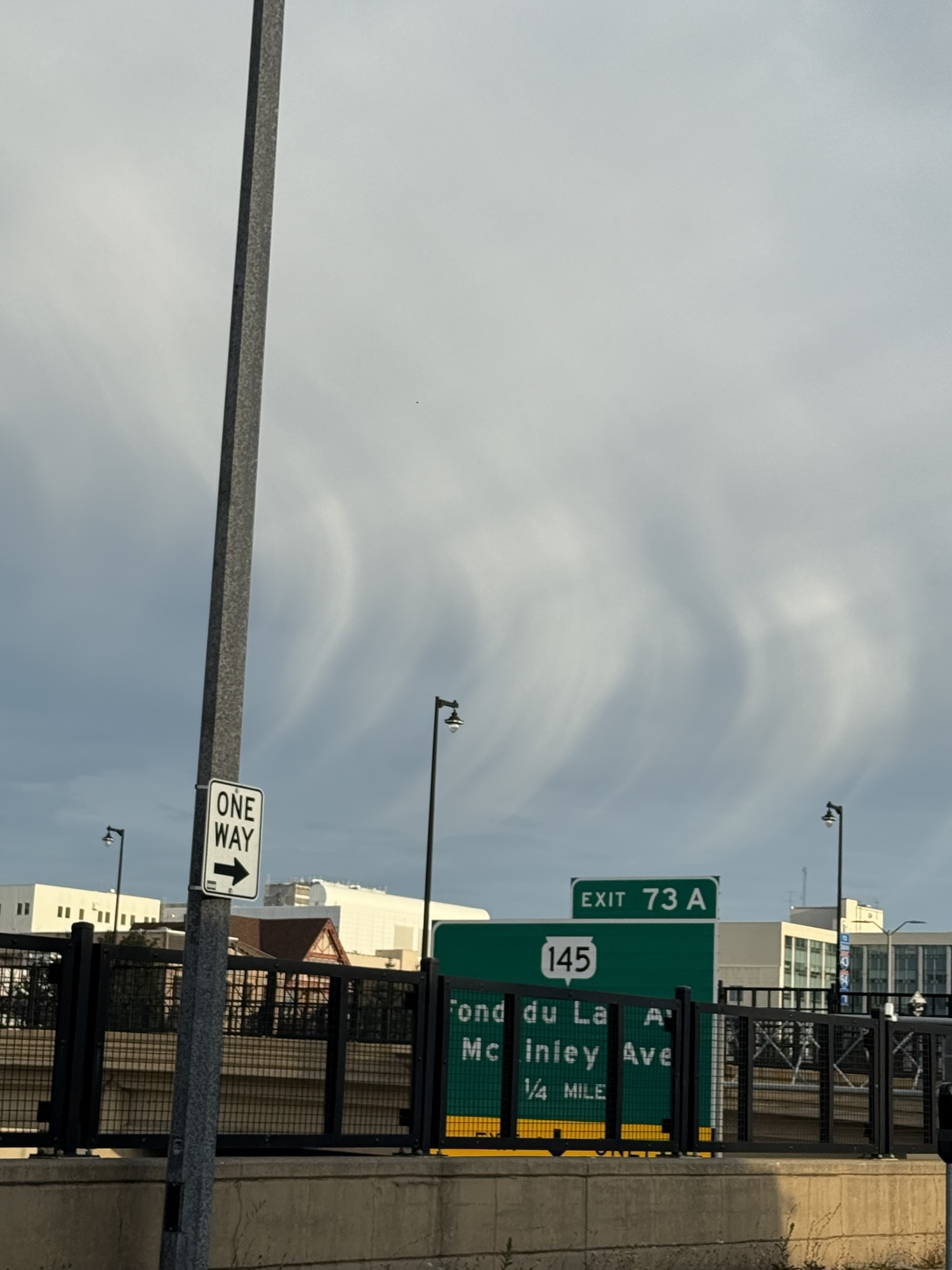
But anyway, I was headed north on 10th Street, stopped for a traffic light just west of the Wisconsin Club and just east of (and above) the freeway, when I glanced slightly left and noticed these comma-shaped, spiral-looped clouds.
Aren’t they cool? I’ve never seen clouds look like that. I don’t know what they indicate in terms of pressure systems or anything else meteorological, but I took a quick picture before the light changed so I could remember them.
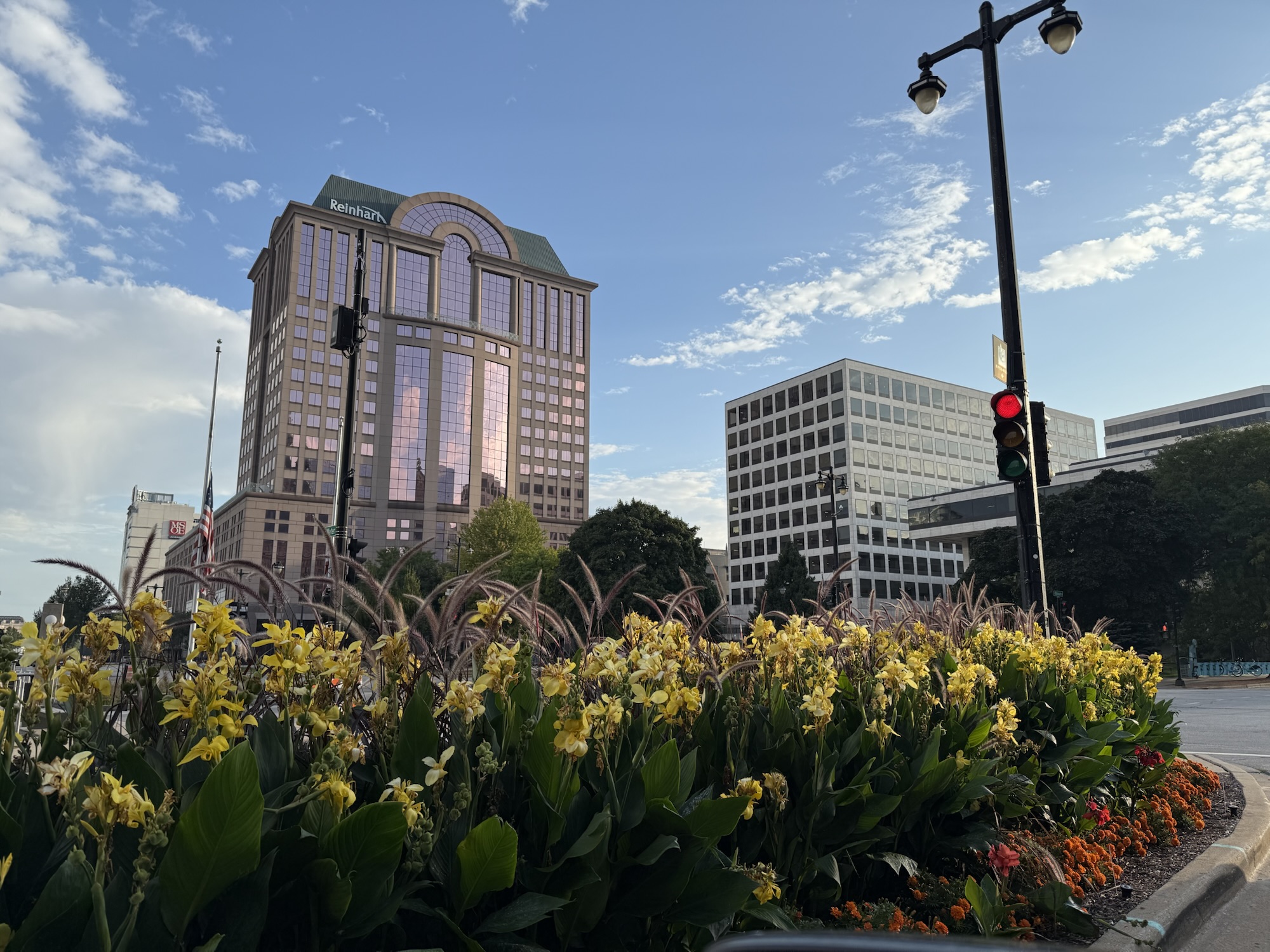
The next photo is another stopped-at-a-traffic-light moment, this time at the corner of Water and Kilbourn. I just liked the way the boulevard plantings framed the buildings, although I know the resulting photograph itself is kind of a clichéd “convention bureau” or “visit Milwaukee” kind of image.
But I don’t care. Sometimes bland, “conventional” pictures are nice, too 🙂
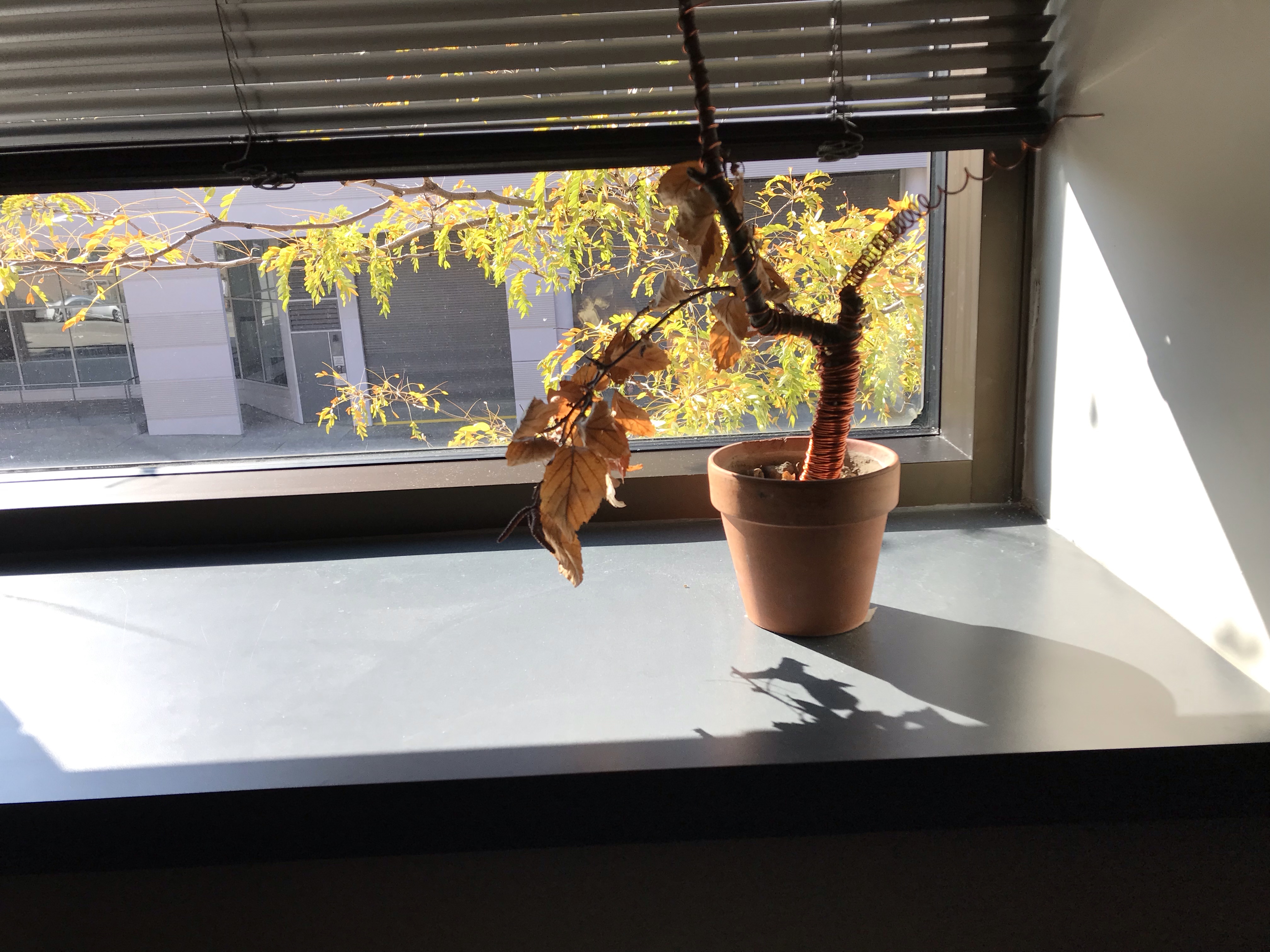
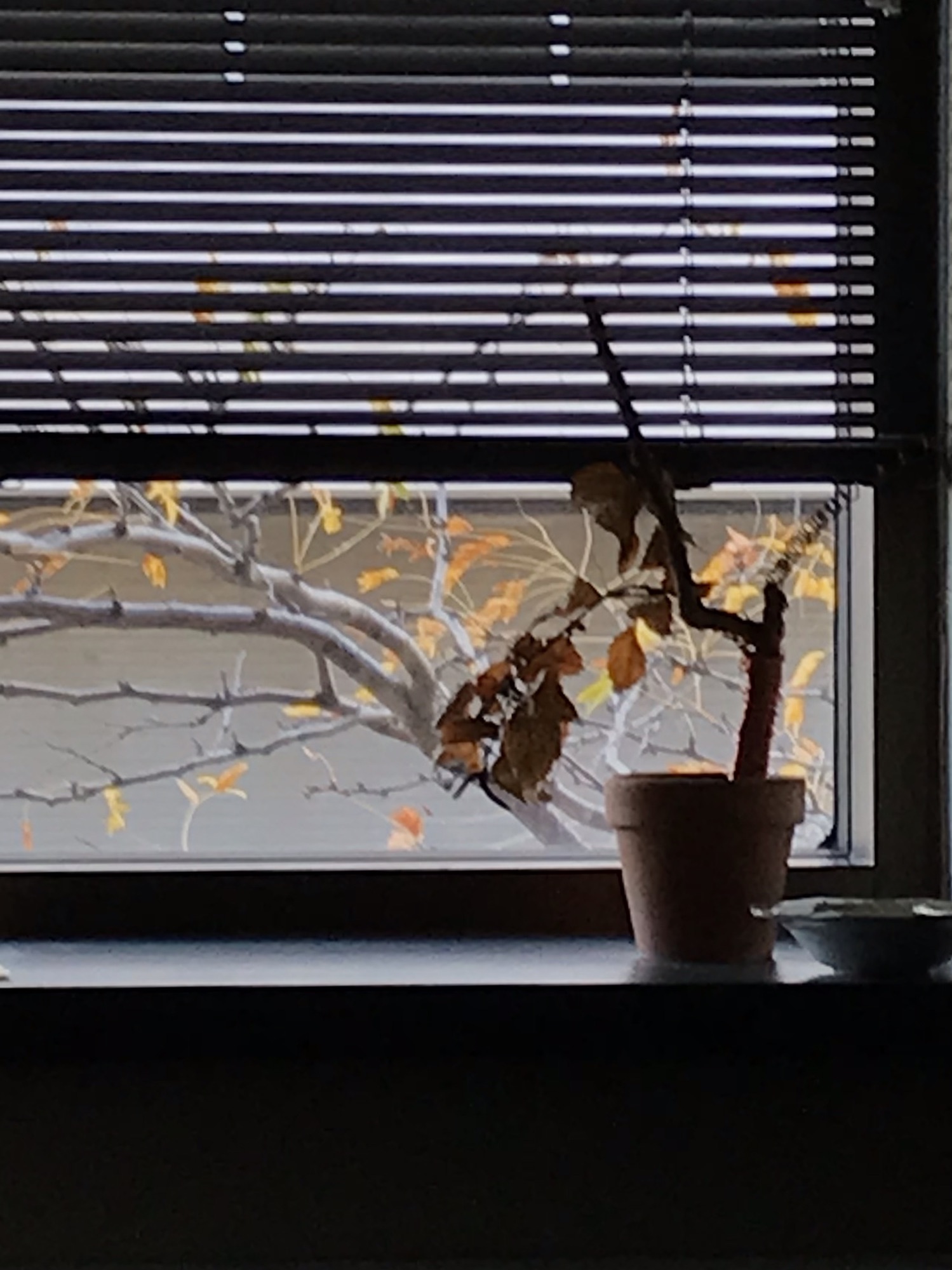
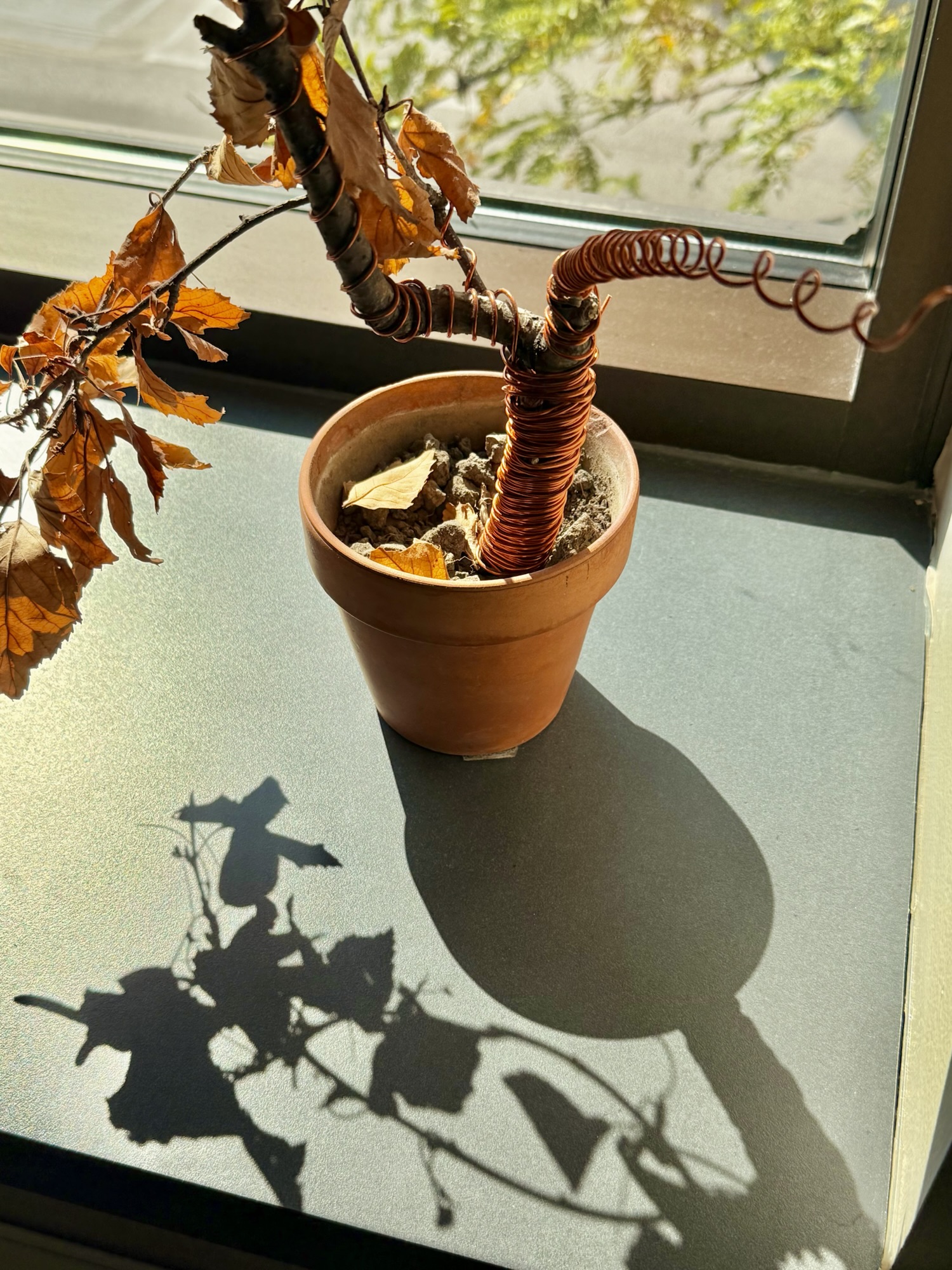
This little work of art sits on the windowsill in my office.
I’ve photographed it before.
It makes me happy.
Today late-morning sun struck at a high angle, casting a well-defined shadow and giving the copper wire a warm, mellow glow. It brightened my day, so I thought I’d share with you and maybe brighten yours a little, too! 🙂
Very interesting article published yesterday in Wired magazine. “Model welfare” is an emerging field of research that seeks to determine whether AI is conscious and, if so, how humanity should respond (e.g., should AI have/deserve “rights”?)
— Read on www.wired.com/story/model-welfare-artificial-intelligence-sentience/
One of my favorite scenes in the movie Working Girl comes near the end, where our heroine, Tess (Melanie Griffith), seizes a last-ditch opportunity to stop her boss, Katherine (Sigourney Weaver) from stealing her deal. After Jack (Harrison Ford) corrals their potential client into an elevator alone with them for the ride up to the mergers and acquisitions offices high in the World Trade Center, Tess delivers the OG high-stakes elevator pitch by explaining how she came up with her inspired, out-of-left-field idea that the client’s company, looking to invest in television networks, acquire a radio network instead.
And here’s the text in print (in case the clip is ever taken down by the person who posted it on YouTube, or in case you’d rather just read):
Okay. See, this is Forbes. It’s just your basic article about how you were looking to expand into broadcasting, right? Okay now, the same day—I’ll never forget this—I’m reading page six of the Post, and there’s this item on Bobby Stein, the radio talk show guy who does all those gross jokes about Ethiopia and the Betty Ford Center. Well, anyway, he’s hosting this charity auction that night: Real blue bloods, and won’t that be funny. Now turn the page to Suzy, who does the society stuff, and there’s this picture of your daughter. See, nice picture. And she’s helping to organize the charity ball. So I started to think: Trask . . . radio, Trask . . . radio.” And then I hooked up with Jack, and he came on board with Metro, and…and so now here we are.
In a similar, though much lower-stakes, moment earlier in the film, Tess suggests to Katherine that they serve dim sum dumplings at a reception instead of the usual appetizers. When she mentions that she’s been reading about them in W (a fashion magazine), a snooty colleague of her boss sneers, “You read W?”—the implication being that Tess, a Staten Island girl with the accent to prove it and a wardrobe to match, couldn’t possibly be reading a “cool kids” publication like W.
Tess keeps her cool, though. Her response (and the setup for her later moment of triumph) is blunt and simple:
I read a lot of things. I mean, you never know where the big ideas could come from. You know?
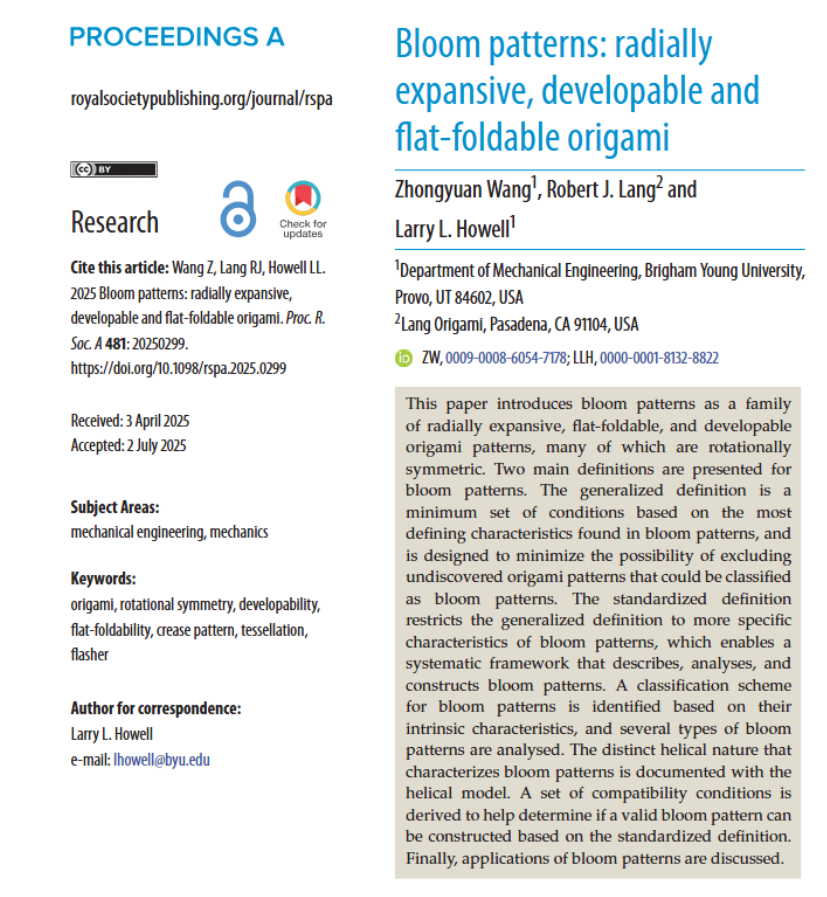
Changing the subject a bit, but along these same lines, I just found an extrememly interesting (and very readable!) article, “Bloom patterns: radially expansive, developable and flat-foldable origami,” written by an engineering professor, an origami artist, and an engineering student who has been fascinated by origami his entire life.
I actually listed the authors backwards just now to call attention to something unusual—and the reverse of how publishing ordinarily works in the fields of science, mathematics, and engineering. In the case of this article, the engineering student, Zhongyouan Wang, is actually the lead author!
As he should be, because Wang is the creator of a unique new type of origami that “blooms” in radials from a center, like a flower. Although many different “bloom pattern” design variations may be created, they will all have that centerpoint in common, like the flower head or disk at the center of a daisy.
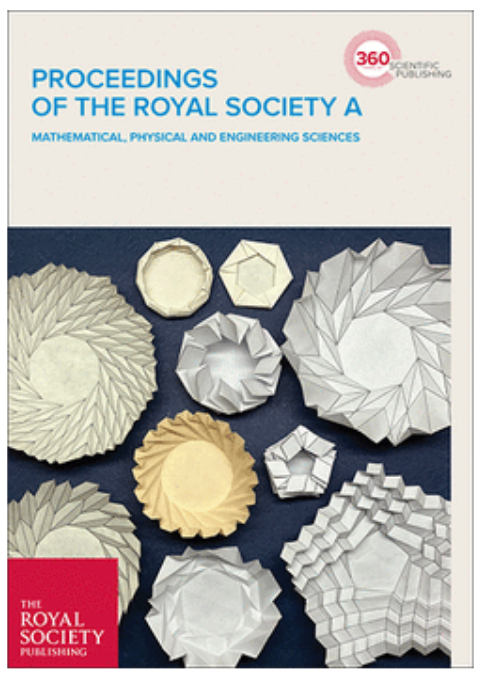
Cover, Proceedings of the Royal Society A: Volume 481, Issue 2320 (Aug 2025)
From a news story published by Brigham Young University this week:
The researchers coined the term “bloom patterns” to describe this new group of unfolding mechanisms that resemble flowers blooming.
“Bloom patterns have three main characteristics that make them unique,” said Wang, a BYU mechanical engineering major. “First, they can be folded flat. Second, they are deployable. Third, they expand like a flower blooming, rotating from a symmetric center.”
In terms of engineering applications, this means that large items that require compact size for storage could be manufactured via origami folds from a single large sheet of material, stored in its fully-folded form, and then either partially or completely “deployed” to become take on the desired final shape. Something like this could give a whole new spin to concepts like prefabricated architecture, for example. The researchers note that the rotational symmetry and somewhat circular shape of the deployed structures give these items more stability than similar structures created using other (non “bloom”) origami folding patterns.
Here’s a video from Brigham Youg explaining this origami and its engineering applications potential.
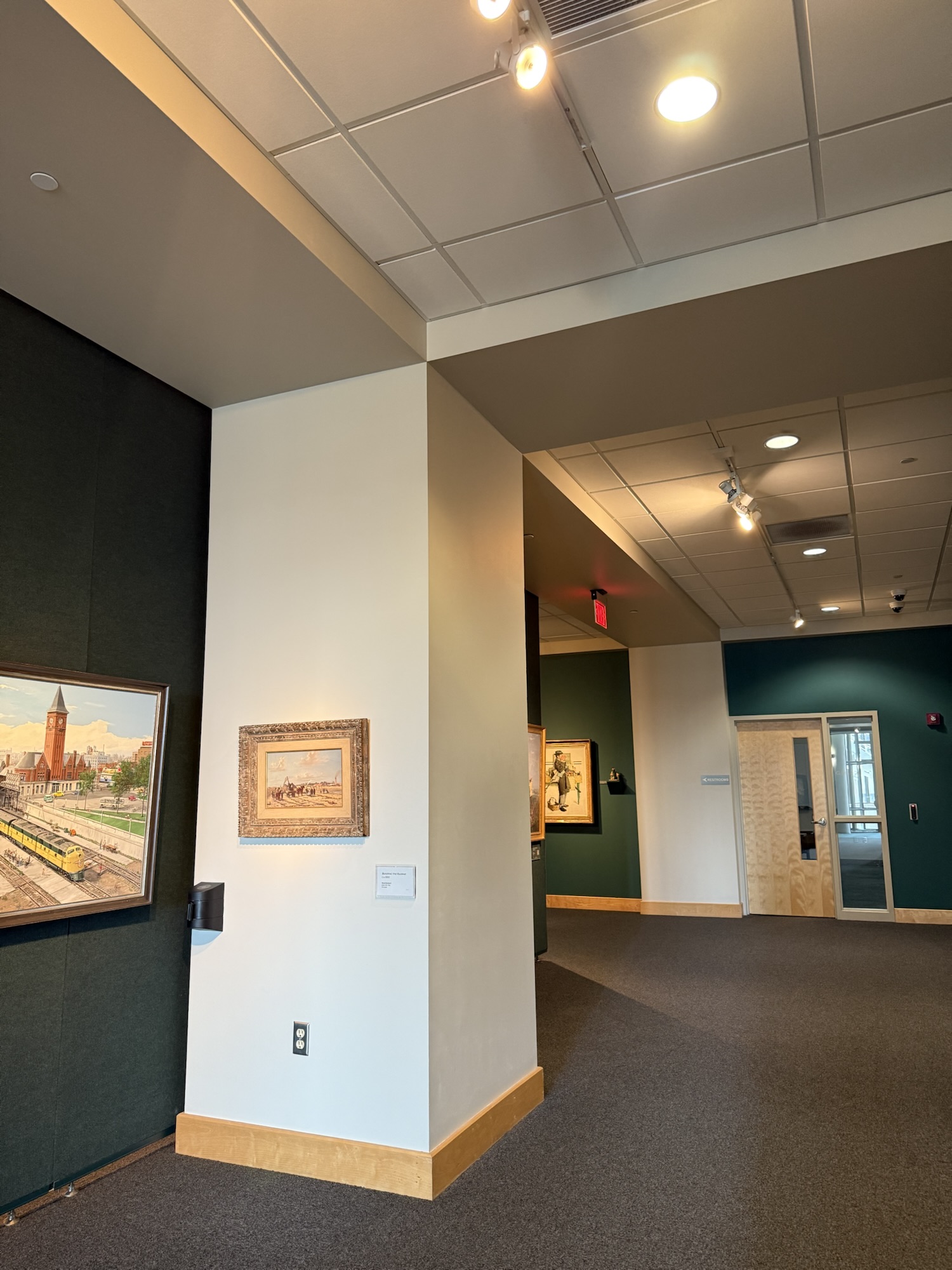
Because working on a computer for hours at a time (in a single sitting) is not good for anyone, I try to take short, frequent breaks to get in some stretching and walking as much as possible. Fortunately, my office is in the Grohmann Museum on the campus of Milwaukee School of Engineering, so not only do my walks get the blood moving and help to work out the kinks in general but they also give me a chance to surround myself with art along the way.
I know this isn’t exactly art.
But it was a fun thing to notice as I walked laps around the second floor in the very late afternoon one day last week. Just a very striking intersection of planes and angles—and as I am a fan of abstract, geometrical images, I naturally had to stop and take a picture.
The above image is a cropped close-up area of the picture I took. Isolating it from the larger context allowed me to approximate the moment of “intersection” that caught my eye.
Below is the entire photo. I’ve worked in this building since it opened in 2007. Not once in nearly 20 years have I noticed that specific little corner of the ceiling before. I’m not sure what drew my attention last week, but there must have been something unique in the quality of light and shadow created at that particular time from both inside and outside (sun) sources.
By the way, do you see the painting below the red “Exit” sign? It’s a Norman Rockwell, titled “The Bookworm.” According to an Artnet News story, it sold in 2015 for $3,834,000, well above Sotheby’s presale estimated value of $1.5 to $2.5 million.
It’s quite astonishing to me, now that I take a moment to reflect on it, that a painting worth that much money could be part of my ordinary daily routine.




 Katherine Wikoff