Watching the “Up” Series (#1, Seven Up)

Several years ago, in one of those serendipitous moments that can occur only in the physical world (i.e., not online),  I stumbled across a film in the documentary section of a Blockbuster video store, 49 Up.  I realized at once that this movie must be part of the “Seven Up” documentary series I’d vaguely heard of before.

In 1964, twenty seven-year-old children in England were profiled/interviewed in a  television series called “World in Action” for Britain’s Granada Television.  Taking its cue from the Jesuit saying, “Give me a child until he is seven and I will give you the man,” the show selected its interview subjects from a variety of socioeconomic circumstances.

“Why do we bring these children together?” asks the narrator rhetorically.  “Because we want to get a glimpse of England in the year 2000.  The shop steward and the executive of the year 2000 are now seven years old.”

The most recent film in the series, 56 Up, was broadcast on British television a year ago.  I’ve been waiting impatiently since then to view it in the U.S., and when it was finally released on DVD here last week, I decided to purchase the boxed set of all eight movies.  Currently priced at $37.99 on Amazon, the entire set together is an excellent deal.

So this past weekend I watched the first film in the series, 1964’s Seven Up.  I wasn’t viewing it through completely new eyes, though, because remember I’d already watched the seventh film, 49 Up, a few years ago after finding it at Blockbuster.  Even though I don’t recall many details from 49 Up, my perceptions of the original film this weekend were definitely informed by my previous viewing.

For example, one of the children, Nicholas Hitchon, lived on a farm in rural Yorkshire in 1964.  By 49 Up he was a professor at the University of Wisconsin, which is in Madison about a 90-minute drive away from my home in Milwaukee.  I remember feeling a little sad for Nick in 49 Up and identifying a bit with some of the choices he had made in life.  In his Madison home, Nick had created a “Yorkshire room” filled with things to remind him of the beautiful countryside of his childhood . . . which he’d had to leave behind in order to become a scientist (a desire that is evident even in the very first film, I see now).

All of us have faced difficult choices like this, but the stark contrast between the life one actually lives and other possible lives one could have chosen instead is something I wasn’t fully conscious of until watching the 49 Up interview with Nick.  To me it seemed very tragic that Nick is a Yorkshire boy who cannot live in Yorkshire.  Being true to his intellectual self required giving up an equally true part of himself.

In Seven Up young Nick seems very self-possessed.  I got a particular kick out of one of his responses.  When the interviewer asks him (as he did all the children) if he has a girlfriend, Nick seems a little nonplussed at first but quickly recovers, retorting something like, “I don’t answer that sort of question.”

Tony Walker, a London taxi driver in 49 Up, was a scrappy little kid from London’s East End in Seven Up.  I recall liking Tony a lot in 49 Up.  He and his wife, also a taxi driver, seemed very practical and down to earth.  They had a second home in Spain, were very family oriented, and in some ways struck me as being happiest of anyone in the series with their lot in life.  By “happiest” I mean that they seemed (to me, at least, viewing everyone’s lives at great distance of both time and space) not merely content with their lives but actually very engaged in living their lives with deliberate joy.

The other person I remembered well from 49 Up is Neil Hughes.  All of the “Up” films review each person’s life via clips from the previous films in order to bring the audience up to date and ensure that each film becomes a standalone experience for newcomers.  What I recalled from 49 Up was that Neil had had a very rough go of things in life.  At one point he was homeless, at another living in public housing in an absolutely gorgeous part of Scotland.

So watching Seven Up this past weekend, it was almost painful to see what a bright, articulate little boy Neil had been in the original movie.  “Chipper” is the best word I can think of to describe him.  So cheerful, so quick-witted, so full of life!  I care about Neil, I realize, and am itching to watch 56 Up to see how he is doing today.  But I’ll have to arrive at age 56 by moving through his life at seven-year intervals, because my plan is to watch all eight films in sequence.

I don’t know yet what insights I’ll take away from the series overall, but I anticipate that following several people through their lives, and hearing their own self-reflections every seven years, will prove to be enlightening.  I’m astounded and grateful that the subjects of the Up series have consented to this fairly extreme invasion of their privacy in order to maintain the integrity of the films’ collective purpose.

Just one other observation to share from the original Seven Up film right now.  At one point the interviewer apparently asked the children about their future educational plans.  The trio of boys from a London-area prep school provide detailed responses about the paths they expect their lives will take, identifying by name not only their intended future public schools but also their intended universities (Oxford and Cambridge) and even a specific college within those universities (Trinity).

From these three privileged seven-year-olds, we then cut directly to Paul, one of the two boys living in a charity-run children’s home.  His brow furrows in confusion at the interviewer’s question.

“What does ‘university’ mean?” he asks.

Would you like new posts delivered to your inbox? To subscribe, click here.

Posted in Life, Movies and film | Tagged , , , , , , , , , , , , | 1 Comment

A pause for river traffic at the Wisconsin Avenue drawbridge

One of the joys of living in a city with a navigable river is encountering its drawbridges.  Around noon yesterday I happened to be two cars back when the Wisconsin Avenue bridge was raised to accommodate one of the larger tour boats.

Wisconsin Avenue bridge

The white, pillared building across the river is the old Gimbels Department Store, where in April of 1945 a duck named “Gertie” laid her eggs and raised her brood atop some of the pilings down along the river.  This was big news at the time, a welcome diversion from the numbing horror of World War II.  The local paper carried daily updates on the unfolding duckling saga for over five weeks.  People lined the bridge along Wisconsin Avenue to catch a glimpse.

Following flooding and fire, Gertie and her ducklings were rescued and placed in one of Gimbels’ large streetside display windows.  According to Wikipedia, over 2 million people paused outside that store window to monitor their progress.  (Milwaukeeans really love their animals.  When I first moved to town, the top newspaper headline for days was about the death of Samson, a much-beloved zoo gorilla.  His taxidermied body resides at the Milwaukee Public Museum, and a bronze-sculpted bust of  his likeness graces the ape house at the Milwaukee County Zoo.)

Eventually the story of Gertie and her brood was immortalized in print, published first by the Milwaukee Journal and later by Rinehart in New York.

About fifty years later, a statue followed.

Gertie the Duck by sculpter Gendolyn Gillen (via Wikipedia)

The Milwaukee River runs south through the heart of Milwaukee’s downtown.  It flows into the inner harbor just below the Third Ward, an old warehouse district now reborn as a hipster center of New Urbanism.  From there boats can either move all the way out to Lake Michigan or stay inside the breakwaters of the outer harbor.  (Milwaukee grew up around the natural inner harbor formed by the confluence of three rivers: the Milwaukee River, the Menomonee River, and the Kinnickinnic River.  The artificial outer harbor was built in the early twentieth century with additional channel dredging and a series of breakwaters.)

I’ve had to pause for drawbridge openings on downtown streets pretty often during the thirty-odd years I’ve lived in Milwaukee.  For several years now the city has been replacing the old bridges that split in the center with newer vertical-lift bridges that rise straight up in one piece, like the one shown in the photo above on Wisconsin Avenue.

Too bad, in a way.  I thought the old bascule bridges were picturesque.  And, really, what is a drawbridge if it doesn’t swing open that way.  The Blues Brothers made the East 95th Street Bridge in Chicago famous when they did an Evel Knievel-style jump from one ramp of that drawbridge to the other across the open gap.  Roger Moore’s final James Bond movie, A View to a Kill, used a similar stunt in a chase scene.  All the romance is gone now😂

Milwaukee’s bridge houses, at least, are still around.  Every drawbridge once needed an operator, and every operator needed a place to work from.  Are operators still required every time a bridge opens?  I don’t know, but I’ve never personally seen anyone inside them.  Although some (if not all) of the bridge houses have been “updated” or replaced for the modern era, every drawbridge does still need a bridge house to hold the “works.”  And the Milwaukee River has some very cool, unique-looking bridge houses downtown.

Wisconsin Avenue bridge house, looking north (via Wikipedia)

Pleasant Street bridge house, before bridge reconstruction (via City of Milwaukee)

Huh.  I’ve been trying to find online images of Milwaukee River bridge houses I could share, but there really aren’t any.  So that can be a project for me this summer, to photograph some of my favorite bridge houses and post again later.  (UPDATE: I did do this in a post about two weeks later.  Here is the link to “A walking tour of the Milwaukee River’s bridge houses.”)

Meanwhile, here is the second photo I took from my car yesterday.  It may be hard for you to make it out amid all the other busy details (railings, buildings), but you can see the boat (it’s pretty long, as well as tall) heading south on the river.

Tour boat heading toward Lake Michigan

Would you like new posts delivered to your inbox? To subscribe, click here.

Posted in Milwaukee | Tagged , , , , , , , , , , | 1 Comment

Watch the Book Trailer for ALL GOD’S CHILDREN

I have to share this book trailer for my friend Anna Schmidt’s next novel, due out in September, I believe. Her publisher has created an promotional video that I think really lives up to the content of Anna’s novel. If you enjoy reading Christian/inspirational, romantic, or historical fiction (in this case WWII), Anna’s book may be right up your alley.

Posted in Books and reading | Tagged , , , , , , , | 2 Comments

Woody Allen on filmmaking as therapy

Great article about Woody Allen in yesterday’s Wall Street Journal Magazine.  In a post I wrote on “Creativity and the importance of routine” last year, I mentioned Allen as an example of someone who shows up every day and does the work.  As a result of his very disciplined routine, Allen has managed to put out 48 films over the span of his entire career and a new film every single year for the last thirty years.

In yesterday’s interview, Allen offers this interesting insight on his work ethic and prolific creative output:

You know in a mental institution they sometimes give a person some clay or some basket weaving?  It’s the therapy of moviemaking that has been good in my life.  If you don’t work, it’s unhealthy—for me, particularly unhealthy.  I could sit here suffering from morbid introspection, ruing my mortality, being anxious.  But it’s very therapeutic to get up and think, Can I get this actor; does my third act work?  All these solvable problems that are delightful puzzles, as opposed to the great puzzles of life that are unsolvable, or that have very bad solutions.  So I get pleasure from doing this.  It’s my version of basket weaving.

You can read the entire article here.

Posted in Movies and film | Tagged , , , , , , | 3 Comments

Pixar’s “The Blue Umbrella” is cinematic poetry. “Monsters University” is fun, too.

This past weekend my younger daughter and I continued our longstanding tradition of catching Pixar’s new release on its opening weekend.

Monsters University was a lot of fun.  Not completely on a par with the studio’s finest hits, but really nothing wrong with it, either.  Very enjoyable, with many nods to the original film, Monsters, Inc.,  as well as to university culture and Greek life.

I love Mike Wazowski, the one-eyed, green ball of a monster voiced by Billy Crystal.  He is such an enthusiastic, can-do little guy.  And resilient—oh, my goodness, is he resilient!  (SPOILER ALERT: the rest of this paragraph alludes to the movie’s conclusion.)  When Mike is kicked out of the “scarer” program, it looks like the end of his lifelong dream of working on the “scare” floor.  But there’s more than one way to skin a cat, and the mailroom is hiring at the Monsters, Inc., utility company.  It’s truly heartwarming and inspirational to track Sully and Mike’s joint career trajectory via the photos and awards taped to the inside of Mike’s locker at the movie’s end.

Speaking of the end, though, don’t bother sticking around for the post-credit epilogue this time.  My daughter and I were the only people left in the theater (except for uniformed teenagers with mops and garbage bags) by the time all nine billion Pixar/Disney employees’ names had finished rolling.  What a letdown:  The snail from the first day of school earlier in the film finally made it to class, only to be told by the janitor mopping the floor that the year had ended.  Come to think of it, watching that postscript surrounded by people waiting to clean up made me feel a bit like a tardy snail myself.

For me, the best part of our trip to the movies last weekend was unquestionably The Blue Umbrella.

Pixar always runs a new animated short immediately ahead of its feature.  The Blue Umbrella is the story of . . . a blue umbrella (guess you saw that one coming) . . . that falls for a red umbrella amidst a sea of black umbrellas crowded together under a downpour on a nighttime city street.  When the surging crowds and gusts of wind threaten to separate the two shy characters, friendly inanimate objects exert their own powers to help throw them together once more.

The Blue Umbrella‘s story reminds me of one of the best short films ever, The Red Balloon (1956).  

That beautiful movie, which won an Academy Award for its screenplay, is sweet and naïve, yet full of truth and insight about what is ugly and what is good in life.  And it’s so uplifiting (literally :)) at the end, when all the balloons in Paris join together to right the wrong that has been done.

Like The Red Balloon, The Blue Umbrella contains no dialogue.  Well, The Red Balloon  contains one word, as I recall.  The Blue Umbrella has no words, just background sounds of rain, city noises like traffic signals and car horns, and an absolutely perfect musical score featuring the singing voice of Sarah Jaffee.  Here is a clip via The Wall Street Journal (sadly, minus the singing voice of Sarah Jaffee).


In addition to the lovely story, what I find most impressive about The Blue Umbrella is its animation.  Like other Pixar films, this short film is computer-animated.  Again:  The entire film is computer-animated, ALL of it!!!!  Take a look at the movie still below to see why that statement requires so many exclamation points.

The city scenes are rendered so incredibly realistically that my daughter was convinced that much of the film’s background footage (rain-slick pavement, etc.) was actually live-action, with the two animated umbrellas and the animated “faces” on traffic signals and buildings merely superimposed over it.

With The Blue Umbrella, Pixar takes animation into a new realm.  It is exciting (although a little scary, maybe?) to see the line between real and not-real images so unequivocally erased.

Posted in Movies and film | Tagged , , , , , , , , , , | 9 Comments

Jessica’s Wednesday Poem Club: What is the Meaning of a Jar Placed in the Woods, If No One Is There to See It?

For today’s post, especially if you enjoy poetry, head over to the “Wednesday Poem Club” hosted by my friend and fellow-blogger, Jessica Slavin. I was planning just to leave a quick comment on the Wallace Stevens poem “Anecdote of the Jar,” but then wrote so much that I decided it should count as a post on my blog, too!

(On August 6, 2021: Several people have visited this page in the last few days, and I don’t think whatever link I had originally used is live anymore. So I just now found Jessica’s blog post again online. Here’s a link to its new location: https://sett.com/likeanapple/uid/118178)

Posted in Uncategorized | 2 Comments

Waiting for Sherlock

I love the BBC One Sherlock Holmes series, starring Benedict Cumberbatch as Sherlock and Martin Freeman as Dr. John Watson.  Have you seen it?  Arthur Conan Doyle’s famous sleuth now carries a smartphone, and his good friend Dr. Watson publishes accounts of Sherlock’s exploits on a blog.

The series’ opening-credits sequence is especially well done.  The use of tilt-shift photography makes London appear in miniature, as if it’s Sherlock’s game board.  Nice touch.

And thank goodness for subtitles!  With the first two seasons available on DVD, I can finally understand what the super-fast-talking, English-accented main characters are saying and thus actually have a clue what’s going on.

Each season has three episodes, meaning there are six of these hip, smartly-written, and brilliantly acted Sherlock stories so far.  Although thoroughly updated for the 21st century, all have titles and plots that are clever twists on actual Conan Doyle tales.

For example, the series’ first episode, “A Study in Pink,” not only cleverly spins out the title of the first Sherlock tale, “A Study in Scarlet,” but it also introduces Holmes and Watson in the same manner as Conan Doyle’s original.  And it features the mysterious word “RACHE” written by the dying murder victim, except now it’s a password as well as a person’s name.  We even have an incompetent member of the police force postulating that it’s the German word for “revenge.”

While we’re on the subject of the police force, I have to mention that I love how this series makes Lestrade a competent, likable guy, yet retains Conan Doyle’s apparent low regard for the police by introducing a few unsympathetic lower-level officers to despise and make idiots of.

There are many other fun references planted for Holmes fans to discover.  Like, for instance, the five Greenwich pips that pay homage to “The Five Orange Pips” in the third episode of Season One, “The Great Game.”  And although today’s Sherlock does not smoke a pipe, he is a “recovering” cigarette addict who savors secondhand smoke and wears a nicotine patch on his arm (or occasionally multiples, for mentally wrestling with cases that pose a “three-patch problem”).

Every time I re-watch one of these episodes, I find something new to enjoy.  But I want MORE!  I want new episodes.

And it looks like I’ll have to keep waiting for them . . . because Season Three (or “Series 3,” as they seem to call it in England) will probably not air until next January.  The show’s stars have unfortunately become so successful (well, fortunately for them :)) that their availability for the three-episode Sherlock shoot has to be worked around their other commitments.

Major bummer.

Meanwhile, because I finally figured out how to embed YouTube clips in my blog, I thought I’d share this funny clip of a Benedict Cumberbatch/Chris Pine interview from BBC One’s “The Graham Norton Show,” a program billed this way on the BBC One website: “Graham Norton presents a show focusing on the people, trends, stories and aspects of celebrity culture that interest him most, featuring trademark Norton comedy monologues and celebrity chat.”

Here watch Benedict Cumberbatch and then Chris Pine run up into the audience to embrace the Cumberb*tches and Pine Nuts who’ve traveled great distances to see them.  Graham Norton is hilarious, and both actors seem awfully good sports.

Posted in Books and reading, Life, Movies and film | Tagged , , , , , , , , , , , | 1 Comment

Great Books: The Devil in the White City

Last night was my Great Books Dinner and Discussion event at Milwaukee School of Engineering.  I usually facilitate a book discussion every June, and lately I’ve added the November discussion to my rotation, as well.  This month’s selection was The Devil in the White City, by Erik Larson.

Although thunder and lightening sent sheets of wind-driven rain onto the street outside the comfortable rooms of MSOE’s Alumni Partnership Center, we hardly gave the weather any notice at all inside the sturdy stone walls.  Our Great Books events are held in the former headquarters of the Blatz Brewing Co. business offices, featuring hardwood floors, high oak-beamed ceilings, hand-carved fireplaces, marble hearths, and a two-story skylight.  A walk-in vault/safe serves as the coat closet, which is fun.  A steep ladder/staircase leads to a second vault above it.

MSOE has been running the Great Books series since 1996, the same year Oprah started her book club, in fact.  It is an enjoyable evening out, a lot like book club except no one has to clean their house and you actually do talk about the book 🙂  The registration fee of $50 covers hors d’oeuvres, wine or soda (“pop” where I’m from; “soda” in the Milwaukee vernacular), dinner, dessert, coffee—and, of course, conversation about the selected book.

People come with friends, or they come alone and make new friends over dinner.  Some people have developed friendships outside of the monthly event after attending over time and seeing each other there.  People also attend with their regular book clubs, sometimes adding our evening to their normal meeting schedule if the book we’re discussing looks good to them.  And we are getting more men at the events, whether alone or as part of a couple, which is nice to see.

I really do enjoy these evenings, even though as the discussion leader I’m technically working.

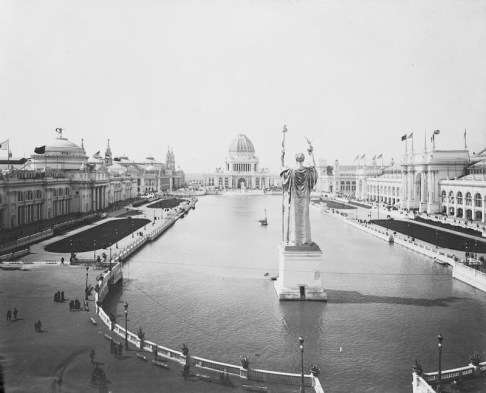
Last night in addition to our usual conversation about the book, I shared some interesting videos I’d found on YouTube about the “White City.”  I really hadn’t known much of anything regarding the 1893 World’s Columbian Exposition before reading Erik Larson’s book, so I supplemented what I’d learned from Larson with some background research.  If you haven’t yet read The Devil in the White City, you should. It’s fascinating.  And your jaw will drop in delight . . . repeatedly . . . as Larson slips yet another famous name, amazing tidbit of information, or astonishing twist of fate into his narrative.  Really a fun book—dense but readable.  And one that rewards repeated reading.

My only complaint is that Larson’s book contains disappointingly few photographs of the fair.  Each new section (but not every chapter) contains a small photograph that provides a tantalizing glimpse of how magical the fairgrounds were.  It’s not enough, though.  I found several photos online, and you really do need to see all the pictures for yourself to appreciate how awesome (in the original sense of the word) the “White City” truly was.  The enormous scale of the architecture and landscaped grounds absolutely floors me.  (Now that I think of it, Larson’s book is so packed with detail already that he couldn’t possibly have included all the photographs I wanted him to 🙂 )

More than 27 million people attended the fair during its six-month run.  Yet because most photos of the fairgrounds were taken prior to the official opening, they contain almost no people, just a few random men in suits standing around the massive structures and landscapes.

Surprisingly few pictures show the “White City” actually crowded with people—as it must have been to have racked up those 27 million visitors.  On its single busiest day, in fact,  more than 700,000 people crowded into the fairgrounds.

One primary preoccupation of the fair’s planners was that their event should have an attraction that could “out-Eiffel” Eiffel, a reference to the Eiffel Tower (and engineer Gustave Eiffel, its designer), that had been built as the entrance arch for the 1889 World’s Fair in Paris.

After rejecting several lame copycat towers, fair planners finally accepted a proposal from a Pittsburgh bridge builder, an engineer named George Washington Gale Ferris, Jr., for a monstrosity of iron scaffolding with moving parts.

The enormous “Chicago Wheel,” or Ferris Wheel, was the hit of the fair.

And it was HUGE!  Each of its 36 cars (the size of railroad boxcars) held 60 people, meaning that the wheel could hold 2,160 people at one time.  Compare that capacity with two of the world’s newest Ferris wheels, the London Eye (800 people) or the Singapore Flyer (784 people).

As the photograph below shows, the Ferris Wheel dominated its location on the Midway Plaisance, a mile-long stretch of green Chicago park jutting inland from Jackson Park (and from which came the term “midway,” referring to the section of a fairground devoted to rides and games).

Here’s a view from inside one of the cars.

Cool, right?  According to Wikipedia, 38,000 people a day rode the Ferris Wheel during the fair’s run.

But back to the book.  The Devil in the White City tells the stories of two very different, yet similar, blue-eyed men.

The first, Daniel Burnham, is Director of Works for the fair.  Without his ambition and drive the fairground’s development probably would not have happened.  He not only pulled together America’s top building and landscape architects (a task similar to “herding cats”) but also managed to build a fantasy city of enchantment on an impossibly tight deadline.  He really did build a city, too.  The White City had its own police force and fire protection, etc.

The second man, H.H. Holmes, is a serial killer who operated in the shadow of the fair, murdering possibly as many as 200 people at his gloomy “Castle” at Sixty-third and Wallace, about two miles due west of the fairgrounds.  As repulsed as you may be by his crimes, you can’t help but be at the same time fascinated by his smoothly confident, entrepreneurial brand of evil.  Leonardo DiCaprio purchased the film rights to The Devil in the White City in 2010.  I wish he’d play the good guy, Daniel Burnham, but I’m sure he’s going to make a fabulous villain of Holmes.

The Devil in the White City also tells the stories of two very different, yet similar, cities: Chicago (crowded, dirty, and hazy with coal smoke) and the White City (spacious, sunny, beautiful, and cooled by clear breezes from Lake Michigan).  Interestingly, these cities become characters as distinct as Burnham and Holmes.

Here are links, etc., to a few of the more interesting sources I found in preparing for the book discussion. If you are curious to learn more about the 1893 World’s Columbian Exposition, I think you’ll enjoy them!

(UPDATE: Because someone visited this post today, Friday, December 17, 2021, and I haven’t thought about it in a long time, I popped in to revisit it myself–and found that several photos I’d linked to in the original post are no longer live. I’ll try to find them again in the next few days, or at least substitute photos that equally illustrate the points I was making in each case. Just FYI, in case you are here reading this post again today or tomorrow❤️)

Posted in Books and reading, History, WPLongform (posts of 1000 words or longer) | Tagged , , , , , , , , , , , , , | 13 Comments

Surf’s up!

Surf's up!

W
A
Y

U
P
🙂

WAY up

Posted in Uncategorized | Tagged , , , | Leave a comment

Colons: how and when to use them

A couple days ago I posted on semicolons, with a note that I’d decided to split my original post, covering both semicolons and colons, into two parts once I realized that the semicolon discussion was getting out of control.  Okay, so now for colons.  These are a lot more fun than semicolons 🙂

The first thing to know about the colon is that it is a mark of “enumeration.”  To “enumerate” is to count off all the specific items in a collection.  Hence the “numer” in the term, as in the word “numeral.”  To continue with the math metaphor, I also think of a colon as being similar to an “equals” sign.  Whatever comes after the colon equals whatever preceded it, but in more specific detail.

There are two main times you should use colons to punctuate sentences.  The first is to introduce a list/quote/idea, and the second is to join two independent clauses with an appositional relationship.

Using a colon to introduce a list, quote, or idea — You already no doubt have used the colon with lists.  But what you may not know is that you need to precede the colon with the THING (a noun or noun phrase) that is subsequently being listed.  A common colon error is to put the colon in front of the list but after a verb.  Think about it, though.  If the colon is an equals sign, then how can a verb = nouns or adjectives?  Here is a list of nouns.

WRONG: We need: milk, butter, and eggs.

RIGHT: We need the following ingredients: milk, butter, and eggs.

RIGHT: We need the following ingredients to make cookies: milk, butter, and eggs.

The THING we need is “ingredients.”  “Ingredients” is a noun, as are “milk,” “butter,” and “eggs.”

Here is colon preceding a list of adjectives.

WRONG: He was: cold, wet, and hungry.

RIGHT: He was miserable: cold, wet, and hungry.

“Miserable” is an adjective, and so are “cold,” “wet,” and “hungry.”

You also no doubt know about using a colon to introduce a quote or idea.  I’ve been doing it with the words “WRONG” and “RIGHT” in this blog post.  First comes the word “WRONG,” then the colon, and then the specific quote/idea that is wrong.  So “WRONG” = this sentence.

With dialogue or quoted statements within a text, a speaker’s words are usually introduced with a comma.  However, you can use a colon for emphasis if you like.  And a colon would always be used if you preceded the person’s exact words with a noun (or noun phrase), as in the third sentence below.

The President said, “The only thing we have to fear is fear itself.”

The President said: “The only thing we have to fear is fear itself.”

One phrase in President Roosevelt’s inaugural address stands out memorably: “The only thing we have to fear is fear itself.”

Using a colon to join independent clauses with an appositional relationship — A colon is sort of like a prism: plain light goes in one side, and all the colors included in its wavelength come out the other.  In other words, the colon refracts general information into its more specific iteration.

If you think about the colon as an equals sign or a prism, then it’s a cinch using it to join two independent clauses correctly.  The first independent clause is the general statement, and the second clause IS the specific enumeration/iteration/naming of that idea.

One thing is clear: Mary is well qualified to be president.

Or, the first clause is the general statement, and the second clause EXPLAINS that statement.

Everyone wants Mary to be elected: she is the most qualified candidate.

Should you capitalize the first letter of what follows a colon or not?  This is a usage issue, and experts/style guides don’t agree on what is “correct.”  My own practice is to use the lower case unless I want to highlight/emphasize the element that follows the colon.  I also use one space to follow a colon, unless I’m capitalizing the first word that follows it.  Then I use two spaces.

Using the colon correctly is like learning to ride a bike.  Once you get the concept, you really can’t make a mistake.  Plus, it’s a “smart” mark of punctuation:  Using it well elevates your writing style a notch.

Posted in Grammar, punctuation, usage, mechanics, Writing, blogging | Tagged , , | 4 Comments