My January 2022 post about Charles Manson and Dennis Wilson is getting LOTS of views today. And now I know why. There’s a new documentary on Netflix starting today, reviewed here in the New York Times: Errol Morris returns to his main obsessions — evil and delusion — in a new Netflix documentary about the famous murders.
— Read on www.nytimes.com/2025/03/06/movies/chaos-the-manson-murders-review.html
This is a long post today, but I’m sharing the entire ChatGPT “chat” from a recent writing group exercise to show my process of completing a finished piece from the “assignment” through the end. If you’re curious enough to stick with me (through the 6,000 words, which you may certainly feel free to skim!), you’ll be able to see the text take shape and grow from nothing to something. The final version of my (rather long) “flash fiction” exercise is at the end, and then I close with a few thoughts about generative AI and the future of writing, plus some thoughts about teaching writing today (from my own experiences teaching writing courses as a college professor).
So, first, which you already know if you have seen my previous “writing exercise” posts, the writing group I belong to, which usually meets every two weeks, has exercise prompts that we all prepare in advance and share each time during our meetings. I have been using ChatGPT to assist with my exercises, mostly as a fun way for me to learn the new tool. This time the prompt was to write a flash fiction story using the following elements: a storm, a cat, and a disease. What follows below is the “journey” of my finished piece from initial prompt to final draft.
I said to ChatGPT:
I would like to write a flash fiction story for my writing group exercise using these three elements: a storm a cat a disease. Can you generate ten flash fiction stories to help me get inspiration for ideas? Thank you!
ChatGPT said:
Here are ten flash fiction story ideas using your elements: a storm, a cat, and a disease.
The Lighthouse Keeper’s Cat
During a raging storm, an old lighthouse keeper falls ill with a fever, barely able to stand. His only companion, a stray cat, watches the beacon flicker out. As a ship nears the rocky shore, the cat leaps onto the control panel, reigniting the light just in time. The keeper, delirious, thinks he’s dreaming—until he wakes to find the cat purring on his chest, its paws covered in oil and soot.
Nine Lives Left
A stray cat wanders into a quarantined town, oblivious to the sickness killing its inhabitants. It seems immune, slipping through broken windows, curling against the fevered, whispering secrets in the night. When the storm floods the streets, the cat disappears—only for survivors to swear they saw its glowing eyes leading them to safety.
Storm Surge
A scientist, sheltering from a hurricane in her lab, watches in horror as her test subject—a genetically altered cat meant to resist diseases—escapes its cage. She’s already infected with the virus she was studying, but the cat, untouched by sickness, sits calmly as the wind howls. In her fevered state, she wonders: is the cure purring at her feet?
The Last Visitor
On the eve of a deadly storm, an old man waits out the night in his boarded-up home, his body weakened by an incurable illness. The power goes out, and in the darkness, he hears soft paw steps. A black cat appears, eyes glowing in the lightning flashes. “Come,” it seems to say. He follows it into the storm, leaving nothing but an empty bed behind.
Plague on the Wind
The villagers blame the storm for the sickness that follows—airborne and relentless. They burn everything the wind touched. Then, the cat appears at their doorstep, untouched by disease. One by one, it chooses homes to enter, curling up beside the ill. By dawn, everyone the cat has visited is either dead—or miraculously healed.
Whiskers and Warning Signs
She wakes feverish to the sound of her cat yowling. Outside, lightning splits the sky, the storm pressing against her windows. She tries to rise, but dizziness pulls her back. The cat scratches at the door, insistent. She finally stumbles outside—just as the ceiling collapses behind her. The cat, satisfied, vanishes into the night.
The Cat in the Rain
As the city drowns in stormwater and plague, a lone cat walks the rooftops. They say it belonged to Patient Zero, the first to fall ill. It lingers outside homes, staring through windows. Those who see it know: the sickness is already inside.
The Fisherman’s Omen
A fisherman, returning home just before a hurricane, finds a sickly cat hiding in his boat. He nurses it back to health, even as his wife warns him of bad omens. When the storm comes, it flattens their village—but their home remains standing. The cat vanishes, leaving only a single wet paw print on his doorstep.
The Carnival That Never Left
A traveling carnival shuts down when a strange illness spreads through its workers. They quarantine in an old fairground, where a storm traps them for weeks. Then, the cats arrive—hundreds of them. They move through the tents, eerily silent, as the sick disappear one by one. By the time the storm clears, the carnival is empty. Only the cats remain.
The Last Cure
A dying scientist injects her own blood into her cat, hoping it might outlive the storm of sickness ravaging humanity. As she succumbs, the cat slinks away, immune to the plague. Generations later, the world has healed, and people whisper about a strange breed of storm-colored cats—always watching, always surviving.
Do any of these spark an idea for your flash fiction? I can refine one or mix elements together if you’d like!
4o (Note: I love this little “signature” that ChatGPT uses to sign off on its comments and notes to me.)
I said:
I kind of like #7, “The Cat in the Rain.” Let’s set this story in a French medieval town. Patient Zero needs to be referred to by a similar term that is appropriate for the French Middle Ages. Add candles, Medieval medicines, parents and children. Please generate a new version, and then we can consider any further revisions. Thank you!
ChatGPT said:
Here’s a medieval version of “The Cat in the Rain” set in a French town, incorporating your requested elements:
The Cat in the Rain
The storm came first—roaring winds, torrents of rain that turned the cobbled streets of Saint-Léon into rivers of filth. Then came the sickness.
It started in the home of a tanner’s wife, a woman now only spoken of in whispers: La Première Malade—the First Afflicted. She collapsed in the marketplace, her skin damp with fever, her breath rattling like dried reeds. By nightfall, her children were coughing, and by week’s end, half the town burned rosemary and rue at their doorsteps, praying to keep the affliction away.
And then the cat appeared.
No one knew from where—perhaps it had always been there, lurking in the alleyways, watching with golden eyes. Now it moved openly, slipping between homes, silent as a shadow. It perched on windowsills where candlelight flickered against the rain. It curled on doorsteps where mothers wept over feeble children.
The apothecary swore by leeches and tinctures of crushed pearl. The priest called for fasting and prayer. The midwife whispered of bad humors rising from the earth. But it was the cat the people feared most.
“Did you see it last night?” murmured the butcher’s wife, clutching her rosary. “By old Pierre’s house?”
Pierre was dead by morning.
The tanner’s apprentice saw it next, its black form hunched atop the wooden beams of the granary. The miller’s wife claimed it stared at her from the well. Always watching. Always waiting.
One by one, the homes it visited were marked with sprigs of yarrow and circles of chalk. Some villagers threw salt at it, some chased it with brooms. A boy tried to drown it in a rain barrel. By the time his fever took him, the cat was gone.
But when the next storm rolled in, bringing winds that howled through the chimneys and rain that battered the rooftops, the cat returned.
It always did.
Does this capture the atmosphere you’re looking for? I’m happy to refine or add more historical details!
4o
I said:
I like this. Some logical transition is needed before the last sentence in the following section: The apothecary swore by leeches and tinctures of crushed pearl. The priest called for fasting and prayer. The midwife whispered of bad humors rising from the earth. But it was the cat the people feared most. Also, why have the streets of Saint-Leon turned into “rivers of filth”? Where does the filth come from that the rain is causing to wash the streets? And one last request: can you somehow add details that make the cat appear malevolent and the rain itself appear sinister rather than cleansing. Not that the rain currently appears cleansing, but since water is often seen as a purifying force, I want this rain and water to somehow be linked with infection and contamination. Can you revise further.
ChatGPT said:
Here’s your revised version with better transitions, a clearer reason for the “rivers of filth,” and an enhanced sense of malevolence from both the cat and the rain.
The Cat in the Rain
The storm came first—roaring winds, torrents of rain that turned the cobbled streets of Saint-Léon into rivers of filth. Water gushed through alleyways, carrying refuse from the tanner’s vats, human waste from overflowing privies, and the rotting carcasses of drowned rats. The rain did not cleanse; it defiled, filling the air with a rank, cloying stench.
Then came the sickness.
It started in the home of a tanner’s wife, a woman now only spoken of in whispers: La Première Malade—the First Afflicted. She collapsed in the marketplace, her skin damp with fever, her breath rattling like dried reeds. By nightfall, her children were coughing, and by week’s end, half the town burned rosemary and rue at their doorsteps, praying to keep the affliction away.
And then the cat appeared.
No one knew from where—perhaps it had always been there, lurking in the alleyways, watching with slitted golden eyes. Now it moved openly, slipping between homes, its black fur slick with rain, its paws silent against the stones. It perched on windowsills where candlelight flickered against the storm, watching the sick through warped glass. It curled on doorsteps where mothers wept over fevered children.
Some said it had crept from the tanner’s house the night the woman first fell ill. Others swore they had seen it pacing along the edge of the cemetery wall just before the gravedigger took to his bed, never to rise again.
The apothecary swore by leeches and tinctures of crushed pearl. The priest called for fasting and prayer. The midwife whispered of bad humors rising from the earth. But as the death toll grew, fear turned its gaze elsewhere—not to the heavens, nor to the herbs, nor even to the unseen pestilence that lingered in the damp. Instead, the people of Saint-Léon watched the cat.
“Did you see it last night?” murmured the butcher’s wife, clutching her rosary. “By old Pierre’s house?”
Pierre was dead by morning.
The tanner’s apprentice saw it next, its black form hunched atop the wooden beams of the granary. The miller’s wife claimed it stared at her from the well, its dripping whiskers casting thin, twitching shadows. It left no paw prints in the mud, but the water where it walked took on an oily sheen. When it passed, candle flames flickered, burning low and sickly green.
One by one, the homes it visited were marked with sprigs of yarrow and circles of chalk. Some villagers threw salt at it, some chased it with brooms. A boy tried to drown it in a rain barrel. By the time his fever took him, the cat was gone.
But when the next storm rolled in, bringing winds that howled through the chimneys and rain that hissed against the rooftops like whispered curses, the cat returned.
It always did.
I’ve refined the transitions, justified the filth in the streets, and made both the cat and the rain feel more sinister and tainted. Let me know if you’d like any further tweaks!
4o
I said:
This is really good, I really like it! Still considering revisions, although only to make this even better. In the last two paragraphs, I’d love to have some sort of hint as to why the cat comes back with the storms. Also, the phrase “it always did” implies that the cat is somehow immortal and has always arrived with every storm. I’d rather have the first storm described in this story be the first time the cat appeared. At the end, can you instead imply that the cat always returned after that, not that it always did. And the ending would be stronger if the knowledge that the cat would always return afterward was implied rather than directly stated. Can you revise for a new version? Don’t write over the previous versions. I like seeing every single version as its own entity so I can look back over the progress we’ve made in each draft. Thank you!
ChatGPT said:
Here’s your latest revision, incorporating your request to hint at why the cat returns with the storms and refining the ending to imply its continued return rather than stating it outright.
The Cat in the Rain
The storm came first—roaring winds, torrents of rain that turned the cobbled streets of Saint-Léon into rivers of filth. Water gushed through alleyways, carrying refuse from the tanner’s vats, human waste from overflowing privies, and the rotting carcasses of drowned rats. The rain did not cleanse; it defiled, filling the air with a rank, cloying stench.
Then came the sickness.
It started in the home of a tanner’s wife, a woman now only spoken of in whispers: La Première Malade—the First Afflicted. She collapsed in the marketplace, her skin damp with fever, her breath rattling like dried reeds. By nightfall, her children were coughing, and by week’s end, half the town burned rosemary and rue at their doorsteps, praying to keep the affliction away.
And then the cat appeared.
No one knew from where—perhaps it had always been there, lurking in the alleyways, watching with slitted golden eyes. Now it moved openly, slipping between homes, its black fur slick with rain, its paws silent against the stones. It perched on windowsills where candlelight flickered against the storm, watching the sick through warped glass. It curled on doorsteps where mothers wept over fevered children.
Some said it had crept from the tanner’s house the night the woman first fell ill. Others swore they had seen it pacing along the edge of the cemetery wall just before the gravedigger took to his bed, never to rise again.
The apothecary swore by leeches and tinctures of crushed pearl. The priest called for fasting and prayer. The midwife whispered of bad humors rising from the earth. But as the death toll grew, fear turned its gaze elsewhere—not to the heavens, nor to the herbs, nor even to the unseen pestilence that lingered in the damp. Instead, the people of Saint-Léon watched the cat.
“Did you see it last night?” murmured the butcher’s wife, clutching her rosary. “By old Pierre’s house?”
Pierre was dead by morning.
The tanner’s apprentice saw it next, its black form hunched atop the wooden beams of the granary. The miller’s wife claimed it stared at her from the well, its dripping whiskers casting thin, twitching shadows. It left no paw prints in the mud, but the water where it walked took on an oily sheen. When it passed, candle flames flickered, burning low and sickly green.
One by one, the homes it visited were marked with sprigs of yarrow and circles of chalk. Some villagers threw salt at it, some chased it with brooms. A boy tried to drown it in a rain barrel. By the time his fever took him, the cat was gone.
But when the next storm rolled in, the wind carried something more than the scent of wet earth and rotting straw. It brought a whisper, an echo of something unseen, slinking between the shutters and under doorways, a thing neither wind nor rain.
And when the storm reached Saint-Léon, the cat was there.
This version suggests a deeper connection between the storm and the cat without fully explaining it, making the ending feel inevitable rather than outright stated. Let me know if you’d like any further refinements!
4o
I said:
I like it! I just thought of a good ironic twist. Can we incorporate the idea of a cat’s “nine lives” and a hinted implication that this is how a cat acquires those nine lives, by being present at human death, and possibly even causing that death, although that should be ambiguous. Maybe the cat just recognizes the opportunity to be present at the moment of a person’s death and takes advantage of it to build up its inventory of “lives” available to it. Be sure to maintain a sinister tone appropriate to medieval France. Thank you!
ChatGPT said:
I love this ironic twist! Here’s the next revision, incorporating the idea that the cat gains its nine lives by being present at death while keeping the cause ambiguous. The sinister medieval tone remains intact.
The Cat in the Rain
The storm came first—roaring winds, torrents of rain that turned the cobbled streets of Saint-Léon into rivers of filth. Water gushed through alleyways, carrying refuse from the tanner’s vats, human waste from overflowing privies, and the rotting carcasses of drowned rats. The rain did not cleanse; it defiled, filling the air with a rank, cloying stench.
Then came the sickness.
It started in the home of a tanner’s wife, a woman now only spoken of in whispers: La Première Malade—the First Afflicted. She collapsed in the marketplace, her skin damp with fever, her breath rattling like dried reeds. By nightfall, her children were coughing, and by week’s end, half the town burned rosemary and rue at their doorsteps, praying to keep the affliction away.
And then the cat appeared.
No one knew from where—perhaps it had always been there, lurking in the alleyways, watching with slitted golden eyes. Now it moved openly, slipping between homes, its black fur slick with rain, its paws silent against the stones. It perched on windowsills where candlelight flickered against the storm, watching the sick through warped glass. It curled on doorsteps where mothers wept over fevered children.
Some said it had crept from the tanner’s house the night the woman first fell ill. Others swore they had seen it pacing along the edge of the cemetery wall just before the gravedigger took to his bed, never to rise again.
The apothecary swore by leeches and tinctures of crushed pearl. The priest called for fasting and prayer. The midwife whispered of bad humors rising from the earth. But as the death toll grew, fear turned its gaze elsewhere—not to the heavens, nor to the herbs, nor even to the unseen pestilence that lingered in the damp. Instead, the people of Saint-Léon watched the cat.
“Did you see it last night?” murmured the butcher’s wife, clutching her rosary. “By old Pierre’s house?”
Pierre was dead by morning.
The tanner’s apprentice saw it next, its black form hunched atop the wooden beams of the granary. The miller’s wife claimed it stared at her from the well, its dripping whiskers casting thin, twitching shadows. It left no paw prints in the mud, but the water where it walked took on an oily sheen. When it passed, candle flames flickered, burning low and sickly green.
One by one, the homes it visited were marked with sprigs of yarrow and circles of chalk. Some villagers threw salt at it, some chased it with brooms. A boy tried to drown it in a rain barrel. By the time his fever took him, the cat was gone.
A priest, desperate to rid the town of its curse, called upon the bishop for guidance. The answer came in an old legend, buried in vellum and dust: “A cat has as many lives as the dead it has watched take their last breath.”
Nine, if the stories were true.
No one could say how many it had now. No one wanted to know.
But when the next storm rolled in, the wind carried something more than the scent of wet earth and rotting straw. It brought a whisper, an echo of something unseen, slinking between the shutters and under doorways, a thing neither wind nor rain.
And when the storm reached Saint-Léon, the cat was there.
This version strengthens the cat’s sinister nature and its possible connection to death, while keeping the cause-and-effect relationship ambiguous. The legend of the nine lives adds depth and a sense of inevitability. Let me know if you’d like any more refinements!
4o
I said:
I absolutely love this! I think we’re finished. Thank you again!
ChatGPT said:
I’m so glad you love it! This was a fantastic concept, and your ideas made it even more haunting and rich. Best of luck with your writing group—I hope they enjoy this eerie medieval tale as much as we did crafting it! Let me know anytime you want to collaborate on another story. Happy writing! 😊 (Note: This was ChatGPT’s emoji. I love that ChatGPT is such a cheerful bot!)
4o
* * *
But, of course, I wasn’t really finished. I continued fiddling a bit—especially with the ending, which I like much better now.
So here, finally, is the “final” finished version—and I love it! (I’ve noticed that I keep saying “I love it!” after practically every draft, LOL)
Also, just to spruce up today’s blog post, I asked ChatGPT to generate an image to illustrate my story. My prompt was: “Please create an image to illustrate my “Storm Cat Disease Ideas” story “The Cat in the Rain,” set in the small town in medieval France. The tone should be sinister, malevolent. It should show the village, the black cat, candles in the windows in the early evening, not completely dark. Also, show the mist associated with the cat’s evil presence. Thank you!” (I always say thank you to ChatGPT 😀) The image returned was wonderful, but the cat’s eyes were white. In the story they are golden. So then I had to ask ChatGPT to change them, but then of course, ChatGPT had to change the whole image, because as I’ve learned, ChatGPT can’t keep the entire original the same and change just one thing. It apparently has to generate a whole new version each time, which is frustrating but is the way it works. So now I have a slightly warmer, less sinister image, but hey, I’m definitely grateful to have an image I can use to illustrate, so I need to stop with the complaining!
ChatGPT-generated image to illustrate my “Cat in the Rain” story
My final version: “The Cat in the Rain”
The storm came first, with roaring winds and torrents of rain that turned the cobbled streets of Saint-Léon into rivers of filth. Water gushed through alleyways, carrying refuse from the tanner’s vats, human waste from overflowing privies, and the rotting carcasses of drowned rats. The rain did not cleanse; it defiled, filling the air with a rank, cloying stench.
Then came the sickness.
It started in the home of a tanner’s wife, a woman now spoken of only in whispers: La Première Malade—the First Afflicted. She collapsed in the marketplace, her skin damp with fever, her breath rattling like dried reeds. By nightfall, her children were coughing, and by week’s end, half the town burned rosemary and rue at their doorsteps, praying to keep the affliction away.
And then they noticed the cat.
No one knew where it was from. Perhaps it had always been there, lurking in the alleyways, watching with slitted golden eyes. Now it moved openly, slipping between homes, its black fur slick with rain, its paws silent against the stones. It perched on windowsills where candlelight flickered against the storm, watching the sick through warped glass. It curled on doorsteps where mothers wept over fevered children.
Some said it had crept from the tanner’s house the night the first woman fell ill. Others swore they had seen it pacing outside the cemetery wall just before the gravedigger took to his bed, never to rise again.
The apothecary recommended leeches and tinctures of crushed pearl. The priest called for fasting and prayer. The midwife muttered about bad humors rising from the earth. But as the death toll grew, fear turned its gaze elsewhere—not to the heavens, nor to the herbs, nor even to the unseen pestilence that lingered in the damp. Instead, the people of Saint-Léon watched the cat.
“Did you see it last night?” murmured the butcher’s wife, clutching her rosary. “By old Pierre’s house?”
Pierre had been dead by morning.
The tanner’s apprentice saw it next, its black form hunched atop the wooden beams of the granary. The miller’s wife claimed it stared at her from the well, its dripping whiskers casting thin, twitching shadows. It left no paw prints in the mud, but the water where it walked took on an oily sheen. When it passed, candle flames flickered, burning low and sickly green.
One by one, the homes it visited were marked with sprigs of yarrow and circles of chalk, futile efforts to ward off doom. Some villagers threw salt at it, some chased it with brooms. A boy tried to drown it in a rain barrel. By the time his fever took him, everyone understood that attempting to remove the cat from their midst marked one for death.
A priest from the priory on the riverbank, desperate to rid the town of its curse, called upon the abbot at Sarlat for guidance. The answer came in an old legend, buried in vellum and dust: “A cat has as many lives as the dead it has watched take their last breath.”
Nine, if the stories were true.
No one could say how many this cat had now. No one wanted to know.
Then, as suddenly as it had come, the cat disappeared.
The storm passed; the dead were buried. Shutters did not rattle; doors did not creak. The sickness was gone. The townspeople decreed, with approval from the priest, that while cats were necessary, black cats were not. One by one, as they were captured and taken in sacks to the pond beyond the pasture to be drowned.
Days slipped into weeks, weeks into months, and the town remained untouched by further misfortune. People began to heal—and forget.
Autumn came. The scent of damp straw and cold ashes lingered in the chilled air as Saint-Léon slept. Nestled beneath thick quilts, their chimneys puffing the last embers of the night’s warmth, the villagers slumbered behind stout doors. Safe. Secure.
But in the early darkness of approaching winter, a thin mist began to rise and curl from the fields, weaving slowly among the sheaves, gathering and thickening in the stillness, settling at last into the shape of something patient, something hungry. It wound through the alleyways, skirted past the well and around the graves, pressed against the cracks beneath the doors. A hint of foulness in the air, a shroud of vapor slinking along the high street and slipping into Saint-Léon as easily as breath into lungs.
Epilogue (on the prologue, ironically 😊)
I told my writing group that I couldn’t think of any practical use for this exercise, as it’s too “nothing” to count as an actual short story. Nothing happens, nothing changes, there’s no insightful twist. Just a feeling of malevolence and maybe a bit of intrigue.
But then Jo suggested that it felt like a prologue, and maybe it could be the prologue of a novel. I liked that idea a lot.
Of course, I’m not writing a novel about medieval or even modern day France, but maybe I could find a way to use it in my own novel (that I’ve been writing forever but recently have started using my writing group’s exercise prompts to write ChatGPT-assisted scenes for, which I’ve shared here on my blog) as some sort of thematic element, which might then logically justify opening with this “Cat in the Rain” story as a prologue. We’ll see.
My Thoughts on ChatGPT as a Writing Teacher
Meanwhile, ChatGPT has made my own creative writing so much fun. My writing group is starting to ask: Did you write this, or did ChatGPT?
Which is a hard question to answer, especially when considering the moral judgments of character, authenticity, and dishonesty that are almost always associated with assumptions regarding what properly constitutes “one’s own writing.” Because remember: I did my PhD dissertation on plagiarism. There’s a lot of anger and morality surrounding the concept of “authorship,” even to the point of comparing plagiarism to murder. I kid you not. Murder. What a person writes is something very intimately connected to the essence of the person himself in many people’s minds. Yet, there’s no way to detect with complete accuracy whether any given text was actually written by a certain person. The space between text and author makes it impossible. Therefore, anything that blurs the connection any further threatens to obliterate it entirely, making plagiarism (and by extension, ChatGPT) an existential danger.
Think of how personal it feels to have your writing criticized. Learning to see my own texts as something other than myself, something separate from my ego, was one of the most important things I learned in graduate school. It’s part of a writer’s training, and it’s a difficult skill/perspective to develop.
Gaining that separation is kind of like being a parent, I guess. At some point you have to recognize that even though you created this human being, they are not YOU, they are themselves, independent of you, and not subject to your ownership or control. You can love them, respect them, be proud of them. But they are not you, and you have to guard against the impulse to take pride in them, as though their attributes or achievements were your own.
My personal take on that question (Did you write that, or did ChatGPT?) is: Yes. I did write that.
I used a tool, but I shaped the story myself. Sometimes alone, sometimes with ChatGPT taking on the execution.
And I guess I don’t make a distinction between “writing” and “editing.” They are two sides of the same coin and, for me, are not linear processes with distinct edges or stages. I am writing, editing, fiddling, and refining constantly as the finished version of a text begins to reveal itself. “Writing” and “editing” are meaningless labels in my opinion; maybe “fiddling” or “refining” would better capture what’s actually going on.
True, the very first draft of this “Cat in the Rain” story returned by ChatGPT was largely ChatGPT’s in terms of the actual text generated. However, even then, you’ll note that the setting of a small town in medieval France was my own idea, as were the additional subject matter details I specified: candles, medieval medicines, and parents and children. So, although ChatGPT took on the first draft for me, and much of that draft did remain in my final version of the story, I’m the one who continued to direct the drafting work, following up with revisions of my own—sometimes asking ChatGPT for continued development of ideas, sometimes replacing ChatGPT’s words with others I thought worked better, sometimes adding entire new sections myself.
The upshot is that generative AI is going to change the writing process (and the creative process in general) in ways that won’t be clear for a long time. Right now most of my “study” of generative AI as a scholar is very much participatory, trying to figure out how the tool works by using it myself.
However, I’ve also begun recognizing the “tells” of AI-generated texts, and it’s clear that the GIGO (garbage in garbage out) principle is manifestly at work in those cases where something is clearly AI written. Generative AI texts that are produced by people who don’t know or don’t care about quality writing (so, for example, poorly written student papers or the numerous “nothing” articles and posts turning up in my social media feeds) tend to be smoothly and correctly written in terms of style, but they are empty. Generic. Cliché-ridden. Bland. Filled with hyperbole. Etcetera, etcetera, etcetera.
Already teachers/scholars are beginning to talk about these features of AI-written text, and I’m starting to include such discussions of bad AI-generated texts in the writing classes I teach. Students are using AI tools, but they have been scavenging their instruction from various “tips” they find on social media. My feeling is that if the tool is here, and they are going to use it anyway (badly), then maybe my job is to is to help them understand more about how it works, about what makes good writing good and bad writing bad, and how the tool can be used to complement and amplify their own writing skills, knowledge, and creativity.
Just a photo from my day, taken of the atrium staircase in the Grohmann Museum shortly before my 1:00 class this afternoon. I liked the way sunlight brightened up the railings as it angled in through the glass. That’s all😀
Because many of the courses I teach in the User Experience (UX) program at Milwaukee School of Engineering are subjects that didn’t even really exist 40 years ago and are still growing and developing domain parameters by the day (e.g., Digital Society, Writing for Digital Media, Digital Storytelling), I subscribe to A LOT of newsletters and other publications to keep up.
This morning I was glad to see that one of my favorite general design publications had a new issue in my inbox. The title of one article especially intrigued me: “The UX Crisis: Why 1 in 3 digital experiences are failing (and how to fix it).”
So I clicked through.
Yes, definitely something I wanted to read!
Given that I am always looking for new design challeges for my students, and this article seemed to provide plenty of food for thought, I decided to print it out so I’d have the hard copy handy for marking up with my own notes.
Except, oh well.
My “user experience” of this article turned out to be a “fail” of the very type described therein.
The Promise (of the article’s commitment to good UX)
Article title bemoaning poor UX
The Reality
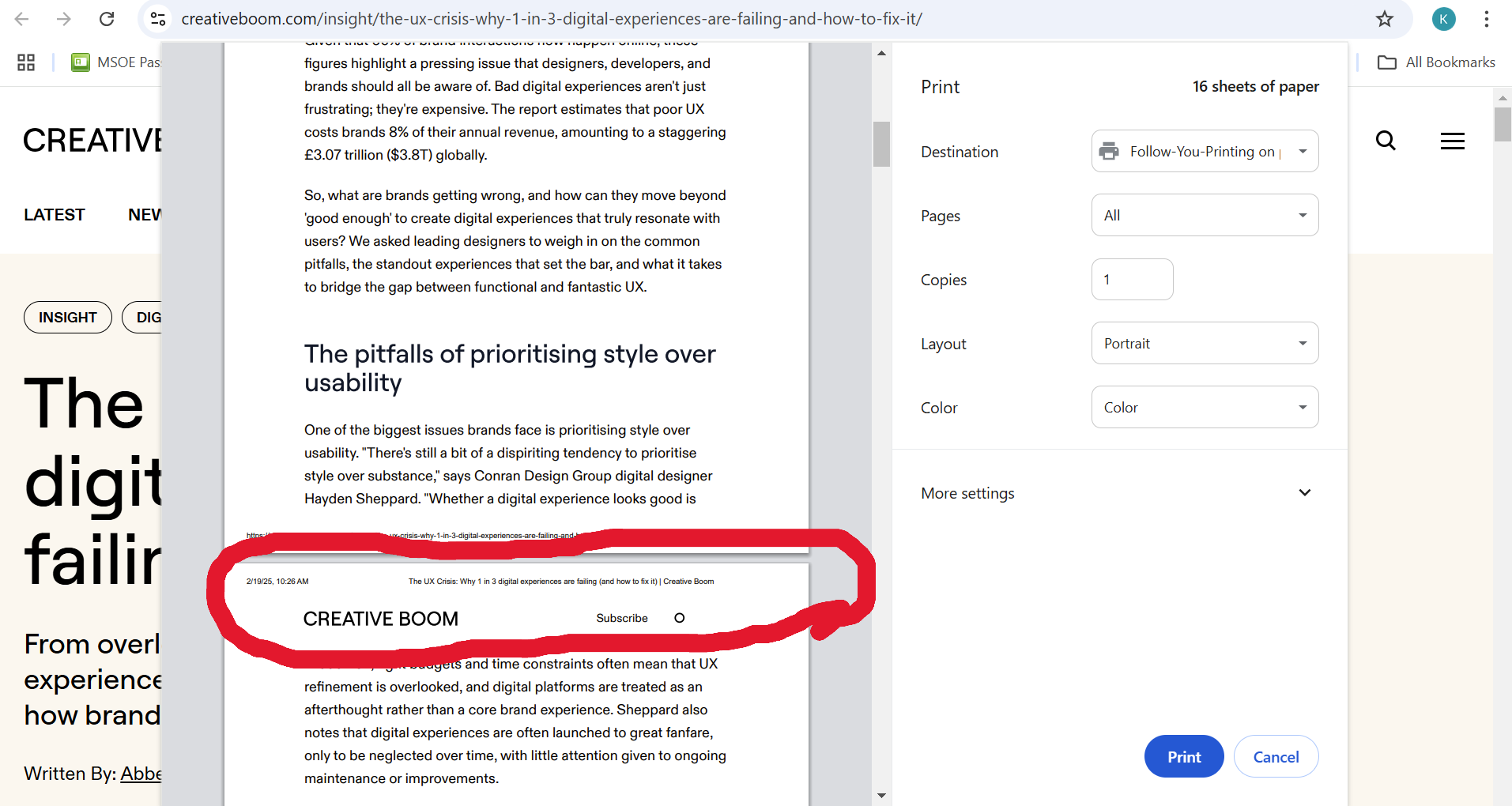
My attempt to print the article but realizing that some text was blocked by a ‘subscribe’ bar that is invisible on the screen (therefore unable to be x’d out)
The Excluded Text
Text excluded from the “print screen” by the “subscribe” bar
Oops, it seems like Creative Boom is deliberately setting out to frustrate anyone trying to print the article (or save it as a PDF) and to ensure that the only way someone can “experience” their article is to read it on their website. To put it another way, by forcing a site-specific, digital-only experience on its users (for ad $$ reasons? for increasing pressure to become a subscriber, which I thought I was already anyway?), Creative Boom limits users’ ability to shape their own experiences of the text and creates unnecessary friction as a result.
Very frustrating and disappointing. I guess I won’t be carrying around and making notes on this article after all.
I hate pop-ups and constant harassment to “subscribe” or to “lock in a 10% discount with your first order” and all the similar in-your-face aggressions of this type that websites inflict on someone who just wants to read an article or look at a potential purchase. Maybe I’ll subscribe, maybe I’ll buy—but first I want to be able to check things out and think about it a little without having to fend off the hard sell.
Call it “site abandonment,” “drop off,” “bounce,” or whatever other term might seem relevant—my decision to leave the Creative Boom website and give up on any further study of or reflection on this piece is (in my opinion) exactly the type of UX “fail” that was the whole point in the first place.
And I guess I expect better from a design publication.
[UPDATE — But, silver lining: As soon as I pressed “publish” on this post, I realized that at least this whole experience has given me an idea for a new design challenge. So there’s that! 🙂 ]
Captured on Broadway outside the Campus Center at Milwaukee School of Engineering after class late last week on the way back to my office (in the Grohmann Museum, the building seen at the left of this video). Sadly my phone didn’t capture the depth of this little snowburst, and this video is super short, sorry! But I’ve never seen anything quite like this before. At first I thought it was just snow being blown off of the trees or down from the building’s roof or maybe from the rooftops of passing cars, but it was far more sustained than that. Although you can see flashes of snow sparkling right in front of the camera, the actual impact in real life was really amazing, with glittering ice speckles flying on breezy sunlight all the way down the street.
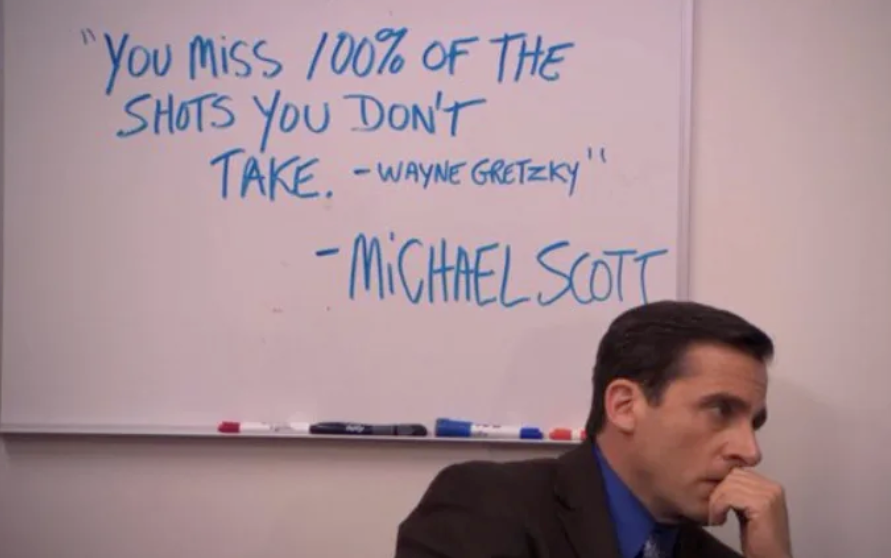
“You miss 100% of the shots you don’t take.” – Wayne Gretzky (MICHAEL SCOTT 😄)
Great quote, of course, but even more intriguing and inspiring to me is the original context in which Gretzky said it.
The passage below is from an article published in the New York Post a couple years ago (Link HERE):
The first documentation of this quote came in 1983 from Gretzky speaking to Bob McKenzie, then the editor of The Hockey News and now a commentator for TSN in Canada. Gretzky attempted the most shots in the league pretty much every season during this era, and MacKenzie asked him about it.
“You miss one hundred percent of the shots you don’t take,” Gretzky answered. “Even though there is only a 1-5 percent probably [sic] of scoring.”
Sad truth: It’s not uncommon for people to be judged negatively for having lots of failures sprinkled throughout the timeline of their careers. I initially read Gretzky’s stated sucess rate as “one in five,” or 20%, which sounded terrible enough. But no, he actually said a “1-5 percent” probability of scoring. Way worse! And yet, if you take enough shots, as Gretzky said, that 1-5% success rate can add up to a large number of goals (or other non-hockey achievements) overall.
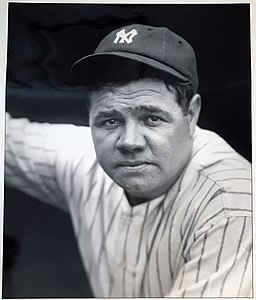
This reminds me of another sports-related truth: As a batter, Babe Ruth held the career record for strikeouts (1,330) for many years until he was overtaken by Mickey Mantle (1,710) in 1964. Babe Ruth also held the home run record (714) for almost four decades after his 1935 retirement, finally ending when Hank Aaron hit his 715th homer in 1974.
So for almost 30 years, baseball’s weakest hitter by one measure was also its most powerful by another! Kind of crazy . . . and a comforting thought for those times when failures seem to be racking up left and right.
Portrait of Babe Ruth, Charles M. Conlon, Public domain, via Wikimedia Commons
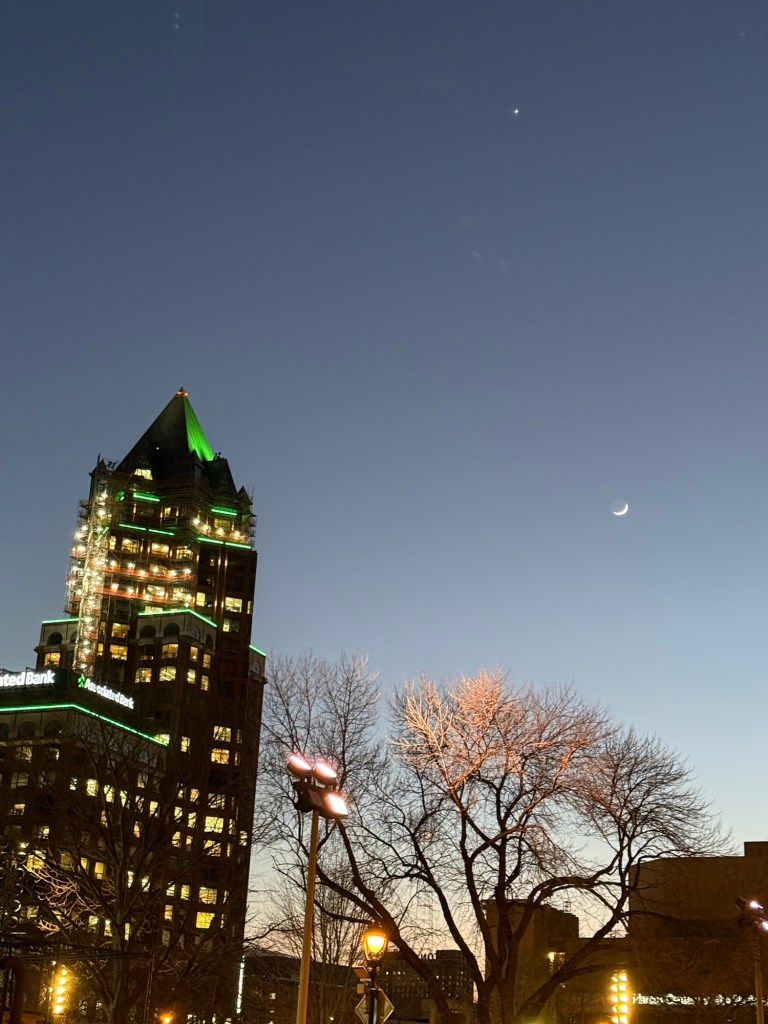
I wish I also could have gotten Red Arrow Park’s ice skating rink at the bottom of this photo, but it was windy and cold, and I was walking to my parking garage after work. Plus this was the first time I’d used the camera in my new phone, so I wasn’t very quick and familiar with it yet. Even still, I loved the colors of everything here at twilight, and the silvery sliver of moon and bright light of Venus hanging above it all was worth stopping on the sidewalk for this past Friday evening to get a picture.
UPDATE (meaning that yesterday’s “last thoughts” weren’t quite that, apparently 🙂 ) – It struck me this morning (the next day, after posting about ChatGPT’s edit of my novel scene yesterday) that my own ending was kind of upbeat and optimistic versus the ChatGPT rewrite that ended on a down note. I was going to add an update at the end of that post, but it got so long that I just decided to give space to it in a new post of its own.
Compare my original scene’s ending with ChatGPT’s revised ending.
My ending
Just for today, Jarrett decided in that split second. Just for today, he would enjoy being around her with no guilt and no worries about the future. Today was enough. Because in the end, he thought philosophically, moving toward the first mark as he and Taryn had practiced, “today” was all any of us really had anyway.
ChatGPT’s ending
Whatever this was between them, it couldn’t last. She was too young, their lives too different. When the cameras stopped, so would this.
The thought sat like a stone in his boot, impossible to shake.
My thoughts for future revisions
Remember, my original instruction to ChatGPT was:
Review and edit the following scene. My usual fault is over writing, especially using too much introspection, too much description, too much explaining, too much purple prose, for lack of a better word. Don’t over edit this scene but make any edits necessary to help it feel more literary and less like a trashy pulp novel.
It occurs to me that ChatGPTs more downbeat ending is doing exactly what I asked for: “to help it feel more literary.” Right? I don’t know why, but many of the “literary” short stories and novels I read are like that. Maybe it’s better artistically to have that “down” vibe going? But I have to think about 1) whether I want that vibe in my novel, 2) whether it fits Jarrett’s character and character arc, and 3) whether the dramatic arc of the scene, chapter, and storyline needs an “up” beat or a “down” beat in order for me to shape what I hope the reader’s experience of the novel will be.
Each of these scene endings would, of course, take place within the larger context of where the scene ultimately falls inside a chapter and inside the overall story. The scene itself is *sort of* modular, but not really. Because of the scattered way I work on this project (stealing time whenever I can from a very packed schedule), I’m writing many of my scenes as stand-alone units, but what this particular ChatGPT session has illustrated to me very clearly is that I can’t continue with the modular thinking for too much longer.
Why? Because a novel is an organic whole. It does not consist of interchangeable units. One scene flows into another, and if one scene ends on a down note, then somehow the next plot incident should either amplify that down note or reverse it, depending on the “journey” I want readers to take.
When I begin to construct the larger story arc for this section of my novel, I need to think about the dynamics of how each scene interacts with the others. Not only should I be thinking about the reader’s experience of moving through the plot’s action, but I also need to think more about Jarrett’s character arc. Is he an optimistic, high-agency person capable of willing himself to think/be/act in a certain way? Or, is he someone deficient in agency, too focused on negatives, with limited ability to envision much less move toward a better future? Where do I want him to start out as a character? Where do I want him to end up? And how will he move toward (and through) this change via the story’s plot events?
I don’t think I have anything super profound to add to this, except to say that it’s even more obvious to me now what the limits of ChatGPT are for writing. It’s the writer who needs to make decisions like the ones I described above. Once the writer has assessed the ChatGPT output and made revision decisions, they then need to communicate the new plan to ChatGPT and judge how well ChatGPT has executed the task before “recalculating” (the way GPS does when encountering an obstacle in the previously defined pathway) their “vision” for the overall piece again and moving into the next phase of crafting the text.
The writer remains at the center of the writing process, at least if the final text is going to be any good. ChatGPT truly is “just” a tool. A remarkable one, and quite fun to work with, but definitely not one capable of taking on all the work that a tired writer with a deadline might like to offload onto it.
Another ChatGPT writing exercise to share today. Quick recap: Back in late September or early October, I began using ChatGPT to generate rough drafts of scenes for my novel in response to writing exercise prompts for my writing group’s bi-weekly meetings.
I’ve posted the results several times so far, always giving 1) the writing group’s assignment/prompt, 2) my prompt/instructions to ChatGPT for writing the scene, and 3) 1-3 draft iterations of the scene returned by ChatGPT. As I’ve noted, the ChatGPT-written scenes are definitely rough drafts in need of a good dose of editing and revisions on my end. But the great thing about ChatGPT is that it feels like a writing buddy, a thought partner who can take somewhat inarticulate ideas and generate a draft (a bad draft, but a draft nonetheless) at lightning speed. Then you at least have a jumping-off point that’s way farther along than you would have gotten otherwise.
This time, though, I decided to try using ChatGPT from the other direction, using it to revise my own prose. My biggest issue with writing fiction is overwriting (self-diagnosed, of course; others may find that my biggest issues lie in other areas, lol). Not only do I always feel the need to cut wordiness and streamline the text, but I also feel that my entire voice becomes too florid, too over-the-top dramatic, even to the point of melodrama. In trying to capture emotion, I end up slaughtering the mood with descriptive overkill. Nothing subtle about it at all.
So in the scene that follows, I’ll give you my own writing first, followed by my instructions to ChatGPT to please tone it (and pare it) down, and then finally the ChatGPT-edited scene at the end.
At first, on the day of writing group, when I read the scene aloud, I was really happy with the ChatGPT version. Gone was my junky overwritten description; in its place was a nice, succinct, smoothly flowing scene, with just the right balance of action, narrative description, and character introspection. But now, in looking back over my original scene, I kind of like some of the overwritten stuff.
This is instructive. Not only do I need to revise ChatGPT-generated rough drafts, but it also looks like I need to revise ChatGPT-edits of my own rough drafts, just to restore some of the “life” that, in my opinion, ChatGPT drains out.
See what you think. The first draft below is mine. Then is my prompt asking ChatGPT to edit/revise. Then comes the ChatGPT revision. Although it’s possible I’d prefer the ChatGPT-edited version again the next time I look it over, just as I did initially upon my first review, I’m fairly confident (at least right now) that I’ll prefer to continue revising the ChatGPT version to come up with something that’s more of a “happy medium” in the end, a Goldilocks “just right” version that tones down my embarrassing propensity to overwrite yet preserves some of the characters’ emotional substance and resonance (if that’s a word that fits?) that I’m also aiming at.
The prompt for my writing group was “a friend in need.” As with my other writing group exercises I’ve posted the past few months, I’ve tried to find a way to incorporate that prompt into a scene for my novel and then also to write my scene using ChatGPT, as a fun way of immersing myself in the technology in order to gain more practice with it (because as a college professor teaching courses in writing, content design/strategy, and digital society, I am learning all this new stuff on the fly and need to develop expertise like yesterday).
First, the usual disclaimer. This is a work of fiction. Names, characters, businesses, places, events, locales, and incidents are either the products of the author’s imagination or used in a fictitious manner. Any resemblance to actual persons, living or dead, or actual events is purely coincidental.
And now, my exercise 🙂
My prompt to ChatGPT, asking for editing of my initial (overwritten) draft
Review and edit the following scene. My usual fault is over writing, especially using too much introspection, too much description, too much explaining, too much purple prose, for lack of a better word. Don’t over edit this scene but make any edits necessary to help it feel more literary and less like a trashy pulp novel. Here it is:
Jarrett tilted the brim of his hat back and squinted at the markers lined up in the dirt. The heat of the New Mexico sun beat down, flattening the shadows and leaving no room to hide from its relentless glare.
Taryn crouched nearby, her small hands smoothing out a scuff one of the crew had left behind and replacing the beige golf tee that served as her mark. She looked so small in the harsh light, her slight frame swallowed up in a loose button-down and jeans. Fragile, like she’d blow away with the next gust of desert wind. But ten weeks into the shoot, Jarrett knew better. Taryn was one of the strongest people he’d ever seen.
“You’re still a step off here,” she said, standing and brushing the dust from her hands. Her voice was cheerful, no hint of frustration despite his inability to get it right. “Try walking it back again.”
Jarrett sighed but did as she asked, pacing backward along the imaginary trail she’d set for him, counting his steps until he hit the black golf tee that marked his own starting point. “Why does it even matter? Nobody’s looking at my feet anyway.”
“It’s not about your feet,” Taryn said, walking back to stand beside him. “It’s about timing. If you’re too late, the camera misses the turn. If you’re too early, the moment falls flat. It’s like you’re dancing with the camera.”
Jarrett raised a skeptical eyebrow. “Dancing?”
“Kind of. Except less fun and more yelling.”
Almost on cue, as if to illustrate her words, the faint sound of Cameron’s voice cut across the set, sharp and rising. Jarrett glanced over his shoulder toward the director, who was pacing back and forth, phone pressed to his ear. Even at a distance, Jarrett could see his agitation, the way he flung his free hand through the air, swatting invisible flies. The crew did a pretty good job of ignoring him and continuing their work, but even from a distance, Jarrett could feel the tension crackling in the air.
Taryn didn’t appear to notice. She simply adjusted her stance and motioned for Jarrett to follow her. “Okay,” she said. “This time, count your steps. You’ll stop here on ‘You’ve got a lot of nerve,’ and turn at—”
“‘—But so do I,’” Jarrett finished for her. He rubbed the back of his neck, feeling the weight of the sun and the lines he’d repeated so many times they’d lost meaning.
“Exactly.” Taryn beamed at him, and he felt that skittering sensation at the base of his sternum, like his heart had skipped a beat, which was becoming all too frequent lately whenever she smiled at him.
She moved in front of him, pointing to each mark in turn. “Let’s do it together. Walk with me, and I’ll count while you do your gestures and expression.”
Jarrett followed her lead, their feet crunching softly in the dry dirt. For a moment, it felt like they were two kids playing a game, her quick, light steps a rhythm he tried to match as they paced off his movements. He almost forgot why he’d been so frustrated.
He looked up as they walked, alerted as he hit the first mark by the imaginary sound of her arrival on horseback. Scowling, he stalked toward the camera, crossing his arms and tightening his jaw in outraged disbelief as he halted on the second mark.
“Now,” Taryn said, stopping with him. “Add the words.”
Jarrett conjured up a cynical smirk. “You’ve got a lot of nerve, Rose,” he drawled, injecting the line with all the cowboy grit he could muster.
Taryn tilted her head, lips pursed. “Maybe less John Wayne and more . . . just you. Mean it. Like what you told me about singing.”
Hearing his own advice turned around like that clicked. He went again, this time trying to feel the emotion and letting the scripted words roll out naturally like they were his own. Taryn’s face lit up with approval, and he felt that disconcerting flutter again.
“Beautiful,” Taryn said. “Now hit the next mark while I’m saying my lines, then grab my hand and pull me toward you the moment I’ve closed the gate.”
As they ran through it again, he was gratified to see all the various parts—the marks, the actions, the lines—begin falling into place, fitting together smoothly and naturally. It was like dancing, like finally knowing the steps well enough to transcend them and become lost in the movement.
It felt good.
Even better, it felt real.
Cameron’s voice broke through their rhythm, cutting through the set like a whip. “No, no, NO!” he shouted, and then, louder: “A friend in need is a pain in the ass!”
Jarrett froze, his boot skidding slightly in the dirt. Taryn looked up, her lips twitching. Their eyes met, and in an instant, they were both stifling laughter.
“I don’t think Cameron understands that saying,” Taryn murmured, a mischievous light in her eyes.
Jarrett snorted. “I don’t think Cameron understands a lot of things.”
They shared a conspiratorial grin as Cameron stormed off the set still arguing on the phone. Jarrett’s gaze drifted past him toward Taryn’s mother, Michelle, seated under a canopy at the edge of the set. Day after day she sat there, unmoving and expressionless, her face hidden behind oversized sunglasses, long blonde hair gleaming in the sunlight.
As Jarrett watched, Michelle raised the metal water bottle in her hand, the only movement she ever seemed to make, and took a casual sip. He couldn’t help but wonder—again—if it was spiked. He doubted there was much of anything hydrating in that bottle.
He huffed a short, humorless chuckle, grimacing at the turn his thoughts had taken. Took one to know one, apparently.
Taryn had apparently heard because he saw her look his way expectantly.
“Is she okay?” he asked, nodding toward Michelle to avoid the scrutiny of those too-knowing silver eyes.
Taryn followed his gaze, her smile dimming slightly. “I don’t know. It’s complicated.”
Jarrett didn’t push. There was something in her voice—matter of fact but protective—that he was coming to understand. Taryn had a way of deflecting questions about her mom, like she’d built a wall around whatever was really going on.
He tried to think of a new topic, but Taryn got there first. She pointed discreetly toward the camera. “Look who’s back and pretending that whole phone debacle never happened,” she said.
Jarrett glanced over. Cameron was engaged in a quiet but serious-looking conversation with Tony, the assistant director. He must have skirted behind the building facades and trees to get there without returning the way he’d left.
“Ready to try it again?” Taryn asked, turning back to him.
Jarrett nodded, feeling the familiar tension rise. If Cameron was finished with his phone call, he’d probably be ready to shoot soon and complaining loudly to the entire set about how he’d gotten stuck with a hapless musician as his lead actor.
He hated how incompetent Cameron made him feel.
But as he and Taryn rehearsed, Jarrett felt the tension ease. Taryn’s calm, steady presence was soothing and allowed him to slow down his thoughts enough to get out of his own head. He found himself detaching, watching her more than the markers. The way her hair caught the light when she moved, the curve of her smile when she thought he’d nailed a line, the effortless way she made him feel like he wasn’t completely out of his depth. Taryn was the one person on this chaotic set who didn’t make him feel like he was failing. She didn’t have to help him with his acting—she could’ve left him to flounder—but she didn’t seem to mind. She made it seem easy, like she even enjoyed it.
“Jarrett.” Taryn’s voice pulled him back.
“Yeah?”
“You’re getting it,” she said, smiling.
Jarrett grinned back, knowing it was true. In the last run-though he’d hit all the marks, said all the lines right, and felt all his emotions in exactly the correct sequence.
“It’s like floating,” he said. “Like hitting the high note. Like great . . . “
Sex.
“Dancing,” he finished smoothly, hoping to erase the unspoken word he’d left hanging.
Thankfully, Taryn didn’t seem to notice. She gave his hands a quick squeeze, which then made him realize he hadn’t let go of hers when their scene ended. An urgent impulse to release them now seized him. But he resisted, for she would wonder why, might feel rejected and hurt. Instead, the moment lingered, and they stood in the center of the dusty corral, hands clasped, smiling at each other.
Ah, Taryn’s smile. He loved the way it transformed her already beautiful features into something even more exquisite, something magical and ethereal. There was no other way to describe it. When she smiled, she was radiant, and her strange, silver eyes shone with an otherworldly glow. Everyone liked Taryn; she had a talent for putting people at ease. Even the grumpiest members of the crew found it impossible to remain surly around her. Her cheerfulness was uplifting and made everyone want to be better, including him. No one could resist her light-filled smiles.
Lately, though, those smiles had started doing funny things to his heart.
He kept finding excuses to be around her. Although he was grateful for her help with his acting, what really mattered was simply being near her. Some mornings, when he was especially miserable about being stuck on the show, the prospect of seeing Taryn was the only thing that got him out of bed.
She fascinated him. The feathery whisper of her voice, the crisp, delicate line of her jaw. Her slender hands and wrists, encircled by their sliver-thin turquoise and silver bracelets. The auburn streaks that had developed in her long, dark hair under the New Mexico sun. Her skin had darkened, too, heightening the contrast of those silver eyes under the dark slash of her brows.
And then the discomfort settled in, like a stone in his boot.
She was just a kid. Or at least, that’s what he kept telling himself. But Taryn was everything he hadn’t known he needed: patient, kind, someone who truly saw him. He felt drawn to her despite his stern resolve to keep his distance. Her gentle inner light, the way she seemed to see beauty in everything awakened his protective instincts and made him feel things he wasn’t sure he should.
Things he didn’t want to feel. That might be wrong.
Things he didn’t want her to know.
They were still holding hands and gazing into each other’s eyes. Next week she would turn eighteen, one part of his mind rationalized, which another part of him immediately rejected with disgust. God, he was no better than Cameron!
Jarrett let go of her hands and glanced away, the realization settling heavy in his chest. What was he doing? Taryn was his “friend in need,” his lifeline in this mess of a job. Whatever this feeling was growing between them, it couldn’t last, shouldn’t even be acknowledged.
She was too young, their lives were too different, and once the cameras stopped rolling, she’d go her way, and he’d go his.
He could hardly bear the thought.
Just then, the assistant director called for quiet on the set, and everyone started getting ready for the next take. Taryn smiled encouragingly up at Jarrett as they walked back into position and surrendered themselves to quick last looks from hair, makeup, and wardrobe.
She didn’t know, Jarrett realized with sudden relief. It was a gift. He could still turn things around. He resolved to see her as the young girl she still was. They would be friends. She would continue helping him with his acting, and he would keep teaching her guitar.
“Lock it down,” called the AD. The extras took up their places behind them, lounging along the fence and beside the shed.
Jarrett glanced at Taryn. Her eyes were closed, and he knew she had gone to that place inside herself to find her character. He should be doing that, too. But the truth was, unlike Taryn, who bore virtually no resemblance to Rose, Jarrett was never anything other than himself. He wasn’t an actor; he was a musician. And no one expected anything more than that except Taryn. She seemed completely confident that he could become Sam.
Despite how much he disliked doing the show and despised Cameron, Jarrett nonetheless found himself looking forward to each day. No matter how foolish, he wanted to live up to Taryn’s earnest belief in him.
“Rolling!” called the AD.
“Speed!” called the camera operator and sound mixer in response. A crew member announced the scene and take, then clapped the slate in front of the camera. The AD called for quiet on the set, and an eerie silence descended as everyone waited for Cameron’s signal for action.
Time hung, suspended.
Just for today, Jarrett decided in that split second. Just for today, he would enjoy being around her with no guilt and no worries about the future. Today was enough. Because in the end, he thought philosophically, moving toward the first mark as he and Taryn had practiced, “today” was all any of us really had anyway.
ChatGPT said:
This scene has great potential, with strong character dynamics and an engaging setting. However, it does suffer from the issues you flagged: over-explaining, excess introspection, and a tendency to belabor descriptions or emotions. Below is a revised version with tighter prose, clearer focus, and a more literary tone, while retaining the heart of your story.
Jarrett tipped his hat back and squinted at the markers lined up in the dirt. The New Mexico sun beat down, flattening shadows and leaving no room to hide.
Taryn crouched nearby, smoothing out a scuff in the dust and resetting the beige golf tee that marked her spot. She looked small in the harsh light, her slight frame swallowed up in loose clothes. Fragile, Jarrett thought—but ten weeks into the shoot, he knew better. Taryn was steel wrapped in sunlight.
“You’re still a step off here,” she said, standing and brushing her hands. Her voice was cheerful, free of frustration despite his repeated missteps. “Try walking it back again.”
Jarrett sighed but did as she asked, pacing back along the imaginary trail, counting steps until he hit his mark. “Why does it even matter? Nobody’s looking at my feet.”
“It’s not about your feet,” Taryn said, joining him. “It’s about timing. If you’re too late, the camera misses the turn. Too early, and the moment falls flat. It’s like dancing with the camera.”
“Dancing?” He raised a skeptical eyebrow.
“Less fun, more yelling,” she replied, just as a sharp voice cut through the set.
Jarrett glanced toward the director, Cameron, pacing in the distance with a phone pressed to his ear. Even from here, his agitation was obvious—wild hand gestures swatting invisible flies. The crew worked around him, heads down, but the tension rippled across the dusty lot.
Taryn didn’t seem to notice. She adjusted her stance, motioning for Jarrett to follow. “Count your steps. Stop on ‘You’ve got a lot of nerve,’ and turn at—”
“‘But so do I,’” Jarrett finished. He rubbed his neck, the heat and endless repetition draining the life from the lines.
“Exactly.” Taryn smiled, and something skittered in his chest—a too-frequent sensation these days.
She walked ahead, pointing to each marker. “Let’s do it together. Walk with me.”
Jarrett followed, their footsteps crunching in the dirt. For a moment, it felt like a game, her light steps setting a rhythm he matched instinctively. The frustration ebbed.
He hit his first mark and scowled, imagining the camera’s frame. His lines came easier this time, the smirk more natural.
“You’ve got a lot of nerve, Rose,” he said, the drawl effortless now.
Taryn tilted her head. “Less John Wayne. Just you. Mean it.”
Hearing his own advice echoed back startled him. This time, he let the words roll out as if they were his own. Taryn’s face lit up, and there was that flutter again, maddeningly out of his control.
“Beautiful,” she said. “Now hit the next mark after I close the gate.”
The scene clicked, piece by piece, until it flowed naturally. It was like dancing, Jarrett thought. The steps melted away, leaving only the movement.
Cameron’s voice cracked through their rhythm. “No, no, NO!” He bellowed louder, “A friend in need is a pain in the ass!”
Jarrett froze, his boot skidding in the dirt. Taryn looked up, lips twitching. Their eyes met, and they stifled laughter.
“I don’t think Cameron understands that saying,” she murmured.
“Cameron doesn’t understand a lot of things,” Jarrett replied, his voice low.
Their shared grin lingered, but Jarrett’s gaze drifted to the edge of the set, where Michelle, Taryn’s mother, sat beneath a canopy. Day after day, she was a fixture, unmoving, her face hidden behind sunglasses, blonde hair gleaming in the sun.
Michelle raised a metal water bottle and took a slow sip. Jarrett’s mouth twisted. He doubted hydration was the goal.
“She okay?” he asked, nodding toward her.
Taryn followed his gaze, her smile dimming. “I don’t know. It’s complicated.”
Jarrett didn’t press. Taryn guarded her mother’s secrets like precious cargo, deflecting questions with quiet finality.
She gestured toward the camera. “Look who’s back, pretending nothing happened.”
Cameron had returned, deep in conversation with the assistant director. His earlier theatrics were wiped clean, as if erased by sheer will.
“Ready to go again?” Taryn asked, turning back to Jarrett.
He nodded, though tension coiled in his chest. Cameron would expect perfection, eager to remind everyone how unqualified the “musician” was for this role.
But as they rehearsed, the pressure receded. Taryn’s steady presence was an anchor. She didn’t just help—she made it feel easy, even enjoyable.
“Jarrett.”
“Yeah?”
“You’re getting it,” she said, smiling.
He was, he realized. “It’s like floating,” he said, wonder creeping into his voice. “Like hitting the high note. Like—”
Sex.
“Dancing,” he finished hastily.
Taryn didn’t seem to notice. She squeezed his hands briefly, grounding him, but didn’t pull away. The moment lingered, and Jarrett felt the weight of it settle, heavy and undeniable.
He stepped back, breaking the connection. Taryn’s eyes flickered with hurt, and guilt twisted in his chest.
Whatever this was between them, it couldn’t last. She was too young, their lives too different. When the cameras stopped, so would this.
The thought sat like a stone in his boot, impossible to shake.
My last thoughts
I do like the flow of the ChatGPT revision, as I said earlier. I like how streamlined it is. It doesn’t embarrass me the way my original rough draft’s overdone description does. But now I want some of the emotion and too-flowery description back. Figuring out the “good stuff” and leaving the majority behind will be a challenge.
But as William Faulkner said, you have to kill your darlings. Or murder them. Whatever he said. (Although, side note: Have you read William Faulkner? I don’t see much evidence of darling-killing in his dense prose. Imagine what it was like before the edits!)
If I ever finish my novel and publish it, you can decide for yourself how skillfully I wielded the scalpel.
UPDATE (So, not quite my last thoughts apparently 🙂 ) – It struck me this morning (the next day, after posting this yesterday) that my own ending was kind of upbeat and optimistic versus the ChatGPT rewrite that ended on a down note. I was going to add an update at the end of this post, but it got so long that I just decided to give space to it in a post of its own. Check out my new thoughts in the post dated January 31, 2025.
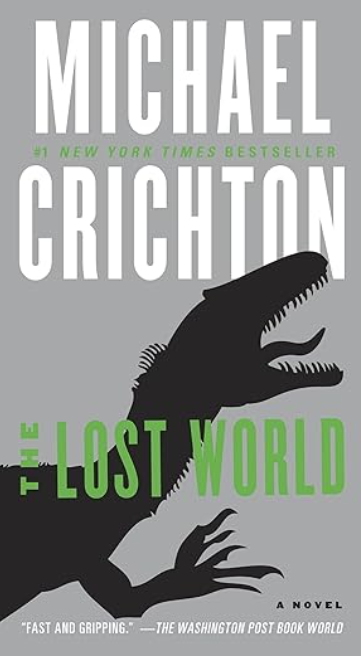
I’m teaching “Digital Society” this semester, and as fate would have it, over my holiday break I decided to read Michael Crichton’s The Lost World, a novel I’d never read before even though I love Michael Crichton and have probably read everything else he’s written.
I said “as fate would have it,” because if I’d read this book when it came out thirty (30!!!) years ago, I might not have paid as much attention to Ian Malcolm’s monologue/lecture on chaos and evolution. Crichton manages to insert this lengthy “idea” passage pretty effectively plotwise during a convenient breather in the otherwise nonstop action. Instead of pedantic background narrative, Crichton positions this “rant” as a rather endearing one-sided stream of consciousness “conversation” Malcolm has with Sarah Harding arising from the morphine haze she’s put him into while she’s fixing his injured leg (broken, I think, but that was a couple weeks ago, and there’s a lot of action, injury, and death in this book—hard to keep it all straight 🙂 ).
Ian Malcolm’s ideas seem chillingly prescient considering the massive sway the internet holds over human society today and particularly given the hyper-fast cycles of AI development we’ve seen in the past couple of years. Much to think about here, especially as we (collectively, as humans) have a vested interest in extending the duration of human existence and human reign over the planet as long as possible.
Here’s the quote that caught my eye. This passage may seem long, but it is just a fraction of Malcolm’s entire speech. Fascinating stuff. I love how Crichton can deliver such intellectual ideas in a way that feels natural and makes learning and thinking about complex topics so easy!
“[…P] ersonally, I think cyberspace means the end of our species.”
“Yes? Why is that?”
“Because it means the end of innovation,” Malcolm said. “This idea that the whole world is wired together is mass death. Every biologist knows that small groups in isolation evolve fastest. You put a thousand birds on an ocean island and they’ll evolve very fast. You put ten thousand on a big continent, and their evolution slows down. Now, for our own species, evolution occurs mostly through our behavior. We innovate new behavior to adapt. And everybody on earth knows that innovation only occurs in small groups. Put three people on a committee and they may get something done. Ten people, and it gets harder. Thirty people, and nothing happens. Thirty million, it becomes impossible. That’s the effect of mass media—it keeps anything from happening. Mass media swamps diversity. It makes every place the same. Bangkok or Tokyo or London: there’s a McDonald’s on one corner, a Benetton on another, a Gap across the street. Regional differences vanish. All differences vanish. In a mass-media world, there’s less of everything except the top ten books, records, movies, ideas. People worry about losing species diversity in the rain forest. But what about intellectual diversity – our most necessary resource? That’s disappearing faster than trees. But we haven’t figured that out, so now we’re planning to put five billion people together in cyberspace. And it’ll freeze the entire species. Everything will stop dead in its tracks. Everyone will think the same thing at the same time. Global uniformity. [..]”
― Michael Crichton, The Lost World, published in 1995