
I suppose every generation believes it has discovered something new when actually that something has been around not just for a while but for a very long time. Like, sometimes centuries!
Let me start off with a little Milwaukee hometown bragging. You know how people sometimes cut stripes or diamond patterns in their lawns? And they got the idea from seeing similar designs cut into the grass of Major League Baseball stadiums’ outfields?
Well, this technique began in Milwaukee, in 1993, when the Milwaukee Brewers’ assistant groundskeeper, David Mellor, cut a fancy diamond pattern in the team’s then-home, County Stadium, to distract from a muddy, damaged section of lawn in front of the stage for a Paul McCartney concert that had taken several rainy days to set up. Soon Mellor was routinely creating elaborate patterns in the outfield, and it didn’t take long after that before groundskeepers for other baseball teams began copying his handiwork.
Mellor is now Senior Director of Grounds for the Boston Red Sox Baseball team at Fenway Park, where he has worked since 2001. Here’s a great interview with him that I found on YouTube, where he is indeed credited with starting the craze for cutting patterns into grass.
As the “Stripe Your Lawn Like the Major Leagues” video above shows, the stripes are achieved by light reflecting (or not reflecting) off of the roller-bent blades of grass, depending on which way the grass now lies.
David Mellor’s life story is really inspiring. At age 18 he was struck by a car and suffered an injury that ended his dream of playing professional baseball. Although he was on crutches for three years, he managed to land a job as a major league groundskeeper after college. He’s written two books on lawn care and has a new book coming out that chronicles his experiences with PTSD after sustaining a sequence of serious injuries from being struck by cars three separate times in his life and enduring 43 surgeries. For more info on Mellor, here’s a link to his website: https://www.davidrmellor.com/
Anyway, getting back to the grass, I always thought that these elaborate, decorative outfield designs were a late 20th-century invention associated with Major League Baseball. And then one day I was watching Downton Abbey, the Season 6 episode where Mary’s beau, Henry, is racing at Brooklands Race Track (a newly-built facility in 1925, when this episode is set) and saw this.

What?
I already know better than to accuse Downton Abbey of anachronisms (e.g., see my post “A Downton Abbey anachronism?” and the many replies, leading to the correct determination that no indeed, “Downton Abbey” was not guilty of inserting an anachronism into Season One, Episode Three). So I did some online poking around and discovered that 1) the lawn mower was invented in 1830 (where else but in England, home of those stately country mansions surrounded by expansive lawns of lush, green grass) and that 2) one by-product of this newfangled equipment was its ability to create stripes in said lawns, simply by virtue of the rollers that were situated behind the blades in order to flatten down any unevenly cut spots.
That’s right. By the time of Henry’s motorcar race at Brooklands in 1925, lawn striping would have been about 100 years old.
In a related “everything new is old” moment, I was reading a Wall Street Journal article on home decoration last spring that showed a photo of some wallpaper in a familiar-looking pattern. Then I saw this text:
In the bar, the chromatically bold wallpaper, a historic flame stitch reinterpreted by British purveyor Fromental, is accurate to the 1700s.
From “This English Country Home Is a Master Class in Decorating With Personality,” Wall Street Journal (April 20, 2023)
What?
I thought this vaguely zigzagged look was from the early 1970s. Lots of girls at my junior high school wore knit sweaters in this pattern, and I thought it was the coolest, most mesmerizing psychedelic design ever.

Results of Google image search for “1970s flame stitch sweater”
Well, it certainly was cool. It definitely was mesmerizing.
But as it turns out, it was absolutely NOT “psychedelic,” a word coined in 1956 by English psychiatrist Humphry Osmond in a letter to Aldous Huxley to describe his drug-distorted experiences under the influence of mescaline.
Nope, the “flame-stitch” pattern, as it’s called, long predates the hallucinatory LSD trips of the 1950s. According to this article in a magazine called “Frederic,” the pattern (in general) dates at least as far back as 5th-century Greece (shown in a mosaic tile-floor pattern) and 12th-century Sweden (shown in the Skog tapestry, documenting Scandinavian monarchs shortly after the region’s conversion to Christianity). It emerged in something more closely resembling the modern pattern in 17th-century Italy and quickly began showing up across Europe but especially in 18th-century France and England in everything from shoes to clothing and home décor.
Who knew? Not me, for sure.
So once I’d been reminded of this stitch pattern that had so fascinate me in my junior high school days, I noticed it pop up in a fun Monk episode in which it’s worn by the mom in a fictional “Brady Bunch” type TV show called “The Cooper Clan,” complete with 1970s-era-appropriate clothing and home décor.
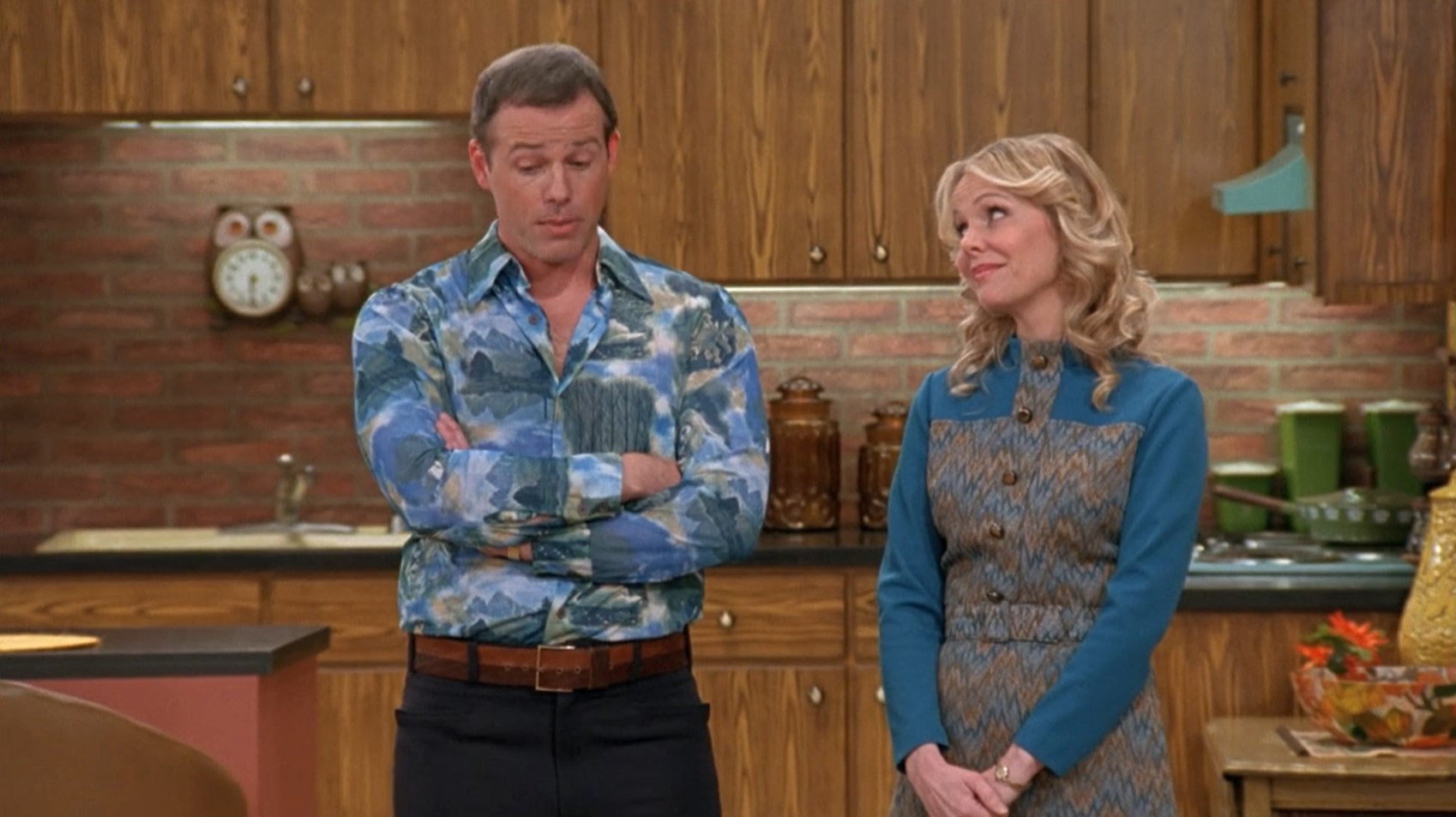
From “Mr. Monk’s Favorite Show” (Season 8, Episode 1)
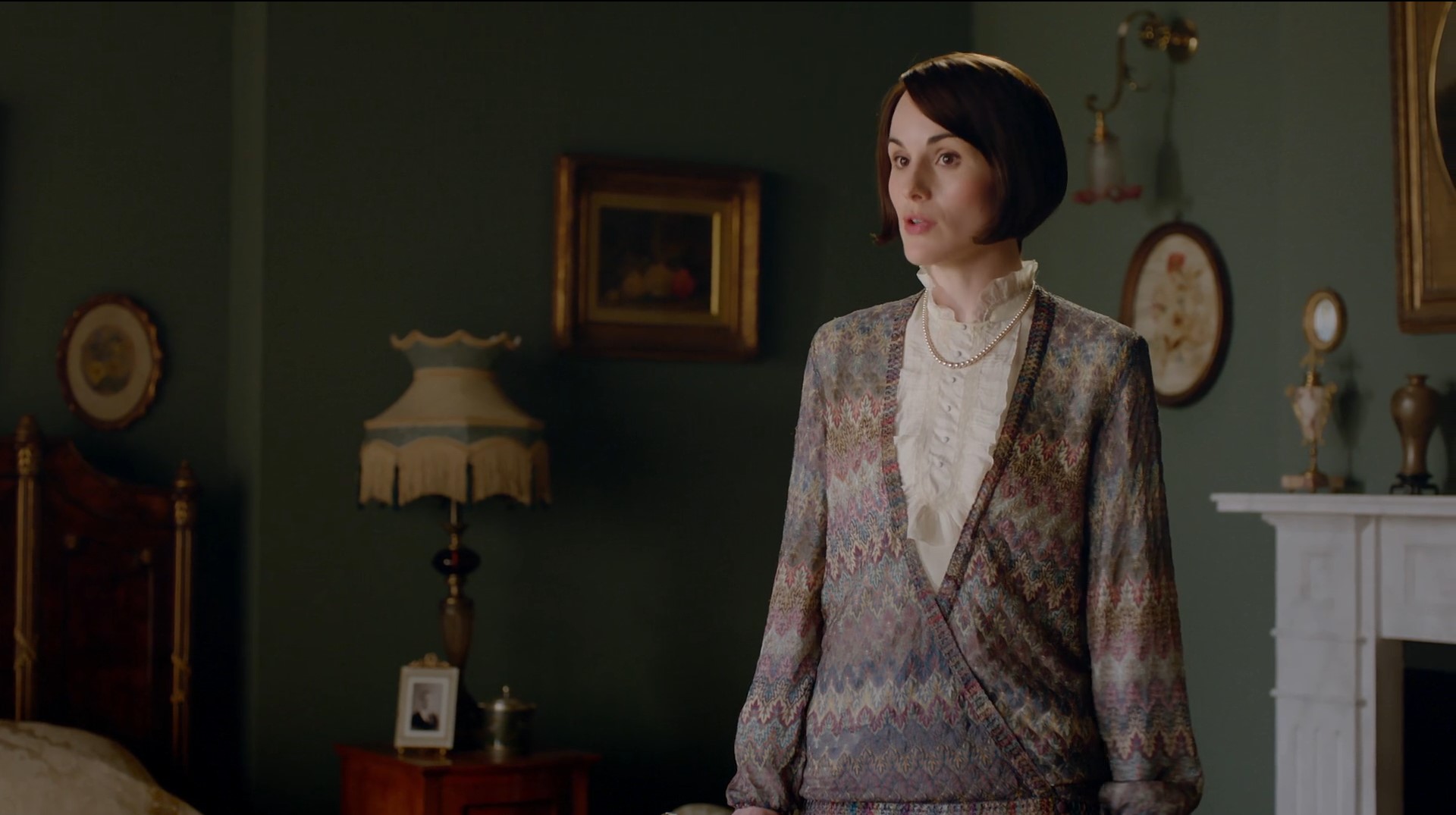
And then, not long after, it turned up again in that same Downton Abbey season, set in the year 1925, in a sweater worn by the oh-so-elegant Lady Mary Crawley (both images below from Season 6, Episode 8).

In a different vein but still somewhat related to all this, I have spent my whole life seeing the derivative (usually in the form of parody) long before discovering the original that the copy was taken from.
For example, my introduction to Charles Dickens’ “A Christmas Carol” came from a 1962 (in reruns! I’m not quite that old!) television special, in which Scrooge is played by Mr. Magoo, who is voiced by Jim Backus.
And, of course, speaking of Jim Backus, my first introduction to Shakespeare’s “Hamlet” was the brilliant “Gilligan’s Island” episode (“The Producer”), in which the gang tries to impress marooned movie impresario Harold Hecuba (Phil Silvers) with their musical staging of “Hamlet,” in hopes that he’ll take them back to Hollywood with him when he’s rescued. (Unfortunately for them, he sneaks off the island having stolen their idea, as revealed shortly afterward via a news broadcast received on the radio that is the castaways’ link to the outside world.)
Speaking of Hollywood impresarios, I didn’t know till much later (the baggy-thighed jodhpurs were my clue) that director Roscoe Dexter (“Dex”) in Singin’ in the Rain (featured in one of the film’s funniest scenes below, involving that newfangled “sound” technology) was actually a stand-in for the extremely famous director Cecil B. DeMille, whose work spanned the silent era through the 1956 VistaVision epic The Ten Commandments.

Cecil B. DeMille, Columbia Broadcasting System-CBS, Public domain, via Wikimedia Commons
And who could forget Dan Aykroyd’s contributions to my well of cultural knowledge?
First was his hilarious and bloody “French Chef” sketch on “Saturday Night Live.” Only later did I learn who Julia Child was (and that she actually had cut herself with a knife on camera while filming her television show).
And then there was this guy, Dan Aykroyd’s chain-smoking, late-late-night talk show host.
Who I (much) later found out was actually a real talk-show host, Tom Snyder (born and raised in Milwaukee, FYI, to work in another plug for my city 🙂 ).
Looking for some “real” Tom Snyder clips, I came across these. First, Tom Snyder interviewing KISS, one of my favorite bands during high school.
And then, this one, an interview with one of my favorite directors, Alfred Hitchcock.
(Note: I don’t really expect anyone reading my blogpost to actually sit here and watch all these clips. Including them is mostly a way for me to save them in one spot so I can come back and view them later. But this also makes it easy for you to click and view immediately if you’re curious 🙂 )
There are probably quite a few more examples of me being late to the party, as it were, thinking the derivative was the original, but I can’t think of any at the moment off the top of my head. I can always update this post once I remember them, which will probably happen here and there while standing in line at the post office, walking on the treadmill, or performing some equally mundane activity.
And my point?
Well, nothing earth shattering, naturally. Lawn stripes? Mr. Magoo? Musical “Hamlet”?But maybe this: Even as it’s disconcerting to realize that we humans keep repeating ourselves while naively believing we’ve created or encountered something “original,” it’s also sort of reassuring to realize how permanent things are. Quality endures, and nothing good, essential, or “true” is ever really lost or discarded.
In fact, perhaps one purpose we have as humans living in our own accidental period of history is to keep finding and “recognizing” all those things worthy of rediscovery.


 Katherine Wikoff
So interesting! (Golf courses cut grass in designs as well. )
LikeLiked by 1 person
I didn’t know that about golf courses!
LikeLike
As was said long, long ago: “What has been will be again, what has been done will be done again; there is nothing new under the sun.” But, yeah, every generation seems to have to relearn that.
LikeLiked by 1 person