One of my favorite scenes in the movie Working Girl comes near the end, where our heroine, Tess (Melanie Griffith), seizes a last-ditch opportunity to stop her boss, Katherine (Sigourney Weaver) from stealing her deal. After Jack (Harrison Ford) corrals their potential client into an elevator alone with them for the ride up to the mergers and acquisitions offices high in the World Trade Center, Tess delivers the OG high-stakes elevator pitch by explaining how she came up with her inspired, out-of-left-field idea that the client’s company, looking to invest in television networks, acquire a radio network instead.
And here’s the text in print (in case the clip is ever taken down by the person who posted it on YouTube, or in case you’d rather just read):
Okay. See, this is Forbes. It’s just your basic article about how you were looking to expand into broadcasting, right? Okay now, the same day—I’ll never forget this—I’m reading page six of the Post, and there’s this item on Bobby Stein, the radio talk show guy who does all those gross jokes about Ethiopia and the Betty Ford Center. Well, anyway, he’s hosting this charity auction that night: Real blue bloods, and won’t that be funny. Now turn the page to Suzy, who does the society stuff, and there’s this picture of your daughter. See, nice picture. And she’s helping to organize the charity ball. So I started to think: Trask . . . radio, Trask . . . radio.” And then I hooked up with Jack, and he came on board with Metro, and…and so now here we are.
In a similar, though much lower-stakes, moment earlier in the film, Tess suggests to Katherine that they serve dim sum dumplings at a reception instead of the usual appetizers. When she mentions that she’s been reading about them in W (a fashion magazine), a snooty colleague of her boss sneers, “You read W?”—the implication being that Tess, a Staten Island girl with the accent to prove it and a wardrobe to match, couldn’t possibly be reading a “cool kids” publication like W.
Tess keeps her cool, though. Her response (and the setup for her later moment of triumph) is blunt and simple:
I read a lot of things. I mean, you never know where the big ideas could come from. You know?
Changing the subject a bit, but along these same lines, I just found an extrememly interesting (and very readable!) article, “Bloom patterns: radially expansive, developable and flat-foldable origami,” written by an engineering professor, an origami artist, and an engineering student who has been fascinated by origami his entire life.
I actually listed the authors backwards just now to call attention to something unusual—and the reverse of how publishing ordinarily works in the fields of science, mathematics, and engineering. In the case of this article, the engineering student, Zhongyouan Wang, is actually the lead author!
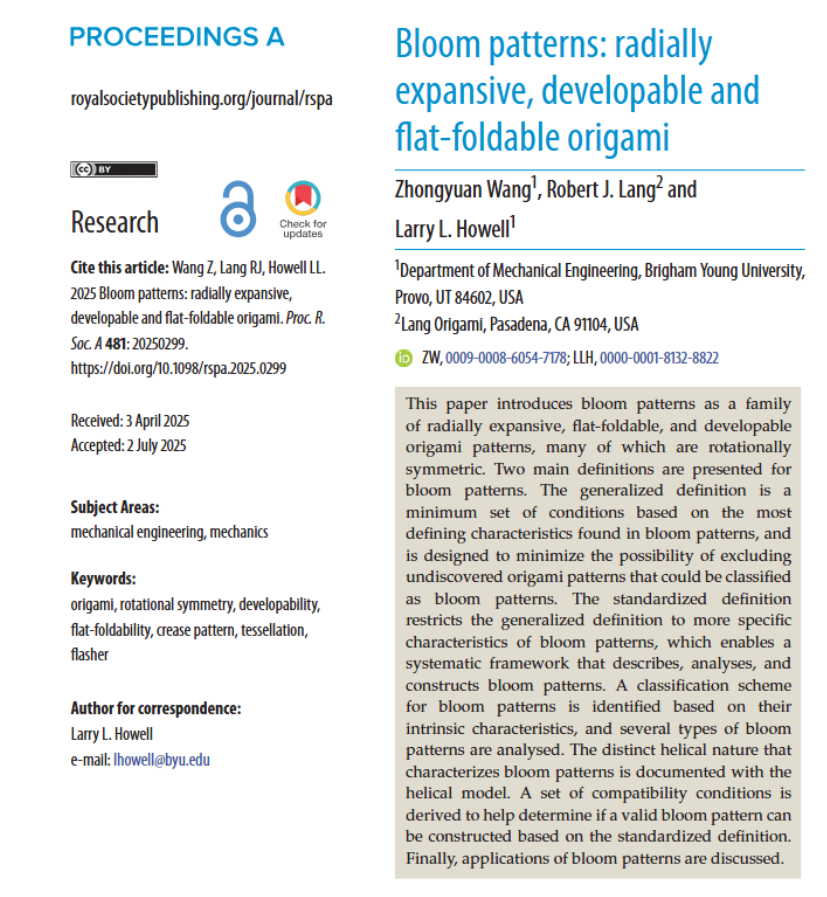
“Bloom patterns: radially expansive, developable and flat-foldable origami” https://royalsocietypublishing.org/doi/epdf/10.1098/rspa.2025.0299
As he should be, because Wang is the creator of a unique new type of origami that “blooms” in radials from a center, like a flower. Although many different “bloom pattern” design variations may be created, they will all have that centerpoint in common, like the flower head or disk at the center of a daisy.
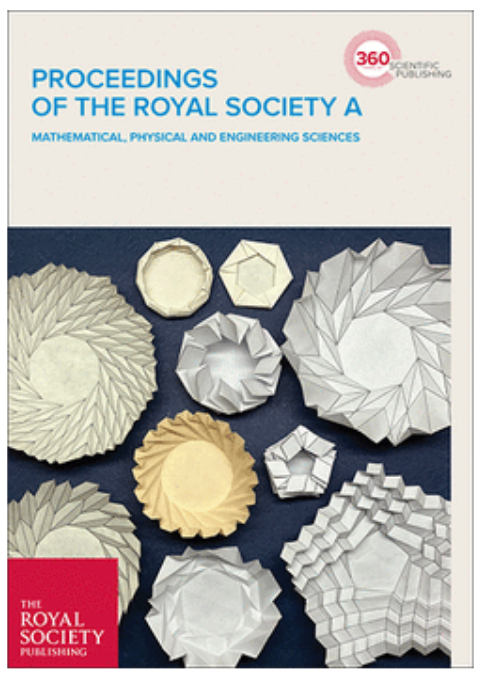
Cover, Proceedings of the Royal Society A: Volume 481, Issue 2320 (Aug 2025)
From a news story published by Brigham Young University this week:
The researchers coined the term “bloom patterns” to describe this new group of unfolding mechanisms that resemble flowers blooming.
“Bloom patterns have three main characteristics that make them unique,” said Wang, a BYU mechanical engineering major. “First, they can be folded flat. Second, they are deployable. Third, they expand like a flower blooming, rotating from a symmetric center.”
In terms of engineering applications, this means that large items that require compact size for storage could be manufactured via origami folds from a single large sheet of material, stored in its fully-folded form, and then either partially or completely “deployed” to become take on the desired final shape. Something like this could give a whole new spin to concepts like prefabricated architecture, for example. The researchers note that the rotational symmetry and somewhat circular shape of the deployed structures give these items more stability than similar structures created using other (non “bloom”) origami folding patterns.
Here’s a video from Brigham Youg explaining this origami and its engineering applications potential.
Hmm, I love the creativity of this mashup:
Origami . . . engineering.
Origami . . . engineering.
If you’d like to see the full article, published by Proceedings of the Royal Society A: Volume 481, Issue 2320 (Aug 2025), click here: https://royalsocietypublishing.org/doi/epdf/10.1098/rspa.2025.0299
Highly recommended reading.
After all, you never know where the big ideas could come from. You know?


 Katherine Wikoff
Cool!
LikeLiked by 1 person
Pingback: Some thoughts on Taco Bell | Katherine Wikoff