
[NOTE – This is a “draft” post from 14 years ago that I just now stumbled across as I was searching for things I have written about movies. I can’t provide any more context than that for this post, and I don’t know why I never hit “publish” back in 2012 when I first wrote it. I got distracted? I wanted to polish it up a little more before putting it out into the world? Who knows! But here it is at last, for what it’s worth, in the raw and better late than never.]
Or, ignorance is bliss.
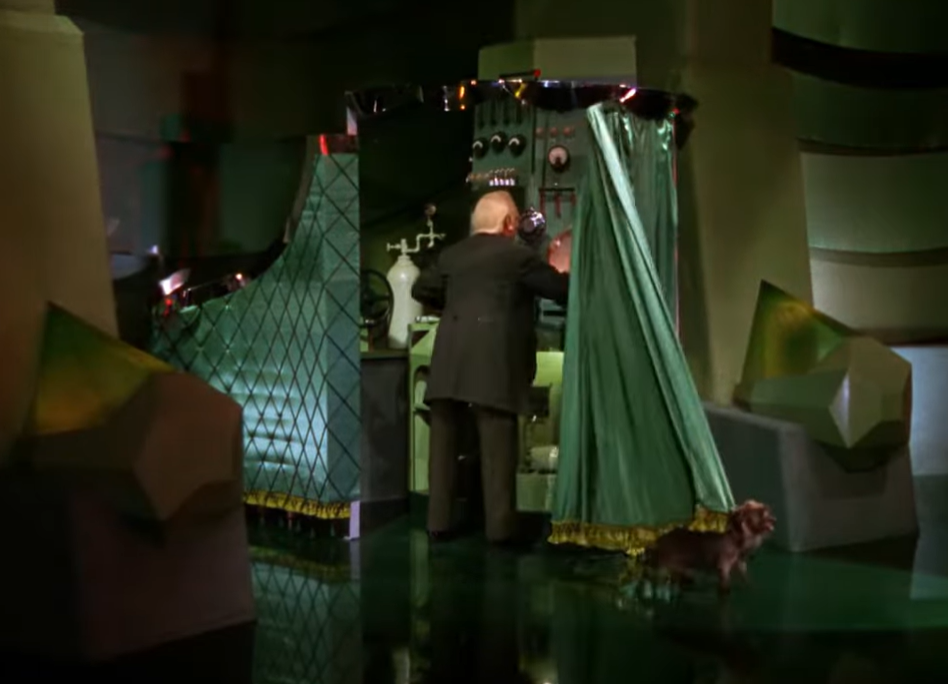
The title of today’s post, of course, comes from one of the final scenes in The Wizard of Oz. Dorothy and her friends have returned to Oz with the broomstick of the Wicked Witch of the West. In exchange, the Wizard is supposed to grant them their wishes, but in their audience with him, The Great and Powerful Oz is stalling, telling them to come back tomorrow. Toto, cute little rat terrier that he is, trots over to a curtain at the side of the room and draws it back to expose a man energetically working the levers of the concealed control booth. (Actually Toto is officially a Cairn Terrier, but dogs of this breed are “ratters,” and don’t you just love the idea of Toto being the only character who “smells a rat” in this scene?)
Yesterday’s Google Doodle indirectly got me thinking about the way we (well, I, anyway) always want to know the inner workings of a piece of art.
Yes, I can simply experience and enjoy art for what it is, on its own and without analysis. In fact, my first encounter with any work of art is always one of sheer, aesthetic bliss. When I see a movie in the theater, I’m as close to the screen as my companion will tolerate, munching on popcorn and gazing up in wonder at the marvelous, larger-than-life motion picture.
But at some point, if a film or photo or sculpture has “lingered” with me, I start to feel a little restless, to get a little “itch” to go deeper. Why has this particular artwork stayed with me? What makes it “tick”?
The Birth of a Nation is considered enormously important in the development of feature-length narrative cinema, a film in which story and characters are fully developed and the footage edited to craft a compelling, long-form story. Most discussion of this film today centers on its racist assumptions and images, which are repugnant to modern American viewers.
The film premiered in 1915, fifty years after the end of the Civil War in 1865, and it did, indeed, present a highly consequential—and profoundly racist—interpretation of the postwar era of Reconstruction.
But what did it mean for an audience to encounter that particular representation of history at that particular historical moment?
The Birth of a Nation toured the United States like any other traveling “show” of the day. It was booked into civic center auditoriums – again, to mark that 50th anniversary of the Civil War’s end – and viewing this film in that context was a communal theatrical experience, complete with an intermission.
I try to imagine how going to see the “show” might have been considered an observance somewhat akin to putting flowers on Civil War veterans’ graves. The film also contains a facsimile reproduction of Lincoln’s assassination, an event within living memory of many people still alive in 1915 – but at a time long before YouTube, network television, or newsreels could have captured and indelibly preserved it. What must it have been like for those audiences to vicariously participate in the first Presidential assassination, a monumental event in America’s history?
This is the way my mind starts to wander (and wonder) the intial exposure to a work of art has passed.
Searching for meaning is a basic human impulse, and an artwork’s meaning can be found in many places. You can look to a work’s creator. You can analyze its structure or form (formal analysis). You can examine the cultural context of the society or historical period from which it emerged.
After the terrible movie-theater massacre in Colorado a few weeks ago, the cause-and-effect relationship between onscreen and offscreen violence was the subject of much discussion. As with the chicken-egg conundrum, it doesn’t really matter which comes first . . . and, actually, it’s impossible to determine anyway. The question of whether violent images can influence violent behavior has produced decades of research and controversy, particularly concerning children.
The more compelling version of this question may be: What happens when art crosses the boundary between representation and reality?
Ignorance may be bliss, but as the poem from which that line is taken makes clear, only children can and should be shielded from reality as long as possible. At its deepest, most meaningful level, art is about reality. Delving beyond the surface beauty (or ugliness) of any artwork allows you to move beyond the material itself to connect with something else . . . eternal, unfettered, transcendent.
[FURTHER NOTE – Maybe I was too traumatized by the movie-theater killings in Aurora, Colorado, at the midnight screening of The Dark Knight Rises. It’s possible I was trying to process the horror by thinking about it in terms of art and senseless violence. In reading through this blog post today, I was very confused by the Google Doodle reference, but with the help of ChatGPT and the version-control time stamps on the draft, I figured out that I started writing this post on July 14, 2012, referring to this Google Doodle celebrating 150 years of Gustav Klimt. Then for some reason, I added in the reference to the July 20, 2012, movie theater killings several weeks later, on August 6 and 8. I must have intuited a strong connection at the time, but I have a feeling that I found the whole thing too excruciating to grapple with in writing. Sometimes words are completely inadequate.]


For years I thought violence (and other dark-side stuff) in media wasn’t an issue. I still think that’s mostly true for intelligent, educated people who consume a lot of different media. I love the John Wick movies, for instance, but fully appreciate they take place in a fantasy world.
Lately, though, I’ve been wondering what a steady diet of TV and movies over, not years, not decades, but generations has done to our collective mental gestalt. There seems no question that media reflects us; the question is how much it affects us.
Does growing up with that steady diet of gun use and casual violation of standards and laws by the “good guys” affect how a kid grows up? I’m thinking: how could it not?
LikeLiked by 1 person