I’m watching documentaries on PBS tonight about the Great Pyramid of Giza (aka the Pyramid of Khufu, Wikipedia article HERE), and seeing bird’s-eye views of the pyramids situated right next to Cairo reminded me of this heartbreakingly sweet children’s picture book that my daughters regularly checked out of our public library when they were young: The Day of Ahmed’s Secret.
Written by a mother-daughter team (from Kenosha, Wisconsin, I later discovered, which is just about an hour’s drive south of Milwaukee), the book tells the story of Ahmed, a boy who delivers butane gas to customers all over Cairo in his donkey cart. The pyramids stand silent beyond the city’s chaos of color and sound as Ahmed cheerfully goes about his day and looks forward to the evening, when he will share an important secret with his family.
Sadly, neither of my daughters remembers this book today. However, thanks to the Internet (YAY!!!) I was able to find not only the authors and illustrator (Florence Parry Heide and Judith Heide Gilliland, authors, and Ted Lewin, illustrator) but also this YouTube video of someone reading the book aloud and turning the pages so you can see the illustrations. Isn’t that wonderful? If you have a few minutes, watch and listen to the story. And then tell me if you don’t tear up a little when Ahmed reveals his beautiful secret at the very end!
Would you like new posts delivered to your inbox? To subscribe, click here.
What a lovely idea talked about in the blog post shared above from Dina-Hanne Siebers and her Fab Four of Cley family, including the two wise Bookfayries, Siri and Selma. I love reading Dina’s popular blog (“The World according to Dina”) and learning more about life as lived in her corner of the world, especially the always-astute observations of Siri and Selma.
For more info about the advent calendar windows of Cley next the Sea, here also is an article from the North Norfolk News. And for some background on this charming, historical coastal village in the UK, here’s a link to the Wikipedia article.
Just a couple of photos from a gray day in Milwaukee. I actually took these pictures over a month ago (October 22), but as today is another gray day, I decided to share them. Sometimes, like today, I’m feeling “gray,” I guess. Which I suppose is better than feeling “blue.” 😀
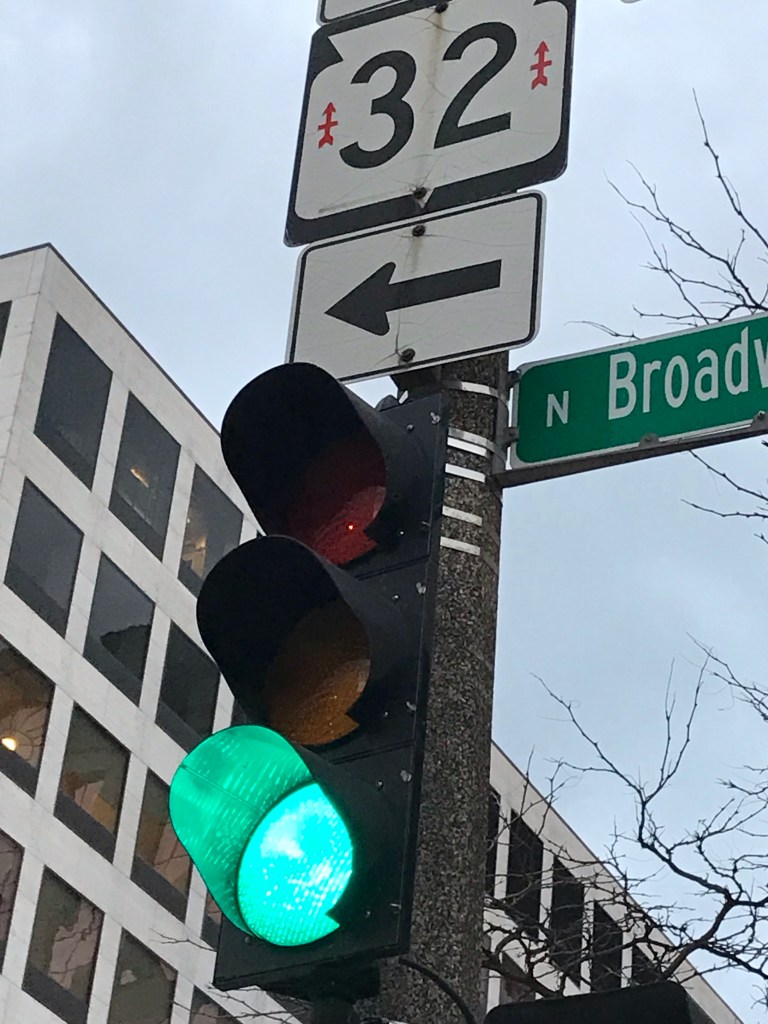
This first picture I decided to title “Go!” for obvious reasons.
I was not taking a photo of the stoplight so much as documenting the Highway 32 sign above it. The little red arrows are the insignia of the 32nd Infantry Division, and now the 32nd Infantry Brigade. After some impressively fierce combat in World War I, the 32nd became known as the Red Arrow Division (for “piercing” the enemy line). The French nicknamed them “Les Terribles,” which captures their fearsome nature pretty nicely. (Wikipedia article on the Red Arrow Division HERE if you’re interested.)
Looking at this photograph again today, I decided that I really like the vertical and horizontal/diagonal lines. Plus I like the way the stoplight dominates. Actually, as long as I am identifying things I like about this picture, I guess I would also give a shout-out to the colors. Just a very nicely balanced composition of color and line even if I do say so myself!
The Starbucks I regularly go to down the hill from my office at Milwaukee School of Engineering (MSOE) is situated in Red Arrow Park, which is part of the Milwaukee County Parks system and contains both the “Slice of Ice” ice-skating rink and the large red granite Red Arrow monument. (See a photo HERE in a post I wrote several years ago after a man named Dontre Hamilton was killed in the park by a police officer within several feet of the monument.)
Anyway, the day I took this photo it was because I had just noticed the little red arrows on either side of the number for the first time, and I thought it was interesting. No other state highway sign has markings on it like this.
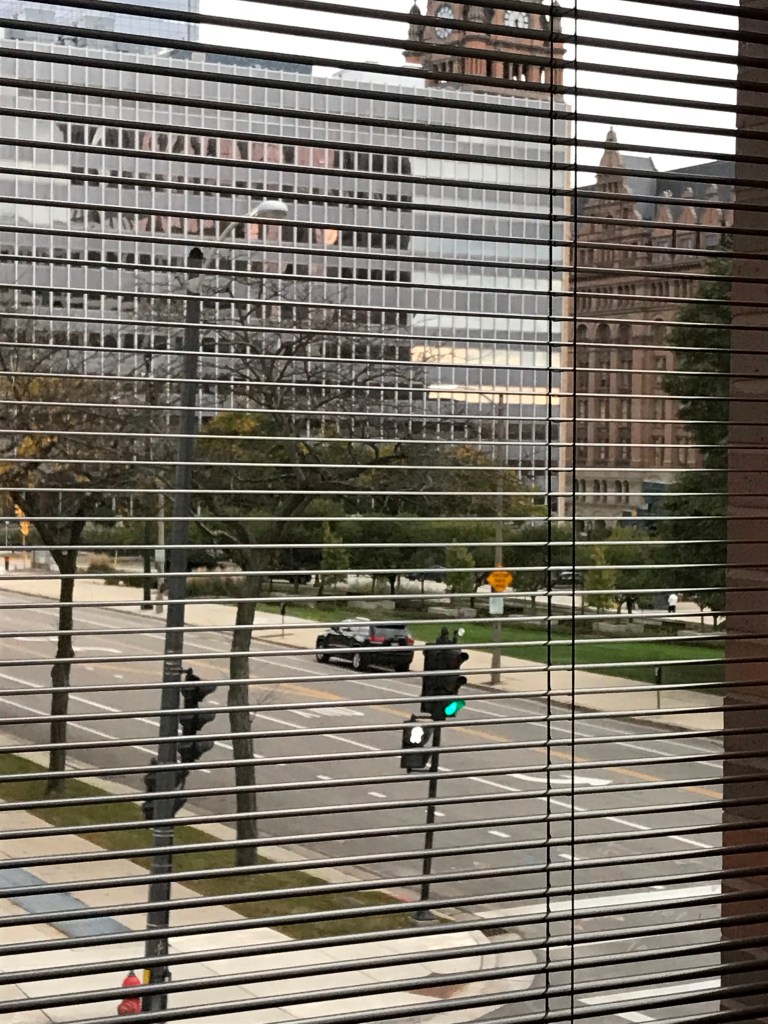
The second photo is one I took right before getting ready to leave work that October day. I was the only person left in the building, and when I took some paper to the shredder bin, I just really liked the colors and lines that I was seeing through the window next to it.
When I was titling this photo, I almost called the large reflective building in the middle the “Municipal Building,” because that’s what everyone refers to it as. But then I realized that it must have a more specific name, so I looked it up and discovered that it’s officially known as the Frank P. Zeidler Municipal Building. Frank Zeidler was mayor of Milwaukee from 1948 to 1960, one of several socialist politicians to serve here. (Another was his brother Carl, “The Singing Mayor,” who resigned from office in 1942 to join the Navy only to be lost at sea, perishing off the coast of South Africa.)
I used to work with Frank Zeidler’s daughter Anita at the University of Wisconsin-Milwaukee. I have not thought about her in at least 25 years, ever since leaving for MSOE, having kids, etc., so I looked her up to see what she’s been doing. Sadly, I discovered that she died a few years ago. Anita was a really nice person. I want to put this statement out into the world since I have a blog and can do that. Just a really nice person who I’m sure is greatly missed by all who knew her❤️ (Here’s the article I found about her death in 2018.)
So that’s it for today. Just some rambling “gray day” thoughts that don’t exactly fit with the title of this blog post.
Although I suppose one could say (if one were seriously committed to making such a stretch) that this gray day gave me the green light to inspire that rambling 😀
I remember thinking when I was about 11 or 12 years old that pretty soon there would be no new music. Because how could people possibly continue creating new songs? There was only an octave’s worth of notes, iterated multiple times on a piano keyboard. Twelve notes, including black keys, from C to B. I guess a full octave would be C to C, but you get my point. How could songwriters keep putting out so many different songs when they only had those 12 notes to work with? Yet songwriters are obviously still going strong like 50 years later.
This Australian musical comedy group, The Axis of Awesome, noted that the same four chords underlie many pop songs, and they made their case brilliantly in this video (which was posted 10 years ago, but which I was only just introduced to by my daughter about two months ago).
It occurs to me that there’s a metaphor here for all creative practice. If you know these four chords, you can improvise a melody that harmonizes with them, and that can lead to a song.
One of the “sneak peak” clips from Peter Jackson’s “Get Back,” the Beatles documentary streaming on Disney+ right now, shows the exact moment that Paul McCartney lands on the melody for the song “Get Back.” If you watch this clip, you see Paul playing a series of chords over and over, lightly singing an exploratory test melody. (John is apparently “late again,” which Paul notes in another version of this clip before beginning to play. I chose this clip instead of that one because this one shows the exact moment Paul nails it.)
It’s interesting to watch the way Ringo and George sit there quietly with Paul while he works out his musical thoughts, just very patiently supporting him with their presence. George yawns, Ringo appears to be zoned out. But we soon realize they are actually very engaged despite their silence. As soon as Paul hits on the melody we recognize as “Get Back” (at about the 1:11 mark), George perks up. He begins to accompany Paul on his own guitar, and tells him yeah, it’s good; musically it’s great. Paul keeps playing, and then Ringo joins in, clapping out a beat.
It’s exciting to see this classic song coaxed into existence!
And circling back to the “4 chords” video, it’s also reassuring for all of us non-Beatles to realize that creativity is a process of building, block by block, upon what already exists. There’s a foundation of the familiar, of the already known, and our job is to search out a new melody that fits atop this preestablished pattern.
Years ago I wrote a blog post on a man called “Mr. Patent,” Marvin Johnson, who was a research fellow at Phillips Petroleum with over 200 patents to his name (link here to read “Creativity, “Mr. Patent,” Keith Richards, and me). All you need for a patent, he said, is a unique solution to a problem. Your idea may build on top of lots of other people’s work, but if it incorporates something new to comprise a unique solution, it may be patentable.
We don’t have to start from scratch to be original.
Just like songwriters can use the same “4 chords” but add a new layer of melody on top and have a hit song. Or, as in the case of “Can You Feel the Love Tonight,” maybe even win an Academy Award for Best Original Song!
Students in my freshman-level technical communication course were intrigued by our discussion today of document design during the “typewriter era.”
We were examining some memos from the early Microsoft Windows period, right about the time that people were beginning to understand how the new features available in Word (allowing for easy switching among font styles and sizes, for example) could open up document design possibilities far beyond what typewriters could afford, which was basically little more than capital letters, underlining, indentation, and numbered/bulleted lists. What prompted our discussion of the “typewriter era” was an example of supposedly “good” document design, in which a memo’s subject line was a string of all-caps words that were practically unreadable thanks to this “design” element.
The class moved on to other topics related to report structure and document design. Eventually we were looking at first-level, second-level, etc., headings and subheadings. The document we were looking at, I told them, was from a really old business writing textbook. It was clearly typewritten, but I liked the strategies it gave for differentiating among the various levels of headings.
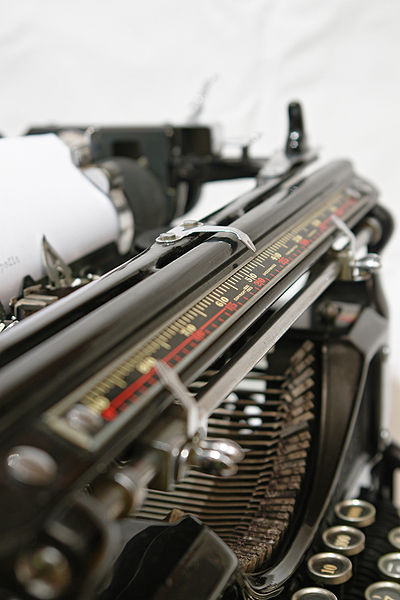
When there was a lull in the conversation, one student raised his hand. How, he wondered, did someone center a heading on the page using a typewriter? In Word, you can just click on the “center” button to position the text in the middle of the page. (Or press Ctrl + E. Remember those shortcuts? Remember how, before the mouse, those “shortcut” codes were your only recourse?) If you were using a typewriter, my student asked, would you have to measure?
To create a title (or first-level heading) on a page, as I recalled, first you’d have to count how many characters it contained, including spaces. Then you’d position the typewriter carriage to align the space where the keys struck with the center of the paper. You’d backspace half the total number of characters and then type the complete title or heading. Voila! Perfectly centered!
I haven’t used a typewriter in 30+ years, but it was amazing how it all came back in a flash. Like remembering how to ride a bike, I guess. And it occurs to me that typewriters may have all the potential for hipster cachet that vinyl records carry. 🙂
[UPDATE, December 11, 2021: I just learned that Michael Nesmith (of Monkees fame) died yesterday. Link to the Variety article HERE. I’m leaving this update here because in the comments following this post I mentioned that Nesmith’s mother invented Liquid Paper, a paint-based correction fluid used by typists to white-out mistakes. It’s so weird that his name would have come up in my life just a week before he died when I haven’t thought about him at all in years. I guess that’s how it happens sometimes. RIP to a man who made my childhood brighter❤️]
Well, there’s only one way to end a post on typewriters. And so, without further ado, here is the incomparable Liberace (West Allis/metro-Milwaukee native!) performing “The Typewriter Song” on his “other keyboard,” complete with a mini-candelabra 🙂
Would you like new posts delivered to your inbox? To subscribe, click here.
Like a circle in a spiral, like a wheel within a wheel . . .
So begins one of my favorite songs, and it popped into my head this morning as soon as I realized that today was “Fibonacci Day.”
And what is Fibonacci, you may wonder? Or maybe not 🙂
It’s a number, sort of. Only better! A Fibonacci number is actually a sequence of numbers in which each individual number is the sum of the two preceding numbers (starting from 0 and 1). Wikipedia article HERE.
Hence the fact that today is Fibonacci Day: 1123 🙂 (0+1=1; 1+1=2; 1+2=3)
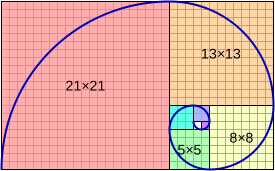
Check out this visualization of the Fibonacci number sequence here. Each square contains an array equaling the square of the number displayed.
This is the spiral that shows up in nature so many times, via seashells, sunflower heads (seeds), pinecones, etc. It’s also the basis of the “Golden Ratio” (Wikipedia article HERE) that characterizes classical art and architecture.
How do I know these things? Well, Walt Disney, of course! And his wonderful 1959 animated movie short Donald in Mathmagic Land. (You can also search for and view it on YouTube if the link below doesn’t work.)
The section talking about the “Golden Ratio” runs from about 2:45-13:40. But I recommend starting from the beginning. I was hooked from the moment Donald the explorer observed that all the trees in this strange new world had “square roots.”
Anyway, when I realized that today was Fibonacci Day, I thought about “Windmills of Your Mind” (Wikipedia HERE). This was the song from the title sequence of one of my favorite movies, The Thomas Crown Affair (the original 1968 film starring Steve McQueen and Faye Dunaway, Wikipedia article HERE), sung by Noel Harrison (son of Rex! today’s trivia 🙂 ).
Since thinking about the song put me in mind of that fabulous title sequence, I went and looked it up so I could waste two minutes enjoying it.
But guess what????
Even though I remembered that the title sequence is a fragmented collection of rectangles, I never realized till TODAY (Fibonacci Day 🙂 ) that it is inspired by the Fibonacci “Golden Spiral” (Wikipedia HERE).
The fragmented-screen style continues (after the opening scene of the getaway driver’s job interview) with all the bank robbers (dressed in hip 1960s Mad Men “disguises,” complete with straw fedoras and Ray-Ban sunglasses) getting set into motion (via Crown’s one-word command to “Go.”) from their myriad locations of origin to converge on the scene of the heist for this one moment in time and this one moment only.
The perfect crime! One that can be solved only by the super-genius, fashion-forward, heavily hairstyled and eyelashed insurance investigator extraordinaire, Vicki Anderson.
Hmmm, I don’t see a clip of the actual bank robber online, which is too bad. It’s one of my favorite movie scenes. But fortunately I own this movie, so I think perhaps I’ll celebrate Fibonacci Day by watching it tonight.
The 1968 film is worth seeking out if you’re ever searching for something new to watch. Very stylish in a self-consciously hip late-’60s sort of way, and much better (imo) than the 1999 remake, although I do love the Magritte bowler-hat returning-the-stolen-painting scene’s homage to the 1968 bank-robbery scene. Plus, the 1999 version does have a (spoiler!) happy ending, which, given the era’s nihilistic tendencies, the 1968 version (spoiler!) does not.
There was a partial lunar eclipse visible from Milwaukee last night, which I really wanted to go outside and see but which I didn’t because I also needed to be asleep at 3:00 a.m. so I could do my job today. Sigh. Someday when I’m retired, I’m going to stay up all night and then sleep all the next day any time I feel like watching an eclipse of the moon!
Meanwhile, all this eclipse talk started me thinking about the night sky. I found this neat video from NASA previewing November 2021 activity, and I assume this is part of a regular series?
And then this video got me to remembering this really bizarre but fun “show” that used to run on PBS called “Star Hustler.” Do you have any recollection of this? It was a five-minute filler that would run (weekly?) at the end of a programming hour, late at night if memory serves. I loved the “host” and his somewhat cheesy delivery, but what made this gimmick work was that, as with the NASA video above, the show’s content was highly educational and made me want to go outside to see the night sky phenomena for myself.
The episode below provides some “night sky” background on where the expression “in like a lion, out like a lamb” came from. I realize that little knowledge tidbits like this are, like, the very embodiment of the term “trivia.” But isn’t life richer and don’t you feel more grounded in the world when you expand the number of “trivia” portals like this one via which you can connect “this” with “that” and make sense of the surrounding chaos?
One final video, as long as I’m at it. I couldn’t remember what the “Star Hustler” was called at first. In my Google search I kept finding references to “Star Gazer” instead, which confused me because I knew the title was something stranger than that. Finally I stumbled across this Wikipedia article on the show, which cleared things up.
Apparently the show was SERIOUS educational astronomy for the first few years, until a producer told the star, Jack Horkheimer, to make it more accessible to a broader audience than fellow astronomers. From which directive, the Star Hustler persona was born. It worked! I was hooked the first time I saw this guy with a comb-over hairstyle strolling along in his windbreaker atop a pathway in space that looked like the rings of Saturn unreeled. And I stayed hooked because his enthusiasm was so infectious and the show’s content so interesting.
The show continued with the “Star Hustler” title until it was undone by the Internet. Mid-1990s search engines were not particularly smart. Apparently when people searched online for information on the PBS show, the top results returned were for Hustler magazine. (Please don’t even ask. You really don’t want to know anything more about that magazine. I hope. Ugh.) At which point, the “Star Hustler” name was dropped and the “Star Gazer” name adopted.
Here’s a nice (and brief) documentary about the “Star Hustler/Gazer” star, Jack Horkheimer.
Would you like new posts delivered to your inbox? To subscribe, click here.
Well, I can’t resist sharing this ARTICLE about the discovery of secret underground bathrooms beneath the flowery landscaping of Milwaukee’s boulevards. The median strips are pretty ho-hum today, but when I first moved to Milwaukee in the early 1980s, our boulevards were world-class AMAZING! The first time I ever saw the gorgeous bird of paradise flower (Wikipedia article HERE) was in maybe 1983 as I was driving along Humboldt Boulevard.
Sigh. The world isn’t what it once was. Appliances are no longer built to last a lifetime. A half-gallon of ice cream is now 1.75 or even 1.5 quarts, because we’re apparently supposed to be dumb enough not to notice that everything is downsizing in order to charge us more while appearing not to have raised prices. And flowers (and even trees) are extravagances that cities can’t afford to maintain on any kind of scale.
On the other hand, I suppose once we’re all living in the Metaverse, we can have as many virtual flowers as we want. We’ll just need VR headsets or other XR devices to see them. And sadly, no one has figured out yet how to digitize scent, so we won’t be able to enjoy them that way. But no matter. By then COVID (“Covid”? Or entirely lowercase “covid”? Or whatever, because who even cares?) may have stolen humanity’s sense of smell anyway.
Gee, sorry about this. All I meant to do was share a fun article. And then I actually went and wrote a downer of a post. I assume I’ll be in a better mood next time!😄
Would you like new posts delivered to your inbox? To subscribe, click here.
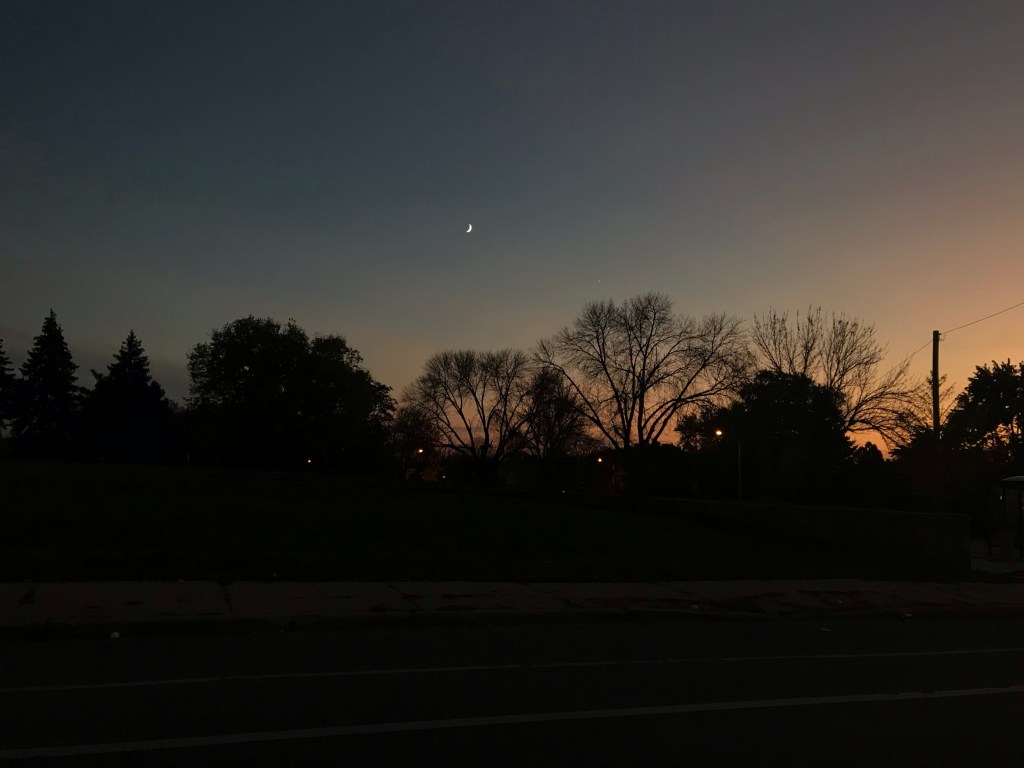
I grabbed this image while sitting at the traffic light just north of the King Park community center at the corner of Vliet and 17th. I can’t say it’s not beautiful in its own way, especially that sliver of crescent moon rising above tiny stars of light twinkling among the silhouetted trees and houses below.
But it is so disorienting and depressing to leave work and walk straight into night! I’m never ready for this sudden shift into winter darkness.
Although if I’m honest, I did enjoy getting that extra hour of sleep over the weekend😄
I was going to do one post and title it “Blue and Red” (you’ll see why), but I decided that these pictures would make better sense if I just lumped them all together beneath an umbrella title uniting them within the context of a coherent “story,” which is that they are random photos documenting my drive home from work last night, including a quick stop at the same grocery store featured in last night’s Edward Hopper photo from two weeks ago.
So.
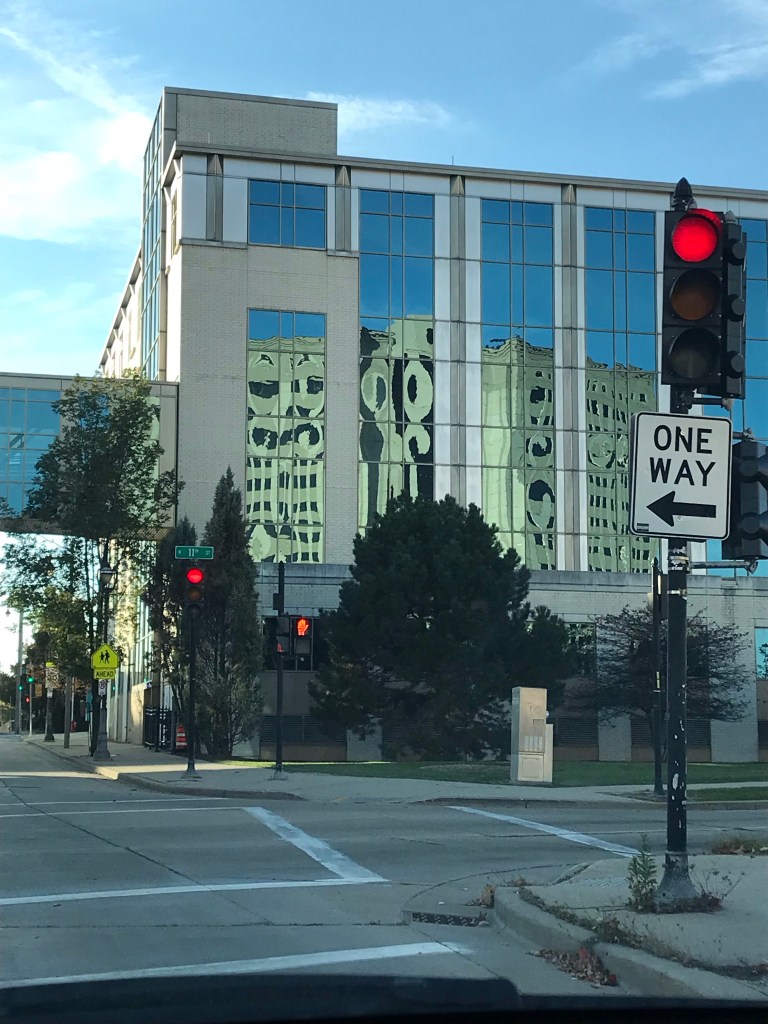
First is the photo I would have titled “Blue.” Taken facing west at the intersection of State and 11th as I sat at the traffic light on my way out of downtown. I liked the crazy reflections of the Milwaukee Secure Detention Facility in the Sinai Medical Center complex windows, but mostly I liked the colors. My windshield was filthy, but I chanced taking the photo through it anyway, and it turned out okay. You can’t even see the bird-dropping residue that the wiper blades couldn’t quite get rid of 😂
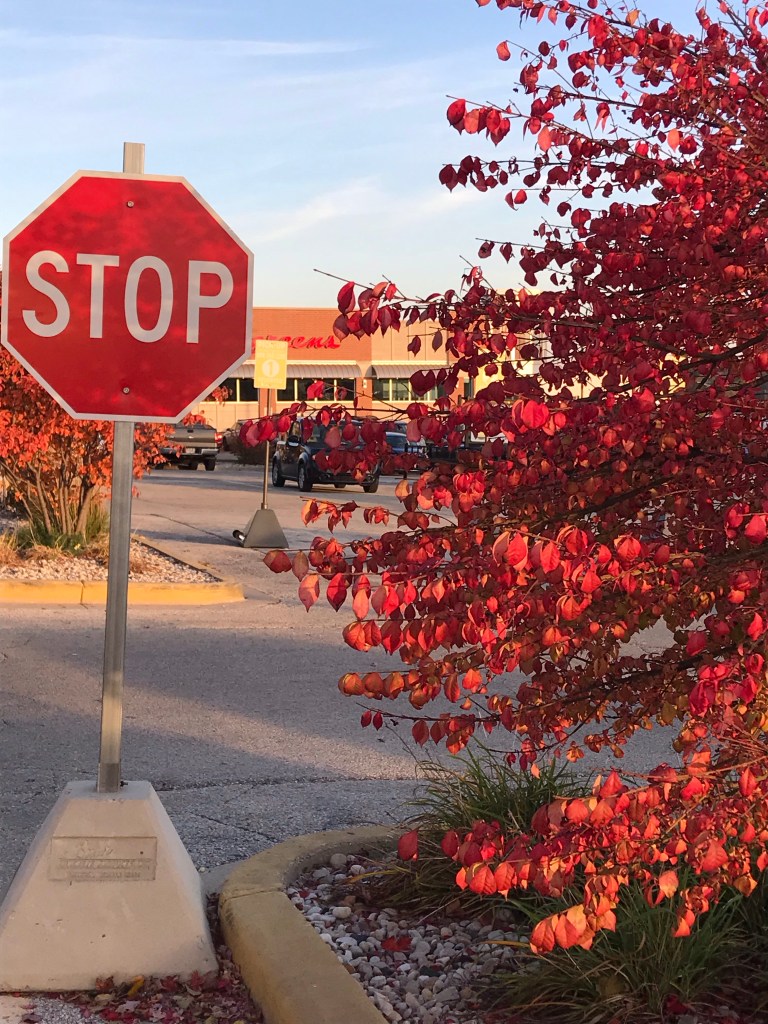
This next one I was going to call “Red.” I was at the store where I took my “Edward Hopper” awnings photo two weeks ago, and I just really liked the strong confluence of reds at this stop sign.
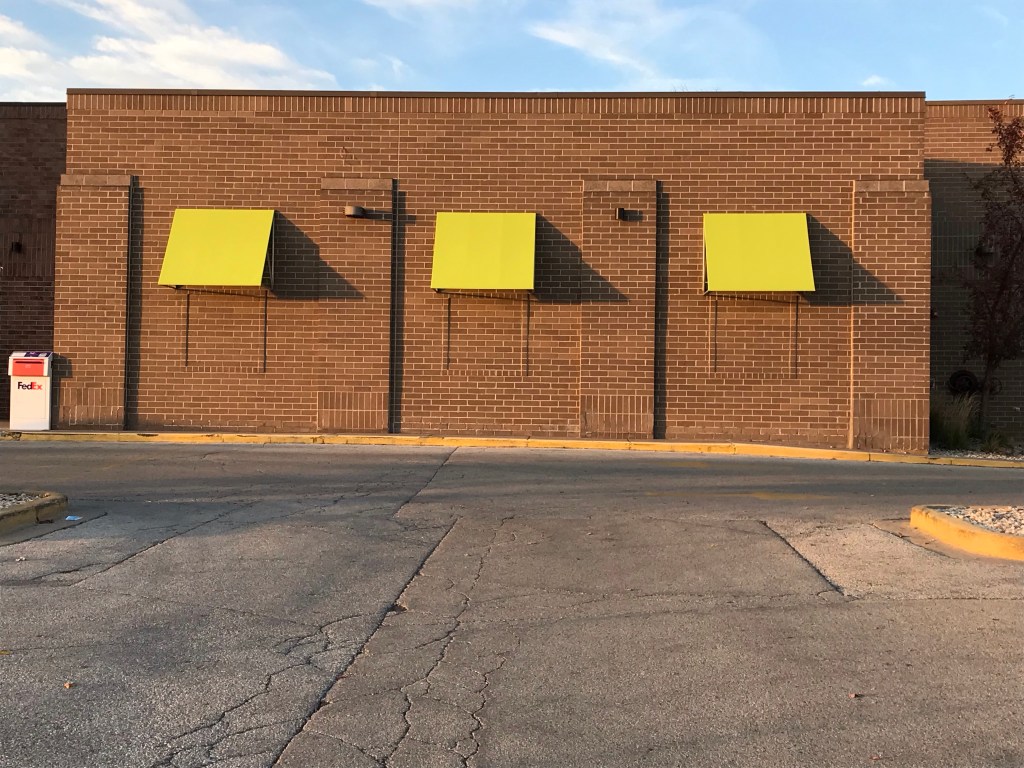
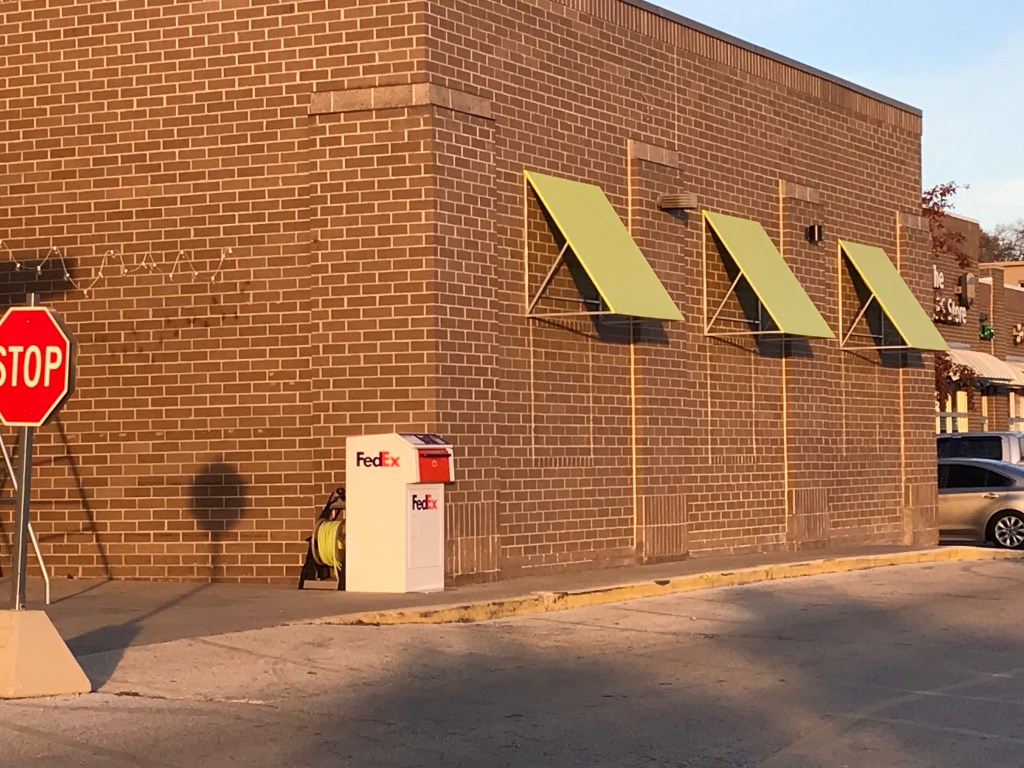
While I was in the parking lot, I took some more pictures of those awnings to show how ordinary they look without the drama of that intensely warm, slanted evening sunlight. (Well, I guess there’s a tiny amount of evening sunlight and drama here, but nothing as noticeable as in yesterday’s photo.)
And from the side, with the FedEx collection box, etc., at the corner, you can see that the awnings are just an add-on adornment of a rather ordinary, featureless wall.
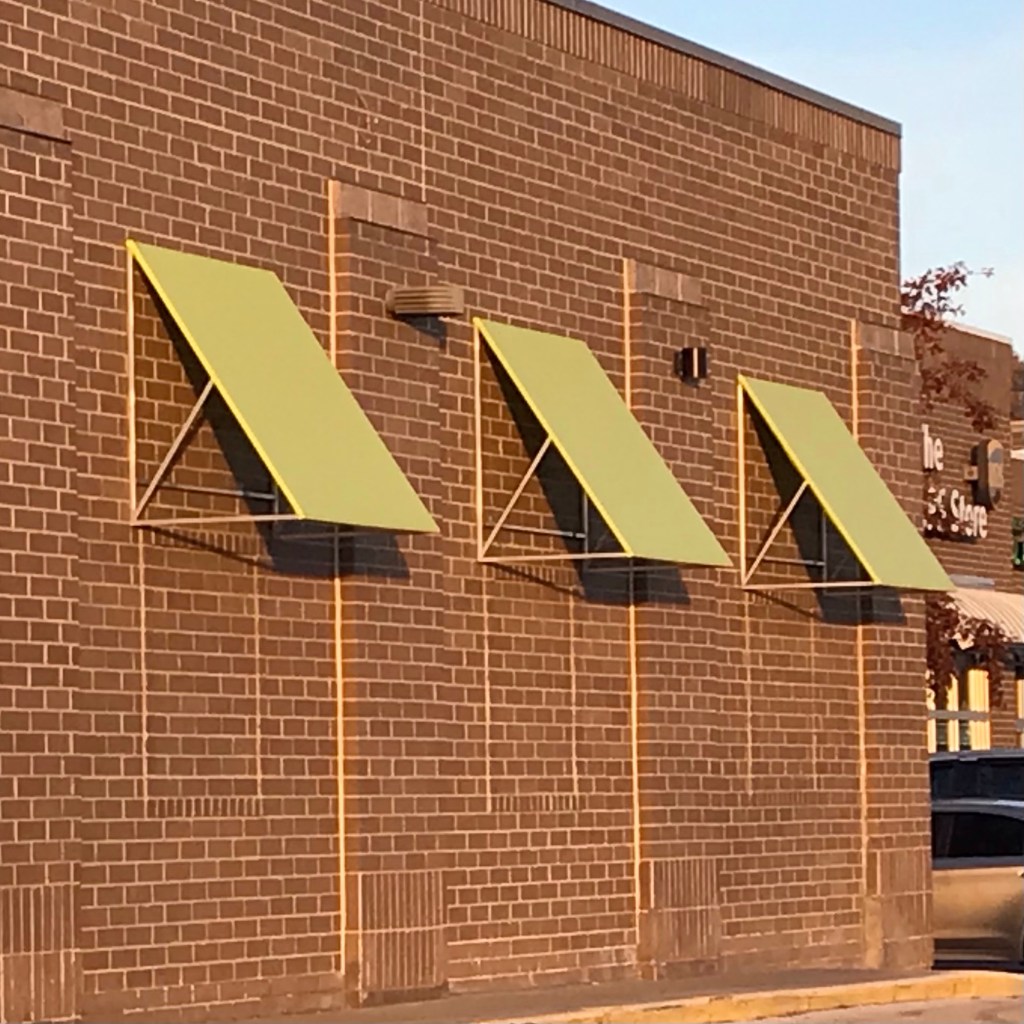
Although actually, I tried cropping that last image as a square and decided maybe it could look pretty good after all. I like the way sunlight is catching the edge rims of those somewhat Art Deco looking faux columns that alternate with the awnings. It gives what is basically a flat surface a bit more of a three-dimensional appearance.
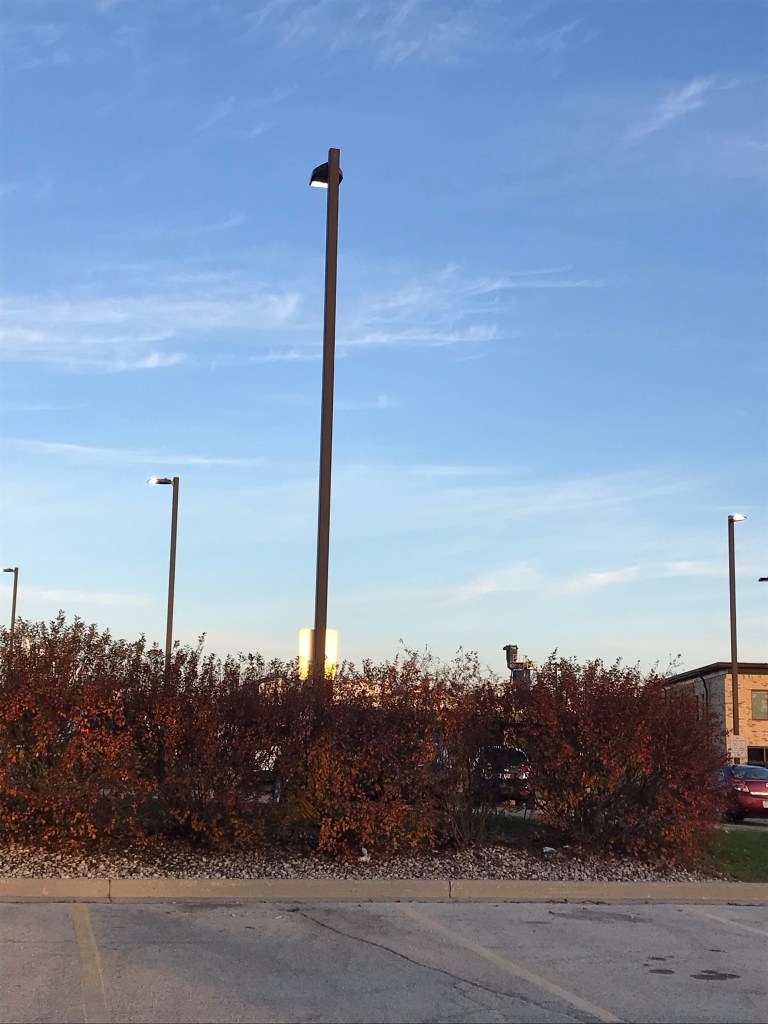
After fooling around with all this awning malarkey, I slipped my phone back into the outer pocket of my purse and got down to the business of loading my groceries into the car. Waking back to my car from returning the cart to the corral, I noticed the parking lot lights had already turned on, even though it wasn’t dark yet. I liked that look of little “stars” barely noticeable at the tips of these light poles.
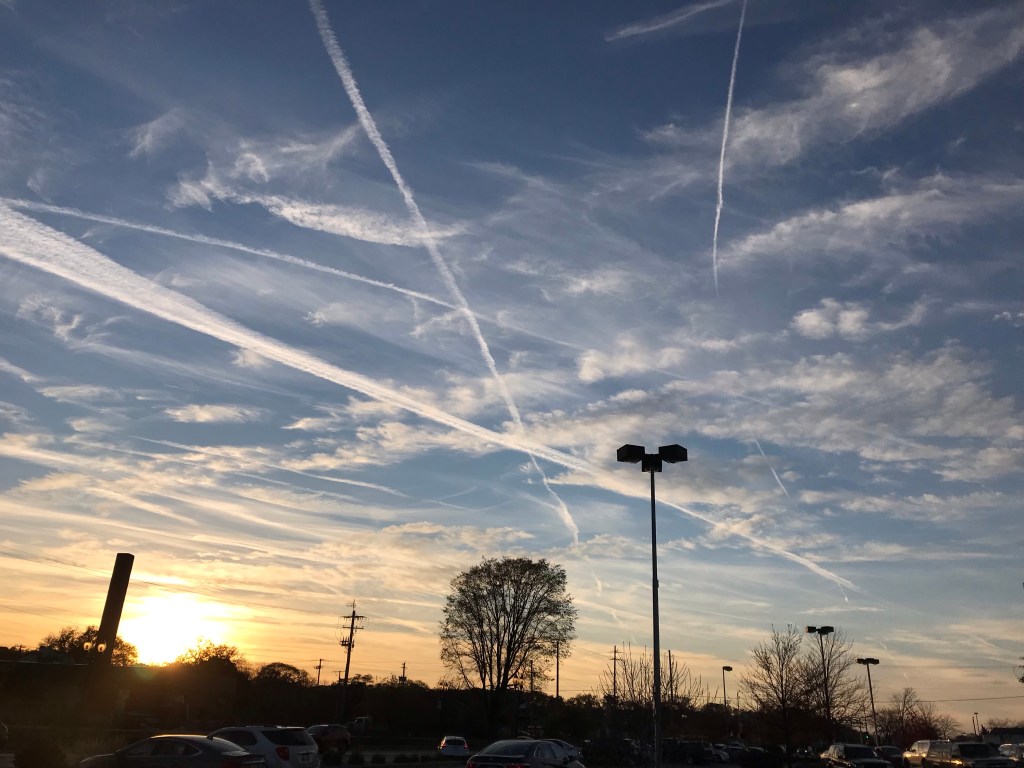
Then, as I shut the rear hatch and turned to get into the driver’s seat, I noticed all the vapor trails up in the sky high above the cars that were now rendered nearly invisible by contrast in the gathering twilight below. And suddenly it occurred to me that, at this time of evening, those planes were most likely headed to their final destinations of the day, the crisscrossed lines representing a homeward commute for hundreds passengers nearing the end of their work day or week. Just like me.
It was a nice moment of “connected” awareness, reflecting on our shared humanity and the fact that, despite our many differences, we’re all seeking essentially the same things.





 Katherine Wikoff