

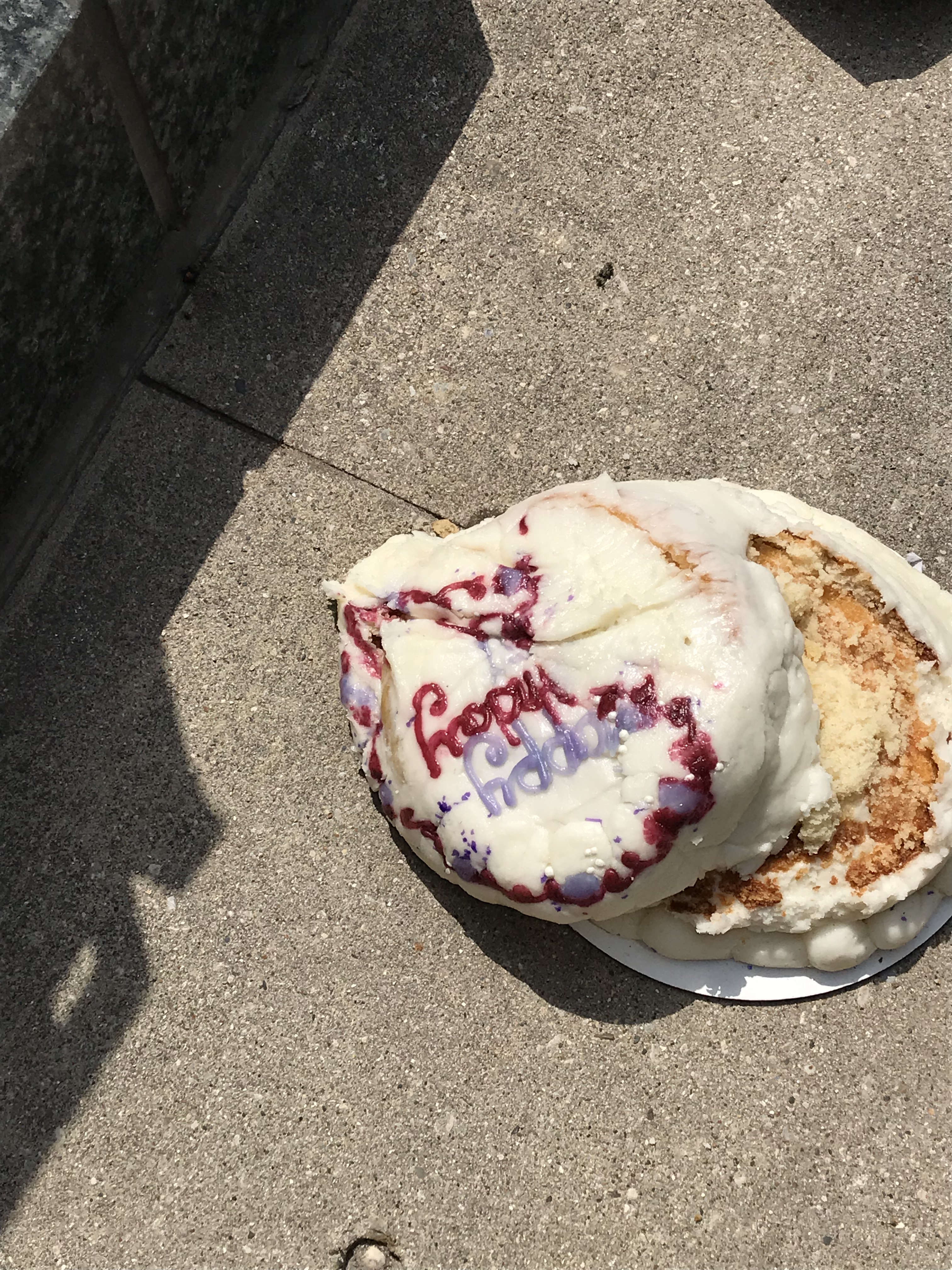
Taken near the NE corner of Jefferson and Wisconsin in downtown Milwaukee on a Saturday morning in early August. There’s a story here. I’m guessing it’s a sad one.
Taken near the NE corner of Jefferson and Wisconsin in downtown Milwaukee on a Saturday morning in early August. There’s a story here. I’m guessing it’s a sad one.
 Not that there would be any doubt in your mind that this is what you’re looking at. All that’s missing is a plant in the corner 😀

Taken with my iPhone while sitting on Juneau, facing west, at the 6th Street stoplight. I really enjoy seeing this building from different perspectives, at different times of day, and in different seasons. Always something new.
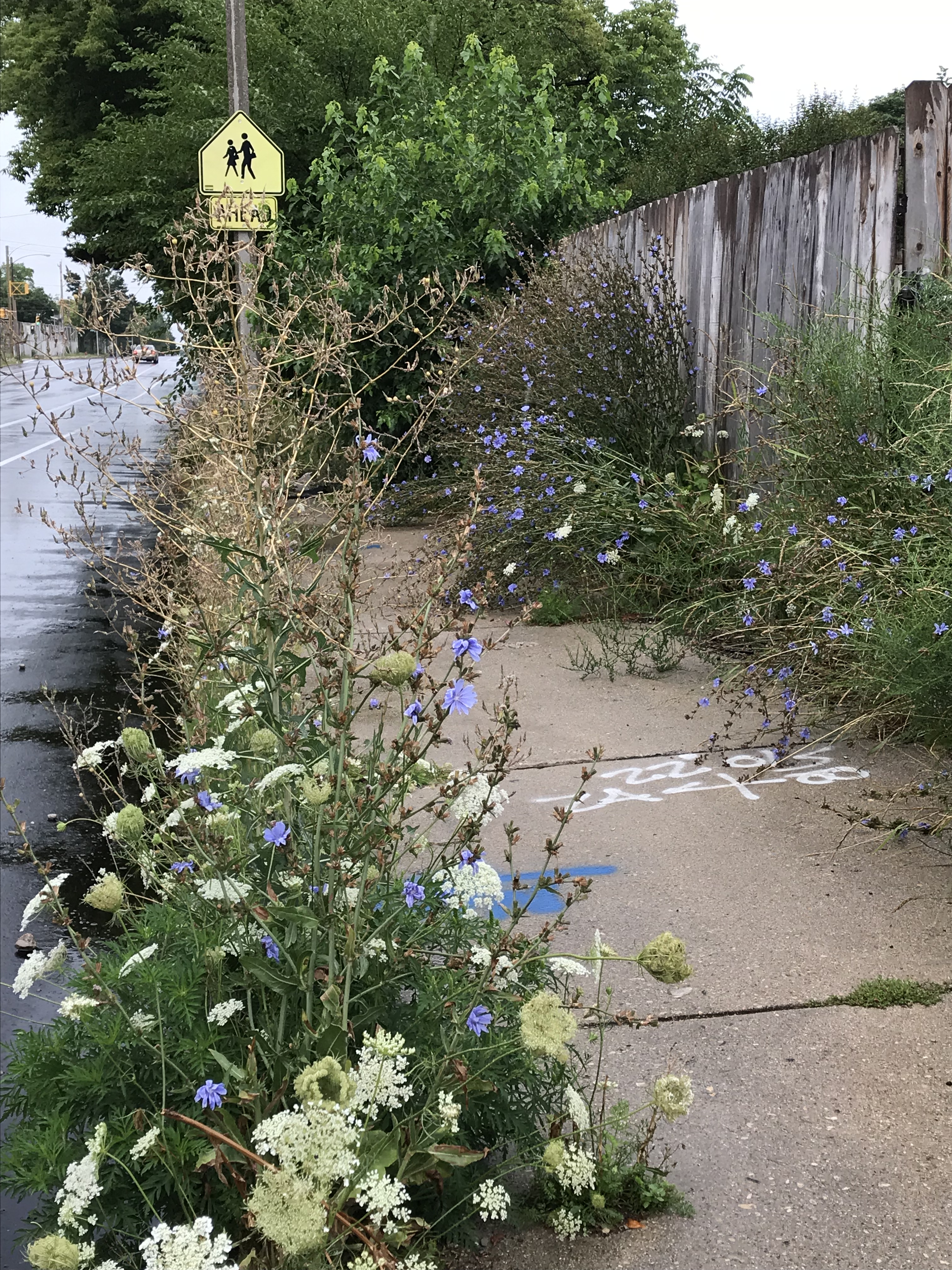
Gray morning in Milwaukee, but these weeds in the 1900 block of West Vliet caught my eye as I was driving past, so I had to stop and get out in the drizzling rain to take a picture. Maybe I should call them wildflowers instead of weeds, though, because they’re so pretty, as if someone had deliberately planted them. Except for the school sign and the public works markings spray painted on the sidewalk, doesn’t this scene kind of resemble a garden path you might see in a magazine?
P.S. – I was curious suddenly about where Vliet Street got its name. Here is an article from Urban Milwaukee with some background. Apparently Vliet came to town with Byron Kilbourn in Milwaukee’s early days. He was the person who surveyed Kilbourntown (the area west of the Milwaukee River) and therefore got to have one of the streets in this new town named after him.
A photo of my colleague, Margaret Dwyer, and me with “The Bronze Fonz,” taken during last Saturday’s walking tour of public sculptures along the Milwaukee Riverwalk and Wisconsin Avenue. We led a group of MSOE students on the two-hour walk as part of our research on using public art in engineering education.

Margaret and I got a Summer Faculty Development Grant this year for a project we titled “Connecting the Classroom and Public Art at MSOE: ‘Scientia Sine Arte Nihil Est‘”—which basically means (in Latin) “Science without art is nothing.”
We borrowed that phrase from our friends at the Grohmann Museum (the building where our department’s faculty offices are also housed). They have it printed on T-shirts you can buy in the gift shop. It’s a nice twist on the original quote from 14th-century architect Jean Mignot: “Ars sine scientia nihil est,” or “Art without science is nothing.” Mignot was a French architect called in to evaluate the Milan Cathedral for structural issues during its construction, as that project required stones to be lifted to new heights, literally. When you’re talking Gothic cathedrals with soaring vaulted ceilings and spires stretching heavenward, art without science would be very dangerous indeed.
So anyway, back to our summer grant. The IRB approved project was Margaret’s brainchild, and fortunately she asked if I’d like to be a co-investigator. After our public art tour ended Saturday, the students had lunch on us and participated in a focus-group discussion about the sculptures and the connections they saw between the public art and their own majors’ engineering disciplines and coursework.
We still have to transcribe the students’ conversation (apparently we can upload our Audacity audio file to Otter.ai, which is a FAR cry from the manual transcriptions of audiocasette tapes I did for my dissertation a million years ago), and then we’re going to produce instructor materials to help our colleagues incorporate public art into their courses. We also hope to write a conference paper for next year’s ASEE conference . . . in Montreal!
Some photos from Saturday below (I didn’t take that many, sorry!).
First, before we even set out from the Grohmann Museum, where the group assembled, I saw this really cool truck parked across the street. The parking meters kind of ruin the picture, but you can make out its “hot rod” style even so.

This sculpture reminds of me of the Easter Island faces. Except it looks out over the Milwaukee River instead of the Pacific Ocean 🙂
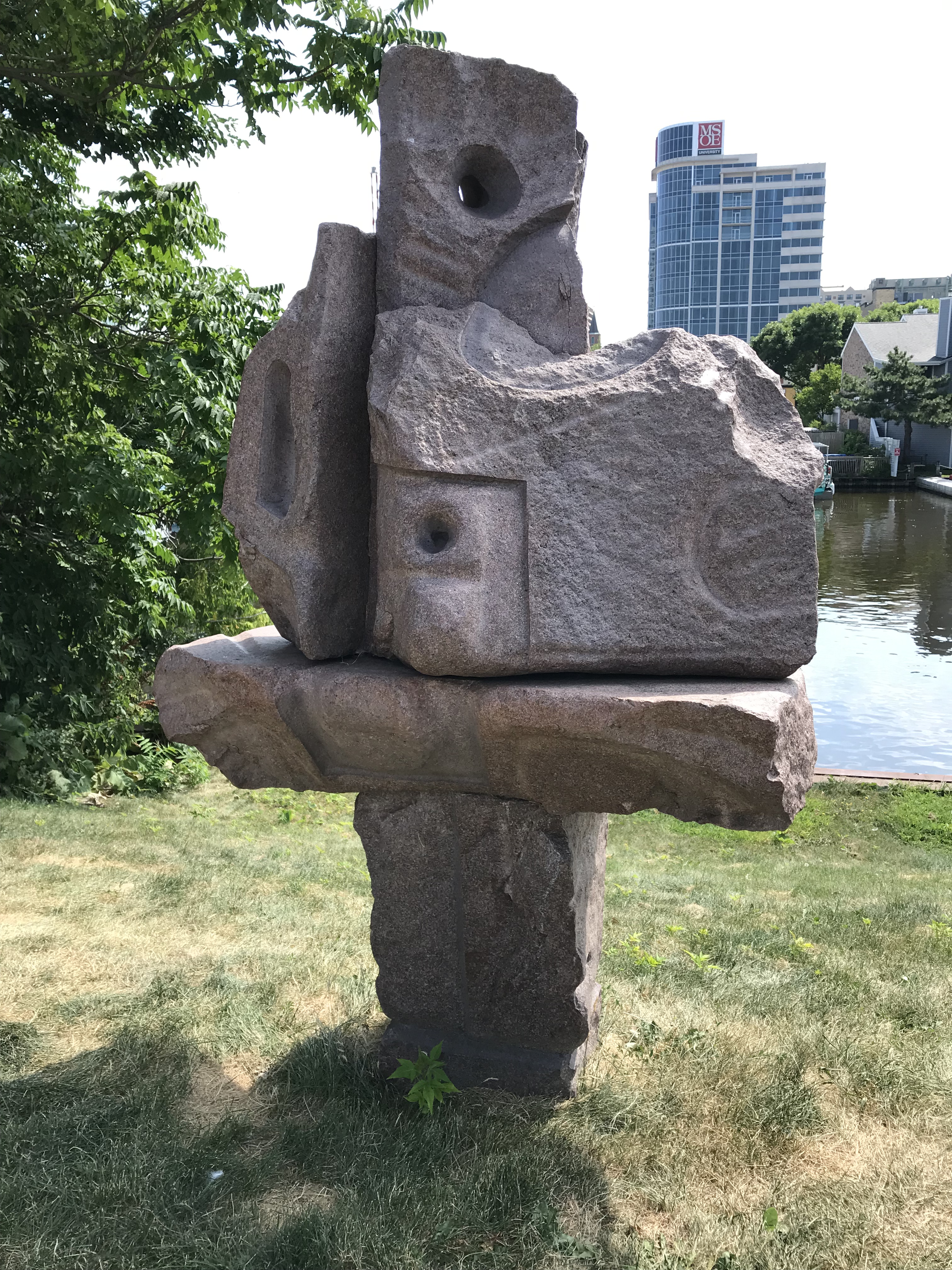
At the Highland Avenue pedestrian bridge stand two metal urns. The work is listed as “Limitation Series: Bowls,” by Paul Sebben.
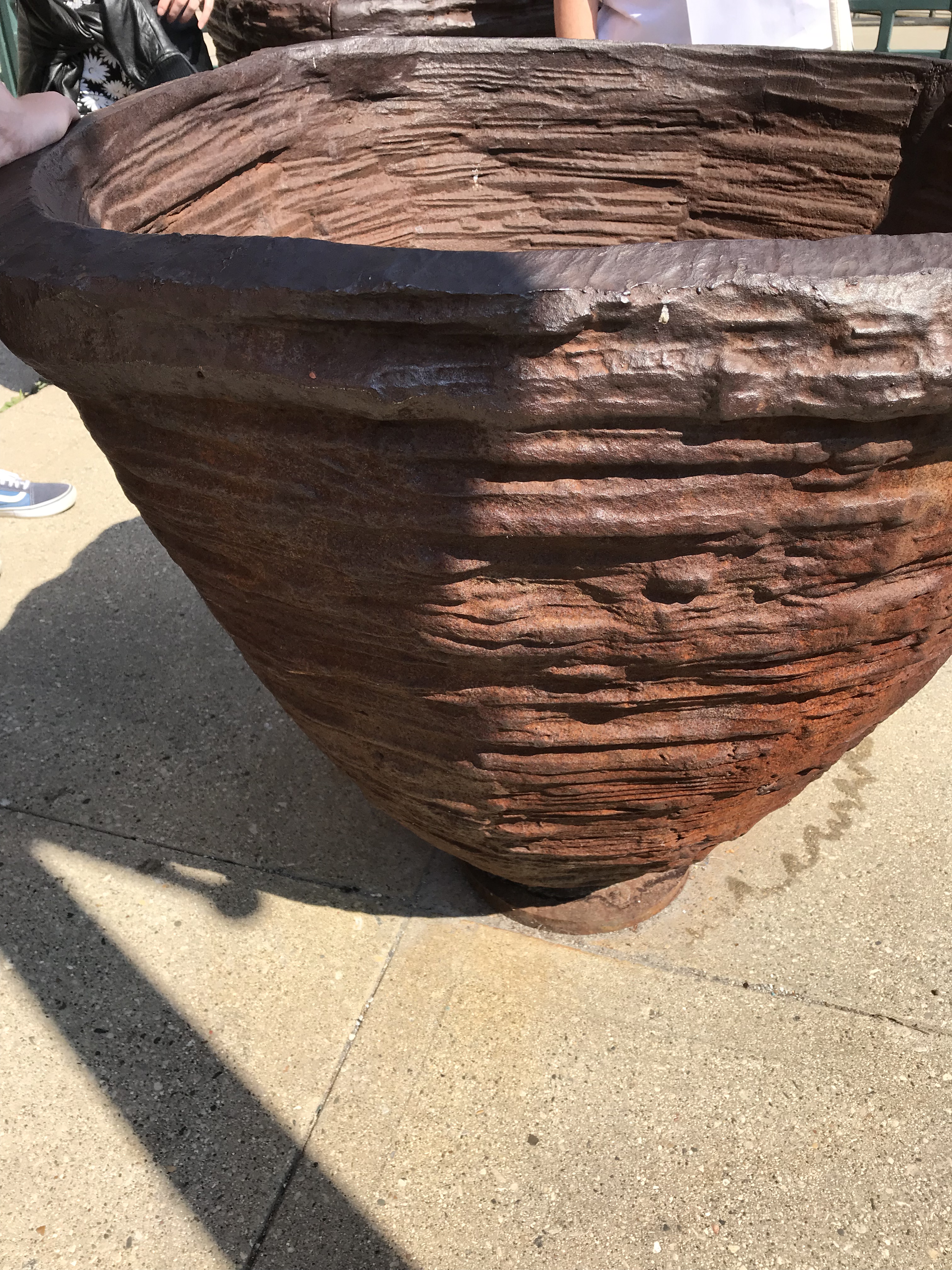
Did Sebben anticipate how the public might interact with large “bowls” lacking signage that identifies them as “art”? Was this intentional on his part? I hope so, because it’s sad if not.

One of my favorite pieces was Aqua Grylli, a highly detailed, puzzling, and provocative sculpture on the west bank of the river, about halfway between Kilbourn and Wells.
(Aside: Margaret used Aqua Grylli in our recruiting poster. I only just now noticed this: Don’t both “faces” in the featured sculptures look really angry? Thank goodness the text sells it!)

If you link over to the artist’s website (she is Beth Shahagian, a Milwaukee sculptor), you can see a photo of the sculpture from a ninety-degree angle as it must have appeared at its installation in 2001. Take a look at the stone base on the lefthand side of the picture on her website. It’s a solid gray color. (Actually, you can see that solid gray color better on her “company” website, here.)
But take a look at that same stone base now, which I photographed on Saturday from the west side of the sculpture, which is the same perspective as the sculptor’s photo is from.
First, on top of the stone base, but at the base of the archway, there are several turtles sunning themselves on what look to be rocks. Streams of water are etched into the bronze, flowing in rivulets across the bronze “riverbed” and among the turtles’ rocks.
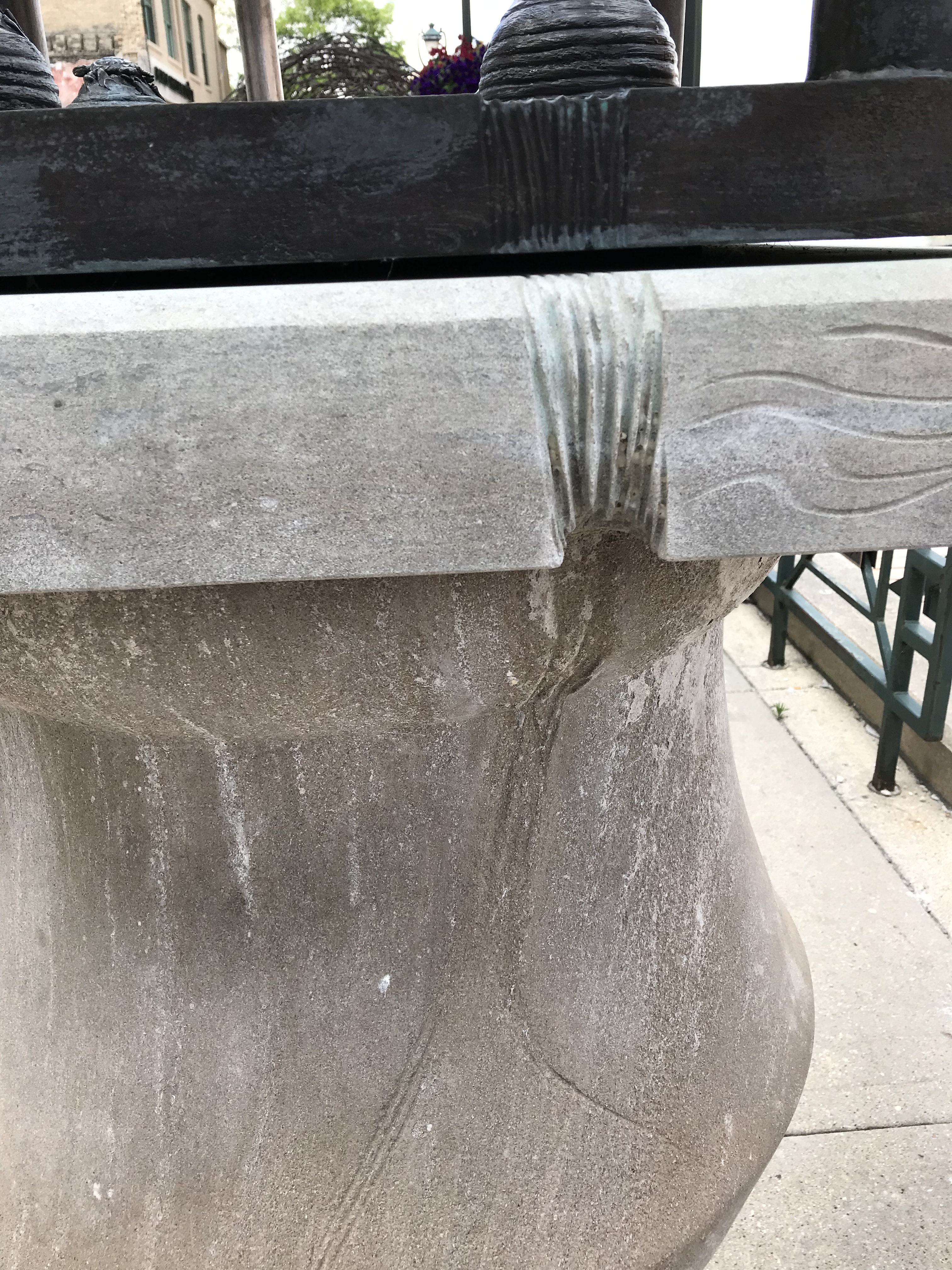
Sadly I didn’t take a photo of the turtles from above. But here is one showing a sideways view, where you can see some symbols etched onto the side of the metal block. The dark piles jutting upward are the turtles on rocks.
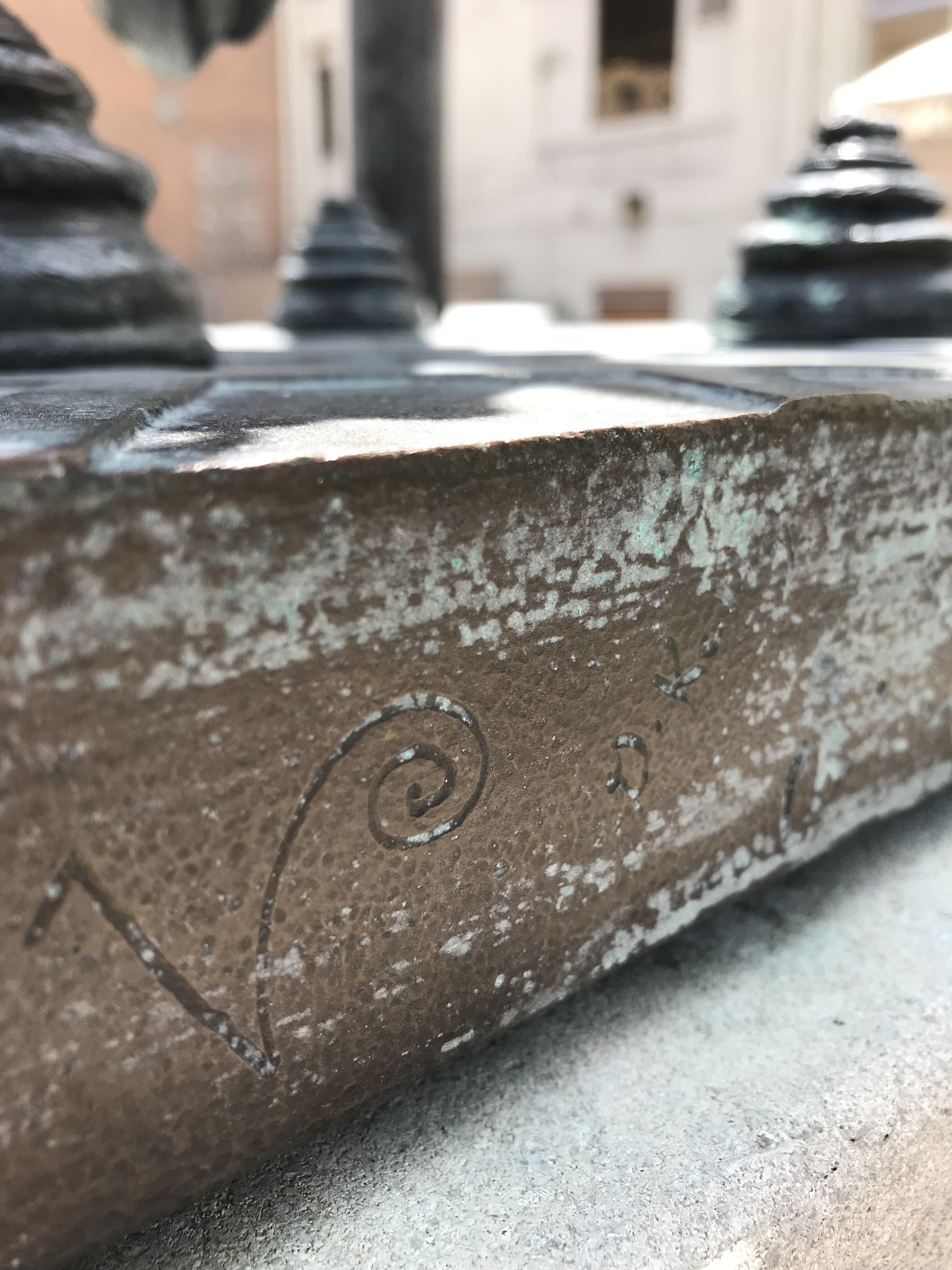
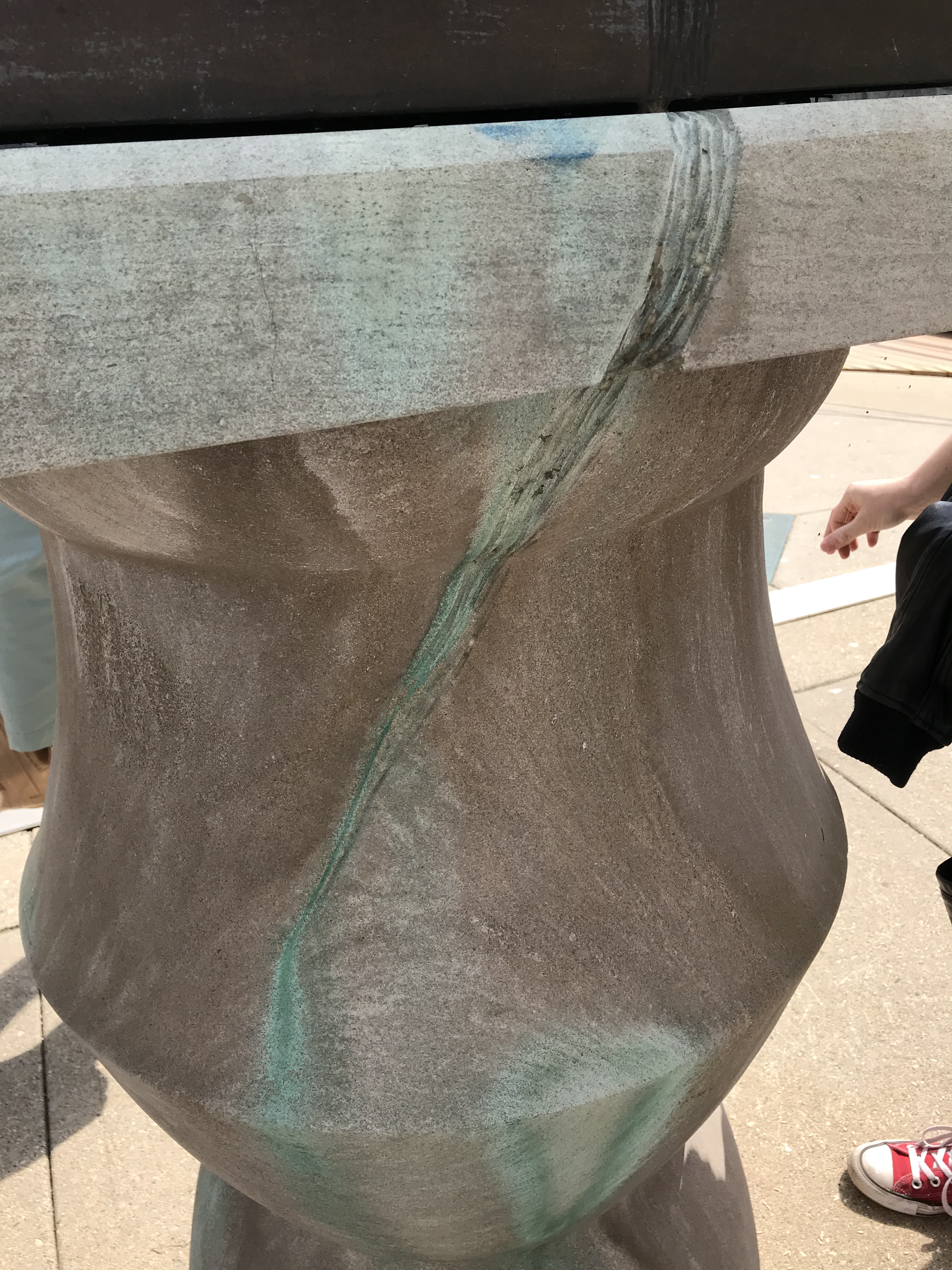
In the photo below you can see where one of the streams flows across the side of the bronze block and down the stone base of the pedestal. What I LOVE is how once the metal oxidized, the patina’s green color was carried by rainwater along the carved “channel” to create a colorful stream flowing down the stone.
This intriguing sculpture has lots of detail associated with “magic” and “luck.” There’s a rabbit’s foot, a horseshoe, a cornicello (a “lucky horn” amulet), a hand making the “devil’s horn” symbol (known as le corna in Italian, a hand gesture aimed at warding off the “evil eye”), and a triangle with the word “abracadabra” written all over. Just as the left base (northernmost) is covered with turtles (considered auspcious in some cultures), the righthand base (southernmost) is covered with what we all decided looked like trilobites.
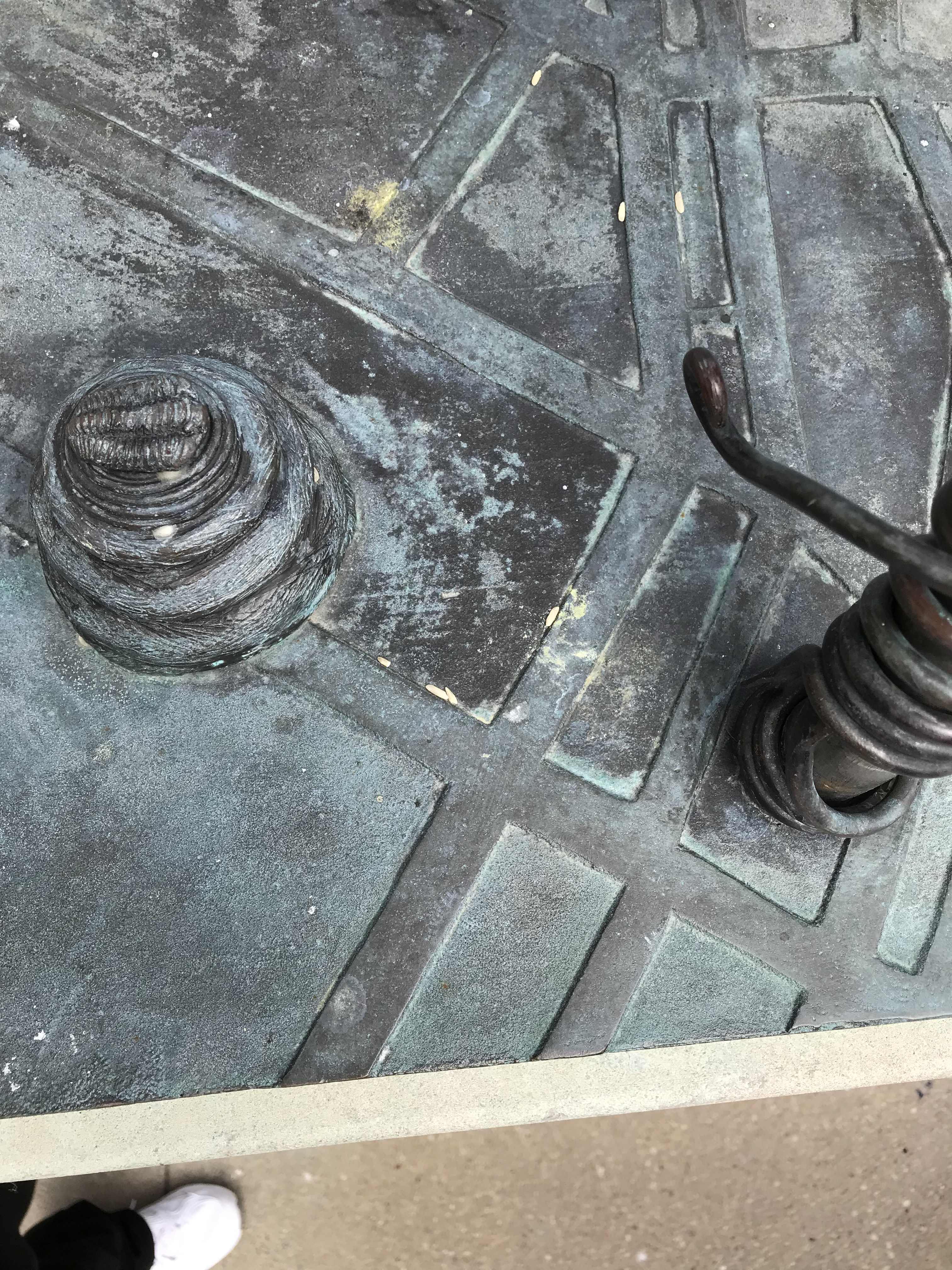
So I just now looked up “trilobites good luck” and found that, yes, apparently trilobites are considered symbols of good fortune. See this Wikipedia article on the Neodrepanura, which describes how in China the fossils are mined “for use as ‘bat stones’ or ‘swallow stones,’ as good luck charms and traditional medicines.”
Interestingly during our Saturday art walk, I noticed lots of rice scattered on the ground beneath the arch of the bronze wave upon which the creature’s chariot rides. Part of me wondered: Might the rice actually be part of the artwork? Does someone come around regularly to replenish this symbol of good luck after a windy day?

The sculpture is situated above a boat landing on the river. So the most likely scenario is that a wedding party arrived via Riverwalk or water to take their photos beneath the arch of this good-luck landmark. Probably people showered the couple with rice to make a good picture.
But I kind of like my theory better 🙂
I’ll try to post a little more on the sculptures this coming week. One (called “Common Comrades”) haunts me, so much so that I went back to it on Tuesday afternoon and took lots more photos. And I may return to take more. Here’s one.
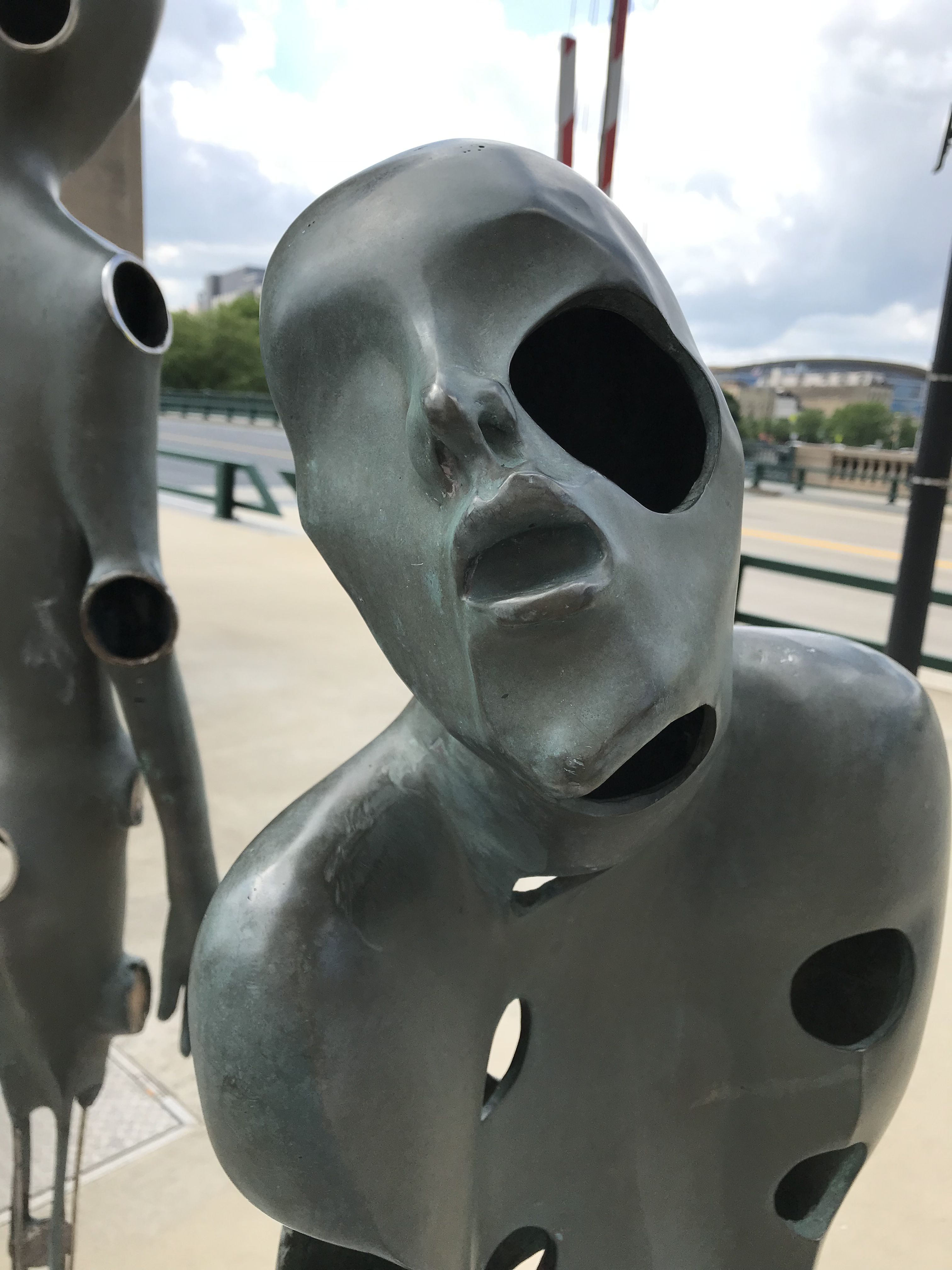
[UPDATE: I finally wrote a whole separate blogpost about this sculpture, including a poem. You can read it HERE if you’re interested.]
Would you like new posts delivered to your inbox? To subscribe, click here.
 😂
😂
Looked up from my desk this morning and noticed the “EXIT” sign outside my door.
I stumbled across a reference to this while doing something else online and couldn’t resist watching. In October 1953 Eleanor Roosevelt appeared as a “mystery guest” on the stump-the-panel quiz show “What’s My Line?” This episode, posted in its entirety on YouTube, including ads for Remington electric shavers, was fun to see for a few reasons.
First, one of the panelists is Bennett Cerf, one of the founders of Random House and an author/speaker, as well. Plus, I discovered after reading the Wikipedia article about him, he was the founder of the Famous Writers School, which offered correspondence courses for aspiring writers supposedly taught by famous authors. The Famous Writers School was the subject of an equally famous 1970 exposé article in The Atlantic Monthly by Jessica Mitford (who is even more famous for her funeral-industry exposé book, The American Way of Death). (Further aside: There certainly is a lot of “famous” stuff going on here. It’s about to get worse 😄)
One additional interesting thing about Bennett Cerf is that he was briefly married to actress Sylvia Sidney, whom many will recognize from Tim Burton’s Beetlejuice (a role for which she won an Academy Award for Best Supporting Actress) but who is most famous to me as the lead in Alfred Hitchcock’s Sabotage, which is the 1936 film in which Hitchcock famously (infamously) let a bomb carried by a child explode on a London bus. In a famous set of interviews that (the also-famous) filmmaker François Truffaut conducted with Alfred Hitchcock (so famous that he really doesn’t even need to be called “famous), Hitchcock discusses why that explosion was such a bad decision:
I made a serious mistake in having the little boy carry the bomb. A character who unknowingly carries a bomb around as if it were an ordinary package is bound to work up great suspense in the audience. The boy was involved in a situation that got him too much sympathy from the audience, so that when the bomb exploded and he was killed, the public was resentful.
The way to handle it would have been for Homolka to kill the boy deliberately, but without showing that on the screen, and then for the wife to avenge her young brother by killing Homolka.
To which Truffaut says
Even that solution, I think, might have been resented by the audience. Making a child die in a picture is a rather ticklish matter; it comes close to an abuse of cinematic power.
And to which Hitchcock concedes
I agree with that; it was a grave error on my part.
Here’s a link to the Google Books version of that interview.
Bennett Cerf was born and raised in New York City, so I’m not sure how to account for his accent (or speech impediment, maybe?) that glides over “r” sounds to resemble “w”s in a manner reminiscent of Elmer Fudd. In trying to find more information about this style of pronunciation, I discovered that the “w” sound is sometimes called the “Winchester ‘r’,” a reference to one of Britain’s famous “public” (private) schools and the aristocratic way of speaking referred to as “Received Pronunciation” (as in “acceptable,” in the way that only acceptable people are “received” in society), which in turn was adopted by broadcasters as the most easily understood pronunciation and became better known as BBC English. In America, especially following the introduction of “talkies” and the employment of diction instructors to teach Hollywood actors how to speak, this resulted in the strange psuedo-aristocratic, fake-British Mid-Atlantic accent of 1930s and ’40s stars like Katharine Hepburn and Tyrone Power. Apparently it was also an accent strived for by America’s upper classes during that same era. This passage from Wikipedia’s article on the Mid-Atlantic accent describes this unnatural way of speaking as a dialect called “World English,” invented by speech teachers to sound upper crust:
World English was a speech pattern that very specifically did not derive from any regional dialect pattern in England or America, although it clearly bears some resemblance to the speech patterns that were spoken in a few areas of New England, and a very considerable resemblance … to the pattern in England which was becoming defined in the 1920s as “RP” or “Received Pronunciation.” World English, then, was a creation of speech teachers, and boldly labeled as a class-based accent: the speech of persons variously described as “educated,” “cultivated,” or “cultured”; the speech of persons who moved in rarified social or intellectual circles and of those who might aspire to do so.
Hmm, according to Wikipedia, Bennett Cerf’s mother was heiress to a tobacco-distribution fortune. Maybe that “r” pronunciation was a reflection of Cerf’s social class? In any case, I’ve seen Bennett Cerf’s name here and there my whole life, so it was fun to see him in person on “What’s My Line?”
So on to Eleanor Roosevelt!
She appears halfway through the show, at the 14:25 minute mark (right after the commercial break). I was curious to know why they kept talking about the United Nations, like wondering if this mystery guest would be found in the neighborhood of the UN. A quick Google search revealed that Eleanor Roosevelt was appointed to the first U.S. delegation to the UN and served from December 31, 1945 till December 31, 1952. Additionally, Roosevelt was unanimously elected chair of the UN’s Commission on Human Rights, which she led from 1947-1951. It was under her leadership that the United Nations’ famous “Universal Declaration of Human Rights” was drafted and published.
I only ever knew of Eleanor Roosevelt as she was in her older age, looking very much as she does in her appearance on this show. So I was surprised to discover photos of her a few years ago as a young woman. Somehow I’d grown up thinking of her as someone who had never been youthful, probably because there were SO many photos and film segments depicting her in those later years when she was such a prominant public figure. But check it out: ER was a girl and young adult once, too!
 From the National Archives via Wikipedia
 From the National Archives via Wikipedia
Would you like new posts delivered to your inbox? To subscribe, click here.
So many photos of this building are just waiting to be taken. There’s one image I’d like to capture along the north side looking west, but I don’t think my equipment is good enough to get it 😦

Photo taken in my parking garage this morning. Lots of cutesy titles suggested themselves, among them:
“Rule of Thirds” – because there are three white pillar bases and three white lights. Plus the “Rule of Thirds” concept.
“Figures 3 and 4 in Black and White” – which would be a play on Charles Demuth’s brilliant I Saw the Figure 5 in Gold.
In the end I went with “Arrangement in Black and White No.1” as a play on Arrangement in Grey and Black No.1, better known as Whistler’s Mother, because I rarely take black-and-white photos and this one seemed to be all about light, shadow, and geometry. Hence, an “arrangement” in black and white of lines, shapes, darkness, and light.

I’m cleaning out my office today, throwing out old student papers and old lecture notes from courses I no longer teach. One of the files I came across was from a one-off course on mythology that I taught in the early 2000s. It was a really neat class to teach, and maybe I’ll propose teaching it again.
In any case, what caught my eye was a quote from Joseph Campbell (Wikipedia article here). It’s long, but because I’m teaching political science this summer, it caught my eye because the first line is so closely related to things we’re talking about in political science:
Man should not be in the service of society, society should be in the service of man.
Doesn’t that sound like exactly the opposite of John F. Kennedy’s famous line:
Ask not what what your country can do for you, ask what you can do for your county.
So it got me thinking a little bit more about the relationship between the individual and the state. Here’s the entire Campbell quote on this topic. I’m pretty sure I pulled it from The Power of Myth video series of interviews with Bill Moyers. I showed a couple of those episodes to my class.
Man should not be in the service of society, society should be in the service of man. When man is in the service of society, you have a monster state, and that’s what is threatening the world at this minute. . . .
Certainly Star Wars has a valid mythological perspective. It shows the state as a machine and asks, “Is the machine going to crush humanity or serve humanity?” Humanity comes not from the machine but from the heart.
What I see in Star Wars is the same problem that Faust gives us: Mephistopheles, the machine man, can provide us with all the means, and is thus likely to determine the aims of life as well. But of course the characteristic of Faust, which makes him eligible to be saved, is that he seeks aims that are not those of the machine.
Now, when Luke Skywalker unmasks his father, he is taking off the machine role that the father has played. The father was the uniform. That is power, the state role. . . . Darth Vader has not developed his own humanity. He’s a robot. He’s a bureaucrat, living not in terms of himself but in terms of an imposed system.
This is the threat to our lives that we all face today. Is the system going to flatten you out and deny you your humanity, or are you going to be able to make use of the system to the attainment of human purposes? How do you relate to the system so that you are not compulsively serving it?
It doesn’t help to try to change it [the system] to accord with your system of thought. The momentum of history behind it is too great for anything really significant to evolve from that kind of action. The thing to do is learn to live in your period of history as a human being.
That’s something else, and it can be done.
So in some ways this boils down to that classic question of political philosophy about the social contract and what the proper relationship between the individual and the state should be. But Campbell is talking not only about “the system,” which seems to be bigger than the state (the “monster state” he mentions at the beginning of this quote?), but also about the “momentum of history.”
In other words, he seems to be saying you can’t fight City Hall, so don’t waste time trying to change the system. His penultimate statement echoes this familiar Gandhi quote:
Be the change that you wish to see in the world.
BUT . . . usually people construe Gandhi’s words to mean that you should “give back” and serve society. See for example Be The Change, an organization devoted in part to achieving a mission to
Make a year of service a common expectation and opportunity for all young Americans.
Which seems the opposite of what Gandhi actually meant if you view his quote through the lens of Joseph Campbell’s statement. Campbell says you should learn to live in your period of history “as a human being.” Gandhi said you should “be” the change. Both men seem to be talking about the self and developing a way of existing in harmony with your truest self.
Actually, I just now tried to find out a little more about Gandhi’s quote, like the entire speech or other context it was taken from, to see if he was talking about service and giving back or not. And guess what?
Gandhi never even said that!
According to The New York Times, what Gandhi actually said was
If we could change ourselves, the tendencies in the world would also change. As a man changes his own nature, so does the attitude of the world change towards him. . . . We need not wait to see what others do.
So Gandhi does seem to be saying something similar to what Campbell said. You can’t change the system by trying to change the system. You can only change yourself, and by changing your own nature, the system will change.
This idea of individuals focusing on themselves could be described as “selfishness.” It seems counterintuitive that the best way to contribute to society would be to put yourself first and pursue your own self-actualization.
Gandhi, of course, realized that while one individual couldn’t change the system, a large mass of many individuals can. Hence, India’s independence. But still, with the Joseph Campbell quote in mind, it seems that change comes not from the organizing and mobilizing of the masses so much as from the ripple effect of one person’s actions flowing through the medium of other people whose own states of “being” are sympathetically attuned to the same feelings and understandings. Any changes to society arise spontaneously, guided by the “invisible hand” that magically transforms an individual’s self-interested actions into benefits for society.
Political conservatives and classical liberals don’t seem able to articulate this way of thinking very well. It would be interesting to see a thinker run for national office who was capable of introducing such complex ideas into the conversation/debate about who we are and what kind of government would allow all of us to live our best-possible lives.
Or to paraphrase Campbell: to help all of us learn to live in our period of history as human beings.
Here are two other Joseph Campbell quotes I found in my files, no doubt taken from that same Bill Moyers interview series:
People say that what we’re all seeking is a meaning for life. I don’t think that’s what we’re really seeking. I think that what we’re seeking is an experience of being alive, so that our life experiences on the purely physical plane will have resonances within our own innermost being and reality, so that we actually feel the rapture of being alive. That’s what it’s all finally about, and that’s what these clues help us to find within ourselves.
. . .
The influence of a vital person vitalizes, there’s no doubt about it. The world without spirit is a wasteland. People have the notion of saving the world by shifting things around, changing the rules, and who’s on top, and so forth. No, no! Any world is a valid world if it’s alive. The thing to do is to bring life to it, and the only way to do that is to find in your own case where the life is and become alive yourself.
If you seek experiences that allow you to feel the “rapture” of being alive, you will in turn bring life to the world. Food for thought.
I think I’m going to take a break and make a Starbucks run so I can focus on the “rapture” of coffee. And then we’ll just see how the world changes. I’m doing my part 🙂


 Katherine Wikoff