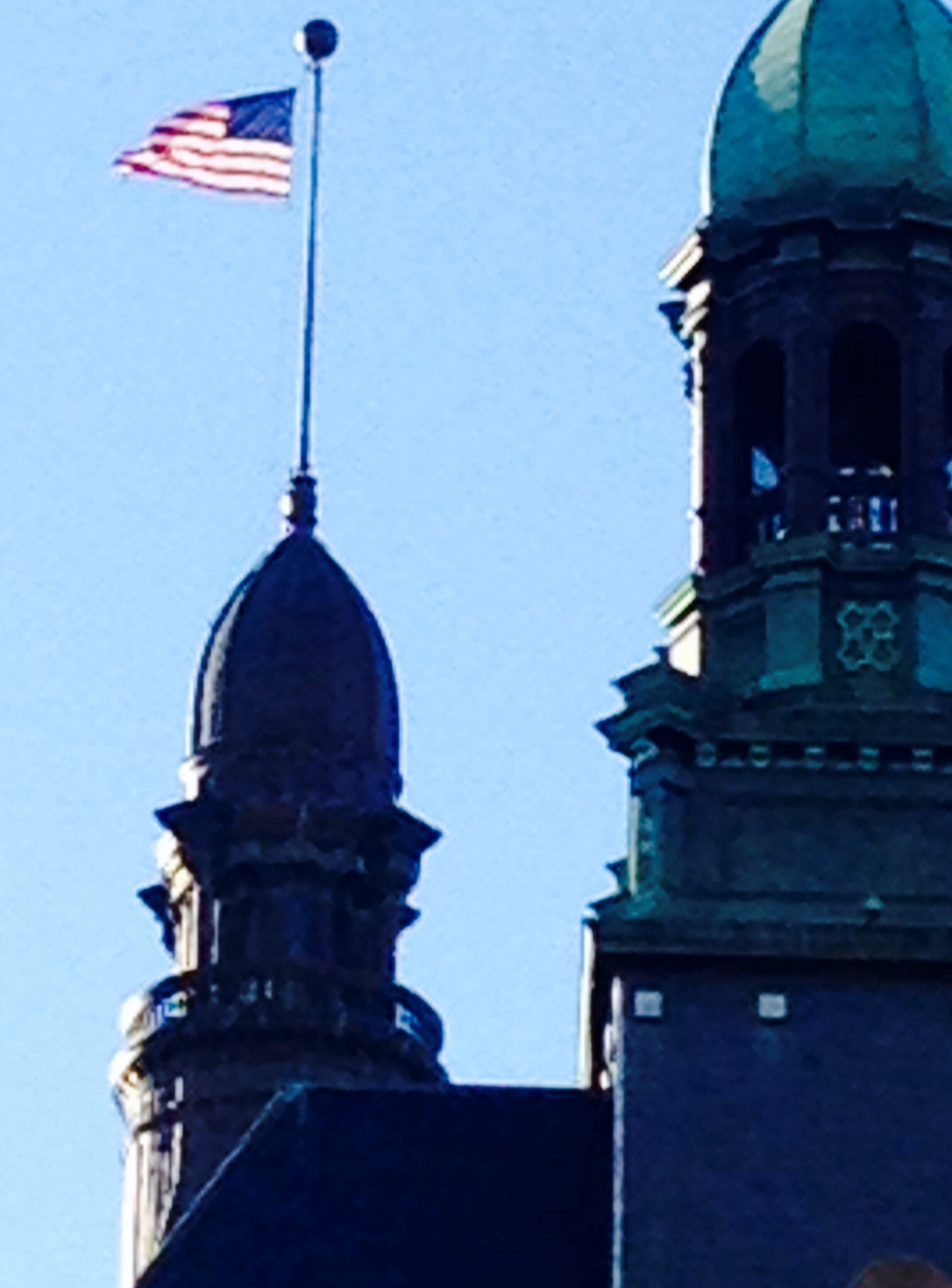
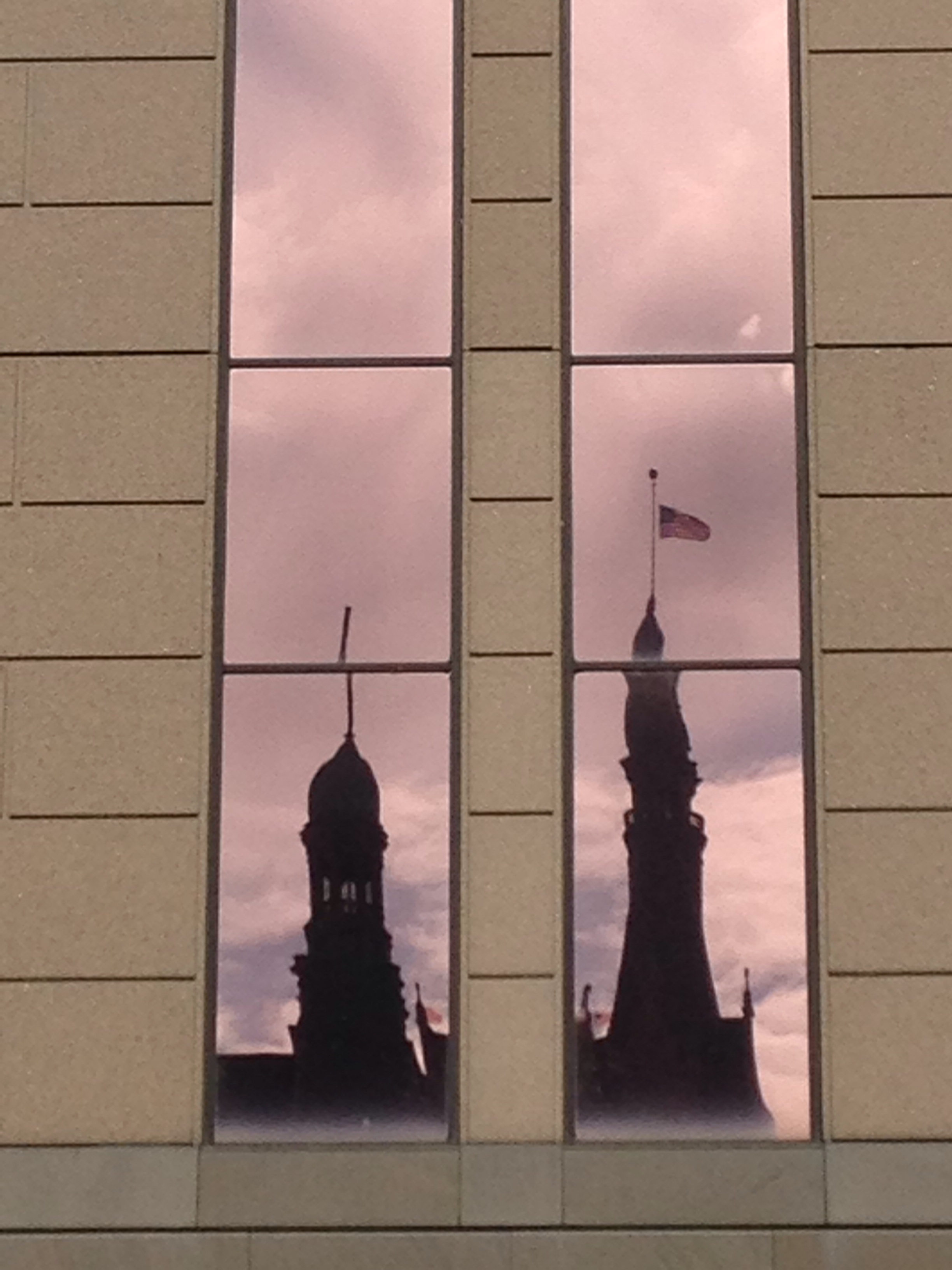
Taken with my iPhone this morning on my way to work. Very grainy, I know (there’s only so “close-up” you can get with a phone!), but I loved the sharp rims of white sunlight along the eastern edge of City Hall’s two towers. So for what it’s worth, I thought I’d post and share 🙂
I had lunch at the Milwaukee Art Museum’s restaurant today with a group of dear, old friends (going on 25 years!): Jo, Kathleen, and Karen.
The restaurant is a well-kept secret. Well, maybe not that secret, but I’m a museum member, and I didn’t know where it was!
(Shhh! The restaurant is on the lower level of the Calatrava addition. Very good food, with a beautiful view of the lake and the North Point water tower. Let’s keep that info just between ourselves so that word doesn’t get out.)
(And speaking of the North Point water tower, it was 30 years ago this past week that Milwaukee artist Terese Agnew mounted a 350-pound iridescent dragon high on the side of this tower, evoking fairy-tale associations with castles and princesses. Remember that, fellow Milwaukeeans? You can read the old Milwaukee Sentinel story here.)
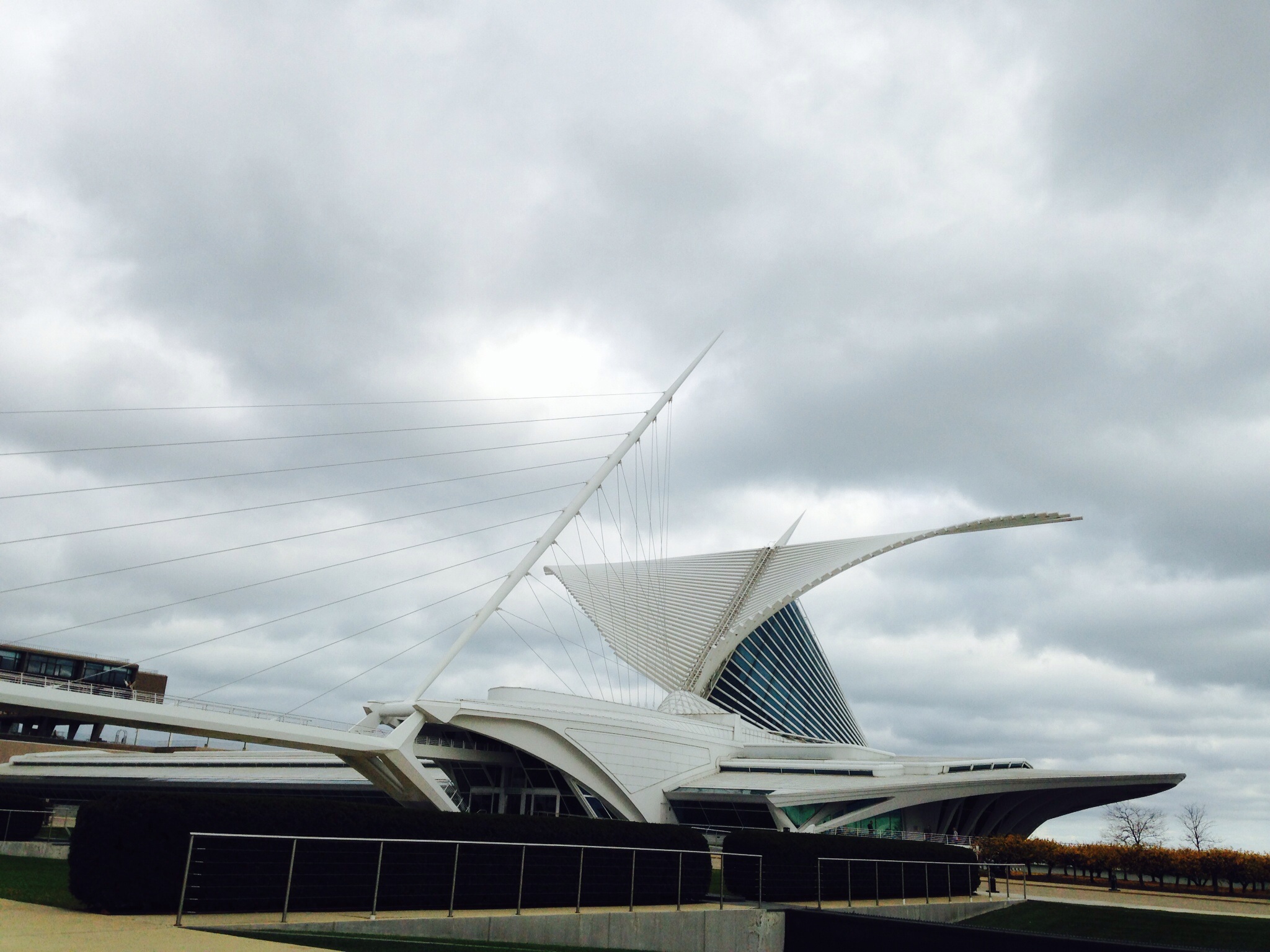
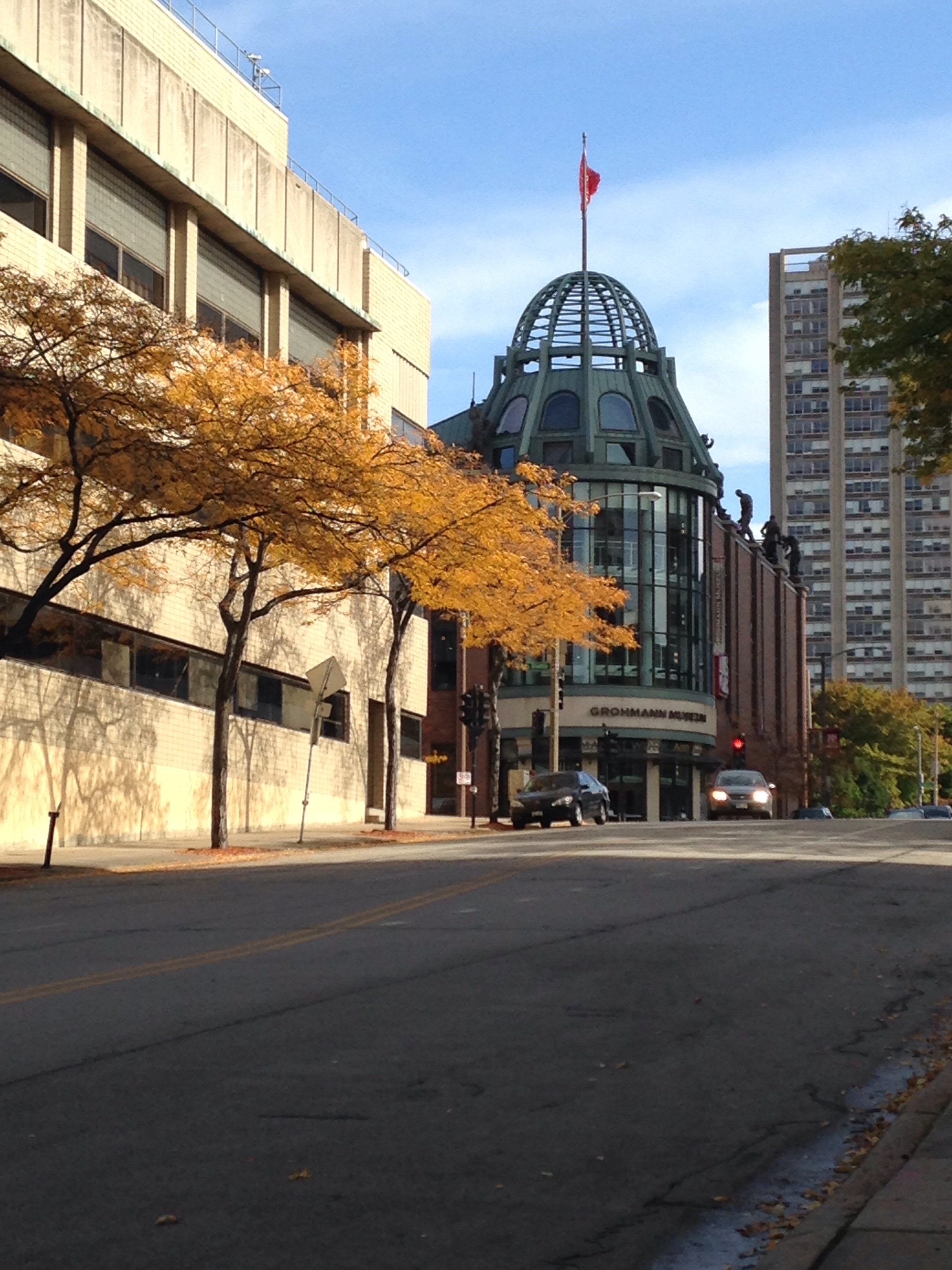
Here’s a photo I took today as I approached the museum. I liked the way the white of the building blended with the gray clouds in the sky.
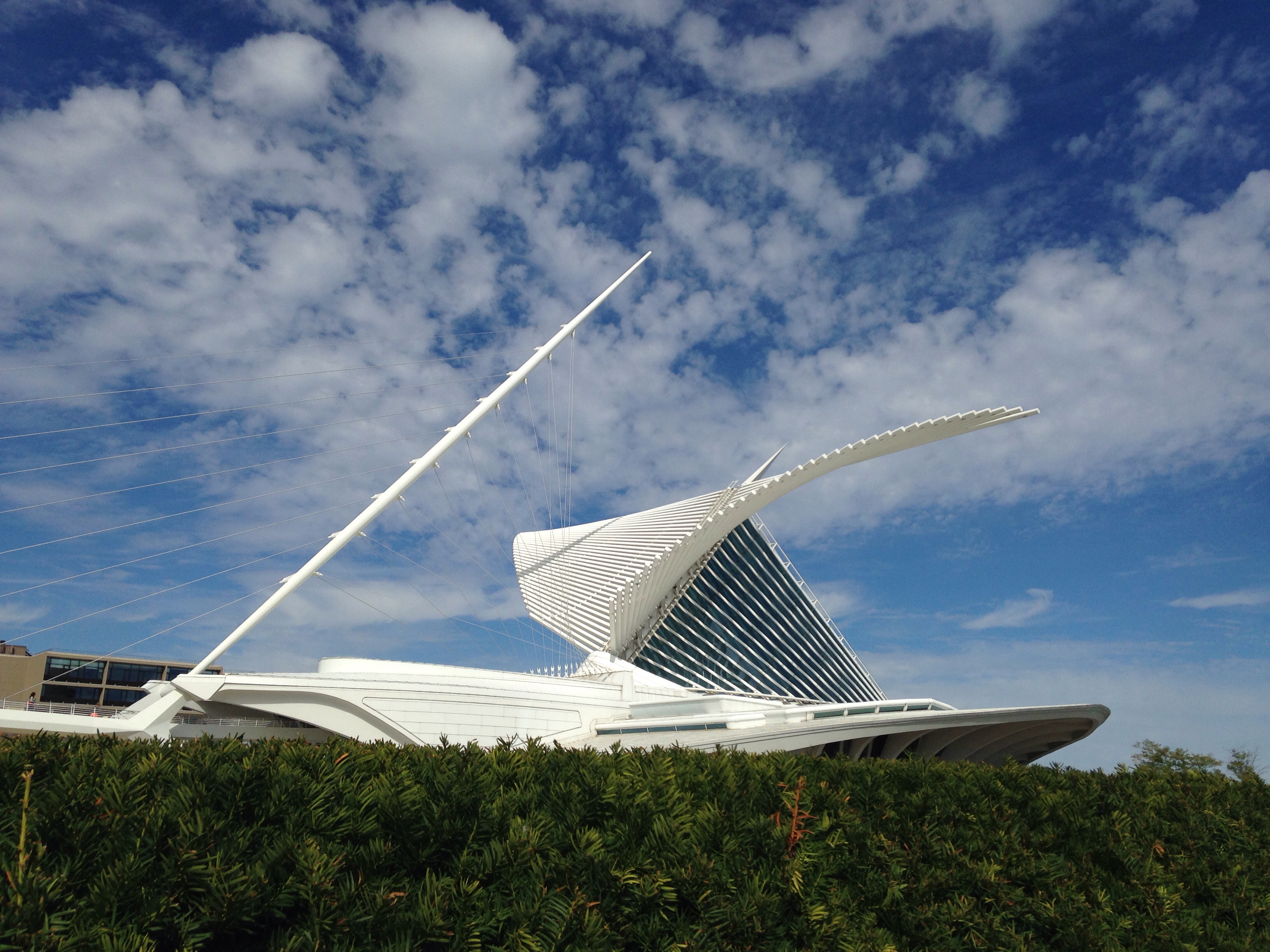
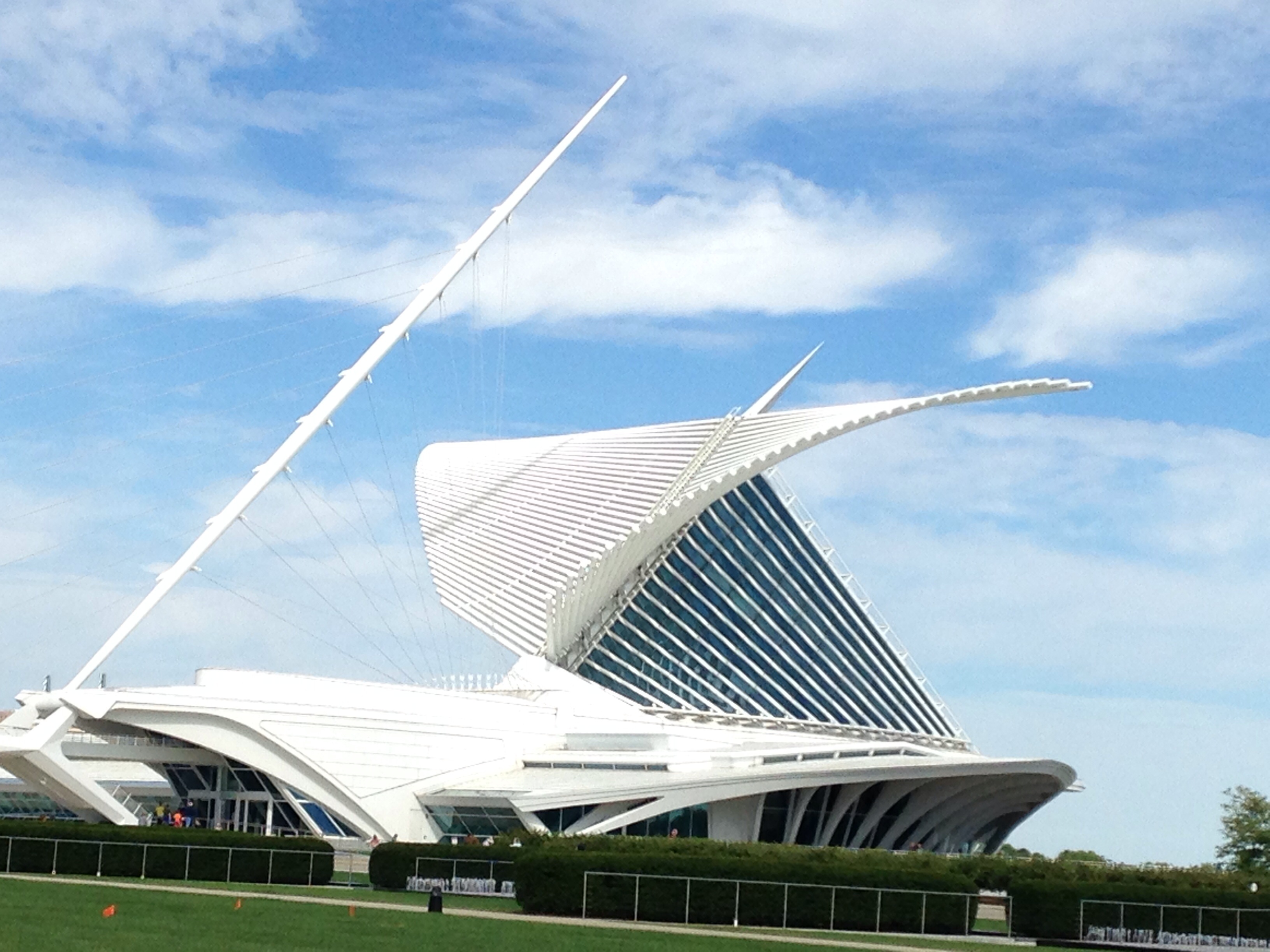
Compare today’s photo with the ones I took several weeks ago, on a beautiful late summer day.
But here’s the main thing I wanted to post today. As Karen and I walked toward our cars, we passed by the “Wind Leaves” sculpture by Ned Kahn (Wikipedia article on this public artwork here). We stood for a few minutes watching the giant, shimmering leaves turn slowly in the breeze. Usually the leaves look silver against a blue sky, but today they looked more pewter against the gray clouds and the dull autumn colors. And here’s a 12-second video of it that I shot. It’s short, but I hope you like it.
While visiting the “Van Gogh to Pollock: Modern Rebels” show at the Milwaukee Art Museum several weeks ago, I was sitting on a bench about twenty feet away from this painting by Mark Rothko (“Orange and Yellow,” 1956) when a woman moved in front of me to stand directly before the large canvas.
All at once, she became part of a new artwork! The colors of Rothko’s painting had already transfixed me, but when I saw this woman’s green outfit merging with the orange-peach shades of the painting, I was delighted by how the original work suddenly morphed into something completely new. For me, anyway 🙂
I quickly (surreptitiously) took this photograph, and it occurred to me that I could crop it a little (someone’s elbow) and post it in hopes that you might see what I did, albeit on a smaller scale and with colors less striking than they actually were.
Would you like new posts delivered to your inbox? To subscribe, click here.
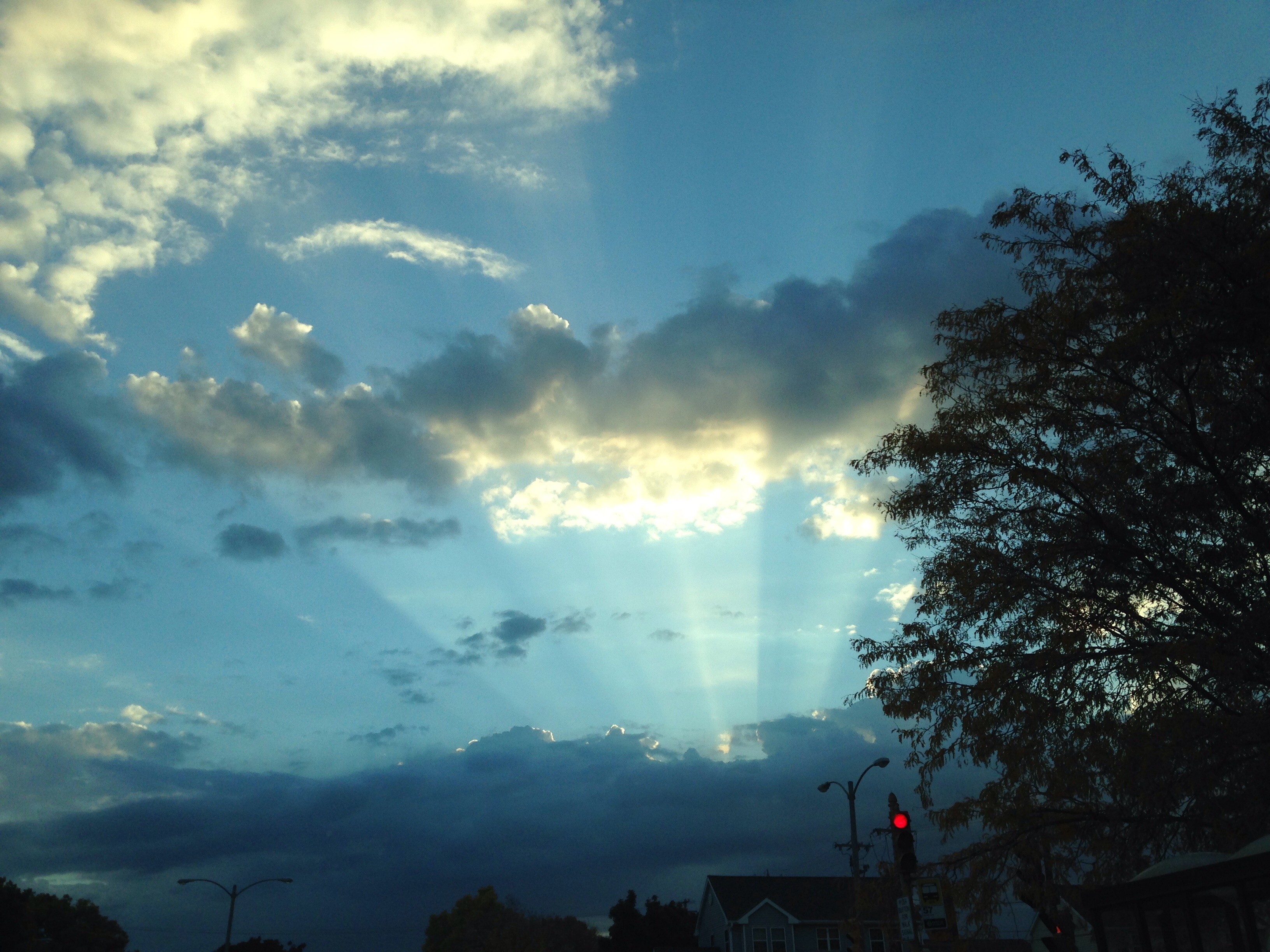
I thought about cropping the “city” fixtures out of this picture, but I’ve decided I like the traffic light at the bottom right. That one little red dot sort of counterbalances and complements all the varying shades of blue.
What is it about autumn light? These beautiful skies make my morning commute such a pleasure!
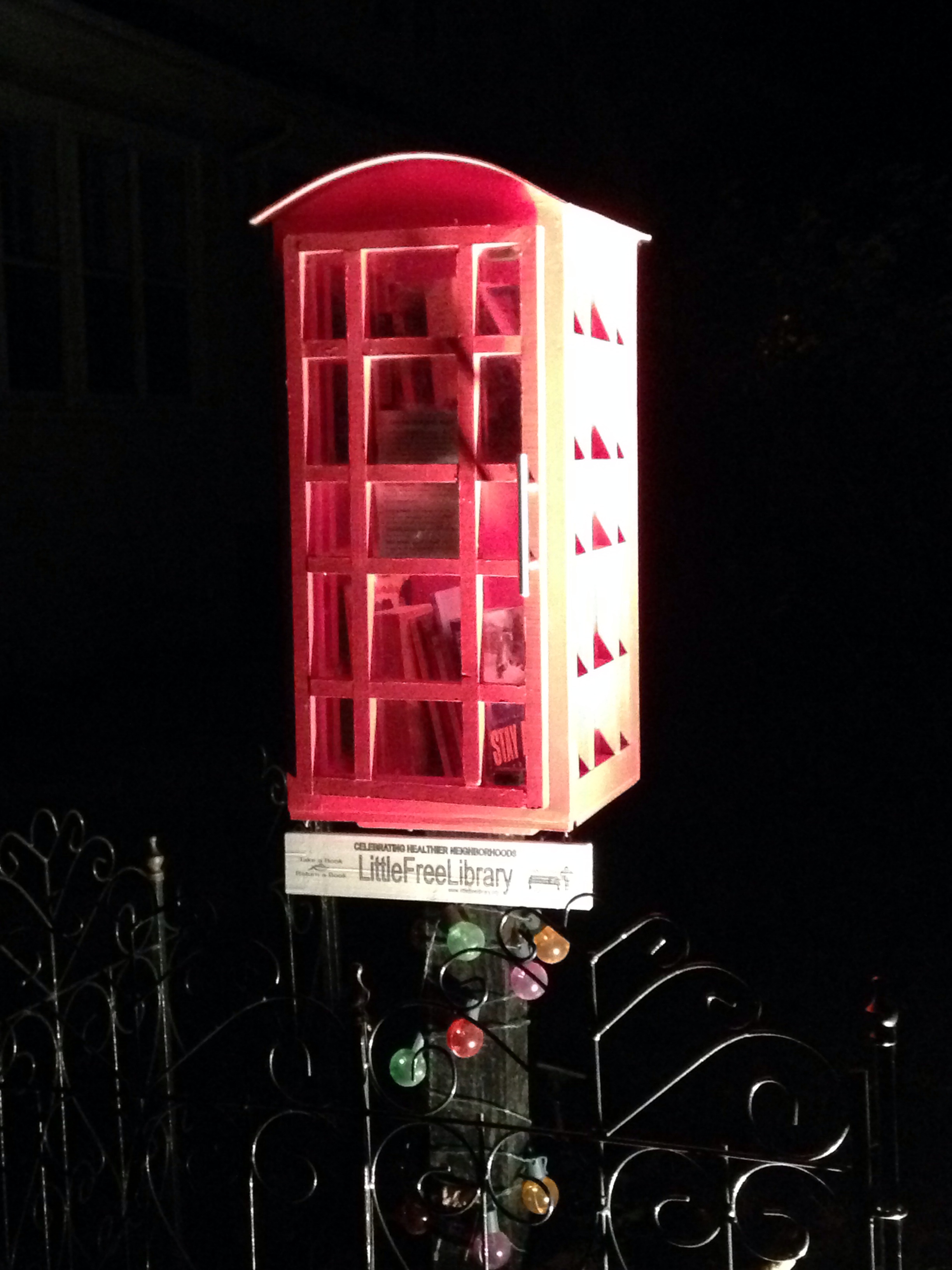
This mini-library replica of a British red telephone box . . .
The real thing, installed in front of St. Paul’s Cathedral in London, photo by Christoph Brown, via Wikipedia CC0 1.0 Universal Public Domain Dedication
. . . is at its best during the night, when it is lit up by a focused spotlight. Its red glow can be seen from a few blocks away down the street—like a literary beacon 🙂 My iPhone cannot do justice to its deep, rich color, but I hope you’ll get an idea, at least, of how cute this facsimile is.
I just picked up this morning’s Wall Street Journal and was surprised to see an article on the front page of the “Review” section that echoed my own thoughts about what’s happening in the Middle East right now. (It made me feel really smart that I was on the same page as the big boys 😄)
I hardly know where to start with this post; so many bits of knowledge are swimming around in my head.
First, I think something really significant is happening in the Middle East right now. Lots of pieces that have been in motion and slowly gathering separate momentums (momenta?) for a few years seem to be coalescing into one giant paroxysm of violence in Syria and Iraq.
At best, a major power shift is occuring. Worst case: this is the start of World War III. No kidding.
I hope I’m wrong about that second one. I hope we’ve learned enough as a people (that is, as members of the one human race) to avoid making the same horrific mistakes of our past.
So here’s a basic summary of my vague fears.
1) Russia needs a stable Syria and a stable Turkey and a friendly, Russia-oriented (not Europe-oriented) Crimea in order to maintain the stability of its Black Sea Fleet—which is its only warm water naval base. Russia needs Crimea because that’s where the Black Sea Fleet is based, in the city of Sevastopol. They need Turkey because the only way to get from the Black Sea out to the rest of the world is via the Turkish Straits. And they need Syria because of the naval refueling station in the Mediterranean coastal city of Tartus. About a year and a half ago I wrote a blog post analyzing this situation, complete with maps. You can link to it here for additional background.
2) Just as happened in World War I, two distinctive “sides” seem to be forming, based on previous alliances and old ethnic sympathies/hatreds.
Russia is allied with Syrian president Bashar al-Assad. One little twist on this story is that Assad ascended to his position as Syria’s president through ascription—i.e., hereditary inheritance of political office and power, similar to the family dynasty in North Korea. Assad’s father was Syria’s previous president-for-life (1971–2000). So part of what started the internal strife in Syria in the first place was the question of Assad’s legitimacy and authority to govern.
Anyway, Russia and Iran both have troops on the ground in Syria now, ostensibly fighting ISIS/ISIL (Islamic State of Iraq and Syria / Islamic State of Iraq and the Levant). Iran’s involvement fighting ISIS on Iraqi soil is also welcomed by the Shiite-led Iraqi government.
Remember the Iran–Iraq war? That was another time, another political reality. The Iraqi government was then run by Sunnis, adherents of a denomination of Islam that was (and remains) in the minority of Iraq’s overall population, far outnumbered by Shia Muslims. Sunnis and Shiites despise each other, despite the fact that they are both branches of Islam. Most Muslims in the world are actually Sunni, but guess where most of the Shia live? Iraq and Iran (and Pakistan and India).
ISIS/ISIL is Sunni. Actually they are Salafi jihadists, which is like saying they are über-Sunni fundamentalist followers of the one true Sunni way—and not just fundamentalists but radical fundamentalists to boot, who believe in an interpretation of “jihad” that requires not just living according to Islam or building a society based on Islam but actually fighting a holy war against all perceived enemies of Islam. Actually not even enemies of Islam but enemies of the one true Islam which would be Sunni. Actually not even Sunni but the one true Sunni, which would be Salafi. Does that make sense?
Iran (Shia) doesn’t like ISIS/ISIL (über-Sunni).
Iraq (now Shia, and actually always Shia in population but long suppressed by the Sunnis, who dominated Iraq’s government, except now the shoe is on the other foot, with a democratically elected Shia government representing a Shia-majority population), yes, Iraq is now friends with Iran. At least “friendly,” anyway.
Sunni Iraqis have been somewhat sympathetic toward and supporting of ISIS. Shia Iraqis don’t like that. Enter Iran, but quietly, so as not to stir up tensions between Iraq’s Sunnis and Shiites. For over a year Iran has been providing technical assistance and training to Iraqi troops, plus it has reportedly been secretly funding Shia militia groups who are fighting ISIS.
Saudi Arabia is Sunni, with a tiny Shia population and a very sizable segment of über-Sunni adherents of Salafism, also known as Wahhabism. (Don’t forget that ISIS is Salafi.)
So, the Islamic world is basically divided up into these two groups, Sunni and Shia, who despise each other.
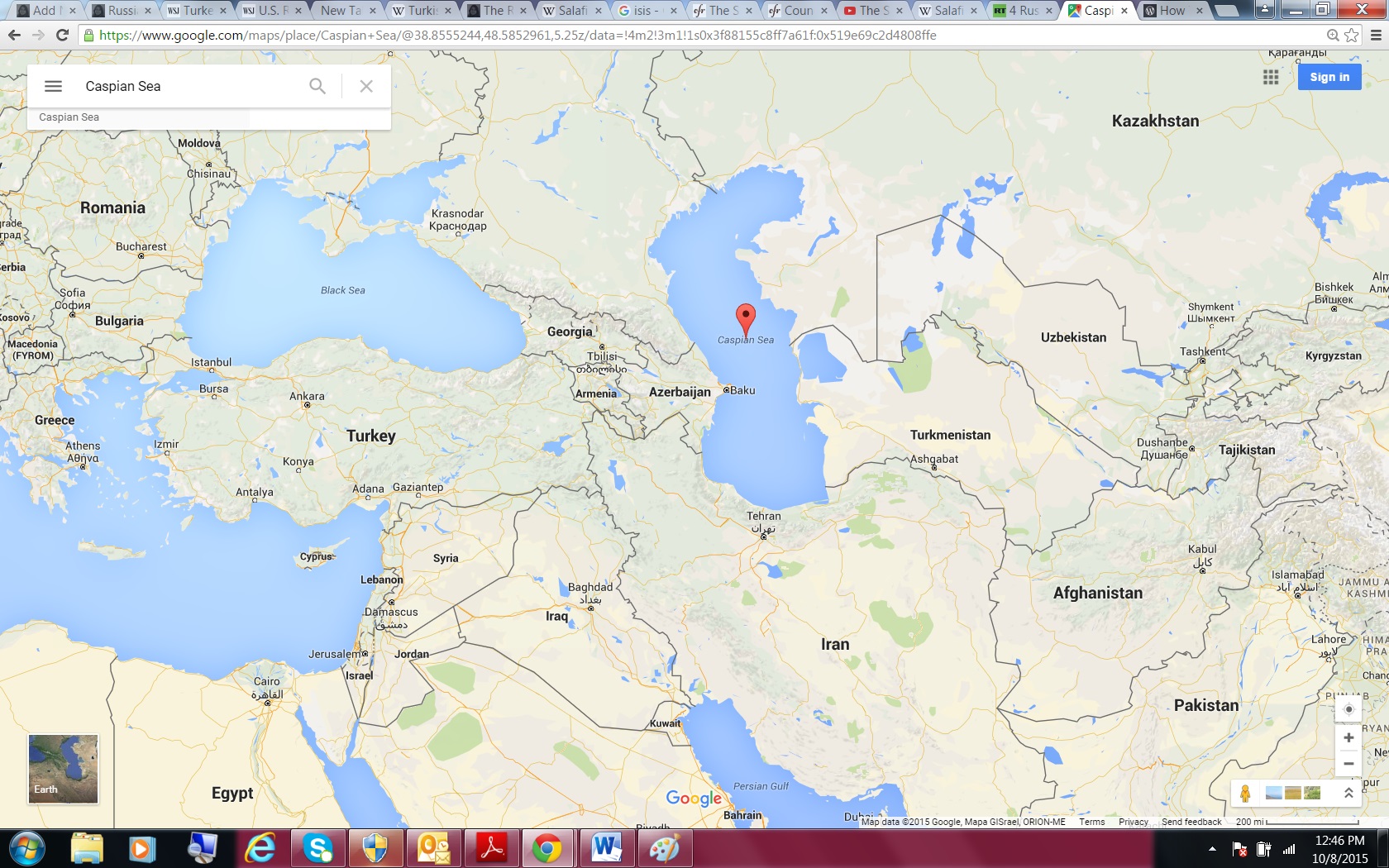
3) (Remember #s 1 and 2? They were so long ago in this post 🙂 ) Russia has just begun launching missiles at ISIS targets from warships in the Caspian Sea. Here’s a screen shot I took of the Caspian Sea on Google Maps. (Look for the red “pin” marking it in the middle of the map.)
This is an interesting place for Russia to be firing missiles from—mostly because I’ve been watching Central Asia for a while now, ever since reading S. Frederick Starr’s brilliant 2009 Wilson Quarterly essay, “Rediscovering Central Asia.” (Link to the essay here.)
Once home to the Silk Road (the original, that is), not only is Central Asia blessed with tremendous reserves of oil and natural gas of its own, but it is also by virtue of its location a place across which many other nations would like to transport oil and gas via pipelines. Central Asia is huge and is bordered by Russia, China, Southeast Asia, and the Middle East.
So does Russia’s using the Caspian Sea to fire missiles have any greater significance? Is it merely because firing from the Black Sea would be too blatantly a violation of Turkey’s airspace? Or does originating missile fire from the Caspian Sea also serve to remind those nations surrounding it that Russia does indeed have powerful military strength? Don’t forget that Russia has experienced several Islamic terrorist attacks committed by Central Asians.
Yes, Central Asia is largely Muslim, and mostly Sunni at that. Only Afghanistan and Tajikistan have sizable Shia populations, although even then Shias are a minority.
Most of the world’s Muslim population, in fact, is Sunni. The Sunni Muslims are spread throughout Africa, Central Asia, and the South Pacific (Indonesia, etc.). The Shia population is concentrated mainly in four countries: Iraq, Iran, Pakistan, India.
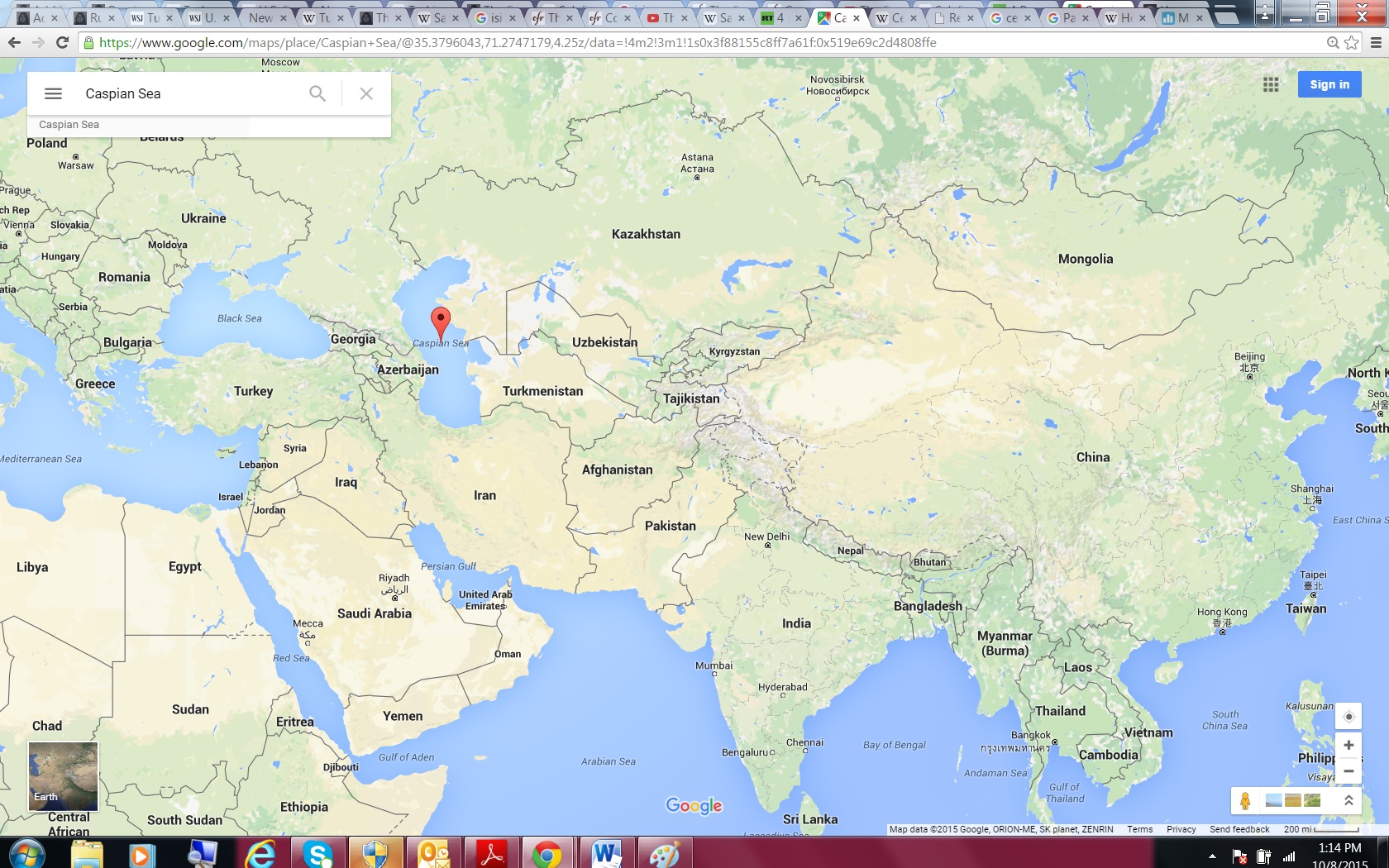
Here’s another screen shot of Central Asia (thanks Google Maps 🙂 ). The shortest, most direct way for Central Asian oil and gas to get to the ocean for transport is to run pipelines directly south—through Iraq, Iran, Pakistan, India. Sort of a Shia rampart standing guard and blocking Central Asia’s way to the Indian Ocean. Okay, that’s an overstatement. But looking at the map, you can see that countries bordering Central Asia and blocking its pipeline/pathway to Europe and to the sea suddenly become both powerful and vulnerable.
Does this post make sense to you? It’s all still a jumble to me, and there are more details than these that feed into my worries.
For example, when the current civil war began in Yemen (Wikipedia article here), my Saudi students told me about the “Shiite crescent,” which is a theory subscribed to by many Sunnis in the Arab world that basically holds that Iran is trying to establish a “crescent” of influence from Lebanon to the Persian Gulf.
Depending on your perspective you may view this “Shiite crescent” idea as a mere conspiracy theory, with all the accompanying paranoia that such theories tend to engender. But it’s a a subject that has gotten scholarly attention, and here is a good article from the Brown Journal of World Affairs (Fall/Winter 2008) that provides some background information: “Iran and the Shiite Crescent: Myths and Realities.”
So to wrap up this post and recap my main concern: Are we on the verge of a new worldwide conflict in which “entangling alliances” based on the internal combustion engine and plastic packaging will drag reluctant (hapless?) nations into a long-simmering cauldron of Sunni–Shia hatred—and spread over an even broader geography than ever before thanks to hubris and 21st-century technology?





 Katherine Wikoff