Lake Michigan, January

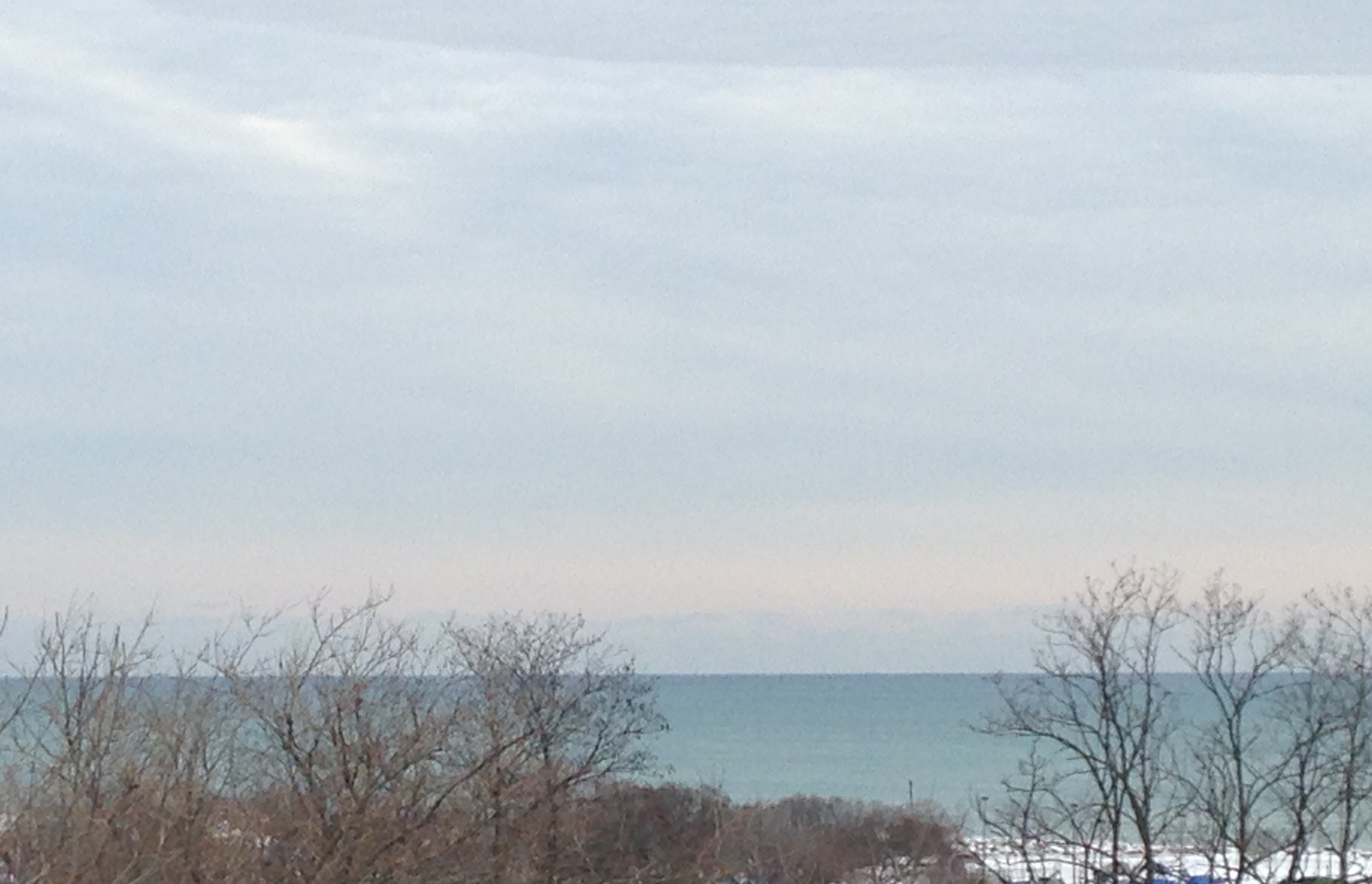
Lake Michigan, JanuaryAn old friend lives on Prospect Avenue, high on the bluffs overlooking Milwaukee’s lakefront.  I visited her today with another friend.  The day was gray, frigid and quite breezy.  But I pulled off my gloves and braved the wind—only for a minute—to take a picture of the lake.

Lake Michigan looks different every day, which might come as a surprise to people who have never lived near a large body of water.  I just noticed the barely-visible line of clouds low on the horizon.  Although it appears you’re seeing distant cliffs or mountains across the water, it’s really just the low-pressure weather system moving east.  You can’t see the Michigan shoreline from Milwaukee.  It’s too far away on the other side of the lake.

Can you make out the thin line of dark blue at the horizon in this photograph?  Some days that stripe is thicker, and closer to shore there’s a third segment of color, usually a brownish green.  There used to be a product called Jello 1•2•3, which “magically” segmented into three layers of jello and mousse.  Those three-layer days (dark blue on the horizon, sea green in the middle, and muddy beige in the foreground) remind me of Jello 1•2•3 🙂

Other days the water is a deep sapphire and covered with whitecaps, a sprinkling of small, cresting waves whipped up on the surface by a stiff breeze.  And when it’s raining and windy, there might be several long lines of waves rolling in, one after another.  Lake Michigan reminds me of the Atlantic Ocean on those days.

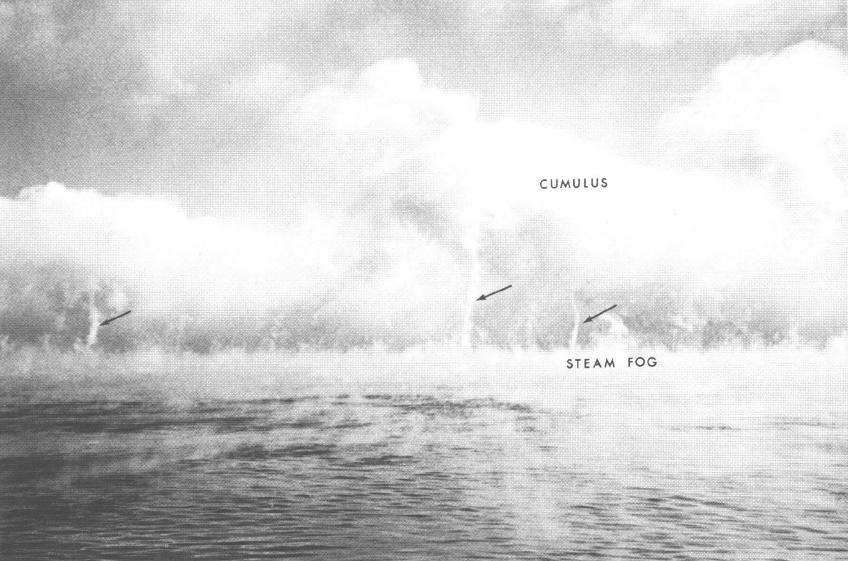
The strangest days are “steam devil” days.  These are days when the lake gives up its heat on the first really cold mornings of the winter.  It’s so eerie to see the curls of steam rising up from all across the water’s surface!  Below is a photo from the Wikipedia article on steamdevils.  It originally appeared in an article on the phenomenon by two UW-Milwaukee geography professors in The Monthly Weather Review (Vol. 100, No. 3, March 1972, pp. 235-237).

By Unknown author – Lyons, W.A. and Pease S.R., “‘Steam Devils’ over Lake Michigan during a January arctic outbreak”, Monthly Weather Review, vol.100, p.235, March 1972., Public Domain, https://commons.wikimedia.org/w/index.php?curid=148925269


Posted in Milwaukee, Nature, Science | Tagged , , , | 2 Comments

Staircase Volute

IMG_0204[1]

Posted in architecture | Tagged , , , , , , | 4 Comments

That winter quality of light

People who brave winter in the North know what I’m talking about: the strangely bluish quality of cold air and golden flash of low-angled sunlight.  When we say we appreciate the change of seasons, this “quality of light” is almost always cited.

Yesterday we had our first measurable snowfall in Milwaukee.  All the neighbors on our street were out shoveling once the snow tapered off in the late afternoon.  As my family was finishing up, I glanced down the street and noticed how all the tree branches seemed gilded by the last rays of sunlight.

gilded tree branches

I quickly went inside for my phone, and naturally by the time I got back outside, the light had faded quite a bit.  Can you make out the color?  And I did get a few other nice photos.  Below is a picture of our birch, showing a hint of that golden color.

IMG_0198[1]

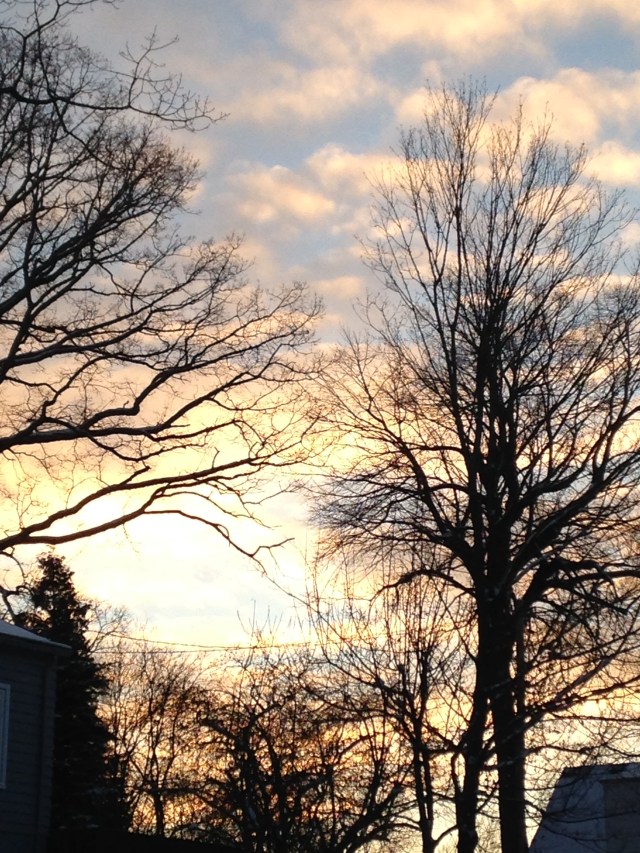
And the clouds in the sky seemed lit from below, which they actually were (sunset).

winter sunset

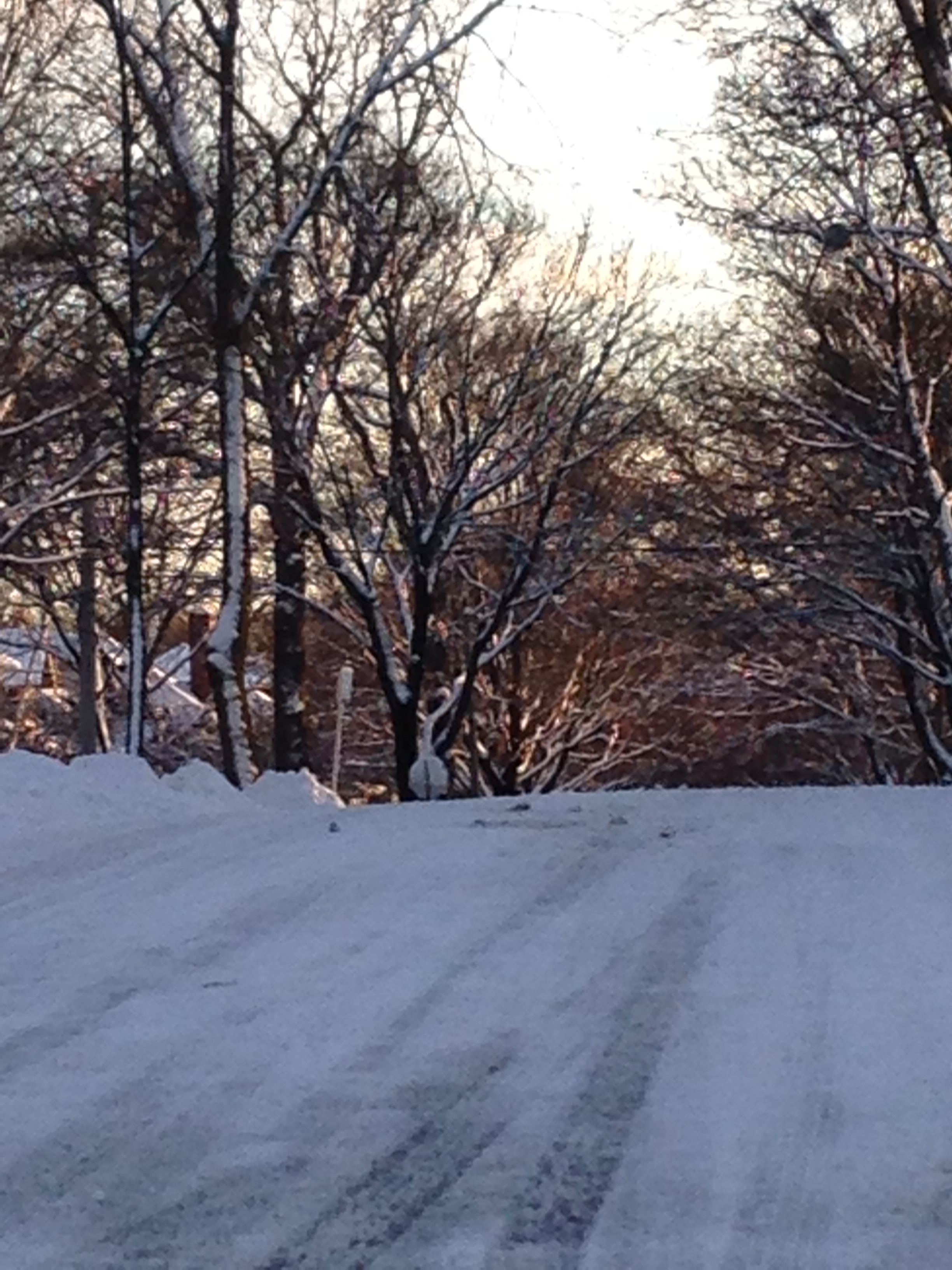
Today’s temperatures were bitter, about twenty degrees colder than yesterday.  Below is a photo of the same trees, facing west.  Although you can’t quite see the sun itself, which in real life could be seen as a hazy orb, you can still make out its chilly glow at center.  Brrrr!

IMG_0202[1]


Posted in Life, Milwaukee, Nature, Science | Tagged , | 3 Comments

Resolved: To Be Good Enough

You’ve surely seen the motivational posters before. Possibly you’ve also seen the “demotivators” from Despair.com. This one has always been my favorite, mostly because of the contempt I’ve always felt for people who practiced mediocrity. Ha! What’s that saying about how you are what you hate?

Being that it’s New Year resolution time again, I thought I’d share one of the hardest lessons I’ve learned in my life: that “good enough” really can be good enough. This blog post is therefore part confession, part pep talk.

If you’re a perfectionist, you can no doubt identify. All my life I was a person who tried my best. I didn’t necessarily care about the outcome, especially if it was something outside of my control, like a teacher awarding me an A on a school assignment. Take those grades, for example. One professor on my dissertation committee expressed skeptical disbelief regarding my statement in the text that I had never paid much attention to grades. External feedback was not what drove me. And thank goodness for that! What a mess I’d have been if I not only pushed myself to perform perfectly but then held myself accountable for outcomes I had no ability to influence.

No, what pushed me to succeed, always, was my need to know inside that I had given something my “all.” Anything less was unconscionable.  Immoral.

Not until I had children did I hit the wall. Suddenly it was impossible to give everything my best. My kids needed me to be the best mother I could. My husband needed me to be the best wife I could. My job needed me to perform all tasks to their utmost. Yet there remained only 24 hours in a day.

Doing my “best” became . . . doing the best I could.

It tore me up inside.

Seriously. I can hardly type these words with a straight face because it sounds so stupid. You know the expression “ASAP” (As Soon As Possible)? To some people that means drop everything and respond immediately. To others it means to respond whenever it’s convenient to get around to it. Obviously when two people with different understandings use the term with each other, there’s going to be some friction.

That’s the kind of personal “friction” I faced when my children were young.  (Who am I kidding—I still face this dissonance pretty much every day of my life 🙂 ) For someone used to doing her “best,” it was excruciating to be reduced to doing the best possible given the circumstances.

While I’m sure there may exist carefree people who have never faced this kind of identity crisis—i.e., struggling with who they are if they are not someone who always does their absolute best—I’m guessing that they are not the type of people who would read my blog. So here comes the pep talk part of today’s post: Perfectionism is a curse.

Yes, a curse. Just as nearly every other character flaw is the dark underbelly of a positive attribute, so too is “perfectionism” the evil twin of “conscientiousness.” Perfectionism robs you of satisfaction. It robs those around you of feeling joy in your presence. It keeps you from doing things that are important, things that matter to you.

Have you heard the expression “D is for done”? (Maybe not.  I just Googled the expression and found it only in Sue Grafton/picture book types of lists, like A is for “alibi” or “apple.” So FYI, “D” refers to the very poor academic grade of D, and “done” means that even though the grade was bad, at least the assignment is completed and over with.) Sometimes “good enough” is good enough.

Steve Jobs, iconic co-founder and longtime CEO of Apple, was famously such a perfectionist that he slept on a mattress on the floor rather than buy a bed that was not the ONE. This behavior did not change once he was married, as this 2011 New Yorker profile by Malcolm Gladwell makes clear:

“We spoke about furniture in theory for eight years,” his wife, Laurene Powell, tells Walter Isaacson, in “Steve Jobs,” Isaacson’s enthralling new biography of the Apple founder. “We spent a lot of time asking ourselves, ‘What is the purpose of a sofa?’ ”

It was the choice of a washing machine, however, that proved most vexing. European washing machines, Jobs discovered, used less detergent and less water than their American counterparts, and were easier on the clothes. But they took twice as long to complete a washing cycle. What should the family do? As Jobs explained, “We spent some time in our family talking about what’s the trade-off we want to make. We ended up talking a lot about design, but also about the values of our family. Did we care most about getting our wash done in an hour versus an hour and a half? Or did we care most about our clothes feeling really soft and lasting longer? Did we care about using a quarter of the water? We spent about two weeks talking about this every night at the dinner table.”

Blogging has been really good for me in letting go of the perfectionism. I publish, despite the possibility of a typo. Or, as Steve Jobs might have put it, I “ship,” like a real artist.

I once didn’t send a sympathy card to a friend whose husband had died because the only stamps I had said “Happy Birthday!” in large lettering upon a festive background of fireworks. I kept thinking I’d get to the Post Office to purchase a more suitable stamp, but I never made it there. By then we’d added two dogs to our family and I was a program director in my department at work—although the particulars of my time shortage don’t really matter. Caught up in my compulsive perfectionism, I was paralyzed at the thought of amplifying my friend’s grief with a celebratory postage stamp.

How messed up is that? Today I would mail the card immediately and apologize for the inappropriate stamp in a postscript. (Because I guess I’m not so “reformed” of perfectionism that I could let that pass unacknowledged, as though I hadn’t even realized the cruel irony of affixing a “Happy Birthday!” stamp to a card marking a death.)

So although I still despise mediocrity, I do try very hard to cut others—and myself—some slack. There are times when deadlines do matter and compromises should not be made, but I pick my battles, as it were. All of us mere mortals down here on earth are just trying our best to make it through this life. We’re largely imperfect, and while human perfection is a glorious thing (and, oh, how uplifting to see when it happens!), the price an individual pays to achieve it is quite high in terms of personal sacrifice.

If you read Greek/Roman mythology, it’s interesting to note that often heroes would “retire” to their farms to live a quiet life following the herculean (couldn’t resist 🙂 ) efforts required for their accomplishments and victories over various monsters and tyrants. The gods never liked this, a hero resting on his laurels, as it were. They’d afflict the poor guy with some sort of trouble to get things moving again.

And then there’s the parable of the talents, in which a master who is embarking on a journey entrusts three of his servants with “talents,” a unit of money, for safekeeping. When he returns, the master finds that the first two servants have put their talents to work and increased the worth of the original investment. Those servants are rewarded for their initiative and industry. The third servant, however, buried his talent in the ground to keep anything from happening to it, and he is punished for his sloth. From the Wikipedia entry linked to above, quoting Matthew 25: 24-30:

For to everyone who has will be given, and he will have abundance, but from him who doesn’t have, even that which he has will be taken away. Throw out the unprofitable servant into the outer darkness, where there will be weeping and gnashing of teeth.

The unacceptability of resting on one’s laurels or wasting one’s talents runs deep in our culture. And I can’t bring myself to valorize mediocrity. Absolutely not, even in a post about letting go of perfectionism.

In Margaret Edson’s Pulitzer-Prize-winning drama Wit (originally spelled W;t, which makes sense once you see or read the play), the main character, Vivian, is a brilliant and demanding university professor whose academic specialty is logical exegesis of 16th-century English poetry, especially the poetry of John Donne. Vivian doesn’t mess around with the emotional response one might have to a poem; she is more enamored of the “wit” and intellectual acrobatics that the text might prompt. When she is diagnosed with cancer, she commits to a painful experimental treatment in order to add to the medical community’s body of knowledge. In the end, though, she realizes that her rigorous scholarship, her uncompromising teaching standards, and her unyielding, almost brutal treatment of students—all of that had been a mistake. As she nears death, Vivian has an epiphany: intellect is not as important as simple human kindness.

One of my friends saw that play in New York, with Judith Light in the main role. The play’s ending is very cathartic and wrenching, to say the least. Just before she dies, Vivian is standing naked, bathed in a bright light. During the performance attended by my friend, when the lights went out abruptly at the moment of Vivian’s death, my friend said that people were sobbing all around her in the darkness of the theater. I’ve read the play and have tears in my eyes as I type this. And I read that play way, way back in 1999 or 2000. I think this emotional response signifies something very deep and important and true—beyond just an ordinary, mawkish reaction that might be wrung out by a sentimentally overwrought production. Which this production most assuredly was not! At least that was my takeaway from the text of the play and my friend’s experience. And my New Year’s resolution is to continue my tightrope focus on balancing perfection with the kindness I believe is more important.

Be kind, both to others and to yourself. Banish the words “slacker” and “underachiever” from your everyday lexicon. People who aren’t living up to their “potential” may still be doing the best they can under the circumstances.

Sometimes “good enough” really is good enough.

Posted in Life, Popular culture, WPLongform (posts of 1000 words or longer), Writing, blogging | Tagged , , , , , , , , , , , , | 8 Comments

Christmas shopping in “The Village”

I don’t like shopping malls at Christmas.  Too crowded.  Too many harried people with too many gifts to buy and too little time.

My husband and my younger daughter don’t mind all that.  In fact, for years now they’ve had an annual tradition of heading to the mall  on Christmas Eve to shop.  This year, though, my husband had the flu.  The real thing, influenza, requiring Tamiflu and antibiotics and lots of water and rest.  My daughter was so disappointed, but I’m sorry.  No way was I stepping into Dad’s shoes to take her to the mall.

But what I could do—and wouldn’t mind at all doing—was take her shopping in the nearby historic district of shops, part of the original community that grew up around the founder’s mill (now long gone) and a railroad depot over 150 years ago.  Locals call this area “The Village.”

First we stopped at an ancient candy shop and bought gifts for relatives—a classic 1-pound box of almond toffee crunch and bags of small chocolates individually wrapped to look like adorable, tiny Christmas presents.

IMG_0186[1]

Then we walked down the hill to a bookstore that is celebrating 29 years as an independent bookseller.  Maybe our purchases will help make that 30 years—our good deed for literacy 🙂

IMG_0179[1] IMG_0180[1]

Along the way we stopped in at boutiques housed in the many small storefronts.  One large boutique is housed in a former hardware store that closed its doors last year September after being in business since 1897.  The new boutique owner has kept many of the hardware store’s original features, including a wall of built-in cabinets and shelves with a library-style rolling ladder.

IMG_0183[1]

IMG_0182[1]

No stress, no crowds, easy parking (although a block outside the village proper, because parking on the narrow hillside streets is always an issue).  A hodgepodge of new stores and treasures to discover around every corner.

IMG_0185[1]

You know what?  We had a great time!  Next year even if my daughter and her dad continue with their annual mall excursion on Christmas Eve, maybe she and I can shop “The Village” a few days earlier.

Posted in architecture, Books and reading, History, Life, Milwaukee, Travel | Tagged , , , , , , , | 2 Comments

Communication lessons learned from the Indian Ocean tsunami and other natural disasters

It has been ten years since the December 26, 2004, Indian Ocean tsunami.  Many “anniversary” articles today will look back at this event, so this post doesn’t cover the same ground.  Because my academic specialty is communication, I wanted to share two thoughts on communication and the horrific loss of life (well over 200,000 people) associated with that event.

First, beyond the natural disaster itself (earthquake followed by huge seismic waves), the Indian Ocean tsunami was at its heart a failure of communication.  The earthquake and subsequent waves occurred on a Sunday, when most government offices were closed.  No one knew who should serve as a designated “point person” who could transcend or supersede international boundaries to receive, coordinate, and communicate messages regarding the underwater geological activity and potential for widespread consequences.

The quake was registered in Japan, which quickly mobilized its emergency management system to determine whether that nation was in danger from a tsunami.  As soon as that risk was eliminated, the all-clear signal went out to Japanese media, and nothing further was done with the information that a significant quake had occurred and a resulting tsunami was possible.  And the Pacific Tsunami Warning Center had put out word that all nations in its “jurisdiction” were safe.  Although Japan and other Pacific Rim countries had an arrangement in place to exchange information and warn each other, no such relationship existed with countries along the Indian Ocean.  One tsunami researcher at Japan’s Meteorological Research Institute later told a reporter that not only did Japan lack technical means to monitor the Indian Ocean (UNESCO has since installed sensors in the Indian Ocean), but it also lacked personal contacts with people who had similar forecasting responsibilities in other countries.

Japanese researchers/forecasters were not alone in lacking adequate contact information for peers in other countries.  One official from Indonesia’s Meteorology and Geophysics Agency in Jakarta sent email messages to counterparts around the region and in Europe.  However, as he noted later, “we only sent emails to the addresses we have.  We did not call them.”  This official also notified Indonesia’s National Coordinating Board for disaster, but since it was Sunday, he wasn’t sure who might receive the information.  “Our duties are simply to monitor earthquakes, analyze the information and provide complete calculations of the impact of the earthquake,” he said.

So both in Japan and in Indonesia, people were doing their jobs.  But for bureaucratic infrastructure reasons, lifesaving information was not communicated beyond the limits of their personal spheres of responsibility.

There was also no diplomatic “protocol” in place.  Although Australia had determined that a tsunami was possible and its Foreign Ministry had communicated that information to several of its embassies, foreign governments were not warned for fear of overstepping.

The only success story of the day in terms of sounding the alarm, in my opinion, was commercial radio.  The Indonesian Meteorology and Geophysics Agency official mentioned above first learned of the earthquake when a reporter for Radio Elshinta called him at home with the news that people in Medan had felt tremors.  And when a weather forecast chief at Thailand’s Meteorological Department got news of the earthquake about an hour after it occurred (and shortly before the tsunami hit), he called a Bangkok traffic radio station, which broadcast the warning.  His office got more than 1,000 calls afterward, which he hoped meant that lives had been saved.

My second communication-related thought I wanted to share today is actually more about learning.  In some instances people who understood the terrifying significance of oddly receding ocean waters were able to warn others to flee to higher ground.  Japanese tourists, obviously, who would have absorbed a lifetime of collective, culturally transmitted tsunami knowledge.  And from the Wikipedia article on the tsunami, these instances:

One of the few coastal areas to evacuate ahead of the tsunami was on the Indonesian island of Simeulue, very close to the epicentre. Island folklore recounted an earthquake and tsunami in 1907, and the islanders fled to inland hills after the initial shaking and before the tsunami struck.[48] On Maikhao beach in northern Phuket, Thailand, a 10-year-old British tourist named Tilly Smith had studied tsunami in geography at school and recognised the warning signs of the receding ocean and frothing bubbles. She and her parents warned others on the beach, which was evacuated safely.[49]John Chroston, a biology teacher from Scotland, also recognised the signs at Kamala Bay north of Phuket, taking a busload of vacationers and locals to safety on higher ground.

Anthropologists had initially expected the aboriginal population of the Andaman Islands to be badly affected by the tsunami and even feared the already depopulated Onge tribe could have been wiped out.[50] Many of theaboriginal tribes evacuated and suffered fewer casualties.[51][52] Oral traditions developed from previous earthquakes helped the aboriginal tribes escape the tsunami. For example, the folklore of the Onges talks of “huge shaking of ground followed by high wall of water”. Almost all of the Onge people seemed to have survived the tsunami.[53]

So lives were saved by the culturally absorbed knowledge of the Japanese tourists and the oral traditions of the Andaman Islanders and the isolated academic knowledge of people like Tilly Smith and John Chroston.

One more “learning” related story is relevant to thinking about communication saving lives in a crisis.  In 1999 a tsunami struck Pentecost Island, a place in Vanuatu that had no running water or electricity and where the only television viewing happened once a week when a pickup truck with satellite reception, a television, and a VCR  made the rounds of the villages.

A few days after that 1999 Vanuatu tsunami struck, the International Tsunami Survey Team visited and discovered that only three out of 500 people in a village completely erased by the wave had died.  The villagers had watched a UNESCO video on tsunamis that had been made in response to a deadly tsunami in Papua New Guinea in 1998.  Because of that video, the villagers knew what to do when they felt the earthquake tremors: flee to higher ground.  Even without electricity and mass warnings via devices like radio or television or phones, and even though the Vanuatu quake and tsunami occurred at night, the Pentecost Islanders’ “disaster training” had given them the same critical advantage held by the Japanese tourists and others during the 2004 Indian Ocean tsunami.

One subdiscipline of my academic field is crisis communications.  Sadly, “crisis communication” has come to mean a C.Y.A. (“cover your ass”; sorry about the language) public relations strategy to help corporations deflect blame and culpability away from themselves when something goes wrong.  This is a rather manipulative use of language and gives “rhetoric” a bad name.  However, technical communicators are far more concerned with clarity and functionality.  Crisis communications in this context refers to systems that enable clear communication during a crisis in order to avert even greater disaster and to integrate all parties working to recover from the initial event. (UPDATE as of May 12, 2021, when I noticed this post was getting lots of views and thought I’d visit it again myself: The term currently used for the concept I described in this post is “disaster communication.”)

This post is really long, so let me just mention three examples of excellent crisis communications

  1. Salt Lake City tornado 1999 – The Mormons have a culture of preparedness, and thirty minutes after this tornado ripped through downtown Salt Lake City, people were directing traffic, cutting up fallen trees with chainsaws, checking on neighbors, etc., with incredible efficiency and no governmental direction.  Within just a few days the city was largely cleared of debris and back to business as normal.  (For more information, see this AP article.)
  2. Wal-Mart’s response to Hurricane Katrina – The corporation mobilized its already stellar efficiencies to quickly deliver key supplies like food, water, fuel, and toilet paper to New Orleans at a time when the U.S. government seemed incompetent to recognize that disaster had actually struck, much less respond effectively.  (For more information, see this Washington Post article.)
  3. FEMA’s Waffle House index – Craig Fugate, head of the U.S. Federal Emergency Management Agency, coined the term for this brilliant tool in 2011, following the tornado that wiped out much of Joplin, Missouri.  According to Fugate, here is the way to deduce how badly a city has been hit by a disaster: “If you get there and the Waffle House is closed?  That’s really bad.  That’s where you go to work.”  Because the (mostly Southern U.S.) Waffle House chain is known for rarely closing due to bad weather, it is possible to quickly gauge the hardest hit areas by checking with Waffle House headquarters to see which restaurants are either closed or serving a limited menu due to power outages.  The Waffle House index was used during Hurricane/Superstorm Sandy in 2012 to move supplies and aid efforts to the areas most urgently needing attention.  (For more info, see the Wikipedia entry on the Waffle House Index.  You can also just Google the term and recent disasters like Sandy and the Moore/Oklahoma City tornado in 2013.)

Sources for information referred to in this post regarding the Indian Ocean tsunami are below:

The Wall Street Journal, December 29, 2004, Lucy Manoppo – “Why Quake Warnings Failed” (different editions have slightly different titles): https://www.mail-archive.com/balita-anda@balita-anda.com/msg62697.html

The Wall Street Journal, December 29, 2004, Costas Synolakis – “Why There Was No Warning”: http://www.usc.edu/dept/tsunamis/2005/news/articles/pdfs/2004_12_29_wsj_tsunami.pdf

The Wall Street Journal, December 29, 2004, Kate Linebaugh, et al – “Asia’s Deadly Wave”: http://www.wsj-asia.com/pdf/ExcellenceJournalism.pdf

Would you like new posts delivered to your inbox? To subscribe, click here.

Posted in History, Learning, Life, Nature, News, Science, WPLongform (posts of 1000 words or longer) | Tagged , , , , , , , , , , , , | 1 Comment

Urban gray fox

This fox was hanging around the parking lot at my doctor’s office yesterday.  There’s something spooky about a wild animal that doesn’t have an appropriate level of wariness around humans.  The fox stared at us for a long time (somewhat balefully, I felt 🙂 ), then turned to slink/trot unconcernedly across the parking lot.

gray and red fox with face mask

The only other foxes I’ve ever seen have been a) completely red and b) at least twice as large as this one, which was about the size of a medium-small dog.  I thought at first it was a raccoon because of its gray coloring and the mask across its face.  Then maybe a coyote.  But the tail gave it away.

P.S. – Yes, I did take this picture yesterday.  December 22.  I’m thinking we’re probably not in for much of a white Christmas this year, although a snow-rain mix is in the forecast for tomorrow, Christmas Eve.


Posted in Milwaukee, Nature, Science | Tagged , , , | Leave a comment

How to disable “related” videos at the end of embedded YouTube clips

Yesterday I posted on my newfound knowledge about how to specify the starting and ending points in an embedded YouTube video.  I was pretty excited to be able to play just a 40-second segment of video from the middle of a full-length documentary.

But then I noticed that when my video clip ended, I got the screen array full of other videos that you sometimes get when you play clips on YouTube.  I didn’t want that distraction.  Plus, even if these particular related videos were “clean,” I’ve noticed that sometimes such “related” videos preview images I’d rather not have on my blog.  (And I can’t imagine how they are related to what I just watched!)

Anyway, I did a little more digging and experimenting, and I figured out how to disable that screen from displaying those related videos.

Here’s the code from yesterday’s post that allowed me to embed the YouTube video with specified “start” and “stop” times:

https://www.youtube.com/watch?v=bokwnLzFMIs&start=3603&end=3643

Here’s the result of that coded instruction displayed in the form of my video clip.  If you want to see the start/stop and related videos, you have to sit tight and just let the 41 seconds play.  Trying to speed things up by dragging the little slider button (don’t know what it’s called 🙂 ) seems to disable the start/stop parameters.

To disable the related videos from appearing at the end, simply add &rel=0 to that long string of code.  (That’s a ZERO on the end, not a lower-case letter “o.”)  So the code would look like this:

https://www.youtube.com/watch?v=bokwnLzFMIs&start=3603&end=3643&rel=0

And here is the result.  (Again, you need to sit tight and let the video play out until the end.)  Cool, right?

UPDATE: I’ve noticed that WordPress has changed the way it embeds video from YouTube. Unlike before, now when you paste in the URL for a YouTube video, WordPress immediately and automatically changes the line of code (URL) to show the actual video itself in your post draft, the way it would appear in your published version. Because the line of code is then no longer visible, it’s impossible to add the &rel=0 addition.

To fix this problem, switch the view  of your draft post from “Visual” to “Text.” As you are writing your post, look up at your tool bar (with your “bold” and “italics” symbols, etc.) and then look over all the way to the right side of the white box that your text is written inside of. See the two tabs there on the upper right? Click on the “Text” tab and instead of the video image, you’ll see the actual URL. Add your &rel=0 there at the end of that.


Posted in Learning, Movies and film, Teaching, Technology, Writing, blogging | Tagged , , , , | 9 Comments

How to specify “start” and “stop” times in embedded YouTube videos in WordPress

I planned to write a post on allusion and homage in literature and film today, but now I’m going to postpone that till another day—because I’m so absolutely thrilled with myself that I figured out how to embed a YouTube video and have it start and start at specific times.

Here is a clip from Leni Reifenstahl’s Triumph of the Will.  That film is an hour and 45 minutes long.  But I wanted to show just a clip about 30 seconds long taken from around an hour into the film.  And I did it!  Check it out:

(Update note: I shouldn’t have demonstrated with this clip, as I learned later. Because of the obviously offensive subject matter, YouTube seems very determined to take down clips from this film whenever they are uploaded to the site. I’ve found it on Vimeo for students in my film studies class to view, but I can’t embed Vimeo video in my blog posts. Fortunately the content of this post still makes sense without the clip. But when I have some time available, I’ll put up a different clip to demonstrate.)

The reason I wanted to show just this section was so I could compare it with a section of video from Disney’s Lion King (the “Be Prepared” song) to illustrate the concept of “homage” in film.  As I said, that post is under construction and will go up sometime soon. But here’s a sneak preview 🙂

Meanwhile I thought I’d share my (minor) success with you.  Yay me! 🙂  I’ve been thinking I want to learn how to code, and this little triumph makes me feel I can do it.  Working on this blog and leaving comments on other people’s sites, I’ve picked up some HTML (Hyper Text Markup Language) tricks, just a little bit at a time.  How to italicize a title, for instance.

Anyway, here’s what you do if you want to embed a YouTube video in your blog and have it begin and end at specific points.

  1. Copy the URL of the YouTube video
  2. Paste it into your WordPress blog post draft
  3. At the very end of the video’s URL, with no extra space, type

&start=[starting point time in seconds]&end=[ending point time in seconds]

So for my video clip, I wanted to start at 1:00:03, or an hour and three seconds into the film.  I wanted to end at 1:00:43, or an hour and forty-three seconds in.

One hour equals 60 minutes.  Each minute contains 60 seconds.  So 60 minutes x 60 seconds equals 3600 seconds.  But I wanted to start at an hour and three seconds.  So my starting time was 3603 seconds.  And, similarly, my ending time would be 3643 seconds.

So my YouTube URL plus my starting and stopping times (in bold, for illustration) looked like this:

https://www.youtube.com/watch?v=ZAT37dXL13I&start=3603&end=3643

Maybe you already knew all this.  But if you didn’t, maybe you’d like to give it a try in your own blog.  Good luck, and have fun!

UPDATE: I’ve noticed that WordPress has changed the way it embeds video from YouTube. Unlike before, now when you paste in the URL for a YouTube video, WordPress immediately and automatically changes the line of code (URL) to show the actual video itself in your post draft, the way it would appear in your published version. Because the line of code is then no longer visible, it’s impossible to add the “start” and “stop” additions.

To fix this problem, switch the view  of your draft post from “Visual” to “Text.” As you are writing your post, look up at your tool bar (with your “bold” and “italics” symbols, etc.) and then look over all the way to the right side of the white box that your text is written inside of. See the two tabs there on the upper right? Click on the “Text” tab and instead of the video image, you’ll see the actual URL. Add your start and stop information there at the end of that.

OR, even more recent update: Paste the YouTube URL into a Word document and add on the remaining string of code there. Copy and paste the YouTube URL into the Word document AS PLAIN TEXT (check your “paste” options). That is, you don’t want to paste extra code attached to that URL because it’s easier to work with when it’s just plain characters and nothing else is going on code wise. Then, after adding your own code at the end of the URL, copy and paste the entire new URL into your blog post. You should still see the embedded video pop up as though you had copied straight from the YouTube video. This strategy is more straightforward and much quicker than dealing with WordPress because sometimes even doing it the way I described above, switching from visual to text, takes a couple of tries before you have a functioning video clip embedded in your post.

AND one more update: If you don’t want other videos to automatically start playing at the end of your embedded video (because sometimes they are set up that way in the original YouTube post), you can add one more little bit of code to the very end of the line of your video’s URL (and after the “start” / “stop” info, if you added that):

&rel=0

Meaning “and related videos = zero.”

You’re welcome!😄

Posted in Learning, Movies and film, Technology, Writing, blogging | Tagged , , , , | 10 Comments

London: We Need to talk about Paris

Enlightening blog post essay about Paris book shops from The Matilda Project. Had to laugh out loud at the “Cry me a river, Goliath” parenthetical aside.

Posted in Uncategorized | 2 Comments