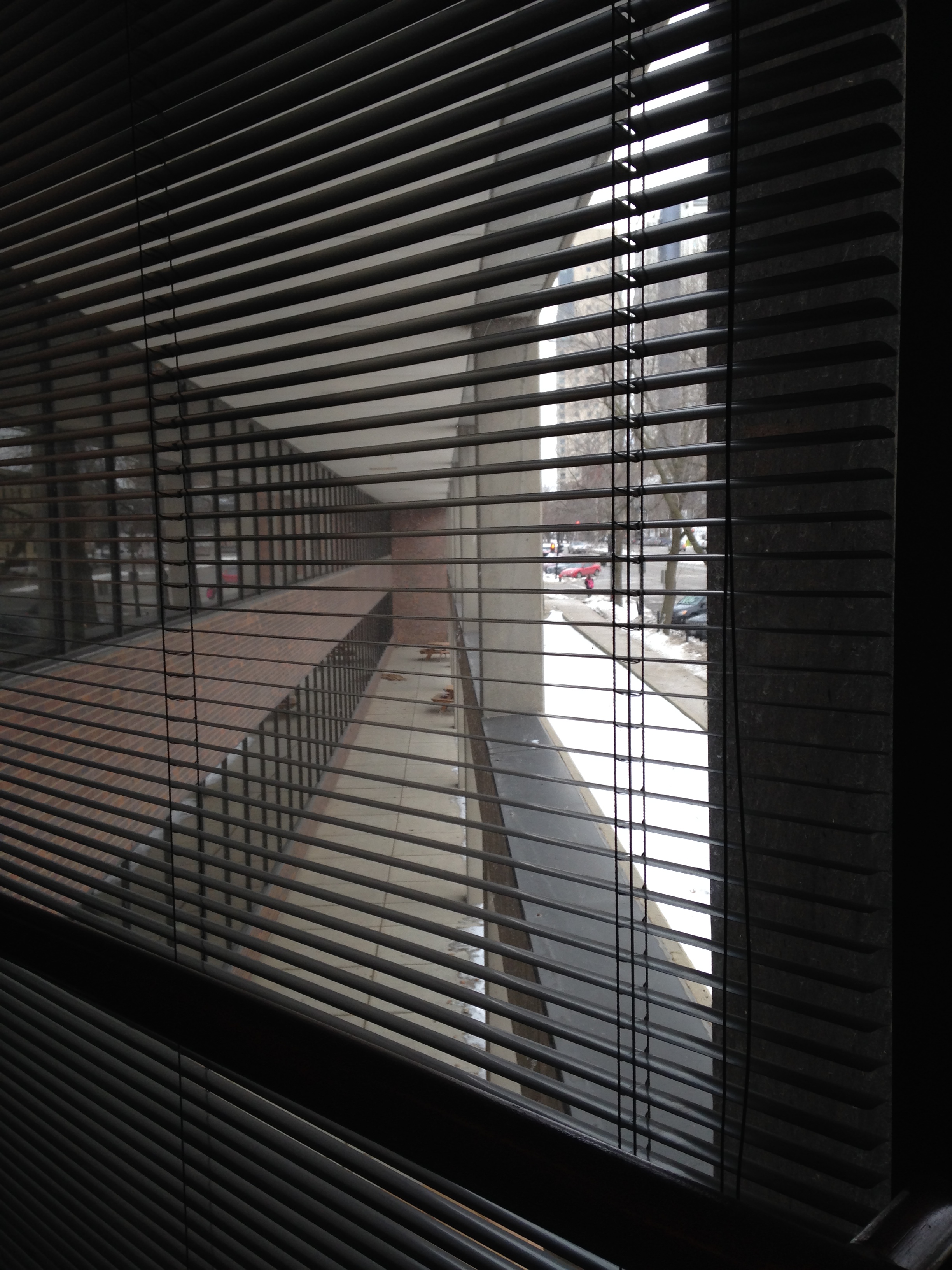
Perspective (2)

image

Bright sunshine today for the first time in maybe a week. Had to pull down the blinds in my office . . . at which point I noticed another “perspective”-type convergence of lines similar (vaguely) to my post last Friday, “Perspective.”

“Perspective” is one of my favorite visual concepts.  Here are two images I’m particularly fond of in film.  The first film still is from Alfred Hitchcock’s Marnie (1964).

I wrote about this sequence in a post a couple of years ago, so I won’t repeat myself.  If you’d like to read my thoughts on how Hitchcock marries form and content through the use of perspective in Marnie’s opening sequence, you can read that post, “Perspectives on depth perception as metaphor in film,” here.

The second still is from The Dark Knight (2008).  It has been a few years since I watched this movie, so I can’t remember seeing this shot or where it comes in the film.  But I’ve seen this photo so many times that it has taken on its own significance for me. The vanishing point is obviously somewhere behind the Joker.  So a few thoughts here.  First, the use of perspective uses the two planes of office buildings to sweep the viewer’s gaze down the street to where the Joker is waiting for us.  The Joker’s stillness contrasts with our involuntary  movement toward him.  Second, the Joker appears to have emerged from the darkness at the center, like the evil thing that he is.  And third, the Joker is standing between us and the horizon.  We’re not going anywhere because he won’t let us.  We’re trapped and facing an ominous doom.

The Dark Knight Heath Ledger

In art, the concept of “perspective” got its start during the Italian Renaissance.  Its invention is generally attributed to Italian architect (artist, sculptor, artisan-engineer) Filippo Di Ser Brunelleschi (1377-1446), the man behind the dome at The Basilica di Santa Maria del Fiore in Florence, an incredibly brilliant engineering marvel.  (More on that another time, maybe.  If you’d like to learn more, here’s the Wikipedia article about him, which has more detail.)

Basilica di Santa Maria del Fiore, via Wikipedia, by MarcusObal (CC BY-SA 3.0)

“A cube drawing using 2-point perspective,” via Wikipedia by Ejahng (CC BY-SA 3.0)

So what Brunelleschi did was realize that you could create a three-dimensional effect on a two-dimensional surface by using one or more “vanishing points” and having lines converge on those.  In Brunelleschi ‘s case, he figured out how to draw perspective in art using science.  The concept of “perspective” is derived from both disciplines.

“Brunelleschi’s perspective experiment,” via Wikipedia, by Amphicoelias (CC BY-SA 3.0)

The term “Renaissance man” is generally used to describe a person who is accomplished in many areas.  It comes from men like Brunelleschi and, of course, Leonardo da Vinci—men who lived during the Renaissance and were widely accomplished in the arts and sciences. Once you take a longer, wider view of knowledge, you realize there really are very few significant divides among disciplines.

Maybe that’s why the idea of “perspective” captures my imagination, both the art term and the concepts generated by the broader definition of the word itself.  “Perspective” comes from the following roots (courtesy of Wiktionary):

  • Medieval Latin perspectiva ars (“the science of optics”)
  •  per (“through”) + specere (“to look at”)
  • Italian prospettiva (“prospect”/”possibility”)
  • Italian prospetto (“elevation,” “view, prospect,” “front, facade,” “table, schedule,” and “summary”)

I especially like that “prospect”/”possibility” connection, in the way the word “perspective” brings together the idea of both sight and thought.  Sometimes a change of scenery can prompt a whole new outlook.

Posted in architecture, Art, Photography, Science | Tagged , , , , , , , , , , | 2 Comments

General Tom Thumb rescued from deadly Milwaukee hotel fire!

In doing some class prep I came across a book titled Vintage Milwaukee Postcards, by Larry Widen, which talks about, among other interesting pieces of Milwaukee history, the famous (in its day) Newhall House Fire.

The Newhall House was a sprawling six-story, wood-framed luxury hotel located on N. Broadway in downtown Milwaukee.  In 1883 it burned to the ground, killing 72 people and becoming Milwaukee’s deadliest fire ever.  (Now that I’m on Facebook, I can tell you that Retro Milwaukee has a page on this fire, with lots of photos. You may want to check it out if you’re interested in learning more.)

Among the fire’s survivors was “the world-famous midget General Tom Thumb.”  As this screenshot passage from Widen’s book indicates, the actor “was rescued by a fireman who carried the 25-inch Thumb from the hotel on a ladder.”

Vintage Milwaukee Postcards

What a small world!  (Update on July 16, 2021: No pun intended, which I just now realized sort of happened there. I saw in my stats today that someone had just visited this post, and since it has been a long time since I’ve seen it myself, I decided to take a peek at it, too.)

One never knows what awaits discovery in the course of just moving through the day 🙂

Posted in architecture, History, Learning, Life, Milwaukee | Tagged , , , , , , | 2 Comments

Be my Facebook friend?

In a comment at the end of a post a couple days ago Kitty Barran (KittyBarran.com) mentioned that she’d rather receive my blog posts through Facebook than either email or Twitter.

So I’ve done it.  Joined Facebook.  I now have a “profile picture” and a “cover photo” there but nothing else.  No “friends” yet.

I think I’ve set up my WordPress account to send out my blog posts to Facebook followers/friends.  But, as I have no Facebook friends so far, I can’t tell for sure that it’s working.  If you’d like to get my blog updates via Facebook, can you be my “friend” and let me know if the posts come through?

Thanks!

Update (January 23):  Duh—I just realized that I didn’t include a link to my profile.  If you decided to be my Facebook friend, you might not be able to find me!  So here it is: the link to my Facebook profile.  🙂


Posted in Life, Writing, blogging | Tagged | 5 Comments

Perspective

MSOE Schroeder Room

I definitely was paying attention at the Faculty Senate meeting this morning in the Schroeder Room of MSOE’s Walter Schroeder Library!

But sitting in a different seat than usual led to a new perspective on a view that is normally at my back.  As I focused on our invited guest, I couldn’t help but notice the interesting parallel lines and planes behind him on the other side of that window.

I think today’s lack of shadows and glare—thanks to a gray, cloudy sky—amplified the building’s spare geometry even more than if it had been a sunny day.

Posted in architecture, Milwaukee | Tagged , , , , , | 3 Comments

Bang! Bang! Bang!

On my way to work this morning I saw this fragment of litter lying on the ground.

sprocket-hole strip from continuous-feed printer paper

Obviously, it’s the outside edge of continuous-feed printer paper.  Anyone younger than thirty may not know what that is, so here’s a photo for reference.

Continuous-feed printer paper, bound in a printout binder, via Wikipedia (photo by Arnold Reinhold, CC by SA 3.0)


This kind of paper was extremely common in the dot-matrix era of computing.  The edge holes fit onto sprocket wheels on the printer, and the paper came in a fan-folded pile that fed continuously through the printer as those sprocket wheels turned.  The paper was perforated at the fan folds and along the edges.  Once you had your printout, you could tear the sheets off of the printer, separate the pages, and remove the edges with sprocket holes.  Et voilà!  You had a document that looked somewhat similar to a typewritten document, depending on how many pins your printer had.

For some reason, when I saw that strip of paper with sprocket holes this morning, I flashed back to the strips of toy gun caps we used to play with when we were kids.

Because anyone younger than about forty may never have played with these, below is a photo for reference.  The “caps” were tiny embedded pockets of powder spaced at regular intervals and sealed into long, thin paper strips.  The strips came in rolls and sold in little “ammunition” boxes.

Via Michelle LaCouture-Ramirez’s “Nostalgia” board on Pinterest (https://www.pinterest.com/glitterbell/nostalgia/)

You were supposed load the roll into a toy pistol.  Then every time you squeezed the trigger, the strip of caps would advance so that the hammer could strike a fresh pocket of powder to create a somewhat frightening facsimile of a real gunshot, with a loud bang, tiny sparks, and a puff of smoke.

None of us had a toy gun, so I’m not sure how we came by the rolls of caps.  Some of the neighborhood kids apparently had access because there were always plenty of caps to play with.  We’d unroll a strip on the sidewalk and then use a rock to strike the individual cap pockets.

Bang!  Bang!  Bang!

We would blow through those rolls of caps pretty quickly, leaving behind bedraggled strips of paper with charred circles at regular intervals.

Looking  a whole lot like that raggedy edge-strip of printer paper I found lying on the ground this morning 🙂


Posted in History, Life, Popular culture | Tagged , , , , , , , | 5 Comments

Intersections: old/new, vertical/horizontal

imageI attended a party/dinner downtown last night with my husband, and as he paid for our parking, I noticed the interesting juxtaposition of lines at the spot where a parking garage met an old office building. Night colors are always off and sort of reddish in iPhone photos, but I liked the result.

Posted in architecture, Milwaukee | Tagged , , | Leave a comment

Lake Michigan, January

Lake Michigan, JanuaryAn old friend lives on Prospect Avenue, high on the bluffs overlooking Milwaukee’s lakefront.  I visited her today with another friend.  The day was gray, frigid and quite breezy.  But I pulled off my gloves and braved the wind—only for a minute—to take a picture of the lake.

Lake Michigan looks different every day, which might come as a surprise to people who have never lived near a large body of water.  I just noticed the barely-visible line of clouds low on the horizon.  Although it appears you’re seeing distant cliffs or mountains across the water, it’s really just the low-pressure weather system moving east.  You can’t see the Michigan shoreline from Milwaukee.  It’s too far away on the other side of the lake.

Can you make out the thin line of dark blue at the horizon in this photograph?  Some days that stripe is thicker, and closer to shore there’s a third segment of color, usually a brownish green.  There used to be a product called Jello 1•2•3, which “magically” segmented into three layers of jello and mousse.  Those three-layer days (dark blue on the horizon, sea green in the middle, and muddy beige in the foreground) remind me of Jello 1•2•3 🙂

Other days the water is a deep sapphire and covered with whitecaps, a sprinkling of small, cresting waves whipped up on the surface by a stiff breeze.  And when it’s raining and windy, there might be several long lines of waves rolling in, one after another.  Lake Michigan reminds me of the Atlantic Ocean on those days.

The strangest days are “steam devil” days.  These are days when the lake gives up its heat on the first really cold mornings of the winter.  It’s so eerie to see the curls of steam rising up from all across the water’s surface!  Below is a photo from the Wikipedia article on steamdevils.  It originally appeared in an article on the phenomenon by two UW-Milwaukee geography professors in The Monthly Weather Review (Vol. 100, No. 3, March 1972, pp. 235-237).

By Unknown author – Lyons, W.A. and Pease S.R., “‘Steam Devils’ over Lake Michigan during a January arctic outbreak”, Monthly Weather Review, vol.100, p.235, March 1972., Public Domain, https://commons.wikimedia.org/w/index.php?curid=148925269


Posted in Milwaukee, Nature, Science | Tagged , , , | 2 Comments

Staircase Volute

IMG_0204[1]

Posted in architecture | Tagged , , , , , , | 4 Comments

That winter quality of light

People who brave winter in the North know what I’m talking about: the strangely bluish quality of cold air and golden flash of low-angled sunlight.  When we say we appreciate the change of seasons, this “quality of light” is almost always cited.

Yesterday we had our first measurable snowfall in Milwaukee.  All the neighbors on our street were out shoveling once the snow tapered off in the late afternoon.  As my family was finishing up, I glanced down the street and noticed how all the tree branches seemed gilded by the last rays of sunlight.

gilded tree branches

I quickly went inside for my phone, and naturally by the time I got back outside, the light had faded quite a bit.  Can you make out the color?  And I did get a few other nice photos.  Below is a picture of our birch, showing a hint of that golden color.

IMG_0198[1]

And the clouds in the sky seemed lit from below, which they actually were (sunset).

winter sunset

Today’s temperatures were bitter, about twenty degrees colder than yesterday.  Below is a photo of the same trees, facing west.  Although you can’t quite see the sun itself, which in real life could be seen as a hazy orb, you can still make out its chilly glow at center.  Brrrr!

IMG_0202[1]


Posted in Life, Milwaukee, Nature, Science | Tagged , | 3 Comments

Resolved: To Be Good Enough

You’ve surely seen the motivational posters before. Possibly you’ve also seen the “demotivators” from Despair.com. This one has always been my favorite, mostly because of the contempt I’ve always felt for people who practiced mediocrity. Ha! What’s that saying about how you are what you hate?

Being that it’s New Year resolution time again, I thought I’d share one of the hardest lessons I’ve learned in my life: that “good enough” really can be good enough. This blog post is therefore part confession, part pep talk.

If you’re a perfectionist, you can no doubt identify. All my life I was a person who tried my best. I didn’t necessarily care about the outcome, especially if it was something outside of my control, like a teacher awarding me an A on a school assignment. Take those grades, for example. One professor on my dissertation committee expressed skeptical disbelief regarding my statement in the text that I had never paid much attention to grades. External feedback was not what drove me. And thank goodness for that! What a mess I’d have been if I not only pushed myself to perform perfectly but then held myself accountable for outcomes I had no ability to influence.

No, what pushed me to succeed, always, was my need to know inside that I had given something my “all.” Anything less was unconscionable.  Immoral.

Not until I had children did I hit the wall. Suddenly it was impossible to give everything my best. My kids needed me to be the best mother I could. My husband needed me to be the best wife I could. My job needed me to perform all tasks to their utmost. Yet there remained only 24 hours in a day.

Doing my “best” became . . . doing the best I could.

It tore me up inside.

Seriously. I can hardly type these words with a straight face because it sounds so stupid. You know the expression “ASAP” (As Soon As Possible)? To some people that means drop everything and respond immediately. To others it means to respond whenever it’s convenient to get around to it. Obviously when two people with different understandings use the term with each other, there’s going to be some friction.

That’s the kind of personal “friction” I faced when my children were young.  (Who am I kidding—I still face this dissonance pretty much every day of my life 🙂 ) For someone used to doing her “best,” it was excruciating to be reduced to doing the best possible given the circumstances.

While I’m sure there may exist carefree people who have never faced this kind of identity crisis—i.e., struggling with who they are if they are not someone who always does their absolute best—I’m guessing that they are not the type of people who would read my blog. So here comes the pep talk part of today’s post: Perfectionism is a curse.

Yes, a curse. Just as nearly every other character flaw is the dark underbelly of a positive attribute, so too is “perfectionism” the evil twin of “conscientiousness.” Perfectionism robs you of satisfaction. It robs those around you of feeling joy in your presence. It keeps you from doing things that are important, things that matter to you.

Have you heard the expression “D is for done”? (Maybe not.  I just Googled the expression and found it only in Sue Grafton/picture book types of lists, like A is for “alibi” or “apple.” So FYI, “D” refers to the very poor academic grade of D, and “done” means that even though the grade was bad, at least the assignment is completed and over with.) Sometimes “good enough” is good enough.

Steve Jobs, iconic co-founder and longtime CEO of Apple, was famously such a perfectionist that he slept on a mattress on the floor rather than buy a bed that was not the ONE. This behavior did not change once he was married, as this 2011 New Yorker profile by Malcolm Gladwell makes clear:

“We spoke about furniture in theory for eight years,” his wife, Laurene Powell, tells Walter Isaacson, in “Steve Jobs,” Isaacson’s enthralling new biography of the Apple founder. “We spent a lot of time asking ourselves, ‘What is the purpose of a sofa?’ ”

It was the choice of a washing machine, however, that proved most vexing. European washing machines, Jobs discovered, used less detergent and less water than their American counterparts, and were easier on the clothes. But they took twice as long to complete a washing cycle. What should the family do? As Jobs explained, “We spent some time in our family talking about what’s the trade-off we want to make. We ended up talking a lot about design, but also about the values of our family. Did we care most about getting our wash done in an hour versus an hour and a half? Or did we care most about our clothes feeling really soft and lasting longer? Did we care about using a quarter of the water? We spent about two weeks talking about this every night at the dinner table.”

Blogging has been really good for me in letting go of the perfectionism. I publish, despite the possibility of a typo. Or, as Steve Jobs might have put it, I “ship,” like a real artist.

I once didn’t send a sympathy card to a friend whose husband had died because the only stamps I had said “Happy Birthday!” in large lettering upon a festive background of fireworks. I kept thinking I’d get to the Post Office to purchase a more suitable stamp, but I never made it there. By then we’d added two dogs to our family and I was a program director in my department at work—although the particulars of my time shortage don’t really matter. Caught up in my compulsive perfectionism, I was paralyzed at the thought of amplifying my friend’s grief with a celebratory postage stamp.

How messed up is that? Today I would mail the card immediately and apologize for the inappropriate stamp in a postscript. (Because I guess I’m not so “reformed” of perfectionism that I could let that pass unacknowledged, as though I hadn’t even realized the cruel irony of affixing a “Happy Birthday!” stamp to a card marking a death.)

So although I still despise mediocrity, I do try very hard to cut others—and myself—some slack. There are times when deadlines do matter and compromises should not be made, but I pick my battles, as it were. All of us mere mortals down here on earth are just trying our best to make it through this life. We’re largely imperfect, and while human perfection is a glorious thing (and, oh, how uplifting to see when it happens!), the price an individual pays to achieve it is quite high in terms of personal sacrifice.

If you read Greek/Roman mythology, it’s interesting to note that often heroes would “retire” to their farms to live a quiet life following the herculean (couldn’t resist 🙂 ) efforts required for their accomplishments and victories over various monsters and tyrants. The gods never liked this, a hero resting on his laurels, as it were. They’d afflict the poor guy with some sort of trouble to get things moving again.

And then there’s the parable of the talents, in which a master who is embarking on a journey entrusts three of his servants with “talents,” a unit of money, for safekeeping. When he returns, the master finds that the first two servants have put their talents to work and increased the worth of the original investment. Those servants are rewarded for their initiative and industry. The third servant, however, buried his talent in the ground to keep anything from happening to it, and he is punished for his sloth. From the Wikipedia entry linked to above, quoting Matthew 25: 24-30:

For to everyone who has will be given, and he will have abundance, but from him who doesn’t have, even that which he has will be taken away. Throw out the unprofitable servant into the outer darkness, where there will be weeping and gnashing of teeth.

The unacceptability of resting on one’s laurels or wasting one’s talents runs deep in our culture. And I can’t bring myself to valorize mediocrity. Absolutely not, even in a post about letting go of perfectionism.

In Margaret Edson’s Pulitzer-Prize-winning drama Wit (originally spelled W;t, which makes sense once you see or read the play), the main character, Vivian, is a brilliant and demanding university professor whose academic specialty is logical exegesis of 16th-century English poetry, especially the poetry of John Donne. Vivian doesn’t mess around with the emotional response one might have to a poem; she is more enamored of the “wit” and intellectual acrobatics that the text might prompt. When she is diagnosed with cancer, she commits to a painful experimental treatment in order to add to the medical community’s body of knowledge. In the end, though, she realizes that her rigorous scholarship, her uncompromising teaching standards, and her unyielding, almost brutal treatment of students—all of that had been a mistake. As she nears death, Vivian has an epiphany: intellect is not as important as simple human kindness.

One of my friends saw that play in New York, with Judith Light in the main role. The play’s ending is very cathartic and wrenching, to say the least. Just before she dies, Vivian is standing naked, bathed in a bright light. During the performance attended by my friend, when the lights went out abruptly at the moment of Vivian’s death, my friend said that people were sobbing all around her in the darkness of the theater. I’ve read the play and have tears in my eyes as I type this. And I read that play way, way back in 1999 or 2000. I think this emotional response signifies something very deep and important and true—beyond just an ordinary, mawkish reaction that might be wrung out by a sentimentally overwrought production. Which this production most assuredly was not! At least that was my takeaway from the text of the play and my friend’s experience. And my New Year’s resolution is to continue my tightrope focus on balancing perfection with the kindness I believe is more important.

Be kind, both to others and to yourself. Banish the words “slacker” and “underachiever” from your everyday lexicon. People who aren’t living up to their “potential” may still be doing the best they can under the circumstances.

Sometimes “good enough” really is good enough.

Posted in Life, Popular culture, WPLongform (posts of 1000 words or longer), Writing, blogging | Tagged , , , , , , , , , , , , | 8 Comments