Christmas shopping in “The Village”

I don’t like shopping malls at Christmas.  Too crowded.  Too many harried people with too many gifts to buy and too little time.

My husband and my younger daughter don’t mind all that.  In fact, for years now they’ve had an annual tradition of heading to the mall  on Christmas Eve to shop.  This year, though, my husband had the flu.  The real thing, influenza, requiring Tamiflu and antibiotics and lots of water and rest.  My daughter was so disappointed, but I’m sorry.  No way was I stepping into Dad’s shoes to take her to the mall.

But what I could do—and wouldn’t mind at all doing—was take her shopping in the nearby historic district of shops, part of the original community that grew up around the founder’s mill (now long gone) and a railroad depot over 150 years ago.  Locals call this area “The Village.”

First we stopped at an ancient candy shop and bought gifts for relatives—a classic 1-pound box of almond toffee crunch and bags of small chocolates individually wrapped to look like adorable, tiny Christmas presents.

IMG_0186[1]

Then we walked down the hill to a bookstore that is celebrating 29 years as an independent bookseller.  Maybe our purchases will help make that 30 years—our good deed for literacy 🙂

IMG_0179[1] IMG_0180[1]

Along the way we stopped in at boutiques housed in the many small storefronts.  One large boutique is housed in a former hardware store that closed its doors last year September after being in business since 1897.  The new boutique owner has kept many of the hardware store’s original features, including a wall of built-in cabinets and shelves with a library-style rolling ladder.

IMG_0183[1]

IMG_0182[1]

No stress, no crowds, easy parking (although a block outside the village proper, because parking on the narrow hillside streets is always an issue).  A hodgepodge of new stores and treasures to discover around every corner.

IMG_0185[1]

You know what?  We had a great time!  Next year even if my daughter and her dad continue with their annual mall excursion on Christmas Eve, maybe she and I can shop “The Village” a few days earlier.

Posted in architecture, Books and reading, History, Life, Milwaukee, Travel | Tagged , , , , , , , | 2 Comments

Communication lessons learned from the Indian Ocean tsunami and other natural disasters

It has been ten years since the December 26, 2004, Indian Ocean tsunami.  Many “anniversary” articles today will look back at this event, so this post doesn’t cover the same ground.  Because my academic specialty is communication, I wanted to share two thoughts on communication and the horrific loss of life (well over 200,000 people) associated with that event.

First, beyond the natural disaster itself (earthquake followed by huge seismic waves), the Indian Ocean tsunami was at its heart a failure of communication.  The earthquake and subsequent waves occurred on a Sunday, when most government offices were closed.  No one knew who should serve as a designated “point person” who could transcend or supersede international boundaries to receive, coordinate, and communicate messages regarding the underwater geological activity and potential for widespread consequences.

The quake was registered in Japan, which quickly mobilized its emergency management system to determine whether that nation was in danger from a tsunami.  As soon as that risk was eliminated, the all-clear signal went out to Japanese media, and nothing further was done with the information that a significant quake had occurred and a resulting tsunami was possible.  And the Pacific Tsunami Warning Center had put out word that all nations in its “jurisdiction” were safe.  Although Japan and other Pacific Rim countries had an arrangement in place to exchange information and warn each other, no such relationship existed with countries along the Indian Ocean.  One tsunami researcher at Japan’s Meteorological Research Institute later told a reporter that not only did Japan lack technical means to monitor the Indian Ocean (UNESCO has since installed sensors in the Indian Ocean), but it also lacked personal contacts with people who had similar forecasting responsibilities in other countries.

Japanese researchers/forecasters were not alone in lacking adequate contact information for peers in other countries.  One official from Indonesia’s Meteorology and Geophysics Agency in Jakarta sent email messages to counterparts around the region and in Europe.  However, as he noted later, “we only sent emails to the addresses we have.  We did not call them.”  This official also notified Indonesia’s National Coordinating Board for disaster, but since it was Sunday, he wasn’t sure who might receive the information.  “Our duties are simply to monitor earthquakes, analyze the information and provide complete calculations of the impact of the earthquake,” he said.

So both in Japan and in Indonesia, people were doing their jobs.  But for bureaucratic infrastructure reasons, lifesaving information was not communicated beyond the limits of their personal spheres of responsibility.

There was also no diplomatic “protocol” in place.  Although Australia had determined that a tsunami was possible and its Foreign Ministry had communicated that information to several of its embassies, foreign governments were not warned for fear of overstepping.

The only success story of the day in terms of sounding the alarm, in my opinion, was commercial radio.  The Indonesian Meteorology and Geophysics Agency official mentioned above first learned of the earthquake when a reporter for Radio Elshinta called him at home with the news that people in Medan had felt tremors.  And when a weather forecast chief at Thailand’s Meteorological Department got news of the earthquake about an hour after it occurred (and shortly before the tsunami hit), he called a Bangkok traffic radio station, which broadcast the warning.  His office got more than 1,000 calls afterward, which he hoped meant that lives had been saved.

My second communication-related thought I wanted to share today is actually more about learning.  In some instances people who understood the terrifying significance of oddly receding ocean waters were able to warn others to flee to higher ground.  Japanese tourists, obviously, who would have absorbed a lifetime of collective, culturally transmitted tsunami knowledge.  And from the Wikipedia article on the tsunami, these instances:

One of the few coastal areas to evacuate ahead of the tsunami was on the Indonesian island of Simeulue, very close to the epicentre. Island folklore recounted an earthquake and tsunami in 1907, and the islanders fled to inland hills after the initial shaking and before the tsunami struck.[48] On Maikhao beach in northern Phuket, Thailand, a 10-year-old British tourist named Tilly Smith had studied tsunami in geography at school and recognised the warning signs of the receding ocean and frothing bubbles. She and her parents warned others on the beach, which was evacuated safely.[49]John Chroston, a biology teacher from Scotland, also recognised the signs at Kamala Bay north of Phuket, taking a busload of vacationers and locals to safety on higher ground.

Anthropologists had initially expected the aboriginal population of the Andaman Islands to be badly affected by the tsunami and even feared the already depopulated Onge tribe could have been wiped out.[50] Many of theaboriginal tribes evacuated and suffered fewer casualties.[51][52] Oral traditions developed from previous earthquakes helped the aboriginal tribes escape the tsunami. For example, the folklore of the Onges talks of “huge shaking of ground followed by high wall of water”. Almost all of the Onge people seemed to have survived the tsunami.[53]

So lives were saved by the culturally absorbed knowledge of the Japanese tourists and the oral traditions of the Andaman Islanders and the isolated academic knowledge of people like Tilly Smith and John Chroston.

One more “learning” related story is relevant to thinking about communication saving lives in a crisis.  In 1999 a tsunami struck Pentecost Island, a place in Vanuatu that had no running water or electricity and where the only television viewing happened once a week when a pickup truck with satellite reception, a television, and a VCR  made the rounds of the villages.

A few days after that 1999 Vanuatu tsunami struck, the International Tsunami Survey Team visited and discovered that only three out of 500 people in a village completely erased by the wave had died.  The villagers had watched a UNESCO video on tsunamis that had been made in response to a deadly tsunami in Papua New Guinea in 1998.  Because of that video, the villagers knew what to do when they felt the earthquake tremors: flee to higher ground.  Even without electricity and mass warnings via devices like radio or television or phones, and even though the Vanuatu quake and tsunami occurred at night, the Pentecost Islanders’ “disaster training” had given them the same critical advantage held by the Japanese tourists and others during the 2004 Indian Ocean tsunami.

One subdiscipline of my academic field is crisis communications.  Sadly, “crisis communication” has come to mean a C.Y.A. (“cover your ass”; sorry about the language) public relations strategy to help corporations deflect blame and culpability away from themselves when something goes wrong.  This is a rather manipulative use of language and gives “rhetoric” a bad name.  However, technical communicators are far more concerned with clarity and functionality.  Crisis communications in this context refers to systems that enable clear communication during a crisis in order to avert even greater disaster and to integrate all parties working to recover from the initial event. (UPDATE as of May 12, 2021, when I noticed this post was getting lots of views and thought I’d visit it again myself: The term currently used for the concept I described in this post is “disaster communication.”)

This post is really long, so let me just mention three examples of excellent crisis communications

  1. Salt Lake City tornado 1999 – The Mormons have a culture of preparedness, and thirty minutes after this tornado ripped through downtown Salt Lake City, people were directing traffic, cutting up fallen trees with chainsaws, checking on neighbors, etc., with incredible efficiency and no governmental direction.  Within just a few days the city was largely cleared of debris and back to business as normal.  (For more information, see this AP article.)
  2. Wal-Mart’s response to Hurricane Katrina – The corporation mobilized its already stellar efficiencies to quickly deliver key supplies like food, water, fuel, and toilet paper to New Orleans at a time when the U.S. government seemed incompetent to recognize that disaster had actually struck, much less respond effectively.  (For more information, see this Washington Post article.)
  3. FEMA’s Waffle House index – Craig Fugate, head of the U.S. Federal Emergency Management Agency, coined the term for this brilliant tool in 2011, following the tornado that wiped out much of Joplin, Missouri.  According to Fugate, here is the way to deduce how badly a city has been hit by a disaster: “If you get there and the Waffle House is closed?  That’s really bad.  That’s where you go to work.”  Because the (mostly Southern U.S.) Waffle House chain is known for rarely closing due to bad weather, it is possible to quickly gauge the hardest hit areas by checking with Waffle House headquarters to see which restaurants are either closed or serving a limited menu due to power outages.  The Waffle House index was used during Hurricane/Superstorm Sandy in 2012 to move supplies and aid efforts to the areas most urgently needing attention.  (For more info, see the Wikipedia entry on the Waffle House Index.  You can also just Google the term and recent disasters like Sandy and the Moore/Oklahoma City tornado in 2013.)

Sources for information referred to in this post regarding the Indian Ocean tsunami are below:

The Wall Street Journal, December 29, 2004, Lucy Manoppo – “Why Quake Warnings Failed” (different editions have slightly different titles): https://www.mail-archive.com/balita-anda@balita-anda.com/msg62697.html

The Wall Street Journal, December 29, 2004, Costas Synolakis – “Why There Was No Warning”: http://www.usc.edu/dept/tsunamis/2005/news/articles/pdfs/2004_12_29_wsj_tsunami.pdf

The Wall Street Journal, December 29, 2004, Kate Linebaugh, et al – “Asia’s Deadly Wave”: http://www.wsj-asia.com/pdf/ExcellenceJournalism.pdf

Would you like new posts delivered to your inbox? To subscribe, click here.

Posted in History, Learning, Life, Nature, News, Science, WPLongform (posts of 1000 words or longer) | Tagged , , , , , , , , , , , , | 1 Comment

Urban gray fox

This fox was hanging around the parking lot at my doctor’s office yesterday.  There’s something spooky about a wild animal that doesn’t have an appropriate level of wariness around humans.  The fox stared at us for a long time (somewhat balefully, I felt 🙂 ), then turned to slink/trot unconcernedly across the parking lot.

gray and red fox with face mask

The only other foxes I’ve ever seen have been a) completely red and b) at least twice as large as this one, which was about the size of a medium-small dog.  I thought at first it was a raccoon because of its gray coloring and the mask across its face.  Then maybe a coyote.  But the tail gave it away.

P.S. – Yes, I did take this picture yesterday.  December 22.  I’m thinking we’re probably not in for much of a white Christmas this year, although a snow-rain mix is in the forecast for tomorrow, Christmas Eve.


Posted in Milwaukee, Nature, Science | Tagged , , , | Leave a comment

How to disable “related” videos at the end of embedded YouTube clips

Yesterday I posted on my newfound knowledge about how to specify the starting and ending points in an embedded YouTube video.  I was pretty excited to be able to play just a 40-second segment of video from the middle of a full-length documentary.

But then I noticed that when my video clip ended, I got the screen array full of other videos that you sometimes get when you play clips on YouTube.  I didn’t want that distraction.  Plus, even if these particular related videos were “clean,” I’ve noticed that sometimes such “related” videos preview images I’d rather not have on my blog.  (And I can’t imagine how they are related to what I just watched!)

Anyway, I did a little more digging and experimenting, and I figured out how to disable that screen from displaying those related videos.

Here’s the code from yesterday’s post that allowed me to embed the YouTube video with specified “start” and “stop” times:

https://www.youtube.com/watch?v=bokwnLzFMIs&start=3603&end=3643

Here’s the result of that coded instruction displayed in the form of my video clip.  If you want to see the start/stop and related videos, you have to sit tight and just let the 41 seconds play.  Trying to speed things up by dragging the little slider button (don’t know what it’s called 🙂 ) seems to disable the start/stop parameters.

To disable the related videos from appearing at the end, simply add &rel=0 to that long string of code.  (That’s a ZERO on the end, not a lower-case letter “o.”)  So the code would look like this:

https://www.youtube.com/watch?v=bokwnLzFMIs&start=3603&end=3643&rel=0

And here is the result.  (Again, you need to sit tight and let the video play out until the end.)  Cool, right?

UPDATE: I’ve noticed that WordPress has changed the way it embeds video from YouTube. Unlike before, now when you paste in the URL for a YouTube video, WordPress immediately and automatically changes the line of code (URL) to show the actual video itself in your post draft, the way it would appear in your published version. Because the line of code is then no longer visible, it’s impossible to add the &rel=0 addition.

To fix this problem, switch the view  of your draft post from “Visual” to “Text.” As you are writing your post, look up at your tool bar (with your “bold” and “italics” symbols, etc.) and then look over all the way to the right side of the white box that your text is written inside of. See the two tabs there on the upper right? Click on the “Text” tab and instead of the video image, you’ll see the actual URL. Add your &rel=0 there at the end of that.


Posted in Learning, Movies and film, Teaching, Technology, Writing, blogging | Tagged , , , , | 9 Comments

How to specify “start” and “stop” times in embedded YouTube videos in WordPress

I planned to write a post on allusion and homage in literature and film today, but now I’m going to postpone that till another day—because I’m so absolutely thrilled with myself that I figured out how to embed a YouTube video and have it start and start at specific times.

Here is a clip from Leni Reifenstahl’s Triumph of the Will.  That film is an hour and 45 minutes long.  But I wanted to show just a clip about 30 seconds long taken from around an hour into the film.  And I did it!  Check it out:

(Update note: I shouldn’t have demonstrated with this clip, as I learned later. Because of the obviously offensive subject matter, YouTube seems very determined to take down clips from this film whenever they are uploaded to the site. I’ve found it on Vimeo for students in my film studies class to view, but I can’t embed Vimeo video in my blog posts. Fortunately the content of this post still makes sense without the clip. But when I have some time available, I’ll put up a different clip to demonstrate.)

The reason I wanted to show just this section was so I could compare it with a section of video from Disney’s Lion King (the “Be Prepared” song) to illustrate the concept of “homage” in film.  As I said, that post is under construction and will go up sometime soon. But here’s a sneak preview 🙂

Meanwhile I thought I’d share my (minor) success with you.  Yay me! 🙂  I’ve been thinking I want to learn how to code, and this little triumph makes me feel I can do it.  Working on this blog and leaving comments on other people’s sites, I’ve picked up some HTML (Hyper Text Markup Language) tricks, just a little bit at a time.  How to italicize a title, for instance.

Anyway, here’s what you do if you want to embed a YouTube video in your blog and have it begin and end at specific points.

  1. Copy the URL of the YouTube video
  2. Paste it into your WordPress blog post draft
  3. At the very end of the video’s URL, with no extra space, type

&start=[starting point time in seconds]&end=[ending point time in seconds]

So for my video clip, I wanted to start at 1:00:03, or an hour and three seconds into the film.  I wanted to end at 1:00:43, or an hour and forty-three seconds in.

One hour equals 60 minutes.  Each minute contains 60 seconds.  So 60 minutes x 60 seconds equals 3600 seconds.  But I wanted to start at an hour and three seconds.  So my starting time was 3603 seconds.  And, similarly, my ending time would be 3643 seconds.

So my YouTube URL plus my starting and stopping times (in bold, for illustration) looked like this:

https://www.youtube.com/watch?v=ZAT37dXL13I&start=3603&end=3643

Maybe you already knew all this.  But if you didn’t, maybe you’d like to give it a try in your own blog.  Good luck, and have fun!

UPDATE: I’ve noticed that WordPress has changed the way it embeds video from YouTube. Unlike before, now when you paste in the URL for a YouTube video, WordPress immediately and automatically changes the line of code (URL) to show the actual video itself in your post draft, the way it would appear in your published version. Because the line of code is then no longer visible, it’s impossible to add the “start” and “stop” additions.

To fix this problem, switch the view  of your draft post from “Visual” to “Text.” As you are writing your post, look up at your tool bar (with your “bold” and “italics” symbols, etc.) and then look over all the way to the right side of the white box that your text is written inside of. See the two tabs there on the upper right? Click on the “Text” tab and instead of the video image, you’ll see the actual URL. Add your start and stop information there at the end of that.

OR, even more recent update: Paste the YouTube URL into a Word document and add on the remaining string of code there. Copy and paste the YouTube URL into the Word document AS PLAIN TEXT (check your “paste” options). That is, you don’t want to paste extra code attached to that URL because it’s easier to work with when it’s just plain characters and nothing else is going on code wise. Then, after adding your own code at the end of the URL, copy and paste the entire new URL into your blog post. You should still see the embedded video pop up as though you had copied straight from the YouTube video. This strategy is more straightforward and much quicker than dealing with WordPress because sometimes even doing it the way I described above, switching from visual to text, takes a couple of tries before you have a functioning video clip embedded in your post.

AND one more update: If you don’t want other videos to automatically start playing at the end of your embedded video (because sometimes they are set up that way in the original YouTube post), you can add one more little bit of code to the very end of the line of your video’s URL (and after the “start” / “stop” info, if you added that):

&rel=0

Meaning “and related videos = zero.”

You’re welcome!😄

Posted in Learning, Movies and film, Technology, Writing, blogging | Tagged , , , , | 10 Comments

London: We Need to talk about Paris

Enlightening blog post essay about Paris book shops from The Matilda Project. Had to laugh out loud at the “Cry me a river, Goliath” parenthetical aside.

Posted in Uncategorized | 2 Comments

One Grecian Urn

I’m searching for a term that would help me find some sort of documentary evidence, preferably video, of a style of dance that was popular around the start of the twentieth century.

Backstory: I encountered a reference to John Keats’s “Ode on a Grecian Urn” recently, which for some reason made me think of The Music Man and the scene where the mayor’s nasty wife Eulalie (Hermione Gingold) performs a classical “tableau” dance with the ladies dance committee (“one Grecian Urn”!) at the ice cream social near the film’s end.

Which then reminded me of a documentary I saw years ago with black and white footage of women doing a similar dance for real around the turn of the century.  Flowing Greek robes and all, just like the characters in The Music Man.  And it was incredibly beautiful.  When Eulalie and her biddies assume their “Grecian Urn” pose, it’s ridiculous.  But when these real-life women struck their poses, they were creating an art form in dance.

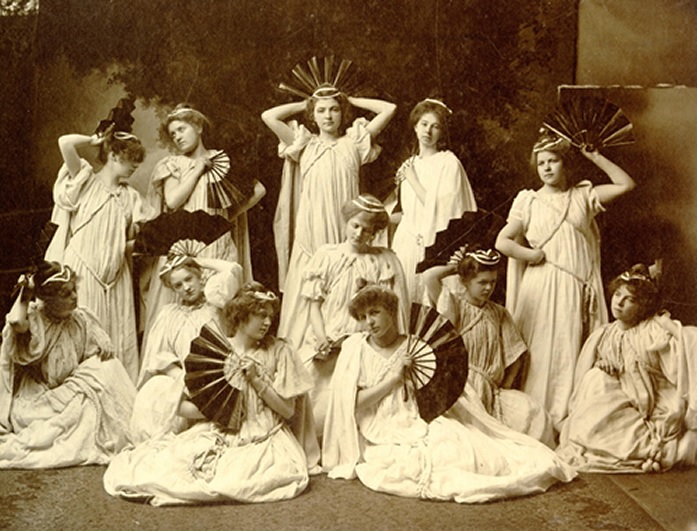
Naturally I can’t figure out what the documentary was or find any video clips online of women performing such a dance—although I did find some photographs of women in classical Greek gowns creating tableaux, like the one below.

Acadia Ladies Seminary Physical Cultural Exhibition Scene from fan drill 1901 - retrieved from February 2015 internet archive Acadia Ladies Seminary Physical Cultural Exhibition Scene from fan drill, 1901 (retrieved from the Internet Archive https://web.archive.org/web/20150215141841/http://library.acadiau.ca/archives/sporthistory/sports/tumbling/1901.html)

And I found an extremely cool short film, “Serpentine Dance,” or “Danse Serpentine” (in French), from 1896 made by the famous Lumière brothers, French film pioneers.

The Serpentine Dance was created by Loie Fuller, Chicago burlesque dancer who experimented with the effects of stage lights on her swirling silk gowns.  Below is a photograph of the real Loie Fuller, taken by Frederick Glasier in 1902.

And here is the Lumière brothers’ film, one of the earliest “color” motion pictures.  Each frame was hand tinted to mimic the effect that stage lighting had on Fuller’s gowns.  This dancer is not the real Loie Fuller, but she is extraordinarily good.  Once you get past the kind of dorky opening 43 seconds, the swirling robes are astonishing.  It’s surprising to me that dancing from 100 years ago would still look so good today.  Somehow I just don’t expect it.

Would you like new posts delivered to your inbox? To subscribe, click here.


Posted in Art, History, Life, Movies and film, Popular culture | Tagged , , , , , , , , | 6 Comments

Random thoughts on time, nostalgia and the human experience

IMG_0169[1]

This photo taken on my way to work doesn’t do it justice. but the sun looked really eerie here, like a science fiction movie.  As you can see, the light was directed upward, while the ground below was in shadows.  And it was such a temporary phenomenon.  By the time I’d driven about 20 more blocks, the clouds were completely gone and the sun was blindingly bright.

Last January I wrote a post about a “miracle” class discussion in my freshman humanities class about the nature of time.  Among other things, we took a close look at the concepts of “past,” “present,” and “future.”  Two years ago I wrote a post about “chasing light,” in which I showed how different the same tree looked in two photos, snapped just seconds apart, as the sunlight suffusing its autumn leaves faded.

Time is such an elusive, illusory thing.

Outside my office in the Grohmann Museum are several paintings of horses in harness, mostly hauling huge logs.  In fact, much of my floor is devoted to “earth”-related work—marble quarries, bridge building, lumber, agriculture, brickmaking, peat harvesting, road construction—and many of those industries once employed oxen and horses.

As I think about time, sitting here surrounded by a visual record of other eras, it occurs to me how strange it is, and how recent, that today’s world is scheduled and documented and organized into queues that are all simultaneously synchronized and segmented into micro-second increments.

In the world of horses and oxen, time moved in shadows.  Shadows that slipped slowly across fields.  Long shadows in the morning and evening, short shadows at mid-day.

I have an acute feeling of nostalgia associated with this “physical” sense of time.  Time measured in shadows is something very different from time measured in mechanized ticks or electronic transition frequency.

“Nostalgia” is one of my favorite words.  (Do you have favorite words?  When my older daughter was a toddler, I’d ask her to tell me her three favorite words that morning, and then I wrote them down in my journal.  She was sort of impressed with the idea that her words were being recorded.  And it’s fun to go back and see them now: ponies, lace, ribbons, rainbows 🙂 )

There is something very sad about the idea of “nostalgia,” yet also something comforting.  There’s an ambiguity, an imprecision in our “imagined” past.  Ironically, our imagined past often also seems so simple, so filled with clarity.

When railroads were introduced in Victorian England, people were alarmed not only by their effect on the landscape and on livestock but also by their impact on the passengers aboard the trains.  Who knew what ill effects might befall a person at breakneck speeds of 35 miles per hour!  How silly and naïve that seems now.

And yet.

For thousands of years human existence was grounded in the natural world.  As our relationship with technology has evolved, as our very concept of time has evolved, I have to wonder how that has altered us.

Posted in Art, History, Life, Milwaukee, Science, Teaching | Tagged , , , , , , , , , , | 2 Comments

No (Introductory) Christmas Lyric Left Behind

“The sun is shining / The grass is green . . .”  Thus begins one of my favorite Christmas songs.  It continues:

The orange and palm trees sway

There’s never been such a day

In Beverly Hills, L.A.

If you don’t recognize it yet, the next couple of lines may give it away:

But it’s December the 24th

And I’m longing to be up north . . .

At which point we finally get down to business and transition to the song’s main lyrics:

I’m dreaming of a white Christmas . ..

I’ve always loved introductory verses like the one in “White Christmas.”  I grew up with plenty of old, classic vinyl LP records (not to mention the brittle, even-older shellac 78 rpm records).  Some of those old records, I noticed, began with an odd, extra verse that got left off of most other versions of the songs.

For example, there’s this melancholy introductory lyric:

The loveliness of Paris seems somehow sadly gay

The glory that was Rome is of another day

I’ve been terribly alone and forgotten in Manhattan

I’m going home to my city by the bay . . .

At which point, as in “White Christmas,” comes the transformation into the song we all recognize:

I left my heart in San Francisco

With the Christmas season now upon us, I started realizing that many Christmas songs seem to have these introductory verses that get left off most recordings.  The aforementioned “White Christmas” is one, of course.  But there are also all these others—and I’m sure I’m leaving some off the list!

  • Rudolph, the Red-Nosed Raindeer − “You know Dasher and Dancer and Prancer and Vixen . . .”
  • Santa Claus Is Coming to Town – “I just came back from a lovely trip along the Milky Way . . .”
  • The Christmas Song (i.e. “Chestnuts roasting on an open fire”) – “All through the year we’ve waited / Waited through spring and fall / To hear silver bells ringing / See wintertime bringing / The happiest season of all . . .”
  • Have Yourself a Merry Little Christmas – “Christmas Future is far away / Christmas Past is past / Christmas Present is here today / Bringing joy that will last. . .”
  • Winter Wonderland – “Over the ground lies a mantle of white / A heaven of diamonds shine down through the night . . .”

Here is the Eurythmics version of that last song, just because I like Annie Lennox so much 🙂

I wonder why so many Christmas songs have these lovely, secret opening verses.  And even more, I wonder:  Why are they so often left behind when the songs are recorded?

Posted in Life, Music, Popular culture | Tagged , , , , , , , , , , , , , , , | Leave a comment

In Praise of the One-Hit Wonder

Driving home today, I was listening to (and, of course, singing along with 🙂 ) Billy Joel’s “Piano Man” on the radio.  My first idle thought was to realize that it is in 3/4 time, like a waltz. Most of his songs are 4/4.  Not that I have ever made a study of this!  It was just one of those weird free associations you may sometimes have.

My second thought, and not for the first time, was to marvel at what an incredible song that was for him practically right out of the gate.  “Piano Man” was Joel’s first hit, and it was released in 1973.  Forty years later, Joel is still performing in concerts, as he was, for example, this past August when he was caught on camera singing to his ex-wife Christie Brinkley, who was in the front row during a concert in New York.

My third thought was that “Piano Man” was the only song Joel ever needed to secure his place in music history.  Yes, he’s had many, many other hit records—songs I really like—but the only one he ever needed was that first masterpiece.  It’s just beautiful, perfect.  The unforced rhyme of the lyrics, the atmospheric mood, the heartbreaking story, the melody, the singing performance.  Perfect.

Then I started thinking about one-hit wonders.  Which got me to remembering the really mean things that Terry Teachout, theater critic for The Wall Street Journal, said about playwright Arthur Miller a day or two after he died (in 2005) and then again when reviewing a newly-published Miller biography in 2009.  (There is a connection here, if you’ll bear with me 🙂 )

“The bells tolled for Arthur Miller all weekend long—but most of them were made of tin,” sniffed Teachout in his obituary/commentary/”tribute.”  He went on to label Miller a “pretentious” playwright who “pretended to have big ideas and the ability to express them with a touch of poetry, when in fact he had neither.”  The real reason Miller rose to fame, Teachout said, was not his work but the fact that he married Marilyn Monroe and testified before the House Un-American Activities Committee.

In the 2009 Commentary review of Christopher Bigsby’s biography of Miller, Teachout expresses bafflement that Miller is regarded as a great playwright in Europe, and he takes Bigsby to task for writing such an “unabashedly admiring” book about Miller.  Several times Teachout notes that the contemporary acclaim for Miller is completely at odds with his critical reception during his lifetime.  And he seems to have undertaken the task of restoring that previously unfavorable regard single handedly.  Among the insults he throws out:

[N]one of the plays he wrote after 1968 was favorably received in this country [and] his American reputation rests almost entirely on Death of a Salesman, All My Sons (1947), and The Crucible (1953), his first three commercial successes and the only Miller plays that continue to be revived with regularity.

[T]he plots of All My Sons, Death of a Salesman, and The Crucible are sufficiently involving to conceal many—if not all—of their artistic defects.

[I]n the end it is hard to see Miller as anything other than a second-string tragedian, a sentimentalist who mistook ideas for art and windiness for poetry

For good measure, Teachout also informs us of a “widely reported posthumous revelation that Miller concealed the existence of his fourth child, whom he institutionalized on learning that the infant, who was born in 1966, suffered from Down Syndrome.” And he brings up politics again and again.

Why, then, do so many modern-day critics feel so differently about Miller [than Teachout does—i.e., they like him and think he’s truly great]?  The answer, I suspect, is that they are willing to overlook his limitations as a writer because they share his political views—

[To which my reaction is: Huh??? When I formed my favorable opinion of Miller, I knew nothing about his political views.]

—and, just as important, his view of what theater should do.

[Which, apparently, is “not unlike attending a taping of a TV show whose audience responds reflexively to the repeated flashing of an applause sign.”]

[T]he critics of yesteryear, most of whom shared the political views of their contemporary counterparts, were nonetheless capable of setting aside those views and judging his plays not as political statements but as works of art.

I guess I don’t want to get too sidetracked by Teachout-bashing.  I usually like his reviews and other writing very much. Something about his dismissal of Miller just really got under my skin, obviously.

And thinking about Billy Joel and “Piano Man” today while I was driving, I recalled the way Teachout disparaged Miller for the fact that his reputation rested largely on those three early plays.

So what?  Even if Miller’s reputation rested entirely on only one play, “Death of a Salesman,” that would be more than enough, in my opinion, to mark his legacy as one of the truly great playwrights in history.  Just as “Piano Man” is more than enough to secure Joel’s place as a singer/songwriter.  Not to mention one heck of a piano player, possibly the very best in popular music.

Both men’s creative output continued long after peaking artistically, if you are disposed to thinking about it negatively.

Again, so what?  All the rest (of each man’s respective oeuvre) is gravy.

Posted in History, Music, Popular culture | Tagged , , , , , | 1 Comment