Home from the conference, the homework begins

Details have never been my strong suit.  I’m a big-picture thinker, which is a good thing, but I’ve learned the hard way that the only way to make things happen is to pay attention to the details.

At the conference I attended in San Antonio this past week, I met many interesting people who, like me, work in some capacity (faculty or administration) in the field of engineering education.  Building a strong network of connections with them, my peers, will allow all of us to move forward more effectively in our careers. 

Years ago I would have squandered these potential relationships.  Going to conferences is exhausting for me, and when I returned home in the past, all I wanted to do was run a couple loads of laundry and go to sleep. 

I’m far more mindful of details now.  Because I’m older?  Because I’ve spent the last 15 years working with scrupulously detail-oriented engineers?  Who knows. 

But I’ve definitely reformed my Type-B personality habits as far as making sure I tie up loose ends after a conference.  There’s a relatively small window of time during which we’ll all remember each other, so it’s important to follow up with forwarding any promised materials and sending out LinkedIn invitations while that window is still open.

Posted in Uncategorized | Tagged , , | Leave a comment

Phil Collins, Alamo historian. Yes, that Phil Collins.

So on the plane from Dallas to San Antonio last Saturday, I met Steve, who lives about 45 minutes northwest of the city.  Among the other tourist tips he gave me, the most intriguing was his joking suggestion that I keep an eye out for Phil Collins at the Alamo. 

The singer?  Yes.  According to Steve, Phil Collins has visited the Alamo several times and made a passionate hobby of the historic Texas fort. 

Admission to the Alamo was free, but there were boxes for donations near the entrance, so I contributed.  The old fort and mission are now a tourist spot, but people seemed respectful of what had happened there.  Although not somber, the mood was quiet compared to the good times happening on Saturday afternoon just outside the compound’s walls in the bustling downtown and famous Riverwalk. 

The only remaining portion of the original fort is called the “long barracks.”  Inside is a museum exhibit that tells the story of the deadly 1836 siege and battle.  And there, in a glass case containing several weapons, was a “short sword” (espada ancha) with a card stating that it was on loan from Phil Collins.  If Steve hadn’t alerted me, the name’s significance wouldn’t have registered at all.

Once I got home, I googled “Phil Collins + Alamo” and found many documents supporting Steve’s remarks.  Apparently Collins’ lifelong interest in the Alamo was sparked by the Davy Crockett fad during his childhood in the 1950s.  Now retired from drumming and living in Switzerland, Collins has recently written a scholarly book,  The Alamo and Beyond: A Collector’s Journey, about his extensive collection of Alamo artifacts and was in Texas just a few weeks ago to promote it, as detailed in this article from the online archives of San Antonio’s daily paper, the Express-News.

Isn’t life is full of surprises?  Discoveries like this one certainly make each new day an adventure!

Posted in History | Tagged , , , , | Leave a comment

On the road in San Antonio

I am in San Antonio for a few days at an engineering educators conference, so I’m experimenting with using my iPod Touch to post an entry.  The flight was $500 cheaper if I came Saturday instead of Sunday, so I came a day early.

Met a guy on the plane who lives in the hill country about a 45-minute drive northwest of town.  He gave me tips on what to see, so I spent yesterday afternoon sightseeing.  I did the Riverwalk boat tour and visited the Alamo.  Ate Tex-Mex, as recommended, at a particularly pretty spot on the Riverwalk, where I had pork tacos with cilantro and onions and the best margarita I’ve ever tasted.

My airplane buddy also told me to keep a lookout for Phil Collins when I was at the Alamo, and I did indeed catch a glimpse of the famous singer . . . sort of.  More about that later this week, when I’m able to write using an actual keyboard!

Posted in Uncategorized | Leave a comment

Light and Shadow

When I got home late from the Great Books session the other night, I loved the shadows cast by the gate on our driveway and decided to take a picture.  I don’t have a tripod, so this photo is blurry and maybe a little Halloween creepy, but still kind of pretty . . .

And then the next morning when I let the dogs out, I also liked the stiking interplay of light and shadow on the stone wall in our back yard.

In fooling around with the “upload” of this photo, I saw a button for making it a “featured” photo.  I didn’t know what that meant until I saw it stretched across the top of my blog page.  I think I like it for now, even though it seems “pretty” in a clichéd and generic way.

With so much to learn about the WordPress software, I think a good project for summer will be to play around with as many features as possible.

Posted in Uncategorized | Leave a comment

Did you get the “Wilhelm scream” joke in Google’s drive-in doodle?

Special thanks to Brandon, a student in my film studies class this past quarter, for alerting me to the Wilhelm scream in the Google Doodle on Wednesday (June 6) celebrating the 79th anniversary of the first drive-in movie theater.

The Wilhelm scream is a bit of film history lore that I teach in the course during our “sound” section.  It is a scream recorded in the 1950s, with a very unique and recognizable quality.  It was a “stock” scream inserted into B-movies in the ’50s and then seems to have fallen into obscurity until it was resurrected in the mid-1970s by sound designer Ben Burtt.

Burtt, whom I’ve written about before, is passionate about the history of Hollywood sound.  He used the Wilhelm scream extensively in the Star Wars films.  Other sound designers picked up on it and have used it in scores of movies since.  Once an in-joke of affectionate regard among sound designers, the Wilhelm scream has also gained a following of movie fans who delight in spotting it.  Several compilation videos exist on YouTube, such as this one

Once you’ve heard the Wilhelm scream, the fun begins and you’ll start recognizing it in unexpected places . . . like Wednesday’s drive-in Google Doodle!  Watch and listen.  Do you hear it?

Posted in Movies and film | Tagged , , , , , , , , | Leave a comment

The appeal of Lisbeth Salander

What a wonderfully energizing discussion of Stieg Larsson’s Millennium series last night at Great Books! 

 In one of those truth-is-stranger-than-fiction coincidences, guess who was across town at Boswell Books at the same time?  Eva Gabrielsson, speaking about her book “There Are Things I Want You to Know” about Stieg Larsson and Me.  When I mentioned this fact to the group, one woman called out, “Field trip!”  Another woman said that she had friends attending the Gabrielsson event and they were all going to meet at a restaurant later to compare notes on their respective “Millennium” evenings.

 One more coincidence: I just found out that yesterday, June 6th, was National Day of Sweden, a public holiday observing the election of King Gustav Vasa in 1523, which is considered the start of modern Sweden. 

 During our discussion last night, participants agreed with me that the series’ main draw is Lisbeth Salander.  Here are a few of the reasons we decided why.

 Lisbeth is a survivor.  Because her very existence is supposedly a threat to national security, she was locked up in a mental institution at age 12 and later kept under the thumb of a social welfare agency that “protected” her as a mental incompetent.  Lisbeth has been bullied and abused her entire life, and she has learned from bitter experience that if she turns to the authorities who are supposed to protect her, things will only get worse.  As a result, Lisbeth develops extreme self-reliance and circumvents the system to maintain her independence. 

Lisbeth is clever and resourceful.  After being shot in the head and buried alive, she manages to dig her way out of her grave.  And when cornered in the empty brickworks factory by Niedermann, the blond giant with superhuman strength and no sense of pain, Lisbeth escapes certain death by shooting dozens of seven-inch nails through his feet with a nail gun, thereby attaching him solidly to the floor and rendering him immobile.

Lisbeth has a strict moral code and is protective of those who are weaker.  She also has a strong sense of justice and sees to it that those who deserve punishment receive it.  Martin Vanger.  The man who tries to kill his wife on the beach during the hurricane in Grenada.  Hans-Erik Wennerström, the corrupt financier who tried to ruin Blomkvist.  Zalachenko.

Lisbeth does not suffer fools.  She sizes people up quickly and decides whether they are worth her attention.  If not, she ignores their existence.  Most authority figures are idiots.

Lisbeth is not what others assume from her appearance.  The police investigating the triple murders are continually flummoxed when all the people they interview provide accounts of Lisbeth’s intelligence and competence that are completely at odds with her officially documented mental disabilities. 

Lisbeth is intelligent and curious.  Although she dropped out of school (no tolerance for incompetent teachers and administrators), Lisbeth spends much of The Girl Who Played with Fire reading a book on math theory and scribbling equations in a notebook.  In one of my favorite moments, Lisbeth circles stealthily toward Zalachenko’s farmhouse in the woods . . . then stops in mid-stride when, out of the blue, she realizes the solution to Fermat’s riddle.  She sits down on a tree stump to relish her discovery, then resumes her approach through the trees.

Lisbeth is worthy of love, even if she is awkward and socially inept.  Although labeled an anti-social loner, Lisbeth actually has created a strong network of people with whom she has long-term connections.  She forms attachments almost in spite of herself (“I keep squandering my friends,” she realizes unhappily at one point).  And when she is in danger, those who care about her come to her rescue without hesitation.  In addition to Blomkvist, there is Armansky, her boss at Milton Security; Paolo Roberto, the celebrity boxer who long ago gave Lisbeth lessons at his gym; Holger Palmgren, her former guardian; Mimmi, her girlfriend and sort-of roommate; Dr. Anders Jonasson, who is in charge of her care at the hospital following her brain surgery; and of course, Plague, Trinity, and the worldwide hacking community, who help expose the corrupt government agents who want her institutionalized to cover up their illegal activities.

 Rereading the entire three-book series over the past week has been an intense experience I never want to repeat.  However, taking in the story all at once has enabled me to hold it in mental suspension, as a complete whole, and examine its details in ways I previously could not. 

 Most valuable to me are these insights into Lisbeth’s character.

Posted in Books and reading | Tagged , , | Leave a comment

What America needs now: “Action Heroes” with pocket protectors

Last night as I read and prepped for Great Books, my daughter was watching A Beautiful Mind in the next room.  Now and then my attention trailed vaguely along after the film, and suddenly I made one of those random connections that sometimes occurs when you’re not deliberately thinking about something. 

 In this case, I realized that not only did Ron Howard direct A Beautiful Mind, but he also directed Apollo 13.   

  Lately I’ve read lots of hand-wringing articles about how the United States needs to encourage young people to enter the STEM fields (science, technology, engineering, and math).  One way to achieve this might be to seek help from Hollywood – in particular, director Ron Howard and his long-time producing partner, Brian Grazer, two men with an amazing talent for bringing  math and engineering to life.

 Consider the scene in Apollo 13 when Gary Sinise and other engineers have to find a way to make the Command Module’s square-shaped lithium-hydroxide canisters (that remove carbon dioxide from the air) compatible with the Lunar Module’s round receptacles.  Although the box-office appeal of watching people fit square pegs into round holes might seem ridiculous, Howard makes that scene as gripping and triumphant as any car chase or game-winning touchdown. 

 In A Beautiful Mind, which won the 2001 Academy Award for Best Picture, Howard dramatizes John Nash’s breakthrough mathematical insights with compelling cinematography and film editing tricks that immerse viewers in the thrill of “discovering” the number patterns themselves.

 Although it would be an overstatement to say that Ron Howard is America’s foremost STEM-fields visionary, he clearly “gets” STEM and has a remarkable ability to render its cerebral nature visible.  For many bright, creative young people to consider STEM-field careers, they need an introduction that animates the possibilities and shows how exciting something like hydraulics actually can be. 

 Sometimes you have to see and “feel” something to believe it.

Posted in Movies and film | Tagged , , , , | Leave a comment

Silent witness (“Leave the gun. Take the cannoli.”)

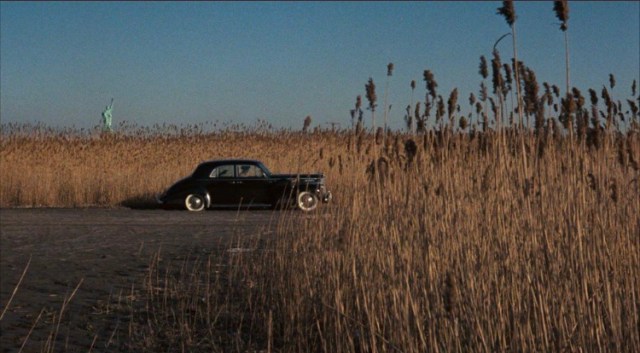
How many times have I watched this scene in The Godfather without ever noticing the most brilliant aspect of its mise-en-scène?  At the far left side of the frame, barely visible above the tall grass, the Statue of Liberty stands witness to the execution of Paulie Gatto, Don Corleone’s turncoat driver.

Isn’t that beautiful?  Mute commentary offered by the single most-recognizable symbol of the American dream for immigrants . . . in a moment where that dream is perverted.

The shot’s composition is also beautiful in the way it employs the “Rule of Thirds.”  Not only is the frame divided into vertical thirds – Statue of Liberty in the left third, the car in the center, and tall grass in the right third – but it is also divided into thirds in terms of background, middle ground, and foreground. Not to mention clear blue sky at the top, golden reeds in the middle, and dark earth at the bottom (except for that foreground curtain of seed-feathered, grassy reeds partially screening the vehicle and its occupants from view).

Astonishingly perfect.  Just another reason why The Godfather is one of the best films ever made, right up there with Citizen Kane.

[Update, almost nine years later😂 The Statue of Liberty’s back is turned, which we can discern by realizing that if her raised hand, the one holding the torch, is her right hand, and her right as we view this image is also our right, then we are looking at Lady Liberty’s back. Therefore, she is not “witnessing” this murder so much as disavowing the men involved. And they are trying to hide their actions from her. I like that interpretation, too. In either case, for me the Statue of Liberty’s rather obvious yet surprisingly unobtrusive and apparently largely unnoticed presence in this shot makes for a profound commentary on the American dream and the Corleone family’s efforts to attain it.]

Would you like new posts delivered to your inbox? To subscribe, click here.

Posted in Movies and film | Tagged , , , | 5 Comments

Rereading the Millennium series

I’m prepping today for next Wednesday’s Great Books event at MSOE.  This event is like a nice evening at book club, except no one has to clean their house or make dinner, and the primary conversation is actually about . . . the book!

The Great Books Dinner and Discussion series has been running for sixteen years now.  We have a number of “regulars” who attend multiple evenings every year, and even a few people who come every month.  Several book clubs come to Great Books once or twice a year in place of their usual monthly meetings; some clubs even make the drive to Milwaukee from other southeastern Wisconsin cities.

Although most people come with a friend their first time, it is not uncommon for people to come solo.  Dinner provides a chance to interact with other participants, and after someone has attended a couple of events, they begin to recognize other “regulars” and sit with them.  I have watched friendships develop over the years from acquaintanceships formed solely through attendance at Great Books.

I usually facilitate one Great Books session per year, in early June.  And even though I work hard to prepare for each event – and technically still am working while leading the discussion (which, believe me, is harder than it appears) – once the evening is off and running, I get so caught up in the conversation that it hardly feels like “work” at all.

Next Wednesday we’re talking about Stieg Larsson’s three-book Millennium series.  I’ve been rereading The Girl with the Dragon Tattoo steadily, bit by bit, over the last couple weeks of the academic year, but now that I’ve finished with exams and turned in my grades, I’m stepping up my reading pace to work through the rest of the series this weekend.

When I bought Dragon Tattoo two years ago, it was because it was summer and I needed something new to read and the book was already a bestseller that everyone else seemed to be reading.  My rereading now has reminded me of something: how amazed I was my initial time through the book that it actually managed to get published in the first place, much less go on to become a bestseller.  The first hundred pages are SO BORING.

The only thing that kept pulling me through the story was the occasional glimpse of this really unusual character, Lisbeth Salander.

My first time reading The Lord of the Rings was similar.  Once Frodo and Sam got separated from the rest of the group, theirs was the only story I cared about; Aragorn and all the various soldiers and battles both overwhelmed and bored me.  Likewise, the first time I read Zen and the Art of Motorcycle Maintenance, I kept flipping through all the boring philosophy stuff to get to the dad and his son.  (When I reread that book a few years ago, I found myself skipping the motorcycle trip in order to get to the philosophical discussions of rhetoric and “quality.”  Funny how reading the same book can be such a completely different experience when you’re older.)

Here is my personal Millennium-series “journey” (to employ a word rendered ridiculous via its appropriation bu and overuse in reality television).  I bought the mass-market paperback and liked it.  Liked it to the point of feeling agitated about not having the next installment, like a junkie needing a fix.  Passing a small bookstore on the way to a restaurant one night, I stopped in and bought both the second book in trade paperback edition (which was the only version the bookstore had) and the hardcover edition of the third book.  My reading would not be interrupted any longer than the interval it would take to close Book 2 and pick up Book 3.

Apparently many American readers who discovered the series long before I did had experiences similar to mine.  After finishing the second novel, they were so anxious to read the third that they ordered The Girl Who Kicked the Hornets’ Nest from England rather than await its publication in America months later.  (Interesting side note: the third book is titled “Hornets’ Nest,” plural, in England and “Hornet’s Nest,” singular, in its American and Canadian editions.)  The reason for this frantic need to get their hands on the third book?

In my opinion, Lisbeth Salander.

Yes, the puzzle aspect of the books’ plot structure is quite good, but I get impatient with Blomkvist’s plodding investigation.  It’s Salander, with her quick mind and unpredictable behavior, who keeps me hooked.  She’s even more fascinating to me in this second go-through, and I’m trying to figure out what makes her “tick” as a character.  I’ll organize my thoughts about her and share some ideas next week.

Oh, one final thing before closing out this post.  Possibly due to the Y2K hysteria a decade ago, I vaguely assumed that the “Millennium” series reference was some kind of metaphor.  Women have been abused for millennia, but now we are entering a new millennium, etc.  But in rereading the books, it occurs to me that because Millennium is the name of the publication Blomkvist works for and partly owns, the novel series is almost certainly named for it.

What an odd organizing theme that is, at least for me.  Having a newspaper/magazine be the “center” of these novels just seems really foreign to me.  I would never describe them as stories about a magazine, and I don’t think I’ve seen that discussion elsewhere.

Yet the ideal of publication-as-change-agent may be an accurate reflection of Stieg Larsson’s own mindset and life experiences as a crusading journalist.


Posted in Books and reading | Tagged , , , | Leave a comment

Those Grim Grimm Brothers

It occurred to me this morning that I should clarify something in yesterday’s post.  When I described the saga of the Hatfields and McCoys as a Grimm Brothers fairytale, it’s because that was the most apt comparison I could think of off the top of my head for a bloody, violent story about scheming people who get done in by their own devices.

 Although many people know only the Disney-fied versions of these stories, my introduction to them came from a book of collected Grimm Brothers tales my grandfather owned.  It wasn’t written in German but it must have been a direct translation.  Cinderella’s sister cut off part of her foot to make it fit into the glass slipper.  I mean these stories were dripping in gore. 

 Hans Christian Andersen was the same way.  In his version of “The Little Mermaid,” as I recall, the poor mermaid was in constant pain when in human form, with her feet feeling like she was walking on knives.  One of my favorites, “Big Claus and Little Claus,” involved lots of dead bodies and betrayals, and the ill-tempered, greedy oaf of the story, Big Claus, wound up at the bottom of a river in a sack weighted down with a stone.

 Ah, yes: great reading for children.

 Of course, these fairytales are nothing compared to Greek mythology.  Think of Achilles, dragging Hector’s body behind his chariot around and around the walls of Troy while the slain man’s father helplessly looked on.  Or how Odysseus lost his men in horrible ways all along the journey home from the Trojan war.

 But that is probably a topic for another day.

Posted in Books and reading | Tagged , , | Leave a comment