Alternative Title: How I Wrote “The Pianist’s Hands” (When I Thought I Was Just Dashing Something Off) 🙂
Back in February or March, I began drafting a short story with ChatGPT for my writing group—just an exercise, nothing too serious. This week, when it came time to choose a piece of creative writing to share for this new blog series on AI and creative practice, I figured that story—The Pianist’s Hands—would be an easy win. A quick polish, a light intro, and done.
The idea behind the “case study” part of this “Creative Practice in the Age of AI” series is to share examples of my own creative work (short stories and poetry) I’ve written in collaboration with ChatGPT. This piece, “The Pianist’s Hands,” felt like the perfect low-stakes place to start. Just a simple, manageable story and chat duo to test the waters. I’d tidy up the first draft and hit publish. Done and done.
Famous last words.
At the time I originally wrote “The Pianist’s Hands,” I didn’t really know what I was doing with ChatGPT. Before writing this story, I’d used it mostly for generating short scenes for my novel or doing brief exercises for my writing group—basic stuff, much of which I documented in blog posts. Maybe a prompt, a response, a couple back-and-forths, and then I’d take the draft offline to revise on my own. I hadn’t yet figured out how powerful this tool could be across the full spectrum of the writing process.
“The Pianist’s Hands” ended up being one of my first real attempts at sustained collaboration with ChatGPT. It didn’t even come from a writing group prompt. I just had the idea—really more of a desire—to write short, jewel-like stories inspired by fairy tales. At the time, I’d been thinking about how much darker the original tales by the Brothers Grimm and Hans Christian Andersen are compared to their Disney counterparts. “The Little Mermaid,” in particular, was on my mind—especially the pain and sacrifice Ariel (or rather, the original mermaid) endures in pursuit of what she wants most.
That was the seed of “The Pianist’s Hands.” Then I got an exercise prompt from my writing group to do a scene in which a character says, “I dare you to tell me the truth.” So I threw that into the mix, as well.
The original version of this story was quite short, barely two pages. Terse. Very stripped-down prose. I remember feeling almost embarrassed by how slight it seemed. To my surprise, my writing group really liked it. Something in the idea itself must have landed.
When I went back to revise the story this past week, thinking it would be a piece of cake, I realized immediately that I’d need to start a whole new chat, just for it. My approach to ChatGPT has changed a lot since those early days. I now use it throughout the entire writing process—from brainstorming and early drafts all the way to polishing and word choice. One result of that deeper engagement is that I’ve learned to be more intentional about keeping my writing organized. Every project gets its own dedicated chat now.
That wasn’t always the case.
In fact, when I first started working on these multiple “fairy tale” short stories, I thought I could keep them all in one chat. (Ah, optimism.) That worked well—until it didn’t. I have a screenshot included on page 5 in the “Appendix chat” that shows what happened when I began a new story (“The Twelve,” based on The Twelve Dancing Princesses) in the same thread where I’d been working on “The Pianist’s Hands.” ChatGPT essentially wrote over the earlier story. The green text was from “The Twelve.” The red strikethroughs? Those were remnants of “The Pianist’s Hands.” Gone, unless I had saved them elsewhere.
It was around this time that I realized ChatGPT sometimes drafts in an “off-screen” way—that is, working internally rather than displaying the process in the chat window. I found this incredibly frustrating. I don’t want my drafts happening behind the curtain. If something disappears, there’s no getting it back. Since then, I’ve made a point of explicitly asking ChatGPT to write everything in the chat. I like to see the progression. I want access to every version. And, to its credit, it seems to have remembered that request ever since.
Back to “The Pianist’s Hands.”
The story didn’t change much in revision, at least structurally. But when I returned to it this week, I wanted to deepen the emotional weight of the protagonist’s decision—to really draw out the cost of choosing between career and self, art and commerce, ambition and joy..
In an ideal world, I would have let the revised story sit for a while and given it time to breathe before coming back to it with fresh eyes for a final pass. But I’ve committed to this weekly series on AI and creative practice—and I’d also committed to using this story as one of the first entries. So here we are.
“The Pianist’s Hands” may still be a bit green from revision. But it’s good enough, I think. And sometimes that’s all you need in order to move forward.
So here it is: The Pianist’s Hands. A story born from fairy tales, shaped in conversation, and offered with gratitude for what creative tools—old and new—can help us discover.
First, HERE is the PDF of my short story, “The Pianist’s Hands.”
And HERE is my entire ChatGPT creative conversation. It’s long and meandering, but it may have some value if you’re interested in seeing how I wrote the story, at least the “trail” left behind by my “chat.”
Finally, we have the beautiful image ChatGPT created to illustrate this post. (Link to the “illustration chat” HERE if you’d like to see my prompt.) Don’t leave yet, though. If you continue scrolling down past the image . . .
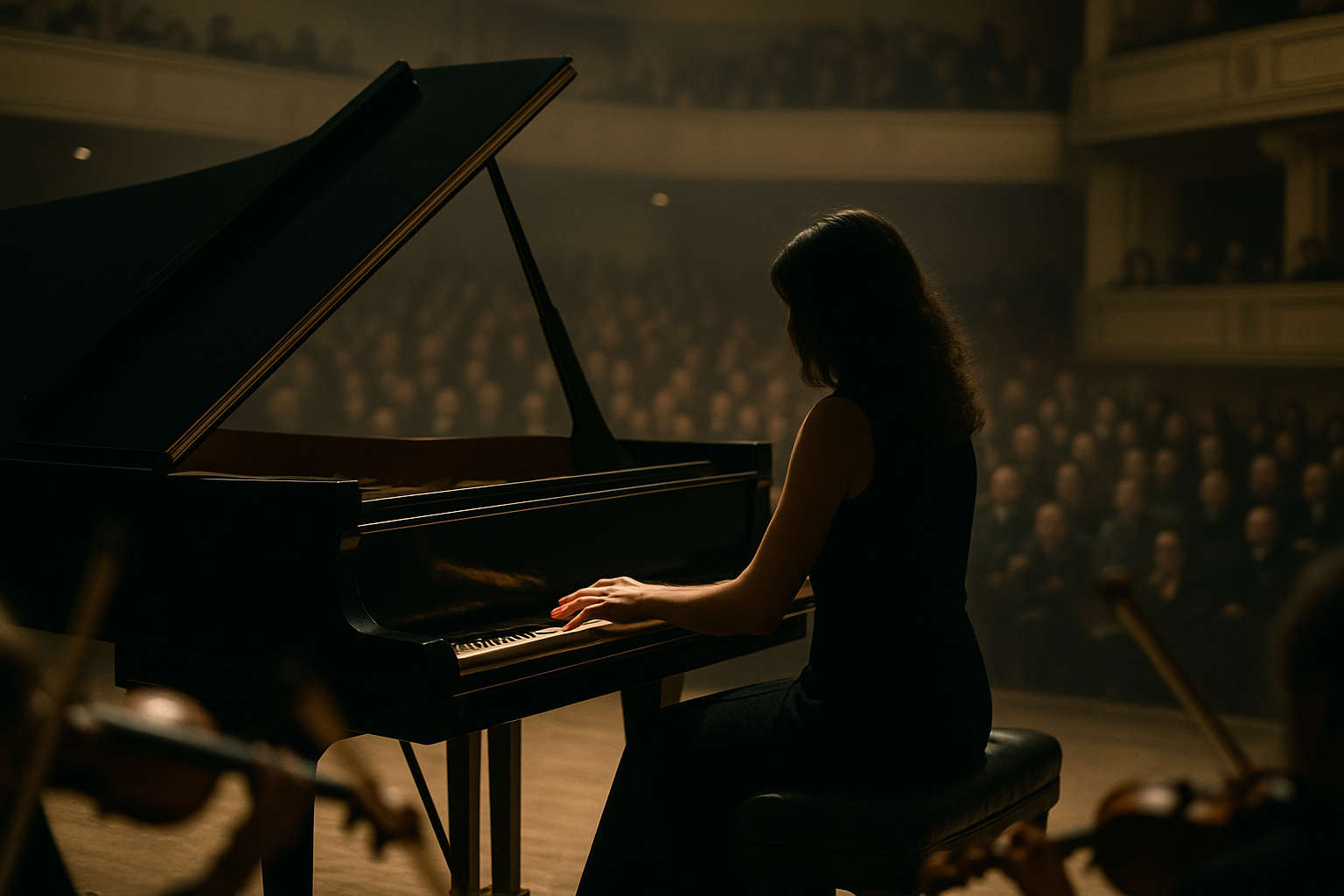 “The Pianist’s Hands,” to accompany the short story by Katherine Wikoff (with ChatGPT assists)
you’ll find this week’s . . .
Creative Exercises
Since this week’s post is about my evolving writing process with ChatGPT, as well as story development and fairy tale inspiration (with themes of transformation, sacrifice, and artistic ambition), today’s creative practice exercises are playing with:
- collaboration with AI
- fairy tale reinterpretation
- emotional revision
- storytelling structure
Here are five creative exercises related to the overall theme of “Creative Practice in the Age of AI” and, in particular, the content of this week’s post on “The Pianist’s Hands.”
1) Trade a Gift for a Cost Fairy tales often hinge on a deal or sacrifice. Explore what you’d give up—and what you’d gain. Prompt: Write a scene or micro-story in which a character receives something they’ve always wanted—on the condition that they give up something intangible but vital (e.g., memory, taste, color vision, sense of time, ability to feel music). Optional twist: Ask ChatGPT to generate the “bargain” based on a wish your character voices in the first paragraph.
2) From Draft to Depth Revisit something you wrote quickly—then deepen it. Prompt: Find a piece of your own writing you once considered “minor” or “simple”—a story, poem, paragraph, or scene. Choose one emotional thread (e.g., regret, longing, resolve) and write a revision that amplifies and explores that feeling more deeply. Bonus: Try using ChatGPT as a revision partner. Ask for suggestions to heighten that emotional tone or to reframe the piece through a more complex lens.
3) Write Over Something Play with layering and erasure to explore how meaning evolves. Prompt: Take a piece of your own writing—maybe an old draft or even a journal entry—and “write over it.” Keep the original visible (strike it through, fade it, or use a lighter color), and layer a new text on top. Let the earlier version bleed through or contradict the new one. Goal: Let revision become part of the art. Let the process of changing your mind show.
4) AI as Memory Keeper Explore your relationship with your own creative evolution—and how AI fits in. Prompt: Write a brief reflection or meta-scene from your own point of view, describing a turning point in your creative practice. Then ask ChatGPT to retell your scene—but from its imagined point of view. Compare the two versions. Where do they align or diverge?
5) Fairy Tale in a Sentence Capture the whole arc in miniature. Prompt: Write a new fairy tale in exactly one sentence. Include a protagonist (hero), a desire, an obstacle, and a transformation. Then ask ChatGPT to expand it into a paragraph—and decide whether it adds or loses something in the process.
Hope you enjoyed this week’s post. Have you tried using generative AI yet in your own creative practice? I’d love to hear your thoughts.
Until next time ❤


 Katherine Wikoff
It’s funny, when I read the first story you shared in which you described your process using AI, I was blown away. This time, not so much. I know that feedback on the story itself is not the purpose of this post, but I can’t help but say it leaves me cold. Too smooth, too slick, but no sense of character or deep emotion — at least for me. Which is obviously hugely subjective.
I did not read your entire Chat GPT prompt document, so I may have missed something. Did you perhaps ask for a narrative style that feels distant? Maybe it is the fact of using the fairytale approach. Or is it possibly something to do with machine-generated prose? (Not that I would want anything too OTT in terms of sentiment either). I guess what I miss is a sense of voice, which I did feel in your earlier story.
Anyway, that’s my take for what it’s worth. Thank you again for sharing your process — it is very instructive even if in this particular case I’m on the fence about generative AI!
LikeLiked by 1 person
You are absolutely right, I DID want that detached , distant tone, and I did specifically ask for it. Not in the beginning, because at that point I was still feeling my way into the story—and I also started this story several months ago, when I knew far less about the entire process. (Not like I’m an expert yet, but I have learned a lot since March or February!)
But yes, at some point in the past two weeks, as I picked up this story again to keep working on it, I made a deliberate decision that this was the tone I wanted. I remember actually giving that specific instruction, in fact. It’s somewhere in the chat. So that distant, detached tone you perceived is on me, not ChatGPT.
I wrote this story fast, which was really exciting for me because I’m a very slow writer by nature. And then I published it immediately, without the benefit of coming back to it with fresh eyes. So it’s possible that the detached tone may not be quite right. I liked that tone, though. I wanted to capture what I saw as the essential emptiness of “greatness” when the cost is everything you love. And maybe I didn’t do that so well. For me it’s hard to judge until I’ve had a chance to go away and come back later.
Please, yes, DO feel free to critique the stories themselves! That’s part of the point of this exercise.
Right now, every literary magazine I would consider submitting to has a statement saying they won’t consider work produced with AI. I think that eventually (a long time from now!) their prejudice against AI-assisted work will fade away. At the moment, however, I feel like plunging in and learning as much as I can about the technology is vital to my work as a college writing professor, and doing fun creative work is how I want to do it. If the literary magazines don’t want AI work, then I don’t want to engage in any sort of deception by sending my poems or short stories to them.
But I also want my stuff to be read, the way any writer would! Fortunately, I have my blog, which allows me to publish them myself—while at the same time being completely transparent about the way they were created.
On the other hand, publishing in a literary magazine means your work has been vetted—and edited—by another skilled writer/reader. Self-publishing on my blog means any stories or poems I put out into the world haven’t had the benefit of that extra step, that final stage of “quality control,” as it were. So I greatly appreciate you caring enough as a writer and editor yourself to share your thoughts!❤️
One thing grad school did for me was give me the ability to separate myself from my work, or maybe I should say to separate my ego and self-worth from my work. There was a time when I’d have been devastated if someone didn’t like what I wrote, as if that meant they didn’t like me. I’m not sure why, and I don’t know how normal that feeling was or wasn’t. Now, though, something I write is just a thing apart from me, that I produced, and I sort of see it as something that can always be better if I have access to it (like it’s in my forever-editable blog rather than print) and also the time and inclination to keep at it.
So again, thank you for sharing your reaction to the story! No worries that it’s not to your liking! I know we don’t all have similar tastes and may not appreciate the same things, so if I end up liking “The Pianist’s Hands” in a few months after all and you still don’t care for it, well, that’s just the way it is.
But now that I understand that the story didn’t work for at least one person—and why it didn’t—I can keep that in mind when I come back with my fresh “reader” eyes (instead of my in-the-excitement-of-the-creative-moment “writer” eyes) a few months from now for potential revisions.
LikeLiked by 1 person
This is so fascinating, Katherine! I love that you have learned to be detached from your work — something I definitely need to work on. As far as having learned a lot since you began the AI journey, I can totally relate as even just reading about it I am far more knowledgeable than before (I even tried Chat GPT on a couple of revisions, but eventually ended up redoing it all). As you say, no agent or publisher currently will touch this material even if, as you point out, that may change. Personally I found myself seduced by the speed at which I could move something forward (I’m also a ve-r-r-ry slow writer), but as I didn’t take the time to hone the work through repetitive briefs as you have done, it ended up not being in line with my voice and intent for the story. I do see the potential though, and am interesting in learning more however vicariously through your experience.
It is also really interesting to learn that you intended the narrative distance. As you say, one person’s opinion, however valid, is just that: one person’s opinion. I am happy that you are able to take what you need from my feedback. Please keep going!
LikeLiked by 1 person
Thank you! It will be interesting to look back in a few months (or a year?) and see where this adventure has led.
LikeLiked by 1 person