Well, I’m back.

So says Samwise Gamgee to his wife, Rosie, and young daughter, Elanor, at the end of The Return of the King, the final book in Tolkien’s Lord of the Rings trilogy.

And where have I been? Well, unlike Sam, I didn’t walk all the way to Mordor to pitch an evil ring down into the Cracks of Doom to save the world. No, I’ve just been out living my ordinary life, doing all the same things I’ve been doing for years—except way more and way faster.

Aren’t we lucky to have email and mobile phones and messaging platforms that allow us to stay connected 24/7 and be so productive? Even luckier for us, this week OpenAI’s Sam Altman has painted a super rosy picture of how great everything going to be on our planet once AI takes over and solves every problem known to mankind. You can read his long-on-rainbows-and-lollipops and short-on-specific-details vision for the future of humanity on his website HERE.

Partly to blame for my malaise, of course, is the pandemic, which seems to be every politician’s “go to” scapegoat for the root causes of our daily stress: supply shortages, inflation, fewer services, lower quality goods, longer wait times, etcetera, etcetera.

In my own case (college professor), the pandemic forced teachers to make the drastic pivot to online “learning management systems” in 2020. Sadly, that LMS monster seems to have taken hold of higher education and both raised and lowered expectations for presentation of course materials, student workloads, grading, and student–faculty relationships. I have mixed feelings about these shifts, mostly negative. Yet, I also recognize reality and accept the truism that you can’t fight City Hall. You live in the time you inhabit. The sooner you stop fighting—the sooner you learn to go with the flow and “be like water,” as Bruce Lee said—the happier you’ll be. So that’s where I am on that.

Complicating things even more on the teaching front, though, is generative AI, aka, ChatGPT and its ilk. Back to OpenAI’s Sam Altman, the “face” of ChatGPT: Prophet or Antichrist? The jury is out, but Pandora’s Box is open, and things are in an unstable steady state, to say the least (and also to combine allusions and metaphors from vastly different domains in a single sentence. Try and match that feat, ChatGPT! 🙂 )

Any writing teacher can tell you what a mixed blessing this new tech development of generative AI is. On the one hand, I think it’s exciting and has the potential to help everyone catapult their writing to a higher level. I’m working on a project of my own right now that ChatGPT has been extremely helpful with. Very exciting stuff. But in the hands of students, so far anyway, it has been a source of underwhelming texts that *seem* well written but, upon closer examination, are actually pretty empty. Having seen enough of this mediocrity by now to be able to articulate the problems with ChatGPT-generated texts, I think I finally have enough of a handle on it to help students use it in ways that 1) aren’t cheating and 2) result in texts that authentically represent their own identity, intellect, and abilities while at the same time ramping them up to a performance they might not have progressed to on their own in years.

Students want to learn how to use this new tool well, and I’m sure employers and society will be expecting them to be experts upon college graduation. I get it, and I want to do right by my students.

But wow. My job in 2024 looks (and feels) a lot different now than it did in January of 2020, less than five years ago. And all of these new realities (working with the tedium of setting up and maintaining learning management systems, figuring out how generative AI works and how to help students learn to use it effectively) have been added on top of the baseline job duties I’ve always had.

Time consuming, to say the least.

So swinging back around to this blog post’s title, one reason I’ve been gone from my blog and posted so rarely lately is that I’m busy working at my job or taking care of personal-life business just about every minute of the day. Which, no surprise, leaves me fairly worn out and not really in the mood to wrap my head around writing or even engaging in any activities but the most passive forms of entertainment, like reading or watching TV/movies.

But ugh! That’s no way to go through life!

Lately, as the weeks of not posting anything on my blog have added up, I’ve been giving a lot of thought to how, or even whether, I should proceed with it going forward. When I started blogging, back in 2012, I thought I’d write articles about lifelong learning, curiosity, creativity, and innovation. I added “other random stuff” to my blog’s tagline because I kept sort of accidentally posting photos and little observations about things I noticed going on in the world that intrigued me. Eventually I gave up on “lifelong learning” as my blog’s official identity because everything I wrote was so patently not an article on that topic. I tried out some other taglines over the years, including one I found so pretentious that I only kept it up for a couple of days: “Trying to say ‘yes.'” So deep, lol 🙂

Then at some point I decided to put up the tagline I currently have, “analog explorer in a digital world,” because I thought I’d start writing posts about digital society at the intersections of the analog and digital worlds. But then I still kept writing posts about “Weird Al” Yankovic and gulls on a rooftop and posting pictures of office windows and interesting patterns of light and shadow. With the occasional academic connection, or sometimes a link to an article on an intellectual topic. Just very random.

I think it’s finally sunk in that I’m never going to force this blog into being anything it’s not inclined to become. It’s time for me to “be like water.”

So here’s where things stand, as I see it.

It has been over four months since my last blog post. Probably people who used to follow me have given up hope of hearing from me again. I’ve noticed that many of the bloggers I used to look forward to reading every week have faded away, as well. My WordPress Reader is so . . . empty. No one is posting, so I don’t bother to check for their posts. Then when they do post, maybe they don’t get the engagement they used to, because no one is as active in checking the reader (or their emails) for their posts. All of which perpetuates the death spiral. So first of all, I apologize to anyone who liked reading my posts and missed me not writing them. I’m sorry that I let you down (and thank you for still being around to read this post 🙂 ). I plan to do better.

At least I hope to, and I think I stand a pretty good chance. Removing the pressure I placed on myself to write a certain kind of post (that I rarely wrote anyway) should help me show up more regularly. My only ambition now is to keep up my little corner of the internet (KatherineWikoff.com) like a friendly letter that appears in your mailbox bringing cheerful news from home and reminding you that there’s more to life than bills and junk mail and their associated drudgery.

Before I close, I’d like to give some credit where it is due. I owe my renewed optimism to Rick, who last week left a comment for me on one of my older blog posts, Fave Movie Moments – “Do you know why this is my favorite tree?”. That post was about The Florida Project, a beautiful 2017 film about a young girl living with her troubled, unstable mother in a motel on the outskirts of Disney World. In particular my post looks at a moment where the girl and one of her friends are companionably eating a snack of white-bread jelly sandwiches while sitting on the trunk of a massive tree that has been uprooted. As the young girl notes with the clear-eyed insight of a child exposed to to hurtful things far too early, this tree is her favorite because “it tipped over, and it’s still growing.” Rick wrote in his comment on that post:

I watched this film on a streaming service shortly following its release. I can’t say I remembered the scene you so eloquently refer to, but the film very much stuck with me at the time and had been on my list to watch again. I recently bought it on Blu-ray and have just rewatched. I am pleased to say that it still resonates with the same sense of broken joy that affected me the first time of watching. But it was this particular scene, with the old, broken down tree that stood out for me. I don’t know why, but I was impelled to type the words of Moonee into Google, just to see if anyone else had been moved by it in the same way. So I was so pleased to discover your post. Aside from the fact it so beautifully encapsulates a central theme of the film, like all great art, it speaks of a deeper metaphor for life in general. The scene itself stood out for me for all its own immediate merits relevant to the film. But as I digest it, I am also left reflecting on how my own life has been laid very low by grief in the 3 years immediately following the film. And in those years since, I like to believe I have continued to grow, however much that grief has continued to weigh me down. Thank you so much for having written something that, for one night at least, makes me feel a little less alone and connected.

Which I thought was just beautifully articulated and brought tears to my eyes. I wrote back:

Rick, thank you for taking the time to write such a thoughtful response to my post. If you were to check out my “home” page, you’d notice I haven’t posted anything new in a few months. That’s mostly because I’ve felt so beaten down by the whole exhausting idea of generative AI regurgitating writing it finds online so that other generative AIs can regurgitate again, and then just re-re-regurgitate it all in one horrible, endless chain of ouroboric LLMs cannibalizing themselves. Honestly, I’ve found myself thinking: What’s the point of writing anymore?

But then today I saw your response! A beautiful message from one human to another about a moment of shared humanity. This is why I started blogging, and your message reminds me that despite the AI apocalypse, there are still other people like me in the world who are going through things and trying to make sense of it all.

I’m so sorry for the grief you’ve been carrying the past several years. Your kind, articulate, and even very profound words make me feel honored and humbled. I’m glad that my reflections on this film jibe with your own thoughts. It’s validating to connect with a kindred spirit. It makes one feel, as you so wonderfully put it, a little less alone and connected. Thank you!

To which he replied:

Thank you for taking the time to send me such a considerate response. I really didn’t expect much more than a quick “thanks”, if that even.

I have been busy trying to sort stuff out prior to a short trip I have just embarked on, so have not had much time outside of this to look at your blog site after my registration was accepted. But I did quickly read your last blog, about the two Herring Gulls – I think these are what I can see in the photo at least. Once again, I was very much taken by your words. At the risk of sounding repetitive, there it was again – connection! It was always going to be a bit of a winning goal for me though, as Gulls are my favourite birds and a daily, characterising feature of where I live. For me, their versatile strength, grace, aloofness, and indomitable spirit far outweighs the negative qualities most my neighbours choose to focus on!

I won’t go on, other than to say that learning you were a teacher did not surprise me. Conveying facts and ideas is made a whole lot easier to receive, if people feel inspired by the “how” of sharing, as much (actually, more) than the what. I had to look up a couple of terms you referenced in fact, so I include myself in this!

But more to the point… in the UK we have a saying: “Don’t let the bastards grind you down”. I don’t mean this to belittle the frustration you express about how others may be abusing your original thoughts and reflections on life. If it has then please put it down to my ignorance on the matters you speak of. All I would add is that if your blogging brings you a sense of satisfaction of itself – and hopefully a sense of joy when you recreate the world you are describing in your own words – then try to let this be the difference you are most concerned with. And if, from time to time, you also manage to reach others like me… the world is an even shinier place to be. Thanks again, and please don’t feel obliged to respond again – keep on blogging instead!

So that’s what I’m going to do!

Thank you so very much, Rick, for allowing me to quote from our back-and-forth comments. Not only does our conversation explain why I feel good about blogging again, but maybe it will also inspire other erstwhile bloggers to start engaging in our creative community once more.
Petar Milošević, CC BY-SA 4.0 https://creativecommons.org/licenses/by-sa/4.0, via Wikimedia Commons

Posted in Uncategorized | Tagged , , , , | 13 Comments

The surprising way those beach plane banners get airborne | GBH

It’s that time of year again in Milwaukee when small airplanes towing long banners begin to fly around (and around and around😀) the lakefront, the baseball stadium, and in a few months the State Fair Park. All of a sudden today, I wondered how those planes manage to take off, and luckily someone else already wondered the same thing and wrote about it. Sharing here because the story was so good. Enjoy (and learn something new and fun)!

The surprising way those beach plane banners get airborne | GBH
— Read on www.wgbh.org/news/local/2022-09-02/the-surprising-way-those-beach-plane-banners-get-airborne

Posted in Life, Milwaukee, Popular culture, Uncategorized | Tagged , , | 1 Comment

Lovebirds over Milwaukee Street

Awww, so sweet❤️

Students in my Digital Society class had just finished their presentations, and I was putting the room back into good repair before leaving myself, performing all the usual courtesies like turning off the projector, pushing errant chairs back into place, and raising window shades that had been lowered for better clarity and contrast for viewing presentation slideshows.

As I raised the second of the two shades at the back of our small classroom, I noticed two surprisingly large seagulls strolling around on the gravel of the rooftop right outside our classroom window on the third floor of the science building. They hopped up onto the ledge, wings flapping and then ruffling back into place with a series of shrugs meant to get the feathers nicely layered together ladder-style, similar to how we might lace our fingers together when folding our hands in our lap.

I realized the two birds must be a couple when they sidled up close to each other and began doing something that looked for all the world like they were having a conversation. One would gaze out over the street and then turn to the other, moving its beak. The other would lean out and look down at the street in response. And so forth.

Then one of the birds settled itself down onto the ledge. The two birds leaned into one another while continuing to look around, occasionally swiveling a head back to share a comment on the scene.

A pair of seagulls sit companionably on a third-floor roof ledge

So that’s all I’ve got today, just a sweet little vignette of two birds in love hanging out on a sunny day. Hope your weekend is likewise filled with love and sunshine!❤️

Posted in Life, Milwaukee | Tagged , , , , | 3 Comments

Parking garage staircase

Two photos from my week. I had to pick up some prescriptions one day and parked in the two-story structure next to the clinic. As I was driving out again along the back wall, I noticed the sun shining down into the alcove, illuminating the stairs that lead down from the top tier. It wasn’t busy (I was the only person in the garage at the moment), so I stopped at the far end right in front of the stairs to take a picture before turning and heading out of the structure.

Here is the more “arty” photo, with a cool mix of diagonal lines and movement from light to shadow.

Crisscrossed open rail staircase, two flights, set into an alcove at the end of a parking garage, with a deep contrast between light and shadow

And here is a just plain photo, which isn’t particularly artful. You can see all the “warts” on display, like the plate covering a pipe on the garage floor and the pile of dead leaves that probably collected recently over several windy days.

Crisscrossed open rail staircases in an alcove at the end of a parking garage, with diagonally painted yellow parking lines at the bottom

But I also liked how the bright yellow diagonal lines sort of met up with the diagonal lines of the lower and upper staircase flights.

In an ideal world, everything here would have been freshly swept and scrubbed, with freshly laid black asphalt and newly painted lines just waiting for me to come by and take a picture.

In the real world, however, we have to take what we can get. Which usually includes the warts.

And that’s okay, right? Because we can imagine the “ideal” only once we have the “real” to show us the way.

Posted in Milwaukee, Photography, Uncategorized | Tagged , | Leave a comment

“The Bridge” at MSOE

Just a photo from my week. Every Milwaukee School of Engineering graduate since the 1970s will immediately recognize this as the skywalk between the Walter Schroeder Library and the Science Building (officially the Allen-Bradley Hall of Science and Fred Loock Engineering Center).

Interior of “The Bridge” skywalk at Milwaukee School of Engineering on a sunny day

I’ve walked through the bridge so many thousands of times since starting my job at MSOE in 1996(!) that I don’t really notice it anymore as I walk across. The bridge provides an especially lovely view of the “Mall” (the “Werwath Mall,” named for the father and son founder and first two presidents of the school, Oscar and Karl) after a snowfall, but other than that, I’m usually too preoccupied with thoughts of class prep, etc., to pay attention to my surroundings.

This day, though, Tuesday I think, was bright and sunny, and as I walked through after class, I suddenly became aware of how the contrast between sharp, dark shadows and bright sunlight added fun interest to the kaleidoscopic geometry of perspective it revealed. So I stopped short, took a picture, then kept rolling along with my cart (full of teaching paraphernalia) over to the doorway into the Library Building.

One thing weird and slightly unsettling that I learned while taking this photo: when you stand on a bridge (instead of walking), you can feel a slight vibration and “give” in the floor from the footsteps of other people crossing over. This is apparently a completely normal thing, having nothing to do with safety. Still, it’s a phenomenon producing enough discomfort for pedestrians that bridge designers will routinely add components to dampen the sensation, again strictly to make people feel safer, not to make the bridges any safer in reality, because they’re already plenty safe.

Isn’t that interesting? I learned something new about bridges just because it was a sunny day and I saw a familiar place in a new light (literally😀).

Posted in Milwaukee, Photography | Tagged , , , , , , | 6 Comments

Coat rack and window shades

As observed via reflected light and shadow on my office ceiling one sunny February morning 😀

Posted in Photography | Tagged , , | 2 Comments

Urban river canyon, with cascades (😀)

Not really, of course, but when I found this photo lurking in my camera roll (I snapped it one sunny afternoon last fall while taking the long way back to my office from the Science Building at MSOE in downtown Milwaukee), that was my first reaction: Gee this feels like someplace in New Mexico or Arizona, a stream working it’s way down a hillside.

Posted in Milwaukee, Photography | Tagged , , , | Leave a comment

Algorithms: Looking for love in all the wrong places?

Really interesting, provocative article here from Time magazine by Apryl Williams, Assistant Professor of Communication and Digital Studies at the University of Michigan, on how dating apps insert and perpetuate race- and appearance-based parameters into technology intended to help people find someone to love and build a romantic relationship with. This opinion piece on dating apps offers up an argument that the digital “machine” 1) amplifies humanity’s weaknesses, like the conscious and unconscious biases that narrow our outlook, and 2) diminishes/minimizes humanity’s intuitive ways of knowing, one example of which is the magical spark of recognition that suddenly makes us aware that we’ve found a kindred spirit in another person. Finding our soulmate, becoming friends with people who truly “get” us and value us for who we are—these are some of the most important things we’ll ever do in life. This “seeking out” requires that we journey through a mysterious landscape shrouded in a fog of uncertainty and contradiction. The “if/then” reasoning of a binary “swipe left/right” system is completely at odds with the non-rational, chaotic serendipity of unexpected encounters, attraction of opposites, against-all-odds coincidences, and other logic-defying “inexplicables” of human experience.

As Shakespeare says of Cleopatra, “Age cannot wither her, nor custom stale / Her infinite variety.” Loving another person goes hand in hand with unpredictability, delight, drama, pain, and unbounded lifelong discovery. No matter how carefully designed an algorithm might be, it is still a functionally closed system. Love, on the other hand, amounts to the most open system in the universe.

If my comments above make any sense to you—and they are more my “take” (okay, “rant”😀) on the article than a summary—I highly recommend clicking over and giving this a read.

https://time.com/6694129/dating-app-inequality-essay/

Posted in Digital society, Life, Technology, Uncategorized | Tagged , , , | 3 Comments

Everything “new” is old (again!😀)

I suppose every generation believes it has discovered something new when actually that something has been around not just for a while but for a very long time. Like, sometimes centuries!

Let me start off with a little Milwaukee hometown bragging. You know how people sometimes cut stripes or diamond patterns in their lawns? And they got the idea from seeing similar designs cut into the grass of Major League Baseball stadiums’ outfields? 

Well, this technique began in Milwaukee, in 1993, when the Milwaukee Brewers’ assistant groundskeeper, David Mellor, cut a fancy diamond pattern in the team’s then-home, County Stadium, to distract from a muddy, damaged section of lawn in front of the stage for a Paul McCartney concert that had taken several rainy days to set up. Soon Mellor was routinely creating elaborate patterns in the outfield, and it didn’t take long after that before groundskeepers for other baseball teams began copying his handiwork.

Mellor is now Senior Director of Grounds for the Boston Red Sox Baseball team at Fenway Park, where he has worked since 2001. Here’s a great interview with him that I found on YouTube, where he is indeed credited with starting the craze for cutting patterns into grass. 

As the “Stripe Your Lawn Like the Major Leagues” video above shows, the stripes are achieved by light reflecting (or not reflecting) off of the roller-bent blades of grass, depending on which way the grass now lies.

David Mellor’s life story is really inspiring. At age 18 he was struck by a car and suffered an injury that ended his dream of playing professional baseball. Although he was on crutches for three years, he managed to land a job as a major league groundskeeper after college. He’s written two books on lawn care and has a new book coming out that chronicles his experiences with PTSD after sustaining a sequence of serious injuries from being struck by cars three separate times in his life and enduring 43 surgeries. For more info on Mellor, here’s a link to his website: https://www.davidrmellor.com/

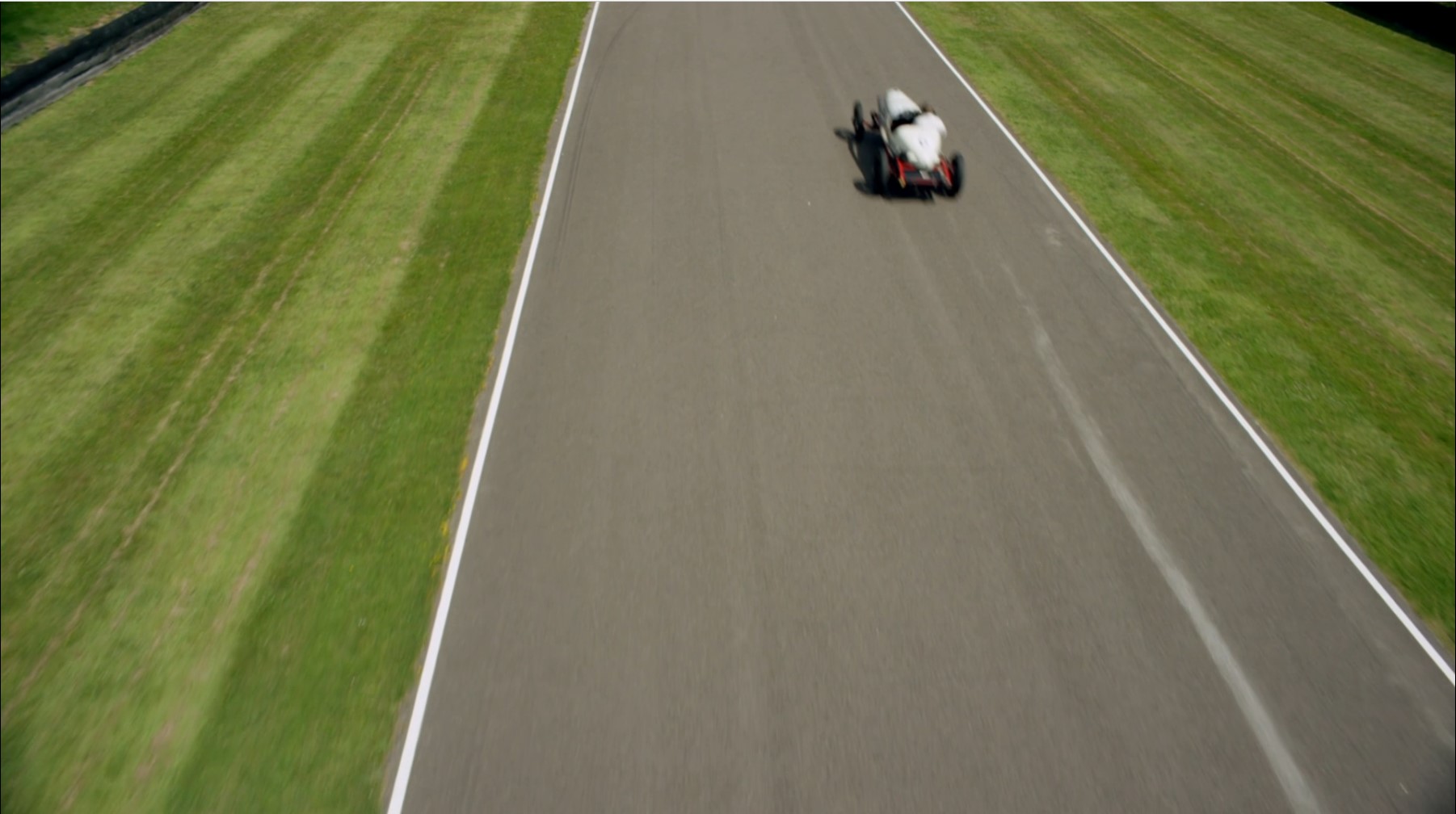
Anyway, getting back to the grass, I always thought that these elaborate, decorative outfield designs were a late 20th-century invention associated with Major League Baseball. And then one day I was watching Downton Abbey, the Season 6 episode where Mary’s beau, Henry, is racing at Brooklands Race Track (a newly-built facility in 1925, when this episode is set) and saw this.

1920s racetrack with decorative stripes mowed into grass along the paved track

What? 

I already know better than to accuse Downton Abbey of anachronisms (e.g., see my post “A Downton Abbey anachronism?” and the many replies, leading to the correct determination that no indeed, “Downton Abbey” was not guilty of inserting an anachronism into Season One, Episode Three). So I did some online poking around and discovered that 1) the lawn mower was invented in 1830 (where else but in England, home of those stately country mansions surrounded by expansive lawns of lush, green grass) and that 2) one by-product of this newfangled equipment was its ability to create stripes in said lawns, simply by virtue of the rollers that were situated behind the blades in order to flatten down any unevenly cut spots. 

That’s right. By the time of Henry’s motorcar race at Brooklands in 1925, lawn striping would have been about 100 years old.

In a related “everything new is old” moment, I was reading a Wall Street Journal article on home decoration last spring that showed a photo of some wallpaper in a familiar-looking pattern. Then I saw this text:

In the bar, the chromatically bold wallpaper, a historic flame stitch reinterpreted by British purveyor Fromental, is accurate to the 1700s.

From “This English Country Home Is a Master Class in Decorating With Personality,” Wall Street Journal (April 20, 2023)

What?

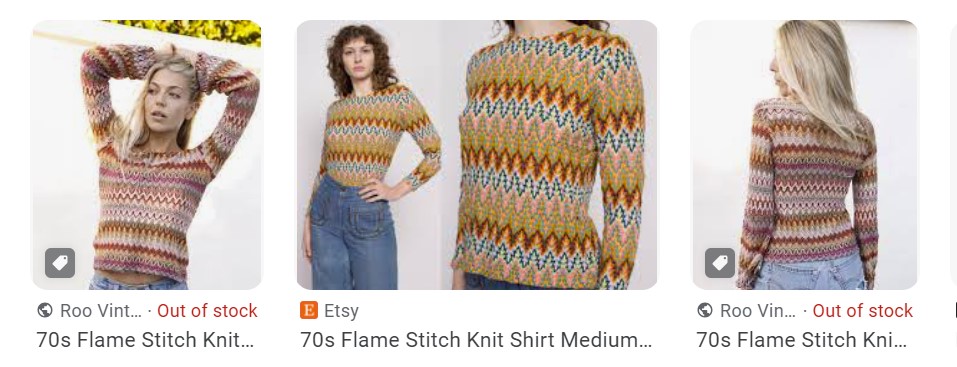
I thought this vaguely zigzagged look was from the early 1970s. Lots of girls at my junior high school wore knit sweaters in this pattern, and I thought it was the coolest, most mesmerizing psychedelic design ever.

Results of Google image search for “1970s flame stitch sweater”

Well, it certainly was cool. It definitely was mesmerizing.

But as it turns out, it was absolutely NOT “psychedelic,” a word coined in 1956 by English psychiatrist Humphry Osmond in a letter to Aldous Huxley to describe his drug-distorted experiences under the influence of mescaline.

Nope, the “flame-stitch” pattern, as it’s called, long predates the hallucinatory LSD trips of the 1950s. According to this article in a magazine called “Frederic,” the pattern (in general) dates at least as far back as 5th-century Greece (shown in a mosaic tile-floor pattern) and 12th-century Sweden (shown in the Skog tapestry, documenting Scandinavian monarchs shortly after the region’s conversion to Christianity). It emerged in something more closely resembling the modern pattern in 17th-century Italy and quickly began showing up across Europe but especially in 18th-century France and England in everything from shoes to clothing and home décor.

Who knew? Not me, for sure.

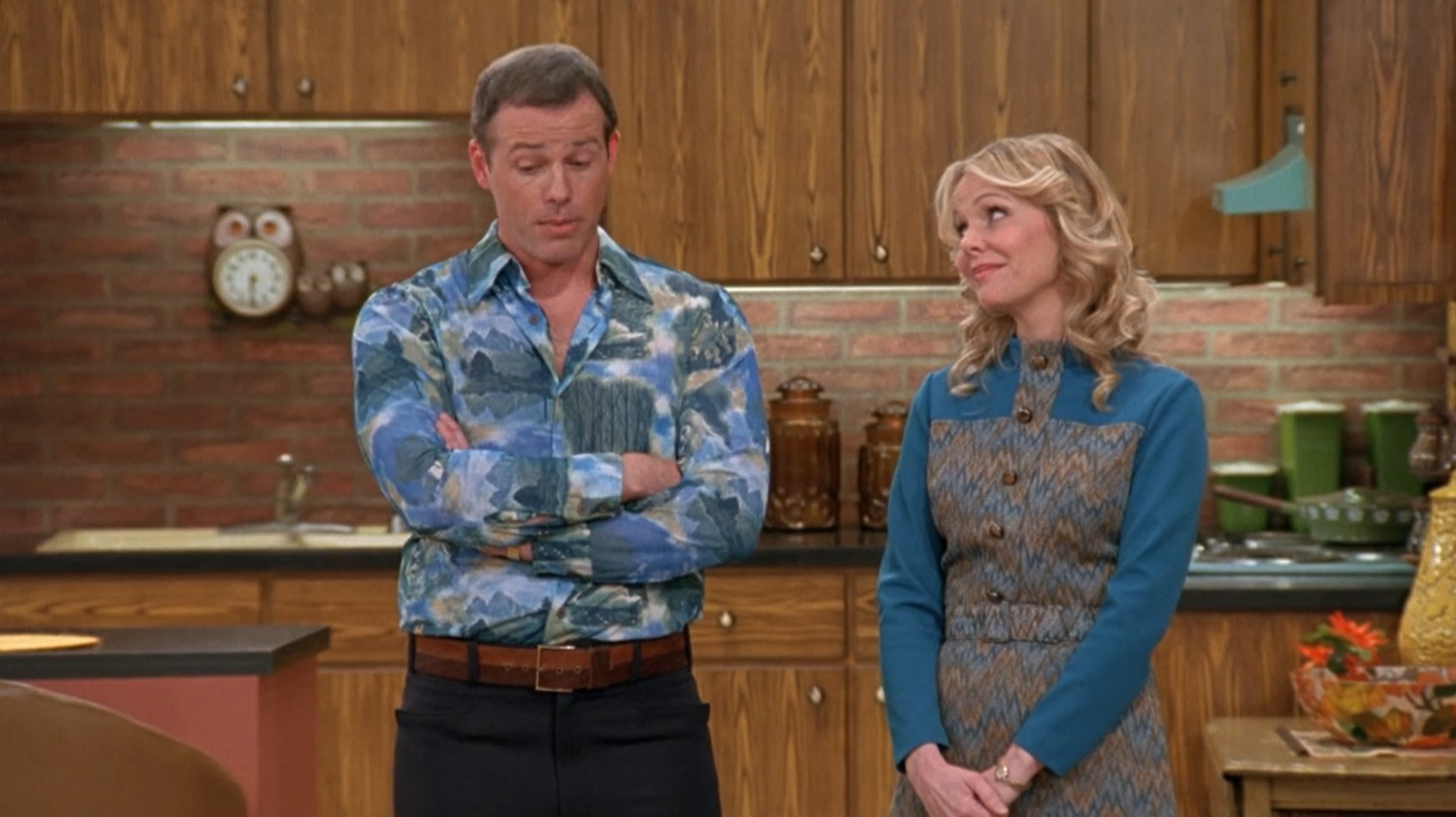
So once I’d been reminded of this stitch pattern that had so fascinate me in my junior high school days, I noticed it pop up in a fun Monk episode in which it’s worn by the mom in a fictional “Brady Bunch” type TV show called “The Cooper Clan,” complete with 1970s-era-appropriate clothing and home décor.

From “Mr. Monk’s Favorite Show” (Season 8, Episode 1)

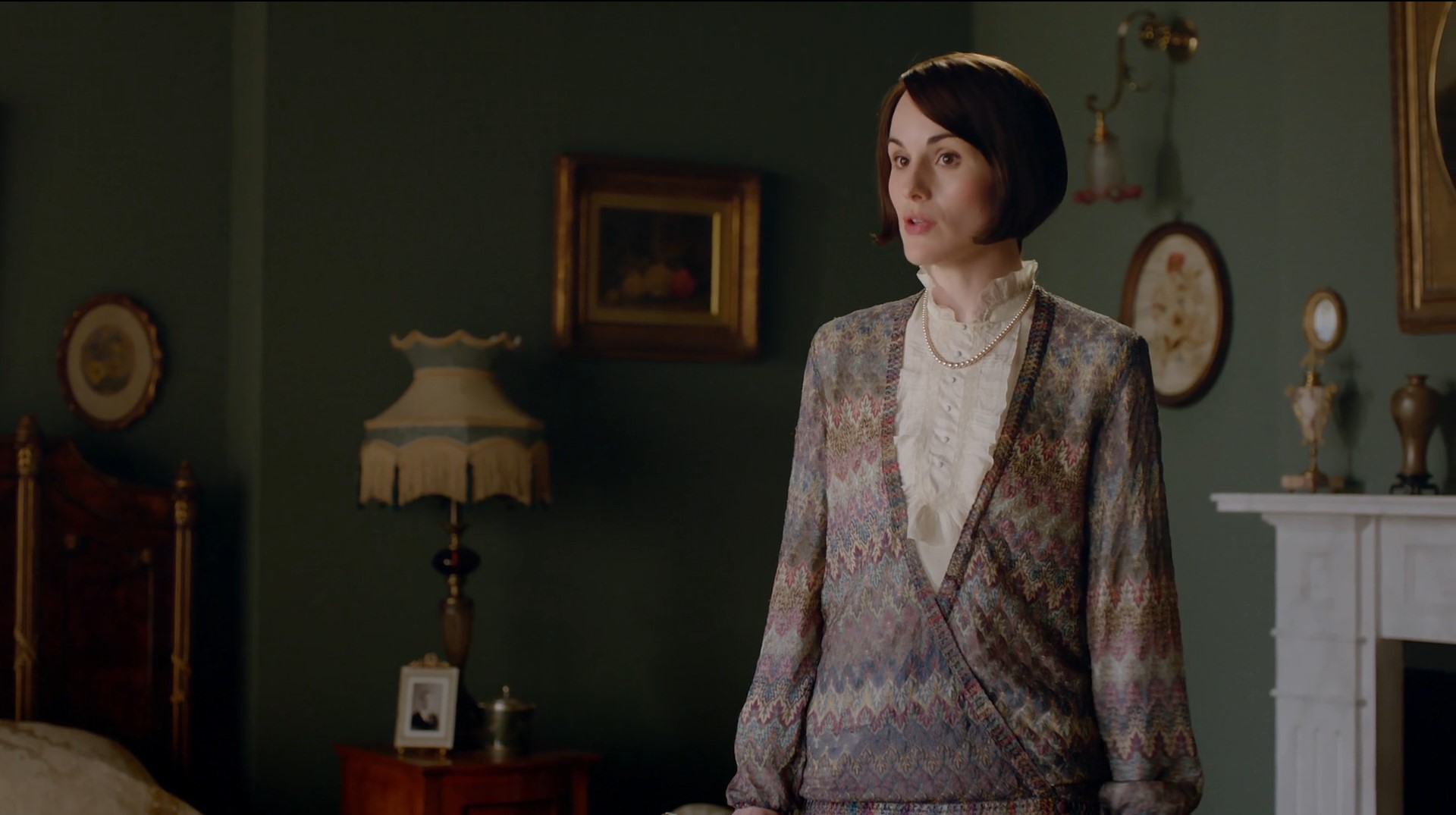
And then, not long after, it turned up again in that same Downton Abbey season, set in the year 1925, in a sweater worn by the oh-so-elegant Lady Mary Crawley (both images below from Season 6, Episode 8).

In a different vein but still somewhat related to all this, I have spent my whole life seeing the derivative (usually in the form of parody) long before discovering the original that the copy was taken from. 

For example, my introduction to Charles Dickens’ “A Christmas Carol” came from a 1962 (in reruns! I’m not quite that old!) television special, in which Scrooge is played by Mr. Magoo, who is voiced by Jim Backus.

And, of course, speaking of Jim Backus, my first introduction to Shakespeare’s “Hamlet” was the brilliant “Gilligan’s Island” episode (“The Producer”), in which the gang tries to impress marooned movie impresario Harold Hecuba (Phil Silvers) with their musical staging of “Hamlet,” in hopes that he’ll take them back to Hollywood with him when he’s rescued. (Unfortunately for them, he sneaks off the island having stolen their idea, as revealed shortly afterward via a news broadcast received on the radio that is the castaways’ link to the outside world.)

Speaking of Hollywood impresarios, I didn’t know till much later (the baggy-thighed jodhpurs were my clue) that director Roscoe Dexter (“Dex”) in Singin’ in the Rain (featured in one of the film’s funniest scenes below, involving that newfangled “sound” technology) was actually a stand-in for the extremely famous director Cecil B. DeMille, whose work spanned the silent era through the 1956 VistaVision epic The Ten Commandments.

Cecil B. DeMille, Columbia Broadcasting System-CBS, Public domain, via Wikimedia Commons

And who could forget Dan Aykroyd’s contributions to my well of cultural knowledge?

First was his hilarious and bloody “French Chef” sketch on “Saturday Night Live.” Only later did I learn who Julia Child was (and that she actually had cut herself with a knife on camera while filming her television show).

And then there was this guy, Dan Aykroyd’s chain-smoking, late-late-night talk show host.

Who I (much) later found out was actually a real talk-show host, Tom Snyder (born and raised in Milwaukee, FYI, to work in another plug for my city 🙂 ).

Looking for some “real” Tom Snyder clips, I came across these. First, Tom Snyder interviewing KISS, one of my favorite bands during high school.

And then, this one, an interview with one of my favorite directors, Alfred Hitchcock.

(Note: I don’t really expect anyone reading my blogpost to actually sit here and watch all these clips. Including them is mostly a way for me to save them in one spot so I can come back and view them later. But this also makes it easy for you to click and view immediately if you’re curious 🙂 )

There are probably quite a few more examples of me being late to the party, as it were, thinking the derivative was the original, but I can’t think of any at the moment off the top of my head. I can always update this post once I remember them, which will probably happen here and there while standing in line at the post office, walking on the treadmill, or performing some equally mundane activity.

And my point?

Well, nothing earth shattering, naturally. Lawn stripes? Mr. Magoo? Musical “Hamlet”?But maybe this: Even as it’s disconcerting to realize that we humans keep repeating ourselves while naively believing we’ve created or encountered something “original,” it’s also sort of reassuring to realize how permanent things are. Quality endures, and nothing good, essential, or “true” is ever really lost or discarded.

In fact, perhaps one purpose we have as humans living in our own accidental period of history is to keep finding and “recognizing” all those things worthy of rediscovery.


Posted in Art, Creativity, History, Life, Media studies, Popular culture, Television | Tagged , , , , , , , , | 3 Comments

Revisiting the Bill Moyers series of interviews with Joseph Campbell

This is revisiting only in a general sense. During discussion in my political science class this morning, I had occasion to refer to Joseph Campbell. My students had not heard of him, so I gave some quick background, referring to the usual anchors of his book The Hero with a Thousand Faces and how George Lucas based his Star Wars story on Campbell’s teachings about mythology, etc.

Anyway, after class I still had the Wikipedia article on Campbell open, which I had pulled up just to have a visual that students could look at while I talked about him. And somehow in doing that, I came across all of the bill Moyers interviews with Joseph Campbell from the late 1989s.

Cool! I have the series at home on VHS tape. Not particularly convenient. But I have been wanting to go through them again, and now it’s easy. Not only are the videos available in one place, but there are also transcripts of each interview’s conversation.

You can link here to BillMoyers.com, a website that has the entire collection of interview videos on one page. When you click on each, it takes you from the thumbnail to the actual video, and below the video is the transcript of that episode, which I love. Although I enjoy video interviews, I can read a transcript so much faster. Nice to have both right there together.

Link: https://billmoyers.com/series/joseph-campbell-and-the-power-of-myth-1988/

Enjoy!

Posted in Books and reading, Creativity, History, Learning, Political Analysis, Popular culture, Teaching | Tagged , , | 3 Comments