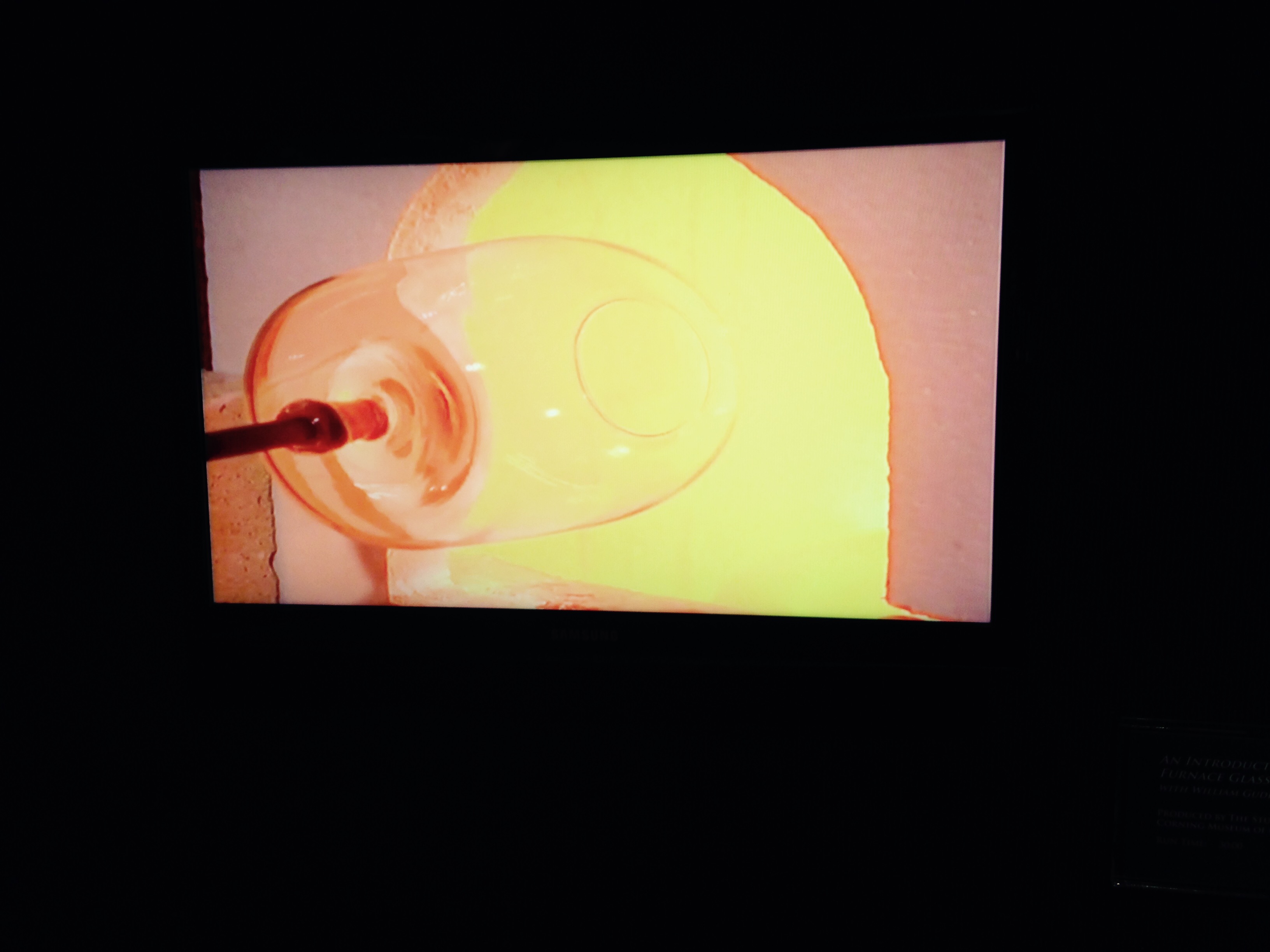
I was walking through the third floor of the Grohmann Museum today, when this section of a wall-mounted video display caught my eye.
My phone camera could not do justice to the video’s vibrant colors, but doesn’t it still remind you a little anyway of Mark Rothko’s Orange and Yellow? (which I was privileged to see in a Milwaukee Art Museum exhibit a couple of years ago; click here to read my post about the photo below 🙂 )
Fifty years ago today “Mr. Rogers’ Neighborhood,” the most caring children’s television show ever, made its debut. You’ve probably seen this before, but it’s worth watching again: Fred Rogers testifying before the Senate Subcommittee on Communications in 1969 in support of public television funding. As the self-described Senate “tough guy” gets “goosebumps” and is persuaded to approve the $20 million, you really do get a sense that LOVE is the answer. To everything. This hopeful glimpse of possibility is exactly what I need when the world and cable news and social media churn with anger.
More snow Friday and Sunday, but Milwaukee is getting lots of sunshine today.
So often bright sun in winter means bitter cold, but today it’s pretty warm outside. I didn’t even need my scarf or gloves walking between buildings, although I wore them anyway out of habit 🙂
Monday’s Google Doodle honored revolutionary Russian filmmaker Sergei Eisenstein. Here is a cool video I found that provides a little biographical info along with the actual Google Doodle.
Sergei Eisenstein was the first “modern” filmmaker. He basically invented modern film editing. Before Eisenstein, cinema was far more similar to theater than what we think of as “movies” today.
For example, check out this short (less than a minute; it just seems long because it’s so static) scene from The Birth of a Nation, which was the first feature-length film (D.W. Griffith, 1915, a film released to coincide with the 50th anniversary of the end of the Civil War and constituting the first movie “event,” playing in civic centers and auditoriums across the country to mark the occasion). Notice how the camera is completely stationary. In other scenes, too, the camera remains fixed as the actors enter and exit the set via those stairs in the back just like they would in a play. Not only does the camera not move, but you’ll note that there are no cuts whatsoever. We don’t see one person’s face as they speak and then cut away to a different person’s face as they speak. Just the fixed stare of the camera, even as the family moves en masse to console each other (over the battlefield death of the younger son) on the couch upstage and far left. (Or, from the viewer’s perspective, to the far right side of the frame and from foreground to middle ground.)
Eisenstein changed all that with his fast cuts and montages in Battleship Potemkin. The scene below is the cinematic equivalent of the invention of the light bulb or something. Or maybe a better comparison might be with the Beatles’ film A Hard Day’s Night, which pretty much created the music video format and the entire genre of “music film” (including documentaries, which the Beatles’ movie sort of is, in the same way that “Keeping up with the Kardashians” is a documentary television series by way of the reality-show sub-genre 🙂 ).
Aside: Phil Collins was an extra in A Hard Day’s Night. Cool to know, right? (By the way, sorry about any ads that may show up in the clips below. I brought them all in from YouTube, and sometimes I can’t get rid of them. GRRR . . .)
But back to Sergei Eisenstein and his contribution to cinematic history. The “Odessa Steps” / “Odessa Staircase” (depending on your translation) sequence is well known to all movie buffs and probably, actually, to anyone who’s ever taken a film studies course.
This movie scene is SO famous and groundbreaking! No wonder it’s so widely alluded to in other films.
For example, this scene from The Untouchables, with several elements of homage (pronounced oh MAHZH, by the way, because it’s a French term from cinema’s early days in that country): the baby carriage, the sailors caught in the crossfire, the outstretched hand with the silently voiced “my baby!” (a counterpart to the original’s “Mama!”).
That four-wheeled pram/buggy vintage baby carriage shows up again during the chase scene in The French Connection.
Additional (non-baby-carriage) allusions to the “Odessa Staircase” can be seen in these short clips from The Hunger Games and its sequel Catching Fire. From the relentlessly advancing line of Peacekeepers to the batons held at the same angle as the guns, even to the same direction of movement (left side of screen to the right), these shots clearly mirror the soldiers from the original Eisenstein sequence.
At a certain point allusions such as these will enter the “language” of film so ubiquitously that they become the way of conveying information and emotional nuance, and to the point where the established form sheds its association with the original source to become a “trope.”
Consider, for example, the “assembly line” trope. We begin with Charlie Chaplin in Modern Times (1936).
And follow up about fifteen years later with Lucille Ball in “I Love Lucy” (1952).
Until finally we arrive at “Drake & Josh” working the sushi line on the Nickelodeon channel (2006), in a scene that imports elements from both the Modern Times and the “I Love Lucy” versions. (Sorry for the subtitles and poor video quality; this was the best clip I could find on YouTube.)
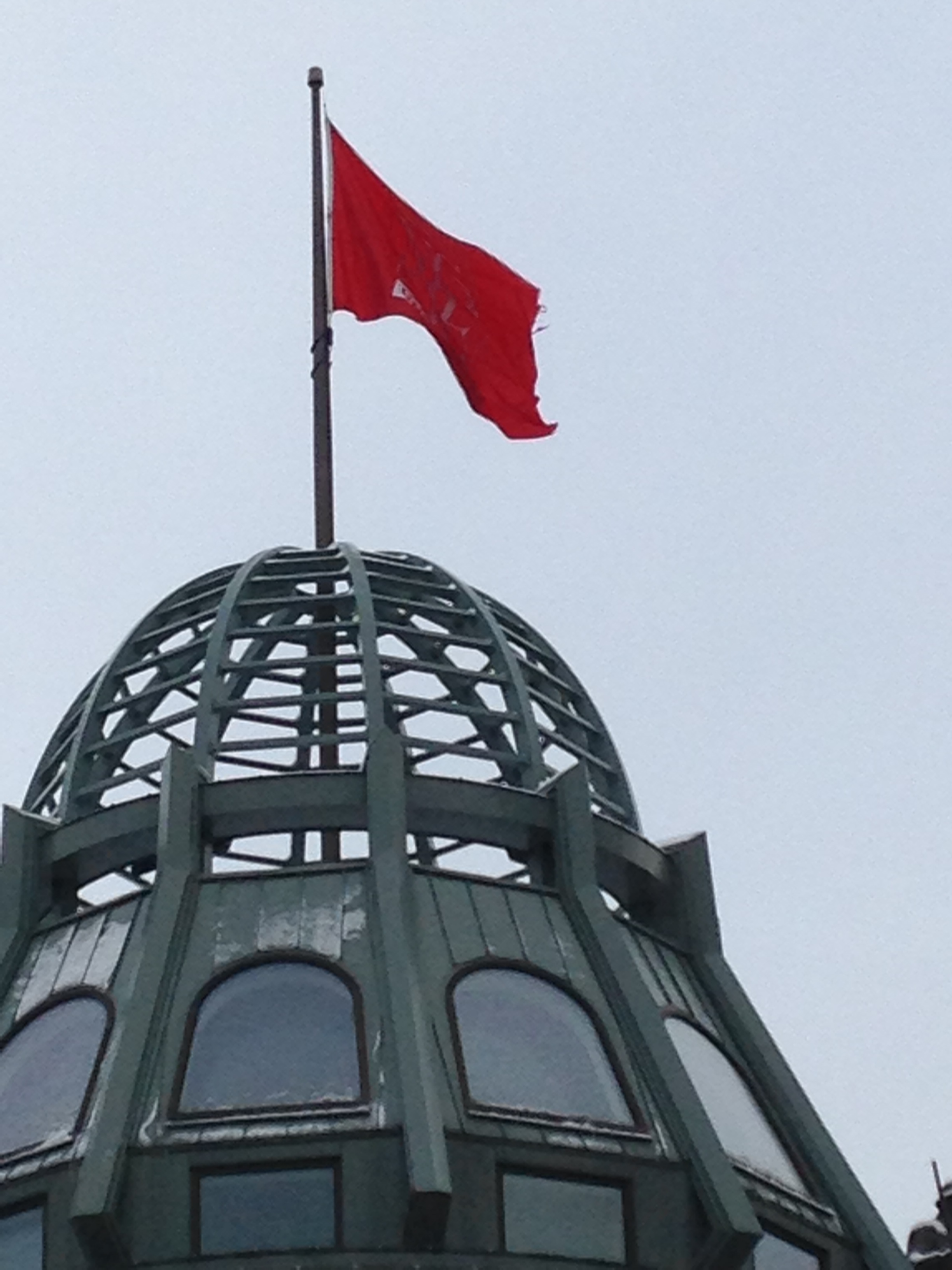
I noticed the Sergei Eisenstein Google Doodle on Monday but probably wouldn’t have posted on it except that while returning to my office from a Starbucks run this morning, I noticed the red MSOE flag flying atop the Grohmann Museum (where my office is located).
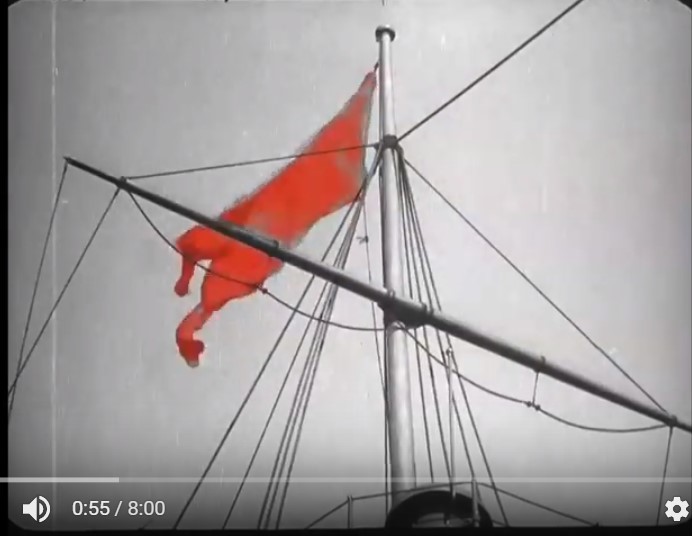
Doesn’t it remind you of the hand-tinted red flag in Eisenstein’s Battleship Potemkin just a little? 🙂
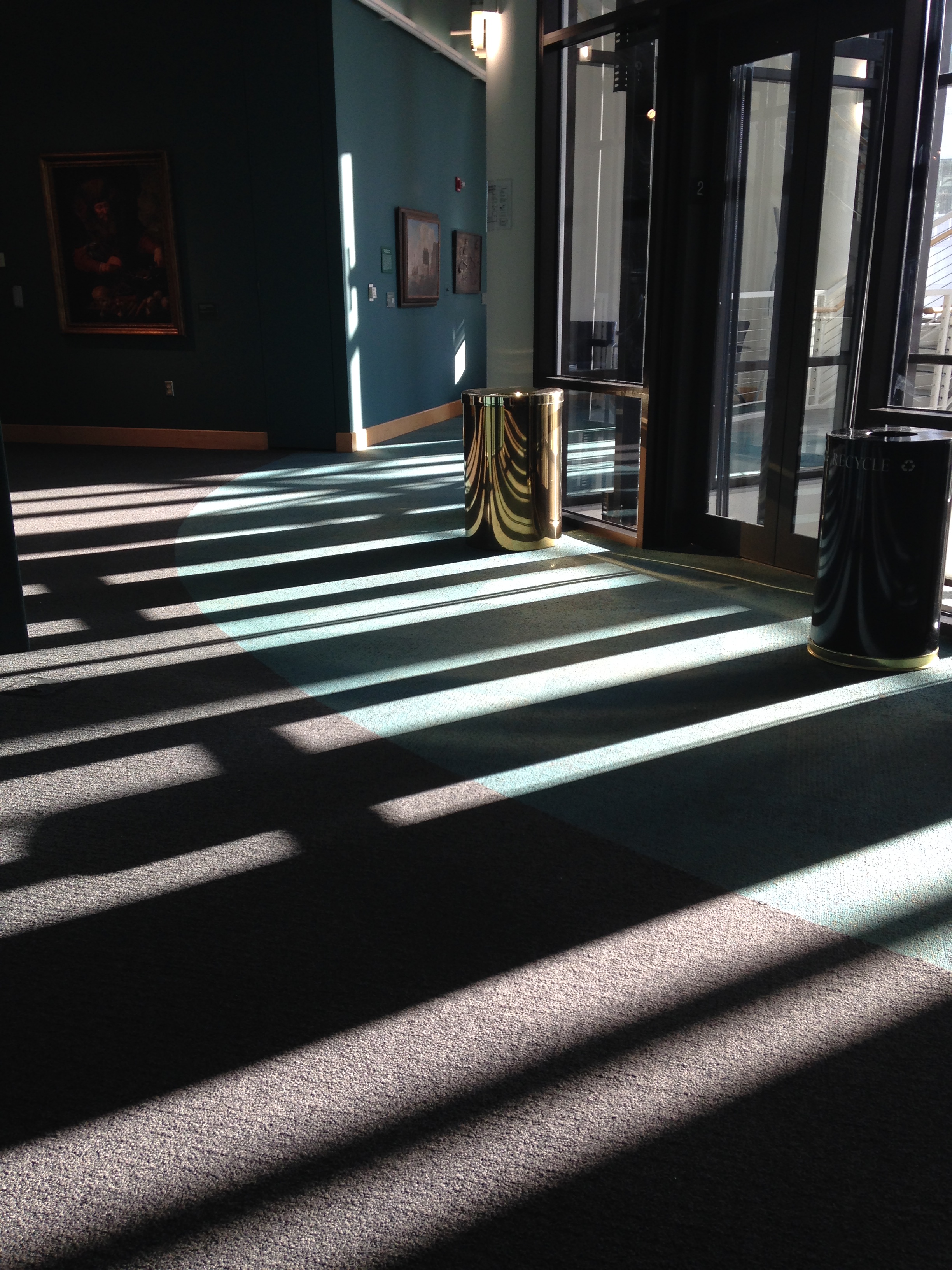
Like a zebra or tiger, this garbage can’s “disruptive coloration” stripes allow it to blend in with its environment . . . at least during the time of day that afternoon sun pours into the Grohmann Museum via its four-story atrium, casting shadows like long fingers stretching into the galleries.
I had to look up “protective coloration” to make sure it was the correct term, and it was, although “disruptive” is more accurate. Both are forms of camouflage, which itself is a word with an interesting etymology.
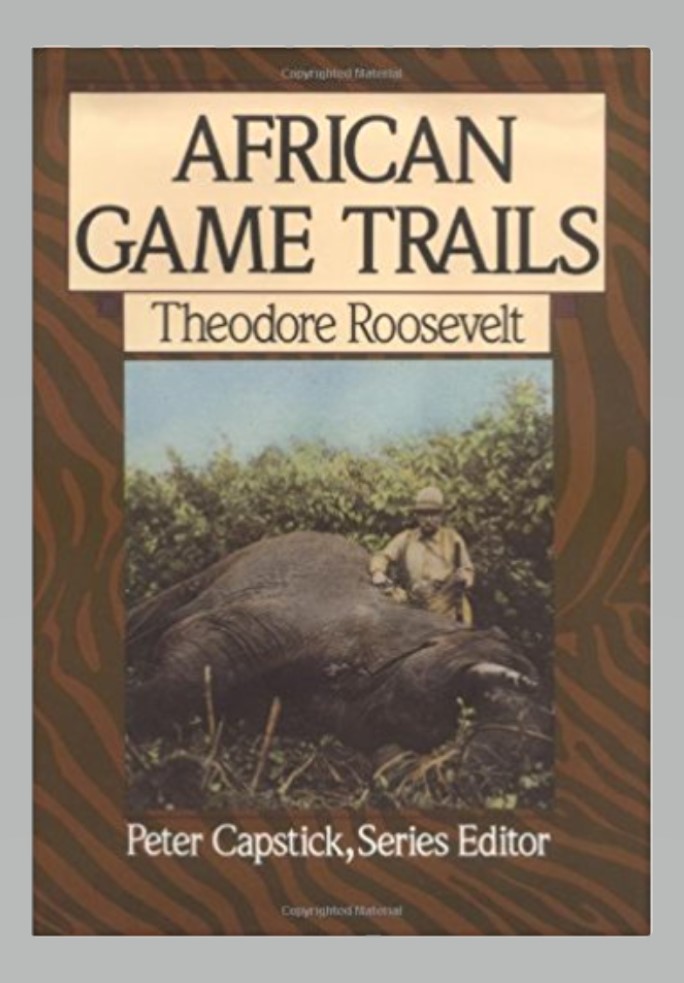
Did you catch the author’s name? Theodore Roosevelt? In March 1909, shortly after leaving the Presidency, Roosevelt made an extended visit to Africa to “collect specimens” (I’m not sure what kind, although as you can see from the book’s cover, he also shot at least one elephant) for the Smithsonian.
Very interesting! I’m putting this book on my “to read” list.
(I wonder what the world would have to say if a modern-day former President were to put out a book with a similar cover? 🙂 )
The old Duran Duran song “Notorious” was playing at the Red Arrow Starbucks (and outside at the ice rink, as well) when I made a coffee run earlier this afternoon.
You know how music—like smells—can instantly transport you to another place or time? Do you ever also have movie associations with a song?
(Aside: Last week I posted some Quincy Jones music videos, and the last one in the post, “Soul Bossa Nova,” was one my younger daughter identified immediately as “perfect for a Quentin Tarrantino movie,” although I don’t think it ever has been used in one. Speaking of Quentin Tarrantino’s stamp on music, if you’ve seen Reservoir Dogs, can you ever again hear “Stuck in the Middle with You” without chills running up your spine?)
There are a couple of songs that I can never hear again without thinking of Donnie Darko, a really weird 2001 movie with an incredibly talented (and famous) cast. One is “Mad World,” and the other is “Notorious.” I can’t say a whole lot more about that last song’s appearance in the film that you can’t divine yourself by watching the video below. So inappropriate, and so strange to see how proud the parents are of their daughters’ performances. Not surprisingly this is a dance routine destined for “Star Search,” that downmarket 1980s version of “American Idol” hosted by Ed McMahon.
One more thing to add as long as we’re talking about Donnie Darko: I think this was Patrick Swayze’s finest performance ever. In my opinion, he deserved an Academy Award for Best Supporting Actor—or at the very least a nomination—for his portrayal of creepy motivational speaker Jim Cunningham. Just sayin’ 🙂
Virtual reality (VR) is going to shape itself into an art form that is quite different from contemporary cinema. We can’t really predict yet how things will turn out, although my bet is that movies as we know them are here to stay. It would be very difficult with VR to replicate the kind of storytelling experience made possible with editing and sound design and musical scoring. Whereas VR follows a viewer’s conscious choices, cinema allows that viewer instead to sit back and be enveloped in a story with layers of meaning created via the synergistic artistic choices of the filmmaking team.
I just read an article in Co.Design this week, though, that hints at VR’s truly awesome potential for a non-entertainment future. The article summarizes the technology’s use in a Nazi war-crimes trial recently, in which the VR team constructed a virtual reality model of Auschwitz, using original blueprints and photographs, because so much of the camp, including the crematoria, had been destroyed. Think of what a video game looks like; that’s basically what jurors and forensic experts were able to navigate in order to experience what a Nazi guard would have seen and felt during World War II. When one former guard was put on trial in Germany recently and tried to claim lack of knowledge about what was happening in the concentration camp, jurors got to see for themselves (virtually) the same things he saw. And what they saw was enough to convince them he was guilty.
The article also contains a 17-minute embedded video demonstrating contemporary use of VR for forensic analysis and crime-scene reconstruction. For example, you could create a 3-D picture of bullet trajectories, or you could walk through the crime scene and look closely for clues that might have been missed initially.
German authorities plan to use the VR model of Auschwitz to try around 30 additional suspected war criminals. After all the trials are finished—and this is the part of the article that most interested me—the VR model will be donated to museums and schools.
If virtual reality can preserve the history of this place in a way that brings it so frighteningly to life, maybe humanity stands a chance of avoiding a repeat performance.
Especially the horns! It reminds me of the even more fabulous Quincy Jones jazz sound of the 1960s. Which inspires me to post a few of my faves here, because why not? 🙂
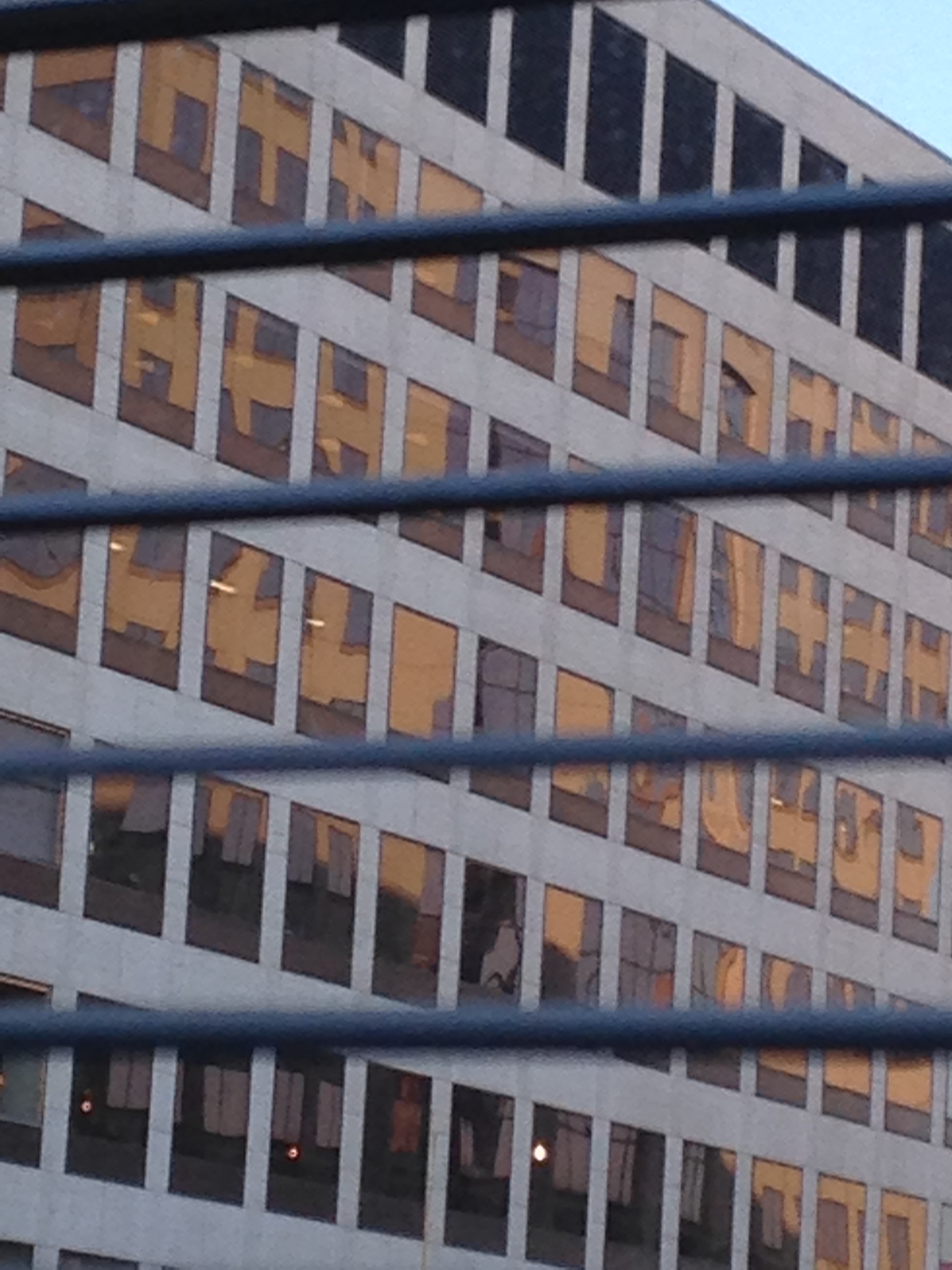
Or should that be “Blinds Through Lines”? Back to work at Milwaukee School of Engineering after a two-week break. I realized this morning that I take a lot of pictures from this window. It’s right next to the printer/copier in our department’s main office, so I tend to stand there looking outside while my copies run or I’m waiting for my printout.
Today I was watching some construction workers (not pictured) doing some kind of work right at the edge of an open/missing window of an office being remodeled. As I watched, all of a sudden it struck me how cool all the lines were: from the horizontal blinds on my office’s window to all the lines of that office building, including the reflected lines of yet another building.
So that’s today’s post, just a low-resolution close-up taken by my iPhone 5c, not even the 5s, which had a better camera but which I never in a million thought I’d ever need or care about. This morning one of my colleagues showed me some photos she took of her dog with her new iPhone X. Wow! Really beautiful. Now I’ve decided it’s time for an upgrade, even though I don’t really need a new phone and have no better reason than getting my hands on that camera😄
After my post on dovecotes ran a few days ago, my friend, colleague, and fellow blogger Sally Cissna published a really fascinating blog post about the relationship between humans and pigeons a century ago. Her post contains several old newspaper articles about how to raise pigeons for food and as a commercial “product,” how pigeons were used by fishermen in New England, how pigeons were used by the military, especially in late-1800s Germany, and how they were used almost as a form of texting back in the day. Read on for some really intriguing insights, especially if you’re a history buff.








 Katherine Wikoff