Tree Climbing

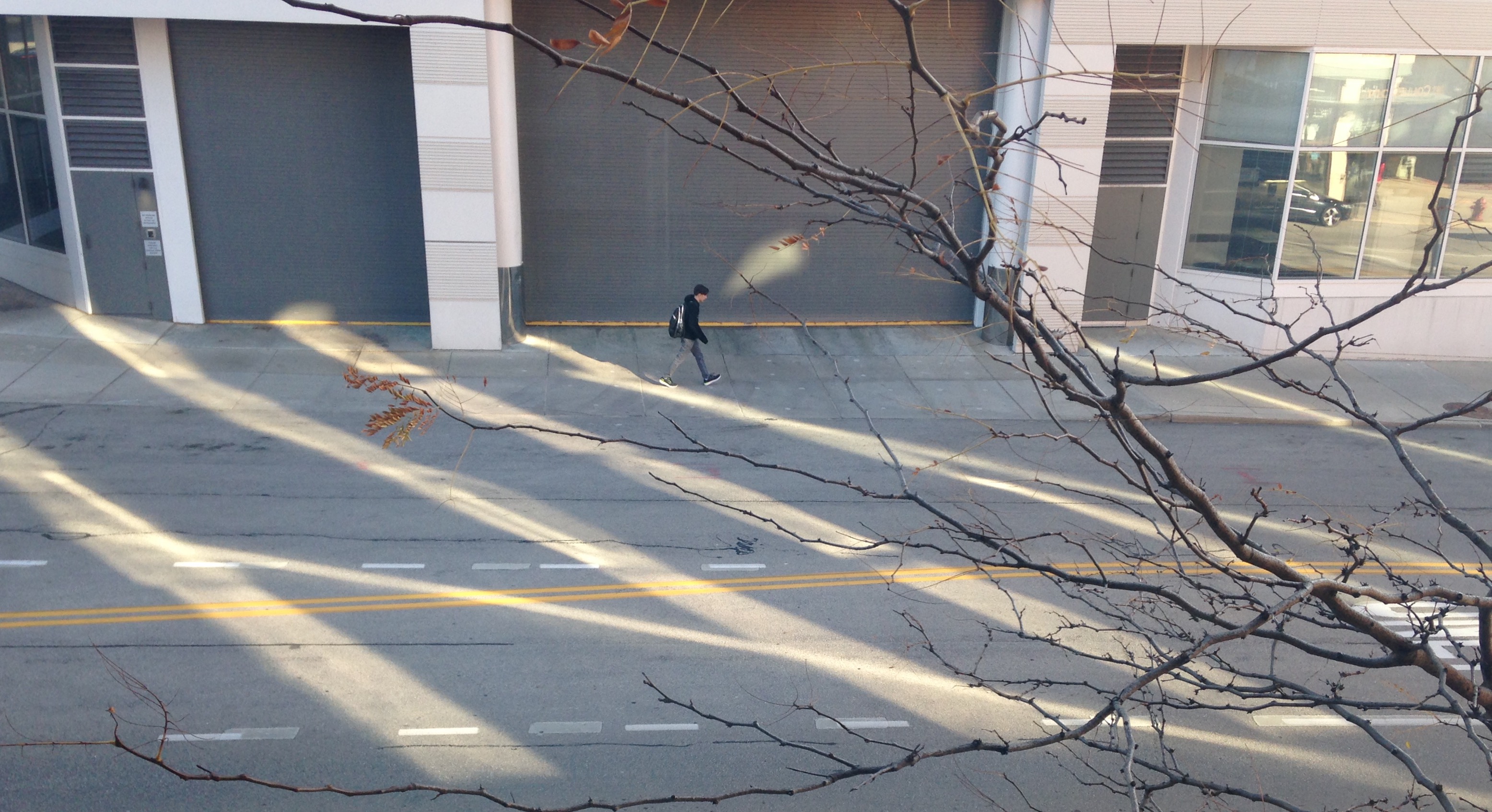
Just a shadow that caught my eye around noon today.

I like how the tree seems to be growing out of the doorway and spreading up the wall. I’ve seen whimsical fairy/gnome doorways in trees before . . .

But this was my first tree in a doorway! 🙂

This is the vestige of what was once a side door into the Val. Blatz Brewing Company’s Bottle House. Now it’s an emergency exit for the Campus Center at Milwaukee School of Engineering. More importantly, it’s also a handy little alcove to stand in on a winter day and be shielded from biting wind while waiting for the light at Broadway and State to change 🙂

Posted in Milwaukee, Photography | Tagged , , , , | 2 Comments

How use of color in Spotlight amplifies theme

I’m showing Spotlight in my political science class this week and next. We don’t have a lot of time to talk about the press in our course, but I wanted to work in some reflection on the place of news media in American political culture. I like using films in my classes whenever I can because they deliver such a tremendous amount of information and nuance for the class time given up.

Spotlight is my positive bookend to the more negative, cynical view of media found in the first film of the quarter, Wag the Dog.

In my film studies class, I always show the most recent Academy Award winner for Best Picture as the final film of that course. In spring 2016, that film was Spotlight. Obviously students in my political science class are watching with a very different agenda than we had in my film studies class a year ago spring.

This time around (in political science), we are thinking about the role of “the press” as the Fourth Estate in civic life. Especially given the rapidly disintegrating sustainability of the news media’s traditional business model, not to mention the rise of “fake news” and accusations of partisanship and bias in news coverage, I think it’s important to think deeply about the press both at its lazy, credulous worst and at its most noble best. Wag the Dog and Spotlight do a pretty nice job of highlighting the opposite ends of the ethics/competence spectrum.

Today I learned that it’s impossible for me to shut down the film-studies side of my brain, even when I’m in political-science mode. While watching Spotlight with my students this afternoon, I kept noticing the colors. I haven’t seen Spotlight since showing it in my film studies class over a year ago. I’d forgotten all about its production design. But, boy, it all came back in a flash.

Take a look at these screenshots. (You can click on each image to enlarge it.)

Can you see what’s going on with the colors? Red, green, and blue are EVERYWHERE. Even items that would normally be white or gray or beige are tinged with hints of red, green, and blue instead. (Balancing out the red, green, and blue are black and yellow/gold/brown, the latter often showing up especially in richly colored wood.)

I’m not sure there’s necessarily a thematic purpose behind the color palette used in Spotlight, but it does occur to me that red, green, and blue (RGB) are the primary hues in an additive color system. Cyan, yellow, and magenta (CYM) are the primary hues in a subtractive color system.

Check out this cool photo from Wikipedia. I like to show it to my film studies students because it’s such a great visual demonstrating these color principles in action.

“RGB illumination” by en:User:Bb3cxv via Wikipedia (CC by 3.0)

White light contains all the wavelengths in the color spectrum. Black essentially has none.

So actually, now that I think about it, if I wanted to make some kind of point about the color design in Spotlight, I might talk about how the RGB colors add up to a white light that echoes and amplifies two related themes.

First, that white is associated with purity, and second that light is associated with truth.

The film’s title refers not only to the Spotlight team itself (a special unit of investigative reporters at The Boston Globe) but also to their act of spotlighting and bringing into the light a problem hidden away too long in metaphoric darkness.

Good. I’m so glad I have my blog and was able to get all this out of my head and into a form that could be shared with someone who might appreciate it 🙂

Now it’s time to pack up all my student papers to grade this weekend and head home.

Have a great Friday night, everyone!

Would you like new posts delivered to your inbox? To subscribe, click here.

Posted in Learning, Movies and film | Tagged , , , , , , , | 6 Comments

A little baseball trivia?

My husband and I were talking in passing about the World Series last night. Although I no longer really follow baseball, I was a big fan as a kid. When I noticed the game on TV, I wondered aloud if “Houston” was still the Astros. After all, many other teams seem to have moved to new cities and states, and even teams that have stayed put seem to acquire new names.

A quick look at Wikipedia showed, obviously, that Houston is still the Astros.

As my husband and I continued talking, a point arose in the conversation where it seemed logical to reminisce about how AstroTurf got its name from the Astros. This was news to my husband, which then made me wonder: Has the Astros’ association with the AstroTurf  name slipped into relative obscurity?

Probably not, but now I’m curious. Do you also remember that the first big installation of artificial turf was at the Houston Astrodome? And that it was kind of controversial?

I remember the Astros seemed very modern in so many ways: the enclosed ballpark in which they played, their association with Houston’s space program (“astro”nauts), their groovy polyester uniforms.

I also remember the trade with Houston that brought Joe Morgan and Cesar Geronimo, and Jack Billingham (whose autograph I still have) to Cincinnati. Without the Houston Astros, the Big Red Machine might never have been.

Posted in History, Life, Popular culture | Tagged , , , , | 1 Comment

Functionality in search of purpose

Although I’ve noticed this item in the corner of a classroom I teach in this quarter, I never looked closely at it until today, when it was in a slightly different location.

I almost didn’t recognize what it was. That’s how long it’s been since I’ve seen one of these. Are you old enough to remember dot matrix printers? If so, you probably understand the significance of that big rectangular hole in the lower shelf.

Amazingly, look at who still sells that striped green continuous-feed paper!

Collector’s item: A bargain at $78.99!

Someone somewhere still uses this product.

Wow.

That’s like a coal truck that makes local delivery rounds, which I suppose might be a routine occurrence in some places but which I haven’t seen in Milwaukee since the early 1990s. And even then, only once. Watching coal tumble down the long chute from truck to basement of an older East Side home, I felt like I’d stepped through a time warp into the 1930s.

I wonder if anyone still uses this printer cart for anything other than a lectern stand, which appears to be its current job. At least it is serving a legitimate need in its repurposed life 🙂

Posted in Higher education, History, Life, Milwaukee, Popular culture, Teaching, Technology | Tagged , | 4 Comments

Remember the Berlin Airlift? Why can’t we do that for Puerto Rico?

I know it’s probably naive and presumptuous of me to assume that America’s leaders haven’t thought of this already and dismissed it for good reason. But why haven’t we done something like the Berlin Airlift for Puerto Rico?

We kept Berlin going for 11 months after the Soviet Union blockaded the city at the start of the Cold War. Planes were landing every 38 seconds 24/7! We sent EVERYTHING that city needed to keep going, including gasoline and coal.

It has been weeks now since the hurricane. Why do we continue to see news reports of such heartbreaking human misery coming out of Puerto Rico?


Posted in History, Life, Political Analysis | Tagged , , , | 6 Comments

Knot Art – How one artist developed a daily creative practice

I love this article in today’s Co. Design, “How An Apple Alum Found Her True Calling–In Knots.”

Windy Chien, a former producer at Apple’s iTunes, is now an artist who creates hanging textile art, jewelry and lights from complex macrame knots. In addition Chien has become a historian of knots and on her Instagram blog has documented hundreds of the 4,000+ knots known in the world.

In 2012 Chien began making art, and soon she also began selling it. But she got bored and blocked as soon as she’d mastered each new artistic technique. Eventually she realized that the key to keeping her art alive and interesting was to develop a craft that required continual learning and exploration. She’d done macrame as a child in the 1970s, and once she took it up again, she quickly realized how few knots most people actually employ in macrame. To teach herself how to tie more unusual and complex designs, she bought a book on knots (The Ashley Book of Knots). And on January 4, 2016, Chien had the inspiration that set her on the path to destiny: to tie one new knot every day of that year. (She tied four on January 4th, to make up for the days she’d already missed.)

“The Year of Knots” was the result, a daily series on her Instagram account in which she made and posted a photo of the one new knot she’d learned to tie that day. Later “The Year of Knots” also became an exhibit, in which all her knots were collected and displayed on a wall as individual (and collective) works of art.

Of her daily knot-tying practice Chien says on her website:

The Year of Knots gave me many rich things.

1. A daily ritual that allowed me to quickly access the blissful state of flow that had previously been so elusive to me

2. My art school, where I learned the elemental building blocks of art: line, form, shape, space, texture, and color

3. A history lesson, where I learned knots’ context in nautical life, the material and physical properties of rope, and how for any given situation there’s a knot that is right while all the others are wrong

4. Most importantly, the knots are a new language. Every new knot is like learning another letter in the alphabet. Alphabets and letters form words, and words communicate. So the knots are a new form of communication, to make, as Rebecca Solnit puts it, “the mute material world come to life.”

Chien’s work is imaginative and beautiful, very streamlined and spare in the minimal way of Apple products. Reading the Co. Design article and the essays on her website, and especially looking at her art on Instagram, is inspiring me to try (to TRY, anyway . . .) to work a daily art practice into my own schedule.

Posted in Art, Creativity, History | Tagged , , , , , , , , , | 2 Comments

Architectural Correspondence

A random thought as I looked across the street while waiting for the light. MSOE’s Campus Center was once the Blatz Brewing Bottle House. Doesn’t that row of vertical stone columns rounding the corner look a bit like a string of beer bottles on a production line?

Posted in architecture, Milwaukee, Photography | Tagged , , , , | 3 Comments

Pedestrian Sidewalk Canopy

Looks like they’re getting ready to do some repair work on the German-English Academy Building. I was struck this afternoon by the crisscrossed geometry of shadow and scaffolding (hence the pic 🙂 )

Posted in architecture, Milwaukee, Photography | Tagged , , , , | 2 Comments

After Hours – Grohmann Museum

Took this photo last night shortly before leaving work. The galleries were closed but were illuminated by the rays of evening sunlight coming through the atrium. I especially liked how the sculpture on the left seemed to float in the darkness like a ghostly apparition.

Here is the same scene in a photo I took just this morning. Looks really different during the day!

And here is a better view of that sculpture.

“Japanese Sawyer” – Anonymous [Japanese, 19th century] Ivory, cast iron, and wood sculpture (collection of the  Grohmann Museum)


Posted in architecture, Art, Milwaukee | Tagged , , , , , , , | Leave a comment

Love! Love! Love!

An article published today at Inc. online (“Self-Made Billionaire Jack Ma Says You’ll Need This 1 Rare Skill to Succeed in the Age of Machines“) argues that IQ (intelligence quotient) and EQ (emotional intelligence, i.e., “soft skills”) are less important today than a new kind of “intelligence.”

It’s called “LQ,” and according to Jack Ma, founder and chairman of the Alibaba Group, it means “the quotient of love, which machines never have.”

Reading this article reminds me vividly of the climactic scene in a book I read in seventh or eighth grade, A Wrinkle in Time—a scene that has always stayed with me and remains one of the profoundest epiphanies of my life.

On a foreign planet where everyone dresses, acts, and even thinks alike (in thrall to a giant, disembodied, evil brain called “IT” that holds sway over the people’s behavior with the hypnotic rhythm of its metronome-like beat), a “plain” 12-year-old girl named Meg faces the seemingly impossible task of rescuing her younger brother, Charles Wallace, from the monstrosity that has taken him prisoner:

There was the brain, there was IT, lying pulsing and quivering on the dais, soft and exposed and nauseating. Charles Wallace was crouched beside IT, his eyes still slowly twirling, his jaw still slack, as she had seen him before, with a tic in his forehead reiterating the revolting rhythm of IT.

As she saw him it was again as though she had been punched in the stomach, for she had to realize afresh that she was seeing Charles, and yet it was not Charles at all. Where was Charles Wallace, her own beloved Charles Wallace?

What have I got that IT hasn’t got?

“You have nothing that IT hasn’t got,” Charles Wallace said coldly. “How nice to have you back, dear sister. We have been waiting for you. We knew that Mrs Whatsit would send you. She is our friend, you know.”

For an appalling moment Meg believed, and in that moment she felt her brain being gathered up into IT.

“No,” she screamed at the top of her lungs. “No! You lie!”

For a moment she was free from ITs clutches again.

As long as I can stay angry enough IT can’t get me. Is that what I have that IT doesn’t have?

“Nonsense,” Charles Wallace said. “You have nothing that IT doesn’t have.”

“You’re lying,” she replied, and she felt only anger toward this boy who was not Charles Wallace at all. No, it was not anger, it was loathing; it was hatred, sheer and unadulterated, and as she became lost in hatred she also began to be lost in IT. The red miasma swam before her eyes; her stomach churned in ITs rhythm. Her body trembled with the strength of her hatred and the strength of IT.

With the last vestige of consciousness she jerked her mind and body. Hate was nothing that IT didn’t have. IT knew all about hate.

“You are lying about that, and you were lying about Mrs Whatsit!” she screamed.

“Mrs Whatsit hates you,” Charles Wallace said.

And that was where IT made ITs fatal mistake, for as Meg said, automatically, “Mrs Whatsit loves me; that’s what she told me, that she loves me,” suddenly she knew.

She knew!

Love.

That was what she had that IT did not have.

She had Mrs Whatsit’s love, and her father’s, and her mother’s, and the real Charles Wallace’s love, and the twins’, and Aunt Beast’s.

And she had her love for them.

But how could she use it? What was she meant to do? If she could give love to IT perhaps it would shrivel up and die, for she was sure that IT could not withstand love. But she, in all her weakness and foolishness, was incapable of loving IT. Perhaps it was not too much to ask of her, but she could not do it.

But she could love Charles Wallace.

She could stand there and she could love Charles Wallace.

Her own Charles Wallace, the real Charles Wallace, the child for whom she had come back to Camazotz, to IT, the baby who was so much more than she was, and who was yet so utterly vulnerable.

She could love Charles Wallace.

Charles. Charles, I love you. My baby brother who always takes care of me. Come back to me, Charles Wallace, come away from IT, come back, come home. I love you, Charles. Oh, Charles Wallace, I love you.

Tears were streaming down her cheeks, but she was unaware of them.

Now she was even able to look at him, at this animated thing that was not her own Charles Wallace at all. She was able to look and love.

I love you. Charles Wallace, you are my darling and my dear and the light of my life and the treasure of my heart. I love you. I love you. I love you.

Slowly his mouth closed. Slowly his eyes stopped their twirling. The tic in the forehead ceased its revolting twitch. Slowly he advanced toward her.

“I love you!” she cried. “I love you Charles! I love you!”

Then suddenly he was running, pelting, he was in her arms, he was shrieking with sobs. “Meg! Meg! Meg!”

“I love you, Charles!” she cried again, her sobs almost as loud as his, her tears mingling with his. “I love you! I love you! I love you!”

A whirl of darkness. An icy cold blast. An angry, resentful howl that seemed to tear through her. Darkness again. Through the darkness to save her came a sense of Ms Whatsit’s presence, so that she knew it could not be IT who now had her in its clutches.

And then the feel of earth beneath her, of something in her arms, and she was rolling over on the sweet smelling autumnal earth, and Charles Wallace was crying out, “Meg! Oh, Meg!”

Now she was hugging him close to her, and his little arms were clasped tightly about her neck. “Meg, you saved me! You saved me!” he said over and over.

Obviously, I enjoy a little melodrama in my novels 🙂  And, just as obviously, it’s hard to convey the huge sense of  movement from despair to elation when reading the key elements of this scene in isolation from the rest of the novel. But I remember so vividly that moment in which Meg decides to love the hateful person her brother has become.  And I remember the presence of Mrs Whatsit in the darkness, also a form of love. In fact, it was this love, which Meg knew intuitively could never be in doubt, that transformed the situation and provided the insight she needed to save her brother.

Love is the answer.

Maybe that’s also why I’ve always liked romance fiction so much. Its central premise is that love conquers all. (Or as my students here in Wisconsin phrase it: Love “stands” all.)

I taught this novel in class a couple years ago. Even though it’s written for younger readers, A Wrinkle in Time contains some interesting ideas and allusions to Christianity and political philosophy. Anyway, during our class discussions, I found it amusing that both my students and I kept referring to the villainous brain not as the pronoun “it“—as I interpreted it to be in my seventh-grade reading experience forty-plus years ago—but as IT, that department in every company charged with keeping all things computer-related running smoothly.

In light of the Inc. article, though, maybe IT (“I.T., abbreviation for “information technology”) is the correct pronunciation, after all? 🙂

By the way, a new movie version of A Wrinkle in Time is in the works, due for release in spring of 2018. It has an amazing cast, which I assume means that it also has an amazing director and script to have attracted them to this project in the first place. So I’m looking forward to it! Here’s a trailer.

Posted in Books and reading, Popular culture, Technology | Tagged , , , , , | 5 Comments