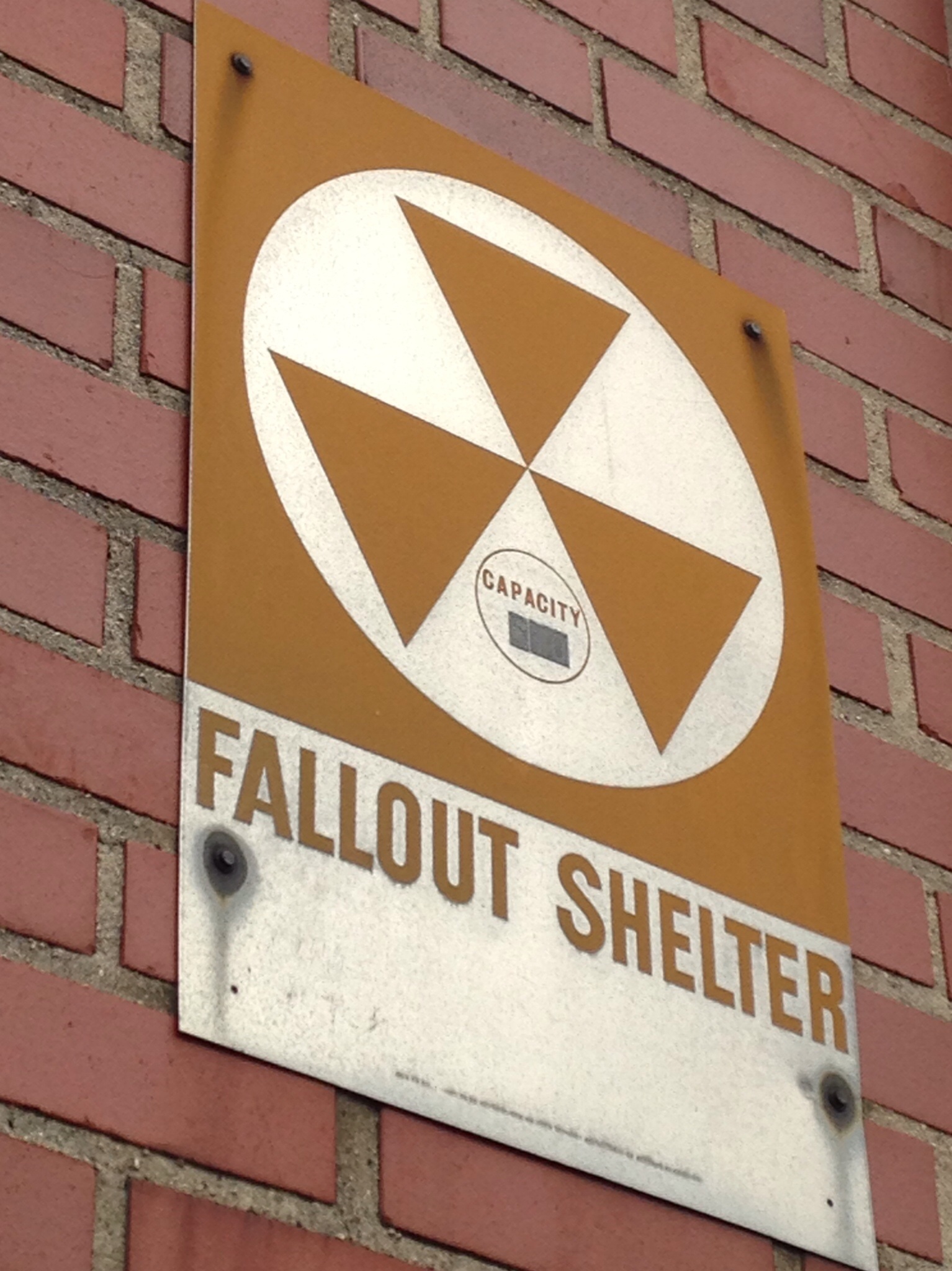
Seen on Milwaukee’s near west side. If you were born in the last 25 years, you might not know what this sign means. The truth is, it probably doesn’t mean anything anymore. Just a relic of a bygone era.
During the Cold War, one form of preparation for surviving nuclear weapons attacks was the designation of many buildings with basements as “fallout shelters” (Wikipedia article here). This sign looks pretty old, and the “capacity” number has been covered over. I somewhat doubt this building’s owner still considers it a civic obligation to shelter citizenry in the event of an atomic bomb explosion in Milwaukee.
Another way America prepared for nuclear holocaust was to teach the “duck and cover” maneuver to schoolchildren across the nation.
America’s preoccupation with the existential threat of “mutually assured destruction” persisted even into the 1980s.
See 1983’s “The Day After,” for example, which according to Wikipedia remains the highest-rated television film in history. This movie documented the horrific ordeal awaiting those “lucky” enough to survive a nuclear attack.
Or 1983’s War Games, starring Matthew Broderick, Ally Sheedy, Dabney Coleman, and a really scary computer named “Joshua” that learns an important lesson by film’s end about what constitutes the only “winning move” in the game of Global Thermonuclear War.
Apparently the Cold War was still quite hot as of 1983.
I came across the video below recently. If real (and I assume it is because I found it via a story on NPR), it boggles the mind that anyone would be so foolhardy as to stand “Directly Under An Exploding Nuclear Bomb,” as the NPR (National Public Radio) story’s headline reads.
Our capacity for self-delusion is pretty staggering. After letting the genie out of the bottle, we remain arrogant or stupid enough to believe we can control the consequences.
Which may be an inescapable aspect of the human condition.
Americans don’t realize how rich we are. It’s so easy not to feel rich when we read about luxury homes sold in London, Paris, or New York for eight or even nine figures. Millions and millions and millions of dollars. Who can afford that? Not us, the vast unrich.
Yet what constitutes “rich” is obviously subject to interpretation—a point that is driven home whenever I teach my Survey of Third World Literature class. (Yes, the course name is outdated. I inherited it and hope to rename it, although I will say it does provide an opportunity to explain terms like First/Free World, Second/Communist World, and Third World. Perhaps not surprisingly, these are fuzzy concepts for many students born after the end of the Cold War.)
A few weeks into the term, someone will observe that the stories we’re reading all seem to be about poor people. Why do so many “third world” authors choose poverty as a central topic/theme in their short stories and novels? At which point another student with first-hand knowledge from travel abroad will speak up and tell them it’s because poverty is the norm.
Literature allows you to experience life inside the skin of another person. It expands your consciousness in a way no other art form can, except maybe cinema. So today’s post is about literature and cinema and real life and perspective.
My last year in college I had three Chinese roommates. One of them lived with me the entire year. Her “American” name was Daphne. Chinese students at my college chose American names for their time studying in the United States. Many of these names were clearly inspired by Greek and Roman mythology, although names like Florence and Gertrude also somehow made their way into the mix. When Daphne arrived at our apartment, she was literally right off the plane. Her flight landed in Columbus, where her sister, a grad student at Ohio State, picked her up and drove her over to Dayton. My other roommate and I had put up “Roommate Wanted” signs around campus with little tear-off strips across the bottom with our phone number. Daphne and her sister went to campus as soon as they got to town, found our sign, and called us.
Daphne had never previously been to the U.S. She had no car and and very few belongings. After her sister departed for Columbus again, I took Daphne food shopping with me. It was her first time in an American grocery store.
Once there, we split up to do our own shopping. I zipped up and down the aisles and eventually found Daphne standing in front of the dairy case. Just standing there, paralyzed. As I approached her, she turned with an expression somewhere between wonder and horror.
“What’s wrong?” I asked.
“So many milks!”
Suddenly I saw that dairy case through her eyes. Whole milk, 2%, 1%, skim. Gallons, half-gallons, quarts, pints, and half-pints. All the different brands, row upon row. The choices were overwhelming. I’d never thought about it before.
Have you seen Moscow on the Hudson? In this 1984 film, Robin Williams plays a Russian circus performer who defects during a visit to Bloomingdale’s department store in New York while his troupe is touring the U.S. One of the store’s security guards gives Williams a place to stay temporarily, taking him home to the Harlem apartment he shares with his parents, sister, and grandfather.
Williams’ first trip to an American grocery store reminded me of Daphne’s experience. Or, what I really mean to say is, it made me realize that Daphne’s experience was not unique.
First he asks where the coffee line is. During the Soviet era, according to one of my professors who had lived in Russia, you had to stand in three lines to buy something at a grocery store: the first, to select your purchase; the second, to pay for your purchase; and the third, to pick up your purchase.
Second . . . well, just take a look at this clip 🙂
How stressed are we by our arrays of choices without even knowing it? Or is it possible we actually aren’t stressed out? Have the incredible variety and bounty available to us led us to develop an ability to tune out extraneous information?
Maybe it takes the astonishment of newcomers to open our eyes to the freedom and wealth Americans take for granted.
I stopped in this morning to see the Grohmann Museum’s new exhibit.
Although it opened May 27, I’ve only been in the building since then during hours when the gallery is closed. Last week was finals, and between holing up to grade over the weekend while also prepping to lead my Great Books event Wednesday evening (we talked about Annie Baker’s The Flick, which won the 2014 Pulitzer Prize for Drama), I just haven’t been around much in the daytime.
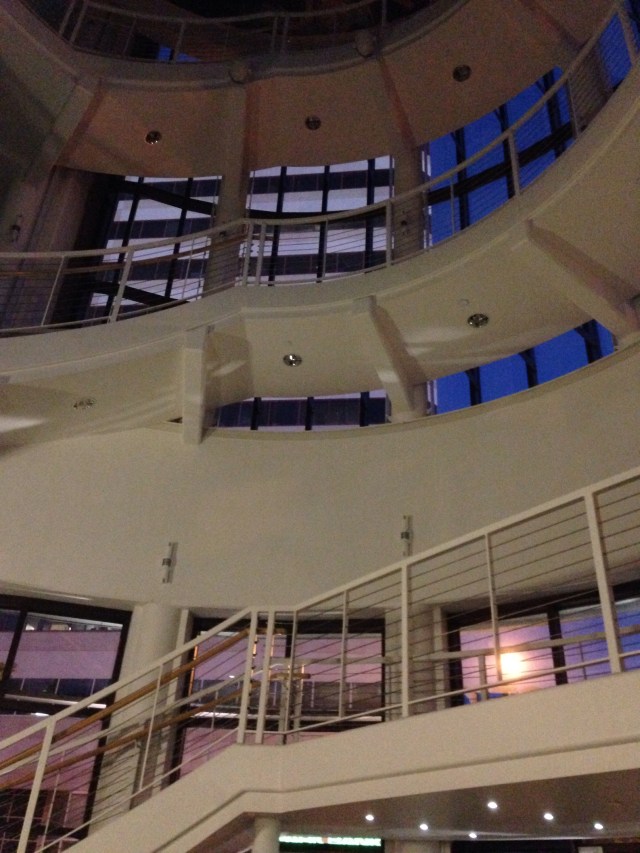
First of all, by the way (and just because . . .), here’s a photo I took of the Grohmann’s entrance atrium as I left the building around 9:00 Wednesday evening after dropping my laptop and other materials at my office when Great Books ended. The “gloaming” twilight made everything more striking somehow than it is during the day. The general public is never inside the museum at night except during Gallery Night, and then all the inside lights are on, meaning you’d never be able to see this exact view anyway, with the bluish-purple evening light illuminating the staircase through the arc of glass walls. So I thought I’d share 🙂
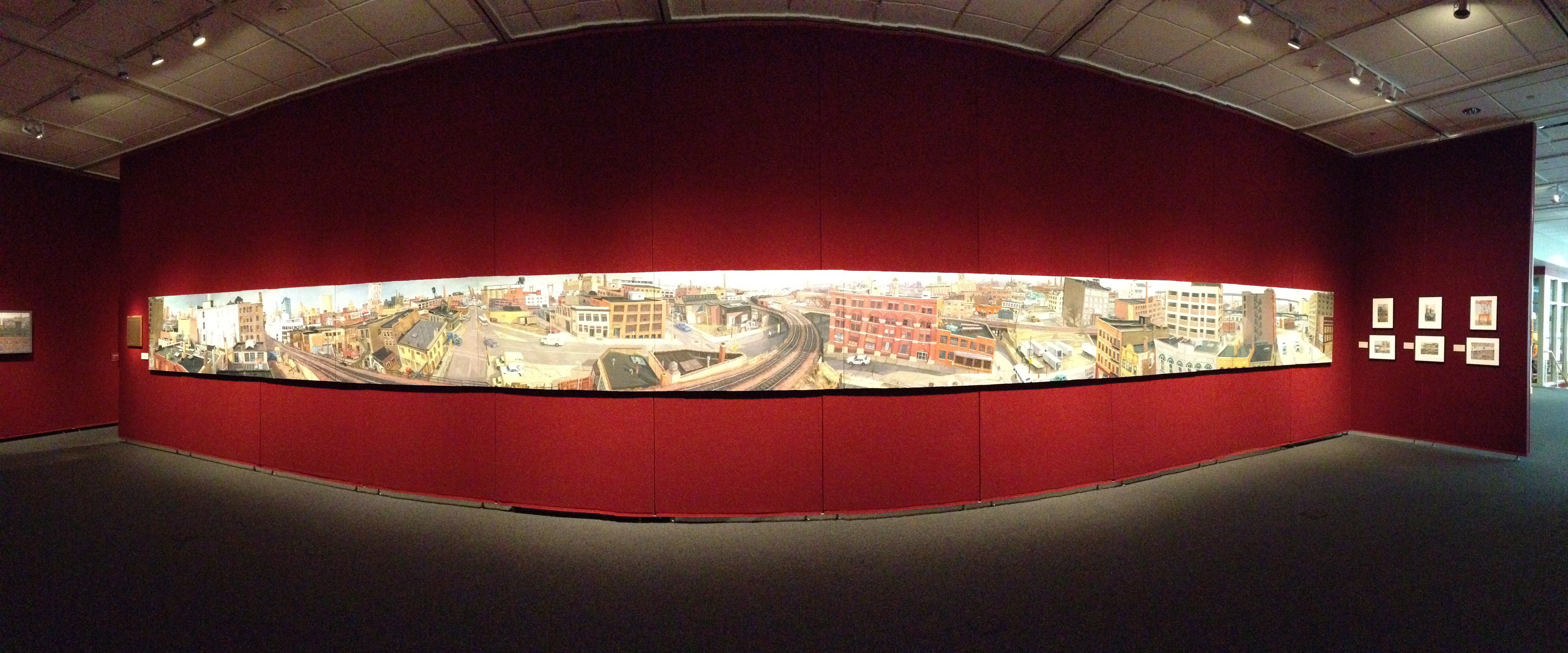
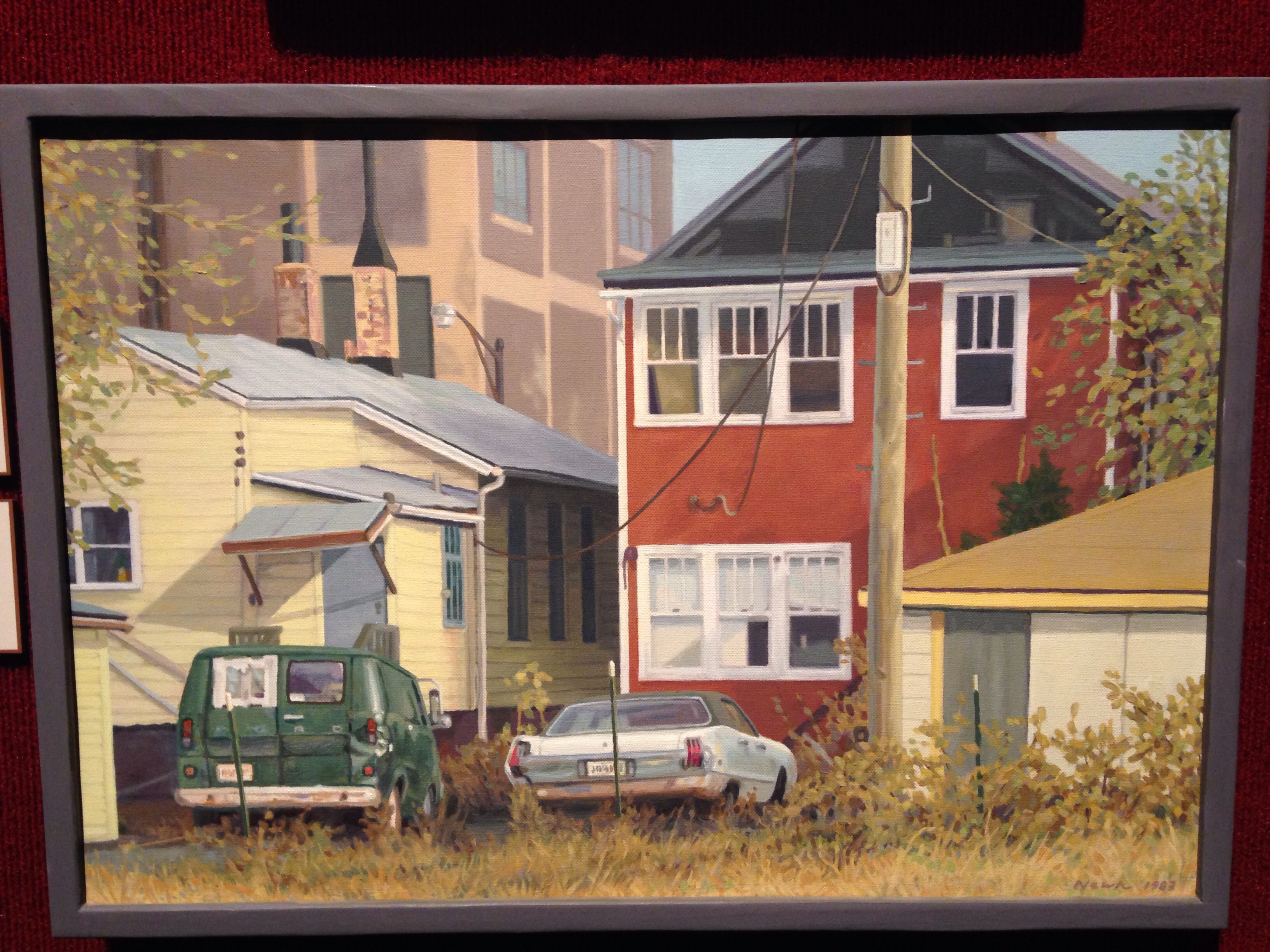
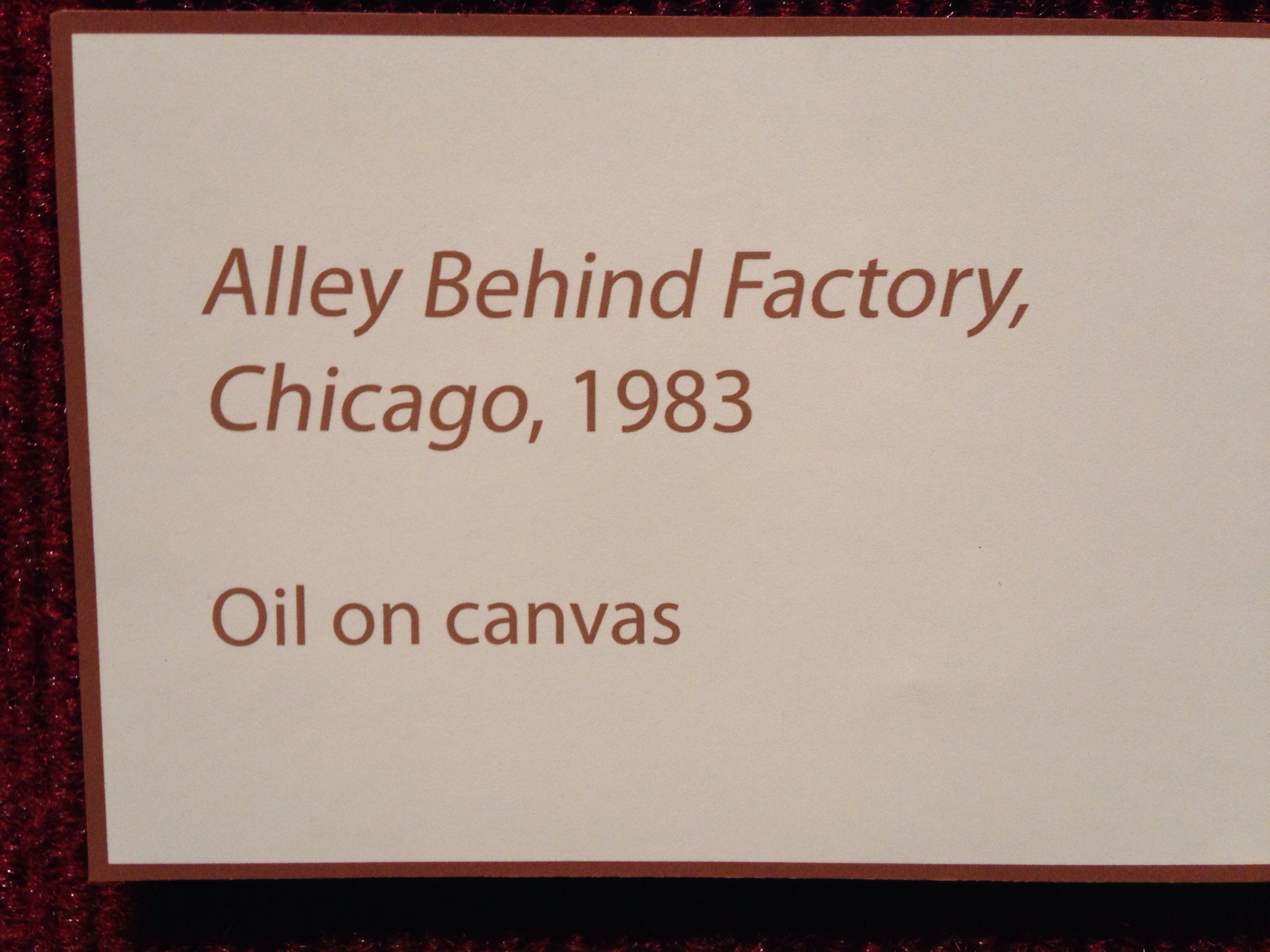
Okay, back to the new exhibit. It’s called “Milwaukee’s Industrial Landscapes: Paintings by Michael Newhall” and it runs May 27–August 21.
The showpiece of the exhibit is a massive 9-panel panorama of Milwaukee’s Walker’s Point neighborhood. It takes up a whole wall by itself! I couldn’t resist taking a “panorama of the panorama” just to see what it would look like. It’s pretty cool! (You can click on the photo to enlarge it to full screen.)
And then there’s also this other painting I liked that struck me as really different and intriguing.
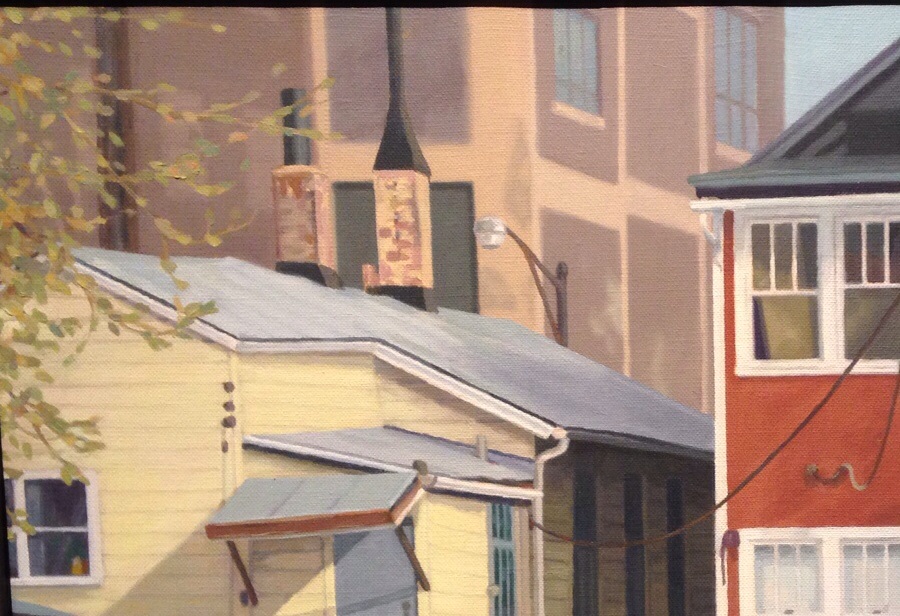
You may be able to experience what I’m getting at if you click on the photo of the painting above to enlarge it. (Don’t double click, for you’ll get an enlargement so huge you can see the canvas weave, which is sort of fun but also way too big for the point I’m making 🙂 ) Or you can just look at the smaller section enlarged below (or even click on it to get a larger version of just this portion of the painting, if you like.)
Look at how crisp the detail of the two houses is compared to the trailing tree branches in the foreground and the factory building in the background. It’s like this painting somehow approximates the shallow depth of field you might see in a photograph taken with a telephoto lens. I’ve never noticed a painting do this before (possibly because I just don’t visit enough galleries and museums), and I really like the effect this technique has on the painting.
Or maybe I should say on the viewer’s experience of this painting.
When I focus my gaze on the chimneys of the yellow house, suddenly the foreground and middle ground elements seem to come closer to me while the cocoa-colored factory in the background simultaneously recedes and rushes forward. Your mind’s eye recognizes the building’s distance while also perceiving its abnormally close presence and mass. It’s a very odd, disconcerting sensation of almost physical movement.
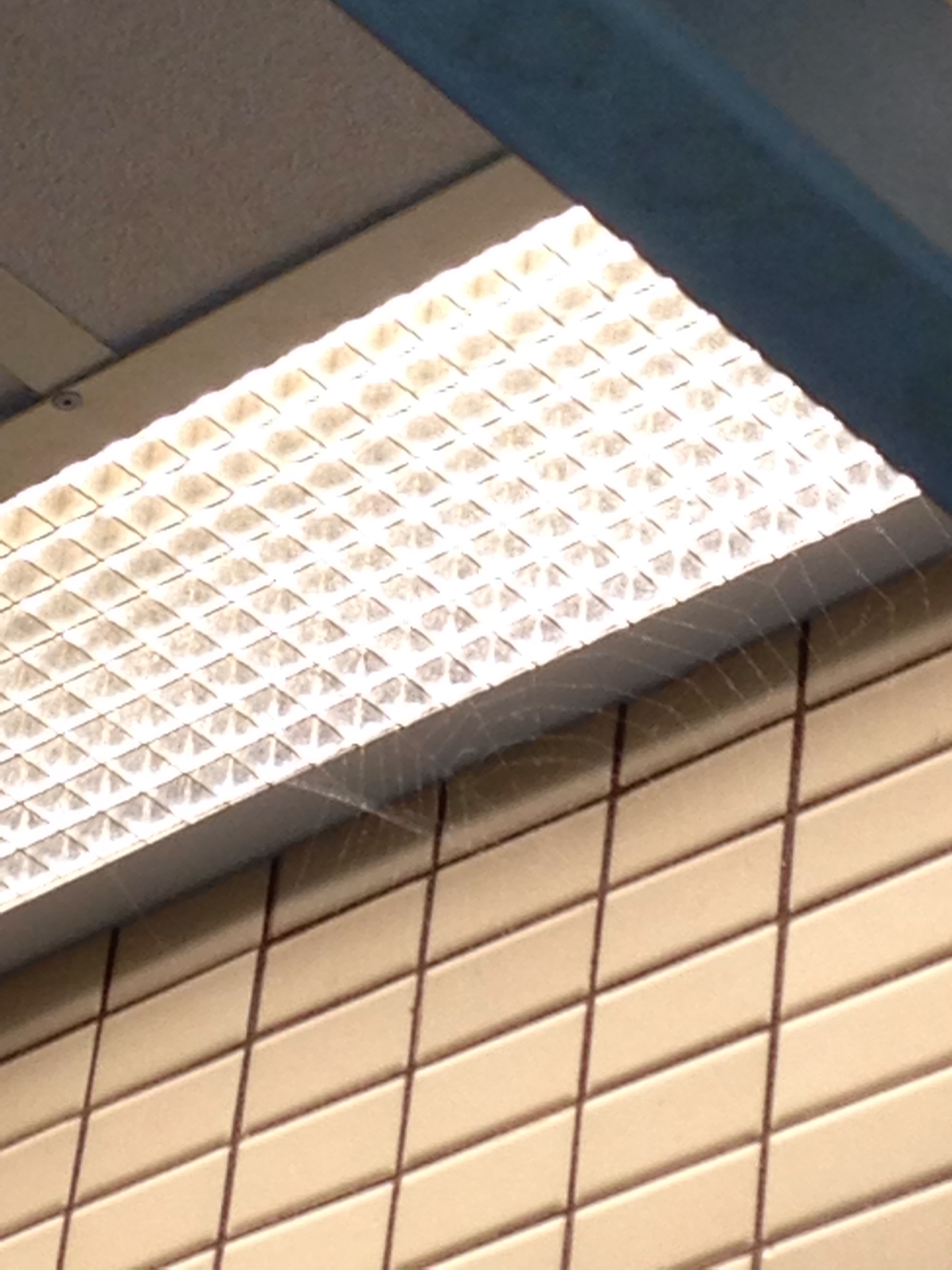
At first glance this probably looks like my usual abstract, geometrical whatever type of photo. (It surprises me to realize I even have a “usual” type of photo . . . )
But look again.
Can you see it? That delicate little spiral framework of a spider’s web?
No matter how impregnable or sterile our human “fortresses” may seem, life really does find a way to”break through” and continue functioning—thriving, even!—despite our best efforts at control.
(Below, from Jurassic Park, an exchange that ends with one of my favorite movie lines ever 🙂 )
It’s been a nose-to-the-grindstone kind of day. Reading lots of student drafts in my two sections of film studies and compiling/composing feedback for the debate teams in my freshman studies class. I got to work shortly after 8:00 this morning and will be reading and commenting on student work into the evening. Fellow teachers know what I’m talking about.
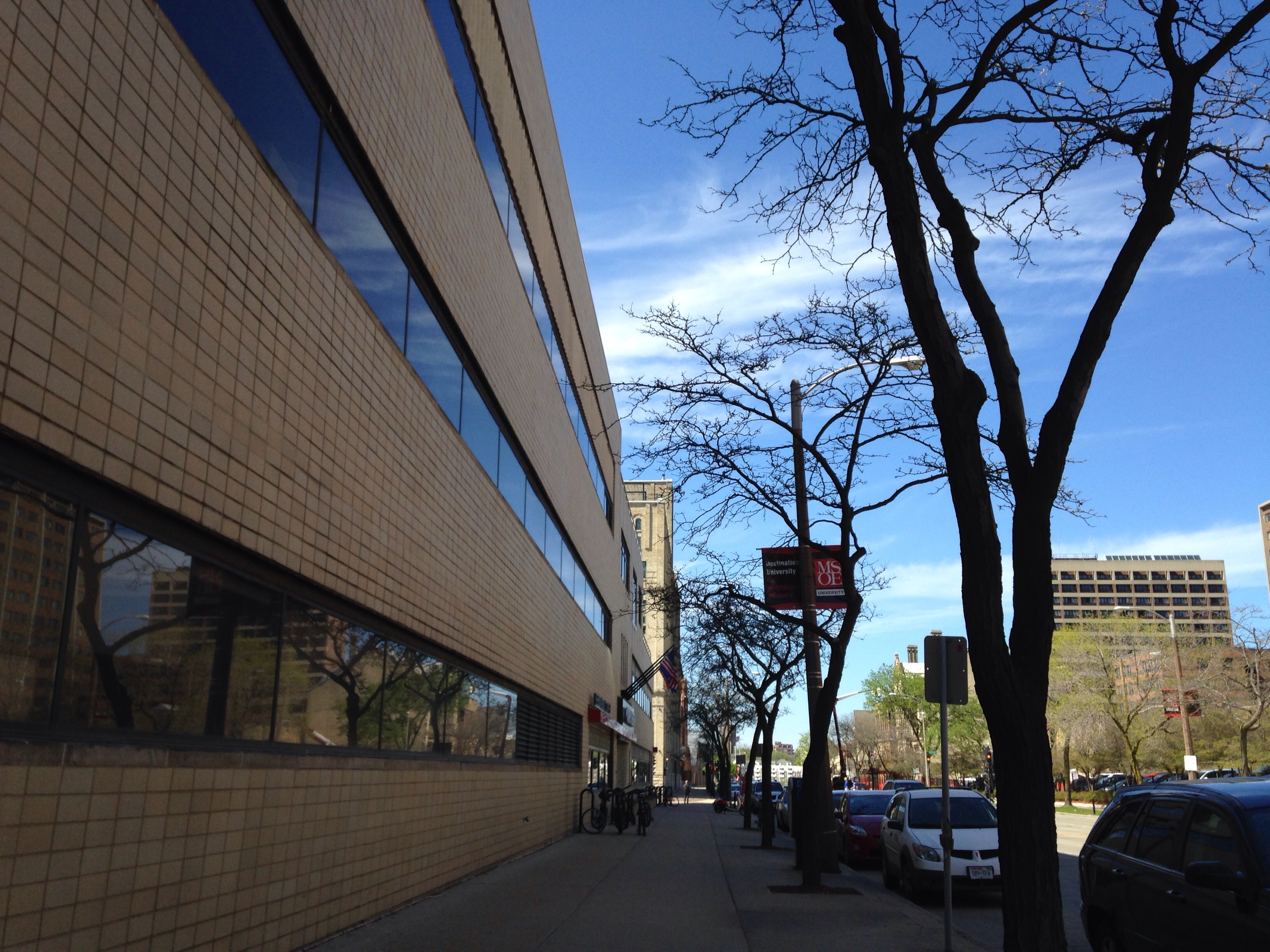
While walking from one building to another under a cheerful blue sky in the cool breeze coming off Lake Michigan this afternoon, though, I did take time out to snap some pics of MSOE’s Campus Center, the former Blatz Brewery Bottle House. This building (an example of Streamline Moderne architecture) is one of my favorites, as I’ve mentioned before, here and here, for example 🙂
So when I saw the sky reflected in the line of windows that sweep along the front of the structure, what else could I do?
That’s the German-English Academy Building most prominently reflected in that bottom row of windows, by the way. Wikipedia article (short one) here.
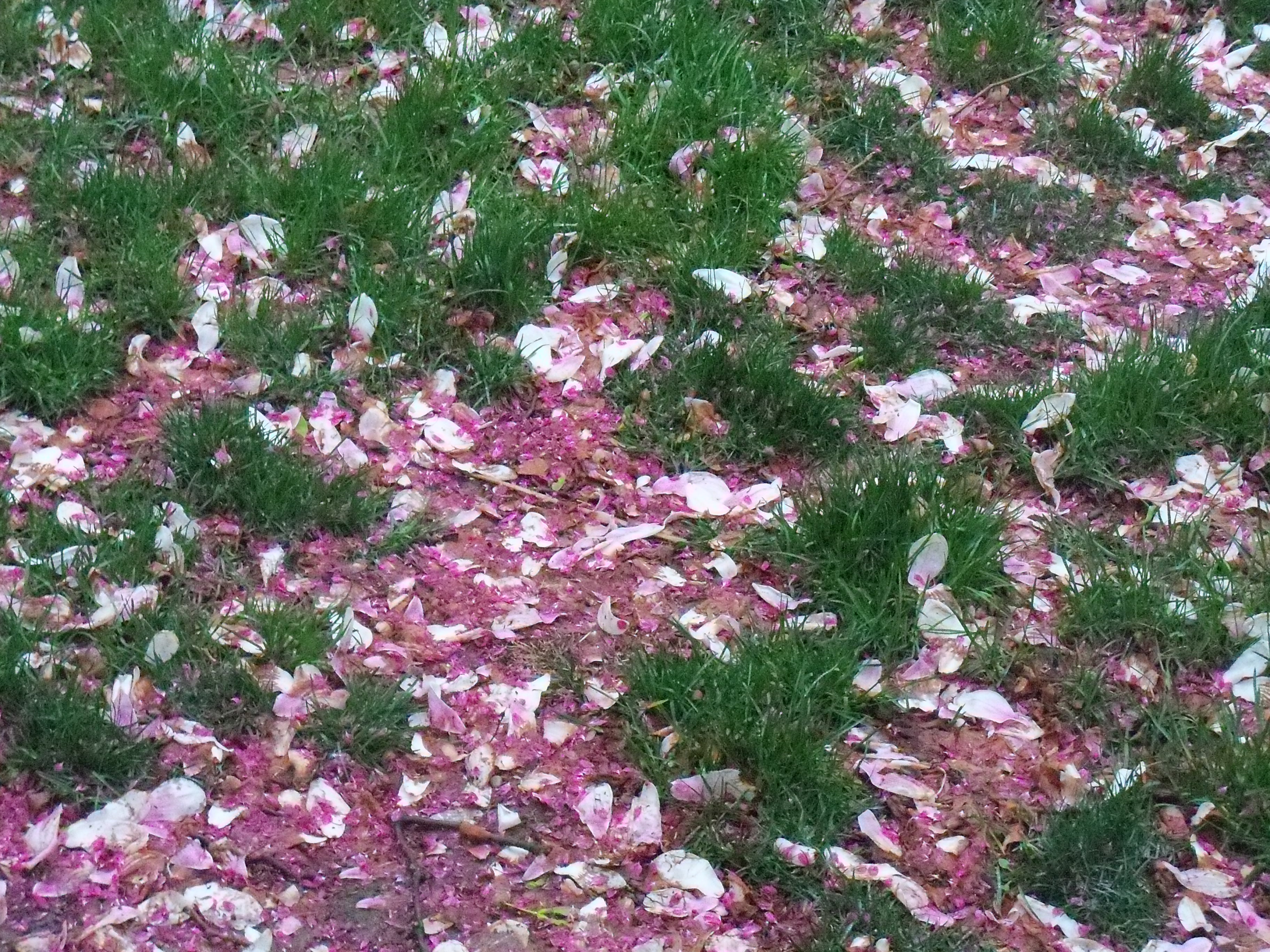
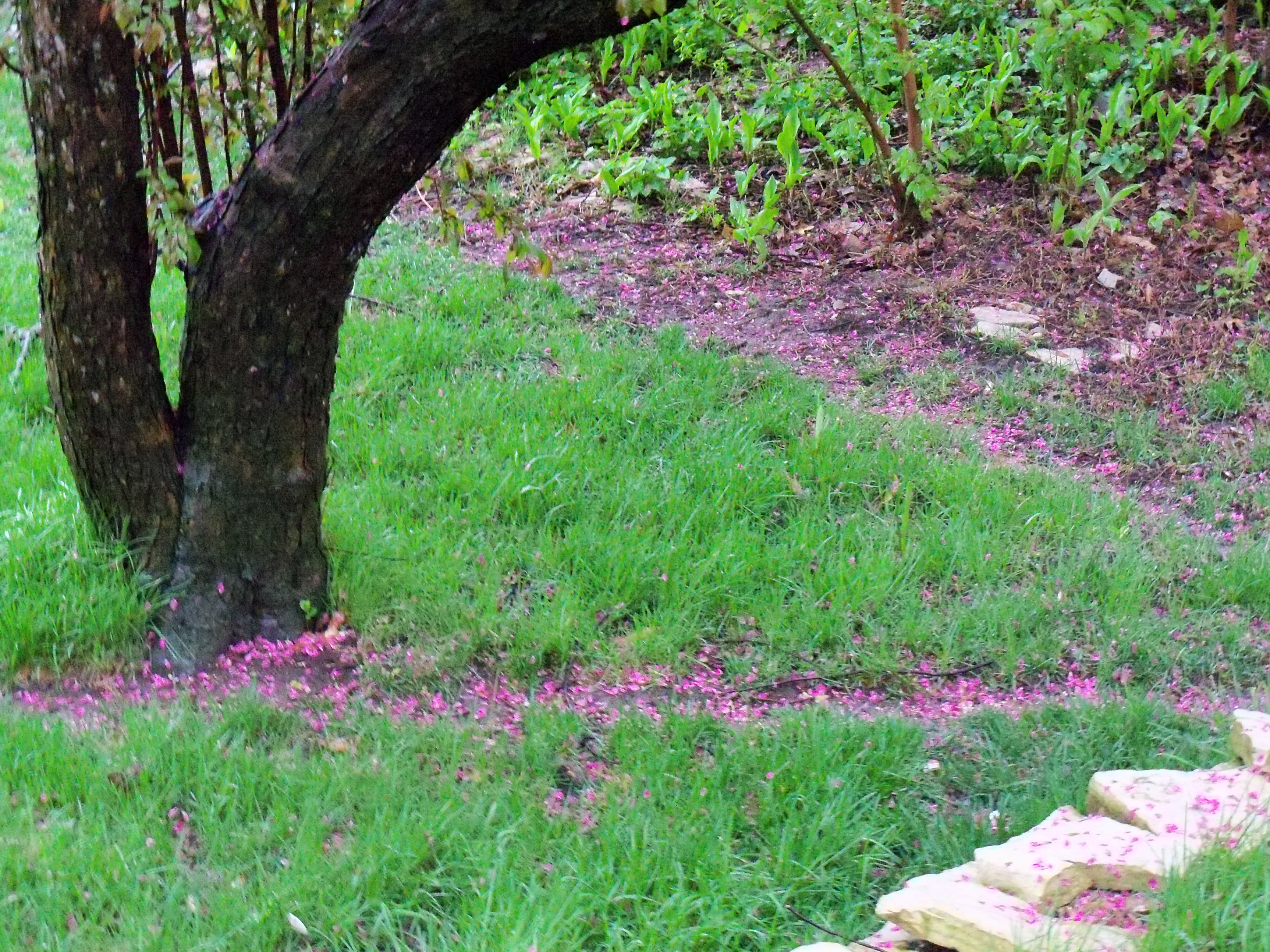
When the spring rains come, the litter of magnolia petals and crab apple blossoms somehow reminds me of the Ezra Pound poem, “In a Station of the Metro”:
The apparition of these faces in the crowd:
Petals on a wet, black bough.
That image! Like a painting, a flash of insight, a glimpse of the eternal.
Dog paths strewn with fallen pink crab apple blossoms (beneath wet, black boughs)
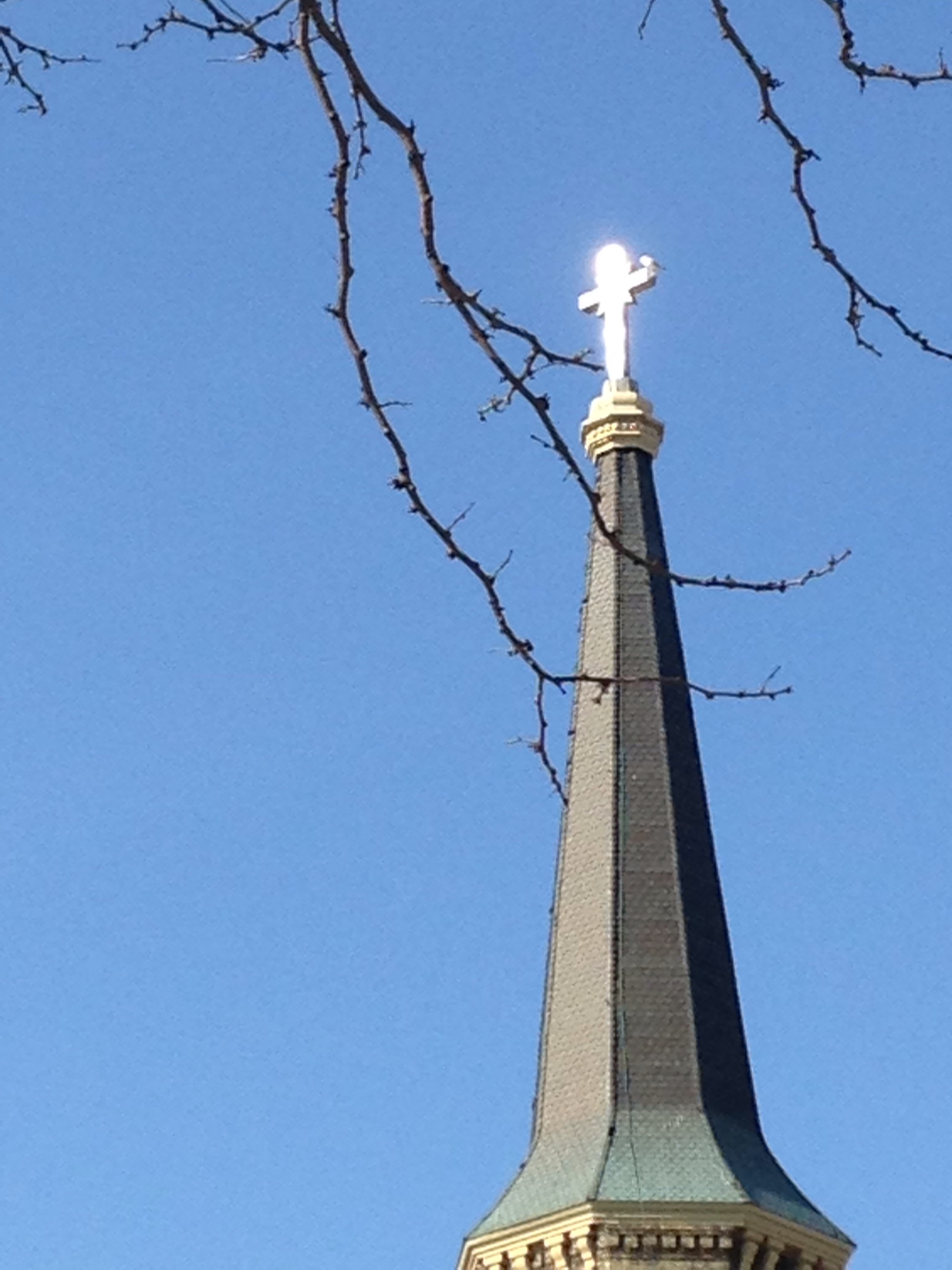
The glint of sunlight reflecting off this cross atop Old St. Mary’s Church caught my eye as I walked back to my office around 9:00 this morning after teaching my first class.
Here’s a reverse shot I took a bit farther down the hill, just to give you an idea of how bright the sun is today and how cloudless the sky after a few weeks of windy, wet, chilly weather.
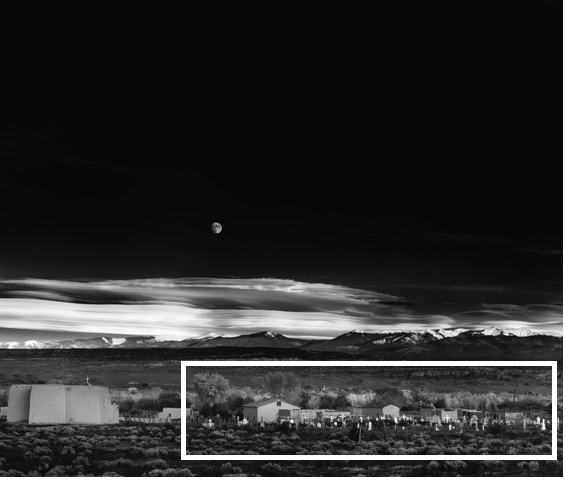
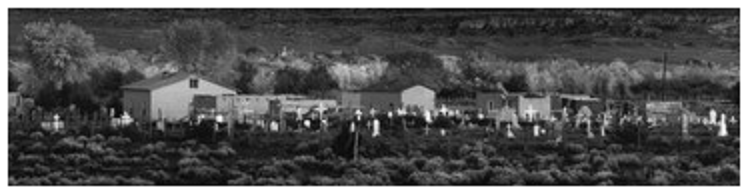
In a way this glowing cross reminds me of some other, far more famous glowing crosses: those of the cemetery in Ansel Adams’ Moonrise, Hernandez, New Mexico.
Moonrise, Hernandez, New Mexico, taken October 31, 1941 (via Ansel Adams Gallery)
Here’s a close-up area of detail, in case you aren’t seeing the almost supernaturally glowing crosses very well here, although some clarity is lost in my enlargement of this print.
Adams described getting this shot in his 1983 book, Examples: The Making of 40 Photographs (via The Ansel Adams Gallery, official source for Ansel Adams’ prints and run by the Adams family since 1902):
We were sailing southward along the highway not far from Espanola when I glanced to the left and saw an extraordinary situation – an inevitable photograph! I almost ditched the car and russed [sic] to set up my 8×10 camera. I was yelling to my companions to bring me things from the car as I struggled to change components on my Cooke Triple-Convertible lens. I had a clear visualization of the image I wanted, but when the Wratten No. 15 (G) filter and the film holder were in place, I could not find my Weston exposure meter! The situation was desperate: the low sun was trailing the edge of the clouds in the west, and shadow would soon dim the white crosses.
I was at a loss with the subject luminance values, and I confess I was thinking about bracketing several exposures, when I suddenly realized that I knew the luminance of the moon – 250 c/ft2. Using the Exposure Formula, I placed this luminance on Zone VII; 60 c/ft2 therefore fell on Zone V, and the exposure with the filter factor o 3x was about 1 second at f/32 with ASA 64 film. I had no idea what the value of the foreground was, but I hoped it barely fell within the exposure scale. Not wanting to take chances, I indicated a water-bath development for the negative.
Realizing as I released the shutter that I had an unusual photograph which deserved a duplicate negative, I swiftly reversed the film holder, but as I pulled the darkslide the sunlight passed from the white crosses; I was a few seconds too late!
I think I may love that story even more than I love the photograph itself. So dramatic!
No such excitement with my own photo, sadly. I just took note of the shining silver cross, stopped walking, pulled out my phone. Yeah, I took several shots from slightly different positions so as to get the most incandescent reflection possible. But no car to ditch, no companions to yell instructions at, no equipment to fumble with, no ticking clock, no setting sun.
Sigh. 🙂
(Update, November 12, 2021: Someone visited this post today, and it’s been a while since I’ve seen this title in my stats, so I revisited it and took a look for the first time in years. And I just noticed for the first time ever that there’s a BIRD!!! sitting atop the cross. I always wondered why the cross looked so distorted and figured it must be a trick of the bright light reflecting off the metal. Nope. It’s a white bird, probably a gull, Lake Michigan being a mere few blocks away. So, FYI 😄)
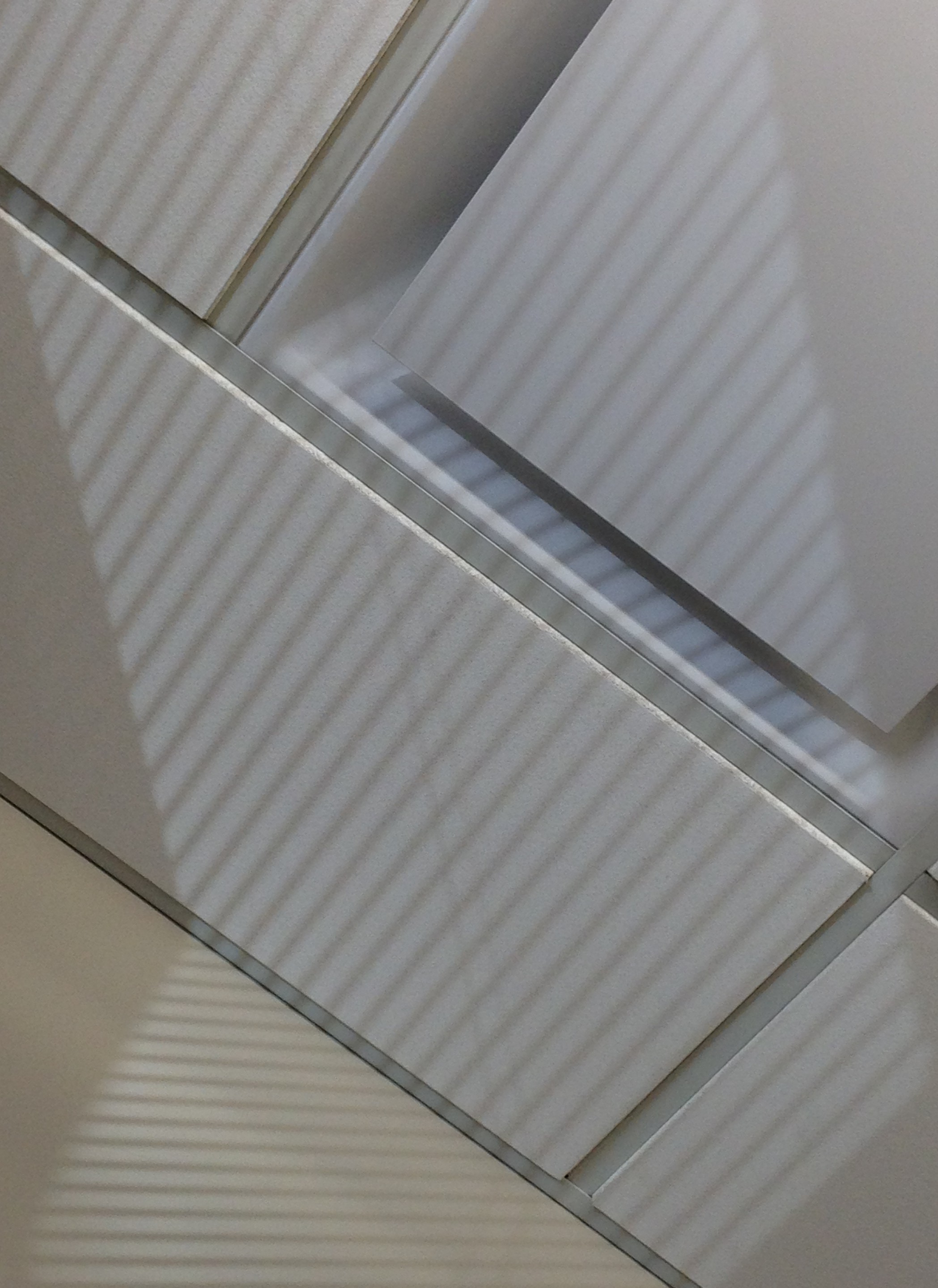
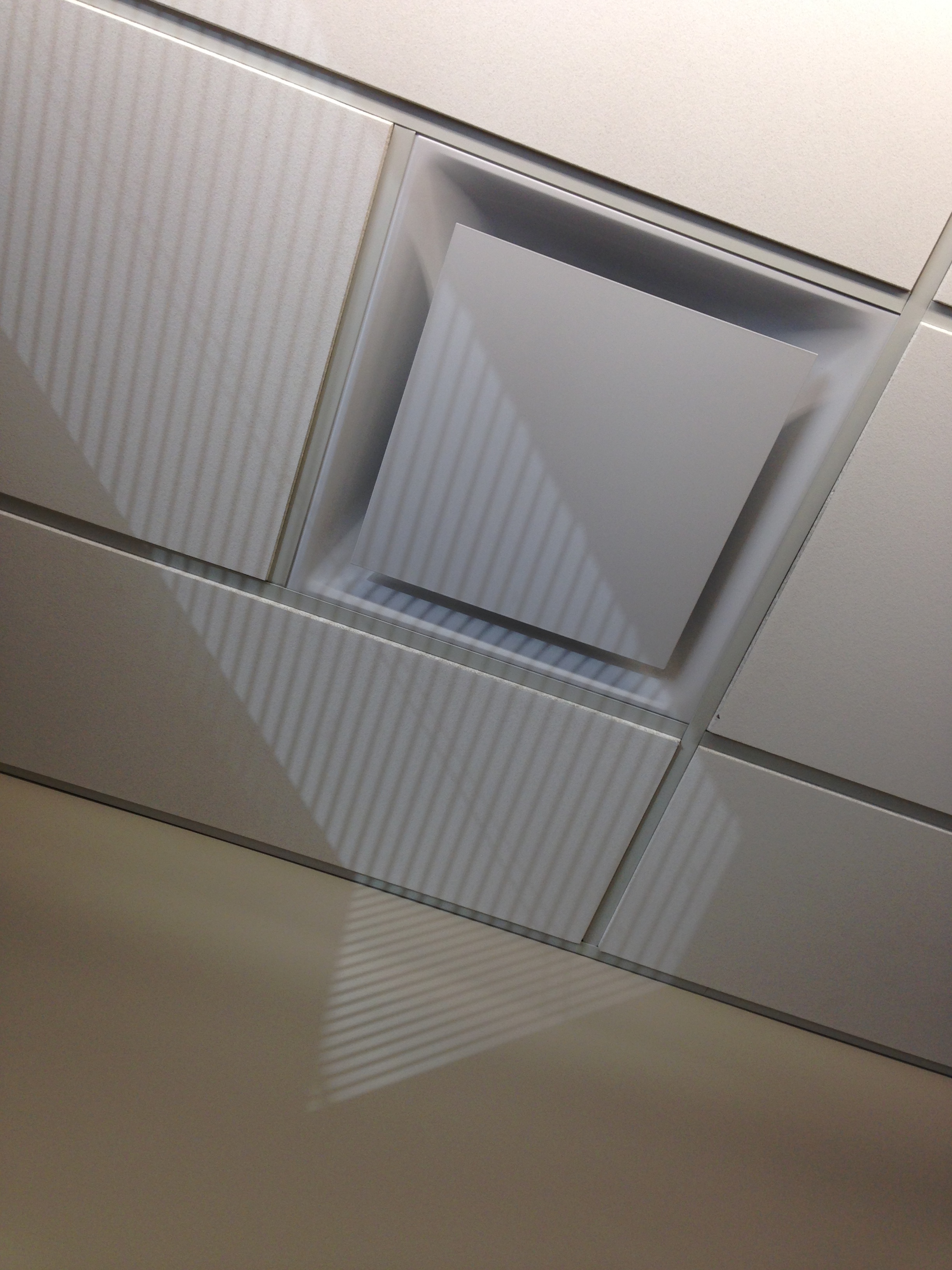
The other day when I posted the “rainbow” light slanting through my office’s Venetian blinds, I mentioned that usually the light coming through is white and casts interesting shadows. Here’s an example of what I mean.
I take a lot of pictures, probably way more than I should mention. Most of them get trashed. I like the photo above. It took a while to get there, though. So I thought I’d share all the “fails” with you, in case you’d find it interesting to walk through my picture-making process.
First, I walked into my office either before or after my 1:00 class and noticed that the sunlight had cast its current pattern of blind stripes on my ceiling. The stripes show up in different locations all over my office walls and ceiling depending on the time of day or year.
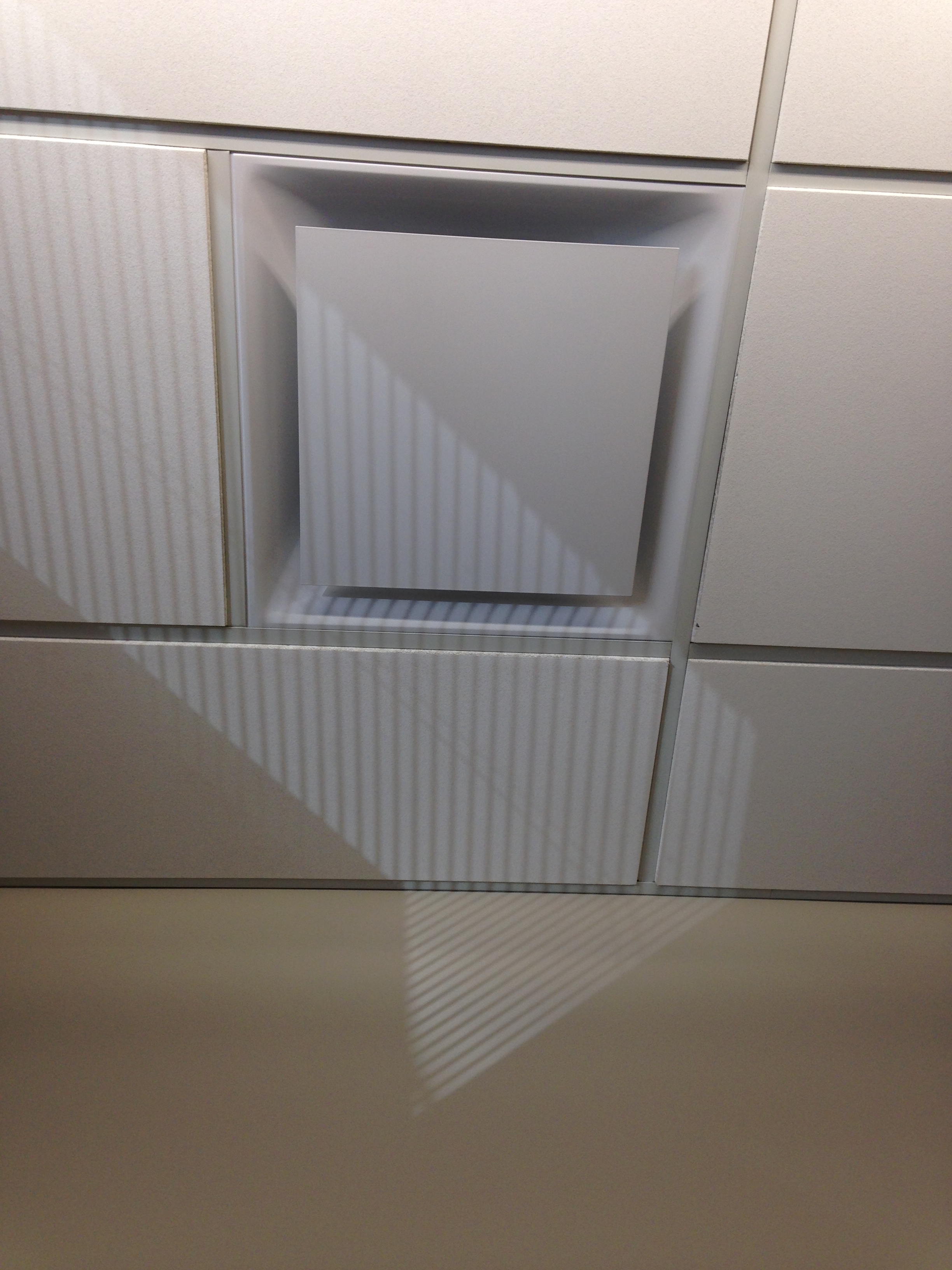
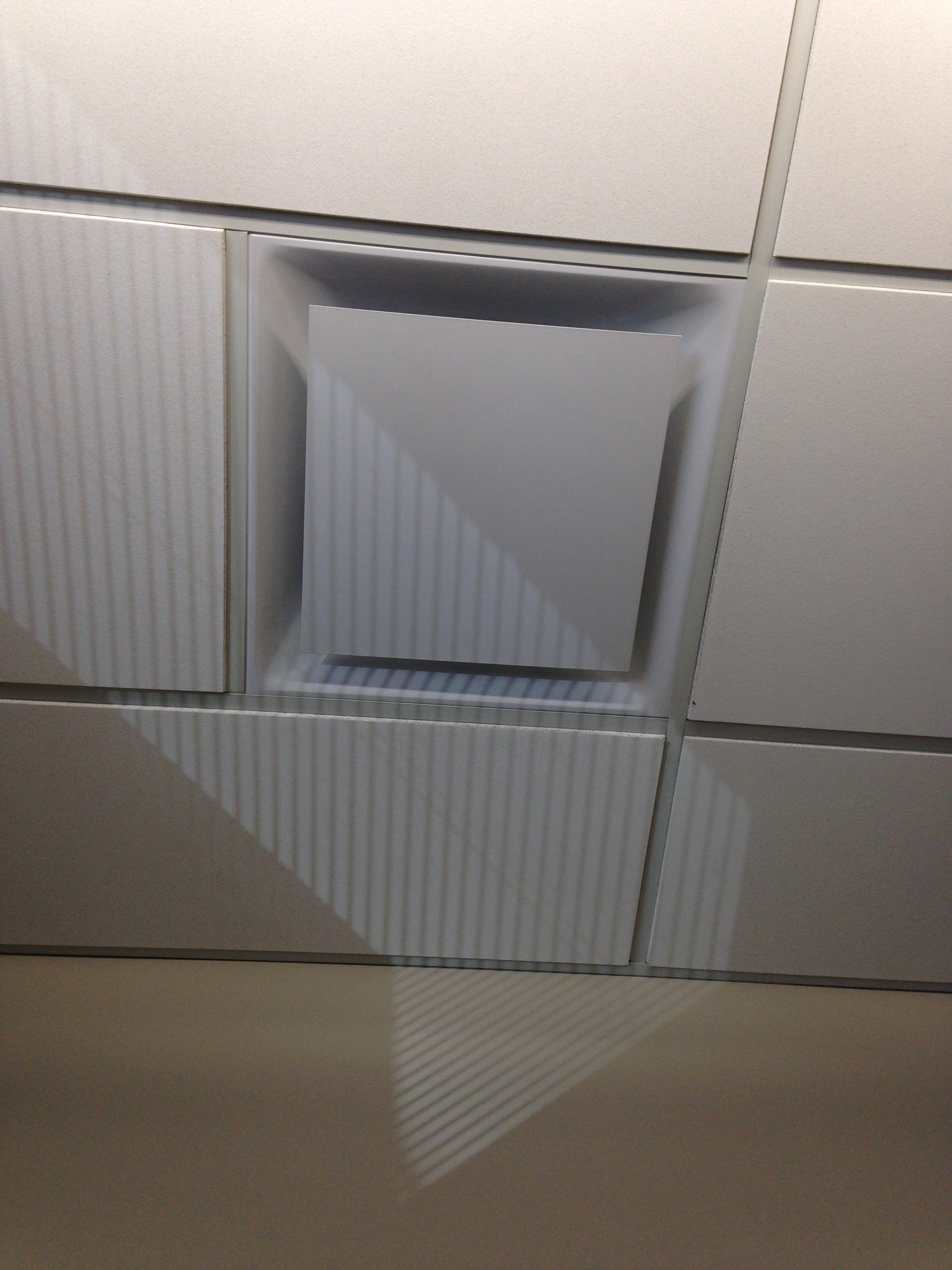
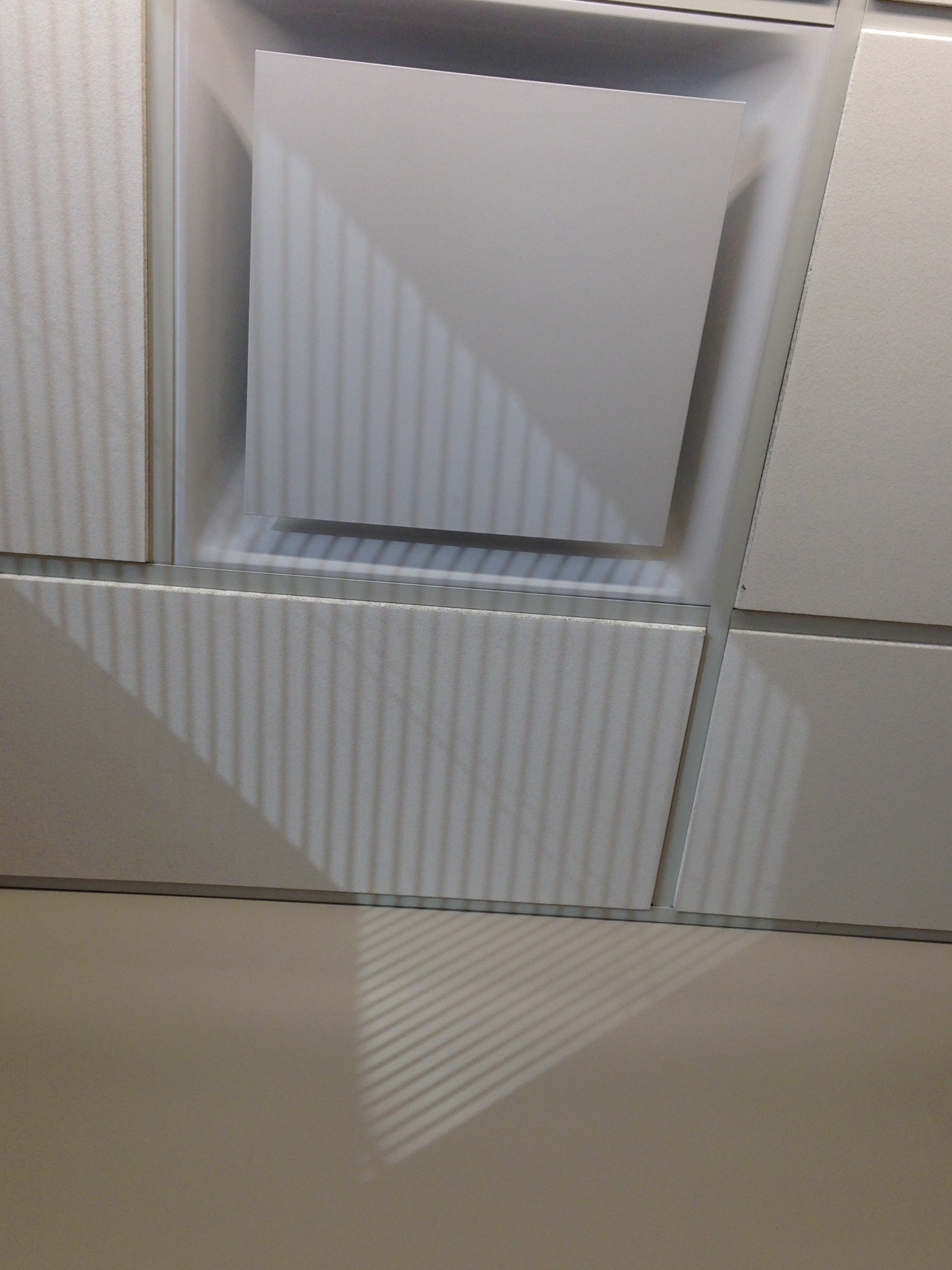
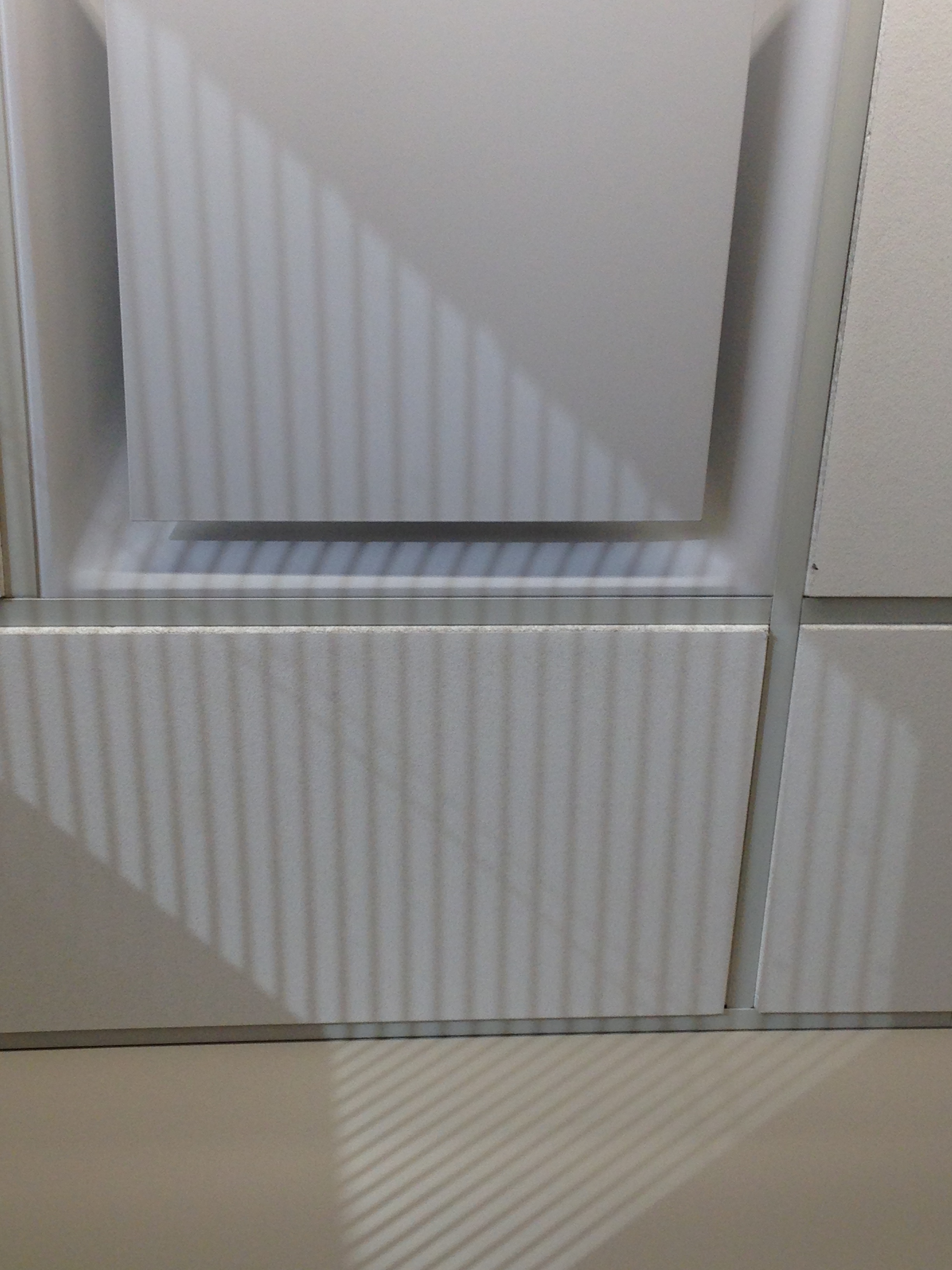
Something about this pattern caught my eye. So, second, I snapped several photos with my phone.
Of all these, I decided I liked the last one best because of the diagonals.
Then, having chosen it as my favorite, I started thinking about the composition of all the various lines and how they might best fit inside a “frame.” In other words, should I crop the photo? And if so, how?
I wanted to merge the patterns of lines into a coherent “whole” as much as possible, so that the ceiling tiles and Venetian blind stripes could be viewed as one single unit instead of two separate overlapping patterns. So yes, cropping would be necessary to create that illusion.
In the end I decided to shave a little bit off the top of the photo and then crop the sides and bottom enough to create a “frame” that would put the edges right at the outermost points of the pattern created by the Venetian blind stripes.
Below are the “before” (left) and “after” (right) versions.
So, that’s today’s blog post. Not especially “deep” but sort of different and hopefully interesting, too 🙂






![IMG_1626[1]](https://katherinewikoff.com/wp-content/uploads/2016/04/img_162611.jpg)


 Katherine Wikoff