Russia, Syria, Ukraine, and Turkey: And so it begins

I hardly know where to start with this post; so many bits of knowledge are swimming around in my head.

First, I think something really significant is happening in the Middle East right now. Lots of pieces that have been in motion and slowly gathering separate momentums (momenta?) for a few years seem to be coalescing into one giant paroxysm of violence in Syria and Iraq.

At best, a major power shift is occuring. Worst case: this is the start of World War III. No kidding.

I hope I’m wrong about that second one. I hope we’ve learned enough as a people (that is, as members of the one human race) to avoid making the same horrific mistakes of our past.

So here’s a basic summary of my vague fears.

1)  Russia needs a stable Syria and a stable Turkey and a friendly, Russia-oriented (not Europe-oriented) Crimea in order to maintain the stability of its Black Sea Fleet—which is its only warm water naval base. Russia needs Crimea because that’s where the Black Sea Fleet is based, in the city of Sevastopol. They need Turkey because the only way to get from the Black Sea out to the rest of the world is via the Turkish Straits. And they need Syria because of the naval refueling station in the Mediterranean coastal city of Tartus. About a year and a half ago I wrote a blog post analyzing this situation, complete with maps. You can link to it here for additional background.

2) Just as happened in World War I, two distinctive “sides” seem to be forming, based on previous alliances and old ethnic sympathies/hatreds.

Russia is allied with Syrian president Bashar al-Assad. One little twist on this story is that Assad ascended to his position as Syria’s president through ascription—i.e., hereditary inheritance of political office and power, similar to the family dynasty in North Korea. Assad’s father was Syria’s previous president-for-life (1971–2000). So part of what started the internal strife in Syria in the first place was the question of Assad’s legitimacy and authority to govern.

Anyway, Russia and Iran both have troops on the ground in Syria now, ostensibly fighting ISIS/ISIL (Islamic State of Iraq and Syria / Islamic State of Iraq and the Levant). Iran’s involvement fighting ISIS on Iraqi soil is also welcomed by the Shiite-led Iraqi government.

Remember the Iran–Iraq war? That was another time, another political reality. The Iraqi government was then run by Sunnis, adherents of a denomination of Islam that was (and remains) in the minority of Iraq’s overall population, far outnumbered by Shia Muslims. Sunnis and Shiites despise each other, despite the fact that they are both branches of Islam. Most Muslims in the world are actually Sunni, but guess where most of the Shia live? Iraq and Iran (and Pakistan and India).

ISIS/ISIL is Sunni. Actually they are Salafi jihadists, which is like saying they are über-Sunni fundamentalist followers of the one true Sunni way—and not just fundamentalists but radical fundamentalists to boot, who believe in an interpretation of “jihad” that requires not just living according to Islam or building a society based on Islam but actually fighting a holy war against all perceived enemies of Islam. Actually not even enemies of Islam but enemies of the one true Islam which would be Sunni. Actually not even Sunni but the one true Sunni, which would be Salafi.  Does that make sense?

Iran (Shia) doesn’t like ISIS/ISIL (über-Sunni).

Iraq (now Shia, and actually always Shia in population but long suppressed by the Sunnis, who dominated Iraq’s government, except now the shoe is on the other foot, with a democratically elected Shia government representing a Shia-majority population), yes, Iraq is now friends with Iran. At least “friendly,” anyway.

Sunni Iraqis have been somewhat sympathetic toward and supporting of ISIS. Shia Iraqis don’t like that. Enter Iran, but quietly, so as not to stir up tensions between Iraq’s Sunnis and Shiites. For over a year Iran has been providing technical assistance and training to Iraqi troops, plus it has reportedly been secretly funding Shia militia groups who are fighting ISIS.

Saudi Arabia is Sunni, with a tiny Shia population and a very sizable segment of über-Sunni adherents of Salafism, also known as Wahhabism. (Don’t forget that ISIS is Salafi.)

So, the Islamic world is basically divided up into these two groups, Sunni and Shia, who despise each other.

Here’s a really nice video explaining the Sunni–Shia divide, produced by the Council on Foreign Relations.

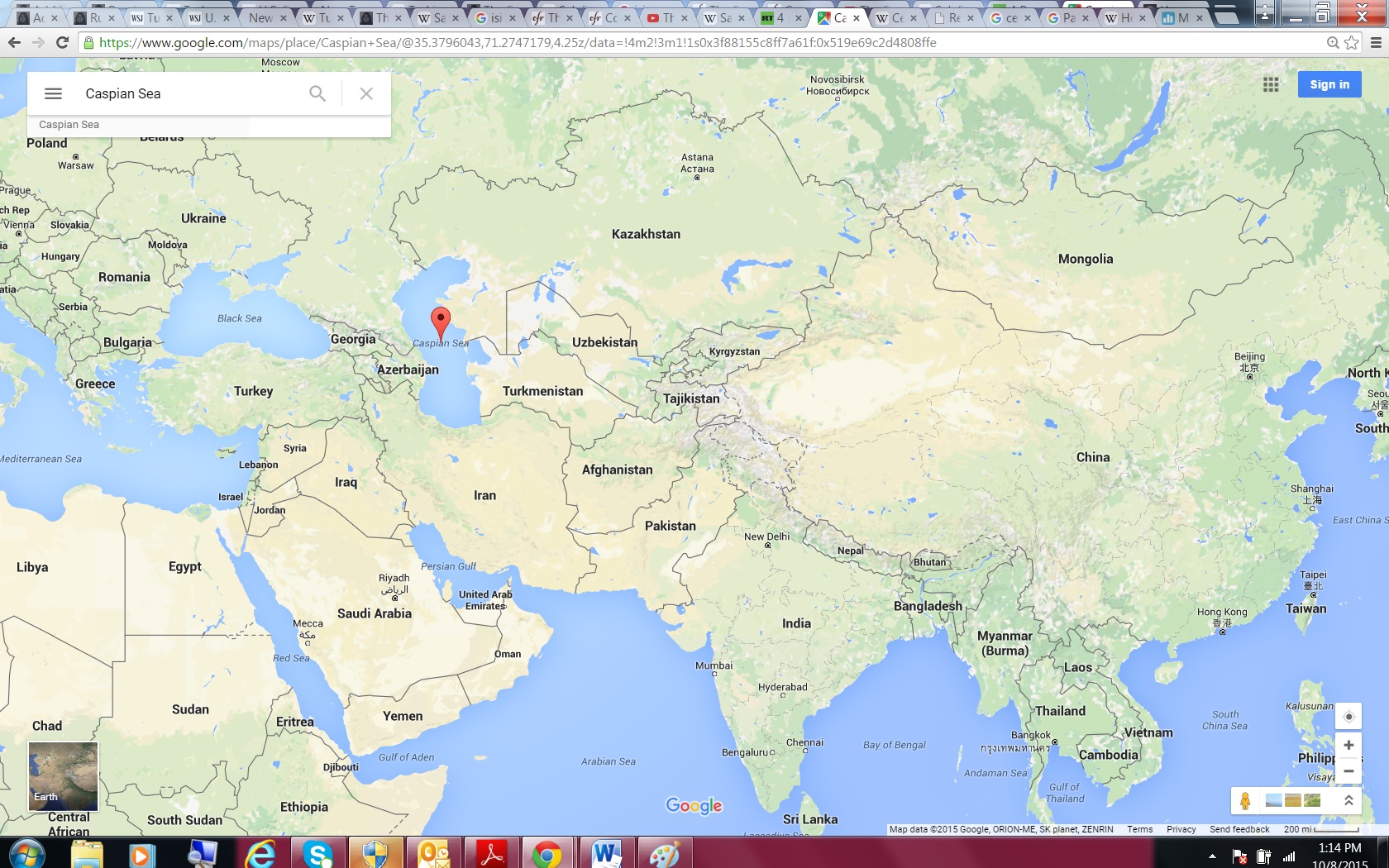
3)  (Remember #s 1 and 2? They were so long ago in this post 🙂 ) Russia has just begun launching missiles at ISIS targets from warships in the Caspian Sea. Here’s a screen shot I took of the Caspian Sea on Google Maps. (Look for the red “pin” marking it in the middle of the map.)
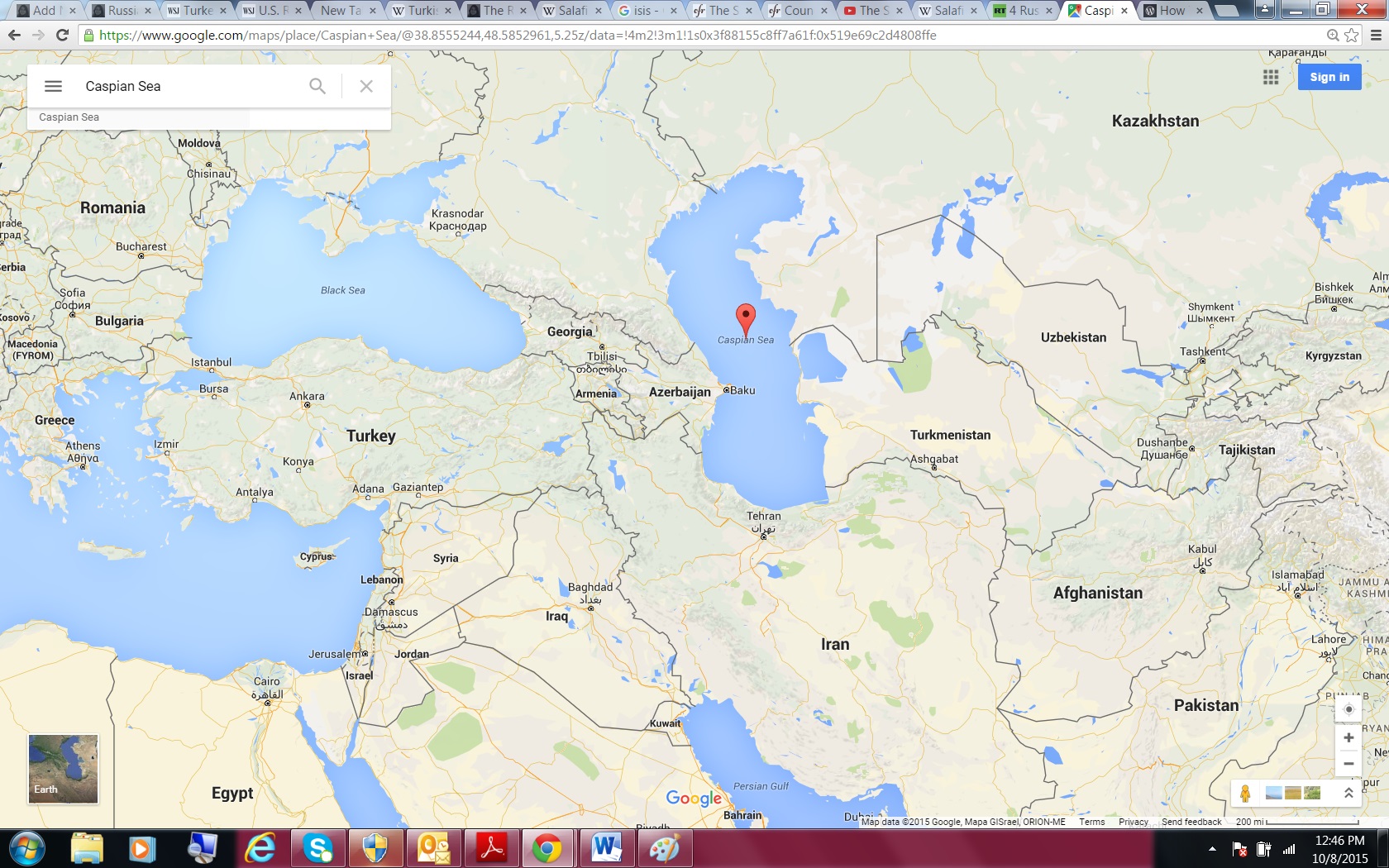
Caspian Sea 2

This is an interesting place for Russia to be firing missiles from—mostly because I’ve been watching Central Asia for a while now, ever since reading S. Frederick Starr’s brilliant 2009 Wilson Quarterly essay, “Rediscovering Central Asia.” (Link to the essay here.)

Once home to the Silk Road (the original, that is), not only is Central Asia blessed with tremendous reserves of oil and natural gas of its own, but it is also by virtue of its location a place across which many other nations would like to transport oil and gas via pipelines. Central Asia is huge and is bordered by Russia, China, Southeast Asia, and the Middle East.

So does Russia’s using the Caspian Sea to fire missiles have any greater significance? Is it merely because firing from the Black Sea would be too blatantly a violation of Turkey’s airspace? Or does originating missile fire from the Caspian Sea also serve to remind those nations surrounding it that Russia does indeed have powerful military strength? Don’t forget that Russia has experienced several Islamic terrorist attacks committed by Central Asians.

Yes, Central Asia is largely Muslim, and mostly Sunni at that.  Only Afghanistan and Tajikistan have sizable Shia populations, although even then Shias are a minority.

Most of the world’s Muslim population, in fact, is Sunni. The Sunni Muslims are spread throughout Africa, Central Asia, and the South Pacific (Indonesia, etc.). The Shia population is concentrated mainly in four countries: Iraq, Iran, Pakistan, India.

Here’s another screen shot of Central Asia (thanks Google Maps 🙂 ). The shortest, most direct way for Central Asian oil and gas to get to the ocean for transport is to run pipelines directly south—through Iraq, Iran, Pakistan, India. Sort of a Shia rampart standing guard and blocking Central Asia’s way to the Indian Ocean. Okay, that’s an overstatement. But looking at the map, you can see that countries bordering Central Asia and blocking its pipeline/pathway to Europe and to the sea suddenly become both powerful and vulnerable.
Central Asia with southern Shia border

Does this post make sense to you? It’s all still a jumble to me, and there are more details than these that feed into my worries.

For example, when the current civil war began in Yemen (Wikipedia article here), my Saudi students told me about the “Shiite crescent,” which is a theory subscribed to by many Sunnis in the Arab world that basically holds that Iran is trying to establish a “crescent” of influence from Lebanon to the Persian Gulf.

Depending on your perspective you may view this “Shiite crescent” idea as a mere conspiracy theory, with all the accompanying paranoia that such theories tend to engender. But it’s a a subject that has gotten scholarly attention, and here is a good article from the Brown Journal of World Affairs (Fall/Winter 2008) that provides some background information: “Iran and the Shiite Crescent: Myths and Realities.”

So to wrap up this post and recap my main concern:  Are we on the verge of a new worldwide conflict in which “entangling alliances” based on the internal combustion engine and plastic packaging will drag reluctant (hapless?) nations into a long-simmering cauldron of Sunni–Shia hatred—and spread over an even broader geography than ever before thanks to hubris and 21st-century technology?

I certainly hope not.

Posted in News, WPLongform (posts of 1000 words or longer) | Tagged , , , , , , , , , , | 9 Comments

Little Free Library (#5) – Stained Glass

Milwaukee’s older homes are characterized by beautiful woodwork and built-in cabinetry, often accented with leaded stained-glass windows. This mini-library box mimics what is probably a standard feature in the neighborhood it occupies.

Little Free Library with stained glass IMG_1107[1]


Posted in Books and reading, Little Free Library, Milwaukee, Photography | Tagged , , , | 3 Comments

Thoughts on Patti Smith

Patti Smith was a little before my time. Definitely WAY outside the bounds of my Midwestern sensibilities by the time I became aware of her during my high school years.

Smith was that punk performer, the one in New York who urinated onstage and yelled her lyrics in a hoarse voice and didn’t shave under her arms. She was the real-life inspiration for Gilda Radner’s drugged-out, angry robotic-deranged “Candy Slice.” Not at all my kind of person.

(Update: The YouTube clip originally embedded in this post is no longer available, but you can watch the entire SNL sketch on NBC’s website. Link is HERE; Candy makes her entrance around the 3:44 mark.)

I did really like Smith’s one big radio hit, though, “Because the Night.” And I was always kind of intrigued (and puzzled!) by the bits and pieces about her life that sifted randomly into my consciousness. She was good friends with Robert Mapplethorpe. She was in a relationship with actor/playwright Sam Shepard. She got married, retired from her music career, and moved to Michigan to raise her kids. What an odd mix!

In his own memoir, The Soundtrack of My Life, Clive Davis (Chief Creative Officer of Sony Music Entertainment and former president of both Columbia Records and Arista Records) recounts his discovery of Smith and the ups and downs of her unusual career. I read his book a couple years ago, and two things he said about Smith have stuck with me.

First was Smith’s style, as projected on the cover of her first album, Horses.

The cover photo was a black-and-white portrait of Smith shot by Mapplethorpe. It was “direct and daring, with a hint of androgyny and an air of insolence.”

It really captured Patti. It exuded a rumpled confidence, the horse-pinned blazer flung over her shoulder Sinatra-style, the pale gray background, the look straight into the camera, daring you to open the album jacket and discover what’s inside. I admit, at first I was conflicted about the image; I was aware of its power, but with my label-president concern, I thought it might confuse the uninitiated . . . . Who was she, and what was she projecting? Whatever reservations I had, I dismissed them quickly: If I was going to have faith in Patti and her music, I was going to trust her artistic instincts thoroughly. And obviously those instincts were, in this case, genius. That photograph is a work of art that absolutely conveys her point of view, and like the album itself, the cover of Horses is now regarded as an undisputed classic. There’s a reason for that. Patti is obsessed with imagery, drawing on poetry, film art, and fashion to enhance her music. She saw herself as a convergence of all these influences, the poets she devoured, filmmakers like Jean-Luc Godard, and all her rock heroes. She also demolished every cliché about what a woman playing rock music should sound, act, and look like. She’s been a groundbreaking artist in every regard.

That picture of Smith immersing herself in other art and synthesizing all those influences into something new—I really liked it and found myself wanting to know more about her.

Here was the other thing Davis said in his book that stuck with me. Smith fell off a stage during a Tampa, Florida, performance in 1977, breaking her neck and forcing her to take time off for a long period of recuperation. When she was ready to resume her career, she decided to call her “artistic resurrection” Easter, giving that title to her 1978 album. Davis says:

Something one should know about Patti: She always wanted a hit. She came off as the ultimate rebel, a creature of the demimonde, without a commercial thought in her head, but she grew up in an era when all her heroes, from Dylan to the Stones, were on the radio, and she wanted to be on WABC-AM also. She wanted to sit on the sofa on The Tonight Show and trade quips with Johnny Carson. Those were goals she shared with me, and while I never would have taken the route of trying to find that hit song by an outside writer for her, or pushing her toward a more pop-friendly producer, I was ecstatic when I heard that one of the key songs on the new album would be a collaboration with Bruce Springsteen.

Bruce was working on the album that became Darkness on the Edge of Town, and as was his process, he demoed many, many songs before paring them down to the ten that would make the cut. One that he’d begun but hadn’t finished was a dramatic, erotic rock ballad called “Because the Night.” When Bruce found out from Patti’s producer, Jimmy Iovine, that the album they were recording didn’t have an obvious single, Bruce gave Jimmy a cassette of the unfinished track. Building on Springsteen’s demo, with Patti adding personal lyrics of her own (she’s said that the line ” Love is a ring, the telephone” came from waiting at home for her new boyfriend, Fred Smith, formerly of the MC5, to call), the Springsteen-Smith composition became a track that instantly stood out. At one of Patti’s comeback shows, before Easter was ready for release, Bruce joined her onstage to share vocals on the new collaboration, and the audience reaction made it clear that we had the elusive hit. The track was beautifully performed and produced, with a great hook, the ideal marriage of Patti’s poetic language and Bruce’s urgency and dynamics. It was thrilling. When it came out as a single, worked persistently by Arista’s promotion team, it rose to number thirteen and Patti finally got the chance to hear herself on Top 40 radio.

There’s something quite endearing to me about the image Davis paints of this punk rebel yearning for these prosaic 1970s markers of achievement—the “hit” record, the Tonight Show interview with Johnny Carson, getting a song played on Top 40 radio. So very contradictory and human!

And here, just this past week, I’ve read excerpts from Smith’s new memoir in both The Guardian (here) and The Wall Street Journal (here) that have caused me to think of her in an entirely new way.

As a woman I might have become good friends with, had our paths ever crossed.

What a strong writer Smith is! And how simply—yet profoundly—she gets right at the heart of human experience.

This paragraph from her book, M Train, quoted in the Wall Street Journal article was so in sync with my own feelings it made me cry:

“We want things we cannot have. . . . I want to hear my mother’s voice. I want to see my children as children. Hands small, feet swift. Everything changes. Boy grown, father dead, daughter taller than me, weeping from a bad dream. Please stay forever, I say to the things I know. Don’t go. Don’t grow.

Wow, Smith totally nails it. That’s exactly how it is. Now I absolutely have to read M Train, not to mention Just Kids, Smith’s earlier memoir about her relationship with Robert Mapplethorpe (which won the 2010 National Book Award for Nonfiction).

Maybe it’s the contractions of time and space that happen as we get older, I don’t know. No, I never liked Smith’s music—and I guess still don’t, actually, except for “Because the Night.” But now I’m beginning to love her as a writer and a fellow adventurer in this somewhat absurd journey we all make through life.

Would you like new posts delivered to your inbox? To subscribe, click here.

Posted in Books and reading, Creativity, Music, Popular culture | Tagged , , , , , , , , , , , , | 2 Comments

Coffee Break (another “magic of light” post)

Friday was a cloudy, blustery day. Very strange, in fact, to look up and see clouds racing from east to west. Normally our weather moves in the opposite direction. But there’s currently a high-pressure system to our north and east that is sending cold Canadian air to the south and west, back toward Milwaukee across Lake Michigan—creating “lake effect” clouds in the same way we get “lake effect” snow sometimes in winter when the winds come from the east.

So this was my view of the Milwaukee Center as I entered the Red Arrow Park Starbucks yesterday morning, immediately after the sun had broken through and turned the glass into silvery mirrors.

Milwaukee Center with sunlight

And this is how it looked just a few minutes later when I walked back outside with my grande half-caf. The sun was tucked back behind the clouds again. And the magic was gone.

Milwaukee Center sans sunlight

Posted in Milwaukee, Photography | Tagged , , , , , | 4 Comments

Little Free Library (#4) – Haunted Schoolhouse

imageThis “schoolhouse” mini-library asks that people leave only children’s books for others to borrow. Right now the library box is decorated for Halloween, so you can’t see it very well  beneath the cottony spider webbing—but there’s a school bell up in the tiny belfry up on the roof. Very adorable!

Posted in Books and reading, Little Free Library, Milwaukee, Photography | Tagged , , , , , | 4 Comments

Straight Narrow Way Missionary Bible Church

Pabst, Schlitz, and Blatz—all former local Milwaukee breweries that gave Miller (also a Milwaukee brewery) plenty of competition in their day—once constructed their own saloons/taverns as outlets for selling their beer. You can still find these old taverns scattered around Milwaukee, largely repurposed as restaurants or other types of businesses.

About once a month I drive past this one, at the corner of 14th Street and Juneau Avenue. It has found new life as the Straight Narrow Way Missionary Baptist Church.

Former Pabst Tavern

But the original signage remains, carved in stone (literally 🙂 ), to remind us of the establishment’s initial identity. In this photo you can see the Pabst sign right between the two middle windows on the second floor.

Another giveaway that this was once a Pabst tavern is the architecture: the rooftop battlements and the crenellated tower. As you can see in the photo below from the Wisconsin Historical Society’s website, the Pabst brewery complex (which sprawled across several city blocks) looked like a medieval fortress.

Pabst Brewing Company Complex (photo via Wisconsin Historical Society)

I’ve never known why. Possibly a nod to founder Jacob Best’s German roots?

Posted in architecture, Milwaukee, Photography | Tagged , , , , , , | 2 Comments

Glorious September Sun and Clouds

imageAbsolutely beautiful sky early this evening. What is it about the changing quality of light this time of year?

As usual, getting the photo depended on my being able to whip out my phone. Although I still like it, the picture below shows how different everything looked less than a minute (and several more quickly snapped photos) later.

Is all this “Oh, look at what I saw today and isn’t it interesting to see how dramatically the light altered the image!” stuff boring? Annoying? I hope not. If it is, I’ll try to do it less.

But on the other hand, this is my blog and these are the things I’m thinking about right now. So . . . 😄

image

Posted in Nature, Photography | Tagged , | 3 Comments

Grohmann Statue and Shadow

image

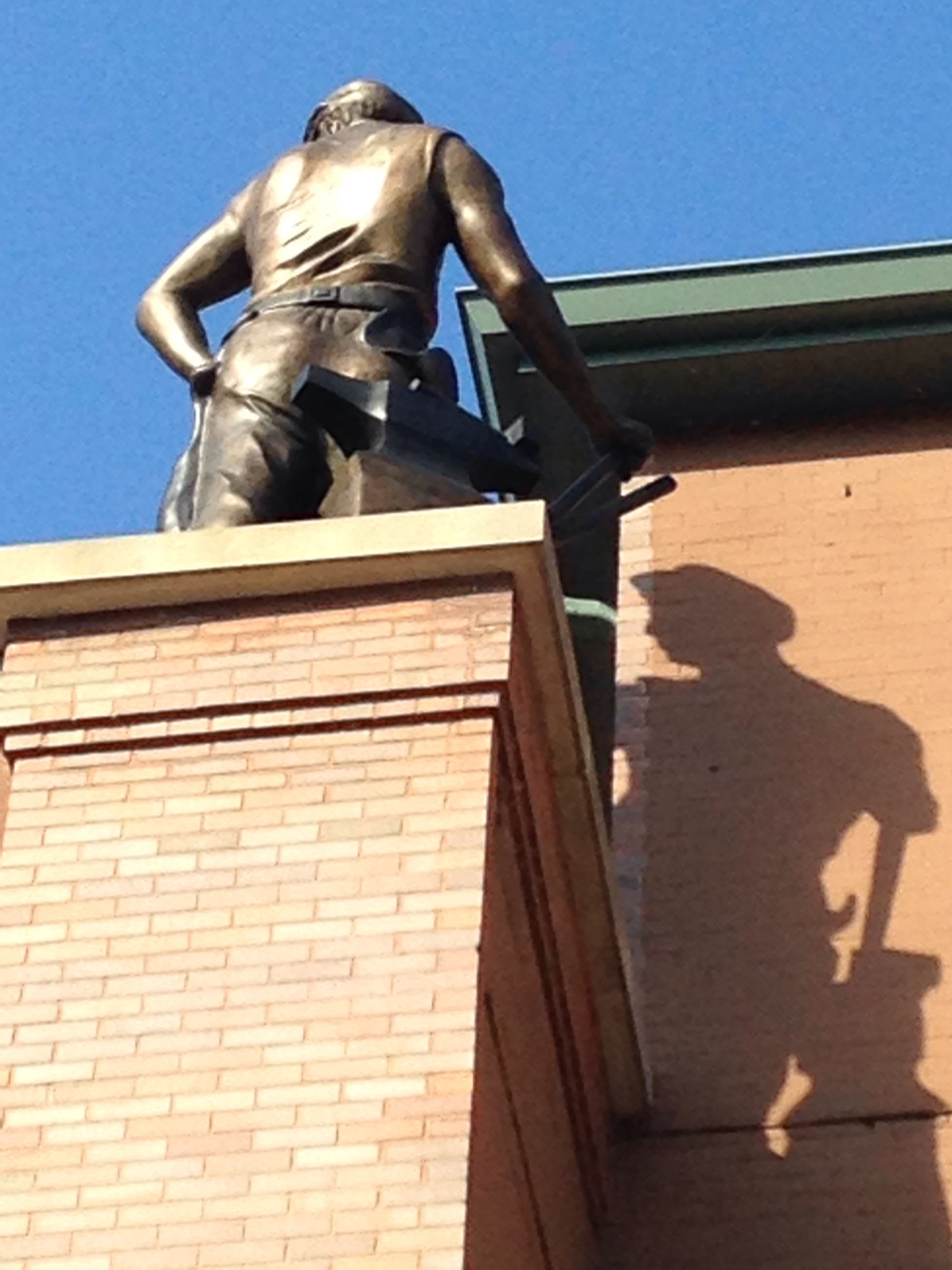
We had to go outside for a fire drill two days ago at work, and while waiting for the emergency coordinator to come and tell us it was clear to go back into the building, I looked up and noticed how well defined and interestingly placed the shadow cast by this giant bronze statue on the roof was. Good thing I had my phone 😄

Posted in Art, Milwaukee, Photography | Tagged , , , , , | 2 Comments

Little Free Library (#3) – “Miss Kris”

imageSaw this mini-library box on my way to work and had to get a picture. Don’t you love the shushing librarian, “Miss Kris,” at her desk safeguarding the “stacks”? Very imaginative!

Posted in architecture, Books and reading, Little Free Library, Milwaukee | Tagged , , , , , , , | 3 Comments

He came to the fork in the road . . . and took it. RIP, Yogi Berra.

America’s greatest living philosopher is no more. He died yesterday at the age of 90.

The New York Times ran a beautiful obit, which you can read here. Yogi Berra the baseball player was phenomenal, one of the very best catchers the game has ever seen. He was part of the powerhouse New York Yankees team in its mid-century glory years. As the Wikipedia article on Berra notes:

Berra was an All-Star for 15 seasons, and was selected to 18 All-Star Games (MLB held two All-Star Games in 1959 through 1962). He won the American League (AL) MVP award in 1951, 1954, and 1955; Berra never finished lower than fourth in the MVP voting from 1950 to 1957. He received MVP votes in fifteen consecutive seasons, tied with Barry Bonds and second only to Hank Aaron‘s nineteen straight seasons with MVP support. From 1949 to 1955, on a team filled with stars such as Mickey Mantle and Joe DiMaggio, it was Berra who led the Yankees in RBI for seven consecutive seasons.

The photograph below is one of those iconic images that anyone hoping for a career as a sports photographer—or maybe even a career as a photographer, period—ought to recognize. Berra’s exuberance was the cherry on top of pitcher Don Larsen’s perfect 1956 World Series game.

Yankees' Yogi Berra (8) jumps into the arms of Don Larsen, who retired every Brooklyn Dodger.

AP photo of Yogi Berra leaping into Don Larsen’s arms at the end of Larsen’s perfect game in the 1956 World Series, via USA Today (http://usatoday30.usatoday.com/sports/baseball/columnist/bodley/2006-04-02-bodley-bonus_x.htm)

But all that was before my time. Yogi Berra the philosopher was the man I knew best.

I became aware of Berra because of his Will Rogers-like commentary on life. His one-liners were both humorous and absolutely on target. I’ve always loved things that appear to be simple but are actually complex. Berra’s remarks—such offhand and seemingly befuddled tautologies—capture both a commonsense, everyday truth and an existential, timeless TRUTH amplified by insights derived from the playful irony of his verbal acrobatics juxtaposed against our thwarted linguistic expectations.

There are entire websites devoted to compilations of Berra’s quotes, known as “Yogi-isms.” USA Today just posted a nice list here. But I also can’t resist including a few of my own favorites:

The game isn’t over until it’s over.

When you come to a fork in the road, take it.

You can observe a lot by just watching.

It’s like déjà vu all over again.

Berra always insisted he didn’t compose his famous aphorisms intentionally:

A lot of guys go, ‘Hey, Yogi, say a Yogi-ism.’ I tell ’em, ‘I don’t know any.’ They want me to make one up. I don’t make ’em up. I don’t even know when I say it. They’re the truth. And it is the truth. I don’t know.

A true “yogi” in the Hindu tradition is self-aware, so maybe Berra didn’t fit the bill that way. But in terms of enlightenment, Berra stands alone in representing something essentially American. We are largely a practical people, preferring “populist” action and physicality to elitist intellectualism. Yogi somehow managed to be both an ordinary “everyman” and a philosopher whose humor prompted reflection about the eternal truths running beneath the surface of daily reality. Our messy lives—as endured day in and day out—are far more meaningful than the constant natter of job noise and family chaos might otherwise imply.

In the immortal words of Yogi himself: “We have deep depth.”

Posted in Life, News, Popular culture | Tagged , , , , , , | 1 Comment