No (Introductory) Christmas Lyric Left Behind

“The sun is shining / The grass is green . . .”  Thus begins one of my favorite Christmas songs.  It continues:

The orange and palm trees sway

There’s never been such a day

In Beverly Hills, L.A.

If you don’t recognize it yet, the next couple of lines may give it away:

But it’s December the 24th

And I’m longing to be up north . . .

At which point we finally get down to business and transition to the song’s main lyrics:

I’m dreaming of a white Christmas . ..

I’ve always loved introductory verses like the one in “White Christmas.”  I grew up with plenty of old, classic vinyl LP records (not to mention the brittle, even-older shellac 78 rpm records).  Some of those old records, I noticed, began with an odd, extra verse that got left off of most other versions of the songs.

For example, there’s this melancholy introductory lyric:

The loveliness of Paris seems somehow sadly gay

The glory that was Rome is of another day

I’ve been terribly alone and forgotten in Manhattan

I’m going home to my city by the bay . . .

At which point, as in “White Christmas,” comes the transformation into the song we all recognize:

I left my heart in San Francisco

With the Christmas season now upon us, I started realizing that many Christmas songs seem to have these introductory verses that get left off most recordings.  The aforementioned “White Christmas” is one, of course.  But there are also all these others—and I’m sure I’m leaving some off the list!

  • Rudolph, the Red-Nosed Raindeer − “You know Dasher and Dancer and Prancer and Vixen . . .”
  • Santa Claus Is Coming to Town – “I just came back from a lovely trip along the Milky Way . . .”
  • The Christmas Song (i.e. “Chestnuts roasting on an open fire”) – “All through the year we’ve waited / Waited through spring and fall / To hear silver bells ringing / See wintertime bringing / The happiest season of all . . .”
  • Have Yourself a Merry Little Christmas – “Christmas Future is far away / Christmas Past is past / Christmas Present is here today / Bringing joy that will last. . .”
  • Winter Wonderland – “Over the ground lies a mantle of white / A heaven of diamonds shine down through the night . . .”

Here is the Eurythmics version of that last song, just because I like Annie Lennox so much 🙂

I wonder why so many Christmas songs have these lovely, secret opening verses.  And even more, I wonder:  Why are they so often left behind when the songs are recorded?

Posted in Life, Music, Popular culture | Tagged , , , , , , , , , , , , , , , | Leave a comment

In Praise of the One-Hit Wonder

Driving home today, I was listening to (and, of course, singing along with 🙂 ) Billy Joel’s “Piano Man” on the radio.  My first idle thought was to realize that it is in 3/4 time, like a waltz. Most of his songs are 4/4.  Not that I have ever made a study of this!  It was just one of those weird free associations you may sometimes have.

My second thought, and not for the first time, was to marvel at what an incredible song that was for him practically right out of the gate.  “Piano Man” was Joel’s first hit, and it was released in 1973.  Forty years later, Joel is still performing in concerts, as he was, for example, this past August when he was caught on camera singing to his ex-wife Christie Brinkley, who was in the front row during a concert in New York.

My third thought was that “Piano Man” was the only song Joel ever needed to secure his place in music history.  Yes, he’s had many, many other hit records—songs I really like—but the only one he ever needed was that first masterpiece.  It’s just beautiful, perfect.  The unforced rhyme of the lyrics, the atmospheric mood, the heartbreaking story, the melody, the singing performance.  Perfect.

Then I started thinking about one-hit wonders.  Which got me to remembering the really mean things that Terry Teachout, theater critic for The Wall Street Journal, said about playwright Arthur Miller a day or two after he died (in 2005) and then again when reviewing a newly-published Miller biography in 2009.  (There is a connection here, if you’ll bear with me 🙂 )

“The bells tolled for Arthur Miller all weekend long—but most of them were made of tin,” sniffed Teachout in his obituary/commentary/”tribute.”  He went on to label Miller a “pretentious” playwright who “pretended to have big ideas and the ability to express them with a touch of poetry, when in fact he had neither.”  The real reason Miller rose to fame, Teachout said, was not his work but the fact that he married Marilyn Monroe and testified before the House Un-American Activities Committee.

In the 2009 Commentary review of Christopher Bigsby’s biography of Miller, Teachout expresses bafflement that Miller is regarded as a great playwright in Europe, and he takes Bigsby to task for writing such an “unabashedly admiring” book about Miller.  Several times Teachout notes that the contemporary acclaim for Miller is completely at odds with his critical reception during his lifetime.  And he seems to have undertaken the task of restoring that previously unfavorable regard single handedly.  Among the insults he throws out:

[N]one of the plays he wrote after 1968 was favorably received in this country [and] his American reputation rests almost entirely on Death of a Salesman, All My Sons (1947), and The Crucible (1953), his first three commercial successes and the only Miller plays that continue to be revived with regularity.

[T]he plots of All My Sons, Death of a Salesman, and The Crucible are sufficiently involving to conceal many—if not all—of their artistic defects.

[I]n the end it is hard to see Miller as anything other than a second-string tragedian, a sentimentalist who mistook ideas for art and windiness for poetry

For good measure, Teachout also informs us of a “widely reported posthumous revelation that Miller concealed the existence of his fourth child, whom he institutionalized on learning that the infant, who was born in 1966, suffered from Down Syndrome.” And he brings up politics again and again.

Why, then, do so many modern-day critics feel so differently about Miller [than Teachout does—i.e., they like him and think he’s truly great]?  The answer, I suspect, is that they are willing to overlook his limitations as a writer because they share his political views—

[To which my reaction is: Huh??? When I formed my favorable opinion of Miller, I knew nothing about his political views.]

—and, just as important, his view of what theater should do.

[Which, apparently, is “not unlike attending a taping of a TV show whose audience responds reflexively to the repeated flashing of an applause sign.”]

[T]he critics of yesteryear, most of whom shared the political views of their contemporary counterparts, were nonetheless capable of setting aside those views and judging his plays not as political statements but as works of art.

I guess I don’t want to get too sidetracked by Teachout-bashing.  I usually like his reviews and other writing very much. Something about his dismissal of Miller just really got under my skin, obviously.

And thinking about Billy Joel and “Piano Man” today while I was driving, I recalled the way Teachout disparaged Miller for the fact that his reputation rested largely on those three early plays.

So what?  Even if Miller’s reputation rested entirely on only one play, “Death of a Salesman,” that would be more than enough, in my opinion, to mark his legacy as one of the truly great playwrights in history.  Just as “Piano Man” is more than enough to secure Joel’s place as a singer/songwriter.  Not to mention one heck of a piano player, possibly the very best in popular music.

Both men’s creative output continued long after peaking artistically, if you are disposed to thinking about it negatively.

Again, so what?  All the rest (of each man’s respective oeuvre) is gravy.

Posted in History, Music, Popular culture | Tagged , , , , , | 1 Comment

The original HONY – O.O. McIntyre

Everyone seems to know and like the extremely popular “Humans of New York” (HONY) blog by Brandon Stanton.  Intriguingly, another man was putting an equally human face on the people of New York City, both celebrities and ordinary folks, nearly 100 years ago.

O.O. McIntyre (Wikipedia article here) was a small-town boy from southern Ohio who brought America’s faraway big city to the readers of small town and rural newspapers across the country.  His syndicated column featured relatively short slice-of-life essays that captured snapshots of New York’s daily dramas large and small.  “New York Day by Day” was hugely successful, due not only to people’s curiosity about life in New York but also (probably primarily) to McIntyre’s voice.  Whether written about a shopkeeper or baseball legend Babe Ruth, McIntrye’s column read like a daily letter home from a local boy who had somehow turned out to live an interesting life in an exciting place.

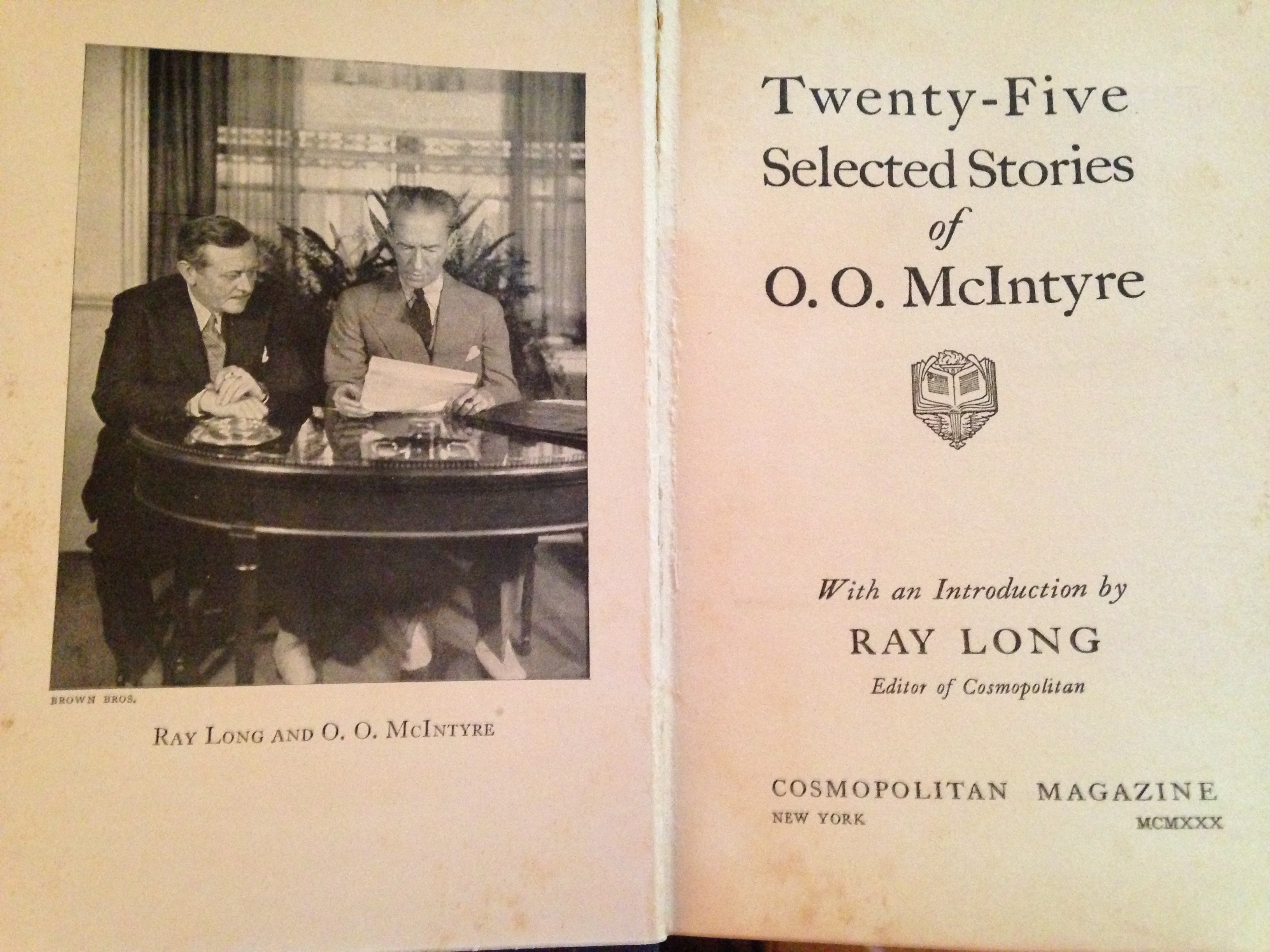
I have a collection of 25 “selected” stories of O.O. McIntyre published in 1929 by Cosmopolitan Magazine, which McIntyre wrote a monthly column for in addition to his syndicated newspaper columns.  The book was “not for sale” but was a gift for subscribers.  (Cosmopolitan was a very different magazine in the 1920s than it is today 🙂 )

O.O. McIntyre Cosmopolitan collection

Despite the fact that he was one of the highest-paid writers in the world at the height of the Depression, today McIntyre is largely forgotten.  When McIntyre’s widow died in the 1980s, found among her papers was a statement showing that her husband’s income for the month of December 1937 was $12,204.12.  According to the Bureau of Labor Statistics’ Inflation Calculator, that would be worth $201,226.45 in 2014.

Imagine: $201,226.45 for the month of December alone!  So times 12 months, if December was representative of McIntyre’s usual monthly income, that would equal $2,414,717.40 for the year.

For more information, if you’re interested, this article on O.O. McIntyre ran in the Smithsonian Magazine in April 2011.  Here’s an excerpt:

By the early 1920s, O. O. (for Oscar Odd) McIntyre was perhaps the most famous New Yorker alive—at least to people who didn’t reside there. His daily column about the city, “New York Day by Day,” reportedly ran in more than 500 newspapers throughout the United States. He also wrote a popular monthly column for Cosmopolitan, then one of the country’s largest general-interest magazines. His annual output totaled some 300,000 words, the bulk of them about New York. In return for all that time at the typewriter, he was reputed to be the most widely read and highly paid writer in the world, earning an estimated $200,000 a year.

[Read more: http://www.smithsonianmag.com/history/odd-mcintyre-the-man-who-taught-america-about-new-york-2317241/#x2tJ0Uk2odxW6eIQ.99
Give the gift of Smithsonian magazine for only $12! http://bit.ly/1cGUiGv
Follow us: @SmithsonianMag on Twitter]

McIntyre’s prose seems very dated today.  But it’s interesting to get a glimpse of New York during the 1920s and ’30s and to get a feel for the kind of newspaper column that Americans liked to read back then.

Given the popularity of HONY, it appears to have been basically the same kind of thing we like to read today 🙂

Posted in Books and reading, History, Life, Popular culture | Tagged , , , , , , , , | 3 Comments

How Ohio State football coach Urban Meyer teaches like a humanities professor

As yesterday’s 59–0 Ohio State victory over Wisconsin shows, something is working very well in the Ohio State coaching strategy.  A story in yesterday’s Wall Street Journal provides some insight into what that might be.

Taking the Buckeyes to School” talks about how Urban Meyer, who has been at the helm of Ohio State’s football team for three years, has a “flipped” coaching technique.  That is, he has players watch videos or study other “lecture” type materials on their own, like homework, outside of team meetings.  And then actual team meetings are devoted to hands-on exercises, drills, and basically “pop quiz” reviews, in which a player is presented with a scenario and asked how he would respond on the field during a game.

The article talks about how this coaching style is similar to the new “flipped classroom” which “turns the traditional-classroom teaching model on its head” by “delivering” lectures/lessons outside of class and using class time for “homework” via individual tutoring.

To which, as a literature and humanities professor, I can only respond: Ho hum.

Of course, classrooms are not for lectures, at least most of the time.  They’re for discussions.  This model is old, old hat for those of us in the liberal arts.  We’ve been teaching the “flipped classroom” way forever.  Students read materials/texts outside of class and come prepared to do their real learning in an interactive group environment.  Classroom discussions are where students (and teachers 🙂 ) create new knowledge in the form of new connections and insights about the basic course material.

Maybe Urban Meyer’s success on the gridiron will inspire teachers in disciplines outside of the liberal arts to try similar strategies in their classes.

Here is a video of Meyer presenting his coaching philosophy and techniques at a 2012 Ohio High School Coaches Association Clinic.

The video is over an hour long, and the audio is not the best.  So here, also, is a website summary of one person’s key takeaways from that presentation.

Update, August 31, 2015: I just noticed that this post is getting LOTS of views today, so I double checked the links (the Wall Street Journal article, video and “website summary”) to make sure they are still current. The WSJ article and the video still look good, but when I clicked over to the website summary of the video’s points (using my phone, anyway), I couldn’t get past an ad wanting me to sign up for newsletter delivery. There didn’t seem to be a way to close it to read the post without signing up. The site is flippedcoach.com and the post is dated February 23, 2012, and titled “Urban Meyers’ Coaching Philosophy” (and a few more words, can’t remember what they are). Maybe you can avoid the ad if you use a pc instead of a mobile device.

I also don’t know what’s bringing you to this page and whether or not the “humanities” classroom model is something you’re finding to be a useful insight. But if so, I’d be happy to talk with you in more detail about how to facilitate productive discussions and interactive learning in such a “flipped” environment. If you leave a comment at the end of this post, I’ll respond here. Otherwise, if you’d like a private response, please see my “Contact Me” page for info.

Thanks for reading, and I hope this post has been worth your time 😄

Update #2: I think I’ve figured it out. Apparently Urban Meyer made students do pushups who wore blue (arch-rival Michigan’s color, BOOOOO!) to his class today. I’m guessing that many people searching for that story have accidentally landed on my page instead. If you stuck around long enough to read my entire post AND this update, thank you! And good luck finding the story you were actually looking for 😄

Posted in Higher education, Learning, Life, News, Teaching | Tagged , , , , , , , , , | 1 Comment

Christmas at Downton Abbey

I try to buy a new CD of Christmas music every December, and here’s my choice for this year 🙂

Buying info and the Amazon description are here (with sample audio clips of all songs).

Posted in Music, Popular culture, Television | Tagged , , , | Leave a comment

The Art of the Fire Escape (Milwaukee’s City Hall)

I had to walk past City Hall to a dentist’s appointment yesterday.  For months (actually, years off and on!) the Market Street shortcut behind City Hall has been blocked off by scaffolding erected to preserve/shore up the nearly 120-year-old structure.  I almost automatically walked farther west to Water Street, which would have added a good five minutes to my trip, before I realized the scaffolding was gone.

It was my first close-up view of City Hall’s exterior in a long time.  About two years ago, I took this picture one morning because the fire escape and its shadow looked so much like the spiraling strands of DNA’s double-helix structure to me.  (And, I just noticed, you can see some scaffolding around the base of the building even then.)

IMG_0139[1]

So yesterday, with the scaffolding gone, I noticed how attractive the actual fire escape is up close.  It doesn’t even look like a fire escape.  So ornate!

IMG_0167[1]

One thing I didn’t take a photo of—because I was worried about being late for my appointment and because seeing it was kind of sad—was some of the flaking, gouged and pitted stone around the large Romanesque-looking archways at the front entrance.  (But, actually, I just now noticed that some of the stone up near the fire escape’s second level in this photo is flaking at the corners 😦 )

I love Milwaukee’s City Hall.  And I fear it is doomed.  Here’s a New York Times article from last June that lays out the whole depressing scenario pretty well.  We’ve no sooner finished (for now) all the exterior repairs than we now have to turn our attention to the fact that it is slowly sinking into the swampy soil that underlies our entire downtown.  Downtown Milwaukee’s buildings rest on pilings—mostly wood, in the case of older structures—so dry rot is a major concern.

I have occasionally taken student groups on tours of Northwestern Mutual Life’s massive complex, and NML’s strategy is to measure the water level of  “Lake Emily” and refill the marshy substratum with water when it gets too low.  Lake Emily was an actual lake in downtown Milwaukee a long time ago before it was filled in with dirt and built over.  The soil is so saturated that “Emily” may still exist as a subterranean lake in some form.  (Here is a great feature article about Lake Emily, with lovely photos of Northwestern Mutual’s marble halls, steps to a long-ago outdoor garden, and the basement piling-management system.)

How much is a building worth?  At what point should we stop throwing good money after bad?  City Hall is such a beautiful piece of architecture.  An instantly recognizable landmark.  An icon, really.  Kind of like the Empire State Building or the Eiffel Tower or the Sydney Opera House.

It’s hard to put a cash value on something that has a greater intrinsic worth than merely the sum of its deteriorating parts.

Posted in architecture, Art, Life, Milwaukee, Nature, Science, Technology | Tagged , , , , , , , , | 1 Comment

Red Arrow “Slice of Ice” (plus “Hank” the Dog)

The “Slice of Ice” skating rink at Red Arrow Park in downtown Milwaukee is nearly ready for skaters.  It opens for the season tomorrow (Thursday, December 4) at 4:00.

Yesterday I noticed that the rink’s cement had been covered by a thin layer of ice, almost like a “prep” foundation.  But this morning when I stopped by Starbucks after my first class of the day, I saw that the ice seemed to have assumed its normal winter appearance.  By the time I left campus, county workers were unloading decorated Christmas trees from a truck and installing them around the rink’s perimeter.

IMG_0163[1]

When I was there this morning, park workers were affixing ads to the rails surrounding the ice.  I couldn’t resist snapping my photo of the ice from a position that would also capture the ad for a “Hank” tree ornament.  If you buy two 4-packs of Milwaukee Brewers tickets (great Christmas gift for a baseball fan), you get the free Christmas ornament.

Slice of Ice (and "Hank" the Dog)

As every Milwaukeean knows, Hank (Wikipedia article here) was a stray who wandered into the Brewers’ spring training camp in Arizona last winter.  Adopted by the team as its mascot, Hank arrived in town last spring to an outpouring of hoopla and adoration.  A crowd of people including the county executive and the mayor of Milwaukee (who brought peanut butter dog cookies) waited for over half an hour at Mitchell International airport to greet Hank as soon as his chartered airplane landed.

Above is a cute picture of Hank in his mascot dog house.  (Photo by Gkasica, via Wikipedia, CC BY-SA 3.0)

Indeed, Milwaukeeans love their animals.  For proof, look no further than the story of Samson, a gorilla who lived for years at the Milwaukee County Zoo.  His death warranted front page newspaper headlines for days.  Or Gertie, the Duck, whose brood of ducklings, nested in a piling in the Milwaukee River under the Wisconsin Avenue bridge during World War II, attracted national attention (and a Readers Digest article and eventually a children’s book) after throngs of locals gathered daily to monitor her progress.

But I digress (oops 🙂 ).  The main points to take away from today’s post:

  1. “Slice of Ice,” the skating rink at Red Arrow Park at the intersection of State and Water streets in Downtown Milwaukee, opens tomorrow afternoon.
  2. You can get a free “Hank” Christmas ornament if you purchase two holiday 4-packs of Brewers tickets (@ $60 each, so $120 total) through December 19.  Here’s a link to the Brewers webpage with all the ordering info.
Posted in Life, Milwaukee, News, Popular culture | Tagged , , , , , , , , , , | 2 Comments

The Northern Soul Project – Streaming 24/7 Northern Soul Radio (Post #4)

A quick post to share my latest Northern Soul find: a radio station that streams classic Northern Soul music online, ad free, 24/7.

A partnership between San Francisco radio station KALW (91.7FM) and National Public Radio, “The Mix: Northern Soul Radio,” can be found HERE.  I opened up the site and am listening right now as I’m working on other things at the computer.

In case you’re new to reading my blog, I started a somewhat casual, but continuing, exploration of Northern Soul a couple of months ago.  Basically it’s 1950s/’60s Motown soul records, which became the soundtrack of an underground dance-oriented club movement in Northern England during the 1970s, and is still going strong today.

You can find my previous posts here if you’d like to learn more about Northern Soul and catch up on the “Northern Soul” series:

Post #1

Post #2

Post #3

In a little twist of karma, the WMSE, the radio station long associated with Milwaukee School of Engineering (where I teach), is also 91.7FM.  Be sure to check out my friend Sonia’s Friday afternoon “Blues Drive” show (3-6 p.m. Central every Friday) if you like classic blues music.

Would you like new posts delivered to your inbox? To subscribe, click here.

Posted in History, Learning, Milwaukee, Music, Popular culture, Writing, blogging | Tagged , , , , , , , , , , , | 1 Comment

Paths of Glory

Actually, that post title came to me just now because I wanted something to do with “paths,” and Paths of Glory, the old Stanley Kubrick film starring Kirk Douglas, is one of my favorites.  Sadly, if you were hoping to read about the film, this post doesn’t have anything to do with it 🙂

Actually, this is sort of a post about our dogs.  Sorry.  (You can stop reading now if you despise this kind of cuteness.)

100_1043[1]

100_1044[1]

100_1493[1]

This afternoon I came home from work, fed the dogs, put away groceries, and took out the garbage.  All my usual getting-home chores.  The snow  melted over the weekend, although today is quite cold.  So I noticed when I went outside that our dogs’ trails/paths through the yard are quite visible, even now when the grass is matted down and frozen and covered by leaves.  (Yes, we raked, but it snowed before all the leaves had a chance to fall.  Leaves are still falling!) 100_1495[1] 100_1497[1]

If you have pets, you have probably noticed that they like to walk in the same familiar little byways throughout your yard.  Locally, the roads between Milwaukee and other cities like Green Bay, Watertown, and Chicago were originally Indian trails.  When the roads were built over them much later, I guess everyone saw the wisdom of the original footpaths.

Even the planets seem to have an affinity for revolving through eternity along their same old elliptical orbits.

What is it about a well-worn path?  Why is it so attractive?  Yes, Robert Frost decided to take the less traveled road “Because it was grassy and wanted wear.”  But he’s an exception.  For most of us, the myriad complexities of daily life demand simplification.

And simplification requires routine—i.e., the road more traveled by!


Posted in Life, Nature, Science | Tagged , , , , | 4 Comments

Countdown to Downton Abbey – Cora’s YouTube Music Video

Last year I wrote a series of “Countdown” posts in anticipation of Season 4 of Downton Abbey.  I had not intended to do the same this year, but yesterday I stumbled across something that was too fun not to share.

So, first the “countdown” part.  Season 5 of Downton Abbey is set to premiere in the U.S. on January 4 at 8:00 pm Central Time (9:00 Eastern).  The official PBS Downton Abbey page doesn’t have a countdown clock, as it has in past years, forcing us all to do the math ourselves.  But the page does have trailers and links and all the usual time-wasting stuff 🙂

Now for Cora’s music video.  Actress Elizabeth McGovern, who plays Lady Grantham, has a band in real life called Sadie and the Hotheads.  They’ve just released a cover of “The Little Drummer Boy,” which has a YouTube video (below) and which is also available for downloading at iTunes.

And, of course, the song itself has now put me in mind of two other versions (well, actually just one; the other is an exact replica, with uncanny mimicry) that I also feel compelled to share 🙂   The first features Bing Crosby and David Bowie, an odd pairing if there ever was one—and an excellent example of how innovative it can be to combine wildly disparate elements.

Apparently the creation of this polyphony between the old “Drummer Boy” and the new “Peace on Earth” was a completely unexpected turn of events.  A Washington Post article, “Bing and Bowie,” details the strange serendipity behind the song’s composition.  Apparently Bing Crosby happened to be in England on a concert tour in September 1977 and had lined up some British stars to appear as guests on his annual Christmas special.  David Bowie’s home was near the studio where Crosby was recording scenes for the show, so convenience was one factor in getting him.  But at the last minute Bowie announced that he hated “The Little Drummer Boy” and refused to sing it, so Crosby’s writers hurriedly wrote the “Peace on Earth” song for him to sing in counterpoint instead.  Necessity truly is the mother of invention.

By the way, Crosby died about a month after this performance was recorded.  So “serendipity” may be a very relevant description, indeed.

The second video is a parody of the first, with dead-on accuracy of reproduction by Will Ferrell and John C. Reilly.  I don’t know why this video makes me laugh so much.  Will Ferrell plays it completely straight, which you can see if you compare the two videos closely, but every eyebrow lift and turn of the head is hilarious.  You’ll have to head over to YouTube to actually watch this video: link here.  For whatever reason, Funny or Die (the producers) have set it up so that I can’t embed it for you to view on my blog.  You’ll be subjected to a really long ad at first, but it’s worth enduring in order to watch the video, IMO 🙂

 Would you like new posts delivered to your inbox? To subscribe, click here.

Posted in Life, Popular culture, Television | Tagged , , , , , , , , , , , , | 1 Comment