This post about London’s Keith Fawkes bookstore beautifully articulates what books and bookstores are all about: “possibility, playfulness, discovery and, most importantly, mess . . . . [Because] it’s good for us, as human begins, to invent that method” necessary to make sense of the disorder and “madness.”
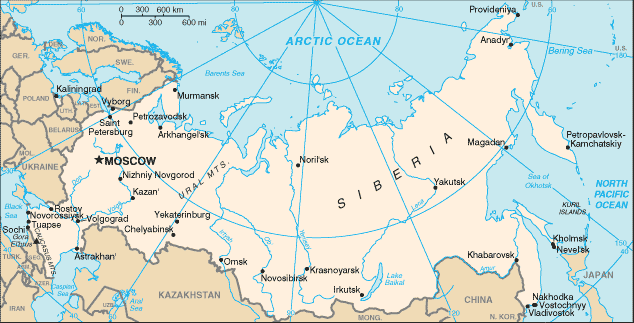
Sometimes looking at a map can tell you a lot. Take a look at this map, for example. It shows that Russia is a largely landlocked country. Unless you count its far northern shores deep inside the Arctic Circle.
Vladimir Putin aspires to revive Russia as a world power, according to news accounts. That may be a pipe dream. As we found out once the Cold War ended, the Soviet Union’s power was actually kind of a Potemkin village all along—an especially apt metaphor since we’re talking about Crimea 🙂 —in the way that its breathtakingly aggressive display of military strength concealed a dilapidated economy on the verge of collapse.
Conventional wisdom holds that no nation can become or remain a world power without a strong navy to support its global interests.
Few lessons from history have remained as incontestable as the importance of sea power to a nation’s political and economic standing.
Sea power has been the ultimate measure of global reach and influence since the Greeks stemmed Persia’s land conquests with a naval victory at Salamis Bay in 480 B.C. Despite having the largest and best-trained army in Europe in the mid-1700s, France lost its overseas empire, including Canada, to Great Britain because France could not support its colonies via the seas. Great Britain held onto a worldwide empire where the “sun never set” throughout the nineteenth century only because of the superiority of the Royal Navy.
Now let’s take a look at another map. This comes from Wikipedia’s entry on the Black Sea. See Ukraine at the top center? That’s the Crimean peninsula hanging off of it. You may remember Yalta as the site of a famous meeting between Franklin D. Roosevelt, Winston Churchill, and Joseph Stalin toward the end of World War II. (See the Yalta Conference photograph of the three men on Wikipedia here.) The city you need to pay attention to with respect to the current crisis in Ukraine is Sevastopol, just around the lower tip of Crimea to the west of Yalta.
Sevastopol is home to Russia’s Black Sea Fleet. So in addition to the complex history shared by Russia and Ukraine, you have a naval base of extreme strategic importance to Russia (as it is Russia’s only warm water base). And feelings in Ukraine toward Russia’s continued presence in Sevastopol have been conflicted to say the least.
In 2010 Russia’s lease on the Sevastopol installation was extended until 2042. Take a look at this Reuters news clip of what happened in Ukraine’s parliament when the ratification vote was counted.
Russia will not allow its control of Sevastopol to be weakened, which goes a long way toward explaining the presence of its troops in the Crimean peninsula. If Ukraine were to join the European Union, would membership in NATO then follow? And if it did, wouldn’t it be exceedingly strange to see a Russian military base hosted by a NATO member!
Interestingly, Russia also has a naval refueling station on the Mediterranean coast of Syria. Below is a great map I found on Wikipedia showing the site of this Soviet-era naval base in Tartus, Syria. It is Russia’s only naval station in the Mediterranean. Without it, Russia’s ships would have to travel clear back to Sevastopol in the Black Sea. (The Crimean peninsula can also be seen on this map, almost due north and slightly to the west of Tartus.)
Russia blocked a UN Security Council resolution in early January that would have expressed outrage and condemnation regarding the Syrian government’s daily air strikes in Aleppo. Russia also opposed a statement in December that would have condemned attacks by Syrian government troops upon civilians, and Russia (with China) blocked three earlier attempts by the Security Council to condemn and possibly impose sanctions against President Bashar Assad’s government. It’s not that Russia loves Assad so much as Russia needs a stable relationship with Syria.
Which brings us to Turkey. Things have been relatively quiet in Turkey lately, but here and there citizens rise up in protest, mostly against the policies (and alleged corruption) of Prime Minister Recep Tayyim Erdoğan. Wikipedia has a really nice timeline of events in 2013-2014. Last June I reblogged a Freshly Pressed post by Insanlik Hali, “What is Happenning in Istanbul,” about the spontaneous demonstrations mounted by thousands of citizens in Turkey’s largest city, initially against Erdoğan’s plans to demolish a popular park (with significant history, including a bloody massacre in 1977) in order to build a shopping center but quickly becoming more about unhappiness in general with life under the Erdoğan government.
Demonstrators in Taksim Square (via Wikipedia)
Demonstration outbreaks have continued to erupt in several cities, most notably Istanbul, this past December, January, and February.
Take another look at that map of the Black Sea. There’s just one way to get from Sevastopol to the Mediterranean and, thus, out to the Atlantic and rest of the world. The map below (once again from Wikipedia 🙂 ) shows a close-up view.
Bosphorus Strait, via Wikipedia (CC BY-SA 2.5); en:User:Interiot – en:File:Turkish Strait disambig.svg modified from Image:Vertrag sevres otoman.svg, created by Thomas Steiner.
Turkey controls this passage, and Russia needs a stable Turkey, especially a stable Istanbul.
Yet Turkey and Russia have a somewhat adversarial history, particularly with regard to Crimea. The Crimean War of “Charge of the Light Brigade” fame (“Theirs not to reason why, / Theirs but to do and die”) was a struggle between Russia and the Ottoman Empire (in alliance with Britain and France). Toward the end of World War II, Joseph Stalin deported a couple hundred thousand Crimean Tatars (Turks) from Crimea, allegedly because they were collaborating with the Nazis. Over a hundred thousand of those deported died of starvation and other causes.
And now Russian troops are apparently taking over Crimea.
What is Turkey to do? Engage in the very delicate balancing act of honoring ties to the Tatars, its ethnic and religious (Muslim) bretheren, and forging diplomatic bonds with the new Ukrainian government in Kiev—while at the same time not arousing the ire of Russia, from which it gets at least half of its natural gas supplies and against which it has historically lost many wars.
Just this past week, about 250 protesters, mostly Turkish Crimean Tatars, gathered outside the Russian consulate in Istanbul. They want Turkey to use its influence to prevent Crimea from being annexed by Russia away from Ukraine.
Today’s Variety has an interesting article about how ten years ago The Return of the King was nominated for—and won—an astounding 11 Academy Awards. Only two other films have won that many Oscars: Ben-Hur (1959) and Titanic (1997). Even more significantly, The Return of the King was the first fantasy film ever to win Best Picture.
Suskind’s article fascinates me on all kinds of levels. I’ve read the entire trilogy (and The Hobbit) many, many times since performing in a children’s play version of The Hobbit when I was in junior high. When I mentioned at a cast reunion a year later that I’d enjoyed reading The Hobbit, older cast members pointed me toward The Lord of the Rings. When the films came out I loved Peter Jackson’s dynamic retelling of Tolkien’s masterpiece (even though, grumble, I felt Jackson’s decision to omit “The Scouring of the Shire” from The Return of the King ruined the trilogy’s structural symmetry and made the ending less than satisfying).
As a specialist in rhetoric, I’m intrigued by the extent of New Line’s marketing campaign to get Academy recognition. And as a cinephile, I love reading people’s recollections in this article of what it was like to be at the 2004 Academy Awards and realize, award by award, that The Return of the King just might have a chance to win in every category.
Some of my favorite quotes from the article:
Laura Carrillo (senior vice president, creative advertising, New Line, in 2004): We had selected The Ant Farm to be the agency of choice for the entire trilogy, from audio through print. I think the flow you see within the ads comes from this agency being with us for five years as we developed the campaign.
Julian Hills (president of print advertising, The Ant Farm, in 2004): If you look at the [campaigns for] Fellowship and The Two Towers . . . they are a bit all over the place. They will use a border for some, a different typeface for another––there is no real cohesive look to them. What we did for Return of the King, we created a look that was very specific. We created sort of a sub-brand. It was obviously Lord of the Rings, it was obviously Return of the King, but it was obviously the Academy campaign. When you looked at the Hollywood Reporter and you came to one of these ads, there was absolutely no doubt in your mind what you were looking at.
Russell Schwartz (president of theatrical marketing, New Line, in 2004): I remember the person who ended up winning for best foreign language film, the director just blurted out, “Thank God the Lord of the Rings was not in this category.”
Bob Shaye (co-C.E.O., New Line, in 2004): When Spielberg [presenting the award for Best Picture] said, “Let’s see what we got here,” and he slowly opened the Oscar envelope, and then with his inimitable dramatic pause looked up and said, “It’s a clean sweep,” that was pretty exciting.
David Tuckerman (domestic-distribution president, New Line, in 2004): We were all trying to figure out some way to celebrate this thing. I just sat there and said, “You know what? Let me find out how much it’s going to cost us to make a ring. Because it is Lord of the Rings.” And that’s what happened. We made 12 of those rings, and 12 people at New Line got them. It looks just like a Super Bowl ring, except it’s not as expensive.
With this year’s Academy Awards coming up Sunday night, it’s appropriate to remember the Oscars sweep that made it possible for genre films like Gravity and Her to be taken seriously as Best Picture contenders.
“Embodied cognition” is the idea that the nature of people’s minds is shaped by the form of their body. Think of how disorienting it is to talk about your right hand while demonstrating with your left, which is something that a parent or teacher might do when facing the person they are trying to instruct. Research has likewise demonstrated a connection between muscle movement and affect: smiling actually causes you to have pleasant thoughts, while frowning leads to unpleasant ones. That great old song standard, “Smile,” gets it right:
. . . Light up your face with gladness
Hide every trace of sadness
Although a tear may be ever so near
That’s the time you must keep on trying
Smile, what’s the use of crying
You’ll find that life is still worthwhile
If you just smile
The interesting news coming out of last week’s conference is that eating something sweet causes people to have kinder thoughts. And sucking on something sour makes us grumpy. You’re probably thinking we don’t need science to tell us this. But wait, there’s more. Apparently the metaphors we use also influence our moods. You know the expression “warm and fuzzy” used to describe a treacly feeling of well-being? Well, a warm and fuzzy physical object not only protects us against actual cold drafts but also makes us feel psychologically warmer, too.
So as we head into the last week of February with below-zero temperatures in Wisconsin, just remember this. Wrap yourself in your softest blanket. Watch a funny movie. Eat more chocolate.
Anyone who lives in Milwaukee or has driven on the elevated freeway loop south of Downtown knows the Wisconsin Gas Building, a beautiful Art Deco tower topped by a weather beacon in the shape of a flame. The flame changes color to announce the weather forecast.
When the flame is red, there’s warm weather ahead!
When the flame is gold, watch out for cold!
When the flame is blue, there’s no change in view!
When there’s a flickering flame, expect snow or rain!
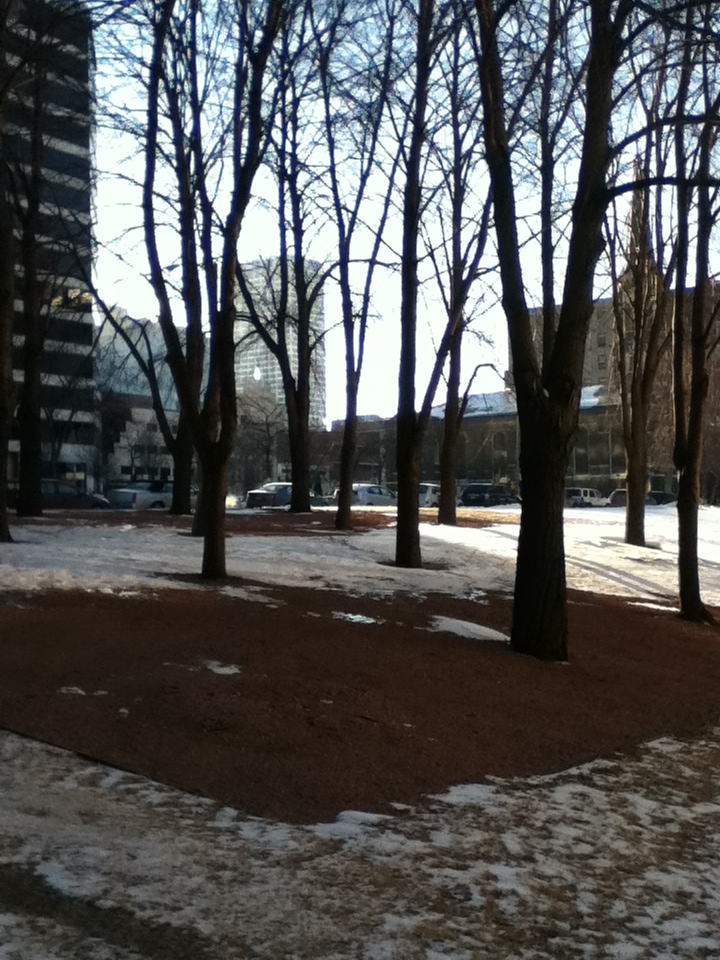
On my way back from getting coffee I happened to notice the Gas Building flame glowing in the sunlight (at center left, below, through the trees). I believe that must be an extreme shade of gold, to signify even COLDER cold!
What’s this? Up in our tree . . . ? More crab apples!
Remember when I wrote about our crab apple tree last September? I guess I haven’t spent time in our yard since winter started (brrr!), but I was surprised to see these guys hanging on late yesterday afternoon.
Wauwatosa, Wisconsin (an old-city inner-ring suburb of Milwaukee), is having its inaugural “all-city read” this month. Children ages 8-12 are reading a fantasy adventure, and people ages 13+ are reading Rocket Boys, the 1998 memoir by retired NASA engineer Homer Hickam, Jr.
Born and raised in Coalwood, West Virginia, Hickam writes an engaging account of his coming of age in an Appalachian mining town during the 1950s Sputnik era, when he and his friends built and launched rockets into space.
Wauwatosa has many activities planned for the month related to the two selected books and to reading in general. One activity I found especially neat was an afternoon and evening of building sessions at the local Home Depot where families could build their own Little Free Library box. Home Depot provided the pre-cut and pre-drilled lumber and helped with assembly, leaving the final staining or painting to be completed at home.
I’m not sure how many people to expect yet, so I haven’t decided on the best format for running the discussion. I know I can lead a group of 40 people in one big discussion, because I do it all the time at MSOE’s Great Books events. But if we have 80 or more people, maybe it would be better to encourage smaller discussions.
My dilemma: which would feel like a more satisfying experience for the participants? One large, all-inclusive performance-type experience where I am the “show”? Or several smaller and more intimate conversations simultaneously occurring throughout the theater, which I could walk around and facilitate? This is a theater with small tables, couches, and recliners, by the way, instead of the usual rows of seats.
If you were attending this event, which do you think you’d prefer?
Interesting post over at The Shatzkin Files, “The future of bookstores is the key to understanding the future of publishing.” What will it take for bookstores to survive in an era of e-readers and online book purchasing? One possibility mentioned is to emulate Soho independent bookseller Sarah McNally (of McNally-Jackson), who is “taking steps to move beyond books to retailing design-heavy but perhaps-more-enduring retail goods like art and furniture.”
What a smart idea! Did you know that funeral homes once doubled as furniture stores? I had thought it was a Midwestern phenomenon, but it was apparently true all over the United States. The news story below comes from Amarillo, Texas, where a local museum mounted an exhibition that focused on the unlikely retail-service combination.
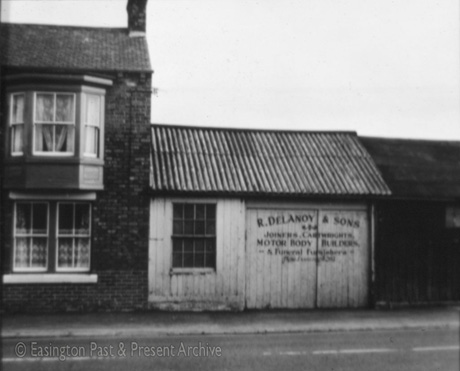
Apparently such multitasking also occurred in England, as seen in the photo below from the Durham County Council archives, taken in the 1930s in Easington Village. The sign on the door reads: R. Delanoy & Sons: Joiners, Cartwrights, Motor Body Builders & Funeral Furnishers.
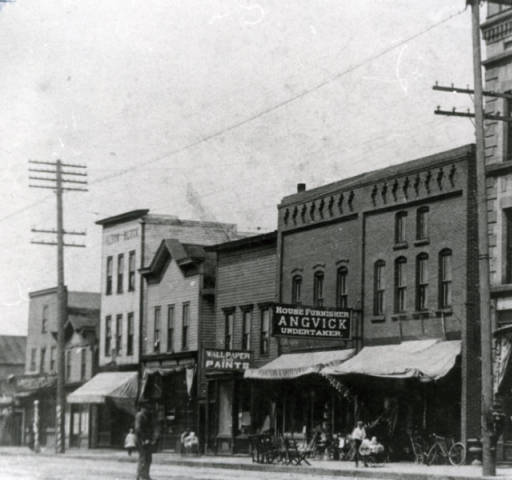
More locally, below is a photo from the Ashland (Wisconsin) Historical Society, from the online “Recollection Wisconsin” program sponsored by Wisconsin Library Services (and hosted by the Milwaukee Public Library). Check out the sign for “Angvick House Furnisher/Undertaker.”
I guess it makes sense that someone with carpentry skills might make both furniture and coffins, not to mention carriages and motor bodies. And a funeral home could easily double as a furniture showroom.
Perhaps it makes equal sense for bookstores to diversify. At the same time you bought a novel you could also pick out a comfortable chair and footstool, an attractive table lamp, hot cocoa and coffee mugs, a warm afghan throw, firewood, maybe some music CDs—everything you might need to spend a cozy evening at home reading by the fireplace.
I’ve been thinking about my great-grandparents lately. Our microwave died not long ago, and with it the ability to heat up coffee and milk instantly . . . IN the cup we plan to drink from. Instead we have to add coffee and milk to a saucepan every morning, heat it to a foamy boil, and then pour the steaming liquid into our cups. It’s not really that hard to do, and it takes almost no time. Plus, it actually tastes better than the microwaved version. (Not that we have any intention of living without a microwave for much longer 🙂 )
With the recent bitter cold courtesy of the polar vortex, I’ve been heating up coffee and milk multiple times every day, which is what puts me in mind of my grandparents. My great-grandfather was custodian of the elementary school where my great-grandmother taught. In cold-weather months of the Great Depression my great-grandfather walked a few blocks to the school every single night (holidays included) to take care of the coal furnace. When he got home, he sat in the living room before going to bed and drank the hot cocoa my great-grandmother had made for him in a saucepan on the stove.
Isn’t it strange? My great-grandparents have been dead for almost fifty years. But they’ve achieved a type of immortality as long as I (or my children, who have heard the stories) still think of them while doing things like pulling the car over to take a photograph or heating up coffee and cocoa the old-fashioned way.
Speaking of coal furnaces, by the way, I actually once saw coal being delivered to an old three-story house on Milwaukee’s East Side. This was probably twenty or twenty-five years ago. A long chute ran from the delivery truck to a basement window, and the whole thing vibrated like crazy, shaking the coal along its path from truck to house.
Being curious, I just found a video online of a residential coal delivery, and apparently what caused all the vibration was a conveyor belt.
My friend and colleague, Lisa Rivero, posted on the topic of “Classroom Grace” last week over on her blog. I’ve been thinking about her remarks ever since.
Lisa was talking about those magical moments that happen in classrooms, especially in humanities and social science classrooms, where an ordinary class period suddenly turns electric and students make exciting connections between the discussion topic and their own lives. It’s funny how unexpected those moments are. You can’t really plan for them; you can only be “prepared” so that when you recognize them, you can respond to them appropriately.
There is a word in rhetoric and politics that seems to fit here: kairos, a term from ancient Greece meaning the right or opportune moment. When the time for speaking or acting is ripe, you have to seize the moment. For teachers, kairos means the “teachable moment.”
The epiphany, that moment of insight (whether teacher or student) that comes with “getting” a concept, is almost a divine experience. “Grace” captures its essence pretty well. Suddenly you see clearly what was previously opaque, sort of like the scales falling from Saul’s eyes (Acts 9:18).
The moment of classroom grace I remember most clearly in my own experience occurred about ten years ago. Ironically, it happened in the same freshman humanities course that Lisa describes teaching in her blog. I was the new program director for our technical communication degree, and learning that job was eating into time that should have been going into course prep. Walking down the hall to my class one day, I was panicking. Caught up in program matters, I hadn’t even thought about what I was going to do in the classroom until that very moment. Now I had about ten seconds to come up with something, anything that could fill up the next fifty minutes. HELP!
And suddenly an idea came to me, like a little intuitive miracle. My class was studying “time,” just as Lisa’s class is studying “freedom.” My idea was a perfect 50-minute time-filler: I’d put people into six groups, give them time-related topics to discuss, and then have them report to the class what they’d come up with. Boom, done.
Three of the groups were easy to think of topics for: one could argue that the “past” was the most important aspect of time, another could argue that the “present” was the most important, and the third could argue that the “future” was the most important. Okay, I just needed three more time-related groups. One group would list every association they could think of to do with calendars; another would do the same thing with clocks and watches. Finally, the last group could list every time-related expression they could think of (“wasting time,” “time is money,” etc.) and talk about what those expressions revealed about our culture’s concept of time.
Whew, just in time. I walked into class, organized my groups, and set them to work. It was a GREAT class period. At the end of the quarter, my teaching evaluations were full of praise for this discussion. “I had never thought of time that way before,” was the gist of the comments.
Ironic, right? It was nothing more than a throwaway class exercise, just something I was grateful to have pulled out of thin air to fill fifty minutes in an emergency. Sometimes that’s how teaching works. Moments of classroom grace happen when you least expect them. Sometimes when you don’t even deserve them.
And they are almost always more about your students’ learning than about your teaching. Knowing this keeps you humble.