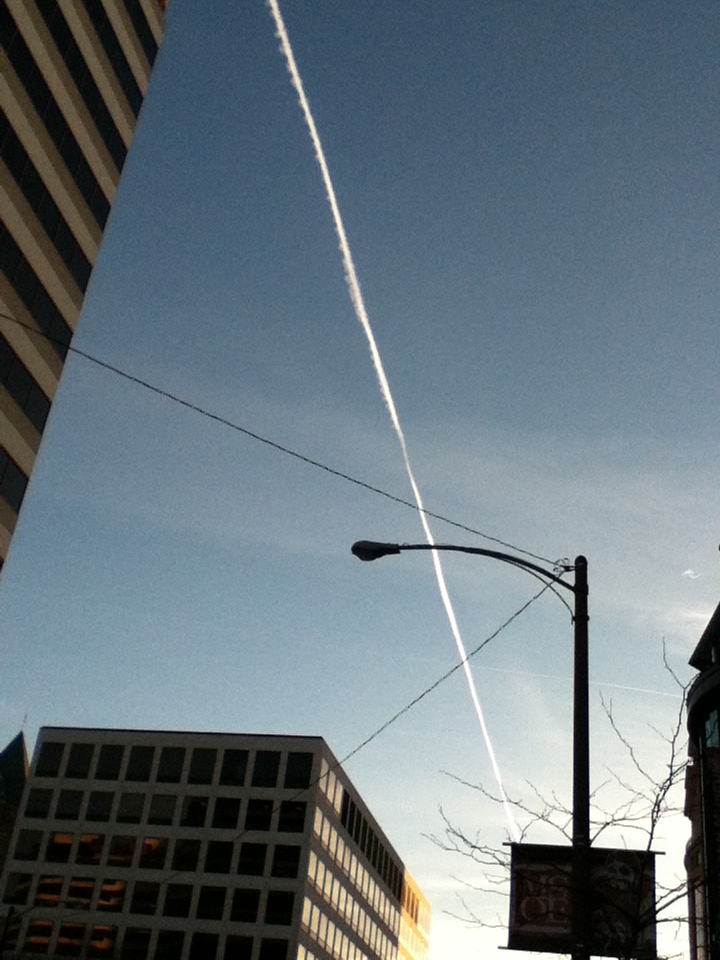
“Criss-cross” (photo)

Really liked the intersecting lines and distorted angles of the condensation trail, power lines, and downtown buildings.  So I had to take a photo 🙂 

Just finished teaching and am ready to call it a day.  Happy Tuesday evening!

"Criss-cross"

Posted in Milwaukee, Uncategorized | Tagged , , , | 3 Comments

First Food Truck Friday!

I spotted the first food truck of the season in front of Red Arrow Park on Water Street shortly after 1:00 this afternoon.  I didn’t notice any customers, so maybe it was just a practice run.  Such a happy sight, though:  Can summer be far away now?

Food truck Friday at Red Arrow Park

Posted in Life, Milwaukee | Tagged , , , | Leave a comment

Marbleized shadow (photo)

IMG_0213[1]

What is this?

Maybe this will help.

IMG_0210[1]

I stopped at the store on my way home from teaching last night and parked under one of those tall, bright lights at the edge of the lot.  As I pulled out my grocery list, I noticed that the overhead light was casting shadows from the raindrops that streaked the windshield down onto the notepad in my hand.  (Yes, it was raining again last night.)

To me, those shadows made the paper look like marble.  So I took a picture.  Then I realized the photo would look way more attractive without my shopping list (milk, bread, eggs . . .), so I flipped the page to the next sheet.  But even without the list, I still had those lines on the paper.  Finally I thought of flipping over the notepad itself and photographing the shadowed gray cardboard.

I like it!

IMG_0214[1]

Posted in Uncategorized | Tagged , , , , | 2 Comments

The banality of evil (Boston Marathon bombing)

A death in Milwaukee last week got me thinking about the nature of evil.

Patrick Kennedy (NOT evil), the Milwaukee police detective to whom serial killer Jeffrey Dahmer (evil) confessed his heinous crimes, died last Thursday of an apparent heart attack.  According to quotes in his obituary taken from various interviews, people sometimes told Kennedy that, in his work with Dahmer, he had looked evil “squarely in the eye.”

Kennedy disagreed:

I can’t say that I really did, because when I looked at Jeffrey Dahmer, what surprised me the most during the six weeks I talked to him was how very much like you and me he really was.

I mean, I had breakfast with him and lunch with him, and I would bring the paper in and show him what the people were saying about him.  It sounds weird that we became friends, but we were kind of friendly.  We were friends.  I actually kind of started to like the guy and feel sorry for him.  He was a pathetic soul.

Jeffrey Dahmer committed his crimes here in Milwaukee.  I vividly recall reading excerpts of Dahmer’s confession in the local newspaper at the time of his trial.  What struck me almost as much as the gruesomeness of his acts was the stark contrast between the horrific murders Dahmer was describing and the simple, matter-of-fact way he described them.  What I “heard” in the transcripts was the voice of a boy.  Jeffrey Dahmer, a man who killed and cannibalized 17 young men and boys, sounded . . . rather lost and naïve.

“Banality of evil” is a phrase originated by Hannah Arendt while covering Adolf Eichmann’s war crimes trial for The New Yorker.  The term also appears in the title of her 1963 book, Eichmann in Jerusalem: A Report on the Banality of Evil.  Arendt was talking about banality at a systemic level more than at an individual one.  But for me the concept has also always resonated as relevant when applied to an individual apart from the societal context.

My “feel” for the phrase arises from Stanley Milgram’s brilliant exploration of individual agency in “The Perils of Obedience.”  Milgram’s famous 1973 essay  recounts the unsettling results of a psychology experiment in which a “teacher” was instructed to deliver an electrical shock to a “learner,” hidden behind a screen, every time the “learner” answered a question incorrectly.  With each additional wrong answer, the intensity of the electrical shock would increase incrementally.  No electrical shocks were actually delivered, though.  The “learner” who issued anguished cries of pain from behind the screen was merely an actor.

Ostensibly, the experiment’s purpose was to observe the effects of punishment on learning.  However, its real goal was to see how far a “teacher” would go in delivering escalating amounts of electricity to the “learner.”  If a “teacher” asked permission to stop, the experimenter replied, “No, the experiment requires you to go on.  Please continue.”  The clear implication was that to end the experiment prematurely would invalidate it completely.

“Teachers” had strange and widely varying reactions to the experimenter’s command to continue.  Some became officious in their administration of the shocks.  Some were distraught but still kept sending the required shocks to the learner.  One man began laughing uncontrollably.  In the first experiment, 25 out of 40 subjects continued to follow the experimenter’s directive until they had administered 450 volts (the most potent level on the generator) for the third time.  At this point, the experimenter ended the session.

Only a small percentage of “teachers” had the wherewithal simply to refuse the order to deliver additional shocks once they felt that the intensity had become too much for the hidden “learner” to bear.  (Read the essay.  It is excellent preparation for acting in a way you could be proud of should you ever find yourself caught up in similarly conflicting circumstances :))

Milgram did a follow-up interview/questionnaire a year later with the man who could not stop laughing.  Identified as “Mr. Braverman” in the essay, the man said that the experience had taught him something very important:

What appalled me was that I could possess this capacity for obedience and compliance to a central idea, i.e., the value of a memory experiment, even after it became clear that continued adherence to this value was at the expense of violation of another value, i.e., don’t hurt someone who is helpless and not hurting you.  As my wife said, “You can call yourself Eichmann.”  I hope I deal more effectively with any future conflicts of values I encounter.

Building on that remark, Milgram concludes that Hannah Arendt was right.  Adolf Eichmann, one of the main forces behind the Holocaust, was not a “sadistic monster,” after all—despite the urgent need everyone instinctively felt to believe otherwise.

Somehow it was felt that the monstrous deeds carried out by Eichmann required a brutal, twisted personality, evil incarnate.  After witnessing hundreds of ordinary persons submit to the authority in our own experiments, I must conclude that Arendt’s conception of the banality of evil comes closer to the truth than one might dare imagine. . . .

Even Eichmann was sickened when he toured the concentration camps, but he only had to sit at a desk and shuffle papers.  At the same time the man in the camp who actually dropped Cyclon-b into the gas chambers was able to justify his behavior on the ground that he was only following orders from above.  Thus there is fragmentation of the total human act; no one is confronted with the consequences of his decision to carry out the evil act.  The person who assumes responsibility has evaporated.  Perhaps this is the most common characteristic of socially organized evil in modern society.

Arendt was talking about socially-organized evil when she described it as “banal,” and Milgram’s reference also refers to Arendt’s meaning because of the “obedience” factor in his experiment.  In a context involving authority and a separation of responsibility from action, people will be reluctant to assert themselves and will rationalize that they are only the instrument and not the actor.

But I think the banality of evil goes beyond that.

One week ago, two bombs exploded near the finish line of the Boston Marathon.  As we all now know, two immigrant brothers were identified as suspects and a massive manhunt ensued.  The older brother was killed in a shootout with law enforcement, and the younger was arrested after an intensive door-to-door search during a citywide lockdown.

What I keep returning to in the aftermath—especially on the heels of reading Patrick Kennedy’s obituary and recalling how strangely ordinary and “lost” Jeffrey Dahmer sounded to me in his confession—is the aghast collective reaction of stunned disbelief from people who knew Dzhokhar Tsarnaev.

According to a story posted on Slate Sunday, Dzhokhar Tsarnaev returned to the campus of the University of Massachusetts–Dartmouth after the Boston Marathon bombings.  He attended classes and went to a party.

“He was just relaxed,” the unnamed witness said. Tsarnaev led such a typical student life after the bombing that even after his photo was released as a suspect, some who knew him didn’t make the connection. “We made a joke like—that could be Dzhokhar,” said a 22-year-old resident assistant at the dorms where Tsarnaev lived. “But then we thought it just couldn’t be him. Dzhokhar? Never.”

According to an article in yesterday’s Chronicle of Higher Education, the UMass–Dartmouth campus was evacuated as a precaution once it became clear that Tsarnaev was a suspect, and his dorm room was searched for possible bombs.  A young woman who lived in that dorm expressed the same confusion as others when interviewed.  So many of the terrible things that happen, from terrorist attacks to mass-shootings by social outcasts, are connected with people who appear to have a screw loose, she said.  In the case of Dzhokhar Tsarnaev, she was at a loss for an explanation:

You usually get an indication of somebody you shouldn’t be around. Now that that is shattered, what do you do?  Am I supposed to start worrying about going to school?  Am I supposed to stop going to college?

Dzhokhar Tsarnaev deserves the presumption of innocence until proven guilty.  Clearly there’s a disconnect between the person everyone knows (or thinks they know) and the person who is suspected of killing and maiming so many people last week.  That’s what’s so puzzling.

And troubling.

How could someone who seems so ordinary, so like the rest of us, be capable of such horrifying action?

The true dimensions of evil may be beyond our comprehension.   It may be that humankind is capable in equal measure not only of more greatness but also of more evil than we care to imagine.

Heroes often downplay their courageous deeds.  “I just did what anyone would have done in the situation,” they say, implying that they are just ordinary folks who rose to the occasion.  Is it possible that the monsters among us are likewise just ordinary folks . . . who sank to the occasion?

And that such rising and falling are both common and predictable, i.e., banal?

Posted in History, Life, Milwaukee | Tagged , , , , , , , , | 8 Comments

#iphoneography

I just discovered a terrific Twitter hashtag: #iphoneography.  (There are also parallel hashtags #iphonegraphy and #iphonography.) If you love photography, you’ll enjoy following this “conversation.”  You probably already know about it, in fact.  I’m usually late to the party.

Basically #iphoneography, et al., is post after post, photo after photo taken by mobile phones and posted via (usually) Instagram.  For some reason the clouds in this photo put me in mind of Michelangelo’s “Creation of Adam” painting on the ceiling of the Sistene Chapel . . .

. . . or, as Justin Bieber called it on David Letterman, for which he was then shamed by the host at about 8 minutes into the interview, poor kid, the “Sixteenth Chapel.”

Really beautiful photos.  It’s amazing what’s happening in photography today.

And, while I’m thinking of it, it’s also amazing what has happened in the past.  If you’re anywhere near Milwaukee before May 19, 2013, you should check out the Milwaukee Art Museum’s “Color Rush” exhibit, celebrating “75 years of color photography in America.”

Posted in Life, Milwaukee, Technology | Tagged , , , , , , , , , , , , , , | Leave a comment

Downtown Milwaukee fog (photo)

Downtown Milwaukee fog

Remember my “Leading Edge” photo from Tuesday evening?  I took this picture after my film studies class ended last night, from basically the same spot.

Thunderstorms the past two days, with rising temps up to about 60 degrees.  I think the temperature was dropping already last night, which is why we had all this fog.  This morning when I put the dogs out, it was COLD and windy.  The high is supposed to be about 20 degrees cooler than yesterday.

I bet you’re getting tired of Milwaukee weather.  Guess what?  Me, too.

Posted in Milwaukee | Tagged , | 1 Comment

Water soccer? (photo)

Flooded soccer field along Menomonee Parkway

I know there’s such a thing as water polo.  How about water soccer? 

As this photo I took from my car this morning shows, the Menomonee River has overrun its banks, flooding a nearby soccer field.  In some places the water has risen high enough that it is lapping the edges of the road (the Menomonee River Parkway).  

I’m glad it’s not snow.  But seriously?  Enough already!

Posted in Life, Milwaukee | Tagged , | Leave a comment

The leading edge (photo)

Leading edge of a weather system?

I took this picture walking back to my office from my film studies class tonight. 

Such an interesting sky!  To the north, all was completely clear.  But to the south, there was heavy cloud cover.  The line running from west to east in this photo (I’m facing west) seems to mark the leading edge of a weather system. 

It has rained relentlessly for the last week here in Milwaukee.  Not that I’m complaining, considering all the snow the poor Plains states have gotten!  Today was sunny, but more rain is forecast for tomorrow and the rest of the week. 

I’ve seen cold fronts move in just a couple times in my life.  The air starts to swirl and suddenly the temperature drops dramatically, like 15 degrees, in a matter of seconds.  Tonight isn’t like that.  The next weather system is advancing impressively but with a stately calm. 

At least so far.

Posted in Milwaukee | Tagged , , | 1 Comment

Who’s the Shop Steward on Your Kickstarter? | Josh MacPhee | The Baffler

Who’s the Shop Steward on Your Kickstarter? | Josh MacPhee | The Baffler.  Interesting, detailed article on how Kickstarter provides the infrastructure for turning your social network into a commodity, which they then take their percentage of.

It’s important that everyone’s eyes be wide open going into such a fundraising transaction . . . and be aware not only of potential moral conflicts but also of the actual monetary return on your investment of time and social capital.

Posted in Books and reading, Technology, Writing, blogging | Tagged , , | 2 Comments

What the decline of tenure and rise of part-time faculty means for higher education

Thanks to my friend and colleague, Lisa Rivero, for tweeting (@Lisa_Rivero) and thus calling my attention to this story and graph in The Atlantic: “The Ever-Shrinking Role of Tenured College Professors (in 1 Chart).” 

Basically what the chart shows is a steep decline of tenured professors from their position as the largest percentage of teaching faculty (nearly 30%) in 1975 to the third-largest percentage in 2011 (approximately 17%).  Meanwhile, the percentage of part-time faculty has risen dramatically from about 24% to about 42%, now constituting the single largest percentage of college faculty.

This shift from full-time, tenured professors to part-time adjuncts as the primary pool of college faculty is significant in a few ways.

First, it means that the largest percentage of faculty on any given campus is most likely a relatively powerless set of temporary employees.  Part-time faculty have little voice in curriculum decisions or department goals.  They have limited-term contracts and make less per course than tenured faculty.  As a result, many part-time faculty teach at multiple institutions and carry overloads, just to help ensure income stability.  Or they have full-time jobs in other employment sectors and teach part-time as an “extra” that supplements their incomes or professional goals.  Even if a department makes the effort to “empower” part-time faculty by including them in meetings, there is an economic disincentive for attendance.  Because part-time teachers are paid a set fee per course, any additional time spent in meetings is therefore essentially unpaid labor.

Second, the shift from mostly tenured faculty to mostly part-time academic staff means that the collective university-level knowledge base is greatly lessened. Getting a master’s degree is comparatively easy.  It involves taking (usually) a year of coursework and then doing a thesis.  While a thesis is a big project, in some ways it is only a bigger-than-usual research paper.  Someone who was able to put a full-time effort into getting a master’s degree could probably do it within a calendar year.

A Ph.D., on the other hand, involves an additional two or more years of coursework beyond the master’s level.  Before starting the Ph.D. coursework, you have to take a rigorous qualifying exam to further demonstrate mastery of your field and potential for doing original scholarship.  So not everyone who gets a master’s degree would pass the qualifying exam in the first place.

Then after completing the next few years of coursework, you would need to take another set of exams, called the preliminary exams.  At some schools prelims may be called qualifying exams; I am speaking from my own experience.

Then once you pass the prelims, you have to write up a dissertation proposal.  A committee of graduate school faculty has to review and okay your proposal.  Then you have to get a dissertation advisor and a committee together.  You need to do all of the dissertation research and then write the dissertation.  If the master’s degree thesis was, say, three times as big a project as any ordinary graduate-course paper, the dissertation is closer to 15 or 20 times bigger than any single graduate-course paper.

Finishing a dissertation is very hard.  And once you complete it, you have to “defend” it.  Your entire committee (your dissertation advisor and usually four other professors, including one from outside your department) grills you in an oral exam that lasts a couple of hours.  Only after you have successfully defended your dissertation will you receive the Ph.D. degree.

So the master’s degree involves taking 1 year’s worth of courses and writing a thesis that is a project about 3 times bigger than a graduate-course paper.  But the Ph.D. involves at least 2 additional years of coursework beyond the master’s degree, plus 4 sets of gate-keeping exams (qualifying, preliminary, dissertation-proposal approval, and dissertation defense), and writing a dissertation that is a project at least 5 times bigger than the thesis.

(Oh, I just remembered.  There may actually be 5 gatekeeping exams.  My Ph.D. program had a foreign language exam I had to pass.  I had to have enough reading knowledge of French to pass a translation test.  And I recall being thankful I wasn’t at a school that required me to know Greek and Latin, as well.  The language exam may only be a humanities requirement.  I’m guessing a Ph.D. candidate in physics wouldn’t need to pass a translation test.)

You can see a difference in terms of mastery of the field and scale of academic achievement right here at the start of a teaching career.  Over the course of time that disparity will increase as tenured, full-time faculty (who usually have Ph.D.s) attend conferences and produce original scholarship, but part-time adjunct faculty (who usually have master’s degrees) do not.  One reason for this ever-widening gap in scholarly growth beyond the initial knowledge differential is that universities provide travel monies for tenured faculty but not, in general, for part-time adjuncts.  Part-time faculty technically remain temporary contract workers, even if they have taught in a department for 20 years.  In any case, part-time faculty members are often just too overwhelmed with grading and scrambling for income to engage in original scholarship anyway.

Part-time faculty members are usually very strong teachers.  They love teaching.  That’s the primary explanation for their continued commitment to their jobs, as the pay for part-time teaching is relatively low, and job security is uncertain.  Often part-time faculty members don’t know how many classes they’ll be teaching from one term to the next, meaning that their income fluctuates.  If their teaching load falls below a certain level, they may also lose eligibility for health-care and other benefits.

The extensive reliance on part-time faculty has become the dirty secret of academe.  It is similar to the way employers in other industries, like farming and construction and hospitality, have come to depend on the cheap labor of undocumented immigrants.  Keeping costs low is made possible only by exploiting a vulnerable labor pool.

As I’ve said before in my blog posts on higher education, I don’t have the answers to the many challenges facing universities.  All I can do is add my two-cents’ worth to the conversation and hope that any points I raise will contribute value to the discussion.

Posted in Higher education, WPLongform (posts of 1000 words or longer) | Tagged , , , , , , | Leave a comment