“Hawks Do Not Share”: Re-reconsidering Zelda Fitzgerald

I’m not sure why, but a slew of books is being published right now about Zelda Fitzgerald, wife of F. Scott.  Here is an article/ book review from the March 22, 2013, Wall Street Journal that discusses several of the new (fictional) offerings.

I can’t find any notable anniversaries in Zelda’s life to explain all these books, a hook to hang them on, so to speak.  Perhaps this surge of interest is tied in with the new Leonardo DiCaprio remake of The Great Gatsby, due for release on May 10.  (Isn’t the poster, below, a beautiful Art Deco piece?)

Zelda Fitzgerald has fascinated me for years, ever since I read Nancy Milford’s 1970 biography, Zelda, as a teen.  (That book had a gorgeous peacock-feather dust jacket I’ve never forgotten, and I was just now able to find the author, title, and publication date to share with you today thanks to nothing more than a quick Google search for “Zelda biography peacock.”  I love the Internet 🙂 )

So here’s the thing that started me thinking.  All these new books seem to present a very PC-revisionist view of Zelda as the poor, abused spouse of F. Scott Fitzgerald, a man who stole her work and presented it as his own.

Maybe.  I don’t really know, and it’s doubtful that anyone can ever really know what happened inside that drama-filled marriage of two such troubled creative people.  But in “Hawks Do Not Share,” a chapter in A Moveable Feast, Ernest Hemingway paints a damning portrait of Zelda that I find both chilling and believable.  Whether or not it’s true is almost beside the point.

Artists often struggle in their personal lives.  As someone whose primary interest is studying creativity from an academic point of view, I’m always curious about the cause-and-effect relationships involved in the making of great art.  Hemingway presents a sad picture of Fitzgerald trying to work and being sabotaged by Zelda.  Not until Zelda was certifiably insane was Scott able to discount some of the damaging things she’d convinced him of and recover an ability to focus on the work again.

In creative fields, it’s all about the work.  One of the first things we learned in graduate school, in fact, was:  You’ve got to protect the work.  You need to protect the time slot in your schedule during which creative work can happen.  That’s hard.   It means the work has to come first, get just about the highest priority, be placed at the very center of your existence, and everything else revolves around that.

Establishing a successful, long-term “creative” life requires that you sustain a boring, routine “real” life.  It’s that maintenance that’s tricky; otherwise, the spark flares too brightly and burns itself out.

In the case of Zelda and Scott, each person seemed to amplify the decadent impulses of the other, resulting in an extravagantly excessive lifestyle that in some ways came to symbolize the 1920s.  Ultimately it was the melodrama of their daily life that ruined the Fitzgeralds, creatively and otherwise.
Posted in Books and reading, History, Movies and film, Writing, blogging | Tagged , , , , , , , | 2 Comments

Invisibility Cloak Research Moves Forward at Michigan Tech « CBS Detroit

Invisibility Cloak Research Moves Forward at Michigan Tech « CBS Detroit.

Not just for Harry Potter or Sam and Frodo anymore!  Actually, the research hasn’t gone quite that far yet, but still . . . this is a really cool, futuristic piece of news.

Posted in Technology | Leave a comment

Learning to focus is our next digital challenge

Will the Internet, with all its abundance, prove to be a distracting road to perdition or the “straight and narrow” pathway that leads humanity to its highest potential?

Here’s a link to an excellent article, “You’re distracted.  This professor can help,” from The Chronicle of Higher Education yesterday (March 24, 2013) about how teachers are using age-old techniques for mindfulness and contemplation to help students develop discernment in their technology habits.

If nothing else, the article makes a convincing argument that educators have a responsibility for helping students reflect on the way they engage with technology:  Do they control technology, or does it control them?

Neither extensive knowledge of a technology’s functionality nor astonishing skill at manipulating it can automatically confer the judgment and wisdom necessary to master it.

Posted in Life, Teaching, Technology | Tagged , , , , | 2 Comments

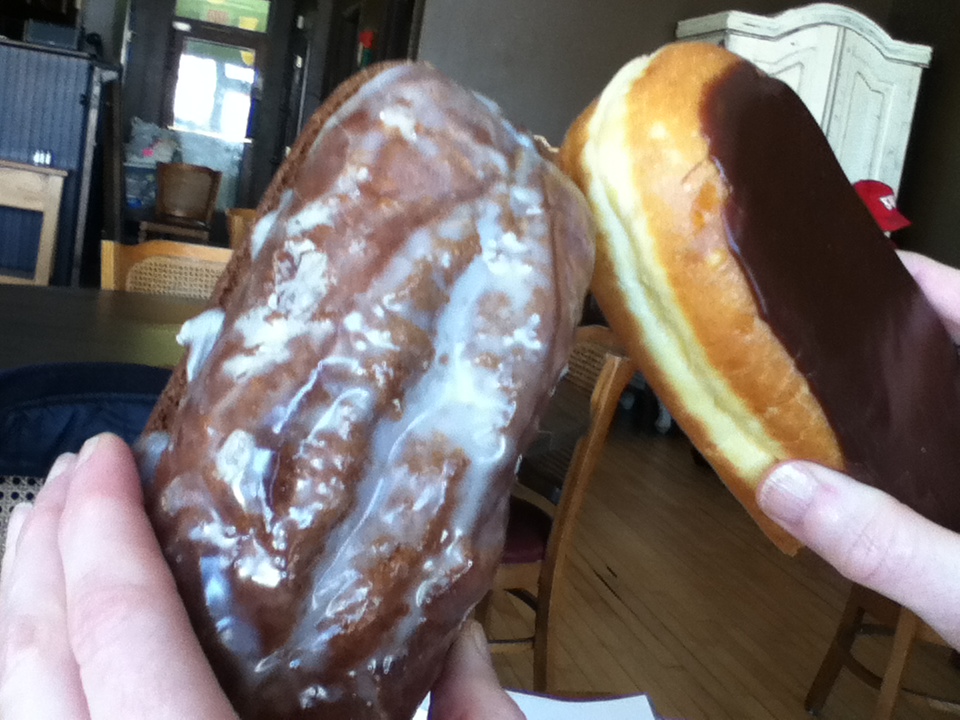
Living the dream, one doughnut at a time

"One doughnut at a time." katherinewikoff.com

“Cheers!”

I met my writing buddy, Lisa, for coffee this morning at our favorite spot, Cranky Al’s in Wauwatosa (an older Milwaukee suburb).  Both of us are busy working moms, struggling to balance all of the other demands on our time with our work as writers. 

We try to meet once a month to read each other’s work and offer feedback and encouragement.  Sometimes one of us will have had a more productive month in terms of pages, while the other will have read a great book or gone to a conference and can share insights from those experiences.  It’s the moral support of a kindred spirit that keeps me finding ways to fit the work into the nooks and crannies of my day.

Often when I’m writing, I think about Lisa as my reader.  Will she like this word choice or the logical way I’ve structured this sequence of thought?

Or I think of the women in my writing group: Jo, Karen, Donna, Kathleen, and more recently Jessica and Anne.  I’ve known the first four women for over 20 years now.  We’ve been together through numerous novels, plays, poetry, articles, and even a screenplay, not to mention births and deaths and cancer and just about anything else life can throw at you. 

How fortunate I am to have met all these women!  Not only are they friends in real life; they’ve also been most cherished companions in the life of my imagination. 

Writers need other writers in their lives, just as artists need other artists and musicians need other musicians, if only to validate our own idiosyncratic ways of “being” in the world.

The title of today’s post?  That’s our new motto, courtesy of Cranky Al’s, where the pizza is delicious, too.

Posted in Life, Writing, blogging | 3 Comments

I’m back (hopefully . . .)

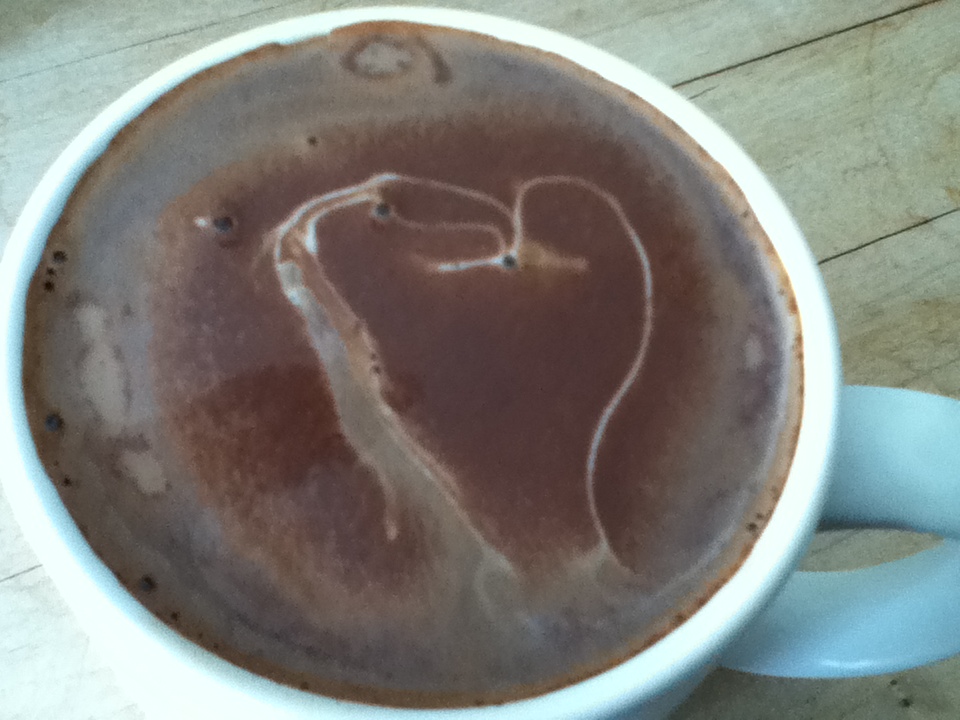
Here’s what happens sometimes when I’m not even trying.

katherinewikoff.com

I have been away from blogging for over a month because my offline responsibilities have claimed the lion’s share of my attention.  Family, job, that sort of thing.

Part of the problem, too, is that I’ve gotten into the habit of writing long posts.  Although I’ll definitely continue doing that, I can also see that my perfectionism has kept me from posting at all.  So, inspired by Sheryl Sandberg’s advice to “lean in,” I’ll try to focus on gettting something up a couple times a week, even when I don’t feel I have anything “perfect” enough to share.

It’s called a blog, after all.  Short for web log and originally meant to be an online diary.  Not a literary magazine or a professional journal.  Just little snippets.

I think I can handle that.

Posted in Life, Writing, blogging | Tagged , , , , | 2 Comments

January raindrops

January raindrops 

Today we are supposed to hit a record-high temperature of around sixty degrees.  Heavy fog during the night and early morning gave way to rush-hour rain.  By the time I took this photo, right before teaching my first class of the day, the rain had stopped, leaving beads of water speckling the window of our department office.

Although I can’t make the picture any bigger on this page, if you click on the photo itself, you can enlarge it to see the droplets in clearer detail.

In typical Wisconsin fashion, today’s predicted high of 60˚ will be followed by Friday’s predicted low of −2˚.

Posted in Milwaukee | Tagged , , , , | 4 Comments

Affect versus effect: which is which?

In commenting on the dash–hyphen post a couple days ago (and that’s an en dash between the words “dash” and “hyphen” 🙂 ), Kathleen suggested that I write a post about “affect” and “effect.”  Great idea!  Using “affect” and “effect” correctly can be tricky because each word can be both a verb and a noun.  So here goes.

Usually “affect” is a verb, and “effect” is a noun.  Affect is the action, and effect is the thing resulting from that action.  When something affects something else, it causes an effect.

One way to remember this is that “a” comes before “e” in the alphabet, and something has to Affect something else to cause an Effect.  The “a” word happens first, and the “e” word happens second.  The “e” word is a result of the “a” word.  So if you’re writing about a thing that has been caused by something else, then the word you want is “effect.”

The bad weather affected people’s moods.

One effect of the bad weather was grumpy people.

The bad weather affected people’s moods.  After that “affecting” occurred, there was an “effect” (which was grumpy people).  Also, notice that the “e” word happens second (as a result of the action); but it doesn’t necessarily have to go second in terms of word order within the sentence

In addition, the words “of” and “on” are often associated with “effect.”

One effect OF the bad weather . . .

The bad weather’s effect ON people was . . .

One effect the bad weather had ON people was . . .

What makes “affect” and “effect” harder to keep straight is is the fact that sometimes “affect” is a noun and “effect” is a verb.  These are used in pretty limited contexts though.

“Affect” as a noun is a term from psychology, referring to a feeling or emotion as opposed to a rational thought.  You would rarely use “affect” as a noun in ordinary writing situations, I’m guessing.  The place I’ve seen it used most is in fiction when, for example, an author describes a character’s emotionless tone of voice by saying it has a “flat affect.”

“Effect” as a verb is much more common than “affect” as a noun.  Fortunately, though, it is used in an extremely narrow sense.  When used as a verb, “effect” means to create, to make, to bring into existence.  It is often used together with the word “change,” as in to “effect change.”

NOTE: I have often seen affect/effect misused in this context.  To “effect” change is to “create” change.  To “affect” change would be to “influence” change.  For example, someone could negatively “affect” change by slowing it (change) down.  But someone could negatively “effect” change by creating bad laws that could hurt people.

Sometimes “effect” is used as a noun that almost seems derived from the word as a verb.  To say that a law takes “effect” on a certain date means that the law comes into existence on that date.  The law may have already been “effected” (created) by the legislature, but it doesn’t officially exist until the date it takes “effect” or becomes “effective.”

The main thing to remember with “affect” and “effect,” though, is that in almost every case you’d ordinarily use these words, “affect” will be a verb meaning to influence or modify, and “effect” will be the noun that follows from this influencing or modifying.

“A” before “e.”

Does that make sense?

Posted in Grammar, punctuation, usage, mechanics | Tagged , , , , , , | 7 Comments

Hyphen or dash: What’s the difference, and when to use which?

Here’s a punctuation “issue” that people have asked me about lately: what’s the difference between a hyphen and a dash, and when do you use which?

Difference #1 — a hyphen is short, and a dash is long.  In Morse code, hyphens would be like the “dots” while dashes would be like, well, the “dashes.”

Difference #2 – a hyphen pulls things together, but a dash pushes them apart.

In the olden days of typewriters, if you had to split up a word at the end of a line, you “hyphenated” it (at a syllable break only!) to “pull” the word together from the end of one line to the beginning of the next.

A line might look some-

thing like this

Hyphens are used to create adjectives from two words:

An old-fashioned ice-cream social

A well-deserved honor

A time-sensitive document

Hyphens also pull together compound nouns before they become commonly accepted as one word.  For example, the noun “make-up” is now usually spelled “makeup.”

(Disclaimer: make sure you’re using “makeup” as a noun, as in cosmetics, if you leave out the hyphen.  If you use it as verb, it’ll be two words: I have to “make up” a test.  If it’s an adjective, it’ll be hyphenated: I have to take a “make-up” test after school.)

For a long time electronic mail was referred to as E-mail or e-mail; now I most commonly see it as “email.”  So if you can remember this progression from 1) two separate words to 2) a hyphenated word to 3) one single, new word, then it may be easier to remember what a hyphen does: it pulls things together.

Dashes, however, push things apart.  There are two kinds of dashes (who knew?), one short and one long.  The shorter dash is called an en dash; the longer is called an em dash.  They are named for the letters “n” and “m.”  An “n” is shorter (one hump) than an “m” (two humps).

Here’s a handy visual to show the differences in length:

Hyphen vs dash

The en dash is used either to show a range of numbers or to indicate a relationship pair; it replaces the word “to” or “and”:

Do the problems on pages 61–70 for homework.

World War II (1940–1945) truly spanned the globe, with battles fought on several continents and at least two oceans.

The Army–Navy game is always must-see viewing in our house.

That last sentence used both an en dash (to indicate the pair of rivals) and a hyphen to create the adjective that describes what kind of viewing (must-see) occurs.  Often you might see a hyphen incorrectly used to punctuate the Army–Navy game.  But Army and Navy aren’t two terms getting pulled together to create one whole new concept, as in American-style football.  Army and Navy are the two rival teams competing in this event; they are distinct from each other, so they need the dash to maintain their separation/distance.  It’s the Army and Navy game, like the current Presidential administration is the Obama–Biden (Obama and Biden) administration.

Em dashes are used to forcibly separate ideas within a sentence—like this.  I could have used a comma to accomplish the separation, like this.  But using a dash calls attention to the words “like this.”  Like commas or parentheses, em dashes used in the middle of a sentence come in pairs:

Using dashes in the middle of a sentence—like this—provides a much stronger break (and, thus, emphasis) than using commas.

Sometimes it’s a nice stylistic twist to open a sentence with a list, and then use a dash to close the list and follow it with the thing that all of the listed items constitute:

Wife, mother, confidante, assassin—Mary juggled many roles in her life.

(Where did that come from?  Too many thrillers and mystery novels, I guess.)

Here’s how to make en and em dashes in Microsoft Word.  Probably there are more elegant ways than this, but I haven’t found them.

To make an en dash: After typing the last character before the en dash, type a space by hitting the space bar.  Then type a hyphen.  Type another space.  Then type your next numeral or word.  Type another space.  As soon as you hit the space bar following the second numeral or word, the hyphen you typed will turn into an en dash.

To make an em dash: After typing the last word or character before the em dash, immediately type two hyphens, right next to each other in a row.  Don’t type a space before those hyphens, as you would if you wanted to make an en dash.  After typing your two hyphens, immediately type your next word.  Then type a space.  As soon as you type the space after the word that followed your two hyphens, the two hyphens will turn into an em dash.

(Update: As soon as I published this post, I realized that the more “elegant” way to make en and em dashes would probably be to “insert” them as symbols.  I had never thought of doing that before, duh.  So I checked, and sure enough found ’em!)

So I think that about does it for hyphens and dashes.  Hope this is helpful 🙂

Would you like new posts delivered to your inbox? To subscribe, click here.

Posted in Grammar, punctuation, usage, mechanics | Tagged , , , , , , | 8 Comments

As inauguration nears, check out the Smithsonian’s “First Ladies” exhibit

As preparations accelerate in advance of of President Obama’s second inauguration on Monday (which is also Martin Luther King, Jr., Day), one of the biggest stories coming out of Washington is Michelle Obama’s new “bangs” hairstyle.  I bring this up not to trivialize Mrs. Obama’s overall achievement and intellect.  She is an attorney, which is to say the that the gray matter under those bangs is pretty formidable.

But the attention generated by her hairstyle change reminds me of Hillary Clinton, also an attorney, who changed her own hairstyle many times seemingly in response to press criticism of her liking for headbands back in 1992.  Now, as she finally leaves behind her own powerful positions as a U.S. Senator and Secretary of State, I am glad to see her return to that long-haired style she apparently always preferred to the various bobs and dress-for-success short haircuts I suspect she adopted to shut up the media sniping.

While it’s annoying that women’s appearance continues to attract such intense interest — especially when the women in question are so intelligent and accomplished — there must be something in our human nature that compels us to focus on hair and clothing as some sort of marker, even as some better part of us acknowledges how superficial it is.

Which brings me to my main reason for posting today.  I came across a reference to the First Ladies exhibit at the Smithsonian and got way too sidetracked by the photos of First Ladies’ evening wear.

One of Martha Washington’s gowns is there (below)

as are gowns worn by many other First Ladies either to Inaugural Balls or to other White House functions.  Looking at their dresses is like looking at snapshots of fashion history.

Dolly Madison’s gown (below) is fashioned in the Empire style associated with the first wife of Napoleon Bonaparte, Joséphine de Beauharnais, and more recognizable to us moderns as that style worn by the Bennet sisters in our many film productions of of Jane Austen’s Pride and Prejudice.

Mary Todd Lincoln’s gown (below) has the full, pouffy skirt of the Civil War era.

The dresses of Lucy Hayes and Frances Cleveland (respectively, below) have the bustles so popular in the 1880s.

Florence Harding’s early 1920s dress (below) corresponds with the end of the floor-length-dress era for women’s daily attire.

The First Lady who followed her, Grace Coolidge, wore a flapper-style gown (below) reflecting the rise of the modern woman as the first quarter of the 20th century came to a close.

If you’d like to experience more of the Smithsonian’s First Ladies exhibit, go to http://americanhistory.si.edu/first-ladies/introduction.  There are many additional photos, and the discussion is fascinating.

(For the record, I like Michelle’s new hairstyle.)

Posted in History, Life | Tagged , , , , , | Leave a comment

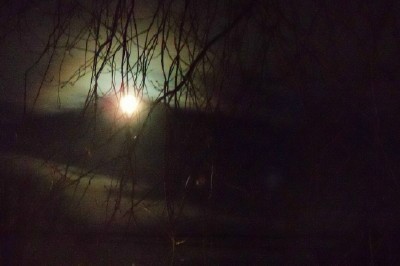
A Tim Burton full moon (photo)

Doesn’t this gorgeous full moon look like something filmmaker Tim Burton might order up? 

Moon and clouds a la Tim Burton

Actually, this is last month’s full moon (December 2012).  I had completely forgotten I’d photographed it until today, when I was working with some other pictures from my camera.

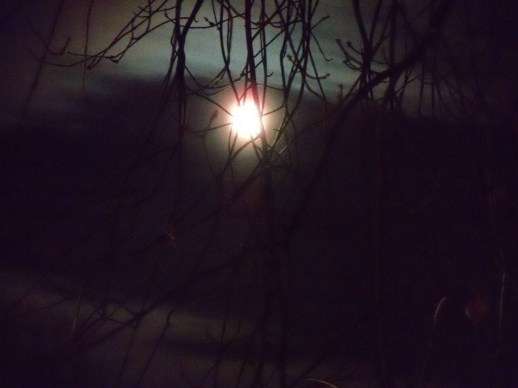
Here’s another photo, shot just a minute or so later.

Tim Burton moon - 1

Although its overall look doesn’t appeal to me as much as the first photo (I love the illuminated cloud strata in that one), I like how the moon in this second photo appears to be entrapped inside a thorny cage. 

What’s actually going on is that light from the moon was SO BRIGHT that evening as to completely obliterate the branches’ silhouettes where they crossed over the orb — thus, creating an impression of individual tree “fingers” clutching at it.

Cool, right?

Posted in Movies and film | Tagged , , , , | 2 Comments