If you build it, they will come: the importance of infrastructure for creativity and innovation

Here’s a little factoid I’d forgotten about until my husband and I were discussing the recent Presidential debates between Barack Obama and Mitt Romney:

The famous series of debates between Abraham Lincoln and Stephen Douglas were not held during the 1860 Presidential campaign but, instead, during their 1858 campaign to represent Illinois in the United States Senate. 

Douglas won; Lincoln lost.

Although the two men ran against each other for President two years later, they did not debate each other during their 1860 campaign.  While Douglas undertook a campaign tour on a rambling two-and-a-half month trip that ostensibly was to visit his mother (it was the first “nationwide” campaign ever, and his meandering “trip” was widely ridiculed), Lincoln stayed home following his nomination as the Republican candidate.  He conducted a “front porch” campaign, meeting with visitors but not giving campaign speeches in any form we would recognize as such today.

Fast-forward 152 years.  Today it’s not unusual for candidates to make campaign stops in a new state every day.  Robots relentlessly telephone voters at all hours urging support of various election-related issues.  Candidates’ tax returns and medical records are scrutinized for potentially scandalous minutiae.

Sitting home on his front porch, Abraham Lincoln could probably not be elected in 2012.

In the mid-1960s, Marshall McLuhan famously noted that “The medium is the message,” meaning not not only that “form” can never be truly separated from “content,” but also that in some ways form becomes the content.

What message does the medium of a modern Presidential campaign communicate?

And why am I talking about politics in my blog that’s supposed to be about “Ideas on creativity, innovation, lifelong learning, and other random stuff”?  (Although, I suppose, politics could count as other random stuff 🙂 )

Because I realized earlier this summer that the writing I’m doing in this blog is better (in my opinion) than writing I’ve done elsewhere, for example, in my dissertation or conference papers or even literary essays.  Always in those other formats I’ve felt constrained by the unwritten “rules” of the genre I’m writing in, whether concerning quotations, source citations, or even routine transitions from one topic to another.

When I was writing my Jonah Lehrer essay in early August, for example, it was so freeing to be able to talk about somewhat complex ideas in ordinary language.  Example:  the blog post begins with the phrase, “Well, the sad news last week was that Jonah Lehrer . . . admitted to fabricating quotes . . .”

That’s exactly what I was thinking, and those words best described what got me started thinking about all the stuff I went on to talk about in that post.

I don’t know what my opening line would have been had I needed to write the essay more formally, for a traditional print publication.  I would have needed to demonstrate that what I had to say was “important.”  Certainly I would have felt bound to contextualize my utterance more profoundly, perhaps situate my own remarks in contrast to or agreement with what other people were already saying.  I also might have opened with an authoritative quote regarding some other famous literary fraud.  Anything other than opening with a statement of my own personal sadness for Lehrer and my dismay that his book was no longer available for me to read.

In other words, I might not have gotten around to writing the piece at all because the “form” would have inhibited my ability to pull together my scattered thoughts into a coherent articulation.

One moment in particular stands out in my memory of writing the Jonah Lehrer post.  I had just finished discussing the possiblity that student plagiarism in college classrooms might sometimes be a phenomenon related to writing growth.  Now I needed to return to talking about Lehrer, who obviously was not a student writer.  Tricky segue.  What commonality between the two topics could I find to make a smooth transition?

In another format (academic article, conference paper, newspaper article), finding the right transition would been a trouble spot for me.  Because it was my blog, however, I just breezily wrote: “But back to Jonah Lehrer, who is neither student nor apprentice.”

I remember thinking how easy – and liberating – it felt to write that sentence.  “But back to Jonah Lehrer . . .”  Done.  I couldn’t have gotten away with such a loose connecting sentence anywhere else.

So, again, you may be wondering: my point is . . . ?

Just this:  Infrastructure matters.  A lot.

Anyone who teaches composition knows the “Five-Paragraph Theme.”  Even if you’re not a writing teacher, you’ll no doubt recognize the format instantly.

In the first paragraph, the writer introduces the topic and finds a way to break it down into three subparts.  Then the next three paragraphs are devoted to discussion of each individual subpart.  The final paragraph summarizes what has just been said, often with instructions to restate the thesis.

Five paragraphs, hence the name.

The five-paragrah structure is a handy tool.  But while a good writer can write a beautiful essay using the form, a weak writer does nothing except fill the container, usually mistaking a declaration of topic for a thesis:

A certain topic is very important to know about, and in this essay, I will discuss three things related to it.

First thing.

Second thing.

Third thing.

In conclusion, three things about this topic were discussed in this essay.

In most five-paragraph student themes, the medium is the message.  You can fill in the blanks with anything.

Recycling is very important in our world today.  The most common types of recycling that everyone should know about are paper recycling, metal recycling, and glass and plastic recycling.

[Note to reader: glass and plastic are obviously two things, but students who are desperate to have three categories, because they believe they are only allowed to have three categories, will find a way to combine them into one thing.]

Paper recycling involves x.  Paper items that should be recycled include x.  The paper recycling process is x.  The end result of paper recycling is x.

Metal recycling involves x.  Metal items  that should be recycled include x.  The metal recycling process is x.  The end result of metal recycling is x.

Glass and plastic recycling [treated as a single unit, remember] involves x.  Glass and plastic items that should be recycled include x.  The glass and plastic recycling process is x.  The end result of glass and plastic recycling is x.

It is clear that recycling has many benefits for society.  It is important for all of us to do our part in protecting the environment.

Empty writing.  The reader is left to wonder: so what?  What is the point?  Where is the thesis?  What value has this writer added to society’s conversation regarding recycling?

Ironically, instead of enabling student expression, the five-paragraph theme shuts it down.

Aristotle defined rhetoric this way:

the art (or faculty) of finding (or discovering or observing) the available (possible) means of persuasion in a given case

The parentheses indicate different translations I’ve found for the original Greek, and it is very interesting to think about the different shadings of definition carried in the alternate terminology.  Not knowing Greek myself, I figure Aristotle’s original meaning lingers somewhere in the aggregate, so I’ve included all the terms I recall ever seeing.

The word “faculty” refers to an innate ability a person has, like the faculty of sight or speech.  “Art” is in oppostion to “dialectic,” “logic,” and “science.”  For me, “art” also connects to Peter Elbow’s distinction between the “Learning Game” and the “Doubting Game,” which I wrote about this past summer.  Science involves certainties and facts; art involves uncertainties in the form of emotions, feelings, and opinions.  The Doubting Game, as Elbow points out, exists in a closed universe that limits inquiry; the Believing Game exists in an infinite universe that allows unfettered inquiry.

Which brings me to another metaphor for rhetoric: the “Open Hand” of Zeno, a Stoic philosopher in ancient Greece.  One of the elder statesmen of my field (rhetoric and composition studies), a man I was privileged to meet in graduate school, was Edward P. J. Corbett.  Andrea Lunsford, a Stanford professor whom I would describe as probably the chief luminary in our field today, studied under him.  In a famous 1969 article, “The Rhetoric of the Open Hand and the Rhetoric of the Closed Fist,” Corbett appropriated Zeno’s closed fist and open hand metaphors as a way to differentiate logic/dialectic from rhetoric.

(Let me pause a moment to say thank you for hanging in there with me if you’re not a composition teacher yourself.  I’m almost finished with this meandering lead-up to my main point.)

Logic is a form of inquiry concerning empirical fact that exists inside a closed universe, like Elbow’s “Doubting Game.”  Hence, the closed fist.  Rhetoric is a form of inquiry concerning belief and opinion that exists inside of an open universe, like Elbow’s “Believing Game.”  Hence, the open hand.  The method of logical inquiry is via syllogism; the method of rhetorical inquiry is via enthymeme.

Aristotle’s Rhetoric contains discussion of “enthymeme,” but it is a confusing concept to understand  In fact, many composition textbooks completely misinterpret the enthymeme as nothing more than a truncated syllogism.

Here is a logical syllogism (the one composition texts usually use):

Socrates is a man.

All men are mortal.

Therefore, Socrates is mortal.

A syllogism is like a math equation.  If your premises are true and your argument structure is valid (i.e., not a logical fallacy), then your conclusion is unassailable.  It absolutely must be true.

An enthymeme looks very similar to a syllogism, which is why composition textbooks get it so wrong.  Building on the syllogism above, textbook writers assert that an enthymeme is a syllogism with a missing premise.  In rhetoric, the authors say (incorrectly), you don’t want to bore readers by making them read all the way through a tedious syllogism, so you save time and allow them to feel like they’ve constructed the argument themselves (which makes them buy into the argument more deeply) by leaving out some of your premises.

Here is an example of such an incorrect, so-called enthymeme:

Socrates is a man.

Therefore, Socrates is mortal.

But this is not an enthymeme; it is, in fact, nothing more than a syllogism with a missing premise.  It is about logic and empirical fact, not about rhetoric and opinion/belief.

Here is an actual enthymeme:

Socrates is a man.

Therefore, Socrates looks forward to watching the football game on Saturday.

The difference is that an enthymeme’s missing premise is a matter of opinion/belief rather than empirical fact:

All men enjoy watching football games.

A good writer will be able to employ an enthymeme effectively ONLY if he understands his audience and knows that they will automatically assent to the “truth” of that missing premise.  Not all men enjoy watching televised sports every weekend, but if the writer guesses correctly that this premise reflects a generally held opinion of his audience, then most audience members will accept it as a true statement within the context of the writer’s argument.

In fact, a better analogy for an enthymeme is not a syllogism but a joke, instead.

A joke employs a premise or premises that eventually lead to a punchline.  That punchline only works, however, if an audience can supply the missing premises and will assent to their “truth.”  A comedian needs to know his audience well.  If audience members lack knowledge about the topic, they will not “get” the joke.  If audience members hold an opinion about the topic contrary to the punchline “conclusion” the comedian wants them to reach, they may “get” the joke, but they will not find it humorous.  Instead of laughing, they will feel insulted, even angry.

So, finally, pulling all of these thoughts together, here’s what I mean when I say that infrastructure matters.

Creativity and innovation do not occur in a vacuum.  Context is everything.  If companies, schools, and societies want to encourage creativity, they need to lay a good foundation, prepare the soil, set the stage, whatever metaphor makes sense for you.  Creativity requires an environment in which it can naturally occur.

Infrastructure is as important as “getting the right people on the bus,” to use an expression I hear a lot.  But getting infrastructure right is tricky because you’re dealing with the human beings who will be riding that bus.  Just as rhetoric (or comedy) requires judgment (in building enthymemes or jokes), no single “right” formula exists for building a creative environment.

In politics, the 1858 debates allowed Lincoln to express his intellect and grasp of key issues in a way that was still remembered in the Presidential election two years later.  The front-porch campaign worked for Lincoln because people cared enough about the ideas he’d put forward in 1858 to come and visit him in 1860.  In the first televised Presidential debates of 1960, John F. Kennedy famously won against Richard M. Nixon among those watching the television broadcast but lost among those listening to the radio broadcast.  The medium was the message.

In student writing, the five-paragraph theme usually signals empty, passive content that merely compiles and organizes commonplace knowledge about a topic.  The medium is the message.

Pixar, Apple, and Google are famous for providing environments in which creativity and innovation flourish.  So is 3M, as immortalized in countless books and articles (including Jonah Lehrer’s Imagine) for its tale of near-mythic status recounting the invention of Post-it® notes.

This post is already ridiculously long, so I’ll write another one later in the week about the in-house infrastructure these companies provide to promote creativity and innovation.  Meanwhile, suffice it to say, you reap what you sow, you get what you pay for, etc., etc.  I have read and thought quite a bit about creativity and innovation over the past 15 years.  The most reliable “engine” for generating them appears to be the lifelong learning mindset produced within a framework that encourages individuals to cultivate their own curiosity and exploration.  The medium is the message; form becomes content.

In business and industry, as in education, if people are given a challenge and then provided the necessary time, space, and social infrastructure to do the work, they are capable of astonishing ingenuity.

Would you like new posts delivered to your inbox? To subscribe, click here.
Posted in WPLongform (posts of 1000 words or longer), Writing, blogging | Tagged , , , , , , , , , , , , , , , , , , , , , | 1 Comment

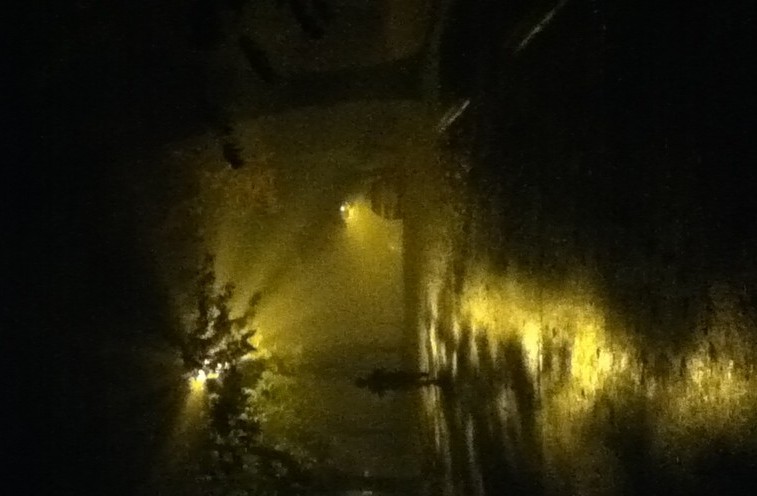
Runner in the night fog

It’s a foggy evening here in Milwaukee.  Only after I’d already taken this photo did I realize that someone was running toward me down the middle of the street.  Kind of an eerie night, but peaceful and quiet.  Nothing except the sound of dripping water . . . and this runner’s footsteps.

Posted in Milwaukee | Tagged , , | 5 Comments

Lynyrd Skynyrd – 35 years later

I just realized that yesterday was the 35th anniversary of the plane crash that killed three members of the Lynyrd Skynyrd band, including lead singer Ronnie Van Zant, and several members of their crew.

High school dances are mostly DJ-powered today, but back when I was in high school, local bands provided the music.  “Sweet Home Alabama” and “Freebird” were two of the most-played songs.  Those and Led Zeppelin’s “Stairway to Heaven.”  (A music-store salesperson once joked with my husband about how every kid coming in to try out guitars played the same song: “Stairway to Freebird.”) 

When Handel wrote “The Hallelujah Chorus,” he said the music so moved him that “I did think I saw heaven open, and saw the very face of God.”  While I could certainly never go quite that far with “Freebird,” I do get chills at the point where the song transitions from the first part’s slower ballad section to the hard-rocking section of the second part.

One of the funniest uses of “Freebird” in film is the marvelous scene near the end of Elizabethtown.  As the cousin’s reunited old band is playing “Freebird” as a tribute at the memorial service for Orlando Bloom’s father, they attempt a rock-arena trick by sending a giant paper-mache bird soaring out into the hotel ballroom on a wire.  The bird catches on fire from the overhead lights, setting off the sprinkler system and causing the guests to evacuate as the band plays on with a joyful abandon that makes the tribute all the more touching within the context of the movie.  Watch it here on YouTube.

Ronnie Van Zant left behind two young daughters.  In poking around the Internet for more background info on the band, I came across this poignant video in which his older daughter, Tammy, now an adult, sings a song she co-wrote with Robert White Johnson, titled “Freebird Child.”

Would you like new posts delivered to your inbox? To subscribe, click here.
Posted in Movies and film | Tagged , , , , , , , , , , , | 1 Comment

Autumn leaves


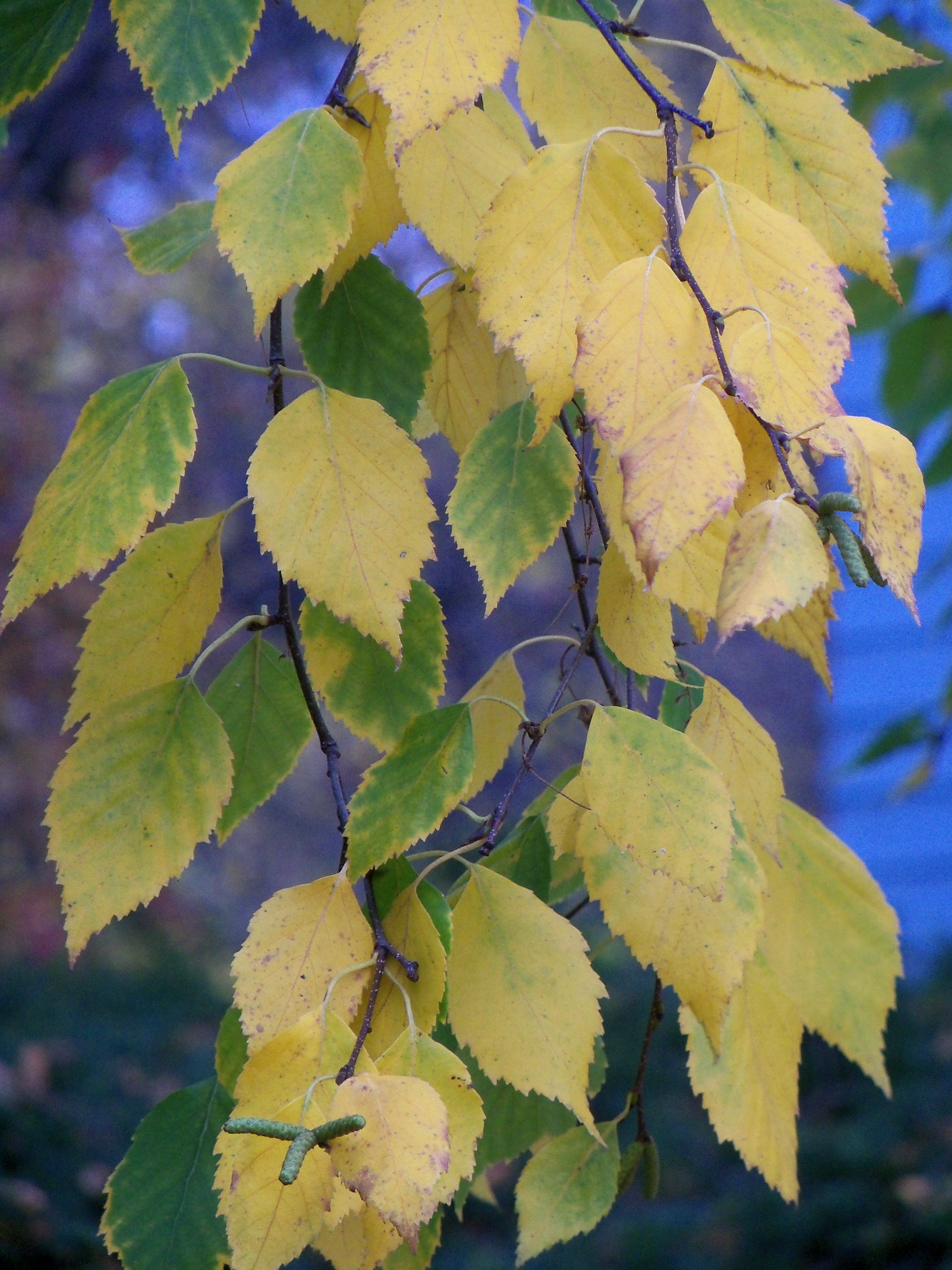
Last week I snapped a photo of a tree with yellow-orange leaves that glowed in the late afternoon sun.  I took that picture Friday as I left my office, and when I got to work again on Monday, that tree’s branches were almost completely bare.  A few moments later on Friday and I would have missed the sunlight; a few days later and I would have missed the leaves themselves.

Today was gray and wet.  It won’t be long until all the leaves have fallen.  I took a few pictures to remind myself of how pretty the colors are.

Because next week, who knows if they’ll still be around.


Posted in Uncategorized | Tagged , , , , | Leave a comment

What’s the difference between grammar, punctuation, and mechanics?

The title of today’s post is actually one of my blog’s categories, shown at the lower right-hand side of the screen.  Someone was wondering about the difference, so I thought I’d explain.  What follows here is not dictionary-type definitions, but rather my own “feel” for each of these terms after teaching English for many years.

I hope it’s not too boring 🙂

GRAMMAR refers to the way words are put together to make units of meaning.  Below are some grammar-related terms.  I’ll run through them in a way that builds cumulatively.

A phrase is a group of words that fit together to mean something.  So “over the river” and “through the woods” are both phrases, while “up tennis cold” is not.  A phrase does NOT have both a subject and a verb.

A clause builds on a phrase.  It is a group of words that fit together to mean something, and it DOES have both a subject and a verb.  There are two kinds of clauses: independent and dependent.

An independent clause can stand alone.  A “simple sentence” is one independent clause:

The rain ended.

We went outside.

A “compound sentence” has two or more independent clauses, joined by a conjunction (i.e., and, but, or, nor, so, for) OR by a semicolon or sometimes a colon:

The rain ended, so we went outside.

The rain ended; we went outside.

A dependent clause looks almost like an independent clause, except it has a word at the beginning that causes it to be unable to stand alone.  Here is a dependent clause:

After the rain ended

This dependent clause can’t stand alone as a complete thought, because we’re still waiting to find out what happened once the rain ended.  However, once you add an independent clause to the dependent clause, then you get a complete thought.  And a sentence that has both a dependent clause and an independent clause is called a “complex sentence”:

After the rain ended, we went outside.

We went outside after the rain ended.

Sometimes you can have a compound-complex sentence, which would be some combination of at least one dependent clause and multiple independent clauses:

After the rain ended, the sun broke through the clouds and we went outside.

Because grammar involves the way we structure our sentences, this category includes the eight “parts” of “speech”: nouns, verbs, pronouns, adverbs, adjectives, prepositions, conjunctions, and interjections (like “ouch!”).

Different languages have different grammars.  In English, for example, an adjective comes before the noun it modifies:

the red ball

Whereas in French, an adjective comes after the noun:

le ball rouge (the ball red)

Grammar can be “prescriptive,” meaning a rule you’re supposed to follow, or the way your sentences should be.  Or grammar can be “descriptive,” meaning a rule that describes the way things are, just like how the “rules” of physics describe how gravity actually works, not how it ought to work.

So that pretty much wraps up grammar: it’s about the rules that govern the way we structure our thoughts in language.

PUNCTUATION refers to the “symbols” we use to help people read/process sentences the way we want them to be heard and understood.  I always think of this as similar to musical notation.  A musical score has all kinds of symbols that specify things like volume, speed, key, “crispness” (for lack of a better word), slurred passages, etc.

So punctuation takes the form of “marks,” as in “marks of punctuation.”  Here are a few common marks of punctuation:

  • .   period
  • ;   semicolon
  • :   colon
  • ,   comma
  • ( )   parentheses
  • !   exclamation mark
  • ?   question mark

I know you know all of these, so I won’t go on.  There are lots of punctuation rules; I’m sure I’ll eventually end up talking about them in future blog posts.

As with the grammar rules, punctuation rules sort of build out on themselves.  Sentences end with periods.  Compound sentences have a comma before the conjunction, but if there is no conjunction, there should also be no comma (for then you would have the error known as a “comma splice,” which means you’ve semi-attached two independent clauses together with inadequate punctuation).  If you don’t use a conjunction, then you join the two independent clauses with either a semicolon or a colon.

So with punctuation you go from the simplest, most clear-cut mark (the period) to the more difficult choices.  But there is always a logical train of thought.  For the most part, punctuation rules follow common sense, and the rules themselves can (and should) be bent if necessary to help readers “get” what you are trying to say.

MECHANICS refers to all the arbitrary “technical” stuff in writing: spelling, capitalization, use of numerals and other symbols, etc.  These are conventions, and you just have to memorize them.  For example, you should never begin a sentence with a numeral:

NOT: 2012 is an election year.

BUT: Twenty-twelve is an election year.

OR: Remember, 2012 is an election year.

Another one you’ll know if you have a strong science background: you use the degree symbol ( ° ) with Farenheit and Celsius temperatures but not with Kelvin.  (And here’s a temperature scale I know nothing about: Rankine.  It also uses the degree symbol.)

Spelling falls into the “mechanics” category, as does capitalization.  Proper nouns (names) are capitalized.  Therefore, things named after people are also capitalized, like a Bunsen burner.  But only the “name” part is capitalized.  Note that “burner” is not capitalized.

USAGE refers to the way language is used.  Correct usage is “correct” only insofar as “experts” agree upon a particular “rule.”  Usage applies to everything talked about so far in this blog post: grammar, punctuation, and/or mechanics.

The most interesting and important thing to know about “usage” is that usage rules change over time and with shifts in context.

For example, when I first started teaching freshman composition, the English teacher’s “rule”  was that someone using the plural “their” with the singular “everybody” (instead of “his” or “her”) would be guilty of a grammar error.  Eventually, my fellow teachers and other experts (journalists, editors, writers, etc.) came to a somewhat general agreement that because no good alternative exists, the plural pronoun is not an error worth correcting.

Here’s another grammar-related change that has occurred relatively recently.  “Data” is now usually considered a singular unit rather than a plural (in Latin, datum is the singular; data is plural), so it takes a verb like “is” and a pronoun like “it” (as it just did in this sentence 🙂 ).

Usage can vary from culture to culture.  In the United States, collective nouns (like committee, audience, faculty) are considered singular, but in England, they take the plural form:

The audience shows its appreciation through applause. (United States)

The audience show their appreciation through applause. (England)

OR

The committee is meeting this morning. (United States)

The committee are meeting this morning. (England)

Because usage evolves, it’s fascinating to encounter a time capsule of a previous era’s language, as in an old book.  I picked up a novel by Gene Stratton-Porter at my grandmother’s house when I was very young (Freckles was its title, a 1904 book in the Horatio Alger tradition), and some of the strange spellings puzzled me greatly.  One of them, “good-bye,” didn’t seem that odd to me because I think when I was a kid, it was actually often still spelled like that (with the hyphen).  And actually, I’ve seen it recently in subtitles while watching the “Downton Abbey” series. But the spelling of “to-morrow” with a hyphen was completely foreign to me.

Expert consensus regarding “correct” usage is reminiscent of the divide mentioned above between “prescriptive” versus  “descriptive.”  Experts can expound upon the way they believe something ought to be OR they can observe common practice and say that’s the way it actually is.

One of the things I love about American English is the way it is constantly reinventing itself.  Although this may also be the case with other languages, I know that some languages (e.g., Spanish and French) have official governing bodies intended to standardize and protect them from the influence of other tongues.

American English is nowhere near so pure.  It’s a dynamic reflection of our very messy, exuberant history and culture.  As such, it’s extremely democratic.  If someone creates a clever spelling, an especially apt way to punctuate, or a new word or catchphrase, others will notice and adopt it as soon as they recognize its value.

Our language’s lack of order is also, ironically, a unifiying force.  Because America’s people come from such disparate backgrounds, it can be challenging for us to share a national sense of “self.”  The ability of American English to embrace, adapt, and morph so rapidly helps put everyone on the same page, so to speak.  Expressions have currency, and if you are quick to pick up on a new way of saying something, you can join the “in” crowd’s conversation.  You belong.

And now, as Aristotle would say: so much for the difference between grammar, punctuation, and mechanics.

Would you like new posts delivered to your inbox? To subscribe, click here.

Posted in Grammar, punctuation, usage, mechanics, WPLongform (posts of 1000 words or longer), Writing, blogging | Tagged , , , , , , , , , , , , , | 77 Comments

Happy birthday, Rod Temperton!

Today is Rod Temperton’s 65th birthday, according to Wikipedia.

For reasons I’m not completely sure of, I’ve always paid attention to songwriting credits.  Michael Jackson’s Off the Wall album had three really great songs written by someone named Rod Temperton: “Off the Wall,” “Rock with You,” and “Burn this Disco Out.”  The name was so unique that I never forgot it.  Over the years I’d see his name pop up again and again.  Temperton is an incredibly talented songwriter. 

Just look at this partial list of Temperton’s songwriting credits (some songs co-written with others):

  • “Boogie Nights,” “The Groove Line,” and “Always and Forever” (during his time with the group Heatwave)
  • “Yah Mo B There” (James Ingram and Michael McDonald)
  • “Give Me the Night” (George Benson)
  • “Man Size Love” (Klymaxx, from the movie Running Scared)

If you link to the Wikipedia article at the top of this post by clicking on Temperton’s name, you’ll see a much longer list of songs. 

But I’ve saved the best for last.  Temperton also wrote “Thriller,” the song that powered Michael Jackson’s monster music-video masterpiece (an annual Halloween must-see 🙂 ). 

Watch the Thriller video here, at the official Michael Jackson website, if you have fifteen minutes.  (And here, in this clip from 13 Going on 30, you can watch Jennifer Garner save a party by getting everyone to do the Thriller zombie dance.  Plus you can see the “moonwalk”  done by Andy Serkis, who played Gollum in Lord of the Rings.) 

Happy birthday, Mr. Temperton!  And many happy returns.

Posted in Uncategorized | Tagged , , , , , , , , , , | 1 Comment

Sonia – Blues Radio DJ

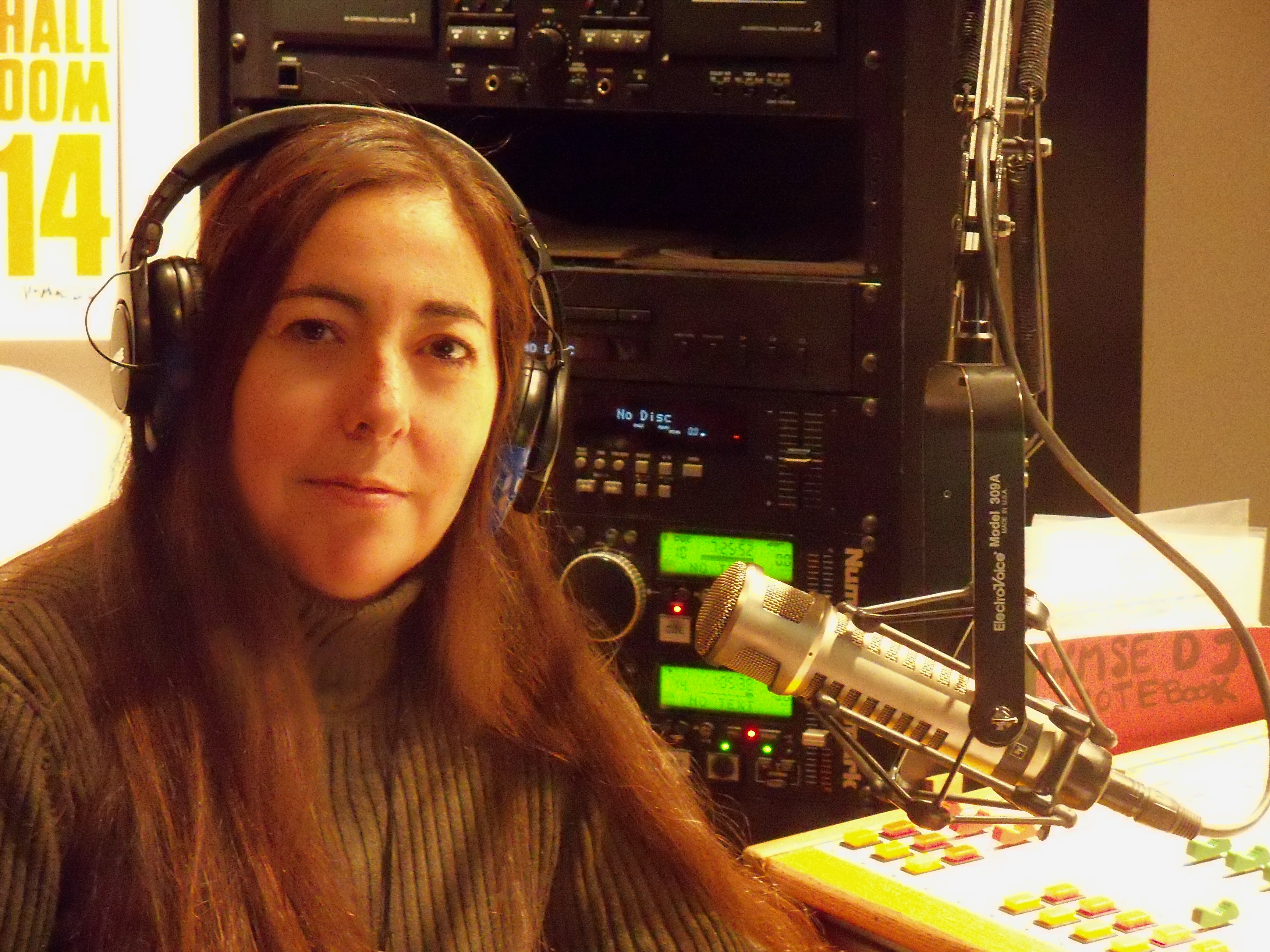
Last week Friday I was fortunate to spend time in the radio booth with Sonia, who hosts “The Blues Drive” every Friday afternoon on 91.7 WMSE (“Frontier Radio, anti-established in 1981”), a radio station owned and operated by Milwaukee School of Engineering, where I teach.

Sonia in the WMSE studio – October 5, 2012

The WMSE radio station website carries this bio page on Sonia:

Sonia is WMSE’s resident authority on the blues and blues history. She has written articles on the history of the blues and blues musicians for many magazines and brings this knowledge to her weekly playlist. Sonia has also interviewed many of the greats on her show such as BB King, Philip Walker, Taj Mahal and on and on and on. This show proves time and time again to be a unique listening experience in the living history of the blues.

I asked Sonia, “Why the blues?”

The first music she remembers listening to was her parents’ records.  She heard Andrés Segovia (the Spanish virtuoso guitarist) playing Bach – “the most beautiful music I’ve ever heard” – and recognized, as a four-year-old, that “music has the ability to be sublime and cathartic for a listener.”  Her brother had records from the Columbia House mail-order music club, so she listened to his music.  As a teen, Sonia attended concerts at the Oriental Theater, Summerfest, and the Jazz Gallery, where she encountered acts like the Kinks and Lou Reed.  And also as a teen, she heard B.B. King, whom she describes as “an ambassador” for the blues.  (All of this background information, and more, can be found on the WMSE website blog feature “Get To Know Your WMSE DJ – Sonia.”)

Sonia has turned her passion for blues into an artistic outlet that has endured in Milwaukee radio for nearly 25 years.

In addition, for the past 12 years Sonia has regularly taught a course on blues music through the University of Wisconsin-Milwaukee School of Continuing Education.  To find new topics each time the course runs, Sonia focuses on a certain instrument (piano or harmonica, for example) or the music of a certain region (Delta blues) or gender (women of the 1920s and ’30s) or playing technique (fingerstyle blues).  This past June her course was titled, “Coffeehouse Blues: The Folk Blues Revival” (Sonia’s course description is on p. 6).

During the Spring 2013 semester, Sonia will be teaching English 360: The Art of Poetry. A Voice without Restraint: The Poetry of Bob Dylan for the U.W.M. English Department, where she holds her primary teaching position.

How did Sonia get started in radio?

“I attended the University of Hawaii-Manoa from 1984 to 1987.  I received a Master’s Degree in Creative Writing.  My Master’s thesis was a collection of short stories, entitled, What They Were Desperate For.  My boyfriend at the time called to tell me that WYMS [a radio station at that time owned and operated by Milwaukee Public Schools; the call letters stand for “Your Milwaukee Schools”] was running ads for women DJs.  There were very few women in radio at that time.

“I had been accepted into the Ph.D. program at New York University.  But it was a very expensive school.  So I thought I’d come back to Milwaukee to be a lecturer [at the University of Wisconsin-Milwaukee] for a year, but I was unable to go to NYU and stayed in Milwaukee.  I wrote a letter to WYMS and was accepted as a DJ.  There were several women at the station then.  We were called the ‘blues angels.’  I played blues for a while, but I also did a Jazz show at WYMS.

“I worked with Manny Mauldin, who said that he was the first Black DJ in Milwaukee.  Mannie celebrated his 50th year in radio during the time that I had my show at WYMS.  We did the shows from Manny’s basement at 37th and Fond du Lac.  It was damp, cold, dim.  Water-damaged LPs.  We had a remote set-up, recorded reel-to-reel.

“I began with 3-6 a.m.; then 2-5 a.m.  From 1988-1994 I worked my way back in time from the middle of the night to evening: I worked 1-3 a.m., then 11-1 a.m., and finally 9:00 p.m. till midnight.

“While I was at WYMS, I had become friends with Jon Klotz, who went by the name J.K., who had a 9 a.m.-noon show at WMSE.  He needed a sub.  In 1990 he asked if I’d apply to WMSE to be a sub.  I took a year, then applied in 1991.  Never heard back.  My application had been filed away.  Tom Crawford, the station manager, finally discovered it and called me immediately.

“I went through a six-month training program, even though I already had several years of radio experience, and substituted for other disc jockeys’ shows for four and a half years before getting my own show.  I subbed for Dewey’s big band show, Pamela Means and Jasper Toast’s folk shows, Hal Rammel’s twentieth-century experimental classical music show, and Jerry and Dewey’s Friday afternoon rock music shows.  I was playing music from every genre.  For a while I had programs at both radio stations.  Saturday I was at WMSE live, 9:00 a.m. to noon.  I taped my WYMS show and would hear it driving down the street Saturday night.”

It worked out well for Sonia that she was just a sub during the early 1990s, for she was presented with two opportunities to teach and live overseas.  First she taught at the Malaysian Institute of Technology Shah Alam main campus from January to June 1991.  Then she spent two years at Justus Liebig Universität in Giessen, Germany, from 1994-1996.

Sonia returned to Milwaukee in 1996.  Back at WMSE, “Jerry could no longer do his time slot due to work commitments.  I took over his show, which at the time was from 2-5 p.m.”

 *          *          *

During her “Blues Drive” radio show, which airs 3-6 p.m., Sonia is amazing to watch.  She moves about the booth like a Zen master.  She rises from her chair to find a CD on the shelf, then sits back down at the console, fluidly opening jewel cases to remove and replace CDs, pressing buttons to cue the next song – all the while talking with me, answering my questions about when she discovered the blues and how she got started in radio.  She is unflappable, easily segueing from our interview conversation back into the maintenance of her show, swinging around to the microphone to tell listeners the title of a song that has just ended.  Every half hour she does the weather and public service announcements.

From my seat on the other side of the desk, it is like watching ballet.

When Sonia answers phone calls on the studio line, her voice is friendly and relaxed.

Hi. . . . Oh, that’s kind of you to say. . . .  Was there a song you wanted me to play?  (pause)  Oh, thank you . . .

So they’re getting married tonight over at the Harley-Davidson Museum?  I’ll mention them shortly.

“I’ve always lived my life in service to others, so my radio show fits with my value that it is important to serve other people.  I accommodate listeners, answer their questions.  I try to serve musicians by being prepared for interviews and doing my homework.  So it is a hobby that serves the community.

“The process is subconscious.  The subconscious is important in relation to the radio.  There is something that happens when you get into a flow.  Your mind starts making connections, and you realize you’ve been playing songs that fit with a theme.  At WYMS, once I read five books for a program that I prepared on British Blues.  I was immersed in doing shows that had themes, just like my courses.

“I have to be able to entertain myself.  I want to learn more about music, so I’ll take a chance.  I see new albums come in, and I take a chance.  I like to play musicians who are virtuosos with the instrument they play and offer something beyond the banal, who do bring something special to their craft.  When I came over to WMSE, I came into the more free-form vision.  Speaking of originality, I want to play songs from musicians who aren’t redoing what has already been done.  If a song has been done before, I want them to have their own arrangement.”

*          *          *

Sonia considers herself fortunate to have interviewed many, many musicians.  She has written many freelance articles, including a few for Living Blues Magazine, published by the Center for the Study of Southern Culture at the University of Mississippi.  Among musicians Sonia has interviewed are Jorma Kaukonen and Jack Casady, guitarist and bass player, respectively, for Jefferson Airplane and Hot Tuna.

“I think it is important to have a conversation, rather than an interrogation,” Sonia says.

One large, ongoing project is her biographical work on Chicago blues guitarist and singer Hubert Sumlin (1931-2011), who played with Howlin’ Wolf.  “We conducted approximately 60 hours of interviews at his home.  He was one of the greatest musicians of the twentieth century.  I interviewed him many times over the years.  He was on the radio program seven times; no one in the world has interviewed him that much.”

Sonia also interviewed Les Paul, the Wizard of Waukesha, twice.  The first time, Les was in Waukesha for a fundraiser related to establishing an exhibit in his honor at the Waukesha Historical Society. The second time was a week before he came to Milwaukee for the opening of the Discovery World Exhibit.  That interview was by phone from Paul’s home in New Jersey.  They spoke for two hours on the radio.

“Les Paul was an inventor.  He offers a good lesson on creativity.  We don’t invent out of a vacuum.  We rely on our environment and creativity that came before us.  He was able to look around a room, outside, and see another purpose.  And I recognize that as genius.  We draw purely upon what is around us, look at it in a different way, and transform it.  That’s what makes art.

“In recent years, I have been asked to do album reviews.  I have my own theory about writing.  It’s very important to be descriptive.  I do not want my words to affect whether people buy an album or go to a concert.  I intentionally reject that kind of power.  It’s much easier to say something is good or bad, but I would rather be descriptive.  Let me give an insight to the life, career, and creations of these musicians.

“John Hammond said when he read my article about him that he felt it was the first time someone quoted him accurately and accurately portrayed his life.  When Hubert listened to a tape of the first radio interview that we did together, he said that it was as if a mirror had been held up to him of his life.  Sometimes we are just the vehicle.”

*          *          *

During my time in the WMSE studio last week, I interviewed Sonia in between her DJ duties while the music played.  During the later portion of her show, Sonia turned the tables and started interviewing me live on the air!  I was petrified at the possibility of long, awkward silences, but Sonia is an excellent interviewer.  Just when it felt like our conversation was headed for dead air because I couldn’t think of anything to say, Sonia would rescue me with a great question or comment on something I’d said earlier.  (Thank you, Sonia 🙂 )

Sonia’s show, “The Blues Drive,” airs every Friday afternoon from 3:00-6:00 p.m. Central Time.  You can hear it live on the station’s website – wmse.org.  In addition, WMSE archives its radio broadcasts.  So if you’d like to listen to our conversation from last week (Friday, October 5, 2012), just click on the “2012-10-5” link here to download or stream the show.

Posted in Milwaukee, WPLongform (posts of 1000 words or longer) | Tagged , , , , , , , , , , , , , , , , | 9 Comments

Chasing light – afternoon sun in the city

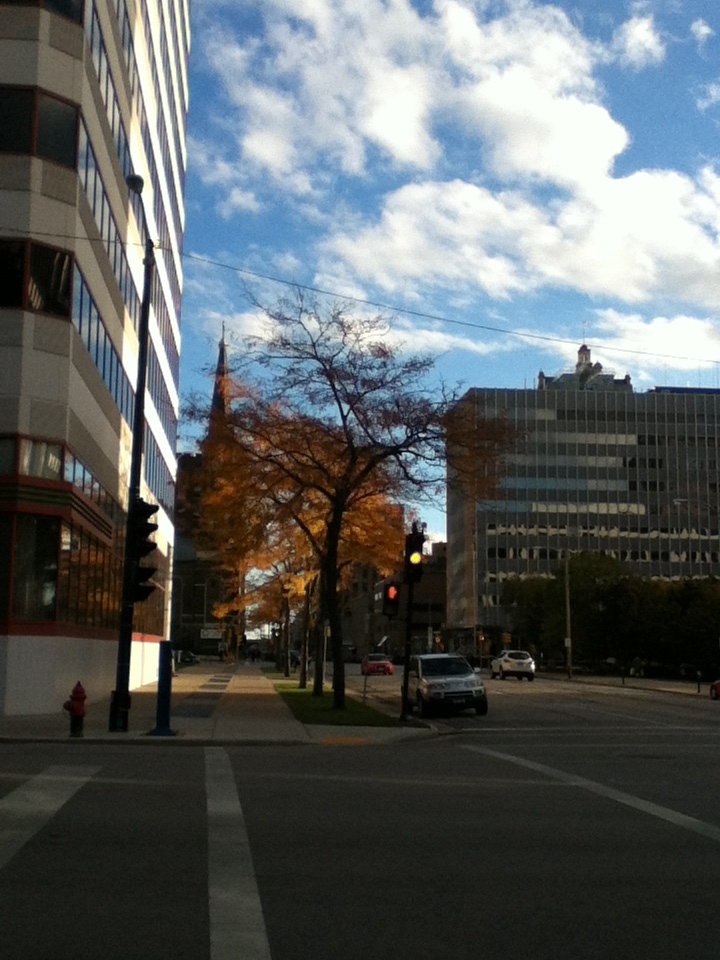
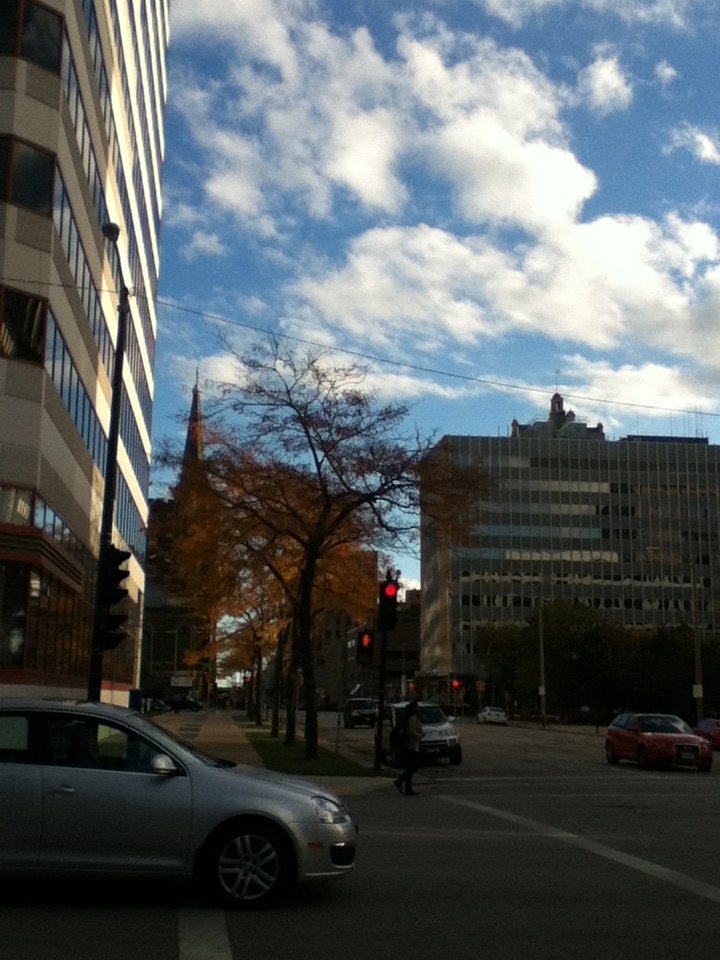
When I left my office around 5:00 this afternoon, the first thing that caught my eye was this tree’s orange leaves, illuminated by the slanting rays of the sun.  The tree fairly glowed in the shadows of downtown Milwaukee office buildings beneath the blue sky. 

The effect was already starting to diminish by the time I dug out my iTouch.  When I snapped my second shot, just moments later, the light was gone.

 My great-grandfather was an avid amateur photographer.  He kept his camera and tripod in the trunk of his car, and if he was out driving and saw something he thought would make a good picture, he’d pull over right there and set up his gear.  He has always been my role model for how to maintain an artistic life in parallel with your everyday existence. 

Years after my great-grandfather died, I discovered Ansel Adams’ Moonrise, Hernandez, New Mexico.  Not only is Adams’ photograph a masterpiece, but I felt my great-grandfather’s presence and had to laugh when I heard the dramatic story of how Adams shouted to his friend to pull the car over to the side of the road and then worked frantically to set up his equipment and capture the twilight image of faded sunlight reflecting on white cemetery crosses under a newly ascended moon.

Just looking at my two photos above, you can see what a difference a mere moment can make when you want to photograph an ordinary object or event rendered fleetingly beautiful by the elusive, magical quality of light.

Posted in Milwaukee | Tagged , , , , , , , , , , | 4 Comments

Sometimes letting Nature take its course leads to surprises we could never have imagined.

Karen J Spivey's avatarKaren Spivey's World

Last year I planted Morning Glory seeds in a pot on my patio. I let the sun and the rain tend them, so, on their own they grew up and flowered. It made me happy to walk past every day and see their lovely colors. Eventually they faded and died away, so I pulled out their vines and let the pot lay dormant for the winter. 

This year other seeds fell into the pot and I let the sun and rain tend them as well. They grew into a various assortment of flowering weeds and grasses. Still, it made me so happy to walk past and see their healthy growth. 

And then, I noticed a vine growing up the neighbor’s fence, across the walkway from my pot. Before too long it flowered — with Morning Glories the same color as mine. Every day when I walked past I’d see more…

View original post 56 more words

Posted in Uncategorized | Leave a comment

“Principle” versus “principal”

Because I’m teaching a technical communication course on writing and editing this quarter at MSOE, I’ve had issues of grammar, punctuation, and spelling on my mind more than usual lately.  One common error that came up in class last week was “principle” versus “principal.” 

Everyone probably knows that a principal is your “pal,” but how do you remember which spelling to use in in contexts not involving school administrators?

Here’s my trick.

  • “Principle” with “le” = a rule.  Both words end in “le.”
  • “Principal” with “pal,” or, more precisely, with “a” = the main something.  Both words have an “a.”

So we would talk about:

  • the principles of physics (the rules of physics)
  • the principle of a thing (the rule that is supposed to be followed)
  • a principled person (a person who lives by a strong moral “code,” or rule)
  • a matter of principle (an expression usually associated with an issue defined by values, morals, expectations, or the rules associated with the situational context)

Or we would talk about:

  • the principal of a school (the main teacher/administrator)
  • the principal point of a discussion (the main point)
  • principal and interest (the main sum of money you have sitting in a bank, which earns interest)
  • the principal of a company (main/key person in charge, often the owner)

Principle = rule.  Principal = main.

I’m very sold on mnemonic devices as strategies for learning, retaining, and recalling complex information.  Using the “le”/“a” mnemonic to remember the correct spellings for “principle” and “principal” has always worked well for me.  Maybe it can for you, too.

Posted in Grammar, punctuation, usage, mechanics | Tagged , , | Leave a comment