Sullivan reinstated at University of Virginia

The big news this afternoon in the world of higher education is the reinstatement of Dr. Teresa Sullivan as president of the University of Virginia.  Two weeks ago she resigned under pressure, igniting an explosive response from that institution’s students, faculty, and alumni, who rallied immediately to her defense.

Why is this story so important?  Because it is bigger than just who is in charge of one university.  It represents an early battle in what may become a full-scale war over the integrity and purpose of the 21st-century university.  It’s a conflict that has been brewing for several years, especially following the 2006 publication of the Spellings Comission Report. 

The Spellings Commission, led by U.S. Secretary of Education Margaret Spellings under President George Bush, was charged with reviewing the state of post-secondary education in America and recommending strategies for reform.  Significantly (fatefully?), the report uses the language of business to describe higher education, calling it “a mature enterprise: increasingly risk-averse, at times self-satisfied, and unduly expensive” (p. 14).  Alleging that most universities are not nimble enough in responding to challenges in the global marketplace, the report warns ominously that, “History is littered with examples of industries that, at their peril, failed to respond to—or even notice—changes in the world around them, from railroads to steel manufacturers” (also p. 14). 

Such a “business” perspective is compelling for its focus on “efficiency,” “accountability,” and “return on investment” – certainly urgent considerations in an era where dwindling financial resources are coupled simultaneously with pressures to “keep up” with global competition. 

Yet employing business terminology in discussions of higher education is problematic, because . . . what is the product?  A degreed person?  A well-trained worker?  A better-informed citizen?  A self-actualized individual?  Creation and dissemination of knowledge for the sake of advancing the human race? 

All of the above?

If higher education is evicted from its ivory tower and relocated to an industrial park (or perhaps outsourced to a call center in another hemisphere), does it follow logically that an ideal university should be a factory of sorts, where “edu-widgets” can be churned out efficiently, using state-of-the-art manufacturing methods?  (Online learning!  Flipped classrooms!  Social media!  Technology!)

Here’s what the “philosophical difference of opinion” cited by Dr. Sullivan as the root conflict between herself and the Board of Visitors – especially  Helen E. Dragas, a real-estate developer with a graduate degree from Virginia’s business school – really boils down to: a fundamental schism between polar-opposite views of not only how Virginia should be run but also how ALL American colleges and universities should be run. 

More to the point, Virginia’s showdown between the Ph.D. (Sullivan) and the M.B.A. (Dragas) is a precursor of the intense struggle yet to come between scholars and managers over the future of higher education itself.

Posted in Higher education | Tagged , , , , | 1 Comment

Rave review for Pixar’s “Brave”!

First, a quick disclaimer: WordPress won’t let me use italics in the headline, which is why I’ve put quotation marks around the title “Brave.” 

I usually italicize titles, as called for by the style guide for my field, the MLA (Modern Language Association), which is the standard documentation style taught in English classes.  However, I do recall from reviewing books for our local newspaper, the Milwaukee Journal Sentinel, that their editorial style guide called for quotation marks around book titles.  In fact, according to its online “Ask the Editor” FAQ page, the official Associated Press Stylebook “doesn’t use italics in news stories. That includes newspaper names and magazine references.  No italics.  The stylebook uses italics for examples only.” 

So I guess WordPress leans more toward journalistic writing than academic.  I’ve actually started using the journalistic lowercase for writing blog post headlines instead of the uppercase titles customary in MLA because it looks better and seems more appropriate for blog entries.  Similarly, I’ve begun using an en dash with spaces instead of an em dash for breaks in this blog because it’s easier to read on the screen. 

Anyhow, now that these punctuation formalities are out of the way . . . I am very happy to report that Brave, Pixar’s newest film, is wonderful! 

I had approached my trip to the theater yesterday with some trepidation after reading lukewarm reviews on Friday.  In the first review, a critic said Brave was “less a film in the lustrous Pixar tradition than a Disney fairy tale told with Pixar’s virtuosity.  As such, it’s enjoyable, consistently beautiful, fairly conventional, occasionally surprising and ultimately disappointing.”  Another critic called Brave a “shake-and-bake hybrid” that reflects Disney’s “penchant for princesses and appetite for anthropomorphism.” 

Nice alliteration there at the end, but I disagree with the charge of anthropomorphism.  It’s completely logical that someone who is turned into a bear yet retains human consciousness should exhibit human traits.  And besides, before Disney came along, Pixar did just fine on its own in giving human characteristics to animals and inanimate objects like bugs, fish, rats, cars, and toys.

I also take issue with the “Disney princess” and “Disney fairy tale” characterizations.  For one thing, Brave has no handsome prince, thus lacking a standard element of every Disney princess story.  Nor is there a scheming, evil villain in the usual Disneyesque, Machiavellian sense.  Finally, while the Disney “formula” requires the heroine to be an orphan or similarly lacking guidance and protection from a parent (usually a dead mother), Merida, the heroine of Brave, has two living parents, both of whom care deeply about her happiness.   

Although there may be merit in the critics’ descriptions of Brave as a “fairly conventional” film that “shrinks its aspirational promise into a mother-knows-best-size life lesson,” I wouldn’t say that convention and familiarity are necessarily bad, especially if well done.  All fairy tales are conventional, after all, and Brave certainly has drawn elements from fairy tales and myths.  In fact, once you’ve read the work of Joseph Campbell, especially The Hero with a Thousand Faces, his book on universal archetypes in world mythology, these “conventional” patterns become recognizable in many other films.

For children, such “conventional” stories and “life lessons” provide reassuring familiarity.  As an adult, I personally find the ending of Toy Story 3 both appropriate and poignantly inevitable:  Andy decides to give Woody and Buzz away to a little girl who will play with them, and as we know from the earlier films in the series, being played with is the one thing toys yearn for above all.  However, younger viewers not ready to part with childhood might have preferred a more conventional “happy” ending . . . in which, perhaps, we flashed forward to see Andy’s grandchildren playing with Buzz and Woody on a visit to Grandpa’s house.  As much as I love Toy Story 3, a more conventional ending wouldn’t have particularly bothered me, either.

One final note: I was surprised yesterday when everybody starting leaving the theater as soon as the credits began to roll.  Don’t they know there is always a payoff for sticking around at the end of a Pixar movie? 

In this go-round, there were two rewards.  The first was a statement in the credits that Brave is “dedicated with much love to Steve Jobs,” a tribute that elicited murmurs of appreciation from the few other people remaining in the theater.  The second was a cute, very brief epilogue that provides a clever follow-up to an event from earlier in the movie.

Posted in Movies and film | Tagged , , , , , , , , | Leave a comment

Beautiful fluid mechanics

I added cream to my coffee this morning and watched, mesmerized, as the white streak slowly triangulated and formed individual spirals, each of which then continued triangulating, until at last a giant, unified spiral sprawled across the surface of the liquid.

It reminded me of a session I attended at the engineering educators conference two weeks ago, in which student art from an engineering course on fluid mechanics was presented. 

You know Vincent van Gogh’s The Starry Night?  Perfect example of fluid mechanics as art. 

Take a look at this gallery of student work done over the past several years in a mechanical engineering course called “Flow Visualization,” taught by Prof. Jean Hertzberg at the University of Colorado-Boulder. 

Although the term “fluid mechanics” once sounded like technical drudgery to me, now even the words themselves look like poetry.

Posted in Uncategorized | Tagged , , , , , | Leave a comment

Pixar’s (nearly) unbroken streak

I want Brave to be good. 

 My younger daughter and I have a standing date every year to see the newest Pixar movie during its first weekend in theaters.  Already today I’ve seen so-so reviews for Brave, but don’t want to give them much credence because these same two reviewers also gave so-so reviews to Cars, and I loved Cars anyway.  I’m like a child on Christmas Eve who has asked for a really expensive present – brimming with hope but trying hard not to be unrealistically optimistic.                    

 I adore Pixar movies.  Not only does their dazzling 3-D animation mimic the “cinematography” and artful “editing” of great films, but also their content is built around the fundamental core elements of great literature: theme, character, story, and plot.  Year after year, Pixar has continually exceeded my expectations, astonishing and delighting me with every new film. 

 Except for last year, with Cars 2. 

 That’s why I’m a little nervous about Brave.  Was Cars 2 an anomaly or does it mark the beginning of the end for Pixar’s remarkable record of excellence?  Although plenty of reviewers have already pointed out Cars 2 ’s flaws, I’d like to contribute my two-cents’ worth now. 

 Two things went seriously wrong with Cars 2, and I can hardly believe that John Lasseter, the creative genius chiefly responsible for Pixar’s string of innovative successes, allowed them to happen.  I was going assign the blame to Brad Lewis, the first-time director who ended up sharing co-director credit on the film with Lasseter (and who left Pixar shortly after Cars 2 was released).  But then I read a New York Times interview in which Lasseter asserts somewhat defensively that Cars 2 is a great movie and that “it’s clear that audiences have responded” to it.  Either he doesn’t believe it and is trying to convince himself, or he truly feels that nothing is wrong.  Whichever, he doesn’t seem to acknowledge there’s a problem.

 Pixar’s first mistake with Cars 2 was to forget its audience.  You don’t release a G-rated movie with scenes of torture and killing, not even in animated form.  You just don’t. 

 Pixar’s second mistake was to lose focus on those fundamental core elements of theme, character, story, and plot that have been so key to creating “enchantment” in its films, (to use a word cropping up frequently in reviews).  Despite exotic locales and impressive action sequences, Cars 2 failed to “enchant” me.  In fact, I don’t remember anything at all about any new characters introduced in that film, except that one of them was voiced by Michael Caine. 

 When I watch a movie, I am more than willing – quite eager, actually – to suspend my disbelief and engage with the story on whatever terms it requires of me.  Unfortunately, Cars 2 was boring, and that is one term of engagement that few moviegoers (including myself) will tolerate.

 So, please, please, please . . . let Brave be good!

Posted in Movies and film | Tagged , , , , , , | Leave a comment

Perspectives on depth perception as metaphor in film

I took this photo of the hallway outside my hotel room in San Antonio last week.

I loved how the striped carpet and the alternating patterns of light and shadow added to the telescoping effect created by the distance perspective.

Of course, once you’ve viewed The Shining, it’s difficult to see a hallway like this ever again and not think of the Overlook Hotel and Danny’s encounter with the two daughters of a previous caretaker, who whisper, “Come play with us, Danny.”  (warning: this film clip contains flashes of gore)

All this got me thinking about one of my favorite Alfred Hitchcock films, Marnie.  When I teach the film studies class, we examine the principle of perspective drawing (and with it, the “vanishing point”) and how cinematographers use it to compose an image within the frame.  In Marnie, Hitchcock brilliantly marries the technique itself with plot events to move the film’s opening scene to a higher level of art.

Marnie, the title character, is a serial embezzeler who regularly adopts a false identity, moves to a new city, takes an office job, cases the business operation, then burgles the company safe as soon as an opportunity presents itself – whereupon she discards that job’s identity and slips away to her country retreat to lie low for a while before starting the whole process over again.

Turner Classic Movies has a clip of the film’s opening credits and first little bit (like 30 seconds) of the movie itself.  If you click on the link below, you’ll go to the TCM page.  Fast forward through the credits (yawn 🙂 ) till you hit the 1:58 mark.

http://i.cdn.turner.com/v5cache/TCM/cvp/container/mediaroom_embed.swf?context=embed&videoId=242261

In these opening moments of the film, we see Marnie at a train station, on the platform, walking away from us  . . . and INTO  THE  VANISHING  POINT.  Here the literal onscreen image corresponds with, and amplifies, the actual meaning of what the character is doing.  Not only does Marnie walk into the vanishing point in terms of perspective drawing, but she is also about to shed her criminal alias and “vanish” into thin air.

If you don’t want to click through to TCM, you can just take a look at the image below, instead.

“Marion Holland” (Marnie) vanishing into the vanishing point

When you see stuff like this, you just know you’re in the hands of a master.  Alfred Hitchcock never won an Academy Award for directing, but his work speaks for itself.  It is a reassuring reminder that quality endures and that external validation, although gratifying, is by nature capricious and, therefore, not the best measure.

Posted in Movies and film | Tagged , , , , , , | 1 Comment

Getting use to journalists who can’t spell?

This morning I was watching The Weather Channel® and saw this promo for an upcoming story: “Getting use to the heat.”  Sigh.  It reminded me of my disappointment two weeks ago when one of my favorite writers, Peggy Noonan, penned a column containing a similar sentence: “This didn’t use to be true.”

 As a college writing teacher, I’ve seen words like “used” misspelled in freshman composition essays for so long that I’m pleasantly surprised when a student actually gets them right:

  • A prejudice person (should be “prejudiced”)
  • A cliché expression (should be “clichéd”)
  • An old-fashion ice cream social (should be “old-fashioned”)
  • It use to be . . . (should be “used”)
  • He was suppose to be here (should be “supposed”)
  • Close captioning for the hearing impaired (should be “closed captioning”)

 The reason for these misspellings is completely logical: the “d” is almost always silent to listeners, especially when followed by a “t” sound, as in “it used to be.”  Someone who only hears (but never sees) the words doesn’t even realize his mistake, which is why the misspellings are so prevalent in student writing.  Few undergraduates are serious readers, and this is doubtless a reflection of the culture at large.

 However, it’s depressing to see these mistakes occur so often in newspapers or text graphics in television news broadcasts.  Such misspellings are particularly odious because they expose a writer’s lack of familiarity with the written word.

 Journalism is still a “glamour” career, and those lucky enough to make it to the field’s major leagues have a professional obligation to know how to spell the words that constitute their stock in trade.

Posted in Books and reading, Grammar, punctuation, usage, mechanics, Writing, blogging | Tagged , | 4 Comments

Home from the conference, the homework begins

Details have never been my strong suit.  I’m a big-picture thinker, which is a good thing, but I’ve learned the hard way that the only way to make things happen is to pay attention to the details.

At the conference I attended in San Antonio this past week, I met many interesting people who, like me, work in some capacity (faculty or administration) in the field of engineering education.  Building a strong network of connections with them, my peers, will allow all of us to move forward more effectively in our careers. 

Years ago I would have squandered these potential relationships.  Going to conferences is exhausting for me, and when I returned home in the past, all I wanted to do was run a couple loads of laundry and go to sleep. 

I’m far more mindful of details now.  Because I’m older?  Because I’ve spent the last 15 years working with scrupulously detail-oriented engineers?  Who knows. 

But I’ve definitely reformed my Type-B personality habits as far as making sure I tie up loose ends after a conference.  There’s a relatively small window of time during which we’ll all remember each other, so it’s important to follow up with forwarding any promised materials and sending out LinkedIn invitations while that window is still open.

Posted in Uncategorized | Tagged , , | Leave a comment

Phil Collins, Alamo historian. Yes, that Phil Collins.

So on the plane from Dallas to San Antonio last Saturday, I met Steve, who lives about 45 minutes northwest of the city.  Among the other tourist tips he gave me, the most intriguing was his joking suggestion that I keep an eye out for Phil Collins at the Alamo. 

The singer?  Yes.  According to Steve, Phil Collins has visited the Alamo several times and made a passionate hobby of the historic Texas fort. 

Admission to the Alamo was free, but there were boxes for donations near the entrance, so I contributed.  The old fort and mission are now a tourist spot, but people seemed respectful of what had happened there.  Although not somber, the mood was quiet compared to the good times happening on Saturday afternoon just outside the compound’s walls in the bustling downtown and famous Riverwalk. 

The only remaining portion of the original fort is called the “long barracks.”  Inside is a museum exhibit that tells the story of the deadly 1836 siege and battle.  And there, in a glass case containing several weapons, was a “short sword” (espada ancha) with a card stating that it was on loan from Phil Collins.  If Steve hadn’t alerted me, the name’s significance wouldn’t have registered at all.

Once I got home, I googled “Phil Collins + Alamo” and found many documents supporting Steve’s remarks.  Apparently Collins’ lifelong interest in the Alamo was sparked by the Davy Crockett fad during his childhood in the 1950s.  Now retired from drumming and living in Switzerland, Collins has recently written a scholarly book,  The Alamo and Beyond: A Collector’s Journey, about his extensive collection of Alamo artifacts and was in Texas just a few weeks ago to promote it, as detailed in this article from the online archives of San Antonio’s daily paper, the Express-News.

Isn’t life is full of surprises?  Discoveries like this one certainly make each new day an adventure!

Posted in History | Tagged , , , , | Leave a comment

On the road in San Antonio

I am in San Antonio for a few days at an engineering educators conference, so I’m experimenting with using my iPod Touch to post an entry.  The flight was $500 cheaper if I came Saturday instead of Sunday, so I came a day early.

Met a guy on the plane who lives in the hill country about a 45-minute drive northwest of town.  He gave me tips on what to see, so I spent yesterday afternoon sightseeing.  I did the Riverwalk boat tour and visited the Alamo.  Ate Tex-Mex, as recommended, at a particularly pretty spot on the Riverwalk, where I had pork tacos with cilantro and onions and the best margarita I’ve ever tasted.

My airplane buddy also told me to keep a lookout for Phil Collins when I was at the Alamo, and I did indeed catch a glimpse of the famous singer . . . sort of.  More about that later this week, when I’m able to write using an actual keyboard!

Posted in Uncategorized | Leave a comment

Light and Shadow

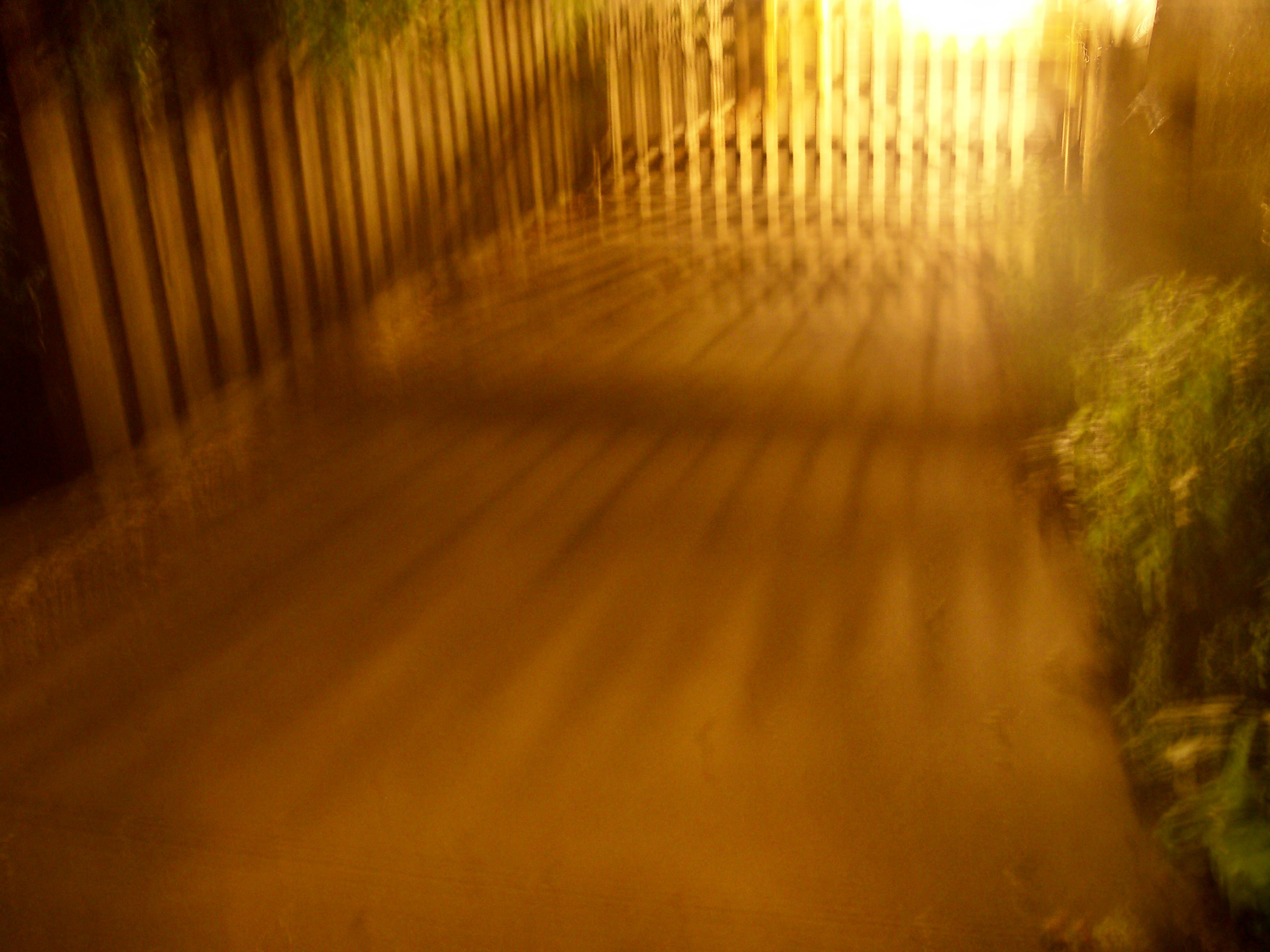
When I got home late from the Great Books session the other night, I loved the shadows cast by the gate on our driveway and decided to take a picture.  I don’t have a tripod, so this photo is blurry and maybe a little Halloween creepy, but still kind of pretty . . .

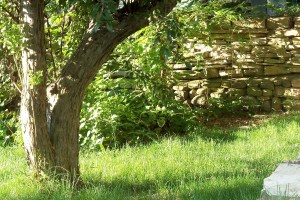
And then the next morning when I let the dogs out, I also liked the stiking interplay of light and shadow on the stone wall in our back yard.

In fooling around with the “upload” of this photo, I saw a button for making it a “featured” photo.  I didn’t know what that meant until I saw it stretched across the top of my blog page.  I think I like it for now, even though it seems “pretty” in a clichéd and generic way.

With so much to learn about the WordPress software, I think a good project for summer will be to play around with as many features as possible.

Posted in Uncategorized | Leave a comment