My equipment is no fancier than A) my older-model iPhone (a 5c, not even the 5s, which apparently had a better camera) and B) my Kodak Easyshare Z915 Digital Camera, which is no longer supported by the company and which I got on sale for $100 through Amazon about six years ago.
Despite the mediocre technology, I love taking pictures! One of these days I’ll feel flush enough to spring for better gear. Meanwhile, I’m going to make do and start setting myself up with “assignments”—sort of my own personal photography school 🙂 —and just see what I can learn . . . about the cameras I have and about taking better photographs, period.
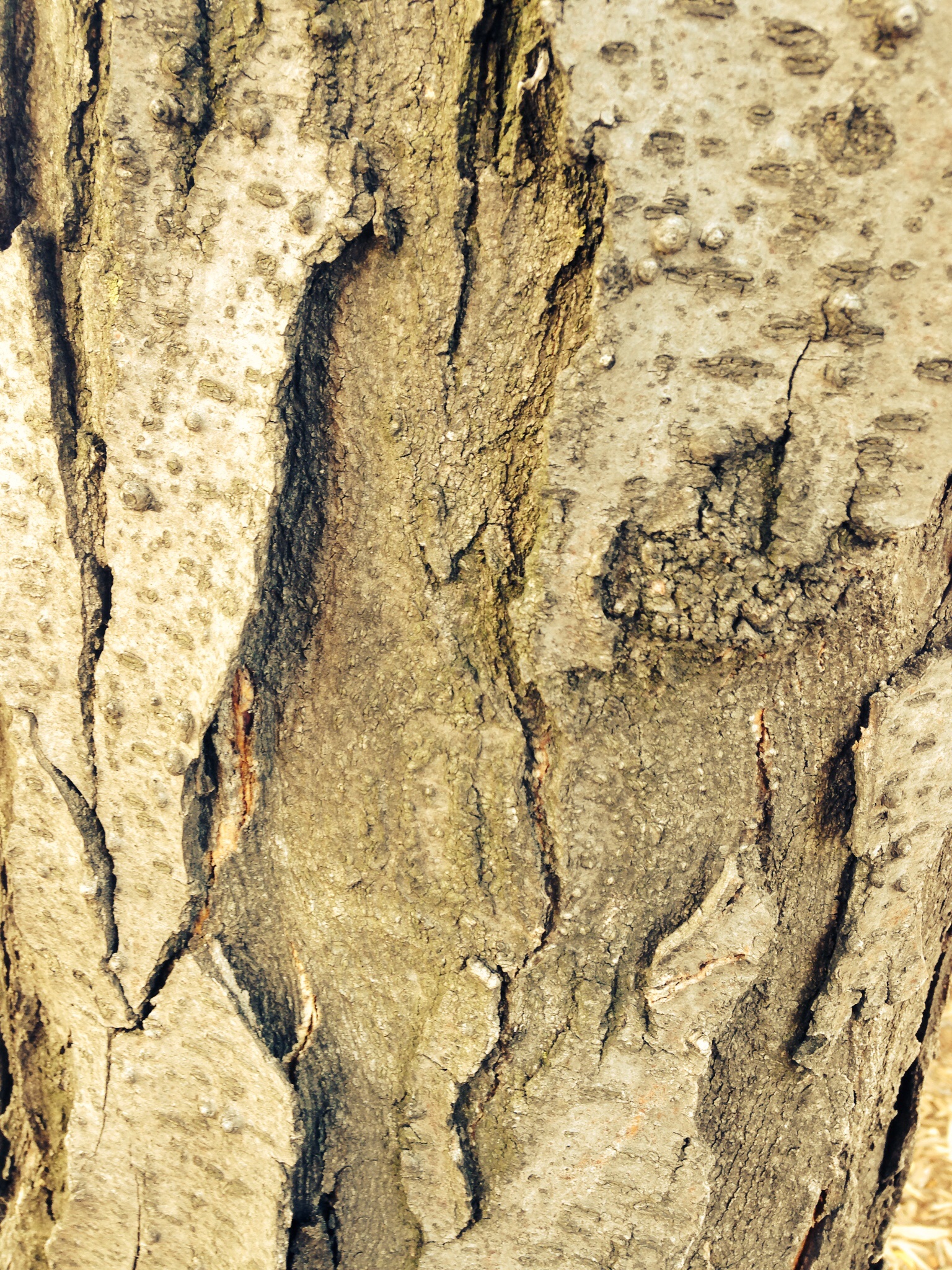
So here is a photo from my first (self-imposed) assignment, “Texture.” It’s the bark of a honey locust tree on State Street in downtown Milwaukee, taken with my iPhone 5c.
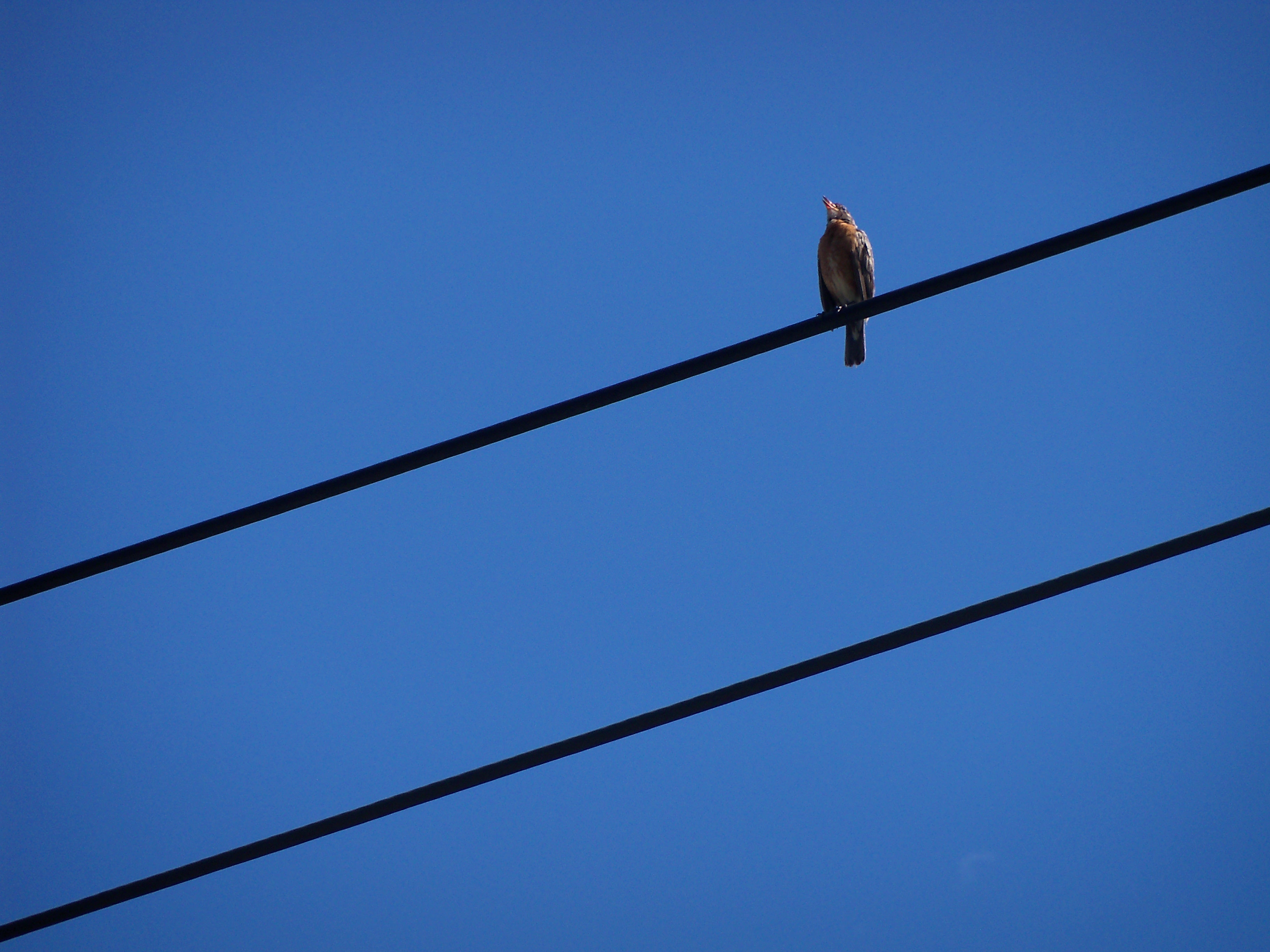
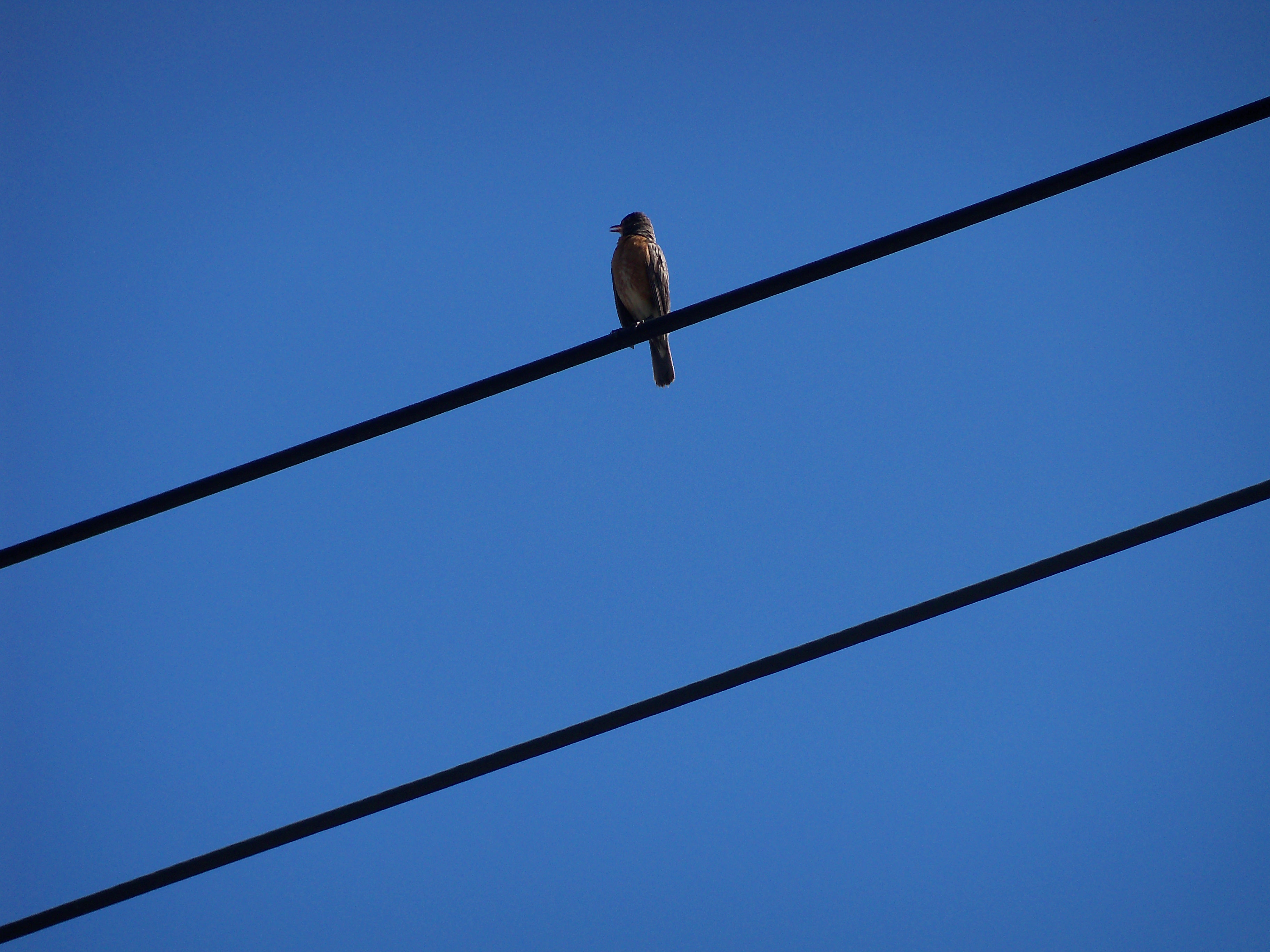
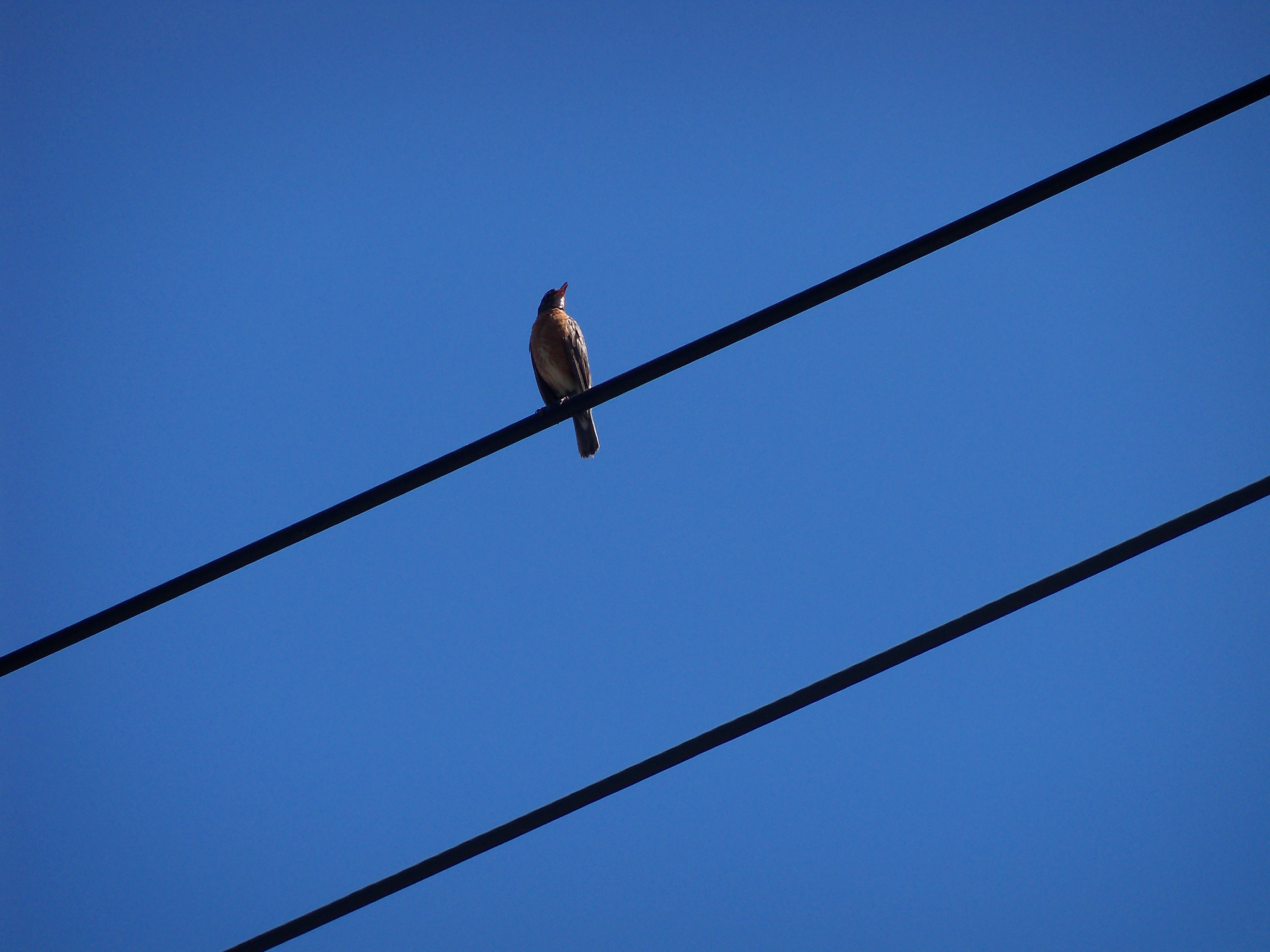
This little critter was warbling away up on the power lines this morning.
Is this a robin? It has a reddish breast but also a fair amount of white lower down. A female? The bill is yellowish with a black tip like what robins have. But I’ve never heard this exact song before. Here is some video (low quality, sorry!) I shot to capture the sound. If you recognize the bird from its song, can you please let me know what it is?
So I was at my office on campus today and walked into our main department office to get something from the printer. Our administrative assistant always has the radio tuned to our school’s radio station, WMSE (91.7 on your FM dial, best station in the world; be sure to listen to my friend Sonia‘s “Blues Drive” show on Friday afternoons, 3-6pm Central).
The song playing caught my ear. I recognized it and wondered aloud what it was. Turns out WMSE livestreams both songs and titles online, so you can always see what’s playing. With a few quick keystrokes on her computer, Rose was able to tell me its name, which was “Sleep Walk.”
We agreed: Technology is awesome!
I had my phone with me (more technology; thank you, Apple), so I googled the title and found this video.
Great 1950s hair. Dick Clark is so young. And the one brother gets all the attention for his flashy playing of the melody while the other just strums away on supporting guitar, kind of like how John Oates gets stuck with all the background vocals while Daryl Hall grabs the limelight singing lead.
Anyway, I didn’t play the video (beyond checking to make sure it was the same song) until after dinner tonight. The steel guitar fascinated me—I’ve always thought of this kind of sound as “Hawaiian guitar” (my grandfather was Native Hawaiian) and wondered how that instrument somehow wound up in country music—so I watched carefully during closeups in this video to see how he played it.
Then I noticed the name on the front of his instrument: Fender.
Double take. Really? I know what a Fender is, but I thought they just made the typical rocker’s guitar, like Strats.
So I looked up Fender, and guess what I found? The very first Fender guitar ever was a lap steel guitar, produced in the 1940s. Below is the illustration for Leo Fender’s patent application.
And I learned some other interesting things, too. For example, a steel guitar can be played horizontally, lying across one’s lap; hence, “lap steel guitar.” Or it can be standing up, with pedals, in which case it might be called a “pedal guitar.” Or it can be played per usual, slung across the body, except you wear a metal tube around one finger and slide it along the strings.
I never knew why it was called a “steel” guitar. I thought maybe the strings were made of steel or something. Nope, it’s called a “steel” guitar because of that metal tube (aka the “steel”) worn on the player’s finger to slide up and down the strings. A steel is also called a “slide” because of the technique (used to play “Hawaiian” guitar).
Lots of different materials can be used to make the slides besides steel. There’s glass, which is apparently the most popular of the other materials. Blues musicians used to slice off the top of a wine bottle to make a “bottleneck” slide. Other materials include ceramic and wood. According to an article on the Gibson guitar website (here) about how to choose the right slide, W.C. Handy wrote down the first blues melody after he heard “an itinerant guitarist swiping a [knife] blade across his strings at a railroad stop in Tutwiler, Mississippi, in 1903.”
Cool to know. I love that everyday life provides such serendipitous learning adventures 🙂
According to the article, several projects are currently in the works to cut down hundreds of acres of forest in New Jersey, Connecticut, and Long Island and then build solar farms in their place. The executive director of an environmental advocacy group is quoted as saying that while it’s always preferable not install solar projects without removing trees, “of all the potential options, there is nothing less impactful on the environment than putting in a solar farm. That’s the real world we live in, and they have a right to develop it.”
Can this world get any stranger? Apparently, like the Vietnamese city of Bến Tre, the environment has to be destroyed in order to save it.
Here’s a thought: What if we installed solar farms in Arizona and other places not densely forested, where the sun shines all day, every day, for most of the year. And in places where the opposite is true, like Long Island, with its miles and miles of coastline, we could experiment with alternative energy sources tailored to fit their unique geography, like tidal power.
Surely this not a new idea, so what is going on? How could any responsible government official even look twice at a proposal to deforest hundreds of acres in favor of solar panels? Political expedience? Corruption? Misguided community pride? Or both, e.g., someone with an ownership stake in solar ventures looking to make money with a project long on eco-trendiness but short on viability?
Does no one in power think that common sense is smart? Or is willful ignorance just part of the human condition.
On a lighter note along those same lines, here’s Joni Mitchell singing the song of this post’s title. It seemed like an appropriate finale, and I love Joni Mitchell, so . . . 🙂
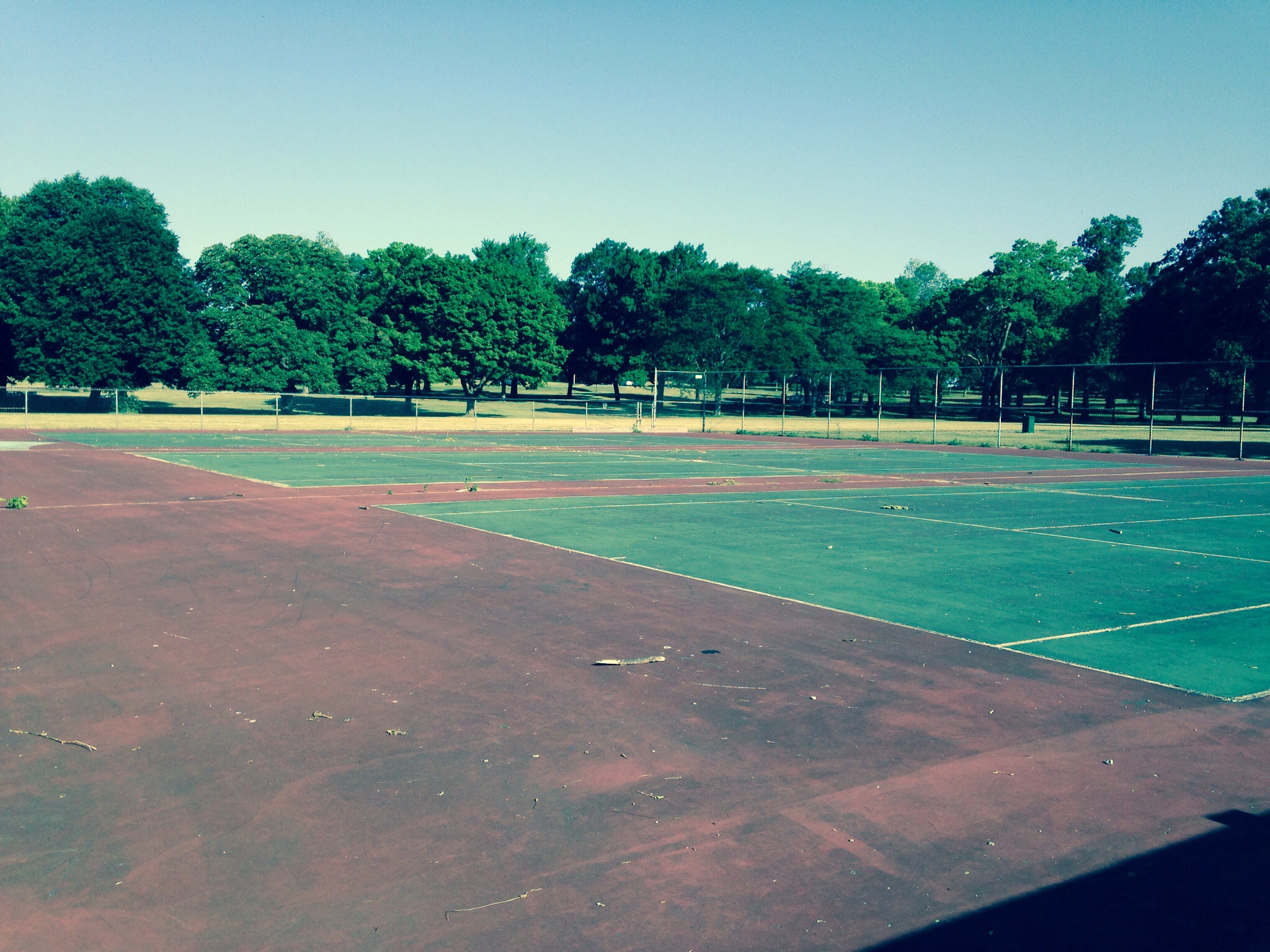
This is a tale of two tennis courts in Milwaukee’s Washington Park. Designed by Frederick Law Olmsted of Central Park fame (see a nice NY Times article about his Midwestern parks here), Washington Park was once home to the Milwaukee County Zoo. The zoo moved decades ago, and at some point early in the years since then, these tennis courts were installed and then abandoned as neighborhood demographics and recreational interests changed.
The tennis court on the left side of the panorama (a closer look at that court is shown in the photo above) is largely abandoned, covered with sparkling glass shards and branches and weeds, although at the far end, barricades have been erected to form a low wall creating an arena for “bike polo.” If you enlarge the photo, you can see the graffiti-looking sign saying “Milwaukee Bike Polo” painted onto the metal barricades. I’m not exactly sure what bike polo is, as I’ve never observed anyone actually playing it, but it involves tiny little soccer goal nets set at opposite ends. So apparently it really is polo, played from bikes instead of horses.
(Aside: Milwaukeeans may remember the days back in the 1980s when real polo matches were played on Sundays up on Good Hope Road between 60th and 76th.)
The group of tennis courts on the right side of the panorama have been redone to create a series of small basketball courts, mostly just hoops, I guess. You can tell by the bright morning sunshine that I was driving by really, really early on the day I shot these photos. By late morning and on through the afternoon and evening, these courts were packed with teens and young men.
So from abandoned, weedy artifact to a vibrant center of public recreation—someone in the parks department was paying attention to the needs of today’s community.
If you build it, and it’s the right thing in the right place at the right time, form and function transcend mere utility. “They” will not just come; they will embrace it and make it truly their own.
Today seems like a good day to link to two of my older (March 2014 and October 2015) posts about Turkey. Mostly I talk about Turkey within the context of wider regional conflicts and history, but these posts may get you thinking about why Turkey matters so much politically, militarily, economically, and culturally.
The Little Free Library movement is huge in Milwaukee. In some neighborhoods you can’t drive more than a few blocks without seeing one of the little book boxes in a front yard. These boxes can be wildly individualistic, which is part of the fun in paying attention to them. A few years ago, I began taking photos of Little Free Library boxes. I’ve posted some of them on my blog.
It was a year ago December that I first noticed this box.
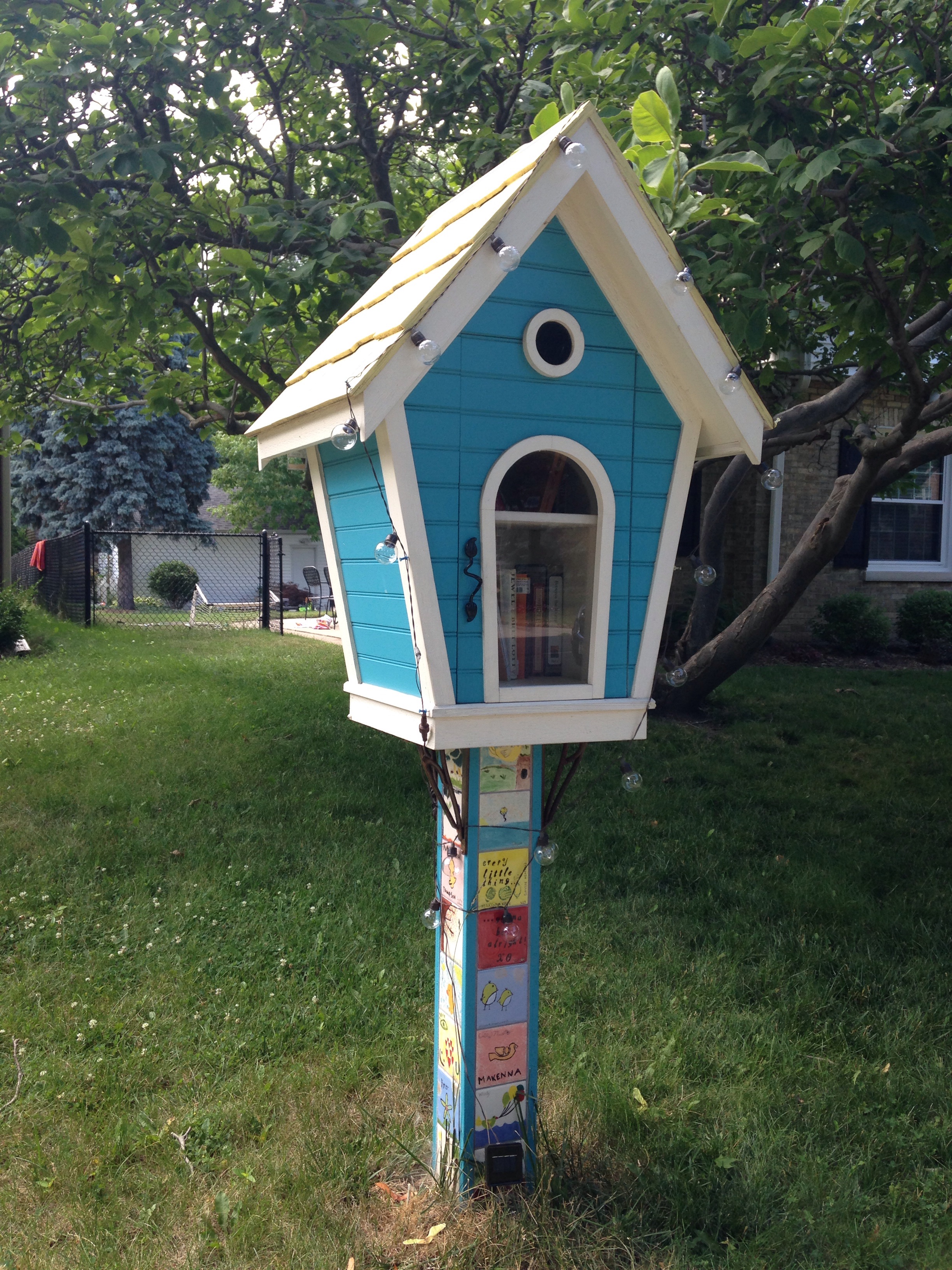
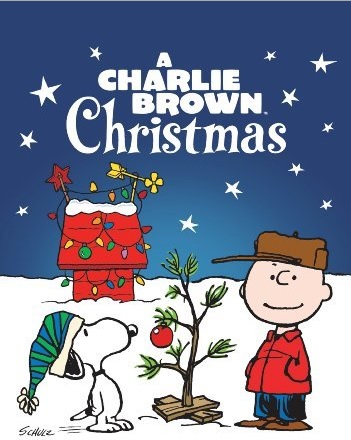
Driving down a street at dusk, I suddenly saw what appeared to be Snoopy’s dog house, festooned with colorful lights, as it appears in “A Charlie Brown Christmas.” Adorable!
Last weekend I happened to be driving down that street again and, since I wasn’t in a hurry for once, I decided to stop and take a picture. As it happened, the homeowner was outside working in her garden. When I asked if it would be okay for me to take the photo, she told me to please snap away, take as many as I liked.
Then she told me the story behind the box. Her daughter, Makenna, died at age 4 of an epileptic seizure in her sleep. Stunned, I told her how sorry I was.
She waved it off. “It’s okay, we’re okay now.” And she seemed to be. Telling me about Makenna made her smile. In her short time here on earth, Makenna had always been full of life. The term her mom used to describe her was either “spitfire” or “spark plug”—or maybe it was “ball of fire.” I can’t remember which it was, but they all convey an image of a little girl just bursting with energy.
The Little Free Library box had been the idea of her neighbor across the street. He was an architect and created the original design himself. When they installed it, the neighborhood kids went to a ceramics store to paint the tiles that line each side of the post the box sits on.
Makenna’s mom Shelly, installed a solar lighting kit at the base and changes out bulbs with the season: orange lights for Halloween, red for Valentine’s Day, green for St. Patrick’s Day, etc. The box is actually supposed to be a birdhouse, which yes, it does resemble. But even though it’s not meant to be Snoopy’s dog house, I’m not alone in seeing it that way. Several people have told her that’s what it looks like it when she decorates it with traditional multicolored bulbs at Christmas.
I asked if it would be okay for me to do a blog post on the photo of her Little Free Library, along with its story. And Shelly told me yes; the more people who know about the book box and its story, the better. She’d love to spread the word.
A local magazine, M, did a story on the book box in November 2014, about the same time that I first noticed it. You can read that article here (it’s the blue-shaded column in the middle of the two-page spread).
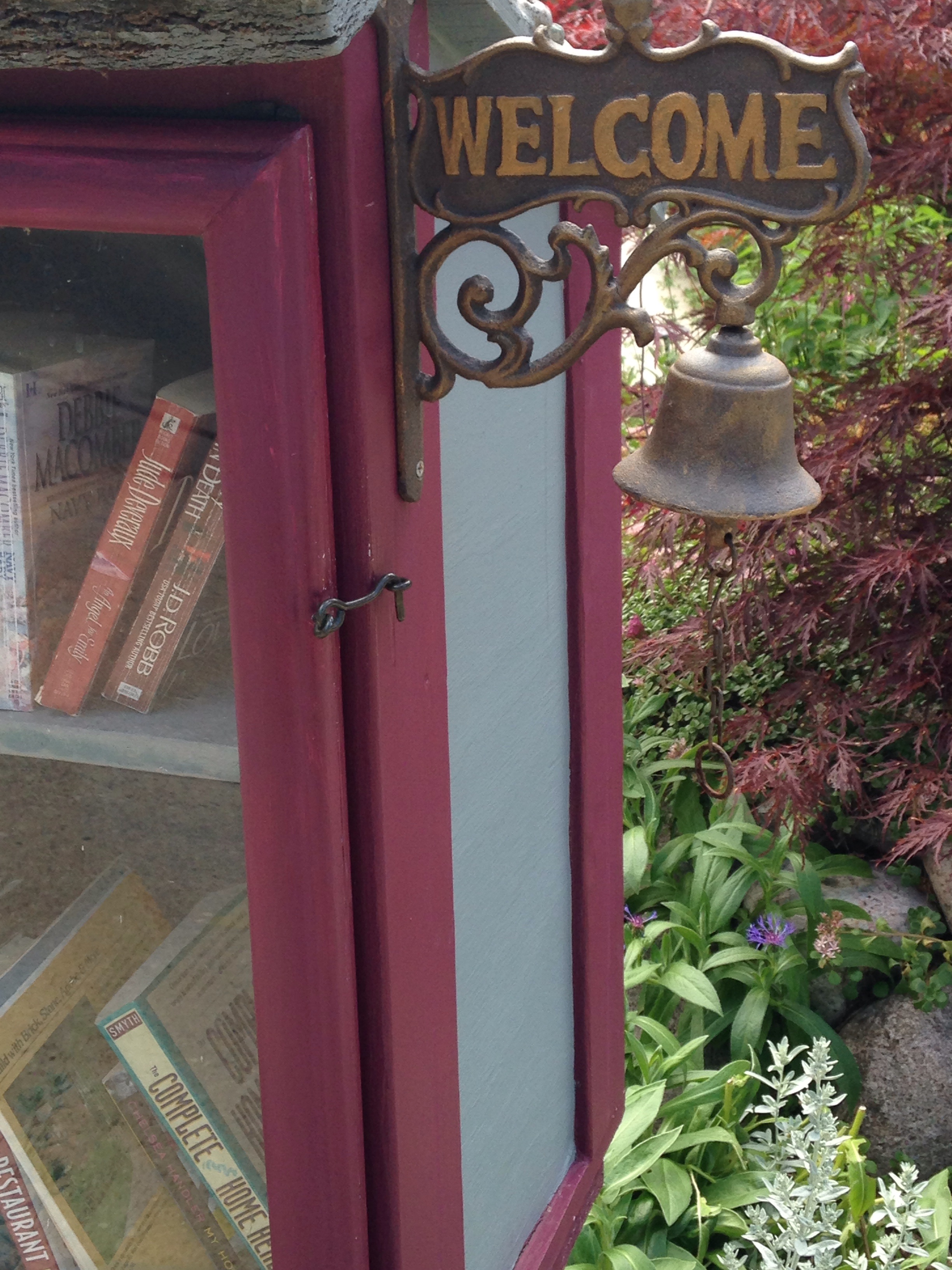
Interestingly, these little book boxes have been associated with the idea of honoring a loved one since the very beginning. The Little Free Library movement got its start in 2009, when Tod Bol of Hudson, Wisconsin, built a little book box and installed it in his front yard as a tribute to his mother. She had been a teacher, so Bol constructed the book box to look like an old-fashioned, one-room schoolhouse. He painted it red, put a glass-fronted door on the front, and put a sign up on the belfry (containing a real bell) that said: “Esther Bol Memorial Library.”
The idea struck an immediate chord with people, and Bol soon was making and giving away more boxes. One thing led to another, and today the Little Free Library is a worldwide phenomenon. You can find out more about this organization (and how to get a box of your own) at littlefreelibrary.org.
Monday’s Wall Street Journal ran an article (read it here) noting the waning days of the department store as anchor in the American shopping mall: “Mall Owners Push Out Department Stores: Fast-fashion chains, restaurants, specialty stores do a better job of driving mall sales and drawing shoppers.”
Today’s post is nothing more than a random, jumbled collection of memories associated with shopping malls and department stores. It doesn’t feel like my usual kind of post, if I even have a “usual” kind of post, but it’s what I feel compelled to write about today. I appreciate your forbearance 🙂
So . . .
I am old enough to remember a time before shopping malls, at least before what I think of as “shopping malls”—that enclosed-under-one-roof collection of stores anchored at each of its opposite ends by a pair of major department stores. When I was very little, shopping meant going downtown. We’d leave the car in a parking structure and—
(Aside: My husband just noted that when he was a kid, his city didn’t even have any parking structures, which prompted me to wonder when the idea of parking ramps really took hold. With a quick Google search, I found a 2009 NPR article about a museum exhibit on the history of the parking garage. In case you also are interested in and easily sidetracked by such arcana 🙂 )
—we’d walk a block to the big department store. And big is what it was! At least six or seven stories. The shoe department, the toy department, the luggage department, the children’s department. Men’s clothing, women’s clothing. Hats. Gloves. Jewelry. Sporting goods. The hair salon. The photography studio. The candy counters. Just huge.
On the top story was the restaurant that took up nearly the entire floor. Tall windows all around. Where dressed-up ladies who lunch would go to eat chicken salad on china plates after a morning spent shopping on the lower levels.
I rather liked department stores. I remember breakfast with Santa and, of course, visiting Santa in the toy department fairyland at Christmas. And speaking of Christmas, I remember my parents taking us to see the department store windows every year at Rike’s in Dayton, Ohio. Magical!
I can’t remember how old I was when I visited my first shopping mall. Under age 10, I believe. I had entered my dog in the Alpo Dog Food dog show at a local grocery store, and when she advanced to the state level (a completely surprising and mysterious victory, which brought me a trophy and a transistor radio that I used for listening to Cincinnati Reds games), my mom drove us to the Eastland Mall in Columbus, Ohio, where the competition was held. According to Wikipedia, that mall was built in 1968, so it was sometime after that, probably 1969 or 1970.
By the early 1970s we had a mall much closer to home. And I thought it was wonderful! As a girl who grew up dreading the slushy slog from store to store in bitter cold during winter shopping trips, I loved that once inside the mall you could stash your coat in a locker! (Some malls still have a few of these; look for them.) And you could walk around from store to store in just your street clothes! All the shopping you needed to do, you could do under one roof.
One memory of that mall stands out because it was such a weird concept: the pay toilet. Anyone else remember this anomaly? Sometime in the early 1970s several shopping mall owners installed locks on their (previously free) restroom doors, so that entering a stall required depositing a dime to open the door. Right. Great idea. People who might never otherwise consider themselves “political” made a point of holding open (and otherwise sabotaging) the stall doors so that others could enter and exercise their basic human rights free of charge.
Pay toilets didn’t last too long.
Huh, I just checked Wikipedia’s entry on pay toilets and discovered that they are actually still a thing in many places around the world. I don’t think I’ve seen one in America in 40+ years. Because, really, charging someone to use the bathroom seems un-American, doesn’t it? However, there must be some call for pay toilets even now because there’s a company in Indianapolis that manufactures restroom security locks.
I moved to Milwaukee in the early 1980s, and one of my first jobs here was (no kidding) selling carpet (in the “carpet department” 🙂 ) at Gimbels Department Store in the old and now-abandoned Northridge Mall. (See an OnMilwaukee article with eerie photos of Northridge as of 2012 here.)
(Further aside: Have you seen the photos of “dead malls”? I did a Google Images search for “abandoned malls” and found all these pictures. There are lots of abandoned malls in the United States and around the world. An interesting collective artifact of a moment in retail history, I guess.)
My position in Gimbels’ carpet department was a seasonal Christmas job. As you might guess, there’s no mad rush to buy and install carpet during the Christmas holidays. I mostly worked evenings and weekends to spell the department’s main employee, with this part-time job added on top of my job as a receptionist at a downtown brokerage firm.
Some (very!) random memories of that job:
The series of “bing” tones I’d always heard broadcast in department stores were actually codes. Especially exciting was the code that meant shoplifters had been spotted. Workers from various departments would zip around to fill each other in on developments.
The mom and her adult son I always saw shopping together (and considered in passing to have a strange relationship because of it) were actually the store detectives.
The boyfriend of a co-worker had a job in New York’s Empire State Building, which to me seemed like the height of sophisticated adulthood.
The employment office was super impressed that I knew my Social Security number off the top of my head (only because it had been my college student ID number) when I filled out my paperwork.
The McDonald’s across the hall from Gimbels, where I sometimes took my dinner break, had the best-tasting fries ever, because they had so many customers that they pretty much sold every batch of potatoes immediately as it came out of the grease. No sitting around under heat lamps. (Plus McDonald’s used to cook their fries in beef tallow, which sounds awful but sure tasted good.)
Sundays were my favorite days to work at Gimbels in the mall. The carpet department was in the basement of the store, wedged into the very corner and bordered on one side by the furniture department and on the other by the (surprisingly very small) electronics department. Sometimes I’d wander over to the electronics department and browse. These were the early days of the Sony Walkman and the RCA VideoDisc, a really odd and short-lived product that essentially was a vinyl LP playing movies instead of music.
But mostly I hung out with Woody Dreyfuss, brother of Wisconsin governor Lee Dreyfuss, who worked in the furniture department. Like carpet, furniture is not high on anyone’s shopping list in December, so Woody was similarly not very busy during the holiday shopping season. On Sundays he and I would sit on a couch at the edge of the furniture department and watch the Green Bay Packers game on a television set at the intersecting corner of the (very busy and very crowded) electronics department.
I felt a bit guilty about getting paid to watch the Packers and listen to Woody’s stories about visiting the governor’s mansion while the poor electronics department folks were so overwhelmed. I tried to help out when I could, but I was no good with the computerized cash registers when anyone wanted to do something more complicated than make a purchase (like return one thing but exchange it for another). Over on Woody’s couch, I could easily keep an eye on my department and run over to talk with any customers who wandered past the electronics department into the rug territory. Which were basically none.
In some ways hanging out in the furniture department with Woody mirrored what the entire mall experience was like for me. Comfortable, informal, homey. Because malls were self-contained centers of commerce and community. In fact, “mall culture” was a thing by the late 1970s and early 1980s (see Fast Times at Ridgemont High). My hair stylist and I still laugh over memories of “mall hair.” (See what my search for that term produced on Google Images.)
(There’s way more info out there regarding malls and free speech, if this is of interest to you. See also, for example, this New York Times article from 1994 discussing protection of free speech:
Declaring that shopping malls have replaced the parks and squares that were “traditionally the home of free speech,” the New Jersey Supreme Court ruled today that the malls must allow access to protesters who want to distribute leaflets on social issues.
When I moved to Milwaukee in the very-early 1980s, the old Gimbels department store downtown on the Milwaukee River appeared not to have been remodeled since at least the 1950s. Walking in through the back entrance off of Michigan Avenue, I felt like I was stepping onto the set of Miracle on 34th Street or something.
The old candy department—with its huge, rounded glass-fronted counters—absolutely enchanted me. Once I’d started working for a downtown law firm as a paralegal/legal investigator, I loved shopping at Gimbels. I’d go there on my lunch hour and be instantly transported into another era. They no longer had elevator operators (although another building in downtown Milwaukee had one well into the 1980s, which thrilled me no end every time I went there), but Gimbels elevator doors still had the multiple gates from the old days.
Sadly (to me) just a few years after I moved here, the downtown Gimbels remodeled. Out went the wide, straight aisles; in came “mall” store design: narrow diagonal aisles that seemingly had no logical starting and ending points. I’m sure the idea was a) to cram more merchandise into the available floor space, b) to mimic the more lucrative “mall” shopping experience, and c) to so disorient shoppers that they’d become lost and, in searching for the exit, notice things they wanted to buy.
Gimbels’ remodel didn’t solve whatever problem it was meant to address, presumably low sales. In the mid-1980s Marshall Fields, the famous Chicago department store, bought at least three of the Milwaukee-area Gimbels stores, both the big downtown store and two of its shopping mall anchors. The Northridge Mall and Southridge Mall Gimbels stores were later sold to the Sheboygan, Wisconsin, department store chain H.C. Prange, which was then sold to an Iowa-based retailer, Younkers. At the same time (mid-1980s) that Marshall Fields acquired their Gimbels stores, three other local Gimbels stores, including the one in Mayfair Mall, were sold to Boston Store.
So . . . what? I really need to wrap up this extremely long post. I’m not sure what my point is except to say
Now, some forty years after they “died,” America’s downtowns appear to be reviving. New York City has certainly come back. There seems to be much more respect for the past. When buildings are “repurposed,” their original character and use often figure prominently in the new design. Check out the TripAdvisor reviews and photos of Marriott’s Residence Inn Downtown Milwaukee, which was once home to the downtown Gimbels. Inside, the building is quite different from its department store predecessor, but to anyone walking down Wisconsin Avenue, Gimbels has never left. Its old ivory-white facade dominates the river at the bend in the street across the bridge just as it always did.
So, finally, getting back to Monday’s Wall Street Journal article, it appears that the large enclosed mall with its department store anchors is evolving into something else. The huge store with something for everyone is being replaced by smaller niche stores and upscale, interesting food courts, among other things. (UPDATE: I just saw a news report, from either today or yesterday, saying that the empty Boston Store space in Southridge Mall may be turned into apartments.)
In many places, in fact, the self-enclosed mall is morphing into an open-air mini-version of yesterday’s downtowns and neighborhood shopping districts. Like stepping into Heraclitus’s river, you can have (but not have) the same retail experience twice. Commerce is change. Like nature, like life—like reality, itself.
But Americans don’t really cotton to the idea of change for change’s sake. We like to think of change as “progress.” I don’t understand why we do this, but it strikes me that seeing the world this way is dangerous.
It’s why we can’t remember lessons we shouldn’t forget. It’s how we lose our history—think 1960s and ’70s “urban renewal,” with all its accompanying arrogance regarding eminent domain and displacement of businesses and homes usually owned by society’s less privileged members. Most significantly, it’s how we lose sight of the end game. We can’t see the forest for the trees—mistaking causes for effects, symptoms for disease, la même chose for ça change. We live in the “moment” (the here and now) instead of in the “present” (the eternal).
And because we think we know it all, we can make some pretty bad decisions.
Would you like new posts delivered to your inbox? To subscribe, click here.
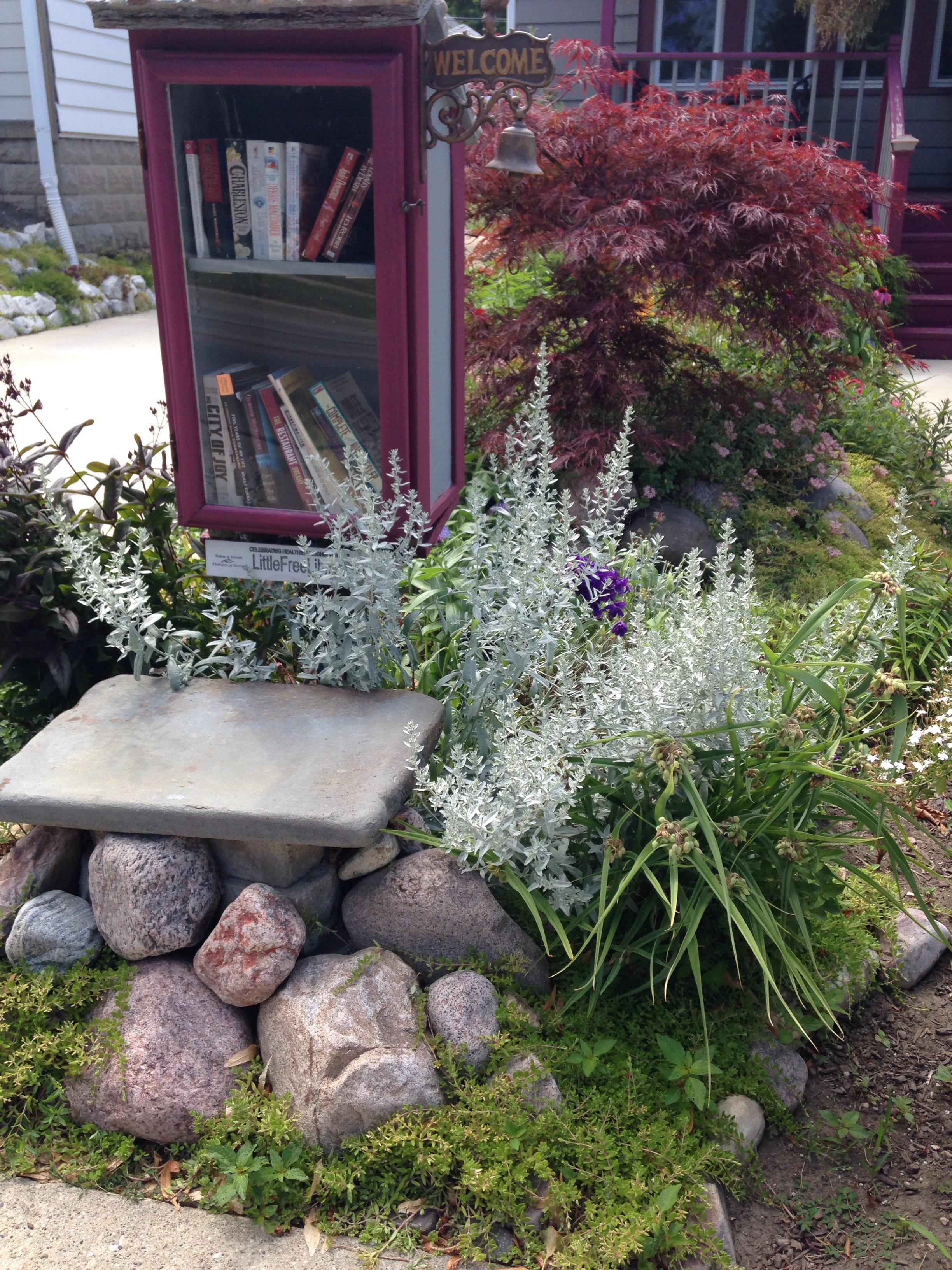
Often Little Free Library boxes match the house they sit in front of. I’ve done a post on one of these before (Little Free Library #2, here) but I didn’t think to include a photo of the house.
For today’s post I wanted to show the house, too, but did not want to include the street address, which appears fairly prominently on the side of the porch. Hence the partial view.
I am working on a special Little Free Library post that I hope to get up tomorrow or Thursday.
When I stopped the other day to take a photo of a Little Free Library box that has been catching my eye for several months now, the homeowner was outside working in her garden. Not only does her Little Free Library box have a fun and unique appearance, but it also is inextricably linked with a story that is both heartrending and incredibly uplifting at the same time. (I just hope I can do justice to it.)
No doubt because I watched that BBC show on “The Hunt,” predators and prey seem to be weighing on me. In terms of “life and death,” the topic for today’s post feels mighty insignificant compared with the scope of human tragedy in the horrible shootings and police killings in the news. Yet, I also think this post kind of reinforces the ordinariness and small scale of everyday horror depicted in the epic life-and-death battles among most of the animal kingdom in “The Hunt.”
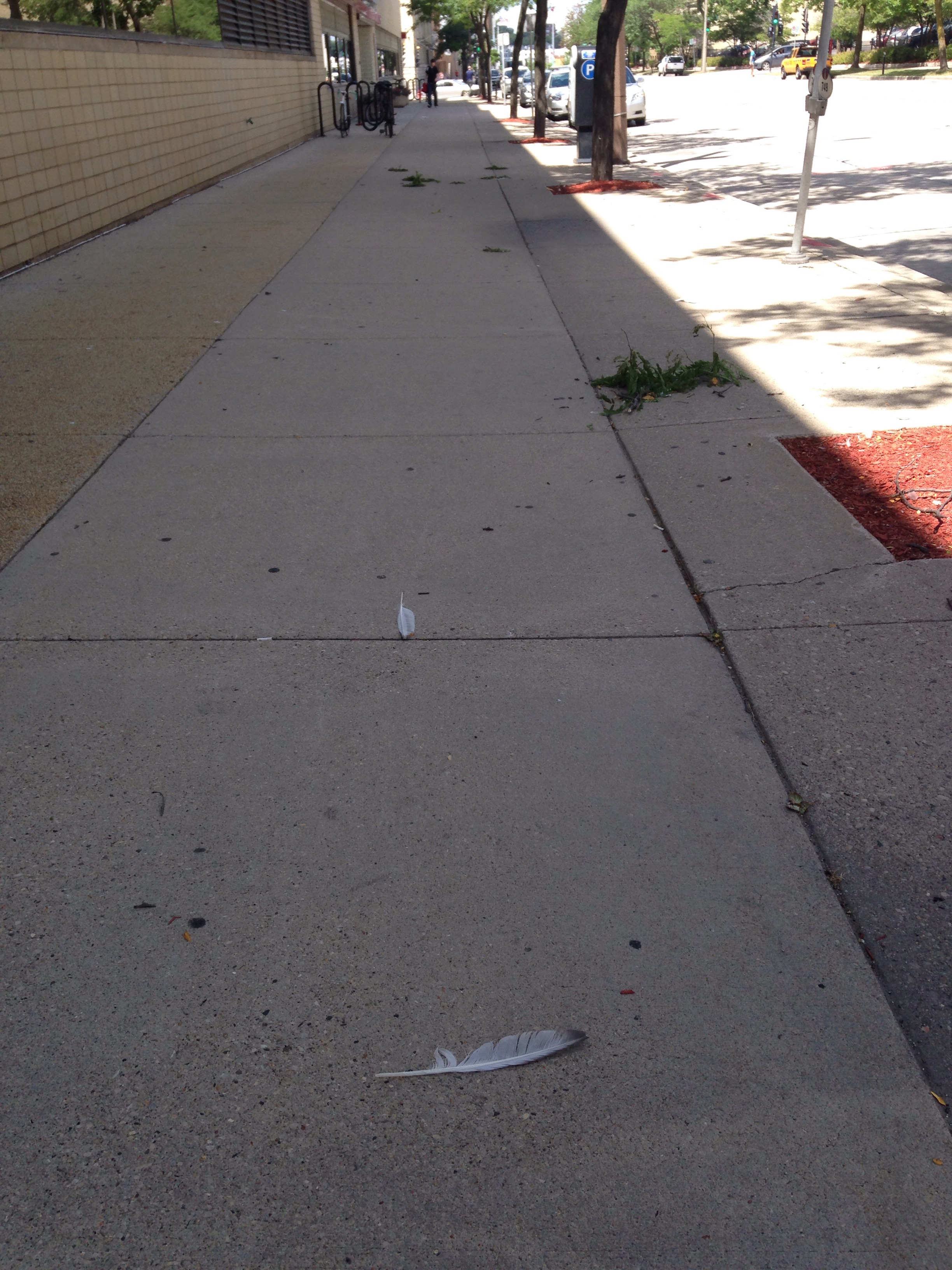
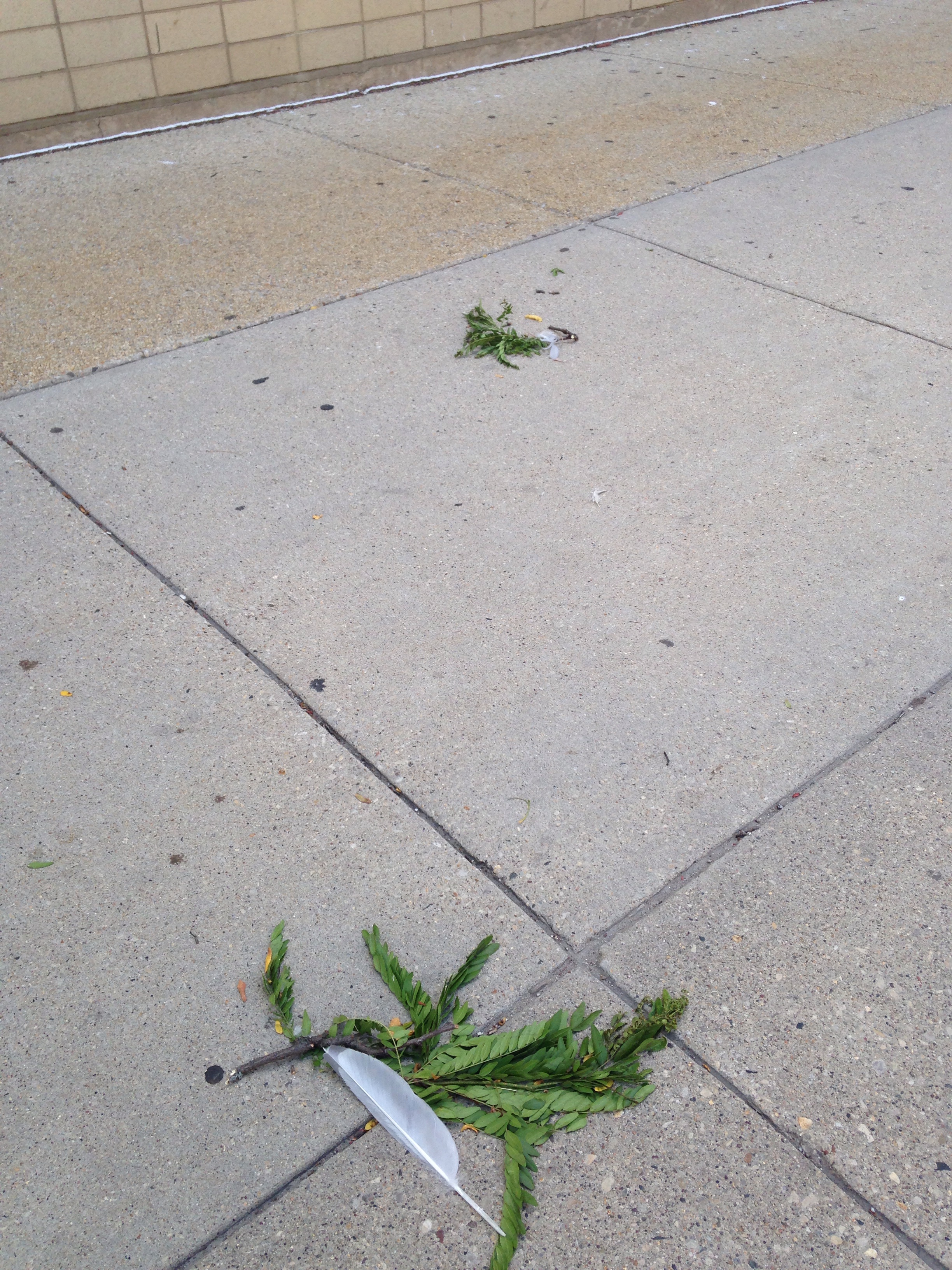
When walking between buildings on campus today, I noticed that several small tree branches were down and littered the sidewalk and street.
And then I noticed the feathers.
You can see feathers and branches scattered along 50 feet of sidewalk. Not shown are the branches in the street between and under parked cars.
Downtown Milwaukee is home to peregrine falcons, which were reintroduced amid much fanfare about three decades ago. For more background on Milwaukee’s raptors, see “peregrine falcons” at the bottom of the Wikipedia article on the U.S. Bank building; it mentions 1987 as the year the first “hacking” box for a nest was installed. As peregrine families took up residence, closed-circuit video of the nest and chicks could be viewed from the bank lobby (at that time known as First Wisconsin and later as Firstar). Since the internet, streaming video from other downtown falcon nests has been available, too. For example, atop the Milorganite factory next to the sewage treatment plant on the harbor (article here) and atop the We Energies building (article here).
Peregrine falcons eat seagulls for dinner, and after putting two and two together (branches, feathers) I felt confident this was the aftermath of a fearsome battle for life itself between a creature that needed to eat and another that didn’t want to be eaten.
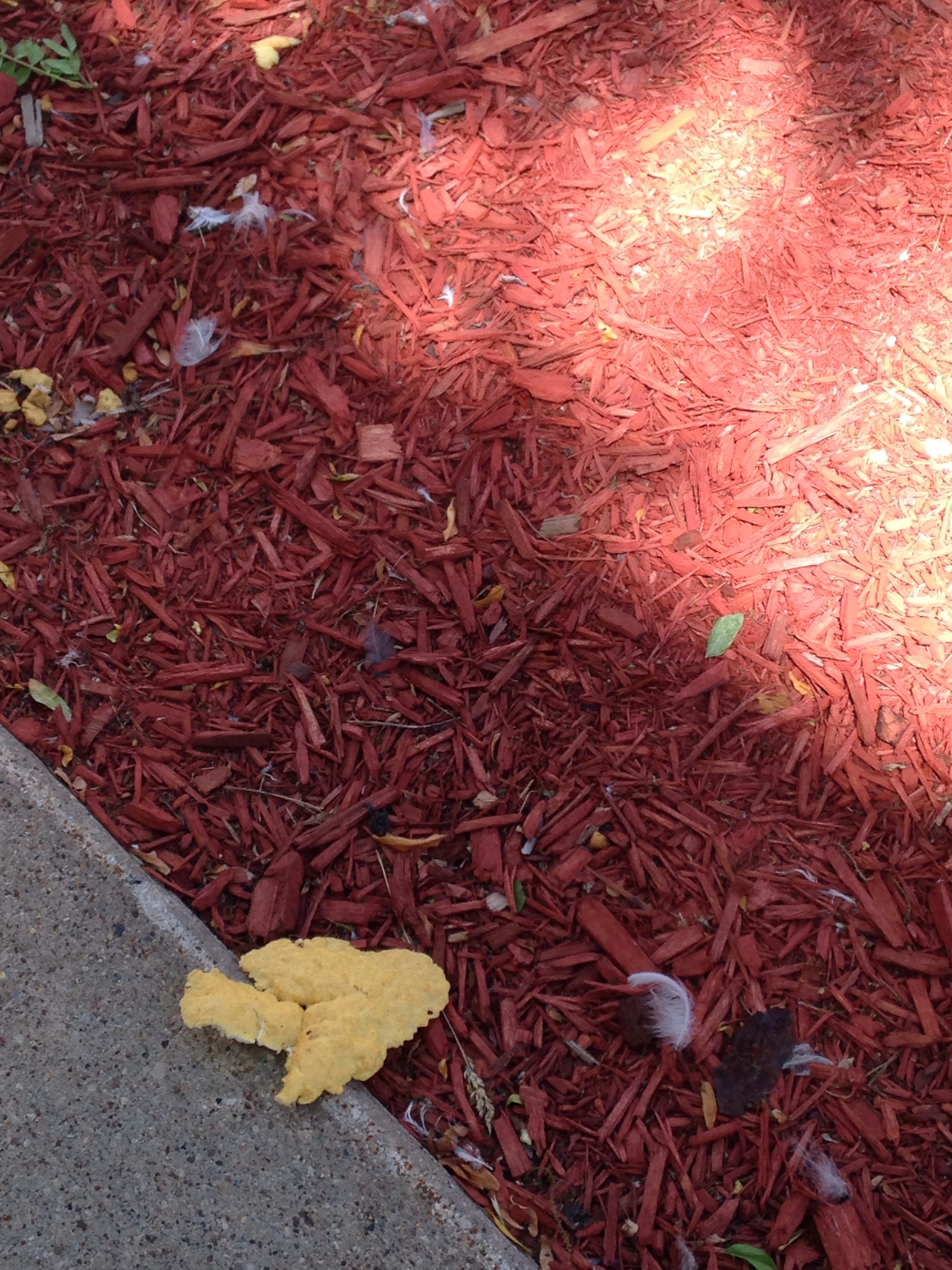
Small feathers scattered everywhere . . .
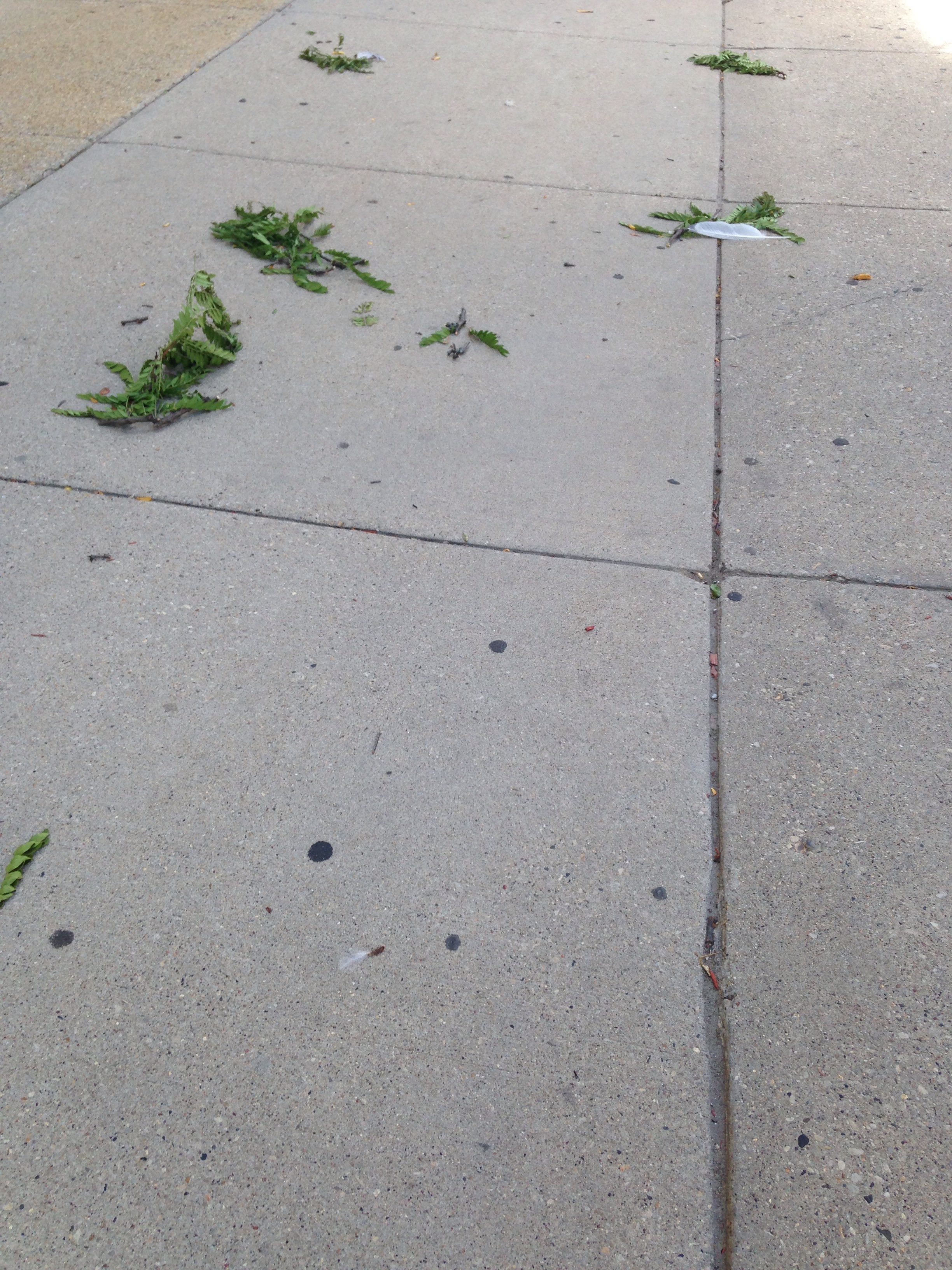
. . . and larger ones, entangled in the fallen branches . . .
. . . seemed to indicate that a seagull had crashed through the trees, tearing off branches snagged on its wings, in a desperate attempt to save itself.
As nothing more gruesome than feathers were left behind, this gull quite possibly lived to see another day.










 Katherine Wikoff