Often Little Free Library boxes match the house they sit in front of. I’ve done a post on one of these before (Little Free Library #2, here) but I didn’t think to include a photo of the house.
For today’s post I wanted to show the house, too, but did not want to include the street address, which appears fairly prominently on the side of the porch. Hence the partial view.
I am working on a special Little Free Library post that I hope to get up tomorrow or Thursday.
When I stopped the other day to take a photo of a Little Free Library box that has been catching my eye for several months now, the homeowner was outside working in her garden. Not only does her Little Free Library box have a fun and unique appearance, but it also is inextricably linked with a story that is both heartrending and incredibly uplifting at the same time. (I just hope I can do justice to it.)
No doubt because I watched that BBC show on “The Hunt,” predators and prey seem to be weighing on me. In terms of “life and death,” the topic for today’s post feels mighty insignificant compared with the scope of human tragedy in the horrible shootings and police killings in the news. Yet, I also think this post kind of reinforces the ordinariness and small scale of everyday horror depicted in the epic life-and-death battles among most of the animal kingdom in “The Hunt.”
When walking between buildings on campus today, I noticed that several small tree branches were down and littered the sidewalk and street.
And then I noticed the feathers.
You can see feathers and branches scattered along 50 feet of sidewalk. Not shown are the branches in the street between and under parked cars.
Downtown Milwaukee is home to peregrine falcons, which were reintroduced amid much fanfare about three decades ago. For more background on Milwaukee’s raptors, see “peregrine falcons” at the bottom of the Wikipedia article on the U.S. Bank building; it mentions 1987 as the year the first “hacking” box for a nest was installed. As peregrine families took up residence, closed-circuit video of the nest and chicks could be viewed from the bank lobby (at that time known as First Wisconsin and later as Firstar). Since the internet, streaming video from other downtown falcon nests has been available, too. For example, atop the Milorganite factory next to the sewage treatment plant on the harbor (article here) and atop the We Energies building (article here).
Peregrine falcons eat seagulls for dinner, and after putting two and two together (branches, feathers) I felt confident this was the aftermath of a fearsome battle for life itself between a creature that needed to eat and another that didn’t want to be eaten.
Small feathers scattered everywhere . . .
. . . and larger ones, entangled in the fallen branches . . .
. . . seemed to indicate that a seagull had crashed through the trees, tearing off branches snagged on its wings, in a desperate attempt to save itself.
As nothing more gruesome than feathers were left behind, this gull quite possibly lived to see another day.
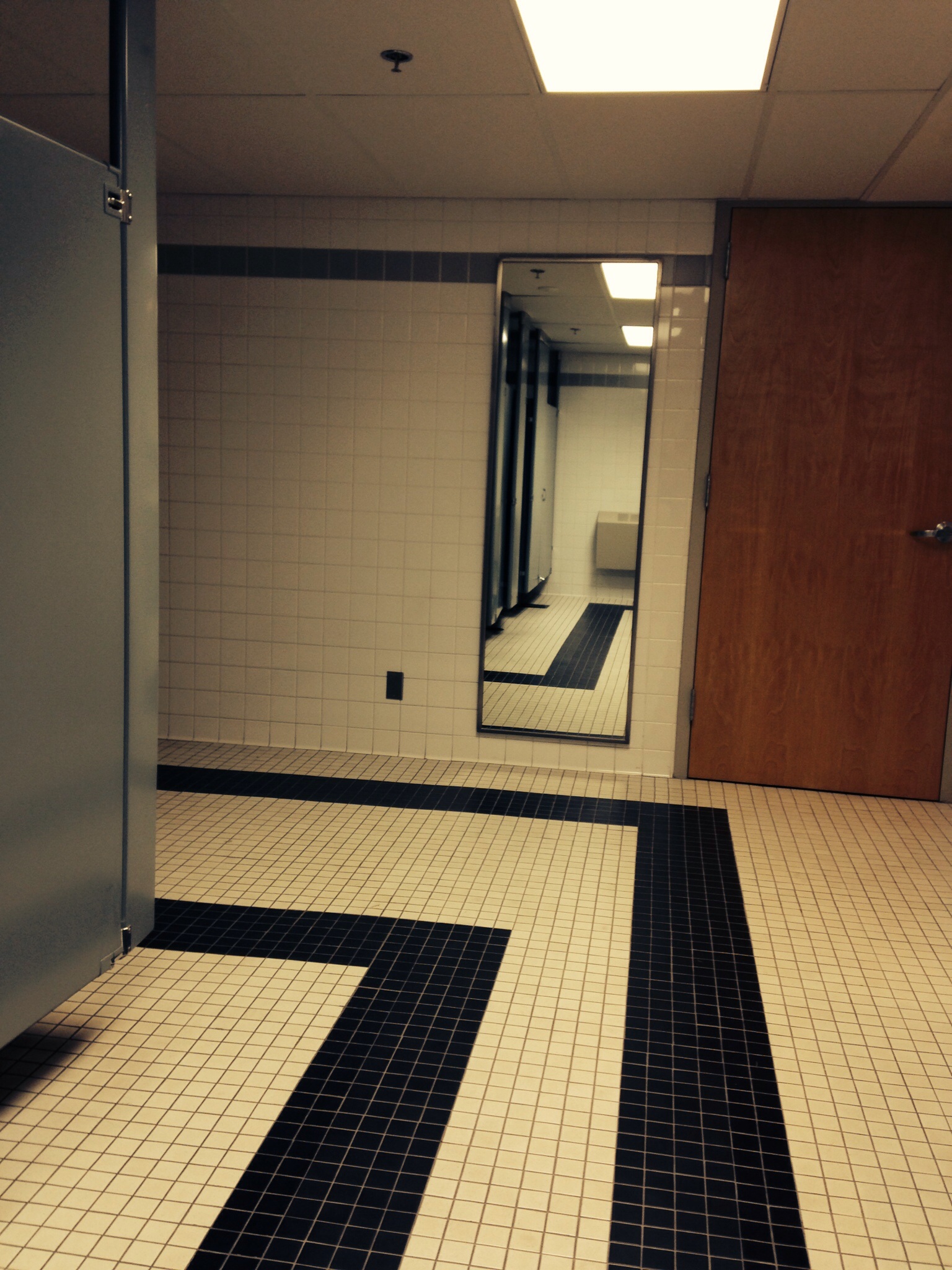
I worked from Starbucks at Red Arrow Park for part of the morning and made a quick visit to their restroom before walking back to campus. Maybe because it was a quiet time of day, I noticed something about the floor that I never have before. Doesn’t this photo look sort of like an abstract painting?
Milwaukeeans can probably guess why this post is titled “A Thousand Cuts.” Hint for everyone else: Red Arrow Park is home to the “Slice of Ice” skating rink in winter.
Apparently this is a thing, to have your dead tree turned into a work of art.
I’ve been driving past this guy for several years now. Might he be described as a “wood wizard”? Today I finally made time to pull over and photograph him 🙂
If you have a dead tree and would like to turn it into art, just Google your general location and the search terms “carved tree art” and “stump sculpture” or even “chainsaw stump art sculpture” to find someone who can make that happen.
You could also try using similar search terms in Pinterest or Google Images to pull up inspirational examples of what other people have done.
Just now I was able to find images both beautiful and whimsical:
And my favorite: a tiny little house with steps leading up to the front stoop and an open door where a friendly gnome is waiting to welcome you inside.
If you take a close look at some of Milwaukee’s older neighborhoods, you’ll notice that a hundred years ago (approximately, say 1870-1930) factories were surrounded not only by the modest cottages of workers but also by the mansions of the owners. Today you’d be lucky to find an owner living in the same metropolitan area as the factory, much less somewhere inside the United States.
The university where I teach, Milwaukee School of Engineering, sits on the site of the former Blatz Brewing Co., and in fact, several buildings on our campus were once part of the Blatz complex. So I’ve taken a casual interest in learning more about Blatz’s history, especially as it relates to our own buildings.
Not long ago, I stumbled across a photograph of the mansion Valentin Blatz built within just a few blocks of his company. Beautiful!
Described as a three-story stone mansion that was a blend of Queen Anne, Romanesque, and Gothic styles, the residence was designed by architect Charles A. Gombert and was home to Valentin Blatz from 1884, the year it was built, until his death in 1894.
Blatz mansion photograph taken from an August 9, 1964, newspaper article. Originally captioned: “The old Victorian mansion of Valentin Blatz, Sr., is shown as it appeared in the 1920’s. The pioneer brewer’s structure was razed last week along with an old coach house that stood behind it. “
Interesting aside: Charles A. Gombert also designed Milwaukee’s North Point Water Tower, Wikipedia entry here and a more detailed Urban Milwaukee article here.
Photo taken by Kevin Hansen. Via Wikipedia, CC BY-SA 3.0
I’ve seen this phenomenon of proximity repeated across the older neighborhoods of Milwaukee. As recently as the 1930s, in fact, neighborhoods appear to have been developed with walkability in mind. Factories and retail businesses lined the main streets, and residential housing filled in the blocks in between. It’s so intriguing to think about factory owners walking home from their places of business, perhaps greeting workers and their families along the way, who would also have been able to walk to work. What a different kind of community that must have created!
Just to make sure I wasn’t extrapolating too much—that is, building up a theory of historical lifestyle based on the evidence of abandoned/repurposed factory buildings, bowling alleys, banks, and retail shops—I did some quick online research looking for info that would support my mental image of life in those neighborhoods a hundred years ago. And found this, for example.
I also found some rather sad information about the home of Valentin Blatz, Jr., whose mansion was located, a few blocks east and slightly north of his father’s, among the mansions that once lined Prospect Avenue above the shore of Lake Michigan.
First this
MIlwaukee Journal article on Blatz mansion vandalism – dated December 22, 1939 (from Google News)
Which then led me to this
From Page 13 of the Historic Designation Study Report seeking City of Milwaukee Historic Structure status for the George J. Schuster house, 3209 W. Wells Street (no date)
Which led, at last, to a little good news on the historic preservation front. I didn’t recognize the “Redstone Apartments” name indicated as the Schuster House’s alias as of the time of this undated report. But when I Googled “Schuster House” and the address indicated, I found this!
Schuster Mansion Bed & Breakfast (link to website here and to an article on the owners here)
The Schuster House has found new life, and you can stay there next time you visit Milwaukee!
Sadly, turning to the fate of the original Valentin Blatz, Sr., mansion, Milwaukee’s downtown area became a rather downscale place to live during the mid-20th century. By 1939, as noted in the article above, the son’s mansion had become a target for vandals. The old Blatz, Sr., mansion was divided up into rooming-house units, and eventually a storefront addition replaced its front and side yards.
Former Blatz mansion, photo dated December 3, 1963 Former Blatz mansion, photo dated August 9, 1964
Finally, as happened all too often with older architecture in 1960s urban America, the former mansion was demolished in August 1964. To be replaced by . . .
A shopping center.
Those familiar with downtown Milwaukee will recognize the exact site of the Valentin Blatz mansion, at the southwest corner of Van Buren and Juneau. It is now the parking structure for Metro Market, a popular (and quite upscale) downtown grocery.
This seems like an appropriate time to cite one of the most haunting poems I know, “Ozymandias,” by Percy Bysshe Shelley:
I met a traveller from an antique land
Who said: “Two vast and trunkless legs of stone
Stand in the desert. Near them, on the sand,
Half sunk, a shattered visage lies, whose frown,
And wrinkled lip, and sneer of cold command,
Tell that its sculptor well those passions read
Which yet survive, stamped on these lifeless things,
The hand that mocked them and the heart that fed:
And on the pedestal these words appear:
‘My name is Ozymandias, king of kings:
Look on my works, ye Mighty, and despair!’
Nothing beside remains. Round the decay
Of that colossal wreck, boundless and bare
The lone and level sands stretch far away.”
Gee, wildebeests at the watering hole two days ago and now this today. I’m sure I’ll post something happier next time 🙂
Would you like new posts delivered to your inbox? To subscribe, click here.
A new series is beginning on BBCA (BBC America) tonight, “The Hunt,” originally broadcast last December on BBC One. Narrated by David Attenborough (who also narrated the brilliant “Planet Earth” documentary series), this new series apparently does something I’ve really never seen before in a nature program: sympathize with the predator.
Having grown up watching Mutual of Omaha’s “Wild Kingdom” and numerous National Geographic specials, I am of course familiar with “the hunt.” Almost a sub-genre of the nature documentary, the hunt is usually set on an African savanna , either on the grassy plains or at the watering hole.
On the plains we see a herd of grazing antelope or zebras, just peacefully going about their business. Until a pair of eyes appears, hidden in tall grass. A lion, or maybe cheetah, lurks, crouched and waiting for the right moment. Suddenly she attacks! A single antelope, young and vulnerable, has wandered too far away from the herd’s protection. The big cat expertly counters the panicked animal’s evasive efforts. Where is the rest of the herd? Separating itself from the unfortunate victim, bunching ever more tightly together. Not us, you can see their tiny brains surmising with relief. Not today.
At the watering hole a group of wildebeests stands at the water’s edge. Surely they know how dangerous it is to drink. And yet the great striped and maned animals lower their horned heads because they must. All is peaceful. Until suddenly, instantly the crocodile springs out of the water! Seizing one of the wildebeests in its jaws, it drags the struggling creature into the water. Do the other wildebeests come to their companion’s rescue? No, they are scrambling up the bank as quickly as possible. Not them; not today.
Whenever terrible things happen to good people, I often think about those nature documentaries. How random and violent and banal it is. Just another day on the savanna. There’s really nothing you can do to prevent a lion from taking down a gazelle. The lion is not evil; the gazelle is not innocent. There is no justice needed. No criminal act has occurred.
To hope that human existence is so very different may be folly. Can predatory behavior really be controlled? When someone commits a crime, it’s interesting how often we either dismiss analysis of motive (he’s evil) or over-analyze and excuse the motive (he was abused as a child). Or we blame the victim for not thwarting the predator’s behavior (what did she expect, wearing that miniskirt and walking home alone at that late hour?) or inflict punishment by projecting our collective fear onto an otherwise innocent scapegoat (human sacrifice at worst; looking the other way at best).
In some ways, we are all just wildebeests at the watering hole, no more and no less. We are at the mercy of a chaotic universe, despite our efforts to elevate ourselves above the animal kingdom. It’s like we think we can intellectualize our way out of the mire: we have laws and complex social rules and education and religion. Civilization regulates primitive impulses.
Maybe that’s why we’re so fascinated by predators? Maybe there’s enough distance between potential threat and immediate threat that we can be intrigued by the danger and power instead of terrified? Because how else can one explain the multitude of “Law and Order” type of television shows and the extensive selection of suspense/thriller novels in bookstores.
I have always sided with the prey in those nature documentaries, even as I must also (reluctantly) acknowledge the thrill I experience in watching a predator at work. Although I personally find wildebeests to be ungainly, unsympathetic, and unintelligent-looking animals, it’s mighty hard to imagine myself rooting for the crocodile.
That’s why I’m looking forward to the first episode of “The Hunt” on BBCA tonight. Empathy is like a muscle, and sometimes the flex is hard. Yet perspective is worthwhile, even if we can never fully identify with a being so very alien to ourselves. (The show is running at 8:00 pm Central Time, which means 9:00 pm Eastern and Mountain and 8:00 pm Pacific. FYI😄)
Would you like new posts delivered to your inbox? To subscribe, click here.
That’s how it feels when you board the train: like you’ve entered into a self-contained world that moves, as if inside a tube, through the outside environment.
Amtrak is the only way to go! If I can possibly manage it in terms of time and destination, I’m going by train any time I need to travel in the future. True, I did splurge on a bedroom instead of sitting in coach for 19 hours. That’s something I’ve always wanted to do. Getting a bedroom required planning, though, because there are only a few available on each run. I made my reservation back in January for my end-of-June trip. Usually I’m not quite that organized.
Once aboard, I realized that I probably could have just booked a “roomette” instead of a “bedroom.” The only real difference between them is space and a private bathroom.
The roomette is a quite-narrow, self-contained little room with two reclining armchairs facing each other and a berth above. To sleep, you can pull down the berth and recline the two chairs completely, and you have sleeping accommodations for two, one up and one down. There’s a sliding door that locks, so you can feel secure during the night. Each roomette car contains a bathroom to be shared by everyone on that car.
The bedroom, on the other hand, contains its own bathroom and a sink. If you get up in the middle of the night, there’s no need to run down the hall. There’s not only a sofa and a reclining chair that face each other, but there’s also an overhead berth. The bedroom easily sleeps two people and could possibly sleep three. You’d feel a little crowded during the day, but certainly no more crowded than in coach.
The space! It felt very unnecessary—but completely luxurious—to have that bedroom to myself. As I stretched out on my sofa, read my novel, and watched the green landscape outside my long picture window, I could not stop thinking about how comfortable I was and how miserable I’d be on a plane.
Meals in the dining car were included in the price of my ticket. Pretty good food! And a very relaxing meal. The pace is unhurried and you can enjoy both nice scenery outside the window and good conversation inside the car. The dining booths seat four people. If you’re traveling solo, as I was, or with one or two other people, you’ll most likely be seated with strangers. The conversations are inevitably mostly small talk, of course, but they can turn surprisingly personal, as well.
The small talk can be fun. At dinner Thursday night I sat with a couple from Bay View (a Milwaukee south side neighborhood) who had been on vacation in New Orleans. They had taken a carriage ride and done the cemetery tour, neither of which I’d had time to do. As they told me about the cemetery tour, I was able to glean interesting tidbits like these from their recounting.
Apparently a year and a day after someone is buried, it’s time to make the tomb available to its next occupant. The body, wrapped in a bag rather than placed inside a coffin, has completely decomposed by then and is nothing more than a bag of bones. The tomb is opened, and a ten-foot pole is used to reach inside and break up the skeleton. Then the now-more-compact “package” is pushed down a shaft, leaving the tomb itself vacant. According to my dining companions’ tour guide, these New Orleans cemetery practices are where we get expressions like giving someone “the shaft” and not wanting to touch something “with a ten-foot pole.”
At breakfast yesterday I sat with two sisters, who were probably in their seventies. One doesn’t fly, and although they had drifted apart during the years they were both raising families, they have recently begun traveling around the country by train every year to visit their children and other relatives. They told me a wonderful story about an impromptu reunion that one of them had been able to have with her son during one of their cross-country trips.
At some point after leaving Chicago on the California Zephyr, this sister had looked at the route map in her compartment and realized that the train would be making a brief stop in Ottumwa, Iowa (fictional home of the M.A.S.H 4077’s company clerk, Corporal “Radar” O’Reilly, in case that town’s name sounds familiar to you 🙂 ) .
Her son lived in Ottumwa! She managed to get a phone call through to him: “Quick, come to the station! We’ll be there in an hour!”
When they arrived in Ottumwa, there was her son waiting at the station along with his wife and children. The mom got off the train; she and her son hugged and cried. They hadn’t seen each other in a very long time. By that time, everyone on the train knew what was up, so as mother and son were having their unanticipated reunion, all the other passengers on the train were looking out the windows and applauding.
And then it was time for the train to pull out and head to its next stop. Just like that, as abruptly as it had happened, the reunion had to break up.
Mom got back on the train. Son and family remained at the station, waving goodbye.
We’ve had some thunderstorms this week in New Orleans. Thankfully I was inside during the worst one Monday evening. Incredibly powerful thunder and lightning, and very low in the sky…seemingly right overhead!
I took this photo as I left the convention center yesterday. I was struck by how white those poles were against the dark gray of the storm clouds above the city. Note the palm tree in the lower left of the picture. I had lunch with my co-author, Cindy, at the restaurant you can just make out at the bottom of the photo, Mulate’s.
Mulate’s bills itself as the original Cajun restaurant; it opened in its original location in 1980. I asked our server how to pronounce the name, by the way, after hearing many different-sounding versions from semi-authoritative sources.
He told us it is “myoo LAHTS.”
So not “myoo LAYTS,” which was one of the many possibilities I’d been presented with. Nor “myoo LAH tayz,” nor “muh LAH teez,” nor “moo LAH tuz,” nor “moo LAYDZ,” which were a few of the others.
The food at Mulate’s is terrific, and there seems to be a line out the door every night. It was really hot at the noon hour and I had a long afternoon of conference sessions ahead of me, so I ordered just a cup of crawfish étouffée and a gigantic pink lemonade to drink.
I also liked the Mulate’s building itself, with its veranda-like roof over the wide sidewalk (very handy protection from rain or the hot sun, both of which we had plenty of experience with this week);
its huge, heavy shutters meant to close over its French doors;
and its lovely ornamental security bars on the doors/windows of the adjoining section of the restaurant, actually an adjacent building, that lacks shutters.