Very interesting article published yesterday in Wired magazine. “Model welfare” is an emerging field of research that seeks to determine whether AI is conscious and, if so, how humanity should respond (e.g., should AI have/deserve “rights”?)
— Read on www.wired.com/story/model-welfare-artificial-intelligence-sentience/
One of my favorite scenes in the movie Working Girl comes near the end, where our heroine, Tess (Melanie Griffith), seizes a last-ditch opportunity to stop her boss, Katherine (Sigourney Weaver) from stealing her deal. After Jack (Harrison Ford) corrals their potential client into an elevator alone with them for the ride up to the mergers and acquisitions offices high in the World Trade Center, Tess delivers the OG high-stakes elevator pitch by explaining how she came up with her inspired, out-of-left-field idea that the client’s company, looking to invest in television networks, acquire a radio network instead.
And here’s the text in print (in case the clip is ever taken down by the person who posted it on YouTube, or in case you’d rather just read):
Okay. See, this is Forbes. It’s just your basic article about how you were looking to expand into broadcasting, right? Okay now, the same day—I’ll never forget this—I’m reading page six of the Post, and there’s this item on Bobby Stein, the radio talk show guy who does all those gross jokes about Ethiopia and the Betty Ford Center. Well, anyway, he’s hosting this charity auction that night: Real blue bloods, and won’t that be funny. Now turn the page to Suzy, who does the society stuff, and there’s this picture of your daughter. See, nice picture. And she’s helping to organize the charity ball. So I started to think: Trask . . . radio, Trask . . . radio.” And then I hooked up with Jack, and he came on board with Metro, and…and so now here we are.
In a similar, though much lower-stakes, moment earlier in the film, Tess suggests to Katherine that they serve dim sum dumplings at a reception instead of the usual appetizers. When she mentions that she’s been reading about them in W (a fashion magazine), a snooty colleague of her boss sneers, “You read W?”—the implication being that Tess, a Staten Island girl with the accent to prove it and a wardrobe to match, couldn’t possibly be reading a “cool kids” publication like W.
Tess keeps her cool, though. Her response (and the setup for her later moment of triumph) is blunt and simple:
I read a lot of things. I mean, you never know where the big ideas could come from. You know?
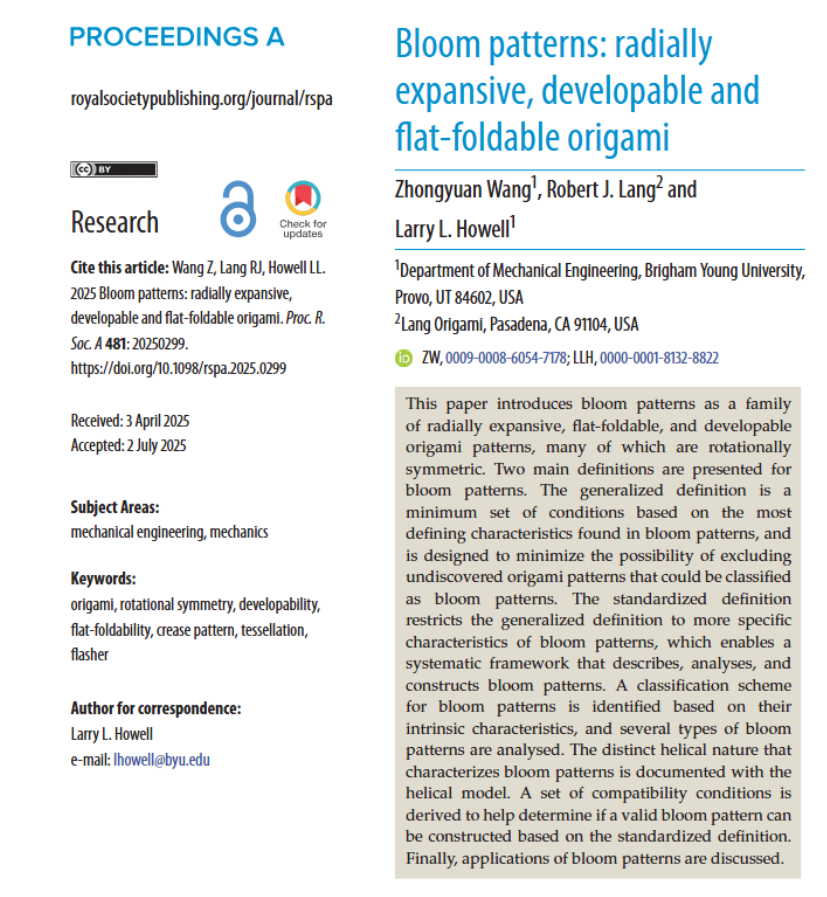
Changing the subject a bit, but along these same lines, I just found an extrememly interesting (and very readable!) article, “Bloom patterns: radially expansive, developable and flat-foldable origami,” written by an engineering professor, an origami artist, and an engineering student who has been fascinated by origami his entire life.
I actually listed the authors backwards just now to call attention to something unusual—and the reverse of how publishing ordinarily works in the fields of science, mathematics, and engineering. In the case of this article, the engineering student, Zhongyouan Wang, is actually the lead author!
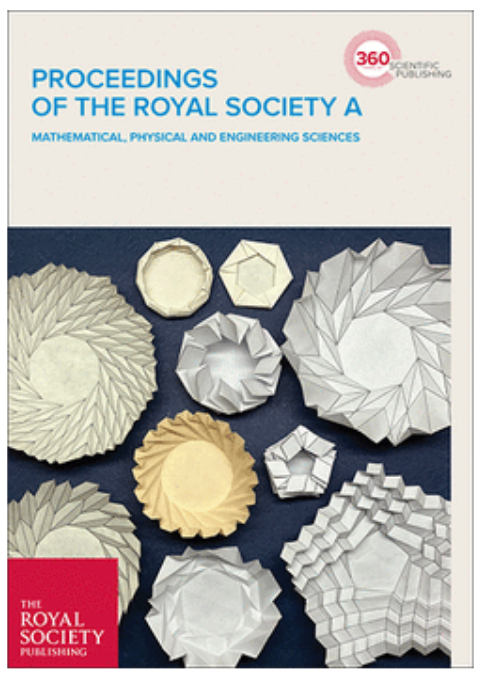
As he should be, because Wang is the creator of a unique new type of origami that “blooms” in radials from a center, like a flower. Although many different “bloom pattern” design variations may be created, they will all have that centerpoint in common, like the flower head or disk at the center of a daisy.
Cover, Proceedings of the Royal Society A: Volume 481, Issue 2320 (Aug 2025)
From a news story published by Brigham Young University this week:
The researchers coined the term “bloom patterns” to describe this new group of unfolding mechanisms that resemble flowers blooming.
“Bloom patterns have three main characteristics that make them unique,” said Wang, a BYU mechanical engineering major. “First, they can be folded flat. Second, they are deployable. Third, they expand like a flower blooming, rotating from a symmetric center.”
In terms of engineering applications, this means that large items that require compact size for storage could be manufactured via origami folds from a single large sheet of material, stored in its fully-folded form, and then either partially or completely “deployed” to become take on the desired final shape. Something like this could give a whole new spin to concepts like prefabricated architecture, for example. The researchers note that the rotational symmetry and somewhat circular shape of the deployed structures give these items more stability than similar structures created using other (non “bloom”) origami folding patterns.
Here’s a video from Brigham Youg explaining this origami and its engineering applications potential.
Because working on a computer for hours at a time (in a single sitting) is not good for anyone, I try to take short, frequent breaks to get in some stretching and walking as much as possible. Fortunately, my office is in the Grohmann Museum on the campus of Milwaukee School of Engineering, so not only do my walks get the blood moving and help to work out the kinks in general but they also give me a chance to surround myself with art along the way.
I know this isn’t exactly art.
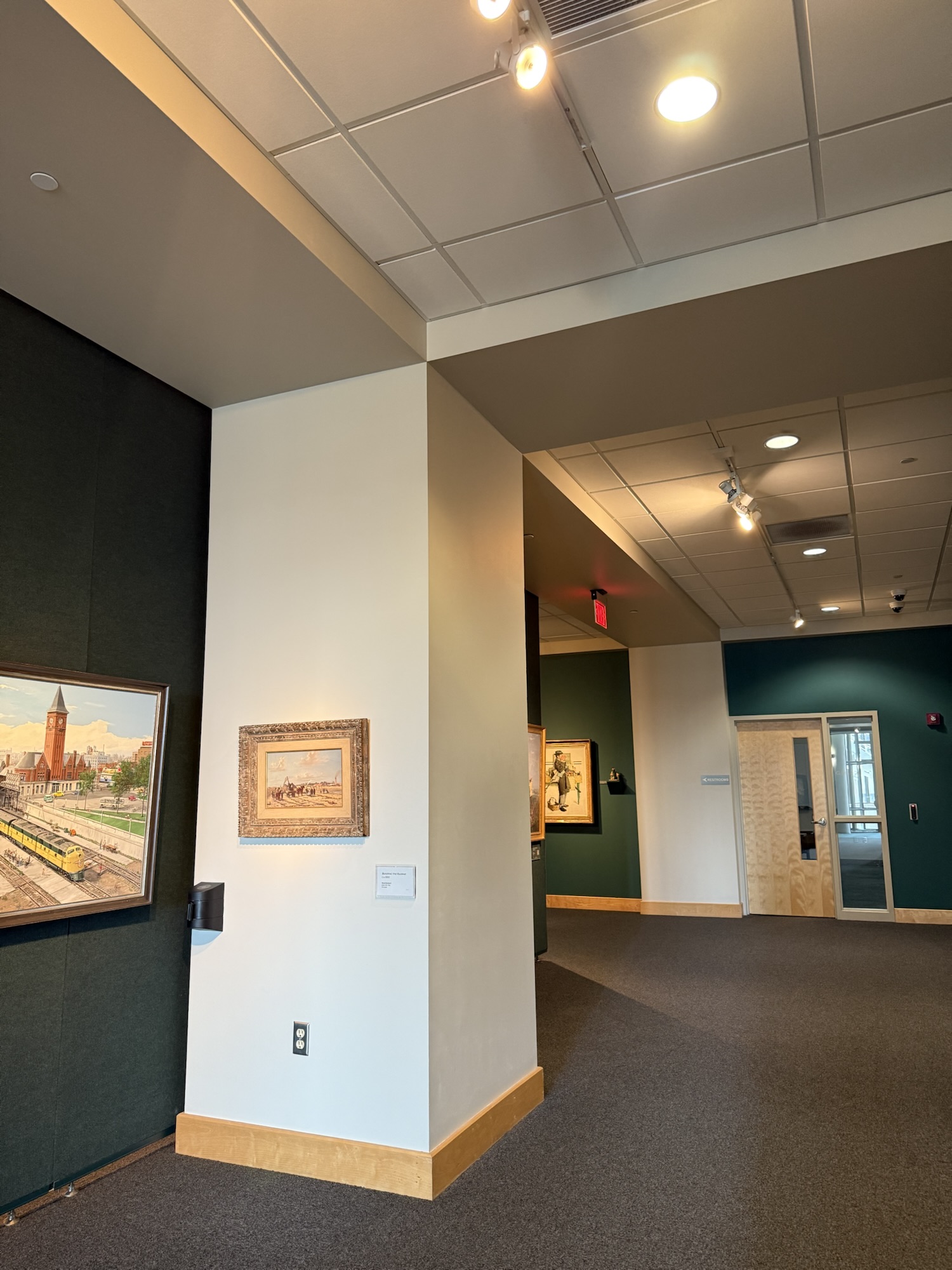
But it was a fun thing to notice as I walked laps around the second floor in the very late afternoon one day last week. Just a very striking intersection of planes and angles—and as I am a fan of abstract, geometrical images, I naturally had to stop and take a picture.
The above image is a cropped close-up area of the picture I took. Isolating it from the larger context allowed me to approximate the moment of “intersection” that caught my eye.
Below is the entire photo. I’ve worked in this building since it opened in 2007. Not once in nearly 20 years have I noticed that specific little corner of the ceiling before. I’m not sure what drew my attention last week, but there must have been something unique in the quality of light and shadow created at that particular time from both inside and outside (sun) sources.
By the way, do you see the painting below the red “Exit” sign? It’s a Norman Rockwell, titled “The Bookworm.” According to an Artnet News story, it sold in 2015 for $3,834,000, well above Sotheby’s presale estimated value of $1.5 to $2.5 million.
It’s quite astonishing to me, now that I take a moment to reflect on it, that a painting worth that much money could be part of my ordinary daily routine.
This week’s short-short story, “The Art of Forgetting,” was fun to write.
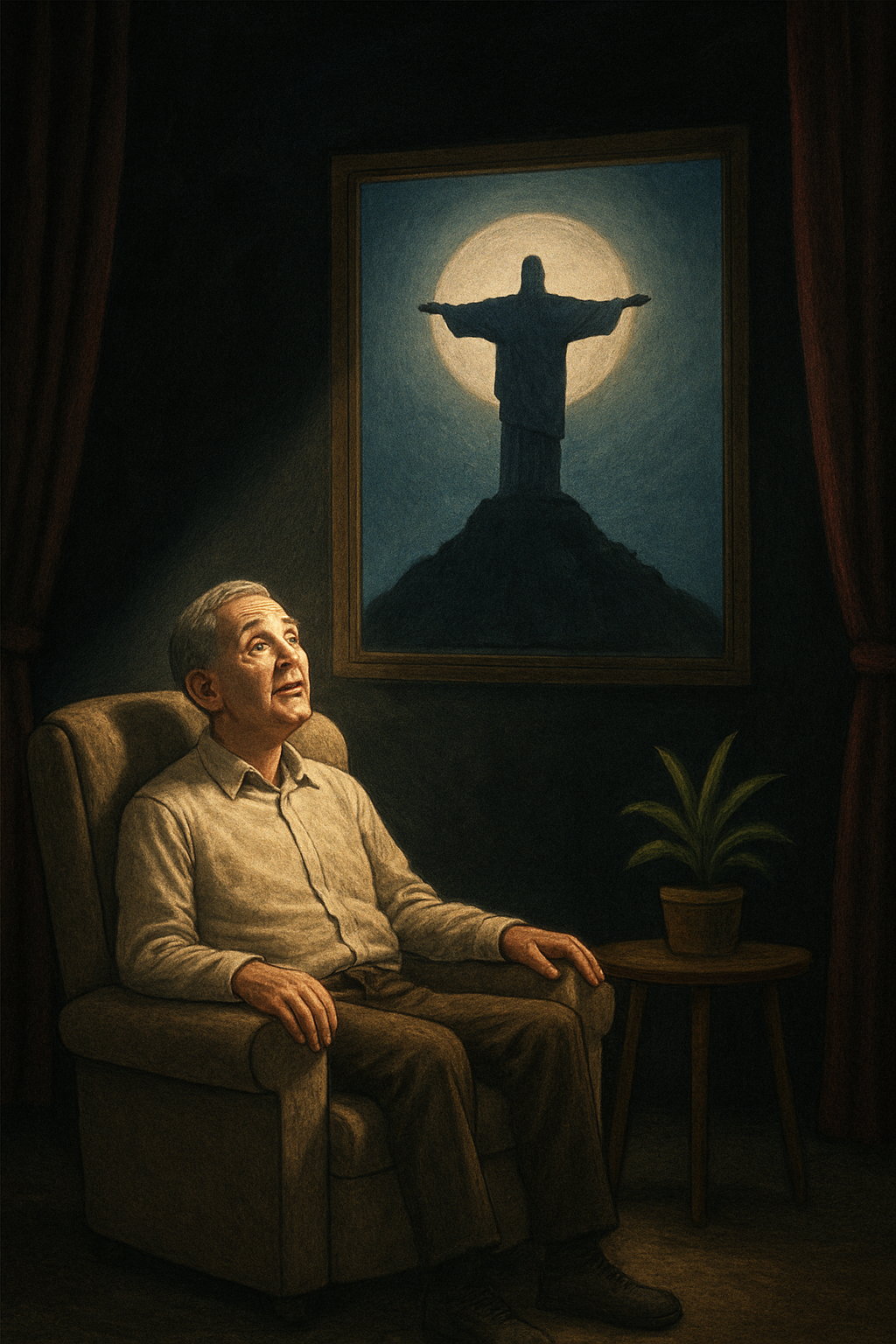
‘The Art of Forgetting’ – ChatGPT Image, prompted by Katherine Wikoff, Aug 19, 2025, 01_38_14 PM
Before I go any further, here are the relevant PDFs for this week’s post.
First, HERE is the PDF of my short story, “The Art of Forgetting.”
And HERE is my entire ChatGPT creative conversation. It’s long and meandering, but it may have some value if you’re interested in seeing how I wrote the story, at least the “trail” left behind by my “chat.”
Finally, HERE is chat I used in prompting ChatGPT to create the image that illustrates this post.
My friend Karen had highlighted it as a phrase she especially liked during her critique of that story, so we decided to turn it around and build on it as the prompt for our next meeting’s exercise. It became the seed for my story’s main character, Edgar, and his frightening journey through grief.
If you look at the “Appendix Chat” I used to prompt this week’s story, you’ll see that ChatGPT suggested a number of story ideas based on the phrase “quietly rotting memories.” Almost none appealed to me—but something about the following description caught my eye and sparked my imagination:
“An elderly man pretends to have dementia to avoid his family, but his lies accidentally trigger real past events. Now he has to untangle his quietly rotting memories from the fake ones he invented.”
That logline emerged only after a lot of back-and-forth with ChatGPT. I asked for multiple lists of potential ideas, identified a few I liked, requested more, and gradually whittled them down—rinse and repeat—until the premise and character finally felt right. I remember feeling a little guilty about being “wishy-washy,” like I was wasting ChatGPT’s time by not settling on a direction. But that’s exactly one of the gifts of working with AI: you can keep iterating until something clicks. After rejecting plenty of false starts, I landed on a premise that truly spoke to me—and that made the project so much more fun.
Much of the initial drafting I don’t remember (it was two months ago), but I do recall realizing early on that this story could lean toward dark comedy. The subject matter (dementia) is scary and upsetting, and I could easily see myself slipping into pathos and melodrama, so the idea of approaching it with an edgy wit appealed to me. Plus, ChatGPT helped nudge me in that direction by suggesting Edgar’s family escalate his ruse by sending him to Shady Pines and tossing out his jazz collection. Those tiny details instantly gave me a sense of Edgar—his history, his quirks, the kind of man who’d cling to his records. Once the theater background started to surface, I embraced it as a source for motifs and perspectives.
In my last “Creative Practice” post, I mentioned that I had noticed my photography “style” emerge gradually over time, almost as a byproduct of taking photo after photo. The same seems to be happening in my writing with ChatGPT. Even though I’ve only produced a handful of pieces, the speed at which I can now write—much faster than I could without AI—has already revealed recurring rhythms and themes in my work. These might be the beginnings of a literary “voice.” I expect this will become even clearer in a couple of weeks, when I share my next original piece, a poem I’ve already finished called “The Museum of Mislaid Days.”
One thing I’ve begun to notice about my style is that I’m oddly drawn to morbid subject matter—by which I mean things that feel nostalgic, tragic, or unsettling—and to liminal spaces. I’ve sensed this in my photography, although there it manifests more in abstraction, geometry, detachment, and abandonment rather than “morbid” content. It’s a surprising realization (although, why?) to see these patterns emerging in my writing as well.
For example, I wrote a poem for a writing group exercise this past winter, “Common Comrades,” about a sculpture along the Milwaukee Riverwalk. I didn’t invent the horrifying subject matter—it was right there in front of me on Kilbourn Avenue at the river—but still it was that sculpture that spoke to me, not one of the many others installed along the Riverwalk. To put it in terms of the “intertextuality” I talked about in my last “Creative Practice” post, my poem entered into a dialogue with the “Common Comrades” sculpture. Both sculpture and poem now speak to each other, and the result is beautiful to me precisely because it is so sad and unsettling.
Edgar’s story for this week nearly went the same way. In draft after draft, he ended up completely lost to madness.
But then, just a few days ago, I asked myself: Why? Why does he need to be lost? My work so often seems to end on a “down” note—but it doesn’t have to. I could let Edgar find something lighter, even if somewhat ambiguous, at the end. So I did. Judge for yourself whether it works, but for me, giving Edgar a measure of hope felt right.
That, to me, is one of the fascinating things about creative practice—patterns emerge, sometimes in spite of ourselves. I don’t know what they “mean.” I’m not interested in psychoanalyzing it. What I do know is that creativity often feels like something flowing through me rather than from me.
When I’m walking down the street and something suddenly strikes me as a potential photograph, I don’t know where that impulse/recognition comes from. I don’t plan for it. That moment really does feel like the muse is announcing its presence. The same thing happens in writing. Even with my novel, where I’ve made deliberate choices about subject matter, once I begin drafting, characters and plot twists pop up and surprise me. It’s as if the stories are already out there, waiting, and my role—sometimes with AI’s help—is to act as the channel that brings them into shareable form.
This Week’s Suggested Creative Practice
Getting Acquainted with the Artist Your Creations Knew Before You Did
Each week in this (nascent) “Creative Practice in the Age of AI” series, I offer a short list of “creative invitations”—small exercises that I hope can be meaningfully adapted to your own work. This week’s invitations focus on self-discovery: not only noticing the recurring styles, subjects, and images that surface in your creative practice but also reflecting on what they reveal about the artist you are becoming.
1. Trace Your Echoes – Pull out 3-5 recent works you’ve made (a photo, a paragraph, a sketch, a song draft). Jot down what imagery, tone, or subject matter repeats across them. What patterns surprise you? Which ones feel inevitable?
2. The Morbid–Tender Sway – Write (or sketch/photograph) something in your usual style. Then rewrite/reframe it with the opposite emotional register. If you lean “dark,” give it a lighter, gentler ending (like Edgar’s) or add a comedic twist. If you lean “light,” twist it toward the uncanny or imbue it with tragedy, sadness, or despair.
3. Memory Remix – Take a phrase or fragment from an older work—something that still resonates with you—and use it as a seed for a new piece. (Like what my writing group did with “quietly rotting memories.”) Notice how the original context colors the new one.
4. AI as Trickster – Ask ChatGPT (or another AI) to generate five versions of a story premise, poem opening, or image idea based on one phrase you like. Circle the least appealing one and try making something from it anyway. (Constraints sometimes reveal surprising aspects of your style.)
5. Your Liminal Self-Portrait – Create a short piece (poem, photo, drawing, even a journal entry) set in a “threshold” space—an airport lounge, a waiting room, a hallway. Then look at what kind of mood your work naturally drifts toward: anxious, whimsical, mournful, playful?
(Note: In addition to the denotative definition of “liminal” spaces as “transitional,” “threshold” spaces between one “state” and another, like that dreamy threshold between wakefulness and sleep, I am also interested in the connotative definition of “liminal” spaces as empty places intended to be occupied, except no one is there, and which when you experience, view, or read about them, you feel a sense of uneasiness. There is often something eerie or mournful or vaguely threatening about a “liminal” space.)
Thanks so much for joining me this week! I hope you enjoy “The Art of Forgetting” and the behind-the-scenes peek at its creation.
Today’s post is something different for me. My friend Kathleen is editor of a newsletter that publishes fiction, poetry, and essays. Because her publication is limited to black-and-white reproduction of images, and the article below contains a color image, she asked if I would be willing to publish it on my website.
I would be happy to do this as a favor for my friend anyway, but it was a pleasant surprise to discover that the article fits in nicely with what I like to publish here, so it’s kind of a win–win–win all the way around, for Kathleen, for the author, and for me!
And so now, without further ado, please allow me to introduce Joe Burke and his intriguing exploration of unexpected dimensions behind a commonly used phrase.
“I See What You Mean”
by Joe Burke
Many of us have heard someone use that phase, and some of us may have used it ourselves. It is an odd expression since it combines two different sensory functions of the body. The phrase combines sight and the spoken words filtered through the intellect producing some degree of understanding. But what does one really see?
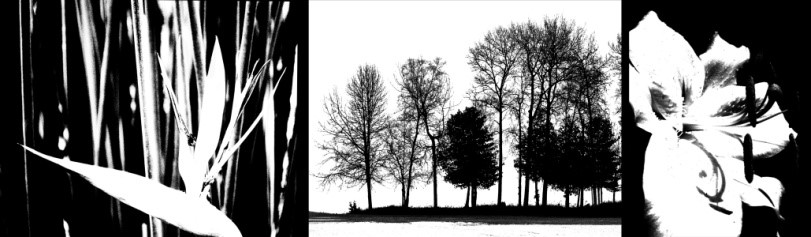
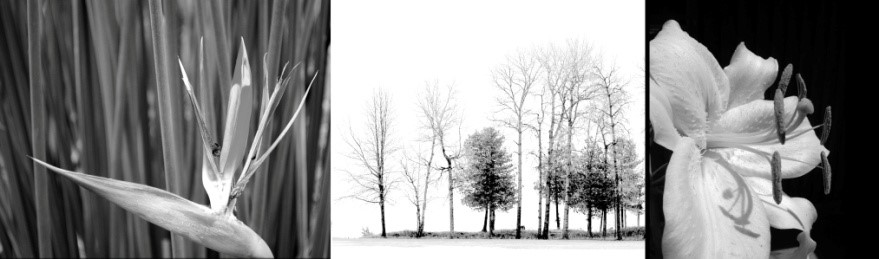
Recently I participated in a spiritual discussion about living in the LIGHT. Having been a photographer my mind jumped to my definition of a photograph as an image that was painted by LIGHT. And I am aware that this LIGHT is only the visual spectrum that our human eyes can SEE. No infrared, nor ultraviolet, nor X-Rays are involved. So, immediately, my mind says that living in the LIGHT, with the visual spectrum, could have limitations.
The phrase, “I see what you mean” came to mind. How much of the LIGHT am I really seeing in my life? Communication demands a speaker and a listener. The words of the speaker may or may not have the same meaning for the listener. Hence I give you this example from photography. The same photograph could be “seen” in high contrast black and white, or possibly in black and white filled with grey tones, or possibly reproduced with all the colors available in the visual spectrum.
It may not be fair to assume that the listener “sees” a colorful statement if he/she is only looking at it with the eyes adapted for high contrast black and white. Even the opposite is possible. The speaker may be using high contrast black and white words and the listener tries to “see” it as a color image.
When a person says, “I see what you mean” do they see the same spectrum and the full meaning of all that the speaker was relating? The conversation can become complicated. I am not sure it can be resolved without each party double checking with each other.
Suppose we add grey tones to the “seeing”. The conversation becomes deeper and picks up more nuances’. More understanding is required, more facts must be communicated. More information is being passed, so more concentration is demanded on both sides. The speaker realizes that his/her message is more important and must use words to indicate that, and the listener must adjust his/her hearing to adapt.
In some cases a whole new meaning is being communicated. Where there was nothing, now there is something. And that something has to be part of the conversation. Both parties have so much more to work with. But if one party is giving this much information, the other party cannot be on the high contrast black and white level. Much more is demanded of the communicator and so much more from the listener or meaningful communication cannot happen.
For the final step in our experiment what happens when the speaker is using the full color spectrum? Oh my, we are now in full conversation where both the speaker is communicating precisely his/her message and the listener must now open up completely in order to “see” what is being presented.
Can the speaker find the words necessary to relay his/her full message, and can the listener absorb all the color tones that are being sent to him/her? When the listener now says, “I see what you mean” both parties are responsible to double check each other if the conversation is to continue on the same level. Living in the LIGHT is not a simple task.
I hope you can “see what I mean”
P.S. Remember, this example only relates to the visual spectrum here.
NOTE — If you would like to see this article in its original format, please click on the title here ‘I See What You Mean’ – by Joe Burke to open a PDF of the original Word document.
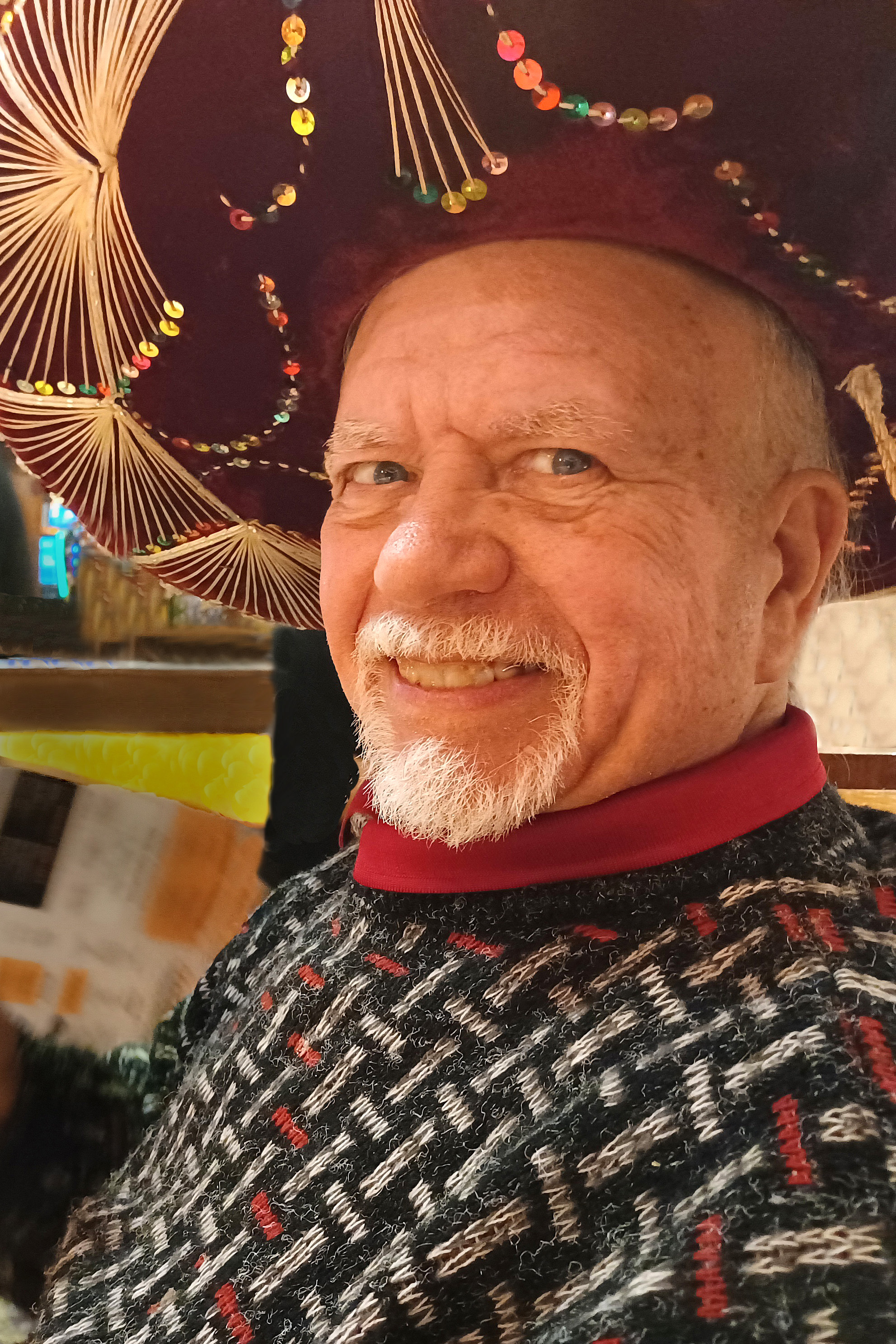
Photo of the author, Joe Burke
Contributor’s note
I was a medical photographer in Richmond VA., supplying the medical staff with visuals for their lectures, publications, and books. I photographed patients before, during and after operations. I was in the operating room, in the morgue, and behind the microscope gathering my photos and then processing and printing them for the doctors. I also taught them how to take better and more accurate photographs for their research.
In my retirement I use the computer to adjust or repair old and new photographs. And because I read a lot of progressive theology I create photos like the one attached [below].
My wife and I live in a retirement community in Milwaukee, WI. At 84 we are still active and curious about life.
A FINAL WORD FROM ME — Thank you, Joe, for sharing your article with my readers!
Inspiration may strike, but creativity accumulates. One is lightning in a bottle; the other is molasses—slow to pour, but sticky enough to catch the stray ephemera that lend rich flavor to whatever artistic projects you’ve got baking.
Creativity is not a trait you’re born with so much as it is a practice you build and a dialogue with everything that came before.
A creative life isn’t built on rare moments of brilliance but, instead, on repetition: showing up and making something out of nothing, again and again. It’s taking 200 photos to keep three. Writing five pages to find one good paragraph. Baking six test batches before the recipe finally tastes the way you imagined. Learning to love the part where it doesn’t work—yet.
That kind of effort might not be glamorous, but over time, it yields something miraculous: a voice, a vision, a style that’s unmistakably your own.
That’s what happened to me with photography. Over the past fifteen years, I’ve taken thousands of photos—mostly unplanned, usually because something caught my eye. I wasn’t trying to develop a personal “style,” but to my surprise, one emerged anyway. People began pointing it out to me before I could see it myself.
More recently, I’ve seen the same thing happening in my writing. The more I write—whether short stories, flash fiction, or essays like this—the more I notice recurring rhythms and themes. The voice sounds like me. It’s a voice cultivated, not born. Specifically, it’s a combination of the way I speak in person, the “scholarly” me who reads academic articles, and the breezy voice I used in a monthly column reviewing romance novels for the Milwaukee Journal-Sentinel for about 5 ½ years. Now that I’ve been using ChatGPT regularly, I suppose my writer’s “voice” also is picking up some of that technology’s tics, although I edit those somewhat repetitive and predictable “tells” out whenever they startle me enough in a draft revision to feel unnatural to my “true” voice.
It’s tempting to romanticize inspiration. But creative practice often works more like a conversation across time that is unexpected, layered, and sometimes quite startling.
This idea, that creativity unfolds in conversation with the past, is something I first explored in graduate school—long before AI was part of the equation. My dissertation focused on plagiarism, but not in the usual “academic dishonesty” sense. I was less interested in cheating than I was in the murky, fascinating questions beneath it:
What does it mean to be original?
Where do we draw the line between influence and theft?
How do authorship and ownership work in a world where language—and culture itself—is inherently collaborative?
I found myself drawn to theories of “intertextuality,” which view creativity not as the invention of something entirely new but as the reconfiguration of what already exists. What began as an academic inquiry slowly became a creative framework, one I now bring to everything I make. That shift in perspective helped me see how meaning emerges not from a single voice in isolation—i.e., not from the notion of the “author as individual genius,” a Romantic-era idea reinforced by legal and educational systems through concepts like copyright and plagiarism—but from the dynamic interplay between texts, readers, and cultural contexts. In many ways, that intellectual grounding continues to shape how I approach my own creative practice—and how I think about the implications of AI tools in our evolving creative landscape.
Art doesn’t emerge fully formed. It borrows. It rewrites. It loops back on itself. This realization—that style emerges from layering and repetition—echoes what literary theory has long argued about how “meaning” is made. And in an era when generative AI can mimic human style, these questions about voice, originality, and authorship feel more urgent than ever.
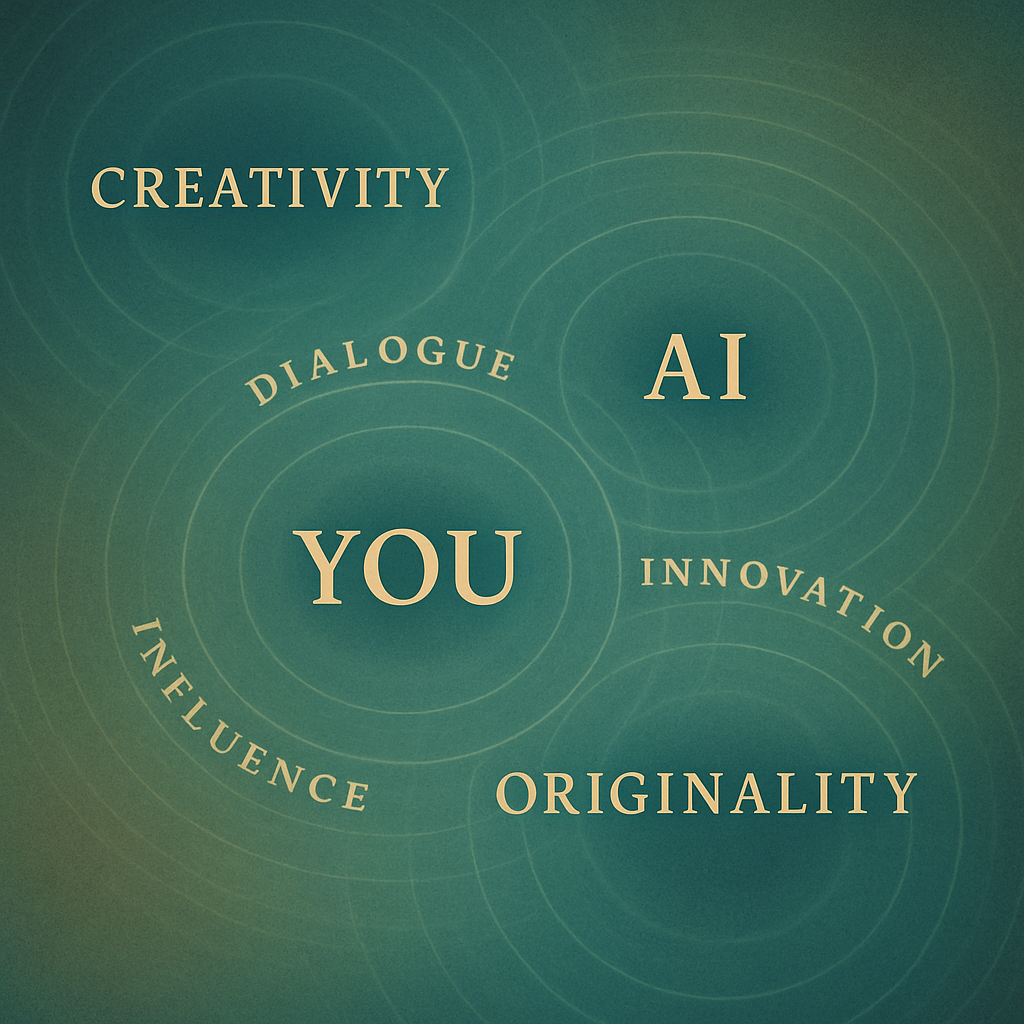
Concentric circles and overlapping ripples of creative practice – ChatGPT image
Where Do Ideas Come From? (Hint: All Art Is a Remix)
The term intertextuality was first coined in the 1960s by Bulgarian-French theorist Julia Kristeva, building on the ideas of Russian literary critic Mikhail Bakhtin. Kristeva’s key insight was this: No text exists in a vacuum. Every work of literature, art, or culture is shaped—consciously or unconsciously—by other works that came before it. Rather than seeing a book or a song or a film as a sealed-off creation, Kristeva urged us to view all texts as part of a vast, ongoing web of meaning, in dialogue with other texts across time and space.
In more practical terms, “intertextuality” refers to the way one work references, echoes, or engages with another. Sometimes it’s deliberate, like a line that quotes Shakespeare, or a scene that restages a famous photograph. Other times it’s more unconscious: a tone, a structure, a melody, or a plot pattern that feels familiar because we’ve encountered it somewhere before.
You can see intertextuality in nearly every form of creative work:
In literature, James Joyce’s Ulysses mirrors the structure of Homer’s Odyssey while placing its action in modern Dublin.
In cinema, Quentin Tarantino’s films are layered with allusions to older grindhouse, Western, and kung fu movies—not as parody, but as homage.
In music, Beyoncé’s Lemonade draws on visual and poetic references from African American literature, history, and visual art, creating new layers of meaning through those echoes.
In satire, intertextuality often becomes a tool for critique: think of The Simpsons or Saturday Night Live sketches riffing on politics or pop culture in real time.
These intertextual moves can take the form of allusion (a nod), homage (a tribute), pastiche (a playful or reverent mashup of styles), or satire/parody (a critical imitation). Each invites the audience to recognize and respond to prior texts, deepening the experience.
We often talk about artists’ “influences”—the books, bands, films, and thinkers who shaped their style or worldview. Influence is a helpful concept, but it can imply a one-directional flow: this artist borrowed from that one. Intertextuality goes a step further. It sees the creative process as layered, recursive, and cultural, not just personal. And it recognizes that meaning doesn’t come solely from the creator—it emerges in the interplay between texts, audiences, and contexts.
Voice, Originality, and the Echoes We Choose
Perhaps nowhere is intertextuality more apparent—and more audible—than in music. Consider Nirvana’s “Smells Like Teen Spirit.” Kurt Cobain once admitted (his term, in this Rolling Stone interview) that he was trying to write a Pixies song when he came up with it, and he was also struck by the guitar riff in Boston’s “More Than a Feeling.”
Here is Boston’s “More Than a Feeling. Listen for that guitar riff at the 43-second mark.
The video below is Nirvana’s “Smells Like Teen Spirit.” Listen for the opening guitar riff at the very beginning and then again throughout.
Here’s how Cobain described the creative spark behind “Teen Spirit”:
I was trying to write the ultimate pop song. I was basically trying to rip off the Pixies. I have to admit it [smiles]. When I heard the Pixies for the first time, I connected with that band so heavily I should have been in that band — or at least in a Pixies cover band. We used their sense of dynamics, being soft and quiet and then loud and hard. ‘Teen Spirit’ was such a clichéd riff. It was so close to a Boston riff or ‘Louie, Louie.’ When I came up with the guitar part, Krist looked at me and said, “That is so ridiculous.” I made the band play it for an hour and a half.
Although the Pixie’s style and the “clichéd” Boston/”Louie, Louie” riff may have been influences for the creation of “Teen Spirit,” once the Nirvana song was released and it gained its own cultural text, its relationship to Boston’s earlier song became an example of intertextuality. Listeners could hear the echo, the contrast, the transformation. That interaction between songs created something new, not only because of what Cobain was doing but also because of what the audience beyond was hearing and interpreting.
In this way, intertextuality reminds us that creativity is not about pure originality—it’s about participation. Every act of creation joins a lineage. That’s not limiting; it’s liberating. It’s not a constraint—it’s a chorus you get to join. It means we’re always part of something larger.
In A Moveable Feast, the 1963 memoir of his time in 1920s Paris, Ernest Hemingway talks about how he would go to the museum every afternoon after he had finished his writing for the day:
I was learning something from the painting of Cézanne that made writing simple true sentences far from enough to make the stories have dimensions that I was trying to put in them. I was learning very much from him but I was not articulate enough to explain it to anyone.
Although Hemingway wasn’t painting, he was in dialogue with Cézanne’s aesthetic of dimension through omission, presence through absence. The result? Stories that spoke volumes by what they left unsaid. In “Hills Like White Elephants,” for example, the woman is pregnant. An abortion looms. But none of this is stated outright. The story asks readers to fill in the blanks—to sense the depth behind the surface. Hemingway’s writing wasn’t a mirror of Cézanne’s art, but an echo of it—an intertextual response across form. This, too, is intertextuality—not copying, but letting one medium inform another in pursuit of deeper meaning.
Like Hemingway, the famed mid-twentieth-century painter Grandma Moses also created in a language others had already spoken—only hers was visual. A self-taught “outsider” artist who took up painting in her late 70s, she brought with her decades of embroidery experience, and it showed in the stitchlike brushwork she used to render grass, trees, and the colorful textures of rural life. Her work was not naive, but deeply intertextual—her painting rooted in visual language shaped by a very different medium, embroidery.
Grandma Moses’ story reminds us that creative style often emerges less from conscious invention and more from a combination of circumstance and accumulated experience—a dialogue between context, media/mediums, materials, and memory. No creative act exists in isolation, which is exactly why the rise of generative AI poses such provocative questions.
When we talk about AI-generated text or art, perhaps the question shouldn’t be “Is it original?” Instead it might be “What lineage, or what thread of conversation, is it participating in?” Intertextuality offers a richer lens for thinking about authorship—especially as generative AI enters the mix as a creative tool. Is ChatGPT merely a “plagiarism machine,” as linguist Noam Chomsky argued in a New York Times op-ed (March 8, 2023)? Or is it something else—more like an amplifier or portal, refining and rerouting the threads of these intertextual conversations? Perhaps whether AI degrades creativity or extends it depends not on the tool, but on the intent and awareness of the person using it.
(Then again, as Marshall McLuhan famously stated, “the medium is the message”—meaning that the tool itself is the message, not the intent and awareness of the person using it. That’s a different discussion—one I’ll save for another post.)
Why This “Creative Practice” Series? Why Now?
I’ve been writing occasionally about AI on my blog for the past year. But I realized that this particular thread—AI and the creative process—needed a dedicated home. A place to reflect more deeply, share experiments, and connect with others who are also wondering what it means to be creative in this strange new landscape.
That’s what this series on “Creative Practice in the Age of AI” is for.
Whether you’re a teacher, artist, writer, skeptic, or simply curious—if you care about creativity and you’re paying attention to what’s changing, you are very welcome here.
Every other week (most of the time), I’ll share either 1) an essay about creative practice and its evolving terrain, or 2) a piece of my own original creative work that emerged from collaboration with AI—along with my behind-the-scenes insights, including the “chat,” on how it came together.
These posts aren’t polished, final “declarations” but rather explorations in progress. They’re snapshots of ongoing discovery—artifacts of the questions I’m living with.
And maybe you are, too?
If so, I’d be honored to have you along.
Who Am I?
I’m Katherine Wikoff, a writer, photographer, and professor of humanities at Milwaukee School of Engineering, where I teach courses in digital culture, communication, and creative expression. I have a PhD in English with a focus on rhetoric and composition, and over the years, my work has spanned everything from political essays and film studies to fiction and photography.
I’ve always been interested in how meaning gets made—how people use language, imagery, and story to understand the world and shape their place in it. That’s what led me to study authorship and plagiarism in graduate school. My dissertation, The Problematics of Plagiarism, asked questions we’re now grappling with in real time: What does it mean to create something “original”? Where do we draw the line between influence and theft? Who gets to be called an author? And, perhaps even more importantly: Who decides?
In the Age of AI, You Are Still the Driver
Generative tools can help with process. They can even be collaborative, even inspiring. But they can’t do the practice part for you. The connecting. The choosing. The listening. The looping.
Creative practice is how you find your rhythm. It’s how you teach yourself what matters, what you’re good at, what you want to say. If you’re experimenting with AI tools, that’s still true—maybe more than ever. A chatbot can’t tell you where your story begins. But practice can.
Just start. That’s where everything begins.
And even with all the “influence” and “intertextuality” in play, your art remains both “original” and entirely your own. The words may previously have been spoken, the colors mixed, the chords struck, the steps danced—but never in quite your way. Not with your hands. Not through your voice.
This Week’s Suggested Creative Practice
Your Intertextual Self: The Artist You’ve Been and the One You’re Becoming
Every post in this “Creative Practice in the Age of AI” series includes a “creative invitation,” a list of small (but hopefully meaningful) exercises you can try on your own terms. This week’s exercises are intended to prompt reflections on your growth as a writer, teacher, artist. How has your creative practice taken shape? What are your influences? What other writers or artists have “spoken” to you through their work? And finally, what style or creative vision seems to characterize your work?
1. The Practice Timeline Look back at the last 10 years (or 5, or 15—your choice). What’s something creative you’ve done regularly—even if it didn’t feel “important” at the time? It could be journaling, taking photos on walks, collecting quotes, designing flyers, tinkering with recipes. Now draw a timeline. Mark moments of growth, shift, or surprise. What emerged over time? Can you see a pattern? A style? A voice?
2. The Influence Inventory Think about this question: What shaped you as a creative person? Make two lists:
Your creative influences: authors, artists, thinkers, places, objects, movies.
Your creative “un-originals”: things you borrowed, mimicked, or remixed.
Then reflect on this question: Where do originality and influence blur for you?
3. The Practice Spiral Creativity isn’t linear. It spirals. Write about something you keep coming back to—an image, a story idea, a question, a problem. What keeps circling back into your work or life? Is it time to move past it—or move deeper in?
Thank you for reading this week’s post, and I hope to see you again next time!
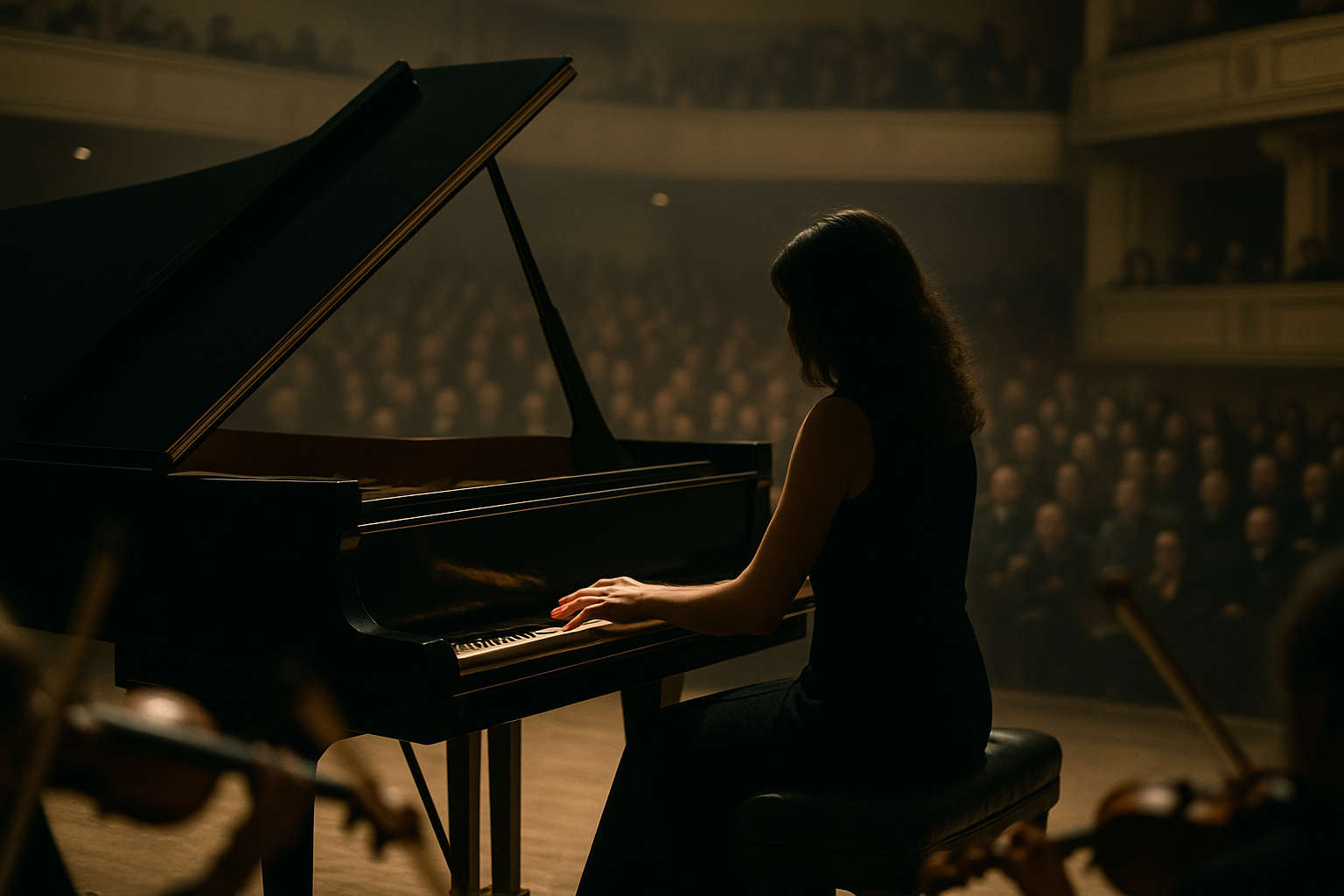
When I asked ChatGPT for an image to illustrate “The Pianist’s Hands,” the short story I wrote with ChatGPT and posted earlier this week, I thought it was gorgeous and (for a few minutes) an “absolutely, breathtakingly PERFECT!!!” image to accompany the text.
And then I noticed something weird.
I wanted the pianist to be seen from the point of view of the orchestra, specifically from behind the violin section, with blurred images of violins and bows in the foreground near the bottom of the image.
Look at how ChatGPT decided to compose the lower left corner of my picture.
“The Pianist’s Hands,” to accompany the short story by Katherine Wikoff (with ChatGPT assists)
That’s a left-handed violinist!
Now, maybe turning things around like that, essentially creating a mirror image to complement the violins over on the right, allowed ChatGPT to balance out the use of space more evenly there at the bottom of the frame.
But so strange! A human artist would (presumably) never do that—create an image that was so factually wrong just to fill up a space pleasingly. It never even occurred to me that I might need to provide instruction for which way the bows ought to be facing. Yet, although I saw the issue almost immediately, I liked the overall image so much that I didn’t want to have ChatGPT start fooling around with it to fix that “technical” issue—because as I’ve learned the hard way, ChatGPT can’t just fix something, it creates a whole new image from scratch.
So I just decided to let it go, and published the image as is.
Then a short while later, I found myself wondering: Just how many left-handed professional violinists are there in the world anyway?
Well, lots. According to Google’s AI overview, roughly 10% of all violinists are left-handed.
But basically no one in a professional orchestra has ever played a left-handed violin in the same way Paul McCartney plays a left-handed bass. Tradition (plus practical logistics, in terms of avoiding crashing bows) dictates that left-handed violinists play in the same manner that right-handed violinists do. If anyone were to play a left-handed instrument, they’d probably need to be seated somewhere on the outside and maybe in the rear of the violin section to keep from tangling up their bow with anyone else’s.
I have to add that ever since childhood I’ve loved watching the simultaneous, en masse up-and-down movements of an entire violin section’s bows during a performance. It vaguely reminded me of the Rockettes’ kick line. My kids ended up playing violin in their school orchestras, so I know that bowing technique and synchronous bowing do have an impact on sound. But to be honest, and yes, this has zero relationship to sound quality, I think having one bow moving at odds with all the rest would severely damage the visual aesthetic
Which is exactly what ChatGPT inadvertently did to my “Pianist’s Hands” picture, even as (I assume) it was intending to create a more balanced composition.
Two references to unpack in that title, but first . . .
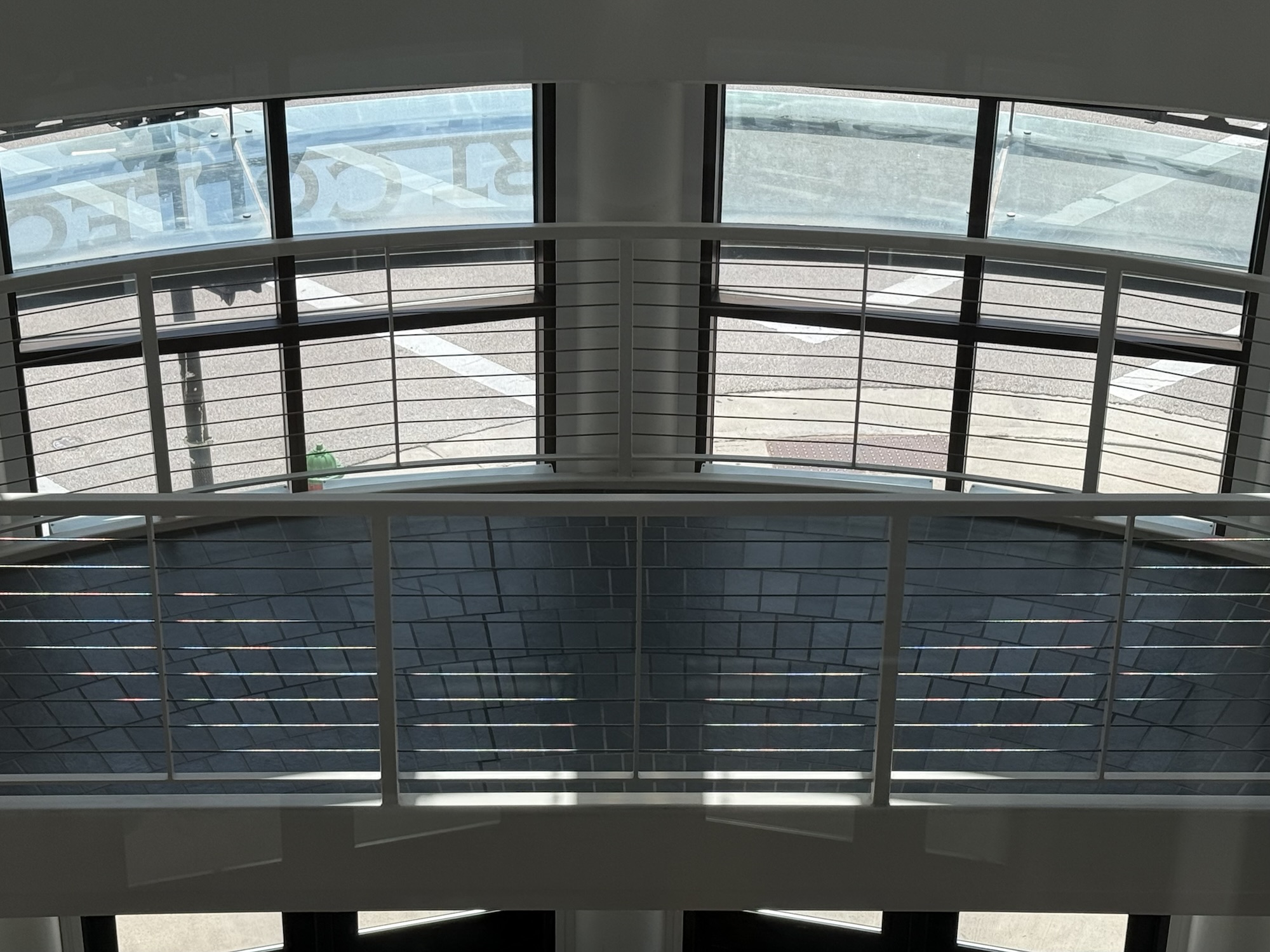
“Smiley” (Or, The Most Happy Staircase) – Anthropomorphism at the Grohmann Museum
. . . here’s a photo I took the other day around 2:15 PM of the atrium staircase at the Grohmann Museum (where my office is). If you look at it just right, taking in the two windows (eyes) and the curved “arch” of light shining on the railing’s strands of wire (smile), doesn’t this staircase landing look like a “smiley face”?
I love it when I notice stuff like this. Just a little day-brightener to add a lift as I go about my business 🙂
We all know the smiley face referred to in this post’s title—not only from the many years it has graced products from throw pillows to tote bags to coffee mugs but also (ever since the advent of digital communications and the invention of emojis) from emails, social media posts, and even occasionally more serious documents like job application letters! But, in case you’re curious to know more, like me, here’s the Wikipedia article documenting this happy little icon’s complete history (although I must add that Wikipedia calls it an “ideogram” instead of an “icon,” to which I can only say that the gradation of meaning between those and similar terms like “pictograms” and “symbols” is a little beyond my knowledge set): https://en.wikipedia.org/wiki/Smiley
The second part of this post’s title is an allusion to a 1956 Broadway musical that was apparently quite popular, The Most Happy Fella. The original production of this musical ran for 14 months, and it was also broadcast live in 1956 on The Ed Sullivan Show, on the same night that Elvis Presley made his second appearance, coincidentally.
The most famous song from the musical was “Standing on the Corner,” a really catchy tune that you’ve probably heard before if you are *of a certain age* as they like to say euphemistically.
I remember hearing this song on the radio when I was a child, although 1) I’m not quite as old as the song’s age would imply and 2) radio programming seemed a little different when I was young (or, more likely, “popular” music constituted an entirely different variety of song types than it does today). I also remember recognizing this song in the “I Love Lucy” episode where Lucy and the gang go to see “The Most Happy Fella” on Broadway.
Anyway, that’s my post for today: A smiling staircase and a cheerful song and a happy emoji here at the very end to seal it all up with good vibes before I hit “publish” and send it off into the world 🙂
Alternative Title: How I Wrote “The Pianist’s Hands” (When I Thought I Was Just Dashing Something Off) 🙂
Back in February or March, I began drafting a short story with ChatGPT for my writing group—just an exercise, nothing too serious. This week, when it came time to choose a piece of creative writing to share for this new blog series on AI and creative practice, I figured that story—The Pianist’s Hands—would be an easy win. A quick polish, a light intro, and done.
The idea behind the “case study” part of this “Creative Practice in the Age of AI” series is to share examples of my own creative work (short stories and poetry) I’ve written in collaboration with ChatGPT. This piece, “The Pianist’s Hands,” felt like the perfect low-stakes place to start. Just a simple, manageable story and chat duo to test the waters. I’d tidy up the first draft and hit publish. Done and done.
Famous last words.
At the time I originally wrote “The Pianist’s Hands,” I didn’t really know what I was doing with ChatGPT. Before writing this story, I’d used it mostly for generating short scenes for my novel or doing brief exercises for my writing group—basic stuff, much of which I documented in blog posts. Maybe a prompt, a response, a couple back-and-forths, and then I’d take the draft offline to revise on my own. I hadn’t yet figured out how powerful this tool could be across the full spectrum of the writing process.
“The Pianist’s Hands” ended up being one of my first real attempts at sustained collaboration with ChatGPT. It didn’t even come from a writing group prompt. I just had the idea—really more of a desire—to write short, jewel-like stories inspired by fairy tales. At the time, I’d been thinking about how much darker the original tales by the Brothers Grimm and Hans Christian Andersen are compared to their Disney counterparts. “The Little Mermaid,” in particular, was on my mind—especially the pain and sacrifice Ariel (or rather, the original mermaid) endures in pursuit of what she wants most.
That was the seed of “The Pianist’s Hands.” Then I got an exercise prompt from my writing group to do a scene in which a character says, “I dare you to tell me the truth.” So I threw that into the mix, as well.
The original version of this story was quite short, barely two pages. Terse. Very stripped-down prose. I remember feeling almost embarrassed by how slight it seemed. To my surprise, my writing group really liked it. Something in the idea itself must have landed.
When I went back to revise the story this past week, thinking it would be a piece of cake, I realized immediately that I’d need to start a whole new chat, just for it. My approach to ChatGPT has changed a lot since those early days. I now use it throughout the entire writing process—from brainstorming and early drafts all the way to polishing and word choice. One result of that deeper engagement is that I’ve learned to be more intentional about keeping my writing organized. Every project gets its own dedicated chat now.
That wasn’t always the case.
In fact, when I first started working on these multiple “fairy tale” short stories, I thought I could keep them all in one chat. (Ah, optimism.) That worked well—until it didn’t. I have a screenshot included on page 5 in the “Appendix chat” that shows what happened when I began a new story (“The Twelve,” based on The Twelve Dancing Princesses) in the same thread where I’d been working on “The Pianist’s Hands.” ChatGPT essentially wrote over the earlier story. The green text was from “The Twelve.” The red strikethroughs? Those were remnants of “The Pianist’s Hands.” Gone, unless I had saved them elsewhere.
It was around this time that I realized ChatGPT sometimes drafts in an “off-screen” way—that is, working internally rather than displaying the process in the chat window. I found this incredibly frustrating. I don’t want my drafts happening behind the curtain. If something disappears, there’s no getting it back. Since then, I’ve made a point of explicitly asking ChatGPT to write everything in the chat. I like to see the progression. I want access to every version. And, to its credit, it seems to have remembered that request ever since.
Back to “The Pianist’s Hands.”
The story didn’t change much in revision, at least structurally. But when I returned to it this week, I wanted to deepen the emotional weight of the protagonist’s decision—to really draw out the cost of choosing between career and self, art and commerce, ambition and joy..
In an ideal world, I would have let the revised story sit for a while and given it time to breathe before coming back to it with fresh eyes for a final pass. But I’ve committed to this weekly series on AI and creative practice—and I’d also committed to using this story as one of the first entries. So here we are.
“The Pianist’s Hands” may still be a bit green from revision. But it’s good enough, I think. And sometimes that’s all you need in order to move forward.
So here it is: The Pianist’s Hands. A story born from fairy tales, shaped in conversation, and offered with gratitude for what creative tools—old and new—can help us discover.
First, HERE is the PDF of my short story, “The Pianist’s Hands.”
And HERE is my entire ChatGPT creative conversation. It’s long and meandering, but it may have some value if you’re interested in seeing how I wrote the story, at least the “trail” left behind by my “chat.”
Finally, we have the beautiful image ChatGPT created to illustrate this post. (Link to the “illustration chat” HERE if you’d like to see my prompt.) Don’t leave yet, though. If you continue scrolling down past the image . . .
“The Pianist’s Hands,” to accompany the short story by Katherine Wikoff (with ChatGPT assists)
you’ll find this week’s . . .
Creative Exercises
Since this week’s post is about my evolving writing process with ChatGPT, as well as story development and fairy tale inspiration (with themes of transformation, sacrifice, and artistic ambition), today’s creative practice exercises are playing with:
collaboration with AI
fairy tale reinterpretation
emotional revision
storytelling structure
Here are five creative exercises related to the overall theme of “Creative Practice in the Age of AI” and, in particular, the content of this week’s post on “The Pianist’s Hands.”
1) Trade a Gift for a Cost Fairy tales often hinge on a deal or sacrifice. Explore what you’d give up—and what you’d gain. Prompt: Write a scene or micro-story in which a character receives something they’ve always wanted—on the condition that they give up something intangible but vital (e.g., memory, taste, color vision, sense of time, ability to feel music). Optional twist: Ask ChatGPT to generate the “bargain” based on a wish your character voices in the first paragraph.
2) From Draft to Depth Revisit something you wrote quickly—then deepen it. Prompt: Find a piece of your own writing you once considered “minor” or “simple”—a story, poem, paragraph, or scene. Choose one emotional thread (e.g., regret, longing, resolve) and write a revision that amplifies and explores that feeling more deeply. Bonus: Try using ChatGPT as a revision partner. Ask for suggestions to heighten that emotional tone or to reframe the piece through a more complex lens.
3) Write Over Something Play with layering and erasure to explore how meaning evolves. Prompt: Take a piece of your own writing—maybe an old draft or even a journal entry—and “write over it.” Keep the original visible (strike it through, fade it, or use a lighter color), and layer a new text on top. Let the earlier version bleed through or contradict the new one. Goal: Let revision become part of the art. Let the process of changing your mind show.
4) AI as Memory Keeper Explore your relationship with your own creative evolution—and how AI fits in. Prompt: Write a brief reflection or meta-scene from your own point of view, describing a turning point in your creative practice. Then ask ChatGPT to retell your scene—but from its imagined point of view. Compare the two versions. Where do they align or diverge?
5) Fairy Tale in a Sentence Capture the whole arc in miniature. Prompt: Write a new fairy tale in exactly one sentence. Include a protagonist (hero), a desire, an obstacle, and a transformation. Then ask ChatGPT to expand it into a paragraph—and decide whether it adds or loses something in the process.
Hope you enjoyed this week’s post. Have you tried using generative AI yet in your own creative practice? I’d love to hear your thoughts.







 Katherine Wikoff