Dreaming of a “White Christmas”? Try “Endless Autumn” instead.

Wreath - front view

Doesn’t our Christmas wreath look pretty, from the front, anyway?  Can you see what’s hiding underneath?  

Wreath with autumn leaf

The wind blew this leaf into our Christmas wreath, where it lodged pretty forcefully.  It’s not noticeable at first glance from the outside, only from the inside looking out.

Just another reminder that we’re not likely to have a white Christmas this year.


Posted in Uncategorized | Tagged , , | Leave a comment

It’s beginning to look a lot like . . . St. Patrick’s Day?

Red Arrow ice rink - 1

A Milwaukee County Parks worker repairs the ice rink at Red Arrow Park in downtown Milwaukee (December 4, 2012)

My favorite Starbucks establishment is just a few blocks away from my office, at Red Arrow Park at the corner of Water and State in downtown Milwaukee.  It is the only Starbucks I know of that’s located in a park . . . and the baristas are confident that it’s the only Starbucks in the world with an ice rink.

Red Arrow Park is named after the famous 32nd Infantry Division of the U.S. Army, Les Terribles of World Wars I and II.  The division’s shoulder patch, shown below, depicts a line shot through with an arrow, which signifies how the division pierced the Germans’ Hindenberg Line in World War I.

The division (now inactive) had its origins in the Wisconsin National Guard and the Civil War’s Iron Brigade.  It continued to be made up of units from Wisconsin and Michigan during its incarnation as the 32nd Infantry Division.

I adore my Starbucks all seasons of the year, but especially in winter!  There’s a two-sided fireplace enclosed between glass screens on a stone wall that offers a cozy spot to sip hot chocolate.  Office workers come and go all day getting their coffee pick-me-ups.  College students sit in the armchairs tapping away on their laptops, while business meetings take place at the nearby tables.

And once the ice rink is open, the usual cast of characters is joined by children.  Lots of children, usually on field trips and delivered via school bus.  What energy!

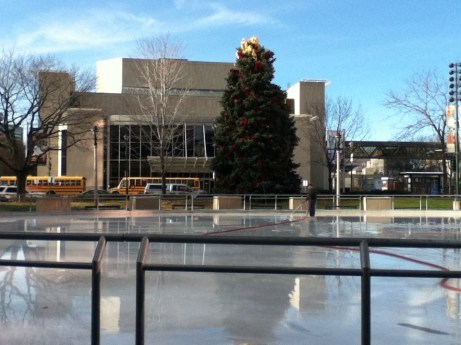
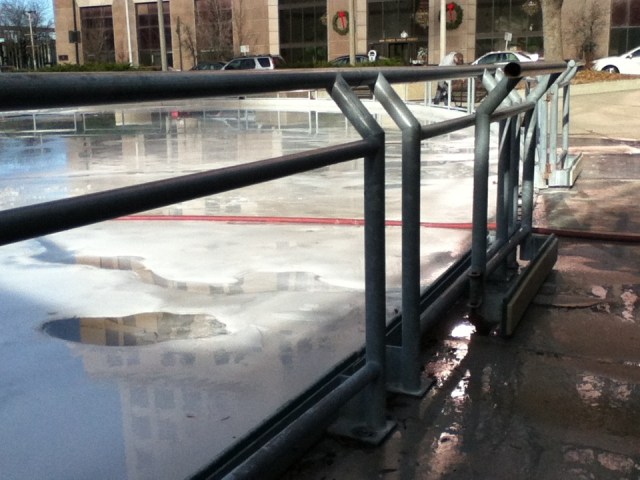
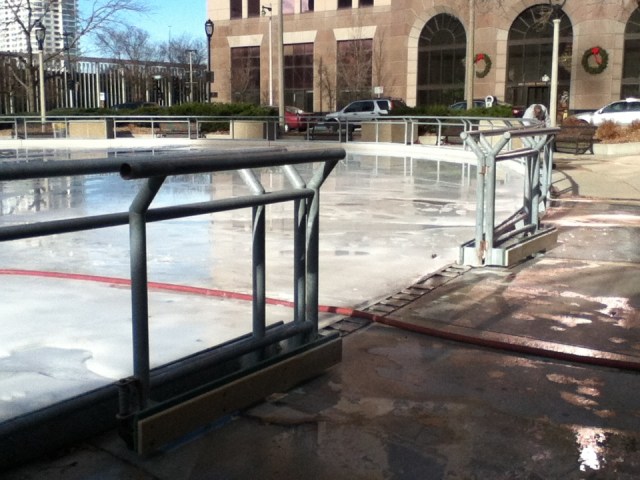
But this year the opening of Red Arrow’s “Slice of Ice” skating rink has been delayed indefinitely by the unseasonably warm weather we’re having this December, according to the park’s official website.  Although the City of Milwaukee’s official Christmas tree is up (shown in the photo above), the ice itself resembles the end-of-season March thaw instead of a crisp sheet of winter surface.

Red Arrow ice rink - 2

As these photos I snapped today show, the ice isn’t quite right for skating yet. 

Red Arrow ice rink - 3

Posted in History, Milwaukee | Tagged , , , , , , , , , , , , | Leave a comment

White Tree of Gondor?

Tree in the night - lit by parking lot light

Nope, just a tree in the parking lot at our local grocery store.  I love the way naked winter trees are illuminated at night by those large overhead lights. 

Here is a shot of three trees at a shopping mall that I took from a distance one evening last December.  Don’t they look like part of some alien landscape?

trees in mall parking log JPG

Posted in Uncategorized | Tagged , , , , , , , , | 3 Comments

Holing up for winter

A few months ago I wrote some posts (here, here, and here) about the chickadees and woodpeckers that nested in our magnolia and silver maple trees, respectively. 

Just the mere act of writing about these birds (and videorecording them) has made me more aware of them than I ever had been before.  So, no surprise, when I was outside doing some last-minute winterizing over the weekend, I noticed both species entering their respective nests.  Perhaps they also sensed the shifting winds that sent my husband and me outside for those final, end-of-autumn chores. 

I always wondered whether these birds returned to the same nest year after year.  Now I know: they never actually leave. 

Like the rest of us, these non-migratory birds hunker down against the elements, as cozily as possible, tucked inside the nest cavities they’ve fashioned in the tree limbs they call home.

Posted in Uncategorized | Tagged , , , , , , | Leave a comment

Twinkies, Dan White, and that raisin in the sun

By now you have probably heard the news that Hostess, makers of Twinkies, Wonder Bread, and Ho Hos, is closing.  A bankruptcy judge has ordered last-ditch mediation between company and union, but if things have gotten so bad that both union and company were willing to walk away from the table last week, I’m guessing there’s not much left to be salvaged.

My mom packed many Wonder Bread sandwiches (helps build strong bodies 12 ways!) in my lunch box during grade school.  Twinkies and Ding Dongs didn’t show up nearly as often, but a person of my generation in America would have been hard pressed to experience childhood without encountering Hostess baked treats at some point.

The association most strongly triggered for me by the news that Hostess was closing, though, was the “Twinkie defense” – a term used as a cultural shorthand to ridicule people for blaming the larger culture for their problems instead of accepting responsibility for their individual behavior.  

Harvey Milk was the first openly gay San Francisco supervisor, whose place in history was tragically secured when he was assassinated, along with Mayor George Moscone, by fellow supervisor Dan White in 1978.

At trial, White’s attorneys argued that their client had been suffering from depression at the time of the shootings, as evidenced by his shift from health-conscious eating to heavy consumption of sugary junk foods.  The jury found White guilty of the lesser charge of voluntary manslaughter instead of first-degree murder.  And the news media derisively dubbed this legal strategy the “Twinkie defense.”

However, what remains indelibly etched into my memory is footage of Dan White being interviewed by a television news reporter (at some point prior to the day of the assassinations) that appeared in The Times of Harvey Milk, a 1984 film that won the Academy Award for Best Documentary Feature.  It has been at least 25 years since I saw this film, but I’ve never forgotten watching Dan White struggle to put his angry thoughts into words.  How chilling it was to observe him, knowing what eventually happened, and see 1) how much anger he had bottled up inside, and 2) how very inarticulate he was.  The man was a walking time bomb whose detonation seemed inevitable.

Thinking of it today, I’m also reminded of a famous poem, “Harlem,” by one of my favorite poets, Langston Hughes.  It asks, “What happens to a dream deferred? / Does it dry up like a raisin in the sun?”  Does it rot and become disgusting in a variety of other ways? 

Or, as the last line implies is the case,  “does it explode?

You can read the short poem in its entirety here at the Poetry Foundation’s website.

Dan White is not someone who garners sympathy, and my juxtaposition of his inarticulate rage with Langston Hughes’s poem may strike someone reading this post as a sacrilege.  I don’t mean to equate Dan White with Walter Lee Younger (one of the main characters in Lorraine Hansberry’s award-winning play, “A Raisin in the Sun”).  But thinking about Twinkies has led me to reflect, via the strange associations things sometimes have, on how very important it is for people to have the means to express themselves. 

In fact, personal expression is one of the primary themes of Hansberry’s play.  Walter Lee, Jr., has big dreams, but all his talk seems to fall on deaf ears.

Man say to his woman: I got me a dream.  His woman say: Eat your eggs.  Man say: I got to take hold of this here world, baby!  And a woman will say: Eat your eggs and go to work.  Man say: I got to change my life, I’m choking to death, baby!  And his woman say – Your eggs is getting cold!

WILL SOMEBODY PLEASE LISTEN TO ME TODAY!

Early on, his sister Beneatha continually experiments with new hobbies – guitar lessons, horseback riding lessons, and now her back-to-Africa exploration complete with a new boyfriend who is a Nigerian college student.  When Walter Lee and their mother, Lena, tease her about the way she flits from activity to activity, she defends her need for self-expression. 

Beneatha: People have to express themselves one way or another.

Mama: What is it you want to express?

Beneatha: Me!

Later, when Beneatha is dismayed that her mother intends to bring a spindly houseplant along to their new home in Clybourne Park, Lena retorts, with feeling: “It expresses me.” 

I teach communication, so no doubt I’m biased.  But it occurs to me that developing an ability to express oneself well may be the single most important life skill a person can learn.

Posted in History, Life, Movies and film, Writing, blogging | Tagged , , , , , , , , , , , , , | 1 Comment

Randy Nelson on Learning and Working in the Collaborative Age | Edutopia

Randy Nelson on Learning and Working in the Collaborative Age | Edutopia (video link)

I haven’t blogged in about two weeks (sorry!!!) because assorted real-life issues have been a distraction.  Last time I posted, I wrote about the importance of infrastructure in making a space in which creativity and innovation can occur.  The link above is to a video interview with Randy Nelson, who at the time was Dean of Pixar University (and who now heads the newly created Apple University).

Like other innovative enterprises, Pixar encourages every employee to be actively engaged in lifelong learning and to spend up to four hours a week taking classes onsite.  Here is a New York Times article from 2006 that describes Pixar University and its philosophy.

The video linked to at the top of the page is fascinating.  Nelson talks about his background in comedy improv and describes a “team” approach he calls  “amplification,” which is quite different from – and, to my way of thinking, far more attractive than – the collaborative group work required by most schools (and probably, by extension, most companies).

In addition, Nelson talks about the importance of “resilience” in the creative process of innovation.   A couple months ago I posted about “success through failure,” an essay inspired by an article by Ken Bain, whose most recent book, What the Best College Students Do, argues that one of the key predictors of a student’s success in college is an ability to recover from failure.

The links I’ve included today will give you real food for thought if you have time to watch and read.  The best collaboration may result only when people are allowed to work individually.  The greatest success may be achievable only for people who have failed often.

Who knew?

Posted in Teaching | Tagged , , , , , , , , , , , | Leave a comment

“If you build it, they will come” (parenthetical afterthought)

I didn’t think to explain my allusion in the title of my previous post.  Possibly you recognized the quote, slightly reworded, from the 1989 film Field of Dreams.  You can watch the trailer here.  Also, if you’re ever in Iowa, you can visit the movie site where filming was done, which has become a shrine of sorts.

In Field of Dreams, farmer Ray Kinsella hears a voice whisper, “If you build it, he will come.”  He realizes, somehow, that he is being prompted to plow under part of his cornfield and install a baseball diamond.  Even as bankruptcy looms, Ray doggedly chases down tenuous leads in an attempt to find the “him” to whom the voice is referring – someone who, the voice has hinted, is in pain.  The film is too complicated and magical to summarize neatly beyond this, but Field of Dreams keeps circling back to that one key statement: “If you build it, he will come.”

What captures my imagination about this quote (and film) is that, like Ray Kinsella, we can’t know where our intuition will lead.  We stumble blindly along a path lit by glimmers of the “truth” we seek.  Without any guarantee of success, we still need to build the infrastructure anyway (in Field of Dreams, a baseball diamond in a cornfield in the middle of nowhere) in order to provide a place where our ideas might show up.

In his now-famous 2005 commencement address at Stanford University (you can watch it here, complete with the excellent introduction by Stanford president, John Hennessy), the late Apple co-founder Steve Jobs described how, after dropping out of Reed College in the middle of his freshman year, he stuck around campus and “dropped in” on a calligraphy class.

Reed College at that time offered perhaps the best calligraphy instruction in the country.  Throughout the campus every poster, every label on every drawer, was beautifully hand calligraphed.  Because I had dropped out and didn’t have to take the normal classes, I decided to take a calligraphy class to learn how to do this.  I learned about serif and sans serif typefaces, about varying the amount of space between different letter combinations, about what makes great typography great.  It was beautiful, historical, artistically subtle in a way that science can’t capture, and I found it fascinating.

None of this had even a hope of any practical application in my life.  But ten years later, when we were designing the first Macintosh computer, it all came back to me.  And we designed it all into the Mac.  It was the first computer with beautiful typography.  If I had never dropped in on that single course in college, the Mac would have never had multiple typefaces or proportionally spaced fonts.  And since Windows just copied the Mac, it’s likely that no personal computer would have them.  If I had never dropped out, I would have never dropped in on this calligraphy class, and personal computers might not have the wonderful typography that they do.  Of course it was impossible to connect the dots looking forward when I was in college.  But it was very, very clear looking backwards ten years later.

Again, you can’t connect the dots looking forward; you can only connect them looking backwards.  So you have to trust that the dots will somehow connect in your future.  You have to trust in something—your gut, destiny, life, karma, whatever.  This approach has never let me down, and it has made all the difference in my life.

In July I wrote a post about “Creativity and the importance of routine.”  In it I recounted writer Flannery O’Connor’s famous quote regarding her disciplined work habits and daily writing routine:

I don’t know if the muse is going to show up or not on any given day, but by golly, I’m going to be at my desk from 8 to 12 every morning in case she does.

We can’t connect the dots going forward.  And we don’t know if the muse is going to show up on any given day.  But like Ray Kinsella in Field of Dreams, we can build our baseball diamond and trust that Shoeless Joe Jackson and other players will come (including, finally, “he” of the whispered prophecy/promise).

Posted in Uncategorized | Tagged , , , , , , , | Leave a comment

If you build it, they will come: the importance of infrastructure for creativity and innovation

Here’s a little factoid I’d forgotten about until my husband and I were discussing the recent Presidential debates between Barack Obama and Mitt Romney:

The famous series of debates between Abraham Lincoln and Stephen Douglas were not held during the 1860 Presidential campaign but, instead, during their 1858 campaign to represent Illinois in the United States Senate. 

Douglas won; Lincoln lost.

Although the two men ran against each other for President two years later, they did not debate each other during their 1860 campaign.  While Douglas undertook a campaign tour on a rambling two-and-a-half month trip that ostensibly was to visit his mother (it was the first “nationwide” campaign ever, and his meandering “trip” was widely ridiculed), Lincoln stayed home following his nomination as the Republican candidate.  He conducted a “front porch” campaign, meeting with visitors but not giving campaign speeches in any form we would recognize as such today.

Fast-forward 152 years.  Today it’s not unusual for candidates to make campaign stops in a new state every day.  Robots relentlessly telephone voters at all hours urging support of various election-related issues.  Candidates’ tax returns and medical records are scrutinized for potentially scandalous minutiae.

Sitting home on his front porch, Abraham Lincoln could probably not be elected in 2012.

In the mid-1960s, Marshall McLuhan famously noted that “The medium is the message,” meaning not not only that “form” can never be truly separated from “content,” but also that in some ways form becomes the content.

What message does the medium of a modern Presidential campaign communicate?

And why am I talking about politics in my blog that’s supposed to be about “Ideas on creativity, innovation, lifelong learning, and other random stuff”?  (Although, I suppose, politics could count as other random stuff 🙂 )

Because I realized earlier this summer that the writing I’m doing in this blog is better (in my opinion) than writing I’ve done elsewhere, for example, in my dissertation or conference papers or even literary essays.  Always in those other formats I’ve felt constrained by the unwritten “rules” of the genre I’m writing in, whether concerning quotations, source citations, or even routine transitions from one topic to another.

When I was writing my Jonah Lehrer essay in early August, for example, it was so freeing to be able to talk about somewhat complex ideas in ordinary language.  Example:  the blog post begins with the phrase, “Well, the sad news last week was that Jonah Lehrer . . . admitted to fabricating quotes . . .”

That’s exactly what I was thinking, and those words best described what got me started thinking about all the stuff I went on to talk about in that post.

I don’t know what my opening line would have been had I needed to write the essay more formally, for a traditional print publication.  I would have needed to demonstrate that what I had to say was “important.”  Certainly I would have felt bound to contextualize my utterance more profoundly, perhaps situate my own remarks in contrast to or agreement with what other people were already saying.  I also might have opened with an authoritative quote regarding some other famous literary fraud.  Anything other than opening with a statement of my own personal sadness for Lehrer and my dismay that his book was no longer available for me to read.

In other words, I might not have gotten around to writing the piece at all because the “form” would have inhibited my ability to pull together my scattered thoughts into a coherent articulation.

One moment in particular stands out in my memory of writing the Jonah Lehrer post.  I had just finished discussing the possiblity that student plagiarism in college classrooms might sometimes be a phenomenon related to writing growth.  Now I needed to return to talking about Lehrer, who obviously was not a student writer.  Tricky segue.  What commonality between the two topics could I find to make a smooth transition?

In another format (academic article, conference paper, newspaper article), finding the right transition would been a trouble spot for me.  Because it was my blog, however, I just breezily wrote: “But back to Jonah Lehrer, who is neither student nor apprentice.”

I remember thinking how easy – and liberating – it felt to write that sentence.  “But back to Jonah Lehrer . . .”  Done.  I couldn’t have gotten away with such a loose connecting sentence anywhere else.

So, again, you may be wondering: my point is . . . ?

Just this:  Infrastructure matters.  A lot.

Anyone who teaches composition knows the “Five-Paragraph Theme.”  Even if you’re not a writing teacher, you’ll no doubt recognize the format instantly.

In the first paragraph, the writer introduces the topic and finds a way to break it down into three subparts.  Then the next three paragraphs are devoted to discussion of each individual subpart.  The final paragraph summarizes what has just been said, often with instructions to restate the thesis.

Five paragraphs, hence the name.

The five-paragrah structure is a handy tool.  But while a good writer can write a beautiful essay using the form, a weak writer does nothing except fill the container, usually mistaking a declaration of topic for a thesis:

A certain topic is very important to know about, and in this essay, I will discuss three things related to it.

First thing.

Second thing.

Third thing.

In conclusion, three things about this topic were discussed in this essay.

In most five-paragraph student themes, the medium is the message.  You can fill in the blanks with anything.

Recycling is very important in our world today.  The most common types of recycling that everyone should know about are paper recycling, metal recycling, and glass and plastic recycling.

[Note to reader: glass and plastic are obviously two things, but students who are desperate to have three categories, because they believe they are only allowed to have three categories, will find a way to combine them into one thing.]

Paper recycling involves x.  Paper items that should be recycled include x.  The paper recycling process is x.  The end result of paper recycling is x.

Metal recycling involves x.  Metal items  that should be recycled include x.  The metal recycling process is x.  The end result of metal recycling is x.

Glass and plastic recycling [treated as a single unit, remember] involves x.  Glass and plastic items that should be recycled include x.  The glass and plastic recycling process is x.  The end result of glass and plastic recycling is x.

It is clear that recycling has many benefits for society.  It is important for all of us to do our part in protecting the environment.

Empty writing.  The reader is left to wonder: so what?  What is the point?  Where is the thesis?  What value has this writer added to society’s conversation regarding recycling?

Ironically, instead of enabling student expression, the five-paragraph theme shuts it down.

Aristotle defined rhetoric this way:

the art (or faculty) of finding (or discovering or observing) the available (possible) means of persuasion in a given case

The parentheses indicate different translations I’ve found for the original Greek, and it is very interesting to think about the different shadings of definition carried in the alternate terminology.  Not knowing Greek myself, I figure Aristotle’s original meaning lingers somewhere in the aggregate, so I’ve included all the terms I recall ever seeing.

The word “faculty” refers to an innate ability a person has, like the faculty of sight or speech.  “Art” is in oppostion to “dialectic,” “logic,” and “science.”  For me, “art” also connects to Peter Elbow’s distinction between the “Learning Game” and the “Doubting Game,” which I wrote about this past summer.  Science involves certainties and facts; art involves uncertainties in the form of emotions, feelings, and opinions.  The Doubting Game, as Elbow points out, exists in a closed universe that limits inquiry; the Believing Game exists in an infinite universe that allows unfettered inquiry.

Which brings me to another metaphor for rhetoric: the “Open Hand” of Zeno, a Stoic philosopher in ancient Greece.  One of the elder statesmen of my field (rhetoric and composition studies), a man I was privileged to meet in graduate school, was Edward P. J. Corbett.  Andrea Lunsford, a Stanford professor whom I would describe as probably the chief luminary in our field today, studied under him.  In a famous 1969 article, “The Rhetoric of the Open Hand and the Rhetoric of the Closed Fist,” Corbett appropriated Zeno’s closed fist and open hand metaphors as a way to differentiate logic/dialectic from rhetoric.

(Let me pause a moment to say thank you for hanging in there with me if you’re not a composition teacher yourself.  I’m almost finished with this meandering lead-up to my main point.)

Logic is a form of inquiry concerning empirical fact that exists inside a closed universe, like Elbow’s “Doubting Game.”  Hence, the closed fist.  Rhetoric is a form of inquiry concerning belief and opinion that exists inside of an open universe, like Elbow’s “Believing Game.”  Hence, the open hand.  The method of logical inquiry is via syllogism; the method of rhetorical inquiry is via enthymeme.

Aristotle’s Rhetoric contains discussion of “enthymeme,” but it is a confusing concept to understand  In fact, many composition textbooks completely misinterpret the enthymeme as nothing more than a truncated syllogism.

Here is a logical syllogism (the one composition texts usually use):

Socrates is a man.

All men are mortal.

Therefore, Socrates is mortal.

A syllogism is like a math equation.  If your premises are true and your argument structure is valid (i.e., not a logical fallacy), then your conclusion is unassailable.  It absolutely must be true.

An enthymeme looks very similar to a syllogism, which is why composition textbooks get it so wrong.  Building on the syllogism above, textbook writers assert that an enthymeme is a syllogism with a missing premise.  In rhetoric, the authors say (incorrectly), you don’t want to bore readers by making them read all the way through a tedious syllogism, so you save time and allow them to feel like they’ve constructed the argument themselves (which makes them buy into the argument more deeply) by leaving out some of your premises.

Here is an example of such an incorrect, so-called enthymeme:

Socrates is a man.

Therefore, Socrates is mortal.

But this is not an enthymeme; it is, in fact, nothing more than a syllogism with a missing premise.  It is about logic and empirical fact, not about rhetoric and opinion/belief.

Here is an actual enthymeme:

Socrates is a man.

Therefore, Socrates looks forward to watching the football game on Saturday.

The difference is that an enthymeme’s missing premise is a matter of opinion/belief rather than empirical fact:

All men enjoy watching football games.

A good writer will be able to employ an enthymeme effectively ONLY if he understands his audience and knows that they will automatically assent to the “truth” of that missing premise.  Not all men enjoy watching televised sports every weekend, but if the writer guesses correctly that this premise reflects a generally held opinion of his audience, then most audience members will accept it as a true statement within the context of the writer’s argument.

In fact, a better analogy for an enthymeme is not a syllogism but a joke, instead.

A joke employs a premise or premises that eventually lead to a punchline.  That punchline only works, however, if an audience can supply the missing premises and will assent to their “truth.”  A comedian needs to know his audience well.  If audience members lack knowledge about the topic, they will not “get” the joke.  If audience members hold an opinion about the topic contrary to the punchline “conclusion” the comedian wants them to reach, they may “get” the joke, but they will not find it humorous.  Instead of laughing, they will feel insulted, even angry.

So, finally, pulling all of these thoughts together, here’s what I mean when I say that infrastructure matters.

Creativity and innovation do not occur in a vacuum.  Context is everything.  If companies, schools, and societies want to encourage creativity, they need to lay a good foundation, prepare the soil, set the stage, whatever metaphor makes sense for you.  Creativity requires an environment in which it can naturally occur.

Infrastructure is as important as “getting the right people on the bus,” to use an expression I hear a lot.  But getting infrastructure right is tricky because you’re dealing with the human beings who will be riding that bus.  Just as rhetoric (or comedy) requires judgment (in building enthymemes or jokes), no single “right” formula exists for building a creative environment.

In politics, the 1858 debates allowed Lincoln to express his intellect and grasp of key issues in a way that was still remembered in the Presidential election two years later.  The front-porch campaign worked for Lincoln because people cared enough about the ideas he’d put forward in 1858 to come and visit him in 1860.  In the first televised Presidential debates of 1960, John F. Kennedy famously won against Richard M. Nixon among those watching the television broadcast but lost among those listening to the radio broadcast.  The medium was the message.

In student writing, the five-paragraph theme usually signals empty, passive content that merely compiles and organizes commonplace knowledge about a topic.  The medium is the message.

Pixar, Apple, and Google are famous for providing environments in which creativity and innovation flourish.  So is 3M, as immortalized in countless books and articles (including Jonah Lehrer’s Imagine) for its tale of near-mythic status recounting the invention of Post-it® notes.

This post is already ridiculously long, so I’ll write another one later in the week about the in-house infrastructure these companies provide to promote creativity and innovation.  Meanwhile, suffice it to say, you reap what you sow, you get what you pay for, etc., etc.  I have read and thought quite a bit about creativity and innovation over the past 15 years.  The most reliable “engine” for generating them appears to be the lifelong learning mindset produced within a framework that encourages individuals to cultivate their own curiosity and exploration.  The medium is the message; form becomes content.

In business and industry, as in education, if people are given a challenge and then provided the necessary time, space, and social infrastructure to do the work, they are capable of astonishing ingenuity.

Would you like new posts delivered to your inbox? To subscribe, click here.

Posted in WPLongform (posts of 1000 words or longer), Writing, blogging | Tagged , , , , , , , , , , , , , , , , , , , , , | 1 Comment

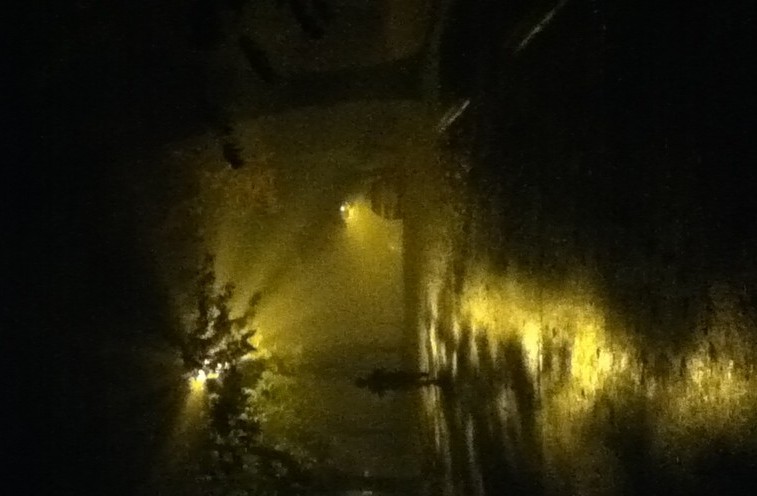
Runner in the night fog

It’s a foggy evening here in Milwaukee.  Only after I’d already taken this photo did I realize that someone was running toward me down the middle of the street.  Kind of an eerie night, but peaceful and quiet.  Nothing except the sound of dripping water . . . and this runner’s footsteps.

Posted in Milwaukee | Tagged , , | 5 Comments

Lynyrd Skynyrd – 35 years later

I just realized that yesterday was the 35th anniversary of the plane crash that killed three members of the Lynyrd Skynyrd band, including lead singer Ronnie Van Zant, and several members of their crew.

High school dances are mostly DJ-powered today, but back when I was in high school, local bands provided the music.  “Sweet Home Alabama” and “Freebird” were two of the most-played songs.  Those and Led Zeppelin’s “Stairway to Heaven.”  (A music-store salesperson once joked with my husband about how every kid coming in to try out guitars played the same song: “Stairway to Freebird.”) 

When Handel wrote “The Hallelujah Chorus,” he said the music so moved him that “I did think I saw heaven open, and saw the very face of God.”  While I could certainly never go quite that far with “Freebird,” I do get chills at the point where the song transitions from the first part’s slower ballad section to the hard-rocking section of the second part.

One of the funniest uses of “Freebird” in film is the marvelous scene near the end of Elizabethtown.  As the cousin’s reunited old band is playing “Freebird” as a tribute at the memorial service for Orlando Bloom’s father, they attempt a rock-arena trick by sending a giant paper-mache bird soaring out into the hotel ballroom on a wire.  The bird catches on fire from the overhead lights, setting off the sprinkler system and causing the guests to evacuate as the band plays on with a joyful abandon that makes the tribute all the more touching within the context of the movie.  Watch it here on YouTube.

Ronnie Van Zant left behind two young daughters.  In poking around the Internet for more background info on the band, I came across this poignant video in which his older daughter, Tammy, now an adult, sings a song she co-wrote with Robert White Johnson, titled “Freebird Child.”

Would you like new posts delivered to your inbox? To subscribe, click here.

Posted in Movies and film | Tagged , , , , , , , , , , , | 1 Comment