Barefoot summers

Driving home yesterday, we saw a woman crossing the street, barefoot and limping.  Was she hurt?  More likely, we suspected, she was reacting to the asphalt under her feet.  With the outdoor temperature hitting 100°, the street probably felt like a hot griddle.

“When I was a kid, that blacktop wouldn’t have bothered me at all,” I bragged to my husband.  Maybe in May, but not by July 4th. 

None of us kids wore shoes in summer.  We went barefoot from the day school let out, and the acclimation process every year was almost a ritual.  At first our soles were so tender that walking on gravel was like a thousand knifepoints.  Running to the Payless grocery store for milk required strategy; we walked on grass as far as we could, and once grass was no longer available, concrete was by far preferable to asphalt.  When we had to cross the street, we hobbled and hopped across the bubbling tar. 

(Literally, on the tar thing.  Either they make streets differently today, or the sun doesn’t beat down as hotly, because I never see tar bubbling anymore.  But, as I recall, one of our favorite pastimes on a hot summer day was puncturing tar bubbles.)  

By midsummer our feet had toughened to shoe leather.  We would race down our alley with nary a twinge.  The glorious day we could finally walk across hot pavement without wincing truly marked our independence from school and grownups and rules.

Then came the end of August and a shopping trip for back-to-school shoes.

Posted in Life | Tagged , , | 4 Comments

Thoughts on “Blade Runner” thirty years later

I recently joined a LinkedIn group called “World Cinema Critics” to be part of a community engaged in serious film discussions.  Lately we’ve had a comment thread going on the subject of Blade Runner, a movie I hadn’t seen since its theatrical release back in 1982. 

The Blade Runner movie poster.
The film © 1982, 1991 The Blade Runner Partnership
Poster artwork © 1982 The Ladd Company
Source: http://www.impawards.com/1982/blade_runner.html

Last Friday I finally made time to watch it again, partly inspired by the early-June release of director Ridley Scott’s latest film, Prometheus, but more immediately prompted by the World Cinema Critics discussion.  

In that conversation, Blade Runner has gotten mixed reviews – praise for its visionary sets but lukewarm regard for its story.  This surprised me.  Although I certainly remember Blade Runner for its dark, atmospheric design, the one thing that has actually stayed with me most all these years is the story itself . . . particularly one key scene. 

If you’re not familiar with Blade Runner, it is about a cop (or, Blade Runner) who hunts down and “retires” escaped “replicants” in the gritty, crowded city of Los Angeles in the year 2019.  Humanlike creatures who have been bioengineered for use as slave labor off-world, replicants are designed to have limited emotional capacity.  They must be strictly controlled to minimize danger to humanity, and they can be distinguished from humans only by evaluators trained to measure their empathic response through biometric data collected during interrogation sessions.

Former cop Rick Deckard (Harrison Ford), the most talented Blade Runner ever, has been called out of retirement to track down and kill those four escaped replicants.  Complicating matters, though, is his discovery that Rachael (Sean Young) – the assistant/protégé of Tyrell, the man whose company makes the replicants – is actually an experimental replicant herself. 

What I recalled so vividly from watching Blade Runner in the theater was Rachael’s attempt to prove to Deckard (and herself) that she is human by showing him a childhood photo of herself with her mother.  Deckard counters with a recitation of Rachael’s most indelible childhood memories – demonstrating to her horror that her sense of “self” is nothing more than implants of memories originally belonging Tyrell’s niece.

This scene, in which Rachael realizes she’s a replicant, is far shorter than I remembered – ironic, considering its focus on unreliable memories!  Maybe that particular moment assumed such significance in my recollection because the idea itself was so powerful. 

Who are we, after all, without our memories?

A few years ago I read Zen and the Art of Motorcycle Maintenance for the second time.  In my first reading (which coincidentally occurred at about the same time Blade Runner was in theaters), I was far more interested in the book’s father-son motorcycle trip than the philosophical musings interspersed with the plot.  I remember impatiently skimming those boring sections to get back to the motorcycle story.  However, in my second time through the book, I was amused to realize that I kept skipping over the motorcycle trip to return to the far more interesting philosophical discussion of “quality” instead.  

Similarly, Blade Runner is not the same film for me thirty years later.  But it holds up remarkably well. 

Last Friday night, I noticed aspects of the film’s production design that didn’t even register the first time I saw it in the theater.  In particular, I was struck by the way its deliberate anachronisms speak to each other to form a surprisingly coherent overall visual experience.

The buildings’ interiors and exteriors are either Art Nouveau or Art Deco, styles that flourished from about 1890 through the 1930s.  Daryl Hannah’s replicant character, Pris, wears leg warmers, a look briefly fashionable during the 1980s, which may have made her a more attractive as a “pleasure model” for a 1980s audience.  The clothing and makeup of other characters (especially Rachael and Detective Gaff) have a distinctly 1940s look that, joined together with design elements like Venetian blinds and low-key lighting, creates a “film noir” feel.

A quick check confirms that Blade Runner won an Academy Award for art direction – an honor well deserved!

In the end, though, it’s the visceral response of my 30-years-younger self to the STORY that I keep circling back to.  What makes Blade Runner a classic, for me, is its central theme of identity and what it means to be human.  While my 2012 self has to smile at Blade Runner’s 1982 vision of Los Angeles in 2019, this film also makes me think quite seriously about Bill Joy’s 2000 Wired Magazine essay “Why the Future Doesn’t Need Us” and Ray Kurzweil’s speculations about the coming “technological singularity.” 

Someday humanity may need to confront difficult questions about what it means to be human, who “counts” as human, and what inalienable “rights” belong to the machines we create.  Blade Runner presciently points the way toward that discussion.

At the same time, Blade Runner strikes far closer to home in exploring another human mystery that remains satisfyingly unfathomable: the union of one man and one woman.

Posted in Movies and film | Tagged , , , , , , | 1 Comment

Little Free Library

Have you heard of the “Little Free Library” yet?

Boxes like birdhouses full of books are popping up in front yards around the metro Milwaukee area.  My own neighborhood has several.

What a nice idea this is . . . and how simple!  A Little Free Library box is basically a weatherproof book cabinet on a post.  You set in up in your front yard and put a few books inside that you’re finished with.  Anyone walking by is invited to take any that look interesting, and people are encouraged, but not required, to pass along books that they’ve finished with to new readers.

Any kind of book is okay – kids’ books, novels, cookbooks, how-to books, coffee-table books.  People browsing or replenishing the stock often meet each other, and the Little Free Library becomes a neighborhood focal point and gathering spot of sorts.  It’s not a replacement for the city library, but it has its own special place in readers’ lives.  It may even serve to bring books to nonreaders, especially in poorer neighborhoods where trips to the larger library may be rare and bookstores don’t exist.

Several articles have been written about the phenomenon, which was started by two men in Madison, Wisconsin, and has spread across America and into other countries.  If you’d like to read more, the Little Free Library website contains links to several news stories in newspapers and television, including this USA Today article that details the project’s beginnings.

If you’re handy, you can build your own Little Free Library with free plans from the website.  Otherwise, you can order one in a variety of styles for a cost of $250 – $400.

Posted in Books and reading, Little Free Library, Milwaukee | Tagged , , | 4 Comments

Leaving the nest

One of the baby chickadees left the nest early this morning, around 5:30 a.m.  (See video of the nest I shot about a month ago here.)

Shortly after letting the dogs back in, I glanced out the kitchen window and saw a bird, too small to be one of the adults, poking its head out of the knothole and looking around.  Up, down, left, right . . . sort of scoping out the situation.  Then another bird popped its head up and pushed its way to the opening.  Just like any other siblings, they jostled for position and finally settled for sharing the view, taking turns sticking their necks out.

At last, the first bird decided it was time.  It hopped from hole to branch, just as its parents have done so many times.  There it sat for about two seconds . . . until it lost its balance and tumbled off.  Tiny (and I mean TINY) wings fluttered in a blur, making the fall slower as it wobbled downward.

Once it landed, the baby chickadee sat motionless in the grass for a long time, probably befuddled by what had just happened.  A ground bee moving past hovered slowly closer, and I wasn’t sure what to expect.  Would it sting the defenseless little bird?  As the bee moved in toward the bird, the tiny chickadee shot its head forward and pecked at it.  The bee backed up and flew off. 

Finally the chickadee took flight again, struggling to get higher than a straight line about a foot off the ground.  It made it to the top of our fence, then sat there for several minutes recovering from the effort before fluttering in a low, lurching line across our neighbor’s driveway to a bush at the edge of her patio.  Our neighbor has a bird feeder, so at least the baby chickadee will have some other birds and food around, if it has the wits to stay there until it’s stronger.

The adult returned to the tree at this point, perching on the rim of the knothole and leaning inside with food.  I wondered what it thought . . . or even whether it thought.  As a parent, I would be frantic to discover one of my children gone.  Do birds think this way, too?  Or does the expression “bird brain,” implying a mind incapable of complex thought, have any basis in reality.

The adult entered the nest, stayed for a few moments as usual, then slipped back out of the knothole and flew off. 

Not much later, a tiny chickadee face peered out.


Posted in Uncategorized | Tagged , , | 3 Comments

Sullivan reinstated at University of Virginia

The big news this afternoon in the world of higher education is the reinstatement of Dr. Teresa Sullivan as president of the University of Virginia.  Two weeks ago she resigned under pressure, igniting an explosive response from that institution’s students, faculty, and alumni, who rallied immediately to her defense.

Why is this story so important?  Because it is bigger than just who is in charge of one university.  It represents an early battle in what may become a full-scale war over the integrity and purpose of the 21st-century university.  It’s a conflict that has been brewing for several years, especially following the 2006 publication of the Spellings Comission Report

The Spellings Commission, led by U.S. Secretary of Education Margaret Spellings under President George Bush, was charged with reviewing the state of post-secondary education in America and recommending strategies for reform.  Significantly (fatefully?), the report uses the language of business to describe higher education, calling it “a mature enterprise: increasingly risk-averse, at times self-satisfied, and unduly expensive” (p. 14).  Alleging that most universities are not nimble enough in responding to challenges in the global marketplace, the report warns ominously that, “History is littered with examples of industries that, at their peril, failed to respond to—or even notice—changes in the world around them, from railroads to steel manufacturers” (also p. 14). 

Such a “business” perspective is compelling for its focus on “efficiency,” “accountability,” and “return on investment” – certainly urgent considerations in an era where dwindling financial resources are coupled simultaneously with pressures to “keep up” with global competition. 

Yet employing business terminology in discussions of higher education is problematic, because . . . what is the product?  A degreed person?  A well-trained worker?  A better-informed citizen?  A self-actualized individual?  Creation and dissemination of knowledge for the sake of advancing the human race? 

All of the above?

If higher education is evicted from its ivory tower and relocated to an industrial park (or perhaps outsourced to a call center in another hemisphere), does it follow logically that an ideal university should be a factory of sorts, where “edu-widgets” can be churned out efficiently, using state-of-the-art manufacturing methods?  (Online learning!  Flipped classrooms!  Social media!  Technology!)

Here’s what the “philosophical difference of opinion” cited by Dr. Sullivan as the root conflict between herself and the Board of Visitors – especially  Helen E. Dragas, a real-estate developer with a graduate degree from Virginia’s business school – really boils down to: a fundamental schism between polar-opposite views of not only how Virginia should be run but also how ALL American colleges and universities should be run. 

More to the point, Virginia’s showdown between the Ph.D. (Sullivan) and the M.B.A. (Dragas) is a precursor of the intense struggle yet to come between scholars and managers over the future of higher education itself.

Posted in Higher education | Tagged , , , , | 1 Comment

Rave review for Pixar’s “Brave”!

First, a quick disclaimer: WordPress won’t let me use italics in the headline, which is why I’ve put quotation marks around the title “Brave.” 

I usually italicize titles, as called for by the style guide for my field, the MLA (Modern Language Association), which is the standard documentation style taught in English classes.  However, I do recall from reviewing books for our local newspaper, the Milwaukee Journal Sentinel, that their editorial style guide called for quotation marks around book titles.  In fact, according to its online “Ask the Editor” FAQ page, the official Associated Press Stylebook “doesn’t use italics in news stories. That includes newspaper names and magazine references.  No italics.  The stylebook uses italics for examples only.” 

So I guess WordPress leans more toward journalistic writing than academic.  I’ve actually started using the journalistic lowercase for writing blog post headlines instead of the uppercase titles customary in MLA because it looks better and seems more appropriate for blog entries.  Similarly, I’ve begun using an en dash with spaces instead of an em dash for breaks in this blog because it’s easier to read on the screen. 

Anyhow, now that these punctuation formalities are out of the way . . . I am very happy to report that Brave, Pixar’s newest film, is wonderful! 

I had approached my trip to the theater yesterday with some trepidation after reading lukewarm reviews on Friday.  In the first review, a critic said Brave was “less a film in the lustrous Pixar tradition than a Disney fairy tale told with Pixar’s virtuosity.  As such, it’s enjoyable, consistently beautiful, fairly conventional, occasionally surprising and ultimately disappointing.”  Another critic called Brave a “shake-and-bake hybrid” that reflects Disney’s “penchant for princesses and appetite for anthropomorphism.” 

Nice alliteration there at the end, but I disagree with the charge of anthropomorphism.  It’s completely logical that someone who is turned into a bear yet retains human consciousness should exhibit human traits.  And besides, before Disney came along, Pixar did just fine on its own in giving human characteristics to animals and inanimate objects like bugs, fish, rats, cars, and toys.

I also take issue with the “Disney princess” and “Disney fairy tale” characterizations.  For one thing, Brave has no handsome prince, thus lacking a standard element of every Disney princess story.  Nor is there a scheming, evil villain in the usual Disneyesque, Machiavellian sense.  Finally, while the Disney “formula” requires the heroine to be an orphan or similarly lacking guidance and protection from a parent (usually a dead mother), Merida, the heroine of Brave, has two living parents, both of whom care deeply about her happiness.   

Although there may be merit in the critics’ descriptions of Brave as a “fairly conventional” film that “shrinks its aspirational promise into a mother-knows-best-size life lesson,” I wouldn’t say that convention and familiarity are necessarily bad, especially if well done.  All fairy tales are conventional, after all, and Brave certainly has drawn elements from fairy tales and myths.  In fact, once you’ve read the work of Joseph Campbell, especially The Hero with a Thousand Faces, his book on universal archetypes in world mythology, these “conventional” patterns become recognizable in many other films.

For children, such “conventional” stories and “life lessons” provide reassuring familiarity.  As an adult, I personally find the ending of Toy Story 3 both appropriate and poignantly inevitable:  Andy decides to give Woody and Buzz away to a little girl who will play with them, and as we know from the earlier films in the series, being played with is the one thing toys yearn for above all.  However, younger viewers not ready to part with childhood might have preferred a more conventional “happy” ending . . . in which, perhaps, we flashed forward to see Andy’s grandchildren playing with Buzz and Woody on a visit to Grandpa’s house.  As much as I love Toy Story 3, a more conventional ending wouldn’t have particularly bothered me, either.

One final note: I was surprised yesterday when everybody starting leaving the theater as soon as the credits began to roll.  Don’t they know there is always a payoff for sticking around at the end of a Pixar movie? 

In this go-round, there were two rewards.  The first was a statement in the credits that Brave is “dedicated with much love to Steve Jobs,” a tribute that elicited murmurs of appreciation from the few other people remaining in the theater.  The second was a cute, very brief epilogue that provides a clever follow-up to an event from earlier in the movie.

Posted in Movies and film | Tagged , , , , , , , , | Leave a comment

Beautiful fluid mechanics

I added cream to my coffee this morning and watched, mesmerized, as the white streak slowly triangulated and formed individual spirals, each of which then continued triangulating, until at last a giant, unified spiral sprawled across the surface of the liquid.

It reminded me of a session I attended at the engineering educators conference two weeks ago, in which student art from an engineering course on fluid mechanics was presented. 

You know Vincent van Gogh’s The Starry Night?  Perfect example of fluid mechanics as art. 

Take a look at this gallery of student work done over the past several years in a mechanical engineering course called “Flow Visualization,” taught by Prof. Jean Hertzberg at the University of Colorado-Boulder. 

Although the term “fluid mechanics” once sounded like technical drudgery to me, now even the words themselves look like poetry.

Posted in Uncategorized | Tagged , , , , , | Leave a comment

Pixar’s (nearly) unbroken streak

I want Brave to be good. 

 My younger daughter and I have a standing date every year to see the newest Pixar movie during its first weekend in theaters.  Already today I’ve seen so-so reviews for Brave, but don’t want to give them much credence because these same two reviewers also gave so-so reviews to Cars, and I loved Cars anyway.  I’m like a child on Christmas Eve who has asked for a really expensive present – brimming with hope but trying hard not to be unrealistically optimistic.                    

 I adore Pixar movies.  Not only does their dazzling 3-D animation mimic the “cinematography” and artful “editing” of great films, but also their content is built around the fundamental core elements of great literature: theme, character, story, and plot.  Year after year, Pixar has continually exceeded my expectations, astonishing and delighting me with every new film. 

 Except for last year, with Cars 2

 That’s why I’m a little nervous about Brave.  Was Cars 2 an anomaly or does it mark the beginning of the end for Pixar’s remarkable record of excellence?  Although plenty of reviewers have already pointed out Cars 2 ’s flaws, I’d like to contribute my two-cents’ worth now. 

 Two things went seriously wrong with Cars 2, and I can hardly believe that John Lasseter, the creative genius chiefly responsible for Pixar’s string of innovative successes, allowed them to happen.  I was going assign the blame to Brad Lewis, the first-time director who ended up sharing co-director credit on the film with Lasseter (and who left Pixar shortly after Cars 2 was released).  But then I read a New York Times interview in which Lasseter asserts somewhat defensively that Cars 2 is a great movie and that “it’s clear that audiences have responded” to it.  Either he doesn’t believe it and is trying to convince himself, or he truly feels that nothing is wrong.  Whichever, he doesn’t seem to acknowledge there’s a problem.

 Pixar’s first mistake with Cars 2 was to forget its audience.  You don’t release a G-rated movie with scenes of torture and killing, not even in animated form.  You just don’t. 

 Pixar’s second mistake was to lose focus on those fundamental core elements of theme, character, story, and plot that have been so key to creating “enchantment” in its films, (to use a word cropping up frequently in reviews).  Despite exotic locales and impressive action sequences, Cars 2 failed to “enchant” me.  In fact, I don’t remember anything at all about any new characters introduced in that film, except that one of them was voiced by Michael Caine. 

 When I watch a movie, I am more than willing – quite eager, actually – to suspend my disbelief and engage with the story on whatever terms it requires of me.  Unfortunately, Cars 2 was boring, and that is one term of engagement that few moviegoers (including myself) will tolerate.

 So, please, please, please . . . let Brave be good!

Posted in Movies and film | Tagged , , , , , , | Leave a comment

Perspectives on depth perception as metaphor in film

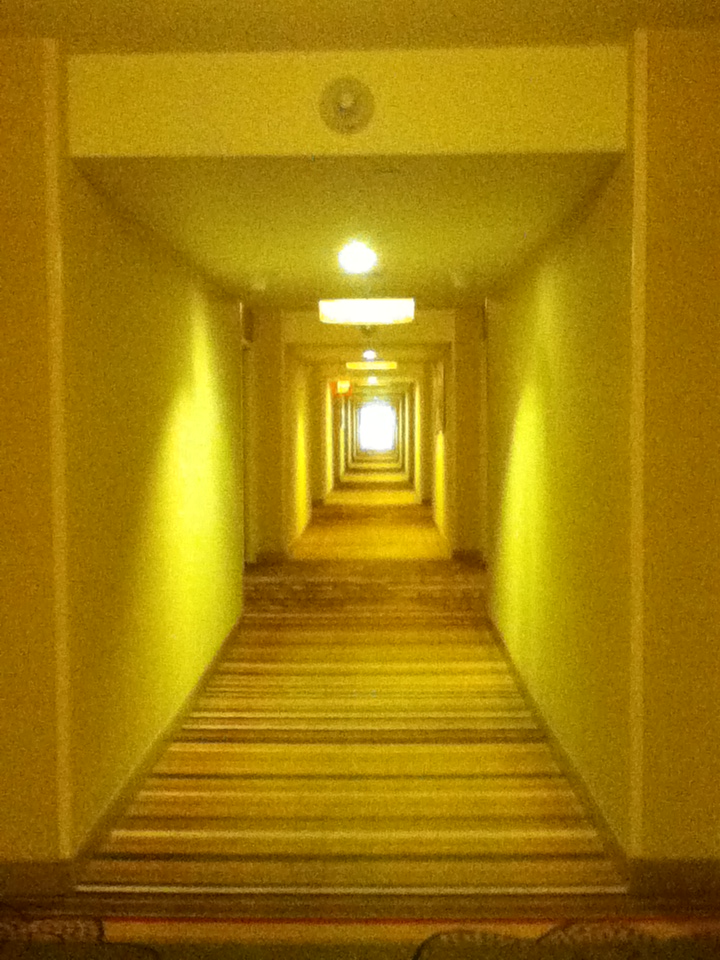
I took this photo of the hallway outside my hotel room in San Antonio last week.

I loved how the striped carpet and the alternating patterns of light and shadow added to the telescoping effect created by the distance perspective.

Of course, once you’ve viewed The Shining, it’s difficult to see a hallway like this ever again and not think of the Overlook Hotel and Danny’s encounter with the two daughters of a previous caretaker, who whisper, “Come play with us, Danny.”  (warning: this film clip contains flashes of gore)

All this got me thinking about one of my favorite Alfred Hitchcock films, Marnie.  When I teach the film studies class, we examine the principle of perspective drawing (and with it, the “vanishing point”) and how cinematographers use it to compose an image within the frame.  In Marnie, Hitchcock brilliantly marries the technique itself with plot events to move the film’s opening scene to a higher level of art.

Marnie, the title character, is a serial embezzeler who regularly adopts a false identity, moves to a new city, takes an office job, cases the business operation, then burgles the company safe as soon as an opportunity presents itself – whereupon she discards that job’s identity and slips away to her country retreat to lie low for a while before starting the whole process over again.

Turner Classic Movies has a clip of the film’s opening credits and first little bit (like 30 seconds) of the movie itself.  If you click on the link below, you’ll go to the TCM page.  Fast forward through the credits (yawn 🙂 ) till you hit the 1:58 mark.

http://i.cdn.turner.com/v5cache/TCM/cvp/container/mediaroom_embed.swf?context=embed&videoId=242261

In these opening moments of the film, we see Marnie at a train station, on the platform, walking away from us  . . . and INTO  THE  VANISHING  POINT.  Here the literal onscreen image corresponds with, and amplifies, the actual meaning of what the character is doing.  Not only does Marnie walk into the vanishing point in terms of perspective drawing, but she is also about to shed her criminal alias and “vanish” into thin air.

If you don’t want to click through to TCM, you can just take a look at the image below, instead.

“Marion Holland” (Marnie) vanishing into the vanishing point

When you see stuff like this, you just know you’re in the hands of a master.  Alfred Hitchcock never won an Academy Award for directing, but his work speaks for itself.  It is a reassuring reminder that quality endures and that external validation, although gratifying, is by nature capricious and, therefore, not the best measure.

Posted in Movies and film | Tagged , , , , , , | 1 Comment

Getting use to journalists who can’t spell?

This morning I was watching The Weather Channel® and saw this promo for an upcoming story: “Getting use to the heat.”  Sigh.  It reminded me of my disappointment two weeks ago when one of my favorite writers, Peggy Noonan, penned a column containing a similar sentence: “This didn’t use to be true.”

 As a college writing teacher, I’ve seen words like “used” misspelled in freshman composition essays for so long that I’m pleasantly surprised when a student actually gets them right:

  • A prejudice person (should be “prejudiced”)
  • A cliché expression (should be “clichéd”)
  • An old-fashion ice cream social (should be “old-fashioned”)
  • It use to be . . . (should be “used”)
  • He was suppose to be here (should be “supposed”)
  • Close captioning for the hearing impaired (should be “closed captioning”)

 The reason for these misspellings is completely logical: the “d” is almost always silent to listeners, especially when followed by a “t” sound, as in “it used to be.”  Someone who only hears (but never sees) the words doesn’t even realize his mistake, which is why the misspellings are so prevalent in student writing.  Few undergraduates are serious readers, and this is doubtless a reflection of the culture at large.

 However, it’s depressing to see these mistakes occur so often in newspapers or text graphics in television news broadcasts.  Such misspellings are particularly odious because they expose a writer’s lack of familiarity with the written word.

 Journalism is still a “glamour” career, and those lucky enough to make it to the field’s major leagues have a professional obligation to know how to spell the words that constitute their stock in trade.

Posted in Books and reading, Grammar, punctuation, usage, mechanics, Writing, blogging | Tagged , | 4 Comments