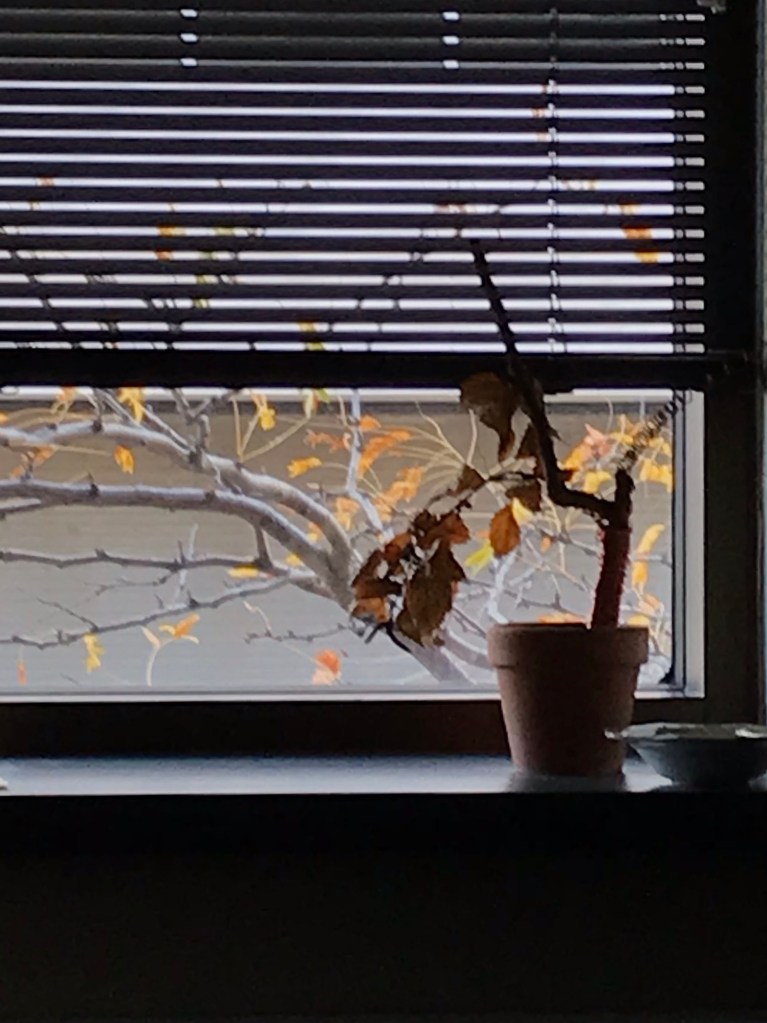
The leaves on the inside of my office window are attached to a long-dead branch from our birch tree, which my daughter and her classmate turned into a work of art about 12 years ago with the aid of a flower pot, some dry soil, and some finely wrapped and coiled strands of copper.
The leaves on the outside are part of a living tree planted along the sidewalk beside the Grohmann Museum in Milwaukee, where my office is located. The trees across the street, heavily shadowed during the day, still have green leaves. But the tree outside my window is exposed to sunlight most of the day, so not only has it already turned but it has also lost many of its leaves.
Maybe “correspondence” would be a more accurate word to use in this post’s title than “synchronicity.” I was struck by the similarities, the parallels even, between my little artwork of “preserved autumn” and the living tree of real, “currently unfolding autumn” on the other side of the glass, which will not be preserved other than this image in a photograph.
My birch tree’s old dead leaves, long detached from their original context, will live forever as a work of art (at least, as long as I’m alive or as long as my heirs may care to keep it around), while the dead leaves still attached to the living tree outside my window will be gone forever once they’re swept away by wind and lost to decay.
I guess I’m thinking about life, death, and immortality today because of the book we talked about last night at the MSOE book club, The Invention of Morel. That seems like a discussion worthy of its own post, however, so I’m going to save it for tomorrow. Plus I have a different picture to accompany that post, coincidentally (or would that be “synchronicitously?😀) another work of art that I took a photo of on my way in the front door of The Explorium Brewpub, where we met.
Yeah, I think a photo of dead leaves inside and outside my office window is enough of a blog post for one day, lol, especially if I’m to have any hope of posting more often than I have been lately. So until tomorrow, arrivederci!❤️
The ubertalented author, who lives in the Appalachian region affected by Helene last week, posted this on Facebook. I am sharing here to amplify the info she provides at the end for two organizations she suggests donating to if you want to help.
My family and I are safe. That’s the main thing, because so many aren’t. Hurricane Helene hit our region harder than anything I’ve ever seen here.
Like a million others, our household had no electricity for the past week. No water, no signal, in a house barricaded by fallen trees. We camped at home, cooking over fire, boiling spring water, tending animals, walking fence lines, checking on neighbors. Reading books. In time we could venture out to find enough cell signal to let folks know we’re okay. Friends and family lent support as power slowly returned to other parts of the county. Rarely have I been so thankful for my resourceful upbringing and entertaining spouse.
And you should have heard us cheering the crews who eventually made their way up our hollow with chain saws, skid-steer, new utility poles, and overtime human effort drawn from far and wide. (We spoke with line crews from West Virginia, Illinois, and Steven’s home turf in Iowa!)
Drip coffee and showers feel miraculous after a week in the dark; reading the news is hard. Many people here will have no “normal” to get back to. The city of Asheville made national news, but most of those hardest hit live in smaller towns and communities throughout Appalachian Virginia, Tennessee, North Carolina, and Georgia. If you’d like to help, I suggest the Appalachia Funders Network – appalachiafunders.org. Another fund that’s specifically helping our corner of Southwest Virginia is this one: https://unitedwayswva.charityproud.org/Donate/MiniCampaign/34132
So says Samwise Gamgee to his wife, Rosie, and young daughter, Elanor, at the end of The Return of the King, the final book in Tolkien’s Lord of the Rings trilogy.
And where have I been? Well, unlike Sam, I didn’t walk all the way to Mordor to pitch an evil ring down into the Cracks of Doom to save the world. No, I’ve just been out living my ordinary life, doing all the same things I’ve been doing for years—except waymore and wayfaster.
Aren’t we lucky to have email and mobile phones and messaging platforms that allow us to stay connected 24/7 and be so productive? Even luckier for us, this week OpenAI’s Sam Altman has painted a super rosy picture of how great everything going to be on our planet once AI takes over and solves every problem known to mankind. You can read his long-on-rainbows-and-lollipops and short-on-specific-details vision for the future of humanity on his website HERE.
Partly to blame for my malaise, of course, is the pandemic, which seems to be every politician’s “go to” scapegoat for the root causes of our daily stress: supply shortages, inflation, fewer services, lower quality goods, longer wait times, etcetera, etcetera.
In my own case (college professor), the pandemic forced teachers to make the drastic pivot to online “learning management systems” in 2020. Sadly, that LMS monster seems to have taken hold of higher education and both raised and lowered expectations for presentation of course materials, student workloads, grading, and student–faculty relationships. I have mixed feelings about these shifts, mostly negative. Yet, I also recognize reality and accept the truism that you can’t fight City Hall. You live in the time you inhabit. The sooner you stop fighting—the sooner you learn to go with the flow and “be like water,” as Bruce Lee said—the happier you’ll be. So that’s where I am on that.
Complicating things even more on the teaching front, though, is generative AI, aka, ChatGPT and its ilk. Back to OpenAI’s Sam Altman, the “face” of ChatGPT: Prophet or Antichrist? The jury is out, but Pandora’s Box is open, and things are in an unstable steady state, to say the least (and also to combine allusions and metaphors from vastly different domains in a single sentence. Try and match that feat, ChatGPT! 🙂 )
Any writing teacher can tell you what a mixed blessing this new tech development of generative AI is. On the one hand, I think it’s exciting and has the potential to help everyone catapult their writing to a higher level. I’m working on a project of my own right now that ChatGPT has been extremely helpful with. Very exciting stuff. But in the hands of students, so far anyway, it has been a source of underwhelming texts that *seem* well written but, upon closer examination, are actually pretty empty. Having seen enough of this mediocrity by now to be able to articulate the problems with ChatGPT-generated texts, I think I finally have enough of a handle on it to help students use it in ways that 1) aren’t cheating and 2) result in texts that authentically represent their own identity, intellect, and abilities while at the same time ramping them up to a performance they might not have progressed to on their own in years.
Students want to learn how to use this new tool well, and I’m sure employers and society will be expecting them to be experts upon college graduation. I get it, and I want to do right by my students.
But wow. My job in 2024 looks (and feels) a lot different now than it did in January of 2020, less than five years ago. And all of these new realities (working with the tedium of setting up and maintaining learning management systems, figuring out how generative AI works and how to help students learn to use it effectively) have been added on top of the baseline job duties I’ve always had.
Time consuming, to say the least.
So swinging back around to this blog post’s title, one reason I’ve been gone from my blog and posted so rarely lately is that I’m busy working at my job or taking care of personal-life business just about every minute of the day. Which, no surprise, leaves me fairly worn out and not really in the mood to wrap my head around writing or even engaging in any activities but the most passive forms of entertainment, like reading or watching TV/movies.
But ugh! That’s no way to go through life!
Lately, as the weeks of not posting anything on my blog have added up, I’ve been giving a lot of thought to how, or even whether, I should proceed with it going forward. When I started blogging, back in 2012, I thought I’d write articles about lifelong learning, curiosity, creativity, and innovation. I added “other random stuff” to my blog’s tagline because I kept sort of accidentally posting photos and little observations about things I noticed going on in the world that intrigued me. Eventually I gave up on “lifelong learning” as my blog’s official identity because everything I wrote was so patently not an article on that topic. I tried out some other taglines over the years, including one I found so pretentious that I only kept it up for a couple of days: “Trying to say ‘yes.'” So deep, lol 🙂
Then at some point I decided to put up the tagline I currently have, “analog explorer in a digital world,” because I thought I’d start writing posts about digital society at the intersections of the analog and digital worlds. But then I still kept writing posts about “Weird Al” Yankovic and gulls on a rooftop and posting pictures of office windows and interesting patterns of light and shadow. With the occasional academic connection, or sometimes a link to an article on an intellectual topic. Just very random.
I think it’s finally sunk in that I’m never going to force this blog into being anything it’s not inclined to become. It’s time for me to “be like water.”
So here’s where things stand, as I see it.
It has been over four months since my last blog post. Probably people who used to follow me have given up hope of hearing from me again. I’ve noticed that many of the bloggers I used to look forward to reading every week have faded away, as well. My WordPress Reader is so . . . empty. No one is posting, so I don’t bother to check for their posts. Then when they do post, maybe they don’t get the engagement they used to, because no one is as active in checking the reader (or their emails) for their posts. All of which perpetuates the death spiral. So first of all, I apologize to anyone who liked reading my posts and missed me not writing them. I’m sorry that I let you down (and thank you for still being around to read this post 🙂 ). I plan to do better.
At least I hope to, and I think I stand a pretty good chance. Removing the pressure I placed on myself to write a certain kind of post (that I rarely wrote anyway) should help me show up more regularly. My only ambition now is to keep up my little corner of the internet (KatherineWikoff.com) like a friendly letter that appears in your mailbox bringing cheerful news from home and reminding you that there’s more to life than bills and junk mail and their associated drudgery.
Before I close, I’d like to give some credit where it is due. I owe my renewed optimism to Rick, who last week left a comment for me on one of my older blog posts, Fave Movie Moments – “Do you know why this is my favorite tree?”. That post was about The Florida Project, a beautiful 2017 film about a young girl living with her troubled, unstable mother in a motel on the outskirts of Disney World. In particular my post looks at a moment where the girl and one of her friends are companionably eating a snack of white-bread jelly sandwiches while sitting on the trunk of a massive tree that has been uprooted. As the young girl notes with the clear-eyed insight of a child exposed to to hurtful things far too early, this tree is her favorite because “it tipped over, and it’s still growing.” Rick wrote in his comment on that post:
I watched this film on a streaming service shortly following its release. I can’t say I remembered the scene you so eloquently refer to, but the film very much stuck with me at the time and had been on my list to watch again. I recently bought it on Blu-ray and have just rewatched. I am pleased to say that it still resonates with the same sense of broken joy that affected me the first time of watching. But it was this particular scene, with the old, broken down tree that stood out for me. I don’t know why, but I was impelled to type the words of Moonee into Google, just to see if anyone else had been moved by it in the same way. So I was so pleased to discover your post. Aside from the fact it so beautifully encapsulates a central theme of the film, like all great art, it speaks of a deeper metaphor for life in general. The scene itself stood out for me for all its own immediate merits relevant to the film. But as I digest it, I am also left reflecting on how my own life has been laid very low by grief in the 3 years immediately following the film. And in those years since, I like to believe I have continued to grow, however much that grief has continued to weigh me down. Thank you so much for having written something that, for one night at least, makes me feel a little less alone and connected.
Which I thought was just beautifully articulated and brought tears to my eyes. I wrote back:
Rick, thank you for taking the time to write such a thoughtful response to my post. If you were to check out my “home” page, you’d notice I haven’t posted anything new in a few months. That’s mostly because I’ve felt so beaten down by the whole exhausting idea of generative AI regurgitating writing it finds online so that other generative AIs can regurgitate again, and then just re-re-regurgitate it all in one horrible, endless chain of ouroboric LLMs cannibalizing themselves. Honestly, I’ve found myself thinking: What’s the point of writing anymore?
But then today I saw your response! A beautiful message from one human to another about a moment of shared humanity. This is why I started blogging, and your message reminds me that despite the AI apocalypse, there are still other people like me in the world who are going through things and trying to make sense of it all.
I’m so sorry for the grief you’ve been carrying the past several years. Your kind, articulate, and even very profound words make me feel honored and humbled. I’m glad that my reflections on this film jibe with your own thoughts. It’s validating to connect with a kindred spirit. It makes one feel, as you so wonderfully put it, a little less alone and connected. Thank you!
To which he replied:
Thank you for taking the time to send me such a considerate response. I really didn’t expect much more than a quick “thanks”, if that even.
I have been busy trying to sort stuff out prior to a short trip I have just embarked on, so have not had much time outside of this to look at your blog site after my registration was accepted. But I did quickly read your last blog, about the two Herring Gulls – I think these are what I can see in the photo at least. Once again, I was very much taken by your words. At the risk of sounding repetitive, there it was again – connection! It was always going to be a bit of a winning goal for me though, as Gulls are my favourite birds and a daily, characterising feature of where I live. For me, their versatile strength, grace, aloofness, and indomitable spirit far outweighs the negative qualities most my neighbours choose to focus on!
I won’t go on, other than to say that learning you were a teacher did not surprise me. Conveying facts and ideas is made a whole lot easier to receive, if people feel inspired by the “how” of sharing, as much (actually, more) than the what. I had to look up a couple of terms you referenced in fact, so I include myself in this!
But more to the point… in the UK we have a saying: “Don’t let the bastards grind you down”. I don’t mean this to belittle the frustration you express about how others may be abusing your original thoughts and reflections on life. If it has then please put it down to my ignorance on the matters you speak of. All I would add is that if your blogging brings you a sense of satisfaction of itself – and hopefully a sense of joy when you recreate the world you are describing in your own words – then try to let this be the difference you are most concerned with. And if, from time to time, you also manage to reach others like me… the world is an even shinier place to be. Thanks again, and please don’t feel obliged to respond again – keep on blogging instead!
So that’s what I’m going to do!
Thank you so very much, Rick, for allowing me to quote from our back-and-forth comments. Not only does our conversation explain why I feel good about blogging again, but maybe it will also inspire other erstwhile bloggers to start engaging in our creative community once more.
It’s that time of year again in Milwaukee when small airplanes towing long banners begin to fly around (and around and around😀) the lakefront, the baseball stadium, and in a few months the State Fair Park. All of a sudden today, I wondered how those planes manage to take off, and luckily someone else already wondered the same thing and wrote about it. Sharing here because the story was so good. Enjoy (and learn something new and fun)!
Students in my Digital Society class had just finished their presentations, and I was putting the room back into good repair before leaving myself, performing all the usual courtesies like turning off the projector, pushing errant chairs back into place, and raising window shades that had been lowered for better clarity and contrast for viewing presentation slideshows.
As I raised the second of the two shades at the back of our small classroom, I noticed two surprisingly large seagulls strolling around on the gravel of the rooftop right outside our classroom window on the third floor of the science building. They hopped up onto the ledge, wings flapping and then ruffling back into place with a series of shrugs meant to get the feathers nicely layered together ladder-style, similar to how we might lace our fingers together when folding our hands in our lap.
I realized the two birds must be a couple when they sidled up close to each other and began doing something that looked for all the world like they were having a conversation. One would gaze out over the street and then turn to the other, moving its beak. The other would lean out and look down at the street in response. And so forth.
Then one of the birds settled itself down onto the ledge. The two birds leaned into one another while continuing to look around, occasionally swiveling a head back to share a comment on the scene.
So that’s all I’ve got today, just a sweet little vignette of two birds in love hanging out on a sunny day. Hope your weekend is likewise filled with love and sunshine!❤️
Two photos from my week. I had to pick up some prescriptions one day and parked in the two-story structure next to the clinic. As I was driving out again along the back wall, I noticed the sun shining down into the alcove, illuminating the stairs that lead down from the top tier. It wasn’t busy (I was the only person in the garage at the moment), so I stopped at the far end right in front of the stairs to take a picture before turning and heading out of the structure.
Here is the more “arty” photo, with a cool mix of diagonal lines and movement from light to shadow.
And here is a just plain photo, which isn’t particularly artful. You can see all the “warts” on display, like the plate covering a pipe on the garage floor and the pile of dead leaves that probably collected recently over several windy days.
But I also liked how the bright yellow diagonal lines sort of met up with the diagonal lines of the lower and upper staircase flights.
In an ideal world, everything here would have been freshly swept and scrubbed, with freshly laid black asphalt and newly painted lines just waiting for me to come by and take a picture.
In the real world, however, we have to take what we can get. Which usually includes the warts.
And that’s okay, right? Because we can imagine the “ideal” only once we have the “real” to show us the way.
Just a photo from my week. Every Milwaukee School of Engineering graduate since the 1970s will immediately recognize this as the skywalk between the Walter Schroeder Library and the Science Building (officially the Allen-Bradley Hall of Science and Fred Loock Engineering Center).
I’ve walked through the bridge so many thousands of times since starting my job at MSOE in 1996(!) that I don’t really notice it anymore as I walk across. The bridge provides an especially lovely view of the “Mall” (the “Werwath Mall,” named for the father and son founder and first two presidents of the school, Oscar and Karl) after a snowfall, but other than that, I’m usually too preoccupied with thoughts of class prep, etc., to pay attention to my surroundings.
This day, though, Tuesday I think, was bright and sunny, and as I walked through after class, I suddenly became aware of how the contrast between sharp, dark shadows and bright sunlight added fun interest to the kaleidoscopic geometry of perspective it revealed. So I stopped short, took a picture, then kept rolling along with my cart (full of teaching paraphernalia) over to the doorway into the Library Building.
One thing weird and slightly unsettling that I learned while taking this photo: when you stand on a bridge (instead of walking), you can feel a slight vibration and “give” in the floor from the footsteps of other people crossing over. This is apparently a completely normal thing, having nothing to do with safety. Still, it’s a phenomenon producing enough discomfort for pedestrians that bridge designers will routinely add components to dampen the sensation, again strictly to make people feel safer, not to make the bridges any safer in reality, because they’re already plenty safe.
Isn’t that interesting? I learned something new about bridges just because it was a sunny day and I saw a familiar place in a new light (literally😀).
Not really, of course, but when I found this photo lurking in my camera roll (I snapped it one sunny afternoon last fall while taking the long way back to my office from the Science Building at MSOE in downtown Milwaukee), that was my first reaction: Gee this feels like someplace in New Mexico or Arizona, a stream working it’s way down a hillside.
Really interesting, provocative article here from Time magazine by Apryl Williams, Assistant Professor of Communication and Digital Studies at the University of Michigan, on how dating apps insert and perpetuate race- and appearance-based parameters into technology intended to help people find someone to love and build a romantic relationship with. This opinion piece on dating apps offers up an argument that the digital “machine” 1) amplifies humanity’s weaknesses, like the conscious and unconscious biases that narrow our outlook, and 2) diminishes/minimizes humanity’s intuitive ways of knowing, one example of which is the magical spark of recognition that suddenly makes us aware that we’ve found a kindred spirit in another person. Finding our soulmate, becoming friends with people who truly “get” us and value us for who we are—these are some of the most important things we’ll ever do in life. This “seeking out” requires that we journey through a mysterious landscape shrouded in a fog of uncertainty and contradiction. The “if/then” reasoning of a binary “swipe left/right” system is completely at odds with the non-rational, chaotic serendipity of unexpected encounters, attraction of opposites, against-all-odds coincidences, and other logic-defying “inexplicables” of human experience.
As Shakespeare says of Cleopatra, “Age cannot wither her, nor custom stale / Her infinite variety.” Loving another person goes hand in hand with unpredictability, delight, drama, pain, and unbounded lifelong discovery. No matter how carefully designed an algorithm might be, it is still a functionally closed system. Love, on the other hand, amounts to the most open system in the universe.
If my comments above make any sense to you—and they are more my “take” (okay, “rant”😀) on the article than a summary—I highly recommend clicking over and giving this a read.