Sweets for the sweet?

An article in today’s Chronicle of Higher Education describes new research on embodied cognition presented last week at the Society for Personality and Social Psychology conference.

“Embodied cognition” is the idea that the nature of people’s minds is shaped by the form of their body.  Think of how disorienting it is to talk about your right hand while demonstrating with your left, which is something that a parent or teacher might do when facing the person they are trying to instruct.  Research has likewise demonstrated a connection between muscle movement and affect: smiling actually causes you to have pleasant thoughts, while frowning leads to unpleasant ones.  That great old song standard, “Smile,” gets it right:

 . . . Light up your face with gladness

Hide every trace of sadness

Although a tear may be ever so near

That’s the time you must keep on trying

Smile, what’s the use of crying

You’ll find that life is still worthwhile

If you just smile

The interesting news coming out of last week’s conference is that eating something sweet causes people to have kinder thoughts.  And sucking on something sour makes us grumpy.  You’re probably thinking we don’t need science to tell us this.  But wait, there’s more.  Apparently the metaphors we use also influence our moods.  You know the expression “warm and fuzzy” used to describe a treacly feeling of well-being?  Well, a warm and fuzzy physical object not only protects us against actual cold drafts but also makes us feel psychologically warmer, too.

So as we head into the last week of February with below-zero temperatures in Wisconsin, just remember this.  Wrap yourself in your softest blanket.  Watch a funny movie.  Eat more chocolate.

Posted in Life, Science | Tagged , , , , , , , , | 1 Comment

Sunlit Gas Flame (photo)

Anyone who lives in Milwaukee or has driven on the elevated freeway loop south of Downtown knows the Wisconsin Gas Building, a beautiful Art Deco tower topped by a weather beacon in the shape of a flame.  The flame changes color to announce the weather forecast.

  • When the flame is red, there’s warm weather ahead!
  • When the flame is gold, watch out for cold!
  • When the flame is blue, there’s no change in view!
  • When there’s a flickering flame, expect snow or rain!

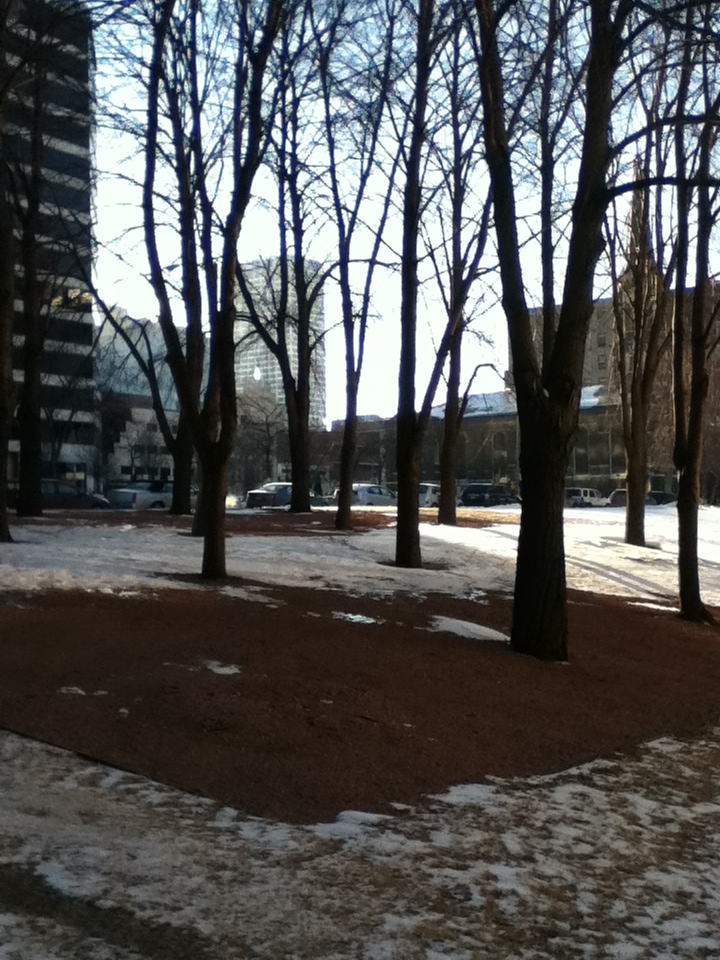
On my way back from getting coffee I happened to notice the Gas Building flame glowing in the sunlight (at center left, below, through the trees).  I believe that must be an extreme shade of gold, to signify even COLDER cold!

Wisconsin Gas Building

Posted in Milwaukee | Tagged , , , , | 2 Comments

Winter Crab Apples (photo)

What’s this?  Up in our tree . . . ?  More crab apples!

crab apples 1

Remember when I wrote about our crab apple tree last September?  I guess I haven’t spent time in our yard since winter started (brrr!), but I was surprised to see these guys hanging on late yesterday afternoon.

crab apples 2

Tenacious.

Posted in Nature | Tagged , , | 3 Comments

Tosa All-City Read: Rocket Boys and October Sky

Wauwatosa, Wisconsin (an old-city inner-ring suburb of Milwaukee), is having its inaugural “all-city read” this month.  Children ages 8-12 are reading a fantasy adventure, and people ages 13+ are reading Rocket Boys, the 1998 memoir by retired NASA engineer Homer Hickam, Jr.

Born and raised in Coalwood, West Virginia, Hickam writes an engaging account of his coming of age in an Appalachian mining town during the 1950s Sputnik era, when he and his friends built and launched rockets into space.

Wauwatosa has many activities planned for the month related to the two selected books and to reading in general.  One activity I found especially neat was an afternoon and evening of building sessions at the local Home Depot where families could build their own Little Free Library box.  Home Depot provided the pre-cut and pre-drilled lumber and helped with assembly, leaving the final staining or painting to be completed at home.

I am honored and excited to be a part of Tosa’s All-City Read, as well.  On Thursday, February 20, there will be a screening of October Sky, the film adaptation of Rocket Boys, at The Rosebud Cinema on North Avenue in Wauwatosa, with a discussion afterward of both book and film led by yours truly.

I’m not sure how many people to expect yet, so I haven’t decided on the best format for running the discussion.  I know I can lead a group of 40 people in one big discussion, because I do it all the time at MSOE’s Great Books events.  But if we have 80 or more people, maybe it would be better to encourage smaller discussions.

My dilemma: which would feel like a more satisfying experience for the participants?  One large, all-inclusive performance-type experience where I am the “show”?  Or several smaller and more intimate conversations simultaneously occurring throughout the theater, which I could walk around and facilitate?  This is a theater with small tables, couches, and recliners, by the way, instead of the usual rows of seats.

If you were attending this event, which do you think you’d prefer?

Posted in Books and reading, History, Milwaukee, Movies and film, Popular culture, Teaching | Tagged , , , , , , , | 2 Comments

To survive, bookstores should be more like funeral homes (were)

Interesting post over at The Shatzkin Files, “The future of bookstores is the key to understanding the future of publishing.”  What will it take for bookstores to survive in an era of e-readers and online book purchasing?  One possibility mentioned is to emulate Soho independent bookseller Sarah McNally (of McNally-Jackson), who is “taking steps to move beyond books to retailing design-heavy but perhaps-more-enduring retail goods like art and furniture.”

What a smart idea!  Did you know that funeral homes once doubled as furniture stores?  I had thought it was a Midwestern phenomenon, but it was apparently true all over the United States.  The news story below comes from Amarillo, Texas, where a local museum mounted an exhibition that focused on the unlikely retail-service combination.

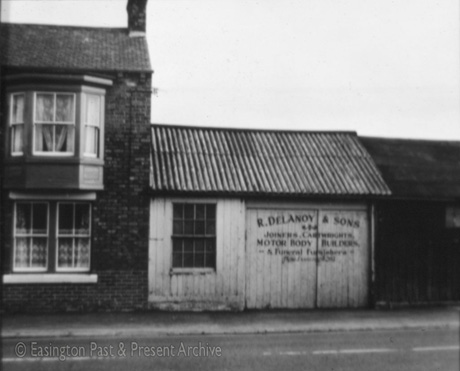
Apparently such multitasking also occurred in England, as seen in the photo below from the Durham County Council archives, taken in the 1930s in Easington Village.  The sign on the door reads: R. Delanoy & Sons: Joiners, Cartwrights, Motor Body Builders & Funeral Furnishers.

carriage maker and undertaker

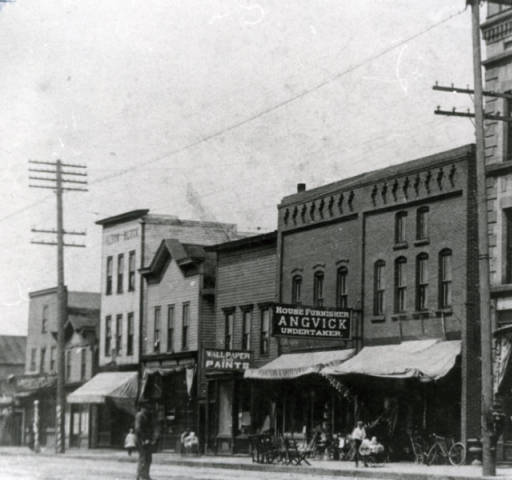
More locally, below is a photo from the Ashland (Wisconsin) Historical Society, from the online “Recollection Wisconsin” program sponsored by Wisconsin Library Services (and hosted by the Milwaukee Public Library).  Check out the sign for “Angvick House Furnisher/Undertaker.”

Angvick House Furnisher/Undertaker

I guess it makes sense that someone with carpentry skills might make both furniture and coffins, not to mention carriages and motor bodies.  And a funeral home could easily double as a furniture showroom.

Perhaps it makes equal sense for bookstores to diversify.  At the same time you bought a novel you could also pick out a comfortable chair and footstool, an attractive table lamp, hot cocoa and coffee mugs, a warm afghan throw, firewood, maybe some music CDs—everything you might need to spend a cozy evening at home reading by the fireplace.

Posted in Books and reading, History, Life, Popular culture, Writing, blogging | Tagged , , , , , , , , , , , , | 3 Comments

Stovetop Hot Cocoa and Coal Furnaces

I’ve been thinking about my great-grandparents lately.  Our microwave died not long ago, and with it the ability to heat up coffee and milk instantly . . . IN the cup we plan to drink from.  Instead we have to add coffee and milk to a saucepan every morning, heat it to a foamy boil, and then pour the steaming liquid into our cups.  It’s not really that hard to do, and it takes almost no time.  Plus, it actually tastes better than the microwaved version.  (Not that we have any intention of living without a microwave for much longer 🙂 )

With the recent bitter cold courtesy of the polar vortex, I’ve been heating up coffee and milk multiple times every day, which is what puts me in mind of my grandparents.  My great-grandfather was custodian of the elementary school where my great-grandmother taught.  In cold-weather months of the Great Depression my great-grandfather walked a few blocks to the school every single night (holidays included) to take care of the coal furnace.  When he got home, he sat in the living room before going to bed and drank the hot cocoa my great-grandmother had made for him in a saucepan on the stove.

Isn’t it strange?  My great-grandparents have been dead for almost fifty years.  But they’ve achieved a type of immortality as long as I (or my children, who have heard the stories) still think of them while doing things like pulling the car over to take a photograph or heating up coffee and cocoa the old-fashioned way.

Speaking of coal furnaces, by the way, I actually once saw coal being delivered to an old three-story house on Milwaukee’s East Side.  This was probably twenty or twenty-five years ago.  A long chute ran from the delivery truck to a basement window, and the whole thing vibrated like crazy, shaking the coal along its path from truck to house.

Being curious, I just found a video online of a residential coal delivery, and apparently what caused all the vibration was a conveyor belt.

Posted in History, Life, Milwaukee | Tagged , , , , , , , | 7 Comments

Moments of Classroom Grace

My friend and colleague, Lisa Rivero, posted on the topic of “Classroom Grace” last week over on her blog.  I’ve been thinking about her remarks ever since.

Lisa was talking about those magical moments that happen in classrooms, especially in humanities and social science classrooms, where an ordinary class period suddenly turns electric and students make exciting connections between the discussion topic and their own lives.  It’s funny how unexpected those moments are.  You can’t really plan for them; you can only be “prepared” so that when you recognize them, you can respond to them appropriately.

There is a word in rhetoric and politics that seems to fit here: kairos, a term from ancient Greece meaning the right or opportune moment.   When the time for speaking or acting is ripe, you have to seize the moment.  For teachers, kairos means the “teachable moment.”

The epiphany, that moment of insight (whether teacher or student) that comes with “getting” a concept, is almost a divine experience.  “Grace” captures its essence pretty well.  Suddenly you see clearly what was previously opaque, sort of like the scales falling from Saul’s eyes (Acts 9:18).

The moment of classroom grace I remember most clearly in my own experience occurred about ten years ago.  Ironically, it happened in the same freshman humanities course that Lisa describes teaching in her blog.  I was the new program director for our technical communication degree, and learning that job was eating into time that should have been going into course prep.  Walking down the hall to my class one day, I was panicking.  Caught up in program matters, I hadn’t even thought about what I was going to do in the classroom until that very moment.  Now I had about ten seconds to come up with something, anything that could fill up the next fifty minutes.  HELP!

And suddenly an idea came to me, like a little intuitive miracle.  My class was studying “time,” just as Lisa’s class is studying “freedom.”  My idea was a perfect 50-minute time-filler: I’d put people into six groups, give them time-related topics to discuss, and then have them report to the class what they’d come up with.  Boom, done.

Three of the groups were easy to think of topics for: one could argue that the “past” was the most important aspect of time, another could argue that the “present” was the most important, and the third could argue that the “future” was the most important.  Okay, I just needed three more time-related groups.  One group would list every association they could think of to do with calendars; another would do the same thing with clocks and watches.  Finally, the last group could list every time-related expression they could think of (“wasting time,” “time is money,” etc.) and talk about what those expressions revealed about our culture’s concept of time.

Whew, just in time.  I walked into class, organized my groups, and set them to work.  It was a GREAT class period.  At the end of the quarter, my teaching evaluations were full of praise for this discussion.  “I had never thought of time that way before,” was the gist of the comments.

Ironic, right?  It was nothing more than a throwaway class exercise, just something I was grateful to have pulled out of thin air to fill fifty minutes in an emergency.  Sometimes that’s how teaching works.  Moments of classroom grace happen when you least expect them.  Sometimes when you don’t even deserve them.

And they are almost always more about your students’ learning than about your teaching.  Knowing this keeps you humble.

Posted in Higher education, Life, Teaching | Tagged , , , , , , , , , , , | 13 Comments

“He’s coming back” – Sherlock mini-episode appetizer

It’s been a long time since the last episode of BBC One’s Sherlock, but tomorrow night marks the return of our favorite sleuth to American television in “The Empty Hearse,” a clever nod to Conan Doyle’s “The Empty House,” the story in which Sherlock returns from plunging to his apparent death at the hands of Moriarty at the Reichenbach Falls.

Have you seen this clever mini-episode “prequel” to Season Three yet?  In it, Anderson, the idiot forensics-team member who dislikes Sherlock (and who has apparently been fired from the police force since “The Reichenbach Fall” finale episode of Season Two) meets with Lestrade in an effort to convince him not only that Sherlock isn’t really dead but also that he’s slowly making his way back to London.

Posted in Popular culture, Television | Tagged , , , , , , , , , | Leave a comment

Countdown to Downton Abbey (1 day to go!) – The Rise and Fall of the English Country House

“History is bunk,” Henry Ford once said.

What he meant was that most history, as written in textbooks and taught in schools, has little to do with life as lived by ordinary people.  War and politics are on the periphery of most people’s daily existence, yet what we learn in history classes too often emphasizes dates and obscure treaty terms over more important things (in my opinion 🙂 ) like when indoor plumbing became the norm for rural Americans or when supersized backpacks became necessary for schoolchildren to carry all of their homework supplies.

One reason I love “Downton Abbey” is that it manages to capture the little details of history as lived in a way that paints the broader picture of life at the start of the twentieth century.  We get hints of standard historical events from the outside world (the Titanic, World War I, the Spanish Flu epidemic, the Ponzi financial scheme) but always in a way that is integral to the story of Downton’s upstairs and downstairs residents.  At the same time we see William ironing the morning newspapers to set the ink, see worries over the dangers of electricity and the Dowager’s dislike of electric lights’ glare, see awkwardness talking on the telephone even while embracing its convenience.

About fifteen years ago I attended a conference in a booming Southern U.S. city.  Its downtown buildings rose tall and gleaming, with no trace whatsoever of its history apparent aside from the occasional plaque affixed near the front entrance noting things like how on a certain site once stood a hotel where Jefferson Davis slept.

In the United States the 1960s brought waves of “urban renewal,” in which entire swaths of history fell to the wrecking ball to be replaced by new construction of dubious merit.  (Again, in my opinion 🙂 )  New York’s Grand Central Station, described in 2013 by BBC News on its 100th anniversary as “the world’s loveliest station,” nearly met that fate in the 1970s before its rescue by (among others) Jacqueline Kennedy Onassis, who said:

Is it not cruel to let our city die by degrees, stripped of all her proud monuments, until there will be nothing left of all her history and beauty to inspire our children?  If they are not inspired by the past of our city, where will they find the strength to fight for her future?

The English country house epitomized by Downton Abbey similarly represents (in the aggregate) an historical epoch of European tradition,  the last vestiges of a feudal society and economy based on agriculture and landed nobility.

The English country house began to rise during the reign of the Tudors, following Henry VIII’s Dissolution of the Monasteries, wherein the multi-married, newly-installed head of the newly-created Anglican church seized the property of the Roman Catholic church and gave it to his friends.  Downton Abbey, then, would have been built onto (or, as was the case for other houses, upon the site of) the former home of a religious order—hence, the “Abbey” part of its name.

With the coming of the Industrial Revolution and the ascent of cities as centers of commerce and employment, the English country house lost economic significance.  We’ve heard Robert Crawley speak often of the importance of Downton as an employer in the county.  In their day, country houses were responsible for employing hundreds of people on and around the estate, not just the household servants but also farmers, doctors, and schoolteachers.  (For example, remember Mr. Collins, the smarmy clergyman who marries Charlotte Lucas in Pride and Prejudice?  His parsonage is “near” Rosing’s Park, the estate of his patroness, Lady Catherine De Bourgh.)

The Reform Act of 1832 shifted political power from the countryside to rapidly-growing urban areas, which lessened the importance of the landed aristocracy in Parliament.  Prior to that, the local earl/duke/whatever not only had influence in national government commensurate with the amount of land he owned—which, through multiple titles like Earl of this, Duke of that, might be considerable—but also had tremendous influence over government and administration of justice in his own county.

Around the time of Downton Abbey (which begins in April 1912 with the sinking of the Titanic), the real death-knell for the English country houses began to sound.  In 1894 “death duties” inheritance taxes were introduced in the United Kingdom, with the effect of beginning to break up large estates for the first time.  In 1914 Estate Duty began, which appears to have followed the enactment of the “People’s Budget” in 1909/10, aimed at eliminating “poverty and squalor.”  The same class conflicts that led to the Russian Revolution and the rise of organized labor were also present in the United Kingdom.  One result was the figurative castration of the House of Lords in 1910-11 (largely in retaliation for preventing passage of an earlier version of the “People’s Budget”); another was a tax policy aimed at minimizing the ability of landed aristocracy to pass along inherited wealth from one generation to the next.

In May 1912, a month after our first encounter with the inhabitants of Downton Abbey, the British magazine Country Life carried an advertisement announcing that roofing ballustrade and urns from the demolished Trentham Hall were available for purchase.

(via Wikipedia: “Destruction of country houses in 20th-century Britain”)


This was only the beginning.  Since 1900 about 1200 country houses have been demolished in the United Kingdom.  A Telegraph article from 2002 chronicles the long decline, noting that when Parliamentary reform robbed the House of Lords of any real political power, many who lived in country houses began to wonder what for.  Seventeen houses were demolished in 1926 alone, and during the 1950s over 300 houses were demolished.  I’ve seen a statistic asserting that at the height of destruction in 1955, one house was destroyed every five days.

The tide slowly began to turn as the public realized how much of the country’s heritage was being lost.  Whereas government policy and public opinion were originally a main cause of demolition in the first place, by 1968 government policy in the form of a new Town and County Planning Act required owners to get permission from the authorities before demolishing (or making any changes to) a building designated by the government as having historical significance.

Shortly after this, and right about the time Jackie Kennedy Onassis was leading the fight to save Grand Central here in the U.S., the Victoria and Albert Museum opened an exhibition that similarly rallied public support around the idea that the English country house was worth saving.  “The Destruction of the Country House 1875-1975” opened in 1974 and contained a “Hall of Destruction” filled with fallen columns and illustrations of the houses lost in the hundred-year period covered by the exhibit.  Inspired by the exhibit, SAVE Britain’s Heritage was formed, although too late to stop the Sotheby’s sale of Mentmore Towers’ contents and real estate over the next two years.

Unfortunately, the loss of England’s country houses continues even today.  Because owners of country houses are required to pay value-added tax (VAT) on any repairs or upgrades, destruction has now taken on the more insidious form of death by a thousand cuts, as the contents of country homes are sold off piecemeal to help fund their upkeep.  Robbing Peter to pay Paul, as it were.  (Yes, another change in government policy could fix this.  But it’s not my government, so maybe also not my place to say so 🙂 ).

Is the demise of the English country house inevitable?  Is Downton Abbey doomed?  Stay tuned . . . .

Would you like new posts delivered to your inbox? To subscribe, click here.

Posted in History, Life, Popular culture, Television, WPLongform (posts of 1000 words or longer) | Tagged , , , , , , , , , | 5 Comments

Champagne and Christmas Tree Lights (Photo)

Champagne and Christmas Lights

Taken with my iTouch last night when I noticed how the lights of our tree sparkled through my midnight champagne.  Happy 2014!

Posted in Uncategorized | Tagged , , , , , , , , | 4 Comments